#127 The Hidden Habits of Highly Successful Founders
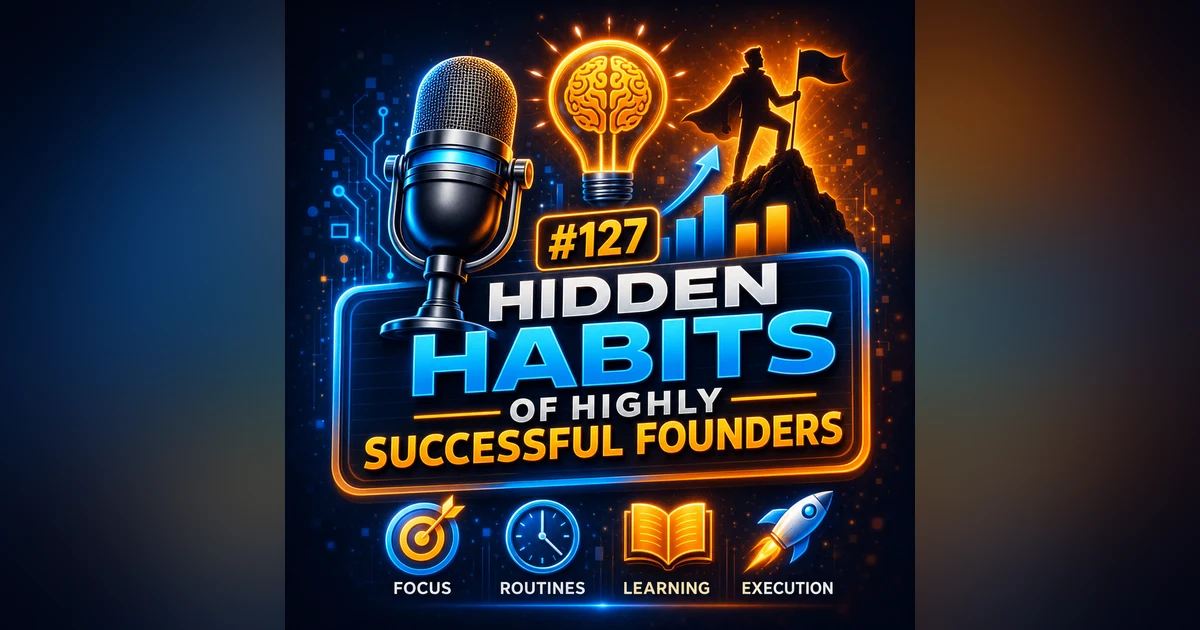


In this episode of the Smart Entrepreneur Show, we tackle one of the most compelling paradoxes in business — two founders, identical starting conditions, and completely different outcomes three years later. What separates them is not luck or innate genius. It is an architecture of small, largely invisible daily habits that add up to a vastly superior operating system. This episode breaks down exactly what that system looks like.
What You'll Learn in This Episode
- Why the myth of the visionary founder who magically sees the future is completely wrong — and what actually builds great companies
- How top founders treat learning as a lifelong compounding investment and build a lattice of mental models from unrelated industries
- The difference between minimum viable data and analysis paralysis — and why data is an early warning system, not a crutch
- Why successful founders fall in love with the problem, not the product — and how that distinction makes pivoting feel natural rather than painful
- The computer RAM analogy for managing your mental bandwidth — and why 50 open tabs crash your most important thinking
- The neuroscience of why chronic sleep deprivation literally powers down the prefrontal cortex and turns high-stakes decisions into reactive, fear-based guesses
- The three diagnostic questions that separate learning from failure versus stubbornly driving off a cliff
- Why the ultimate act of adaptability may be unlearning the habits that made you successful in the first place
Key Takeaways
- Success is constructed through small, largely invisible daily actions — not one extraordinary cinematic moment
- Being busy is not the same as being effective — exhaustion is not a performance metric
- Move from synchronous to asynchronous communication wherever possible — protect your peak cognitive hours for deep work
- Treat your physical health with the same strategic importance as your balance sheet — it is cognitive fuel, not vanity
- Motivation is a feeling and feelings are unreliable — systems and consistency are reliable
- Stubbornness is an ego-driven refusal to acknowledge reality — consistency is waking up with the same goal but a radically improved approach
- Reputation is an invisible, untaxed asset on the balance sheet — optimise for it relentlessly
- Building deep long-term relationships across customers, employees, mentors, partners and investors is not soft — it is your most powerful scaling mechanism
- The five relationship groups every founder must invest in: customers, employees, mentors, partners and investors
🔗 About Your Host (Roy Coughlan)
- Explore more podcasts: Find all podcasts at the PodFather Network
- Website: https://roycoughlan.com/
- Virtual Assistants: https://va.world/
- Virtual Assistants: https://va.world/
- Private Networking Group: Learn about a Private Networking Group in 50 US States & 44+ Countries with 675+ Members https://connectedleaders.academy
- Brain Upgrade: https://brainupgrade.org/
#SmartEntrepreneurShow #FounderHabits #Entrepreneurship #BusinessGrowth #Mindset #Leadership #ProductivityHacks #Resilience #ScalingUp #SuccessHabits #RoyCoughlan
#127 The Hidden Habits of Highly Successful Founders
Welcome to the Smart Entrepreneurs Show, the podcast where we share smart ideas, strategies, and lessons to help entrepreneurs build better businesses. And today, we're diving into, well, kind of a strange paradox. It really is.
Right. So imagine you have two founders, both of them have Ivy League degrees, both of them just secured, I don't know, let's say $5 million in seed funding. A pretty great start.
Exactly. And they both have genuinely brilliant ideas. But you fast forward three years, and one of them is ringing the bell at the New York Stock Exchange, while the other is quietly liquidating their assets.
Which happens all the time. It does. So if the starting conditions were virtually identical, what is the actual structural difference between them? Right.
Because it isn't luck, and it isn't some rare, innate genius. No, not at all. And I think this completely shatters the myth of the visionary founder who just magically sees the future.
When we examine the source material for today's deep dive, the core premise redefines success entirely. Those massively successful companies, they're constructed through small, largely invisible daily actions. And it's built piece by piece.
Exactly. It's an architecture of habits. The founder who succeeds is simply running a vastly superior operating system when it comes to gathering information, managing their resources, and processing friction.
I am thrilled to unpack this because it moves us away from that vague motivational advice, you know? Like, just hustle harder. Oh, absolutely. Instead, it gives us the actual mechanisms, the mental software, and the routines that highly successful founders use.
So let's look at how they construct this operating system. Let's start with the input-output engine of a business, which is how a founder learns, gathers data, and adapts. Yeah.
That's the foundation. Right. Because when we think about the brain of a founder, like a machine learning algorithm, the very first requirement is feeding it a massive, continuous dataset.
Spot on. And that continuous dataset comes from treating learning as a lifelong, compounding investment. Top founders, they do not view education as an event that ended when they got their degree or launched their product.
It's not a checkbox. No, not at all. They are aggressively pulling information from really diverse sources.
So reading history, studying psychology, listening to deep dives from industries completely unrelated to their own. Unrelated industries? Yeah. Because the goal isn't just to memorize business tactics.
They're building a lattice of mental models. When you have a wider array of mental models, you drastically expand the menu of options available to you when you hit a bottleneck. Okay.
So it's like cross-pollination. Exactly. A sauce founder studying how a high-end restaurant manages customer flow might find a breakthrough for their own user onboarding experience.
Precisely. They see the underlying pattern. But having a massive library of theories in your head is dangerous if those theories never have to actually survive contact with reality, right? Oh, completely.
And that is where the algorithm requires a feedback loop. Learning gives you the hypothesis, but objective data proves or disproves it. So they have to test it.
Right. Founders who survived the long haul, they transition early on from just founder intuition to rigorous instrumentation. Which makes sense.
In the early days, gut instinct is necessary because you literally have no data. Exactly. You're just guessing.
But relying on your gut exclusively as you scale, that introduces massive unhedged risk. Top founders actively seek out customer feedback, behavioral metrics, and market research to strip the emotion and, honestly, the ego out of their decision-making. Let me push back on that for a second, though.
Sure. Because I hear data-driven thrown around in every boardroom. But isn't there a very real danger of analysis paralysis? Oh, definitely.
Like, how does a founder know when they have enough data to act versus when they're just, I don't know, hiding behind spreadsheets because they're afraid to make a call? That's a great question. The distinction lies in seeking minimum viable data rather than perfect certainty. Minimum viable data.
I like that. Yeah, because hiding behind spreadsheets is an attempt to eliminate risk entirely, which is impossible. You just can't do it.
The successful founders in our sources use data to reduce unnecessary risk. They look for leading indicators, so like a sudden drop in user engagement. That tells them a feature is failing right now rather than waiting six months for the lagging indicator of a massive revenue crash.
So data isn't a crutch. No, it is an early warning system. It tells you what is actually happening in your business, regardless of what you passionately hope is happening.
Okay, let's unpack this. If you treat the business like a high performance vehicle, continuous learning is the GPS, right? And data is the dashboard. But adaptability, that's the steering wheel because you can't navigate tomorrow's changing roads using yesterday's map.
That is a perfect analogy. And that early warning system you get from the dashboard is what triggers adaptation. Right, because if you're continually learning and your data tells you the market is shifting, you have to rewrite the code.
You have to. Markets evolve, technology disrupts practically overnight, and customer expectations are just notoriously fickle. The founders who win are the ones who treat their current business model as a temporary hypothesis.
Wow, just temporary. So they embrace the pivot instead of resisting it? Exactly. A mediocre founder builds a product, falls madly in love with it, and tries to force the market to buy it even when the data screams otherwise.
We've all seen that happen. Right. But a highly successful founder falls in love with the problem they are solving.
If the data shows their current product isn't the best solution, they adapt. They leverage their continuous learning to see the shift coming, and they steer into the new reality without sentimental attachment to the old way. So we have this incredibly optimized input-output engine.
The founder is learning, they're running the data and adapting. But running that heavy processing software requires hardware resources, it requires fuel. It does.
And the most successful founders are absolutely ruthless about managing the only two resources they cannot manufacture more of, which are their time and their physical energy. Yeah, time is the ultimate non-renewable asset. Our sources highlight a critical shift in how top founders view their calendars.
How so? They recognize that being busy is not the same as being effective. Oh, that's a trap. It's a huge trap.
The amateur founder falls into it all the time, doing a million things, answering every Slack message within seconds, micromanaging a design tweak. And they feel productive because they are exhausted. Yeah, exhausted doesn't mean effective.
Instead of the usual time management cliches, I look at a founder's focus like a computer's RAM. Okay, I like where this is going. If you leave 50 browser tabs open in your brain, your processing speed crashes.
You literally cannot run the one heavy software program like long-term strategic planning because your background tasks are eating all the memory. Exactly. So the most successful founders are ruthlessly closing tabs.
But here's where it gets really interesting. Protecting your time sounds great, but how do you do that without becoming completely isolated? It's like building a fortress, you know? You need strong walls to keep distractions out, but you also need a drawbridge to let the right things in. So how do they manage that? Well, you implement structural boundaries, not emotional ones.
It is about moving from synchronous to asynchronous communication wherever possible. Oh, okay. Elite founders don't just try to avoid distractions, they build systems to prevent them.
They might mandate that all internal updates happen via a shared document rather than a one-hour meeting. That saves so much time right there. It's massive.
And they utilize time blocking. So perhaps refusing to take any external calls before 1.0pm, reserving their peak cognitive hours for deep, uninterrupted work. They remain highly accessible, but only on their terms, and only for issues that truly require their specific level of authority.
That makes perfect sense. You're engineering the environment so the default state is focus rather than distraction. And speaking of peak cognitive hours, we have to talk about the physical battery powering that RAM.
Taking care of physical health is often framed as, like, a lifestyle poke. But in the context of building a company, it is a hardcore business strategy. It is the ultimate leading indicator of business performance.
We are talking about the physiological science of decision-making. The sources focus heavily on quality sleep, rigorous exercise, nutrition, and stress management. Because if those are off, everything is off.
Completely. From a neurological standpoint, when a founder is chronically sleep-deprived and running purely on adrenaline and cortisol, the prefrontal cortex literally powers down. And that's the area of the brain responsible for risk assessment, impulse control, and complex problem-solving.
Exactly. You lose all of that. So the brain basically reverts to its primitive state.
You start making reactive, fear-based decisions. You snap at a key partner, or you choose the quick-fix solution that causes massive technical debt later simply because you don't have the biological bandwidth to think through the long-term consequences. You're operating with a compromised CPU.
Wow. Yeah. Regular exercise and adequate sleep clear out the metabolic waste in the brain and regulate those stress hormones.
Treating your body with the same strategic importance as your balance sheet isn't about looking good. Right. It's not vanity.
No. It is about ensuring that when you face a high-stakes, million-dollar pivot, you actually have the cognitive capacity to make the right call. If the founder's energy crashes, the business crashes.
Okay. So the founder's mental software is updated, their schedule is cleared of low-impact tasks, and they are biologically optimized. They're ready for the long haul.
They're primed for it. But the reality of building a business is that the long haul is brutally messy. Oh, it's incredibly messy.
Which brings us to what I call the resilience protocol. You're going to face massive setbacks, and the only way through is consistency. Yeah.
And consistency is often misunderstood as just working hard. Right. Just grinding.
But it is much more mathematical than that. It's the compound interest of business effort. Yes.
Success is rarely the result of one extraordinary cinematic day. It is the momentum generated by executing mundane, necessary tasks over months and years, especially on the days when motivation just completely flatlines. Because motivation is a feeling, and feelings are unreliable.
Extremely unreliable. Systems and consistency are reliable, but here's the catch. Consistency mathematically guarantees that you will eventually hit a wall.
You will fail. It's inevitable. A product launch will flop, or a major client will churn.
How a founder processes that failure is the hinge point of their entire trajectory. It really is. The defining trait of TOPS founders is that they treat failure as neutral feedback.
Neutral feedback. That's a huge mindset shift. Huge.
They do not allow a failed initiative to trigger a spiral of self-doubt, nor do they brush it under the rug to protect their ego. When a failure occurs, they immediately run it through a specific diagnostic protocol. Or are they asking themselves? Three things.
What exactly went wrong? What specific variable can I improve? And what foundational lesson can I extract for the next iteration? So it turns a disaster into a data point. Exactly. It's the scientific method applied to a business crisis.
But this raises a really tricky question. Okay. What's that? If a founder is supposed to be incredibly consistent and never give up, but they are also supposed to learn from failure, how do they know the difference between staying consistent and just stubbornly driving the company off a cliff? That is the million-dollar distinction.
And those three diagnostic questions are the exact mechanism that separates the two. How so? Well, stubbornness is an ego-driven refusal to acknowledge reality. It is pushing forward with the exact same tactic, ignoring the data that says it isn't working.
Consistency, on the other hand, is waking up the next day with the same overarching goal, but using the feedback from your failure to radically alter your approach. The feedback dictates when to change the strategy, while consistency provides the engine to push through the temporary friction of executing that new strategy. I see.
Every setback is just recalibrating the algorithm. You are constantly applying your adaptability to your consistency. You don't change the destination, but you are more than willing to change the vehicle.
That's a great way to put it. And that resilience allows a founder to survive those brutal early stages. But surviving isn't scaling.
To truly thrive and play the infinite game, founders eventually have to look outward. They have to build an ecosystem. Yes.
Because business, at its absolute core, is a human endeavor. It is very easy for a technical or product-focused founder to get lost in the spreadsheets and the code. No, absolutely.
But long-term, asymmetric opportunities are forged by investing deeply in relationships. Our sources specifically point to building strong ties across five distinct groups. Okay, what are they? Your customers, your employees, your mentors, your partners, and your investors.
Let's break that ecosystem down because each group serves a distinct mechanical purpose in scaling. They do. Like customers aren't just revenue sources, they are co-creators of your product through those feedback loops we talked about.
And employees represent your operational leverage. You cannot scale your own time, but you can scale your vision through a highly aligned team. And mentors act as a time compression mechanism.
A 10-minute conversation with someone who has already navigated the labyrinth you are currently stuck in? That can save you six months of trial and error. Wow, yeah, time compression. What about partners and investors? Partners provide asymmetric advantages.
They allow you to borrow their established distribution channels or their brand trust. And investors, when chosen correctly, they bring strategic capital and network access that goes far beyond just writing a check. So what does this all mean? Building that ecosystem requires a specific mindset, which is the relentless focus on long-term value over short-term extraction.
Absolutely. It's like the difference between hunting for a single meal, which is chasing quick profits, versus planting an orchard that will feed you for decades. We see so many flash-in-the-pan companies that just hunt.
They use manipulative marketing or they cut corners on product quality just to juice their quarterly numbers. And that approach always catches up to them because it spikes customer churn and it burns lifetime value. Highly successful founders reject the quick buck if it compromises their reputation.
Reputation is an invisible, untaxed asset on the balance sheet. When you optimize for customer satisfaction and deep, enduring trust, you are building structural advantages like network effects and organic word-of-mouth growth. It's the difference between building a single-use app and building a foundational platform.
If you aggressively monetize a user today with hidden fees, you capture that one transaction, but you lose them forever. If you invest in the relationship and deliver overwhelming value, you create a compounding infrastructure. It takes significantly more time, and it requires all the discipline, learning, and energy management we've discussed, but it ultimately creates a business that can scale independently of the founder's daily grind.
Synthesizing all of this, the narrative of the overnight success is completely dismantled. It really is. The reality is far more accessible, but it demands far more discipline.
A better business is the byproduct of a better operating system. It is the result of continuous, aggressive learning. It is relying on hard data rather than ego.
It is building systems to protect your time and treating your physical health as cognitive fuel. It requires the resilience to consistently run the scientific method on your own failures, and the foresight to build long-term value through deep relationships. It's a full package.
It is. When a founder executes these actions consistently, they aren't just scaling a company. They are fundamentally upgrading their own capacity to navigate the world.
It is the ultimate exercise in personal leverage. You are forcing yourself to become a more effective human being simply to keep up with the demands of the machine you are building. Beautifully said.
But as we wrap up this deep dive, that evolution leaves me with one final, slightly provocative thought for you to mull over as you analyze your own routines. We've established that our habits shape our success, and we build these intense protocols to get our ideas off the ground. But what happens when your business outgrows the very habits that got you here? Think about the early stage habit of needing to have your hands in every single project to guarantee quality.
That habit might be the exact reason your product survived year one. Very true. But as you scale to year three or year five, does that successful habit silently morph into a comfortable crutch? Does your superpower of extreme micromanagement eventually become the bottleneck that actually holds your company back from the next level of growth? It's a fascinating tension to consider.
The idea that the ultimate act of adaptability might be unlearning the habits that made you successful in the first place. That's a great thought to leave on. If you enjoyed this episode of the Smart Entrepreneur Show, make sure to follow the podcast so you don't miss future episodes.
And feel free to share your thoughts or experiences in the comments.
PodFather
I am a serial entrepreneur who has founded 21 companies across 6 countries. Known in the industry as “The PodFather,” I am a business podcast coach and host who has launched eight successful podcasts—6 ranking in the Top 5%, with four reaching the coveted Top 0.5% globally.
Beyond podcasting, I co-founded brainupgrade.org a platform designed to boost cognitive performance and unlock peak mental potential. I am also the co-founder of VA.World, connecting businesses with exceptional Virtual Assistants tailored to their unique needs.
I also have Sponsorship ads available that are Dynamically inserted into my 8 shows