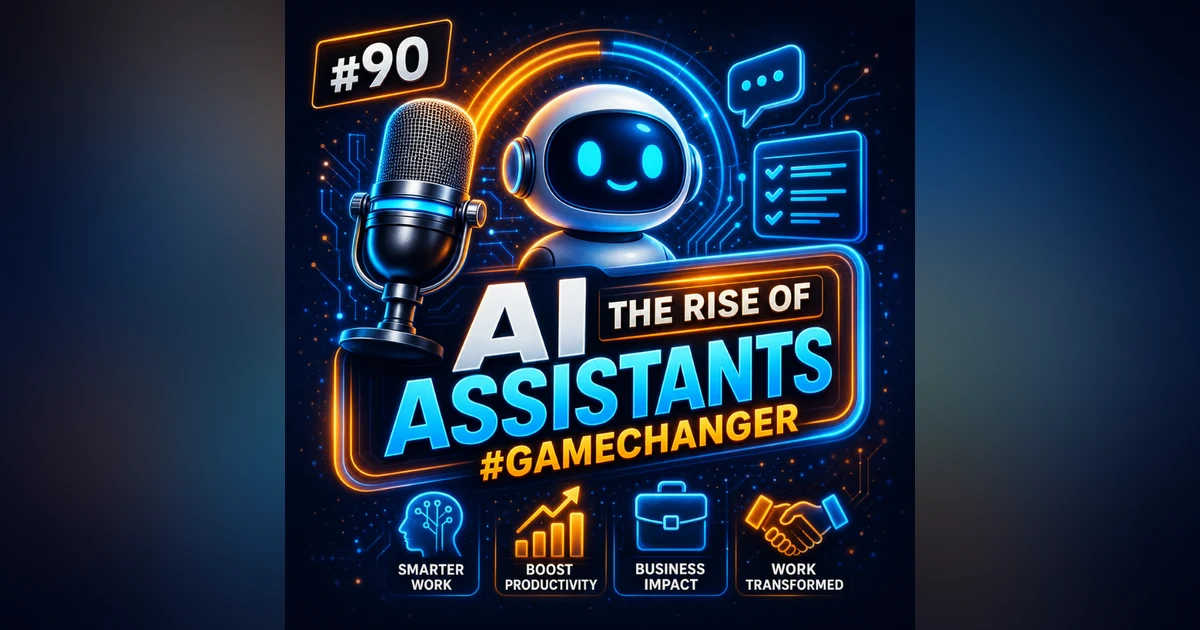
#90 The Rise of Personal AI Assistants and Their Impact on Business & Work


What if your entire creative team, admin staff, and data analysts fit on a thumb drive? In this episode of the Smart Entrepreneur Show, we move past the AI hype phase and into the heavy application phase — unpacking exactly how entrepreneurs are weaving personal AI assistants into their daily workflows to build a real competitive moat, without losing their strategic edge or their voice.
From the mechanics of how large language models actually work, to the content factory a solo founder can run from a single webinar transcript, to the very real risks of hallucinations and data privacy — this is the practical, no-nonsense blueprint for the human-AI hybrid business.
In this episode you'll learn:
- Why treating AI like a search engine sets you up to be severely underwhelmed — and what it actually is (a reasoning engine, not a retrieval system)
- The "eager intern" analogy: why AI has zero context about your business unless you explicitly provide it
- Retrieval Augmented Generation (RAG) in plain English: how to prime your AI with proprietary data to get useful, specific results
- The blank page tax: how AI takes you from zero to 80%, freeing your cognitive energy for the high-value 20% that makes your voice unique
- The content factory model: how one 40-minute webinar transcript becomes a Twitter thread, LinkedIn post, and 5-part email sequence — operated by one person
- Intelligent support triage: how AI handles tier-one tickets in seconds and routes complex issues to humans with full context attached
- Why execution is no longer the premium — and why taste, strategy, and hyper-specific domain expertise are now the only things the market will pay a premium for
- The new skill stack: critical thinking, complex synthesis, and knowing when the AI's answer is plausible but wrong
- Automation complacency: why blindly trusting AI output is playing Russian roulette with your business
- Data privacy: the risk of feeding confidential client data into public AI models
- How to use AI as a sparring partner, not a crutch — and why you must always remain the architect
Contact & Resources
Listen to this episode on Podbean: smartentrepreneur.podbean.com
Explore more podcasts: Find all podcasts at the PodFather Network
Website: RoyCoughlan.com
Need help running your business? If you are looking for a Virtual Assistant and get reliable support for your daily operations.
Virtual Assistants: VA.world
Communities: BrainGym.fitness
Learn about a Private Networking Group in 50 US States & 39 Countries with 640+ Members: connectedleaders.academy
#SmartEntrepreneurShow #PersonalAI #AIAssistants #AIForBusiness #AIProductivity #LargeLanguageModels #AITools #ContentAutomation #SoloFounder #OneBusiness #AIMarketing #CustomerSupportAI #AIWorkflow #AIStrategy #FutureOfWork #HumanAI #AIEthics #DataPrivacy #AIHallucinations #PromptEngineering #ContentFactory #SmartEntrepreneur #DigitalEntrepreneur #BusinessAutomation #RoyCoughlan #PodFatherNetwork #VAWorld #VirtualAssistant #AIandBusiness
#90 The Rise of Personal AI Assistants and Their Impact on Business & Work
Welcome to the Smart Entrepreneur Show, the podcast where we share smart ideas, strategies, and lessons to help entrepreneurs build better businesses. So glad to be diving into this one today. Yeah, it's a really exciting topic.
So I want you to imagine, just for a second, running a seven-figure digital agency, right? But your entire creative team, your administrative staff, your data analysts, they all fit on a thumb drive. You know, you don't have this massive downtown office, you don't have a bloated payroll. It's literally just you, a laptop, and a highly orchestrated stack of personal AI assistants.
Which is wild to even think about. It is, and like a year ago, that scenario sounded basically like speculative sci-fi. But today, it's becoming a standard, highly profitable operating model for a lot of people.
Yeah, and that transition, like moving from speculative fiction to actual operational reality, that is exactly where the friction is for so many entrepreneurs right now. We're basically moving out of that novelty phase. You know, that phase where everyone was just amazed the computer could write a poem or make a funny picture.
Right, the hype phase. Exactly, and now we are firmly, firmly in the heavy application phase. For you, the entrepreneur listening to this deep dive right now, the challenge isn't finding the AI tools anymore.
The tools are everywhere. Yeah, there's a new one every five minutes, it feels like. Literally.
So the real challenge is figuring out how to weave these models into your actual daily workflows. Because if you can do that, you stop feeling totally overwhelmed by the news cycle. Right.
And you actually start building a tangible, competitive moat for your business. Yeah, I love that framing. But, okay, before we start applying these tools to build that moat, we kind of need to understand the engine under the hood.
Right? To be sure. Because there's this massive misconception that adopting a personal AI assistant just means you're using a slightly more conversational version of a search engine. Oh yeah, that's a huge mistake.
And holding onto that mental model completely sets you up for failure, doesn't it? It sets you up to be, frankly, severely underwhelmed. Because a search engine is just a retrieval system. Okay, break that down for us.
So you give a search engine a keyword, right? And it basically searches a massive index to find an existing document that matches that keyword. It doesn't understand the document, it just fetches it. It's like a really fast librarian.
But a large language model, which is the engine behind these personal AI assistants, it is not a massive filing cabinet. It's a reasoning engine. That's the key difference.
It works by analyzing these incredibly complex, multidimensional patterns in language to basically predict the most logical next sequence of words based entirely on the parameters you set. Okay, so it's actively synthesizing. Exactly, it's not passively fetching.
So rather than thinking of it as a software program you're querying, is it more accurate to think of it as an eager, tireless intern who never sleeps? That's a great way to put it. But an intern who occasionally needs incredibly specific instructions so they don't completely misunderstand the assignment? The intern analogy works perfectly, actually. But we should probably push it a bit further into the mechanics.
Because an eager human intern, they might use context clues, right? Just from walking around your office hearing conversation. They absorb the culture. Right, but an AI has literally zero context about your business.
None. Unless you explicitly provide it. So if you just sit down and tell this AI intern, write an email to a client, the model has to rely on its massive generalized training data.
Which is basically the whole internet. Exactly. So it will spit out the most average, statistically probable email possible.
It's gonna sound incredibly generic because you gave it a generic prompt. Because it's just guessing at the context. Precisely.
To make this tool actually useful for your specific business, you have to feed it the context. In the technical space, people call this retrieval augmented generation. Okay, ARGI, right.
But practically speaking, for the everyday entrepreneur, it really just means establishing standard operating procedures for your AI. You have to feed it your ideal customer profile, your previously successful emails, the specific goal of the communication. So you're giving it the boundaries.
You are priming the reasoning engine with your proprietary data. The magic doesn't happen because the AI is inherently smart. The magic happens because the operator, you, knows how to construct the right guardrails.
Okay, that makes so much sense. So if we accept that this AI intern needs these hyper-specific instructions and guardrails, where are entrepreneurs actually deploying this intern right now to see the biggest return on their time? Yeah, let's get into the practical stuff. Exactly, I wanna look at the daily grind, you know, the operations.
And looking at the sources we're diving into today, the immediate areas that jump out are writing, marketing, and customer support. Those are the big three, yeah. Let's start with writing.
Because the friction of the blank page is basically a universal tax on every entrepreneur's time. Oh, absolutely. The cognitive load of starting from scratch is massive.
It's exhausting. It is. Because your brain has to simultaneously ideate what you wanna say and format how you wanna say it.
And that's why you end up staring at a blinking cursor for 20 minutes. We've all been there. Right, but AI separates those two processes.
Now, you could just dump a messy stream of consciousness, brain dump-like, literally just raw bullet points about a new project proposal straight into your personal AI. Just word vomit. Exactly, just get it out of your head.
You instruct the AI on the target audience, the tone you want, and within seconds, it generates a structured, coherent draft. Okay, but let me challenge that for a second. Sure.
If every entrepreneur out there starts using the same underlying reasoning engines to draft their newsletters, you know, their proposals, their marketing copy, don't we run the risk of the entire internet just sounding like one massive, generic corporate brochure? Like, do we lose the unique company voice entirely? I hear that concern a lot. But I would argue that losing your company's unique voice is, well, it's a symptom of user error, not a limitation of the technology itself. Oh, okay.
How so? Well, if you just copy and paste the very first draft the AI spits out, then yes, you will absolutely sound like a robot. Right, and people definitely do that. They do, and it's obvious.
But smart entrepreneurs don't do that. The AI gets you from zero to 80%. It breaks the barrier of the blank page, which, like we said, is the most energy-intensive part of writing.
So it's doing the heavy lifting. Exactly. And that frees up your cognitive energy to focus entirely on that final 20%.
The editing, the polishing, injecting your own personal anecdote, refining the tone. Ah, I see. It actually amplifies your ability to produce your unique voice because you aren't completely exhausted from just getting the basic structure down.
That makes a lot of sense, actually, because editing uses a totally different, much less resource-intensive part of the brain than creating from scratch. So you're reserving your mental bandwidth for the high-level polish. So how does this chain of events play out when we scale it up, like moving from just writing an email to full-on marketing and customer support? Well, in marketing, it's a game-changer because it allows you to scale a single idea across multiple formats instantly.
Let's say you record a 40-minute webinar. Previously, turning that into marketing assets would have required a whole team, right? Oh yeah, a copywriter, a social media manager, the whole nine yards. Exactly.
But now, you take the transcript of that webinar, you feed it into your AI, you prompt it to, say, extract the three most counterintuitive insights. Okay. Then you ask it to format those insights into a Twitter thread.
Then you ask it to turn them into a long-form LinkedIn post using a very specific copywriting framework, like the Problem-Agitated Solution Framework. And then you have a draft, a five-part email nurture sequence, all from that one transcript. You're essentially building a content factory operated by one person.
Yes. Yeah. Exactly.
And it's the same principle in customer support. We're talking about intelligent triage here. Right, not those old chatbots that just make everyone angry.
No, not at all. We aren't talking about those clunky, rule-based bots. We are talking about AI systems that can instantly read an incoming ticket, categorize the actual intent, like, okay, is this a simple refund request or a complex technical glitch? And then it automatically handles the tier one issues.
The AI can process a return based on your standard operating policy in literal seconds. And then what about the complicated stuff? It specifically routes those nuanced, high-stakes complaints to a human agent. But it includes a concise summary of the customer's entire history.
So it completely clears the operational bottleneck. Which naturally creates this massive ripple effect across the broader business ecosystem. Huge ripple effect.
Because if the daily operations, the writing, the content distribution, the support triage, if all of that can be automated and scaled by a single person, it fundamentally changes the game for startups and freelancers. It really does. Like the barriers to entry for launching a competitive business are dropping to near zero.
It is a profound structural shift in how businesses are actually built. I mean, think about it. Five or 10 years ago, if you wanted to launch a digital agency or some niche software company, capital was your primary barrier.
Yeah, you needed funding. You needed to hire a copywriter, a graphic designer, a front-end coder, a data analyst, all before you even had a single product to sell. It was incredibly risky.
Right. But today, a solo entrepreneur who just has deep industry knowledge can orchestrate all of those roles using different AI tools. You use language models for the copy, image generators for the creative assets, coding assistants to build the landing pages.
So you basically become the director of an orchestra where the instruments are essentially playing themselves. Yes. That's a perfect analogy.
But wait, if that's the case, if execution is virtually free and instantaneous now, doesn't that just create a race to the bottom? Ah. Like if anyone can spin up an agency this weekend using these tools, how does an entrepreneur charge a premium anymore? That is the pivotal question of this whole transition. When the cost and the time required to execute an idea drop basically to zero, the premium completely shifts away from the execution and moves on to the quality of the idea itself.
Okay, explain that. So the market will no longer pay you just for putting words on a page or lines of code in an app because like you said, AI can do that instantly. Right.
What the market will pay a premium for is taste, for deep strategic insight, and for solving hyper-specific, complex problems that require actual human context. The tools democratize the execution, but they absolutely do not democratize strategy. Wow.
Okay, so that means the skillset required to actually survive and thrive in this environment has to evolve completely. About 100%. If we are operating in this human-AI hybrid future, rote memorization and just like basic task execution are basically obsolete skills.
Yes, they're commodities now. So how does an entrepreneur adapt? What is the new required skill stack? The new skill stack is heavily weighted toward critical thinking, adaptability, and complex synthesis. Yeah, because the AI can handle all the raw processing, right? Yeah.
Your job is no longer to be the person who sorts the data or drafts the initial report. Your job is to be the person who looks at that output and asks, okay, does this actually align with our long-term brand strategy? Right, is this even the right problem to be solving in the first place? Exactly. So the vital skill kind of shifts from being the calculator who sits there and crunches all the numbers to being the mathematician who actually knows which equations matter.
I love that, yeah. You have to know what questions to ask the AI and you have to possess enough domain expertise to know when the AI's answer is plausible but ultimately wrong. I think that mathematician analogy is spot on because a calculator is an incredibly powerful tool, right? Yeah.
But it is completely useless if you don't know what problem you're trying to solve. Totally useless. The value of the human worker now lies in directing the machine, contextualizing its outputs for the real world, and applying judgment.
You are essentially the editor-in-chief of your business operations. And there's a human element to this that the technology simply can't replicate. Right, precisely.
Things like emotional intelligence, empathy, high-stakes negotiation, these are domains where AI just falls flat. Like an AI can draft a theoretically flawless apology email to a furious high-value client. It can use all the perfect corporate speak, say all the right things.
We apologize for the inconvenience. Right, exactly. But the human entrepreneur is the one who has to understand the actual emotional weight of the situation.
The human has to realize that actually, an email is just gonna make this client angrier and make the strategic decision to pick up the phone instead. That's a great point. The human applies the emotional intelligence that the reasoning engine fundamentally lacks.
So that dynamic actually sounds incredibly empowering. You know, you are elevating yourself out of the weeds and into pure strategy. Yes, exactly.
But, you know, we have to look at the whole picture here. Deploying these tools isn't without some pretty significant pitfall. Oh, there's a dark side for sure.
Yeah, to truly be a smart entrepreneur, you have to understand the operational and ethical minefield you are walking into when you integrate this stuff into your business. And this is exactly where that critical thinking skill we just talked about becomes an absolute necessity. Right.
Because the single biggest operational risk right now is what we call automation complacency. Meaning you just get lazy. Basically.
It's treating the AI's output as an infallible truth. You have to remember, these are probability engines. They are designed to give you the most statistically likely answer, not necessarily the truest answer.
Right, they just want to complete the pattern. Exactly. And because of that, they can and do hallucinate.
Which is such a wild term for software. It is, but it means that if they lack the right data, they will confidently invent facts, they'll fabricate citations, or they'll generate completely false information that sounds incredibly convincing. Which means, if you just blindly trust an AI to say, compile your market research, or worse, draft a binding legal contract without thoroughly verifying it.
You are playing Russian roulette with your business. You really are. Because at the end of the day, you are still the one legally and ethically responsible for the output.
Absolutely. And beyond hallucinations, there are also massive considerations around data integrity and client privacy. Yes, this is huge.
If you are feeding confidential client financials or proprietary business secrets or NDAs into a public AI model, just to get a quick summary, you might inadvertently be training that public model on your proprietary data. You could literally be exposing your client's secrets to the world. Yes, it's a massive breach of trust.
Entrepreneurs have a strict ethical responsibility to understand the privacy policies of the specific tools they use, and they need to build secure, localized AI environments if they're handling any kind of sensitive data. I'm really glad we touched on that. But I want to push back on one final practical concern.
And this is something I hear debated constantly among founders right now. Okay, let's hear it. By automating so much of our daily workflow, are we risking our own cognitive decline? Like, if we let the AI do all the heavy lifting for writing, coding, and problem solving, could our baseline skills eventually just atrophy? It's a very real concern.
And we actually have historical precedents for it. Think about GPS. Before smartphones, we had a highly developed spatial awareness and a natural sense of direction.
We had to know how to read maps. Now, we just outsource our navigation to a satellite. And, I mean, many of us can't find a way across our own cities without staring at a screen.
I definitely can't. Right. Our spatial skills atrophied.
So if you outsource all your strategic thinking and your initial drafting to a machine, those cognitive muscles will undoubtedly weaken over time. So how do we prevent that? Do we just intentionally do things the hard way sometimes, just for the workout? Well, you prevent it by shifting your baseline. Let's go back to the GPS example.
Yes, we lost the ability to navigate by the stars, but GPS enabled global, real-time logistics, ride-sharing, same-day delivery. Right, we traded up. Exactly.
We traded a micro skill for a macro capability. The antidote to cognitive atrophy in business is continuous, active learning. You maintain your sharpness by using AI as a sparring partner, not a crutch.
A sparring partner, I like that. You use it to challenge your ideas. You ask it to provide counterarguments and to pressure test your strategies.
You use it to synthesize massive amounts of data so you can make higher level decisions faster. But you don't let it make the decision. Never.
You never let it make the final strategic choice for you. You must remain the architect. The AI is simply the builder.
The AI is the builder, but you are the architect. That is a brilliant framework to operate from. It really changes how you look at the whole system.
It does. And man, we've covered a massive amount of ground today. We moved past the whole sci-fi novelty phase and really looked at the actual mechanics of these reasoning engines.
Yeah, moving from fetching to reasoning. Right. And we explored how automating the friction of writing and marketing and support, how that's clearing bottlenecks and allowing solo entrepreneurs to build essentially one-person agencies that punch far above their weight class.
But the core takeaway, I think, is that this requires a fundamental shift in how you view your role. It requires stepping away from basic task execution and leaning heavily into complex synthesis, high-level strategy, and rigorous editing, all while staying incredibly vigilant about the very real risks of hallucinations and data privacy. It really is a total paradigm shift in what it means to build a business today.
So as we wrap up this deep dive, I want to leave you with one final thought to mull over. If we are entering an era where AI eventually handles all the execution and the operational grind, the drafting, the coding, the data crunching, and the formatting, does pure human imagination, taste, and empathy become the single most valuable, unreplicable commodity in the business world? That is a question we all need to be asking ourselves. Absolutely.
If you enjoyed this episode of The Smart Entrepreneur Show, make sure to follow the podcast so you don't miss future episodes, and feel free to share your thoughts or experiences in the comments.

PodFather
I am a serial entrepreneur who has founded 21 companies across 6 countries. Known in the industry as “The PodFather,” I am a business podcast coach and host who has launched eight successful podcasts—6 ranking in the Top 5%, with four reaching the coveted Top 0.5% globally.
Beyond podcasting, I co-founded brainupgrade.org a platform designed to boost cognitive performance and unlock peak mental potential. I am also the co-founder of VA.World, connecting businesses with exceptional Virtual Assistants tailored to their unique needs.
I also have Sponsorship ads available that are Dynamically inserted into my 8 shows