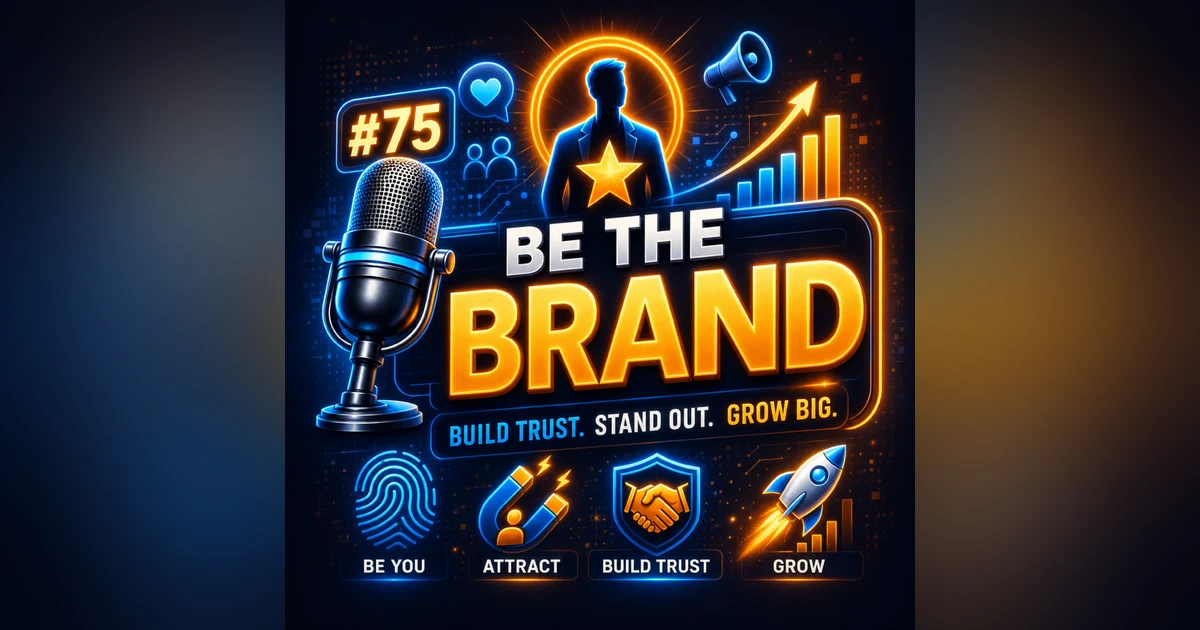
#75: Be the Brand 🌟 – How Your Personality Can Build a Successful Business


For years, people believed that successful businesses had to follow a strict, polished corporate formula. But today, the internet has changed everything. Infinite consumer choices have created a massive trust deficit, and traditional corporate facelessness is failing. In this episode of the Smart Entrepreneur Show, we explore how to build a highly profitable business entirely around your personality — breaking down why your messy, authentic story is your greatest asset, how to find your niche based on what people are already asking you for, and the specific progression you must follow to monetize trust without destroying it. Timestamps Timestamp Topic 00:00 Introduction — why authentic personalities are beating big corporations 00:41 The personal brand blueprint: you aren't hiding behind a brand, you are the brand 01:00 The modern consumer landscape: infinite choices and the collapse of corporate trust 01:32 The cereal aisle analogy: your personality makes you the trusted friend 01:47 The trust deficit: why polished logos trigger our "marketing manipulation" filter 02:03 Biologically hardwired to assess humans, not LLCs 02:18 Your story is your biggest business asset: challenges, failures, and successes 02:40 Why perfection repels: sharing only wins makes you an "unreachable alien" 03:01 Shared struggles are the exact glue that binds an audience to a creator 03:13 Why copying others always fails: you're adopting a solution to different life experiences 03:32 Finding your focus: the three key questions to identify your niche 04:00 The "favours" signal: your market is already telling you what to teach 04:17 Free focus groups: your colleagues are already conducting them on you 04:38 Platform psychology: LinkedIn (lecture hall), Instagram (cafeteria), YouTube (seminar) 05:24 The monetization progression: why you never start by selling a massive product 05:47 Stage 1 — high-intimacy coaching and consulting for a premium 06:04 Stage 2 — productizing your frameworks into digital courses 06:20 Stage 3 — membership communities: monetizing your network effect and culture 06:43 Stage 4 — speaking engagements and sponsorships as offline leverage 06:54 Common mistakes: copying competitors, inconsistency, and trying to appeal to everyone 07:06 The "flavorless mush" problem: diluting your message destroys the trust you built 07:43 The bank account of trust: deposits (free content) vs. withdrawals (sales) 07:54 Creating psychological debt so your pitch feels like the logical next step 08:15 The uncopyable moat of consistency: content, values, and communication 09:05 Your personality is not a weakness — it is your greatest competitive advantage 09:19 Skills and products can be copied in weeks; your voice and perspective cannot 09:34 Full blueprint recap 10:12 Final thought: how do you ensure your brand evolves as you grow and change as a person? Contact & Resources Listen to this episode on Podbean: smartentrepreneur.podbean.com Explore more podcasts: Find all podcasts at the PodFather Network Website: RoyCoughlan.com Need help running your business? If you are looking for a Virtual Assistant and get reliable support for your daily operations. Virtual Assistants: VA.world Communities: BrainGym.fitness Learn about a Private Networking Group in 50 US States & 39 Countries with 640+ Members: connectedleaders.academy #SmartEntrepreneurShow #PersonalBranding #CreatorEconomy #Authenticity #BusinessGrowth #Entrepreneurship #ContentStrategy #Monetization #DigitalBusiness #RoyCoughlan #PodFatherNetwork #VAWorld #BrainGymFitness #SmartEntrepreneur
Welcome to the Smart Entrepreneur Show, the podcast where we share smart ideas,
strategies, and lessons to help entrepreneurs build better businesses. For years, people
believed that successful businesses had to follow a specific formula. But today, the internet
has changed everything.
Some of the most successful entrepreneurs aren't winning because they have the biggest
companies. They're winning because they have the most authentic personalities. People no
longer connect only with products.
They connect with stories, values, perspectives, and people. In today's episode, we'll explore
how to build a business around your personality and why being yourself can become one of
your greatest competitive advantages. Let's get started.
Yeah, and our mission for this deep dive today is to really lay out the roadmap for you.
We're going to dive into the personal brand blueprint to uncover the practical tools you
need. We'll also cover how to avoid the common traps that trip a lot of people up and learn
how you can literally turn your authentic self into a tangible, monetizable business asset.
Okay, let's unpack this because it's a huge shift in how we think about business. It really is.
We're talking about a personality-driven business, which basically means it's built on who
you are, what you believe, and how you communicate.
You aren't hiding behind a brand. You are the brand. Exactly.
And to understand why this works, we have to look at the modern consumer landscape. Oh,
right. Because customers just have endless choices now.
Endless. I mean, infinite leverage, infinite options. And because of that, traditional corporate
facelessness is actually failing.
It's like walking down a cereal aisle with 500 options. You eventually just buy the one
recommended by a friend you trust. Your personality makes you that friend to the
consumer.
That is a perfect analogy because what you're describing is bypassing consumer skepticism.
We have a massive trust deficit right now. Yeah.
Nobody trusts a faceless corporation anymore. Right. When a polished logo makes a
promise, our brain instantly categorizes it as marketing manipulation.
We put our guard up. We're just biologically hardwired to assess humans, not LLCs.
Precisely.
So when you step into the spotlight as a human being with vocal inflections, quirks, your
own beliefs, you offer the consumer a psychological shortcut to trust. Trust is the ultimate
differentiator. So if trust is the ultimate currency, how does someone actually build it?
Because the source we're looking at points directly to the entrepreneur's personal history,
right? Yeah.
Your story is your biggest business asset. It's made up of your challenges, your lessons, your
failures, and your successes. So what does this all mean for someone listening right now
who thinks, but my story is boring or I don't want to air my failures? What's fascinating here
is that perfection actually repels people.
Wait, really? Repels them? Yes. Think about it. If you only share your massive wins and you
look flawless, people can't relate to you.
You seem like an unreachable alien. That makes a lot of sense. Shared challenges and
relatable struggles are the exact glue that binds an audience to a creator.
It's a principle where authenticity creates loyalty. Because it humanizes you. Exactly.
When you share the climb, the slipping, the broken gear, and how you fixed it, you become
a guide. And that's why copying others always fails. Because you're adopting a solution to a
completely different set of life experiences.
Right. And your audience will sniff that out immediately. Being genuine leads to faster trust,
loyal audiences, natural content creation, and honestly, just much easier marketing.
I love that. So once you embrace your messy, authentic story, you need to translate it into a
practical, real-world business structure. You do.
You have to find your focus and build a platform. How do we actually do that, though? The
blueprint mentions identifying your strengths through three key questions. Yeah, three
simple questions.
First, what topics do you enjoy discussing? Second, what skills do people ask you about?
And third, what experiences make you different? Here's where it gets really interesting. That
second question about what skills people ask you about. Oh, it's the best one.
For you listening, your market is already telling you what your business should be based on
the favors people ask of you. If your colleagues are constantly dragging you to coffee to ask
how you negotiate with vendors or organize your inbox. The market is literally screaming at
you to teach that.
Exactly. They're already conducting free focus groups on you. It entirely removes the
guesswork.
And synthesizing those three questions ensures you don't just build a brand, but a
sustainable brand you won't burn out running. Because you actually enjoy the topic and
have the unique experience to back it up. Right.
Now, once you have that focus, you have to build the brand's visibility. Content creation,
podcasting, social media, teaching, stuff like that. Yes.
The sources specifically mention platforms like LinkedIn, Instagram, and YouTube as the
modern tools for sharing this expertise. How should someone view those different
platforms? Because they aren't all the same. No, they serve completely different
psychological functions.
Think of LinkedIn as your lecture hall. Okay. Establishing professional authority.
Exactly. Then Instagram is like the cafeteria, the quad. It's the behind-the-scenes, day-to-day
reality that humanizes you.
Showing the relatable struggles. Right. And then YouTube is your deep dive seminar.
It's where people can spend hours absorbing your specific way of thinking. Wow. Okay.
So we've built the audience through an authentic brand across these platforms. You've got
their trust. But now, how does this actually generate income? Because trust doesn't pay the
mortgage, and what mistakes will just kill the business before it gets off the ground? This is
the critical transition.
Monetization avenues only open up once trust is established. The framework lays out a very
specific progression. So you don't just jump straight to selling a massive product? Never.
Yeah? You usually start with high-intimacy models like coaching or consulting. Why start
there? Because early on, you have high trust from a small number of people. So you apply
your highly-specific brain to their highly-specific problems for a premium.
But consulting hits a hard ceiling, right? You only have so many hours in the day. Exactly.
And that's when you transition to digital products and courses.
Okay. So you take the frameworks you developed during consulting and productize them.
Yes.
If you've been teaching your audience how to solve a problem for free, a certain percentage
will happily pay for a structured course that saves them time. What about membership
communities? That's mentioned as another avenue. Memberships are brilliant because you
transition from monetizing your knowledge to monetizing your network effect.
People pay a recurring fee for access to you, but also for proximity to other people who
share your values. Oh, I see. You're selling access to the culture you built.
Exactly. And as that community grows, you unlock offline leverage, like speaking
engagements and sponsorships. Where other brands essentially pay a premium to, you
know, rent the trust you've built.
That's exactly how it works. But there are common mistakes to avoid here, right? Like
pretending to be someone else or copying competitors. Exactly.
Huge mistakes. Or being inconsistent. But the biggest one is trying to appeal to everyone.
Oh, trying to appeal to everyone is like trying to cook a dinner that a vegan, a strict
carnivore, and a sugar-obsessed toddler will all love. You end up serving flavorless mush.
That is painfully accurate.
If you dilute your message to capture everyone, you destroy the personality that built the
trust in the first place. You want to attract the right people, not everyone. This raises an
important question, though.
How do entrepreneurs balance offering value with the necessity of selling? Because focusing
only on selling destroys the trust asset you just built. Right. If you just pitch, pitch, pitch,
people tune out.
Think of trust as a bank account. Every piece of free, high-value content is a deposit. Every
time you ask for a sale, you make a withdrawal.
So you need a massive surplus of deposits. Yes. You want your free content to be so
valuable that the audience almost feels a psychological debt to you.
When you finally sell a course or a membership, they see it as the logical next step, not a
sleazy pitch. That makes so much sense. Avoiding those pitfalls isn't just a one-time task,
though.
It requires a long-term strategy. It really does. Building a personality-based business takes
time.
Which brings us to the source's final powerful takeaway, the uncopyable moat of
consistency. Consistency is everything. Trust is cultivated through a three-pronged
approach, consistent content, consistent values, and consistent communication.
Break that down for us. Consistent content just means showing up repeatedly? Yeah,
showing up repeatedly so your audience can calibrate their expectations. Consistent values
mean standing by the same core beliefs over years.
So you aren't just chasing whatever the algorithm says is popular today. Exactly. And
consistent communication is maintaining your unique tone, your vernacular, your specific
way of explaining things.
And over time, those three things combine to make you a permanent fixture in their life.
Right. It transforms a fragmented message into a recognizable, trusted entity.
The key takeaway here is that your personality is not a weakness. It is your greatest
advantage. I think it's just so empowering for you listening to realize that simply being
yourself is your strongest competitive moat against giant corporations.
It really is an impenetrable moat. I mean, skills and products can be reverse-engineered by
competitors in weeks, but your unique experiences, your voice, and your perspective, that
literally cannot be copied. It scales infinitely without ever losing its uniqueness.
Let's do a quick recap of everything we've covered today. Sure. We started by looking at
trust as the ultimate currency in a market with endless choices.
Then we talked about using your authentic story, especially the messy parts and failures, to
build relatability. Right. Then we moved into finding your niche by asking those three key
questions, especially listening to what skills people already ask you about.
And we broke down how to monetize carefully, starting with coaching, moving to courses
and memberships, and why alienating the wrong audience is actually a good thing. And
finally, remaining consistent over the long haul to build that uncopyable moat. It's a
completely different way to look at building a business.
It is. And, you know, I want to leave you with a final thought to ponder that builds on
everything we've discussed today. Let's hear it.
If your brand is built on who you are today, how do you ensure your business has the
flexibility to evolve as you grow and change as a person tomorrow? Oh, wow. That is a great
question to end on. If you enjoyed this episode of The Smart Entrepreneur Show, make sure
to follow the podcast so you don't miss future episodes.
And feel free to share your thoughts or experiences in the comments

PodFather
I am a serial entrepreneur who has founded 21 companies across 6 countries. Known in the industry as “The PodFather,” I am a business podcast coach and host who has launched eight successful podcasts—6 ranking in the Top 5%, with four reaching the coveted Top 0.5% globally.
Beyond podcasting, I co-founded brainupgrade.org a platform designed to boost cognitive performance and unlock peak mental potential. I am also the co-founder of VA.World, connecting businesses with exceptional Virtual Assistants tailored to their unique needs.
I also have Sponsorship ads available that are Dynamically inserted into my 8 shows