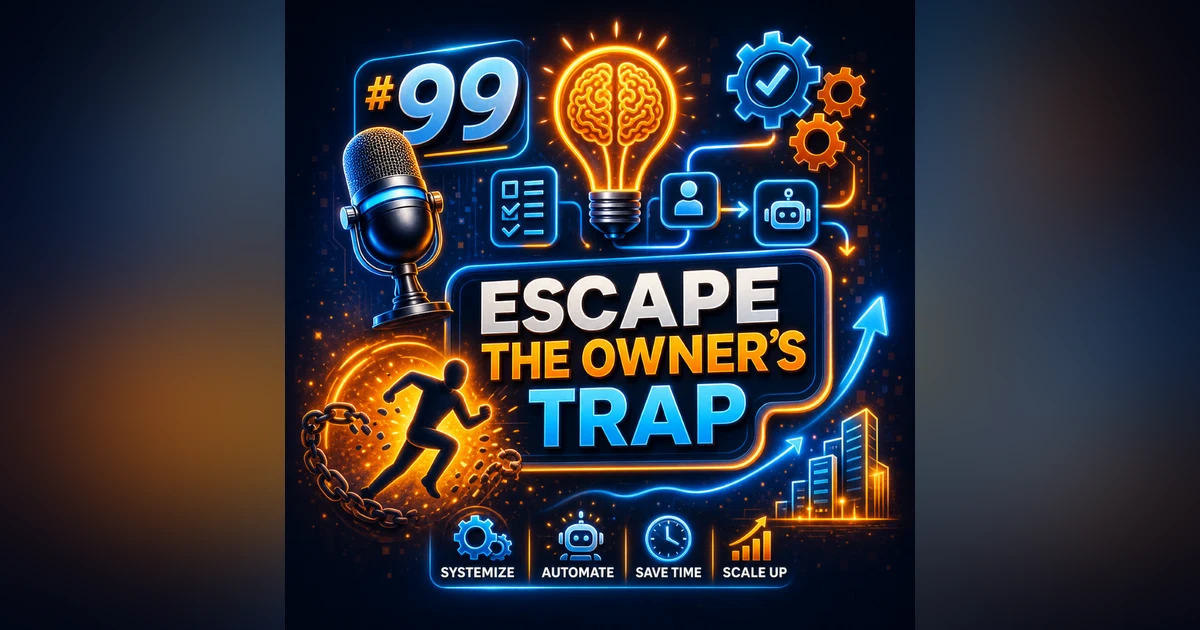
#99 Escaping the Owner's Trap – How to Systemize and Automate Your Company


If you took a spontaneous three-month vacation tomorrow and turned your phone off, what would happen to your business? For most founders, the honest answer is: it would collapse. In this episode of the Smart Entrepreneur Show, we map out the exact blueprint to escape the owner's trap — transitioning from stressed-out daily operator to visionary owner of a business that runs, grows, and generates revenue entirely without you.
This is the freedom machine blueprint.
In this episode you'll learn:
- The brutal diagnostic: if your business collapses without you, you don't own a business — you own a high-stress job where you're the most overworked employee
- Why being the person clients refuse to speak to anyone else about feels like a badge of honour — and why it actually makes you the ceiling of your own business
- The traffic cop analogy: why directing every decision means you're managing the current traffic jam instead of building a road network
- The Rule of Two: if a task needs to be done more than twice, it needs an SOP — full stop
- Why a modern SOP isn't a dusty 50-page binder but a simple Loom screen recording you make while doing the task anyway
- How documenting a refund process removes the founder's ego and emotion from a transaction that previously felt like a personal attack
- The difference between delegation and abdication — and why the "dump and run" method is a self-fulfilling prophecy that sends you straight back to the trap
- The 3-step delegation framework: I do / you watch → you do / I watch → you do / I check results
- Why "I am watching you so you literally cannot fail" eliminates anxiety instead of creating it
- The middle management trap: how escaping the technician role lands many founders in an equally exhausting plateau of managing 10 people's daily chaos
- How installing one operations lead collapses 100 daily friction points down to a single weekly check-in
- What the founder's actual job becomes once the engine is built: dashboards, health metrics, and steering the ship toward next year — not rowing below deck today
- The closing challenge: look at your calendar for tomorrow — what is one task on that list you should absolutely never do again?
Contact & Resources
Listen to this episode on Podbean: smartentrepreneur.podbean.com
Explore more podcasts: Find all podcasts at the PodFather Network
Website: RoyCoughlan.com
Need help running your business? If you are looking for a Virtual Assistant and get reliable support for your daily operations.
Virtual Assistants: VA.world
Communities: BrainGym.fitness
Learn about a Private Networking Group in 50 US States & 40+ Countries with 650+ Members: connectedleaders.academy
#SmartEntrepreneurShow #OwnersTrap #SystemizeYourBusiness #BusinessAutomation #SOPs #StandardOperatingProcedures #Delegation #ScalingBusiness #BusinessSystems #Entrepreneur #FreedomMachine #PassiveIncome #BusinessOwner #TeamBuilding #OperationsLead #LoomVideo #WorkOnYourBusiness #BusinessGrowth #ScalableBusiness #RemoteTeam #VirtualAssistant #Outsourcing #BusinessBlueprint #Bootstrapping #RoyCoughlan #PodFatherNetwork #VAWorld #VirtualAssistant #SmartEntrepreneur
#99 Escaping the Owner's Trap How to Systemize and Automate Your Company
Welcome to the Smart Entrepreneurs Show, the podcast where we share smart ideas, strategies and lessons to help entrepreneurs build better businesses. Let me ask you a brutal question. If you took a spontaneous three month vacation today.
Oh boy. Right. If you just packed up and completely turned off your phone, what would happen to your business? I think we both know the answer for most people.
Yeah, exactly. Would it collapse or would it continue to run, make money and grow without you? If your answer is that it would collapse, then you don't actually own a business. You own a high stress job where you are the employee.
And usually the most overworked employee, honestly. 100 percent. So today we are discussing the holy grail of entrepreneurship.
How to create a business that runs without you. We will map out the exact blueprint to transition from being a stressed out daily operator to becoming a visionary owner. It is such an important transition.
It really is. We'll talk about systems, delegation and building an engine that thrives in your absence. Let's build your freedom machine.
I love that intro. Because what we're looking at in today's deep dive, pulling from the principles of architecting autonomy, it isn't just about, you know, time management or like quick productivity hacks. Right.
It's way deeper than that. Yeah. It's a fundamental identity shift.
We're unpacking a framework that moves you from being the indispensable center of your universe to being the actual architect of an engine, one that thrives entirely in your absence. OK, let's unpack this, because if the goal is to step away, the immediate barrier is that your business's brain is currently, well, your brain. Exactly.
It's all locked up in there. Right. And before we get into the mechanics of extracting that brain, we really have to look at the reality most founders are currently living in, which the source material calls the owner's trap.
And it's a trap precisely because psychologically it doesn't really feel like a trap at first. I mean, early on, being involved in every little detail feels exactly like success. You're busy.
Yeah. You're hustling. You're closing deals.
You're fulfilling orders. The dopamine hits are just constant. But as you grow, the symptoms of the owner's trap become pretty suffocating.
Like what? What are the big red flags? You basically become the absolute bottleneck of the company. Every single decision, no matter how trivial, has to cross your desk. You're still personally delivering the service.
And here's the classic warning sign. Your clients flat out refuse to speak to anyone else on your team. Right.
And, you know, I have to push back a little here, because when you say it like that, it sounds like a failure. But isn't it kind of a badge of honor that clients only want to speak to the founder? It feels like one. Sure.
Like, think about a master chef. If I go to a Michelin starred restaurant, I kind of want the master chef back there making my appetizer. I don't want the sous chef doing it.
You know, doesn't that just mean you're doing an incredibly good job? It means you are highly competent. Yes. But it also means you are fundamentally unscalable.
To use your chef analogy, if the master chef insists on topping every single onion, reducing every single sauce and plating every single appetizer, they're going to crash. Exactly. That restaurant can only serve maybe 10 people a night.
The chef burns out. The customers wait hours for their food and the business just stops growing entirely. So your own skill becomes the problem.
Yeah. And what's fascinating here is how our own ego reinforces this trap. We constantly tell ourselves nobody can do it like I can, which honestly might be true for the top 5 percent of the work, but it is absolutely false for the other 95 percent.
Wow. So you basically become a victim of your own competence. Exactly.
You are so good at doing the thing you become the ceiling of your own business. I used to think of this like a wheel where the founder is the hub and every employee is a spoke. But honestly, it's more like a busy traffic intersection without any traffic lights.
Oh, that's a great way to picture it. Right. If you were the traffic cop standing in the middle directing every single car, the system only works as long as you were standing there waving your arms.
The second you step away to, I don't know, get a drink of water, everything crashes. That's spot on. And if you're the traffic cop, you aren't building a road network.
You're just managing the current traffic jam. This leads to the really pivotal mindset shift required here, which is you have to stop viewing yourself as a genius with a thousand helpers. The realization you have to make is that the job of an entrepreneur is not to do the work.
The job is to build a system that does the work. You have to work on your business, not in it. Yes.
As long as your value is tied to the manual hours you personally put in delivering the product, your income and your impact are completely capped by the 24 hours in a day. OK, so if we accept this, someone listening right now has the epiphany that they need to stop directing traffic. How do they actually do it? That is the million dollar question.
Because the immediate friction is that all the genius, all the nuanced know-how of like how to handle an angry client or how to format a specific proposal is locked securely inside their own head. How do you extract that without just grinding the whole business to a halt? So that extraction process is what the text calls building the business DNA. And it's primarily composed of SOPs or standard operating procedures.
Now, before anyone rolls their eyes at the term SOP. I've already rolled my eyes a little bit. I know, I know.
But there's a brilliant, highly practical threshold introduced for when you actually need to create one. It's called the rule of two. The rule of two, meaning if you do it twice, write it down.
Precisely. If a task needs to be done more than twice in your business, it requires an SOP. Full stop.
OK, that is aggressively simple in theory. But let's look at the messy reality for a second. When I hear standard operating procedure, I instantly picture this massive, dusty corporate manual in a three ring binder.
But from the 1990s, yeah. Exactly. The kind of thing that takes six months to write.
And by the time you finish it, the software is updated and the manual is totally useless anyway. Who has the time to write a textbook for their own small business while they are already overworked? That is the number one objection. And it's completely valid if you're using an outdated corporate definition of documentation.
But the solution here is incredibly low friction. An SOP does not have to be a 50 page text document. Well, what is it then? The most effective SOPs today are just simple screen recordings.
You use a tool like Loom or just any basic screen capture software where you record your screen and your voice while you are doing the task anyway. Oh, that's brilliant. So you don't stop working to write about working.
You just document the work in real time. Exactly. You don't have to set aside a whole weekend retreat to write a manual.
Next time you are onboarding a new client, you just hit the record button. You just narrate what you're doing. Right.
You just say I'm opening this specific CRM software. I'm clicking this exact button. I'm copying this email template and I'm modifying this one line.
You save that video, title it Client Onboarding SOP and you are done. That significantly lowers the barrier to entry. I mean, I imagine you can apply this to almost anything.
How to post on social media, how to run payroll, how to handle a customer complaint. Actually, the customer complaint or like a refund request is a perfect example to highlight because that's usually a highly emotional, high stress moment for a founder. If you're the one processing the refund, you might feel defensive.
Oh, absolutely. Right. Or you might overthink it and waste 20 minutes drafting this highly customized response.
Because it's your baby. Yeah. Someone asking for a refund feels like a direct personal attack.
Yes. But if you have an SOP that says if a client requests a refund within 30 days, do not argue. Click this button in Stripe to process it and send template B. Suddenly the emotion is entirely removed from the transaction.
It's just a process. Exactly. It neutralizes the friction for you.
And more importantly, it makes it incredibly easy for someone else to just take over that task. That makes total sense. But I can hear some founders arguing right now.
Well, OK, 90 percent of my tasks are repetitive. Sure. But what about the nuances? What about the weird edge cases where my unique judgment is actually required? It's a fair point, but it's often another ego trap.
We mistakenly believe our unique founder level judgment is required for every single scenario. Yes, edge cases happen. But by documenting the exact steps for the 95 percent of repetitive operations, you are cloning your baseline competence.
Cloning your baseline competence. I like that phrase. Yeah.
You establish the floor. And when an edge case does happen, your team can bring that specific rare problem to you rather than coming to you every single day to ask how to log into the software. So the goal is ultimate clarity.
Right. The goal of this phase is creating a guide so incredibly clear that you could literally hand it to someone who just walked in off the street and they could execute the task perfectly without ever calling you for help. OK, so let's say we've done this.
We recorded our screens. We have a centralized drive full of videos and checklists. We have successfully extracted the business DNA.
But, you know, having the recipe isn't the same as getting someone else to successfully bake the cake. Not at all. I know founders who have amazing documentation, but their teams still constantly mess up.
And that leads us directly into the execution phase, which is delegation. This is where brilliant operators often stumble because they confuse delegation with abdication. Abdication versus delegation.
That's a huge distinction. It really is, because having the SOP is only half the battle. How you physically and emotionally hand that SOP over to another human being determines absolutely everything.
I feel like the default setting for an overworked founder is to just dump the work. You finally hire someone. You throw a bunch of videos at them.
You say, good luck. Read the manual. And you just walk away expecting absolute perfection on day one.
It's the classic dump and run method. And what inevitably happens, the new hire makes a mistake. Of course they do.
They are human and they are trying to interpret a brand new system. Right. But the founder, who is already stressed out, sees the mistake throws their hands up in frustration and says, see, nobody can do this as well as I can.
I guess I just have to do it myself. And boom, you are right back in the owner's trap. It becomes a completely self-fulfilling prophecy.
You sabotage your own hires because you didn't actually train them. You just gave them a reading assignment. Exactly.
To break that cycle, the text introduces a very deliberate, safe, three-step delegation framework. It's designed to build psychological safety for both the founder and the new employee. OK, what are the three steps? The three steps are, I do, you watch, you do, I watch, and you do, I check the results.
Let's break those down because the mechanics here seem really crucial. Step one. I do, you watch.
Yeah. What does that look like in practice? In this step, the founder performs the task while the new hire observes in real time. But this isn't just about silently watching a screen.
It's about the founder explaining the why behind the actions. OK, so giving them the context. Right.
The SOP tells them what buttons to click. But in this step, you are providing the context. You're demonstrating the standard of quality you actually expect.
You're passing on the philosophy of the work, not just the mechanics. So if I'm showing someone how to do customer service emails, I'm not just saying click reply. I'm saying, notice how I use a really warm tone here because our brand is all about approachability.
Exactly. You are setting the baseline. Once they truly understand the philosophy, you move to the most critical transition point.
Step two, you do, I watch. Now, I have a theory about this step. If I'm the new hire and my boss, the actual founder of the company, is hovering right over my shoulder watching me type an email, I'm going to be terrified.
Doesn't that just create anxiety? It can, yeah, if it's framed as a test. But if it's framed as a safety net, it actually eliminates anxiety. You have to communicate.
I am watching you so that you literally cannot fail. Oh, that's a great way to frame it. Right.
The new hire attempts the task and the founder provides real-time constructive course correction. If they are about to click the wrong button and send a totally angry email to a client, you just stop them. Here's where it gets really interesting to me.
Think about what this does for the founder's anxiety too. Yes, absolutely. Handing over a crucial part of your business is terrifying, but this step mitigates the blast radius.
You know, the company won't break because you can step in immediately if they take a wrong turn. You aren't throwing them into the deep end to see if they swim. You're getting in the pool with them.
Exactly. It builds profound mutual trust. The employee learns they were supported and the founder learns that the employee is actually capable.
You do this step as many times as necessary until that trust is totally solidified. And then you move on to the final step. Right.
Which is step three. You do. I check the results.
So this is where we actually get our time back. Yes. At this stage, the employee has full autonomy to execute the task from start to finish.
The founder is no longer watching the process at all. They are only reviewing the final output. The bottleneck has been officially removed.
Let's do the math on that for a second. If a task used to take you two hours to complete and now you have an employee doing it while you spend maybe five minutes reviewing their final product to ensure it meets the standard you've just bought back an hour and 55 minutes of your life. And you multiply that by 10, 20 or 50 tasks across the week.
That is how you quite literally manufacture time as an entrepreneur. You are trading a heavy short term investment in training for a long term compounding yield of automated hours. I love the mechanics of that.
Yeah. But I want to introduce a little reality check here because real business is messy. Let's play out a scenario.
Okay. Let's hear it. Let's say I've done all of this perfectly.
I recognize the trap. I built the business DNA with flawless screen recordings and I use the one, two, three delegation framework like a champion. Over the last year, I've hired 10 amazing employees to handle all the day to day tasks, the emails, the fulfillment, the marketing.
Sounds great so far. Right. But wait, now I'm managing 10 people.
I'm answering their daily questions. I'm approving their vacation time. I'm mediating disputes when the marketing person annoys the sales person.
I'm not doing the technical work anymore, but I am still completely trapped in the day to day operations. That is a highly astute observation and it's a frustrating plateau where so many mid-sized businesses just stall out. You've successfully escaped the technician trap, but you've fallen straight into the middle management trap.
Yeah. Which sounds exhausting. It is.
This is where founders burn out all over again because managing humans is arguably more exhausting than doing the technical work. So how do we break through that final ceiling? Because if the goal is that three month vacation we talked about, I can't take it if 10 people need my personal approval to buy paper clips. This requires the fourth and final phase from the deep dive today.
Transitioning to a management structure. OK. What does that involve? Once your staff knows how to run the daily tasks using the SOPs independently, your job is no longer to manage them.
Your job is to hire or promote a manager or an operations lead. Someone whose sole responsibility is to manage the people who are doing the tasks. Exactly.
Let's look at the math of freedom here because the contrast is profound. Previously, you were managing 10 employees who are collectively executing 100 different tasks. Your attention was fractured 100 ways every single day.
Right. Death by a thousand cuts. But by installing a competent operations lead, you now only manage one connection.
You talk to one person. Going from 100 points of daily friction down to just one. But conceptually, how hard is that for a founder to actually do? Because giving an employee an SOP on how to send an email is one thing, giving a manager the authority to basically parent your business that requires a massive leap of faith.
It is the hardest emotional hurdle of the entire journey. You are literally handing over the keys. You have to remember, you aren't doing it blindly.
The manager isn't inventing a new way to run the business. They're using the DNA you already built. Exactly.
They are managing the system you built. They ensure the SOPs are followed by the staff. They handle the daily fires.
They mediate the disputes and they conduct that three step delegation for any future hires. They manage the engine so you don't have to. So what does the founder actually do then if they aren't directing the traffic and they aren't managing the traffic cops? What is their actual day to day reality? You step out of operations entirely and fully into the visionary role.
The new reality looks like this. Instead of daily firefighting, you have a check in once a week with your operations lead. And in that meeting, you aren't discussing how a specific email was sent or why a social media post was late.
What are you looking at then? You are looking at the core health metrics of the business. The dashboards like revenue targets, profit margins, customer acquisition costs, churn rate. Precisely.
You are steering the ship based on high level data and focusing on where the market is going next year rather than frantically rowing the boat below deck with your bare hands today. You've gone from the engine room to the captain's chair. And that means you have officially transitioned from being a trapped operator to the true owner of a self-sustaining asset.
The business runs, it generates revenue, and it grows. Whether you are sitting at your desk on a Tuesday or whether you are completely off the grid on that spontaneous three month vacation. Because the business is no longer reliant on your daily physical or mental energy to survive.
It has its own heartbeat supported by its own DNA and its own management structure. And that is the true definition of a scalable asset. It's a remarkable transition.
It requires checking your ego, doing the unglamorous work of documenting your processes and having the patience to truly mentor your team instead of just dumping work on them. But the payoff is literal freedom. It's the journey from being the ultimate bottleneck to becoming the ultimate architect.
If you enjoyed this episode of the Smart Entrepreneur Show, make sure to follow the podcast so you don't miss future episodes. And feel free to share your thoughts or experiences in the comments. We love hearing how you're applying these blueprints in the messy reality of the real world.
And as we wrap up, I want to leave you with a final thought to apply this directly to your reality right now. Take a look at your calendar for tomorrow. Look at every single meeting, every single to do item.
What is one task on that list that you are planning to do that you should absolutely never do again?

PodFather
I am a serial entrepreneur who has founded 21 companies across 6 countries. Known in the industry as “The PodFather,” I am a business podcast coach and host who has launched eight successful podcasts—6 ranking in the Top 5%, with four reaching the coveted Top 0.5% globally.
Beyond podcasting, I co-founded brainupgrade.org a platform designed to boost cognitive performance and unlock peak mental potential. I am also the co-founder of VA.World, connecting businesses with exceptional Virtual Assistants tailored to their unique needs.
I also have Sponsorship ads available that are Dynamically inserted into my 8 shows