#97 Don't Risk It All – The Lean Way to Build Your Next Business
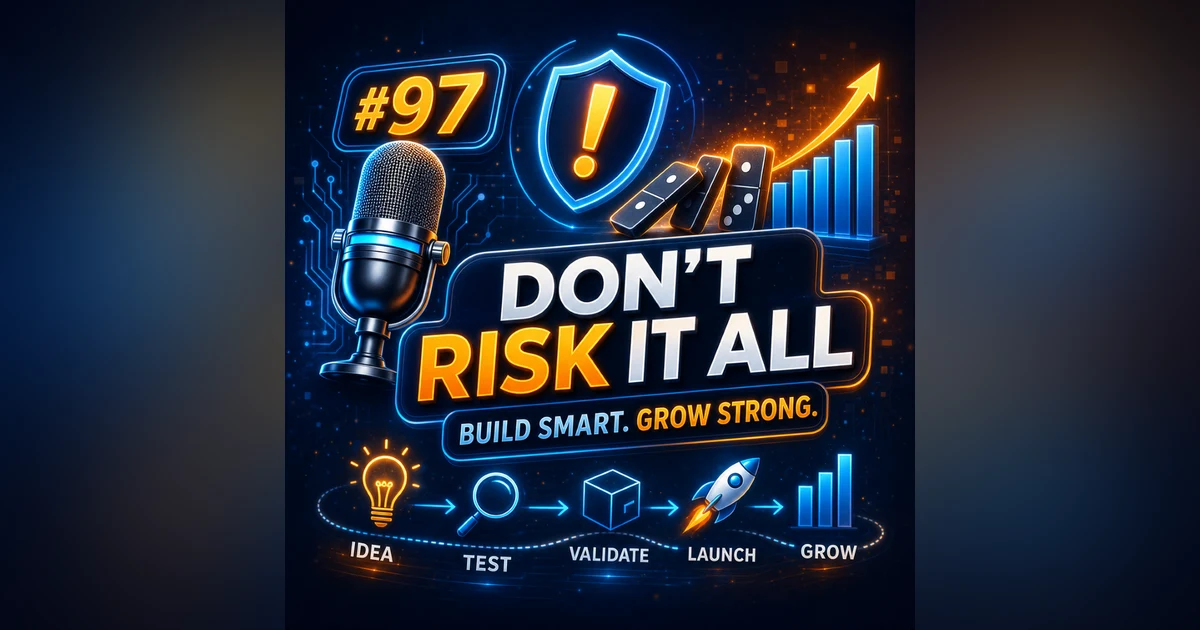


The smartest entrepreneurs aren't risk seekers. They're risk mitigators. In this episode of the Smart Entrepreneur Show, we decode the asymmetric bet — the modern business model where the downside is strictly capped but the upside is virtually unlimited — and map out the exact stepping stones from idea, to validation, to service, to scalable digital product, without ever risking your financial security.
This is the lean startup playbook for anyone who wants to build something real without betting the house on it.
In this episode you'll learn:
- Why the "max out 10 credit cards" founder myth is a trap — and why the smartest entrepreneurs cap their downside first
- The blackjack analogy vs. the scratch card analogy: why digital models fundamentally flip the risk equation
- Why time is the real currency at risk — and how capping financial downside removes the psychological paralysis that kills most builders before they start
- The Lean Startup rule: validate before you build — and why most founders fail by building in a vacuum for six months before finding out nobody wants it
- The painted door test: how to measure real buying intent with a one-page website and a buy button — without writing a single line of code
- The ethics of preorders: how to take real money for something that doesn't exist yet without destroying your reputation before you start
- Why freelancing and consulting are the lowest-risk entry point into entrepreneurship — and why they're not the destination
- The freelancer trap: how to avoid trading hours for dollars forever by treating your service work as paid research
- The B2B copywriter case study: how spotting a universal bottleneck led from freelancing → productised service → self-funded SaaS
- The zero marginal cost rule: why the 10,000th copy of a digital product costs exactly the same to fulfil as the second — nothing
- Why empathy is the competitive moat in a crowded digital market — and why the product built on real client pain points always beats the AI-generated generic copy
- The closing challenge: which task in your daily routine could you digitise, productise, and duplicate at zero marginal cost tomorrow?
Contact & Resources
Listen to this episode on Podbean: smartentrepreneur.podbean.com
Explore more podcasts: Find all podcasts at the PodFather Network
Website: RoyCoughlan.com
Need help running your business? If you are looking for a Virtual Assistant and get reliable support for your daily operations.
Virtual Assistants: VA.world
Communities: BrainGym.fitness
Learn about a Private Networking Group in 50 US States & 40+ Countries with 650+ Members: connectedleaders.academy
#SmartEntrepreneurShow #LeanStartup #AsymmetricBet #RiskMitigation #ValidateBeforeYouBuild #PaintedDoorTest #DigitalBusiness #ZeroMarginalCost #FreelanceToFounder #ProductisedService #SaaSBusiness #OnlineBusiness #StartupStrategy #DigitalProducts #PassiveIncome #Entrepreneur #BusinessValidation #Bootstrapping #SideHustle #ServiceToProduct #CustomerEmpathy #BusinessGrowth #WorkFromAnywhere #MakeMoneyOnline #RoyCoughlan #PodFatherNetwork #VAWorld #VirtualAssistant #SmartEntrepreneur
#97 Don't Risk It All The Lean Way to Build Your Next Business
Welcome to the smart entrepreneur show, the podcast where we share smart ideas, strategies, and lessons to help entrepreneurs build better businesses. When you think of the word entrepreneur, what comes to mind? A lot of people picture a reckless gambler, someone who quits their nine to five, takes out a massive bank loan and risks everything on a wild idea. But let me tell you a secret.
The smartest entrepreneurs aren't risk seekers. They are risk mitigators. They look for asymmetric bets, opportunities where the downside is strictly capped, but the upside is unlimited.
Today, we are breaking down exactly how to build a business with low risk and high potential. We will discuss how to validate your ideas for free, why digital leverage changes the game and how you can launch a profitable empire without risking your financial security. If you want to build a business safely and smartly, this deep dive is for you.
Let's get into it. Yeah, I am. I'm super excited for this deep dive because that traditional narrative is just so deeply ingrained in us.
Oh, totally. The whole high risk, high reward thing. Exactly.
We constantly hear this myth of the founder maxing out 10 credit cards. But the sources we're looking at today, they draw a really massive, bright line between that old physical business model and the modern digital one. Right.
Like signing a five year commercial lease for a restaurant or a retail shop. Yeah. You buy inventory, you hire staff.
And the outcome is, well, it's highly binary. If it fails, I mean, you are financially recovering for a decade. But when you transition to a digital or a service based model, that dynamic completely flips because the upfront cost is basically nothing.
Pretty much. If you launch a creative agency or build a software tool, the financial downside is strictly limited. You're risking your time, a laptop you probably already own and maybe a few bucks a month for software.
So you cap the downside at nearly zero, but leave the upside virtually infinite. Right. You have the ability to reach a global market of billions.
It's kind of like the traditional brick and mortar business is like walking up to a blackjack table and betting your entire life savings on a single hand. One bad turn of a card and you are just wiped out. Wow.
Yeah, that is exactly what it feels like. But the digital model is like someone handing you a massive stack of free scratch off lottery tickets. Your only cost is the time it takes to sit there and scratch them.
I love that analogy. But wait, let me push back on this premise a little bit. Yeah.
You're saying the risk is low, but time is money. Right. Time is our most finite resource.
So if I spend, I don't know, 12 months building a digital product, sacrificing my evenings, my weekends, and it completely flops. Hasn't that cost me massively? Like, is the investment of time actually a much heavier risk than we're admitting in this shiny digital model? That's a really fair pushback. The investment of time is definitely significant.
But if we look at the underlying mathematics and really the psychology of the builder, the asymmetric bet is still fundamentally superior. How so? Because capping your financial downside, meaning a failure, doesn't literally result in bankruptcy. It fundamentally shifts your psychology.
It removes that paralysis of fear. Because you aren't terrified of absolute ruin. Exactly.
And when that fear is gone, you have a greater creative freedom. You have the agility to pivot quickly. And most importantly, you gain the runway to survive multiple failures until you finally strike gold.
Oh, right. Because you didn't lose your house on the first try. Right.
If you waste a year on a digital project that fails, yeah, you've lost some free time. But you haven't lost your home. The psychological liberation of an asymmetric bet allows you to keep stepping up to the plate.
You can afford to swing and miss a few times when the bat is free. That makes total sense. That runway to fail safely is critical.
But obviously, no one wants to waste a year. Nobody. So if time is the main currency we are risking here, the obvious next step is figuring out how to protect that time.
And our sources point directly to the lean startup method, specifically this rule of validating before you build. Yeah. And this is where the vast majority of aspiring founders just completely stumble.
What do they do wrong? Well, a founder gets a brilliant idea, right? They retreat to their basement and they spend six months and hundreds of hours building a product in a total vacuum. It's totally isolated. Right.
They obsess over the logo, the code, all the little features. And then they launch it to the world. And absolutely no one wants it.
Frick it. Total crickets. They built a solution for a problem that didn't even exist.
So the antidote to that is to sell it before you make it. Precisely. Instead of building the entire product, you use landing pages, simple digital mockups, maybe preorder campaigns to test actual market demand.
Right. It's exactly how Hollywood operates with movie trailers. They frequently release these teaser trailers that are like almost entirely concept art or early test footage just to gauge audience hype before they spend 200 million dollars rendering the final CGI.
They need to know the audience is actually there. That's a great way to think about it. You need proof of audience.
But how does this actually work for a normal person? Like what are the actual mechanics of testing demand without building the thing? So you set up what's often called a painted door test. Let's say you have an idea for a new piece of software, something that helps freelance writers format their invoices. OK, good example.
Instead of spending three months coding it, you spend three hours building a simple one page website. You describe the software, list the features, and you put a big button at the bottom that says buy now for ten dollars a month. And when they click it, I mean, the software doesn't exist yet.
When they click it, a pop up appears saying we are currently in beta testing and finalizing development. Enter your email to get early access when we launch. Oh, wow.
Yeah, you aren't actually taking their money, but you just measured real concrete buying intent without writing a single line of code. So if a thousand people visit the site and no one clicks the buy button, you just saved yourself three months of coding a tool nobody wants. Exactly.
You pivot and you've lost zero dollars. OK, but what if we take it a step further and actually take preorders? Say I'm planning to write a comprehensive guide on a specific marketing strategy. I put up a page saying preorder this guide for a 50 percent discount to fund the writing process.
If people hand over their credit card details up front, I have the ultimate green light. But let me challenge the ethics of this for a second. OK, go for it.
If I set up a page and take actual money for something that literally doesn't exist yet, what happens if I realize I can't build it? Or what if life gets in the way? Doesn't failing to deliver on a preorder just ruin your reputation before you even start? That delivery risk is very real, which is why transparency is the non-negotiable mechanism here. You manage that risk by being explicitly clear about the timeline and the nature of the preorder. So you just tell them straight up? Yeah, you're essentially saying I am validating this idea.
If we hit 100 preorders, the project goes ahead and you get it on this specific date. If we don't hit the goal or if development stalls, you receive an immediate no questions asked refund. I see.
So you are treating your early customers almost like micro investors. Exactly. If the project fails to materialize, you refund the money, send a transparent email explaining the roadblock and you move on.
The reputational damage only occurs if you take the money and disappear. Right. If you ghost them.
Yeah, don't ghost them. When handled transparently, it's actually a joint venture with your target market. It's highly ethical because you are confirming you're solving a real problem for them.
You're testing the appetite before cooking the meal. And if the ingredients don't come together, you just give them their money back. Yeah, that completely protects both the builder's time and the customer's wallet.
Exactly. But let's pivot to the listener who is sitting there thinking, this all sounds great, but I don't even have an idea to test yet. I don't know what software to build or what guide to write.
Right. The blank slate problem. Yeah.
This is where the sources offer incredibly pragmatic stepping stone, which is starting with the skills that are already sitting in your head. We so often assume entrepreneurship means inventing something entirely novel, like from scratch. But the progression mapped out in the research highlights that the fastest, lowest risk entry point into business is selling a skill you already possess.
Like what? Freelancing, consulting, copywriting, video editing, web development. You require literally zero inventory and zero capital. You just need your brain and Internet connection.
So you just monetize the expertise you've already built up in your day job. Or even through your hobbies. Yeah.
It's the equivalent of being a backup singer or a session musician before you go off and record your own solo album. I love that. You get paid to be in the studio.
You get paid to learn how the industry operates. And you build your technical chops without taking on the financial risk of a solo tour. That is spot on.
But here is the classic trap. So many freelancers basically just build themselves another nine to five job. Oh, yeah.
The freelancer trap. They're just trading their hours for dollars forever. Yeah.
And they hit an income ceiling because they're only 24 hours in a day. Yeah. How does someone avoid getting permanently stuck in that phase? The answer lies in how you view the purpose of that service phase.
It should never be viewed as the final destination. Or should it be? It must be viewed as paid research. The goal isn't just to hoard as many clients as possible and grind yourself into burnout.
The goal is to actively look for recurring bottlenecks. OK, bottlenecks. Because you are in the trenches with these clients, you gain an incredibly intimate understanding of their deepest pain points.
Let's make this concrete for everyone listening. Walk me through exactly how someone pulls off this transition from service provider to product deliver. Sure.
Let's trace a specific example of, say, a B2B copywriter. They start by offering a freelance service, maybe writing cold outreach emails for software companies. Right.
So right now they are trading time for money. Exactly. But because they are doing this every single day, they start noticing patterns.
They realize that every single client they work with struggles with the exact same preliminary step, which is finding the right send leads to email in the first place. OK. The clients don't just need the emails written.
They need clean, verified lists of prospects to send them to. Yes. So the copywriter just found a universal bottleneck.
They are literally getting paid to find universal problems. That's a huge shift in perspective. It changes everything.
Now the copywriter takes that insight and productizes it. First, they might transition to an agency model or a productized service offering a flat fee package like one thousand verified leads and a five email sequence for two thousand dollars. So it's less custom work, more scalable.
Exactly. But then they take the ultimate step. They realize the process of finding those leads can actually be automated.
So they use the steady cash flow from their copywriting service to hire a developer to build a simple software tool that scrapes and verifies leads automatically. Wow. And they just funded their own software startup using their freelance income.
Exactly. They transitioned from offering a manual service to selling access to a software product. And their risk remained incredibly low the entire time because their cash flow is already secure from the service business.
They didn't have to guess what software the market wanted. No guessing at all. They had a roster of clients explicitly showing them the problem every single day.
You aren't just doing a task. You're studying a system. Beautifully put.
Which brings us to the absolute pinnacle of this journey. That exact pivot from manual hourly service to an automated, scalable product is what unlocks the ultimate goal of the asymmetric bet. Yes.
It's what the sources call the zero marginal cost rule. This concept completely separates the physical economy from the digital economy. Let's break down the economics of it, because it's fascinating.
In a traditional business, the cost of producing one additional unit, which is the marginal cost, remains high. Like making a chair. Right.
If you manufacture physical wooden chairs, every single time you sell a chair, you have to buy more wood, pay for more factory labor, pay for shipping. So your revenue goes up, but your costs go up right alongside it. Exactly.
But in the digital world, duplicating your product costs exactly zero dollars. It's like writing a book once, but every time someone buys it, the book simply prints itself out of thin air for free. That's the magic of it.
Whether it is an e-book, an online course, a premium website template or a software as a service product, you only have to endure the pain, effort and cost of creating it once. And selling the second copy costs you nothing. Selling the 10,000th copy costs you nothing extra.
This zero marginal cost reality is where the absolute highest profit potential lives, because every sale after the first one is practically pure profit. This is the true realization of the asymmetric bet. Your downside was capped during the validation and service phases.
You protected your time and your money. But now, because of zero marginal cost, your upside is genuinely infinite. You have fully decoupled your income from your time.
A digital product can be sold to someone on the other side of the planet while you were sleeping, and it costs you nothing to fulfill that order. That economic leverage is just incredible. But, you know, I have to raise one final critical question regarding this infinite scale.
All right, lay it on me. It really costs nothing to duplicate. And literally everyone with a laptop has access to these same tools.
Doesn't that mean the digital market is insanely, overwhelmingly crowded? It is very crowded. Right. If I can spin up a digital template or a piece of software for near zero cost, so can a million other people.
How on earth do you stand out in a sea of infinite digital products? That is the million dollar question. And the answer to standing out is actually hidden in the very stepping stones we just discussed. Yes, the market is crowded with generic digital products.
But you stand out precisely because you didn't skip straight to the end. You didn't just guess what the market wanted. Exactly.
You validated it first. You spent time in the service trenches doing the paid research, learning the exact nuanced pain points of real human beings. So the empathy generated during the service phase becomes the competitive moat.
Absolutely. Empathy is the moat. A thousand people can use an A.I. tool to generate a generic online course or a basic software tool.
But the digital product that wins, the software that becomes indispensable to a user's daily life is the one built on a foundation of real world empathy. Because it solves a real problem. It wins because it actually solves a highly specific problem the founder experienced firsthand alongside their clients, rather than just being a cheap duplication of someone else's idea.
In the digital economy, the high barrier to entry isn't financial capital anymore. The high barrier to entry is a deep, validated understanding of the customer. That perfectly ties everything together.
We have completely decoded the smart entrepreneurs playbook today. We've learned that to succeed, you don't need to bet your life savings. You need to mitigate risk by hunting for asymmetric bets where the downside is capped.
Right. We learned that you must rigorously validate your ideas to protect your time using painted door tests to measure real demand before writing a single line of code. We discovered how to leverage your existing skills as a service, not just to make a living, but as highly paid research to find the universal bottlenecks.
Paid research is key. And finally, we saw how to scale that intimate knowledge into a product using the zero marginal cost rule, turning deep customer empathy into infinite digital leverage. It is a totally pragmatic, achievable roadmap that anyone can start executing today.
And to leave you, the listener, with something actionable to chew on as you go about the rest of your week, I want to offer a final challenge. Let's hear it. Take a hard, objective look at the tasks you do every single day, whether at your day job, in your freelance work, or even just managing your personal life.
Ask yourself which one of those specific specialized skills or recurring problems could you potentially digitize, productize and duplicate at zero marginal cost tomorrow. The opportunity for an asymmetric bet is likely sitting right in front of you, disguised as a routine chore. Find the chore, build the tool, keep the upside.
If you enjoyed this deep dive of The Smart Entrepreneur Show, make sure to follow the podcast so you don't miss future deep dives and feel free to share your thoughts or experiences in the comments.

PodFather
I am a serial entrepreneur who has founded 21 companies across 6 countries. Known in the industry as “The PodFather,” I am a business podcast coach and host who has launched eight successful podcasts—6 ranking in the Top 5%, with four reaching the coveted Top 0.5% globally.
Beyond podcasting, I co-founded brainupgrade.org a platform designed to boost cognitive performance and unlock peak mental potential. I am also the co-founder of VA.World, connecting businesses with exceptional Virtual Assistants tailored to their unique needs.
I also have Sponsorship ads available that are Dynamically inserted into my 8 shows