#92 Why Modern Brands are Failing Without a Tribe
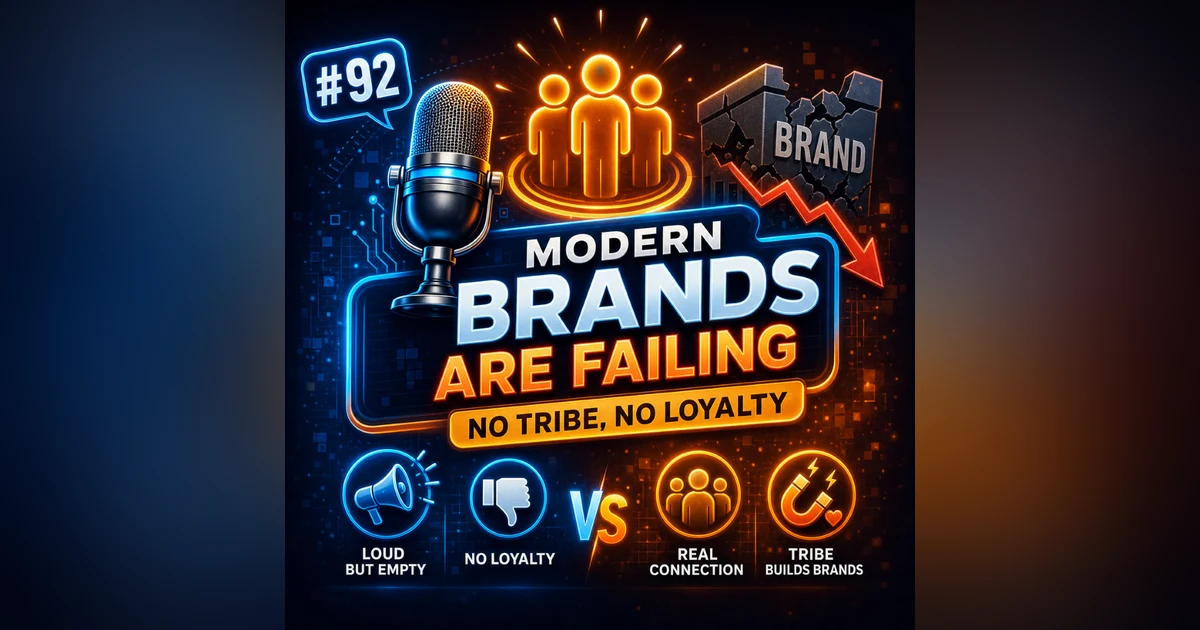


Copycats can replicate your product overnight. Ad costs are through the roof. And consumer trust in corporations is at an all-time low. So what's the one competitive moat that can't be copied, can't be bought, and gets stronger the longer you build it? In this episode of the Smart Entrepreneur Show, we break down why community is the new competitive advantage — and exactly how to build one that turns casual buyers into superfans who do your marketing for you.
From the iOS privacy collapse that broke the paid ads arbitrage, to Duolingo's zero-budget global event empire, to how Notion accidentally built a six-figure creator economy on top of their product — this is the practical blueprint for the community-led growth model.
In this episode you'll learn:
- The ad fatigue epidemic: why the megaphone model is structurally broken — not just psychologically annoying
- How Apple's iOS tracking transparency wiped out the Facebook ads arbitrage overnight — and what it means for your CAC
- Transactional loyalty vs. identity-based belonging: why a punch card customer leaves for a free pastry, but a Harley rider won't touch a Honda
- Why the switching cost of a community is social, not financial — and how that rewires churn entirely
- The Tom Sawyer fence principle: how community members happily do your selling, support, and marketing for free — and love doing it
- The flywheel effect: how super fans self-police your brand reputation better than any PR agency
- How Duolingo built a global event footprint across thousands of cities with virtually zero event management budget
- How Notion seeded a creator economy that turned power users into their marketing department — for free
- How Figma gave designers a stage and watched their community become their most powerful distribution channel
- The diagnostic question to ask yourself: if your company disappeared tomorrow, would your customers miss each other?
Contact & Resources
Listen to this episode on Podbean: smartentrepreneur.podbean.com
Explore more podcasts: Find all podcasts at the PodFather Network
Website: RoyCoughlan.com
Need help running your business? If you are looking for a Virtual Assistant and get reliable support for your daily operations.
Virtual Assistants: VA.world
Communities: BrainGym.fitness
Learn about a Private Networking Group in 50 US States & 40+ Countries with 650+ Members: connectedleaders.academy
#SmartEntrepreneurShow #CommunityMarketing #TribeBuilding #BrandCommunity #CommunityLedGrowth #CustomerRetention #SuperFans #IdentityMarketing #FlywheelEffect #BrandLoyalty #Duolingo #Notion #Figma #CommunityBuilding #DigitalMarketing #AdFatigue #iOSPrivacy #CustomerAcquisition #ContentCreator #CreatorEconomy #AudienceBuilding #WordOfMouth #OrganicGrowth #Entrepreneur #BusinessStrategy #RoyCoughlan #PodFatherNetwork #VAWorld #VirtualAssistant #SmartEntrepreneur
#92 Why Modern Brands are Failing Without a Tribe
Welcome to the Smart Entrepreneurs Show, the podcast where we share smart ideas, strategies, and lessons to help entrepreneurs build better businesses. In the past, if you wanted to beat your competitors, you just needed a better product, a lower price, or a massive advertising budget. But today, the game has completely changed.
Copycats can replicate your product overnight, and ad costs are through the roof. So, what is the ultimate moat for a modern brand? Today, we are breaking down a powerful shift in the business world. Why community is the new competitive advantage.
We'll talk about how building a tribe around your brand can turn casual buyers into superfans who will do your marketing for you. If you are a creator, business owner, or marketer, this episode is your unfair advantage. Let's dive in.
Yeah, thanks for having me. We are doing a deep dive into the source material today to really unpack the mechanics behind this whole paradigm shift. Right.
Because if you're building a brand or scaling a business right now, I mean, we want to give you a practical toolkit. This isn't just about slapping a forum on your website. Yeah, we're chasing likes on Twitter.
Exactly. We're talking about fundamentally restructuring your growth engine because, frankly, the old playbook is completely broken. Okay, let's unpack this.
Because the sources point to this overarching issue, they call it the ad fatigue epidemic. But looking closer at the notes, it's not just that consumers are tired of ads. There is this massive structural fracture in digital marketing.
I love this analogy. Traditional digital marketing is basically like shouting with a megaphone in a stadium where everyone else also has a megaphone. Eventually, the consumer just puts on noise-canceling headphones.
They have to. You're spot on. It is a structural shift, which is where the real panic in the market is coming from right now.
It's not just a psychological thing. When Apple rolled out app tracking transparency- Oh, well, the iOS update. Exactly.
The iOS privacy changes. They essentially made the IDFA, the identifier for advertisers. They made it opt-in.
So overnight, platforms lost the signal they relied on to serve those hyper-targeted ads. Which is wild because for years, the arbitrage was so simple, right? So simple. You pour money into Facebook, acquire a customer for less than they spend, and just pocket the difference.
Right. Because before that update, an algorithm could reliably predict that a specific user was like 90% likely to buy a highly specific type of running shoe on a Tuesday. Right.
They knew everything. But when that data signal went dark, the algorithms had to start guessing. And when algorithms guess well, your customer acquisition costs skyrocket.
Which means the math just completely stops working for the average business. Yep. If you're a direct-to-consumer brand, and maybe it used to cost you $15 to acquire a customer who buys a $30 product, you had a solid business.
Sure. Now that same acquisition costs you $45. You're literally losing money on the first transaction.
And you're just praying they stick around for a second or third purchase. Right. Just to break even.
But they aren't sticking around. Because at the exact same time this tech shift happened, that psychological shift you mentioned peaked. The banner blindness.
Exactly. Consumers see thousands of ads a day. We develop total banner blindness.
We just tune out the noise. Human psychology has incredible defense mechanisms against that kind of sensory overload. I mean, when a faceless corporate entity just shouts its value prop at you while you're trying to watch a video, your brain just registers it as a nuisance.
It's annoying. It is. The trust deficit is at an all-time high right now.
People do not want to be sold to by corporations. They want to be guided by peers. They crave connection and belonging.
Which, let's be honest, traditional digital marketing is fundamentally incapable of providing. Totally. So if brute forcing your way to new customers through paid ads is both structurally compromised and psychologically rejected, you have to pivot.
You have to. You have to drastically increase the lifetime value of the attention you already have. You have to turn that single purchase customer into a lifelong advocate.
But so what does this all mean for the listener? Is a community just a glorified, rebranded customer loyalty punch card? What's fascinating here is that it's actually the exact opposite. A punch card is entirely transactional. Right.
Buy 10 coffees, get one free. Exactly. The relationship is purely financial.
If a competitor opens up across the street and offers the 11th coffee free, plus like a free pastry, that customer is gone. There's zero friction. Zero.
What the most resilient brands are building isn't transactional loyalty. It's identity based belonging. OK, let's explore that distinction, because that seems to be the core of this entire strategy.
It is. An identity based community means the switching cost goes from being financial to being social. Yes.
Like if I switch from a generic coffee shop to another, I lose a piece of cardboard. But if I ride a Harley Davidson and I decide to sell it and buy a Honda. You're losing a lot more than a bike.
Right. I'm potentially ostracizing myself from my weekend riding club. I'm taking off the leather jacket.
I'm abandoning a tribe. And that is the ultimate retention engine. The math alone proves it costs like five times more to acquire a new customer than to retain an existing one.
Wow. Five times. Yeah.
So when someone buys a Harley or look at Gymshark, when someone exclusively wears Gymshark to the gym, they are signaling to the world who they are. It's a status thing. Exactly.
The brand becomes a proxy for their own identity. If a consumer adopts your brand as a core part of their self-image, leaving your brand feels like abandoning a piece of themselves. Which completely rewires how we think about churn.
You aren't fighting a competitor's feature set anymore. No, you're anchored to fundamental human biology. We are hardwired for tribal belonging.
So if leaving a software platform means losing the network of peers you collaborate with, you'll tolerate a price increase. You'll tolerate a few bugs, too. Right.
Here's where it gets really interesting. I was thinking about this dynamic and it reminds me of the classic Tom Sawyer story. Oh, right.
With the fence. Yeah. He's tasked with whitewashing this fence, which is awful, tedious labor.
But he convinces his friends that painting the fence is this exclusive privilege. Suddenly they're paying him in apples and marbles just for the chance to do his chores. But applying this to modern business, it isn't a trick.
The customers actually want to paint the fence because they live in the neighborhood. They take pride in it. Because the fence is their home, too.
In a traditional business model, the company does all the heavy lifting, right? Yeah. You hire sales reps. You fund the support team.
You run the PR campaigns. Exactly. You push the boulder up the hill and the second you stop funding it, the boulder rolls backward.
But in a community-led model, your members take over those functions. They become the engine. Yeah.
It creates what the sources call the flywheel effect. Yeah. The members do the selling.
They become a self-sustaining ecosystem. But wait, isn't there a massive risk in handing over the keys to the brand? Like if you let the community paint the fence, what happens if they decide to paint it neon green? That's the classic fear. Because handing your PR over to a subreddit sounds like a nightmare.
If they get mad at an update, they could turn on you overnight. Well, that fear of losing control is exactly why most legacy brands fail at this. But you have to realize in the modern internet era, you already lost control of your brand.
That's a good point. People are going to talk about your product on Reddit and TikTok, whether you build a community for them or not. The difference is when you actively facilitate the space, you foster super fans who will actually self-police.
The sources mentioned that specifically, the defense mechanism of a community. Yeah. Because if a faceless corporation gets criticized online and issues a sterile PR response, it looks so defensive.
It looks fake. But if someone critiques a brand and 50 passionate super fans immediately jump in to share personal success stories and defend the product that doesn't look like PR, it looks like a movement. The community absorbs the shock and they do it for free because attacking the brand feels like an attack on their tribe.
But, you know, the flywheel goes far beyond just crisis management. Look at customer support. Which is usually a massive cost center.
Huge. But in a vibrant community, members just jump in to answer each other's questions. Because they want the status.
Like if I figure out a complex workaround in a piece of software and I share it in the forum, I get upvoted. Exactly. I get recognized as an expert.
The company gets a free support interaction that might have taken a paid agent an hour to resolve. But I get the dopamine hit of gaining social capital. It's a symbiotic exchange.
And it creates a virtuous cycle. The brand might give those top users a special badge or invite them to an advisory board. Which just binds them even tighter to the company.
Right. You are effectively outsourcing your onboarding, your support, and your marketing to the people who use your product the most. OK.
So the psychology is sound. The mechanics make total sense. But for the person listening who is actually trying to build this, we need to look at the practical application.
Sure. How do you actually construct this infrastructure? The source material highlights Duolingo, which I think is a brilliant case study. Because language learning is usually such an isolated task.
You're just staring at your phone. But they turned it into this global community. Well, Duolingo recognized that learning a language isn't just an academic exercise.
The ultimate goal is human connection. Right. You want to actually speak to people.
Yeah. So they built a massive community of learners who independently host their own local meetups all over the world. We are talking about thousands of events.
People meeting in cafes in Tokyo or parks in Berlin just to practice speaking together. And here is the mind-blowing part for any marketer listening. Duolingo achieves this massive global event footprint with virtually zero event management budget.
Zero. They aren't renting out hotel ballrooms. They aren't paying for catering.
The community handles all of it. If I'm a creator or a business owner listening right now, I don't have Figma's budget. But the beautiful thing here is that Notion and Duolingo didn't build the tutorials or events themselves.
Right. They just provided the playground. This raises an important question because you're exactly right.
What Duolingo did was build the infrastructure. They created a global ambassadors program that didn't just tell people to go meet up. They created a platform where passionate users could apply to become official hosts.
They gave them a digital playbook and a centralized platform for RSVPs. So they basically gave them the digital Legos, but the users built the castle. Exactly.
And by making the host position something you had to apply for, they introduced that status element we talked about. Becoming a Duolingo event host was a credential. It was something to be proud of.
So people happily did the heavy lifting of finding a local cafe. And every single one of those meetups serves as a localized zero cost marketing channel. And it scales infinitely because the marginal cost of the company is practically zero.
That's incredible. And, you know, this framework isn't just limited to consumer apps. If we pivot to the B2B software space, which is notorious for being pretty cold and utility driven, we see the exact same dynamics.
The sources point specifically to Notion and Figma. Oh, both of those tools absolutely exploded. And they didn't do it by deploying armies of enterprise sales reps in suits.
No, they did it by weaponizing their user base. But Notion is basically a blank slate. It's a very complex tool.
If you just drop a new user into a blank Notion workspace, they're going to get overwhelmed and cancel their subscription in 10 minutes. The learning curve is steep. If Notion had tried to rely solely on their internal team to create every possible tutorial or every niche template, like from a law firm CRM to a college student's exam planner, they would have burned through millions of dollars.
And moved way too slowly. Exactly. So instead, they seeded a creator economy.
They opened up their platform and essentially told their power users, if you build something incredible here, you can share it. And users didn't just share them. They started selling them.
People built entire six-figure businesses just creating and selling Notion templates. Which perfectly aligns the incentives. Notion provided the blank canvas.
The creators, driven by the financial upside and the status, spent hundreds of hours building these intricate templates. Right. Then to sell those templates, the creators made viral YouTube videos and TikToks demonstrating how to use them.
They literally became Notion's marketing department. Because if I'm a creator selling a template, I have to convince my audience to sign up for Notion first. Yep.
So the creators bring in net new users. They train them via their templates and ensure the user is successful. Notion acquired a deeply engaged customer without paying a cent for acquisition or onboarding.
And Figma did something very similar for designers. They built the Figma community hub. Before Figma, if a designer created a brilliant new workflow, it just sat on their hard drive.
No one saw it. Right. But Figma gave them a stage.
Suddenly, a designer in Seattle could publish a wireframe kit and watch as thousands of designers around the world downloaded it. It all circles back to status and belonging. You are taking natural human desires, the drive to create, the need for recognition, the urge to help others, and weaving them into the architecture of your product.
You're facilitating a network. And what's crucial to understand here is the role of the brand. Your job as a founder isn't to dictate every interaction.
You're a facilitator, not a dictator. Right. You build the playground, ensure the equipment is safe, establish the rules, and then you get out of the way.
Trust the community to lead. But building that playground is hard work. It takes patience.
I mean, you can buy a thousand clicks on Google by this afternoon, but you cannot buy a thriving community. No, you can't. It takes time to foster that core group.
But once that flywheel starts spinning, it creates a moat that is nearly impossible to breach. And let's really contextualize that moat. If a copycat company launches tomorrow with the exact same feature set or the exact same fabric for your apparel line, and they undercut your price by 20 percent.
They might win a few transactional customers. Sure, but they cannot copy a vibrant, interconnected web of thousands of human relationships. They can't instantly replicate hundreds of YouTube tutorials created by your fans or the local meetups or the Discord server where people have made genuine friends.
The product can be cloned, but the network cannot. That is the ultimate unfair advantage. Exactly.
So if we synthesize the core value from this entire shift, it comes down to accepting that the era of cheap brute force customer acquisition is over. It's done. The tech has changed.
Consumer patience has evaporated. Shifting your focus to cultivating deep identity-based belonging isn't just a tactic anymore. It's a requirement for survival.
By creating the infrastructure for connection, you transform your customers from an acquisition cost into your most powerful engine for growth. The mechanics are completely clear. We've moved from a linear transactional model to a self-sustaining flywheel.
100 percent. So I want to leave you with this final thought to really test where your business stands today. Think about your own business or brand.
If your company disappeared tomorrow, people might miss your product for a day. But would they miss the relationships they built with each other through your brand? Because if the answer is no, you don't have a community yet. You just have an audience.
That is the perfect way to look at it. If you enjoyed this episode of The Smart Entrepreneur Show, make sure to follow the podcast so you don't miss future episodes. And feel free to share your thoughts or experiences in the comments.

PodFather
I am a serial entrepreneur who has founded 21 companies across 6 countries. Known in the industry as “The PodFather,” I am a business podcast coach and host who has launched eight successful podcasts—6 ranking in the Top 5%, with four reaching the coveted Top 0.5% globally.
Beyond podcasting, I co-founded brainupgrade.org a platform designed to boost cognitive performance and unlock peak mental potential. I am also the co-founder of VA.World, connecting businesses with exceptional Virtual Assistants tailored to their unique needs.
I also have Sponsorship ads available that are Dynamically inserted into my 8 shows