#88 Digital Ethics and Responsible Entrepreneurship in the Modern World
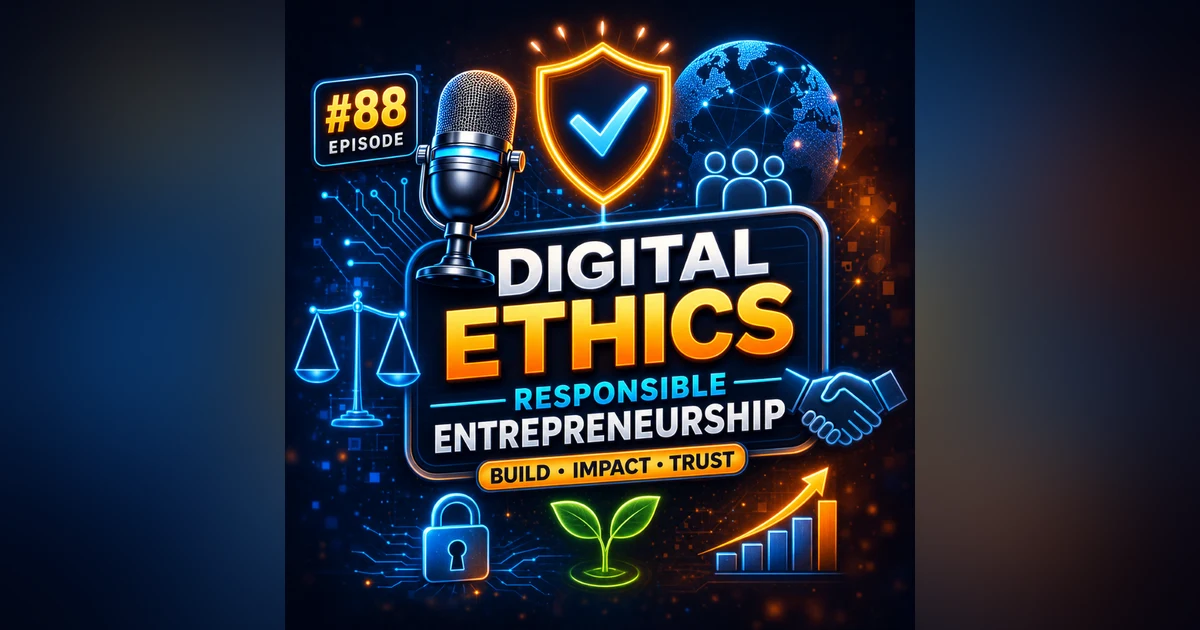


What if you made a million dollars in a single weekend — and then woke up on Tuesday to find your payment processors frozen, your ad accounts banned, and your refund queue overflowing? In this episode of the Smart Entrepreneur Show, we break down the invisible math of digital ethics: why doing the right thing online isn't just morally correct — it's the most financially sound growth strategy available to entrepreneurs today.
From the algorithmic death spiral triggered by a fake countdown timer, to why privacy has become a conversion tool, to why ethical businesses compound momentum while unethical ones run on an ever-accelerating treadmill — this episode makes the business case for integrity with hard numbers and cold logic.
In this episode you'll learn:
- Why trust is your business's battery — and how deceptive practices drain it invisibly until the business suddenly dies
- The chain reaction from a fake countdown timer: chargebacks → frozen funds → algorithm penalties → skyrocketing ad costs
- Why honest urgency ("I only take 20 clients a month") converts just as well as fake scarcity — without the downstream destruction
- How customer data is like a spare house key — and what "installing hidden cameras" actually looks like in a modern marketing stack
- Why Apple's iOS privacy updates wiped out ad accounts built on third-party data — and why zero-party data is the only reliable foundation left
- How putting your plain-English data policy front and centre actually increases opt-in rates by charging the trust battery
- The physics of ethical vs. unethical business: friction vs. momentum, treadmills vs. orchards
- Why ethical businesses become insulated from rising ad costs — because word of mouth does the heavy lifting
- The closing challenge: if a browser extension existed tomorrow that exposed every deceptive tactic you've ever used, how would your business survive the transparency test?
Contact & Resources
Listen to this episode on Podbean: smartentrepreneur.podbean.com
Explore more podcasts: Find all podcasts at the PodFather Network
Website: RoyCoughlan.com
Need help running your business? If you are looking for a Virtual Assistant and get reliable support for your daily operations.
Virtual Assistants: VA.world
Communities: BrainGym.fitness
Learn about a Private Networking Group in 50 US States & 39 Countries with 640+ Members: connectedleaders.academy
#SmartEntrepreneurShow #DigitalEthics #ResponsibleEntrepreneurship #EthicalMarketing #BusinessIntegrity #CustomerTrust #DataPrivacy #ZeroPartyData #OnlineBusiness #TransparentMarketing #TrustInBusiness #DigitalMarketing #CustomerLTV #ChargebackPrevention #EthicalBusiness #BrandTrust #MarketingStrategy #DataEthics #PrivacyFirst #WordOfMouth #OrganicGrowth #LongGameBusiness #Entrepreneur #BusinessGrowth #RoyCoughlan #PodFatherNetwork #VAWorld #VirtualAssistant #SmartEntrepreneur
#88 Digital Ethics and Responsible Entrepreneurship in the Modern World
Welcome to the Smart Entrepreneur Show, the podcast where we share smart ideas, strategies, and lessons to help entrepreneurs build better businesses. Thanks for having me. I'm really excited to dig into this today.
Yeah, we've got a fantastic deep dive for you today. So I want you to imagine something. Imagine making like a million dollars in a single weekend.
It's a dream, right? Right, it's the absolute dream. But then you wake up on Tuesday and you realize that you've permanently blacklisted your brand from ever making a single cent again. Oh wow, yeah, the nightmare scenario.
Exactly, you have the cash in hand, sure, but your payment processors have completely frozen your accounts, your ad platforms have banned your domain, and your refund requests are just stacking up way faster than you can even process them. It happens so much more often than people think. It really does.
So today, for this deep dive, we are looking at the invisible math of digital ethics. Our mission today is to figure out what digital ethics actually means when you are operating an online business. Right, and it's not just about being a good person.
Exactly. We want to show you why focusing on it isn't just some feel-good corporate initiative. It is the ultimate mathematical moat.
Absolutely. And it's really the most aggressive tool for value creation in a market that just feels more crowded every single day. Yeah, and we really have to look at the environment we're operating in right now to understand why that moat is so critical for you.
Right. What does that environment actually look like for the entrepreneur today? Well, I mean, we live in an era of absolute information overload. It's unprecedented, your customers are bombarded with literally thousands of marketing messages every single day.
More easily, every time they open their phone. Exactly, and because of that, their skepticism is at an all-time high. People just don't believe what they read online anymore.
Which makes sense, honestly. It does. So in this kind of environment, digital ethics isn't just a moral compass.
It's not just a nice-to-have. It is a foundational business strategy. A survival strategy, really.
Exactly, and by the end of this deep dive, you are going to understand how to apply these practical ideas to build better, far more resilient businesses. Businesses that can actually last. Right.
Businesses that can actually weaponize transparency to lower customer acquisition costs and just completely outlast the competition. Okay, let's unpack this. Because before we can start applying any of these practical tools, we really have to define the mechanics of what we are working with here.
We need to lay the groundwork. Right. So the core argument here seems to be that trust is vastly more valuable than a quick profit.
100%. So I wanna float a concept here. Is trust essentially like a business's battery life? Ooh, I like that, a battery.
Yeah, hear me out. So quick unethical profits, like tricking someone into a purchase, they might give you a temporary surge of power. Right, you get that quick hit of cash.
Exactly, but they permanently damage the internal chemistry of that battery. Oh, that's a great way to put it. And over time, it holds less and less charge until it's just totally dead.
Whereas ethical practices, they slowly and consistently charge it for the long haul. Does that make sense? Yeah, I mean, the battery analogy holds up perfectly. When you look at the economics of an online business, it's spot on.
Why do so many smart founders fall for it then? Well, the reason entrepreneurs fall for the quick charge is because the surge of revenue is immediately visible on a dashboard. You know. Right, you literally see the strike notifications popping up on your phone.
Exactly, it's a dopamine hit. But the internal damage to the battery is completely invisible until the business just suddenly dies out of nowhere. Wow, invisible damage.
Yeah, and if we connect this to the bigger picture, we have to stop looking at trust as an abstract feeling. Right, it's not just a brand vibe. No, not at all.
We have to start looking at it as the actual literal currency of the online economy. Trust is the mechanism that converts attention into dollars. So it's basically the conversion rate multiplier.
Exactly. Let's look at the math of why that battery gets damaged. When a business makes a quick profit from a deceptive practice, they're optimizing entirely for a single day one transaction.
They just want that first sale, whatever it takes. Right, but the math of survival in modern online business relies on customer lifetime value. You cannot survive on one-off sales anymore.
Right, we all know LTV is the holy grail. You want that customer buying your backend offers, right? Yes. Or staying in your membership month after month, or purchasing your annual software upgrades.
Right, and if you use a misleading tactic to get that initial sale, you might win the transaction today. Sure, you get the 50 bucks. But you permanently suffocate that LTV.
Because they never come back. Exactly. The customer feels burned, they churn immediately, and worse, they become an active detractor.
They tell their friends not to buy from you. Right, they're leaving bad reviews. Yep, you've drained the battery.
But on the flip side, an ethical approach focuses on solving a genuine problem, honestly. Setting the right expectation. Exactly.
When you do that, the trust you build reduces your second purchase customer acquisition cost to basically near zero. Oh, that's huge. It is.
You don't have to pay Meta or Google to acquire that customer for their second, third, or fourth purchase. Because they're already on your list and they actually like you. Right, that zero cost retention is what actually funds your business growth over time.
Okay, so if trust is the battery and LTV is the ultimate payoff, we need to look at how businesses are actively draining or charging that battery in plain sight. Yes, on the front lines. Right, and the fastest way they do this is through their marketing and their content.
That's the storefront. It's what everyone sees first. Exactly.
So the focus is heavily on absolute honesty in marketing. Avoiding scams, misleading ads, and fake promises. Right.
But wait, let's be real for a second. Let me push back on this because I wanna advocate for the entrepreneur who is in the trenches right now. Sure, let's hear it.
If I put a fake 10-minute countdown timer on my checkout page today, my conversion rate will absolutely spike. It will. It definitely will.
And I have payroll to meet on Friday. My ad costs are through the roof. The pressure is real.
It is. So how do you argue against the immediate, verifiable math of survival? I mean, why shouldn't I use a little exaggeration or a fake timer just to get over the hump? Isn't that just good marketing? This raises an important question about how we define value and survival. And look, I completely understand the pressure of payroll and rising ad costs.
I've been there. Right, it's terrifying. It is.
But let's look at the mechanical chain reaction of what happens after you get that spike in conversions from a fake timer. Okay, let's play it out. You get the cash today, yes.
But tomorrow, the customer realizes the timer was fake. They go back to the page and it says 10 minutes again. Oh, right.
They realize they got played. Exactly. They experience buyer's remorse because they were manipulated into an impulse buy.
So what do they do? They issue a chargeback. Oh man. And payment processors do not mess around with chargebacks.
They really don't. If your chargeback rate hits just 1% on Stripe or PayPal, they will freeze your funds. 1% is so low.
It is. And suddenly, that cash you needed for Friday's payroll is locked up for 90 days. Wow.
So the timer actually costs you your payroll. Exactly. But it gets worse.
Your ad platforms, they monitor user experience very closely. Like Facebook and Google. Yes.
If a user clicks your ad, buys the product, and then immediately complains or bounces or requests a refund, the algorithm flags your domain as a poor user experience. Because they want to keep users happy on their own platforms. Right.
They don't want their users getting scammed. So your ad costs don't just stay high, they multiply. Your CPMs just absolutely skyrocket.
Oh, so you're actively being penalized. Yes. You are triggering an algorithmic death spiral.
The short-term cash you gain from the fake timer directly causes a long-term catastrophic failure of your infrastructure. So the line between a catchy hook and a fake promise isn't just some moral boundary, it's a technical one. That's exactly it.
It's built into the code. Honest marketing sets accurate expectations, which prevents the chargebacks and keeps the algorithms happy. Exactly.
Honest marketing makes a promise the product can actually fulfill. Can you give an example of how to do urgency ethically then? Sure. Let's take your scarcity example.
Fake scarcity relies on anxiety and deception. But a transparent value proposition uses real scarcity, which relies on the actual value of your time and resources. What does that sound like in practice? It sounds like saying, I only have bandwidth for 20 clients this month to ensure quality.
Ah, okay. You still get the urgency, you still get the conversion spike, but the expectation completely matches the reality. Because you actually will stop taking clients at 20.
Right. The customer is satisfied, the payment processor is happy, the ad algorithm rewards you with cheaper traffic, and your battery is fully charged. That makes perfect sense when you break down the downstream consequences like that.
The fake timer isn't a life raft, it's an anchor. A very heavy anchor. Yeah.
But, you know, marketing is just the storefront, is what the customer actually sees when they walk by. Right. It's the surface level.
Right. If we want a comprehensive understanding of digital ethics, we have to look at the invisible architecture. We have to look at what businesses do when the customer is completely unaware.
And this is where a lot of companies mess up. Yeah. Here's where it gets really interesting, because the rules surrounding data, artificial intelligence, and customer tracking, they just feel incredibly murky right now.
It is the Wild West for a lot of businesses right now. Nobody really knows where the lines are. Right.
And collecting customer data, to me it feels a lot like a neighbor giving you the spare keys to their house before they go on vacation. Okay, I like this. Yeah, so think about it.
You can use those keys ethically, right? You water their plants, you bring in the mail, you make sure the house is secure. You're being a good neighbor. Exactly.
You're personalizing their experience and providing value based on the access they granted you. Right. Or you can use those keys unethically.
It's like taking those keys, going inside and installing hidden cameras to see what brand of cereal they eat. Oh man. Right.
Reading their diary to find out their deepest insecurities and then selling that information to a grocery store or like the therapist. That's what exploiting data and AI feels like today. The evolution of that analogy is spot on.
It really is. Because it highlights the technological reality of what actually happens behind the scenes. It's creepy.
It is incredibly creepy. So let's anchor this in practical application for you. The ethical use of AI and data requires treating customer information as a loaned asset that demands respect.
A loaned asset. I like that. Not something you own forever.
Exactly. Not as infinite property you can just mine forever. When a customer gives you their email address for a receipt, that is the key to water the plants.
That's all it is. But what does installing the hidden cameras look like in an actual marketing stack? Because most founders, they aren't thinking I'm going to spy on my customers. They just want better targeting.
That's true. The intention is usually just to increase conversions. But installing the hidden cameras looks like taking that receipt email and feeding it into an AI enrichment tool that scrapes the entire internet.
Oh, wow. Yeah. It cross-references their social media profiles.
It identifies their income bracket. It tracks their browsing history across other sites. All from just an email address.
Just from an email. Yeah. And it builds a shadow profile to predict their psychological vulnerability.
That is terrifying. It is. And then you use that shadow profile to hit them with hyper-targeted ads for a high-ticket offer, right when the algorithm predicts they're most emotionally susceptible to an impulse buy.
Like late at night when they're doom scrolling. Exactly. It is extracting immense value without their consent.
And consumers are entirely aware of this now, right? It's why everyone jokes that their phone is listening to them when an ad pops up for a product they literally just mentioned at dinner. We've all had that happen. Yeah.
The creepiness factor is at an all-time high. It is. And here is the counterintuitive insight that completely shifts how we should approach this entire thing.
Because consumers are terrified of how their data is being used, privacy has transitioned from a legal compliance headache into a massive conversion tool. Wait, really? A conversion tool? Yes. Smart entrepreneurs look at the landscape and realize that solving a customer's anxiety about data actually increases opt-in rates.
Wait, explain the mechanism there. How does talking about privacy restrictions increase opt-ins? I know it sounds backward. Yeah, because doesn't adding friction to an opt-in form, like extra text to read, usually decrease conversion? You would think so, right.
But the data shows the exact opposite when it comes to zero-party data. What's zero-party data? It's data the customer intentionally and proactively shares with you. Not scraped, not bought, but willingly given.
Ah, okay. And as third-party tracking gets blocked by companies like Apple with their iOS updates. Which destroyed a lot of ad accounts.
Oh, completely wiped them out. But because of that, zero-party data is the only reliable information left. So if you put your data policy front and center, in plain English.
Not legal jargon. Right, no legal jargon. Yeah.
You just say, here is exactly what we track. Here is how we use it to customize your experience. We will never sell it.
And here is a one-click button to completely delete your profile. Oh, I'd feel so much better seeing that. Exactly.
The trust battery instantly charges. Consumers are so starved for transparency right now, that when a brand treats their digital home with respect, they willingly hand over more accurate, highly valuable data than you could ever scrape secretly. It's the difference between, like, stealing someone's diary and having them willingly sit down and tell you their life story because they actually trust you as a friend.
That's exactly it. The quality of the information is vastly superior. It is.
And as AI becomes integrated into every single CRM and marketing platform on the market, this ethical boundary is gonna be the defining characteristic of brands that survive. Because the AI needs good data to work. Right.
And if your business model relies on secretly exploiting data, you are building your skyscraper on a digital swamp. The ground is already shifting under them. Yes.
Privacy updates, international regulations, and massive consumer backlash will eventually just swaddle that model whole. Okay, we've covered a massive amount of ground here. We really have.
We've looked at the technical pitfalls of deceptive marketing, the algorithms that literally penalize fake scarcity. Yep. And we've looked at the hidden architecture of data tracking, and how transparency is actually a conversion asset.
A huge one. So I wanna pull all of these threads together now and look at the final outcome for the entrepreneur. So what does this all mean for the bottom line? Let's get into the numbers.
Yeah. Definitively settle the debate for us. Is running an ethically sound online business actually a measurable mathematical competitive advantage? Or is it just the nice thing to do while ruthless competitors just steal all the market share? What's fascinating here is that the data consistently proves the ruthless competitors are operating at a massive unsustainable disadvantage over a long enough timeline.
So they might win the sprint, but they lose the marathon. Exactly. It all comes down to the physics of business growth.
Friction versus momentum. Okay, break that down. Unethical practices.
So your fake hooks, your hidden subscriptions, your massive data scraping, they introduce immense friction into your business model. You are constantly burning bridges with your customers. And when you burn a bridge, your customer acquisition costs absolutely skyrockets.
Because you can't rely on repeat buyers. Exactly. Yeah.
You have to replace every single burned customer with a brand new one. You are paying peak market rates for cold traffic on a treadmill that just keeps speeding up every single day. Because nobody is coming back.
Right. Nobody is leaving a five-star review. And nobody is telling their network to buy your product.
You have absolutely zero organic lift. Zero, wow. It requires endless exhausting capital to maintain that.
Yeah. But responsible, ethical businesses, they enjoy compounding momentum on the trust they've built. The fully charged battery.
Yes. When you deliver on your promises and you actively respect a customer's data, they don't just return, they become evangelists for your brand. They tell it for you.
Exactly. Your retention rates skyrocket, which means your lifetime value goes way up. Your acquisition costs drop because word of mouth is doing the heavy lifting for you.
It's basically free marketing. It is. You become insulated against rising ad costs and those crazy algorithm changes because you own a direct, trusted relationship with your audience.
Verifiable digital ethics is literally the most financially sound growth strategy available today. Man. It's the difference between hunting for every single meal from scratch every day.
Right. And just planting an orchard that feeds you year after year without you having to stress over it. That's exactly the goal.
The trust battery is fully charged and it's powering a self-sustaining machine. We've really flipped the script today on what ethics means in business. I think we have.
It's not just a mission statement you put on your website. It's the structural integrity of your revenue. Yep.
We saw how deceptive marketing doesn't just make people mad. It triggers payment freezes and algorithmic penalties that can ruin your business. Literally overnight.
Right. We learned that treating data like a loaned set of house keys rather than installing hidden cameras actually yields higher quality data from customers who appreciate the transparency. They want to trust you.
They really do. And ultimately we established that playing the long game with verifiable ethics lowers your acquisition costs and builds just an unshakable financial moat. It is a complete paradigm shift for most founders.
Yeah. And to leave you with something to really analyze within your own business after this deep dive is over. Yeah.
What should they be thinking about? Consider the trajectory of the internet right now. What if the next major disruption in online business isn't a new AI model or a new social platform? Yeah. What if it's a radical shift toward absolute verifiable transparency? What do you mean by that? Well, imagine if consumers suddenly had a browser extension that instantly exposed every deceptive marketing tactic a brand used.
Oh, wow. Or it showed their inflated price history or every hidden data grab that company executed. If that technology existed tomorrow, how would your favorite businesses or your own business survive that exposure? That is a terrifying and brilliant question.
It really forces you to look at your own infrastructure. It does. Are you building on a swamp of quick tricks and hidden tracking or are you pouring the invisible unshakable concrete of genuine trust? Because the market will find out eventually.
Because eventually, yeah, the market is going to test that foundation. If you enjoyed this episode of the Smart Entrepreneur Show, make sure to follow the podcast so you don't miss future episodes and feel free to share your thoughts or experiences in the comments.

PodFather
I am a serial entrepreneur who has founded 21 companies across 6 countries. Known in the industry as “The PodFather,” I am a business podcast coach and host who has launched eight successful podcasts—6 ranking in the Top 5%, with four reaching the coveted Top 0.5% globally.
Beyond podcasting, I co-founded brainupgrade.org a platform designed to boost cognitive performance and unlock peak mental potential. I am also the co-founder of VA.World, connecting businesses with exceptional Virtual Assistants tailored to their unique needs.
I also have Sponsorship ads available that are Dynamically inserted into my 8 shows