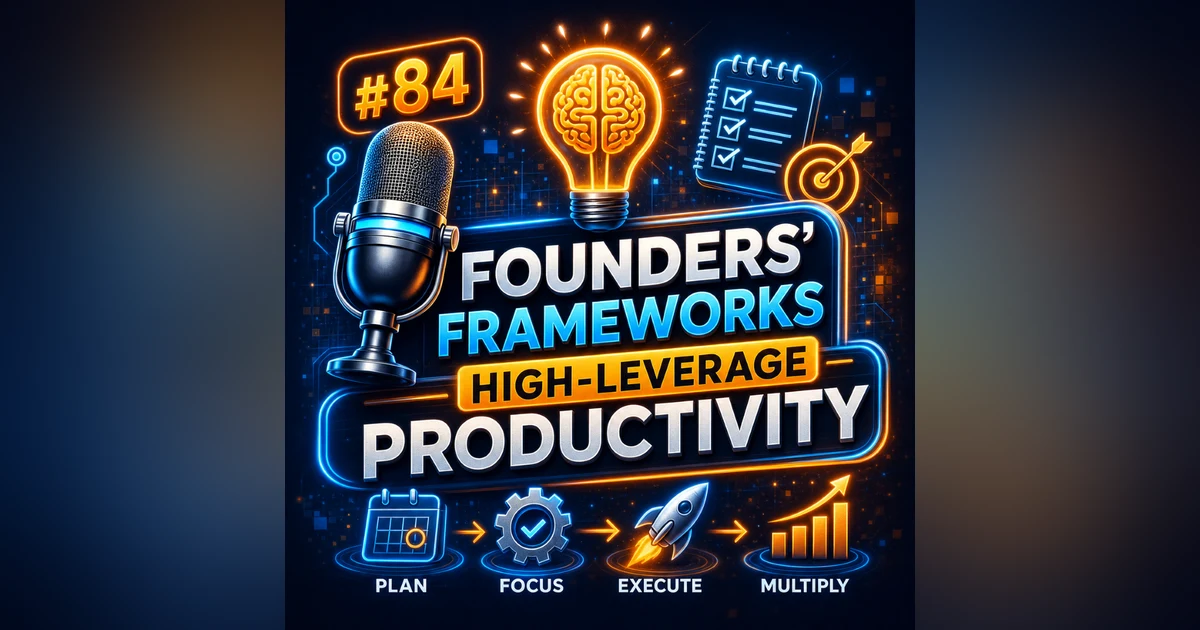
#84 Founders' Frameworks for High-Leverage Productivity


It's 7pm. You've answered 120 emails, put out a dozen fires, and survived another chaotic day — but the one project that would actually double your revenue never got touched. In this episode of the Smart Entrepreneur Show, we break down the operational architecture and psychology of focus that separates founders who scale from founders who stay trapped as the most stressed employee in their own company.
This isn't about productivity apps or 3am ice baths. It's about cognitive RAM, strategic neglect, and building systems that let your business run without you.
In this episode you'll learn:
- Completion bias: why your brain rewards busywork with dopamine regardless of whether it actually matters
- The critical difference between operational drag (maintenance) and forward propulsion (growth) — and how drag disguises itself as productivity
- Attention residue: why context-switching destroys your cognitive capacity like 40 open browser tabs
- Maker schedule vs. manager schedule — and why even one pure 90-minute deep work block can outperform a scattered day
- Asymmetric leverage: how to find the "lead domino" that eliminates 10 future problems at once
- Strategic neglect: why trying to achieve "inbox zero" across your whole business is a path to mediocrity
- How notifications exploit the same variable reward psychology as Vegas slot machines — and how to fight back with asynchronous communication by default
- The 80% rule of delegation: why buying back 50 hours a year is worth a 20% dip in task quality
- Why systems don't kill creativity — they protect it, by routinizing the predictable so you can focus on the unpredictable
- The diagnostic question to ask yourself: if you vanished for 30 days, where would your business break first?
Contact & Resources Listen to this episode on Podbean: smartentrepreneur.podbean.com Explore more podcasts: Find all podcasts at the PodFather Network Website: RoyCoughlan.com Need help running your business? If you are looking for a Virtual Assistant and get reliable support for your daily operations. Virtual Assistants: VA.world Communities: BrainGym.fitness Learn about a Private Networking Group in 50 US States & 39 Countries with 640+ Members: connectedleaders.academy
#SmartEntrepreneurShow #FounderProductivity #DeepWork #Delegation #BusinessSystems #EntrepreneurMindset #TimeManagement #CognitiveLoad #StrategicFocus #BusinessOwner #Leadership #ScalingABusiness #ProductivityTips #FounderLife #WorkSmarter #SOPs #AsynchronousWork #DigitalDistraction #BusinessGrowth #HighLeverage #SmallBusinessOwner #StartupLife #DecisionMaking #FocusStrategy #RoyCoughlan #PodFatherNetwork #VAWorld #VirtualAssistant #SmartEntrepreneur
#84 Trust in the AI Age 🤖 – How Smart Businesses Win Customer Confidence
Welcome to the Smart Entrepreneur Show, the podcast where we share smart ideas, strategies, and lessons to help entrepreneurs build better businesses. Glad to be here for this one because it's a topic that hits, uh, pretty close to home for anyone running a company. Oh, absolutely.
So I want you to picture this. It's 7.0 PM on a Thursday. You've been staring at your screen since like 8, 0 AM.
Oh yeah. We all know that feeling. Right.
And in that time, you've answered maybe 120 emails, you resolved this sudden supply chain hiccup, you mediated some dispute between two key hires, and you signed off on payroll. Just a standard Tuesday, really, or Thursday, I guess. Exactly.
And you are completely, totally drained. But as you close your laptop, you realize the one project that will actually double your revenue, uh, the new product strategy you've been meaning to map out for three weeks now, it hasn't even been touched. Not even a single glance.
It's the universal founder experience, honestly. It really is. So today we are doing a deep dive into a collection of source material titled Founders Frameworks for High Leverage Productivity.
And our mission here is to decode how the world's most effective founders escape that exact overwhelming scenario we just talked about. And right from the start, I think we need to draw a pretty hard line in the sand. This deep dive is not about finding, you know, a new app to sort your to-do list.
Yeah. Please no more apps. Right.
And it's certainly not about life hacks, like, uh, forcing yourself to wake up at 3am to take an ice bath. Thank goodness for that. I mean, the sources we are unpacking today, they deal with operational architecture, they deal with the actual psychology of focus.
We're looking at the underlying mechanisms that shift a founder from being, well, the most stressed employee in their own business to becoming the architect of its growth. I love that phrasing. And let's pull the thread on that psychology piece immediately, because the first major concept in the source material targets this delusion that I think almost all of us suffer from at some point.
The motion versus action trap. Yes. The conflation of motion and action.
The material breaks down the friction between just being busy and being truly productive. And it turns out our brains actually actively reward us for doing the wrong things. They absolutely do.
It's kind of a cruel trick of biology. The research points to a psychological phenomenon called completion bias. Completion bias.
Okay. What does that actually look like in practice? Well, our brains release a hit of dopamine every single time we check a box or finish a task. And here's the kicker.
That happens regardless of how important that task actually is. Oh, wow. So all tasks are created equal to the brain.
Exactly. When you spend your morning just clearing out your inbox or replying to basic customer queries on Slack, you feel this incredible momentum. Oh yeah.
You feel like a machine that's just crushing it. You feel like you're crushing it because you are in motion, but that motion is entirely reactive. You are really just maintaining the current baseline of your company.
True productivity, on the other hand, is proactive. It's tackling the ambiguous, complex tasks that actually propel the business forward, things like redesigning your pricing model or recruiting a top tier executive. And the problem is those high leverage tasks are usually incredibly messy.
Very messy. There's no clear checklist for redesigning a pricing model. So you don't get that immediate dopamine hit.
You just get like a headache. Yeah, a headache and a lot of self doubt. It makes me think of an airplane fighting drag.
You can run the engines all day long just to stay suspended in the air, you know, just burning fuel to maintain altitude. I like that analogy. But unless you physically angle the nose up and generate forward thrust, you aren't actually flying anywhere.
You're just hovering there until you run out of gas. That is exactly what completion bias does to a founder. You just hover.
But I want to push back on this a little bit on behalf of the listener, because here's the reality for the operator in the trenches right now. That baseline maintenance, the drag it day, still has to happen. I mean, if you just ignore your customer supports or you stop paying your vendors because it's quote unquote not high leverage, the business collapses.
Well, yeah. And that is the perpetual tension of entrepreneurship. But the framework doesn't suggest that operational maintenance is irrelevant.
You can't just stop paying people. Right. That would be bad.
Very bad. The failure point happens when founders allow that maintenance to masquerade as growth. Masquerade as growth.
Interesting. Because those baseline tasks are so easy to define and they offer those quick dopamine hits we talked about, founders unconsciously use them to procrastinate on the hard, ambiguous work. Oh, I've absolutely done that.
You sit down to map out a five-year vision, you feel that spike of cognitive friction, and immediately you're like, well, I better go clear out my Slack messages. Exactly. Because answering Slack feels like working, but it's a trap.
The shift happens when you mentally separate your tasks into two very distinct buckets, operational drag and forward propulsion. Drag and propulsion. You have to handle the drag, yes, but you cannot allow it to consume the cognitive bandwidth that's required for the propulsion work.
Okay, so if the baseline maintenance is constantly threatening to eat all our cognitive bandwidth, how do we actually isolate time for that propulsion work? Right. The source material leans pretty heavily into time blocking and deep work here, but it frames it much differently than the standard advice of, you know, just put it on your calendar. Yeah.
A lot of people think time blocking is just color coding your Google calendar, but the mechanical difference in these frameworks lies in understanding a concept known as attention residue. Attention residue. Okay, bring that down for us.
So the sources dive into how the human brain handles task transitions. When you switch your focus from, say, a complex strategy session to a really quick operational question from your team. Like a got a minute kind of question.
Exactly, the got a minute interruptions. When you answer that and then try to pivot back to your strategy, your brain doesn't just cleanly snap back to the strategy. A residue of your attention is still stuck on that operational question.
Ah, okay. It's almost like computer RAM. Yes, precisely.
If you leave 40 browser tabs open, the whole processor slows down to a crawl because it's constantly allocating resources to things you aren't even looking at right now, you're just bleeding processing power. That is a perfect way to visualize it. Every single time you switch contexts, you open a new tab in your brain.
And it just stays open. It stays open. So by 2.00 p.m., a founder who operates in a highly reactive state has so much attention residue built up that their cognitive capacity is effectively bankrupted.
Wow, bankrupted. They literally couldn't do high leverage deep thinking if they tried. Their RAM is full.
So how does time blocking fix the RAM issue? Well, time blocking in this framework, at least, isn't just about scheduling an hour for a task. It is about creating these heavily fortified silos where context switching is physically impossible. Fortified silos.
Right. You aren't just blocking 90 minutes for strategy. You are aggressively closing all the other tabs to allow your cognitive RAM to fully deploy on a single massive problem.
Okay, I totally understand the theory there. But let's pressure test this against a chaotic reality for a second. Let's do it.
Say you are listening to this and you run a boutique PR agency or maybe a logistics firm. Your entire value proposition to your clients is your rapid response to crises. Right.
You're in the business of putting out fires. Exactly. So if you vanish into a fortified silo for four straight hours, a client might literally walk away.
How does a highly available founder utilize deep work without burning their own house down? It's a great question and it requires adapting the architecture. The sources address this by distinguishing between what they call a maker schedule and a manager's schedule. Okay, what's the difference? If your role fundamentally requires high availability, that's the manager's schedule.
You cannot realistically block out four hour deep work sessions. It's just not going to happen. Yeah, that would be professional suicide for some folks.
But you can ruthlessly protect much smaller, denser pockets of time. The research indicates that even a single unbroken 90 minute block of deep work can yield exponential returns. Just 90 minutes.
Just 90 minutes. But it has to be pure. Often founders will position this early in the morning before the crisis cycle even begins, or maybe late in the evening.
Oh, that makes sense. You get in before the noise starts. Right.
It's about the intensity and the purity of the focus, not just the duration. You construct your day so that you play strict defense for one 90 minute block and then you willingly play offense with the chaos for the remainder of the day. I see.
So you're not denying the chaos. You're just walling off a tiny section from it. But, you know, guarding that 90 minutes doesn't mean anything if you deploy it on the wrong problem.
Oh, absolutely. You can have the purest, most intense focus in the world. But if you spend it focusing on a low leverage issue, you've completely wasted that silo.
And this is where we have to look at the prioritization frameworks that top operators use to filter all that noise. Because everything feels important. Exactly.
The core dilemma for a founder isn't usually a lack of options. It's an infinite menu of seemingly vital things to do. The source material highlights tools designed to ruthlessly separate the genuinely urgent from the genuinely important.
Now, we often hear about the Eisenhower matrix for this, right? Where you plot things on that grid of urgency and importance. Is that what the material is pointing to here? It builds on that foundation, but it upgrades it for the entrepreneurial reality. How so? Well, the classic Eisenhower matrix can still leave you drowning in tasks that feel both urgent and important.
There's just too many of them. The more advanced operators use a filter based on what the sources call asymmetric leverage. Asymmetric leverage.
They look at a task and ask themselves, if I solve this specific problem today, does it permanently eliminate 10 other future problems? I love that. They aren't just categorizing tasks into boxes. They are actively hunting for dominoes.
Hunting for dominoes. You're looking for that one strike that knocks down a whole row of issues rather than running around picking up each issue individually. Exactly.
You find the lead domino. But let's be honest about the emotional reality of doing this. If you actually choose to focus on the big domino, it means you are actively consciously ignoring other things that are currently screaming for your attention.
Yes, it is deeply uncomfortable. I mean, you've got an angry vendor. You've got a delayed shipment.
There's a broken link on the checkout page of the website. How do founders deal with the sheer anxiety of letting those things just sit there unresolved while they do deep work? They have to develop a really high tolerance for minor chaos. The sources actually call this strategic neglect.
Strategic neglect. It sounds terrifying. It is.
It is deeply uncomfortable to let a small fire burn. But the framework forces founders to objectively evaluate the actual cost of that neglect. OK, so playing out the worst case scenario.
Right. If you ignore the angry vendor for, say, 24 hours, what is the actual tangible worst case outcome? An uncomfortable phone call. A slight shipping delay.
The foundation of the business will probably survive. It will survive. But what is the consequence of neglecting your long term talent acquisition strategy for another month because you were busy putting out small fires? Well, then the business stagnates and eventually dies.
Exactly. Top founders train themselves to endure the psychological discomfort of unresolved minor issues. They understand that trying to achieve inbox zero across their entire business is a guaranteed path to mediocrity.
Wow. Trying to achieve inbox zero across your whole business is a path to mediocrity. That is a heavy, but I think vital concept.
You are basically choosing what to fail at today so you can win the year. That's a great way to put it. But executing that strategic neglect is incredibly difficult when the tools we use to work every day are actively trying to sabotage us.
Oh, the digital environment. Yeah. Right.
You sit down, you found your big domino, you've accepted that the small fires will just have to burn for an hour. And then your laptop pings, your Apple Watch buzzes, Slack channel lights up with a red dot. The modern digital environment is arguably the greatest single threat to a founder's cognitive capacity.
The source synthesis goes really deep into the architecture of digital distraction here. Because they aren't just accidents. Right.
Not at all. We have to recognize that these notifications are not neutral tools. They are built on operant conditioning, which is the exact same psychological principle used in slot machines in Vegas.
Slot machines? So we're carrying little casinos in our pockets. Literally. It's called a variable reward schedule.
Every single time your phone buzzes, there is this tiny microscopic chance that it's something incredibly exciting. Like a huge new sale or a massive breakthrough. Right.
Now, most of the time it's nothing. It's a newsletter you forgot to unsubscribe from. But that element of unpredictability totally compels you to look.
As a founder, you are essentially going to war against billions of dollars of behavioral engineering that is designed specifically to fracture your attention. It's like we are trying to conduct this complex symphony, but someone is constantly tapping us on the shoulder every 10 seconds. It completely shatters the rhythm.
Exactly. You can't reach deep work in that state. But the immediate counterargument I hear from listeners is that we can't just opt out of the digital economy.
We don't have the luxury of retreating to a cabin in the woods to run a modern business. No, of course not. I mean, our sales, our teams, our entire operations, they all live inside these devices.
And the framework doesn't advocate for like digital aestheticism. You don't have to throw your laptop in the river. OK, good.
What it advocates for is intentional communication architecture. Instead of being always on, successful founders shift their companies to asynchronous communication by default. Asynchronous by default.
What does that actually look like for a team? It means they establish strict internal hierarchies for how information flows. For example, they might say Slack is only for non-urgent updates and the expectation is that it only gets checked twice a day. OK.
Email is for external communication and that's batched into specific time windows. And if there is a genuine critical emergency, a real fire, there is a designated protocol, like an actual direct phone call. Ah, so you are dictating the terms of engagement rather than letting the software dictate them to you.
Exactly. You remove the variable reward by removing the variability. You turn off all visual and auditory notifications on your devices.
All of them. Wait, all of them? Every single one. You don't let a piece of software interrupt your cognitive flow.
You check the software when your schedule dictates that it is time to do so. That honestly feels terrifying just thinking about it. It feels terrifying for the first week.
But founders who implement this discover a pretty amazing secret. Almost nothing in business actually requires a response within three minutes. Right.
Most things can wait a couple of hours. Almost everything can. OK, so let's synthesize where we are in this deep dive.
You've conquered completion bias. You've built these deep work silos to protect your cognitive RAM. You are hunting for dominoes.
You're practicing strategic neglect. And you finally shut down the digital slot machines. You're doing great at this point.
You are operating at peak personal leverage. But, and here's the wall, even if you are an absolute machine, you still hit the biological limit. There are only 24 hours in a day.
Right. And this is the inflection point where a business either scales or it completely stalls out. The source material identifies this as the critical transition from individual output to organizational leverage.
Because you just can't work any harder. Exactly. If a founder's primary mechanism for growth is just working harder and faster themselves, the business will never outgrow the founder's personal energy reserves.
You have to move from being the lead engine of the business to being the mechanic who actually builds the engine. Which means we are talking about delegation. We are.
And I can hear a collective groan from our audience right now because delegation is that holy grail that always sounds amazing in a business book, but feels like an absolute nightmare in reality. It's the hardest transition for most entrepreneurs. I mean, let's say I have a complex operational task and my personal hourly value as the founder is, say, $500 an hour.
It absolutely kills me to spend three hours training an employee to do a task that I could easily finish myself in 20 minutes. Right. The math feels totally wrong.
It feels like I'm destroying value, not creating it. Why shouldn't I just do it myself? Because in the micro moment, it does look like a loss. But the framework tackles this by applying the math of long term leverage.
Let's look at the actual numbers of that scenario. OK. Yes, it might take you three hours of frustrating, slow work to teach an employee how to handle that 20 minute task.
But if that task needs to be done three times a week, that is an hour of your time every single week. Right. By investing three hours up front, you are buying back roughly 50 hours of your own time over the course of the next year.
That is an incredible return on investment. The friction you feel in that moment is just a short term bias. Buy back 50 hours for the cost of three.
That makes a lot of sense. But the friction isn't just about time, is it? It's really about quality. The ego trap.
Yes. The classic founder ego trap. Yeah.
No one can do this as well as I can. And honestly, sometimes they are completely right. If you hand off a critical client facing process and the employee only does it at like 80 percent of your quality standard, hasn't the business suffered? This is where the framework introduces the 80 percent rule of delegation.
As a founder, you literally have to grieve the loss of your own perfectionism. Grieve it. Wow.
An employee executing a task at 80 percent of your ability, but doing it 100 percent independently of your time is infinitely more valuable to the scale of your business than a task done at 100 percent perfection that keeps you chained to your desk. Because the 100 percent perfection just doesn't scale. It doesn't scale at all.
You are trading a slight dip in microscopic quality for a massive gain in macroscopic capacity. If you demand perfection on every minor task, you just become the primary bottleneck of your own company. So you accept the 80 percent, you train the team and you buy back those 50 hours.
But you know, if you just toss tasks over the fence to your team whenever you feel overwhelmed, that isn't really leverage, is it? That's just abdication. That is a recipe for disaster. Right.
Because if they leave or if they forget how you taught them, the task just falls right back onto your desk. Which brings us to the final and really the most critical phase of the source material. True leverage isn't just delegating individual tasks to people.
It is building systems. Building systems. A system is essentially a recorded decision.
It is the operational architecture that ensures a result is achieved consistently, regardless of who is actually pulling the levers. Let's break that down for the listeners. What does a recorded decision actually look like in the day to day operations of a scaling company? Let's think about client onboarding.
In a highly reactive company, every time a new client signs on, the founder makes a dozen fresh decisions. Oh, yeah. What email do we send them? Where do we store their files? Yeah.
Who needs to be notified? It burns all that cognitive RAM we talked about earlier. Exactly. A system records those decisions once.
You build a standard operating procedure, an SOP, that dictates exactly how onboarding happens every single time. It includes email templates, the automated software triggers and the clear areas of responsibility. And once that's done? Once that system is built and tested, the founder's brain is entirely removed from the onboarding process.
The system runs the business and the employees run the system. Now, I can hear the resistance to this from some founders already. When you talk about SOPs and automated triggers and widget workflows, it sounds like we are trying to turn dynamic, agile startups into slow, bureaucratic corporations.
The dreaded corporate red tape. Right. A lot of founders really pride themselves on their agility, you know, their ability to freestyle and creatively solve problems on the fly.
Does hyper-systematizing the business kill the creative spark that made the company successful in the first place? It's what the sources call the paradox of structure. The framework argues that systems do not kill creativity. They are actually the only way to protect it at scale.
Protect it. Let's go back to cognitive bandwidth. If you are using your daily mental energy to freestyle routine operations, figuring out how to format an invoice for the hundredth time or how to resolve a standard customer complaint, you have absolutely nothing left in the tank for true innovation.
Ah, because your RAM is full of mundane tasks. Exactly. By routinizing the predictable, you liberate your bandwidth for the unpredictable.
You systematize the maintenance so you can fully unleash your creativity on the propulsion. That makes a lot of sense. Look at a company like McDonald's, right? It is one of the most hyper-systematized organizations on Earth.
True. Everything is a rigid process there. But because of the baseline operations, how the fries are cooked, how the floors are cleaned, how the register works, because that is perfectly systematized, the leadership has the immense creative freedom and the resources to innovate on a massive global scale.
Systems don't trap you in the mundane. They elevate you above it. They routinize the predictable to protect the unpredictable.
That is a profound shift in perspective. You aren't building a cage. You are building a foundation so solid that you don't have to constantly look down anymore.
That's exactly it. Well, let's pull all of these threads together for you, the listener, because we've covered a massive amount of operational ground in this deep dive today. We really have.
We started by confronting the illusion of motion, recognizing that just clearing an inbox is operational drag, not forward propulsion. We explored how to defend your cognitive RAM by utilizing deep work blocks and eliminating that massive tax of attention residue. The fortified silos? Yes, the silos.
We looked at how top operators filter their actions, hunting for the big dominoes and developing the stomach for the strategic neglect of the small fires. Which is so hard to do. So hard.
And then we discussed going to war against digital distraction by implementing asynchronous communication and taking back control of the terms of engagement from our phones. And finally, we move past the biological limits of a 24 hour day by embracing the 80 percent rule of delegation and building bulletproof systems that record our decisions and scale our overall output. It's an incredibly interconnected architecture.
You can't successfully build systems if you are constantly distracted by your phone and you can't carve out deep work if you haven't delegated the daily maintenance. It all has to work together. It does.
I'd like to leave you with a final diagnostic question based on everything we've unpacked today. If you were forcibly removed from your business tomorrow and you couldn't communicate with your team for 30 days, where exactly would the machine break first? Ooh, that's a tough question to face. Does your client acquisition completely stop? Does your fulfillment fall apart? Because the exact point of failure in that scenario is the exact place you need to start building a system tomorrow morning.
That is a phenomenal thought to leave everyone with. If you enjoyed this episode of The Smart Entrepreneur Show, make sure to follow the podcast so you don't miss future episodes and feel free to share your thoughts or experiences in the comments.

PodFather
I am a serial entrepreneur who has founded 21 companies across 6 countries. Known in the industry as “The PodFather,” I am a business podcast coach and host who has launched eight successful podcasts—6 ranking in the Top 5%, with four reaching the coveted Top 0.5% globally.
Beyond podcasting, I co-founded brainupgrade.org a platform designed to boost cognitive performance and unlock peak mental potential. I am also the co-founder of VA.World, connecting businesses with exceptional Virtual Assistants tailored to their unique needs.
I also have Sponsorship ads available that are Dynamically inserted into my 8 shows