#82 The Art of Pricing Why Expensive Products Sell Better Than Cheap Ones
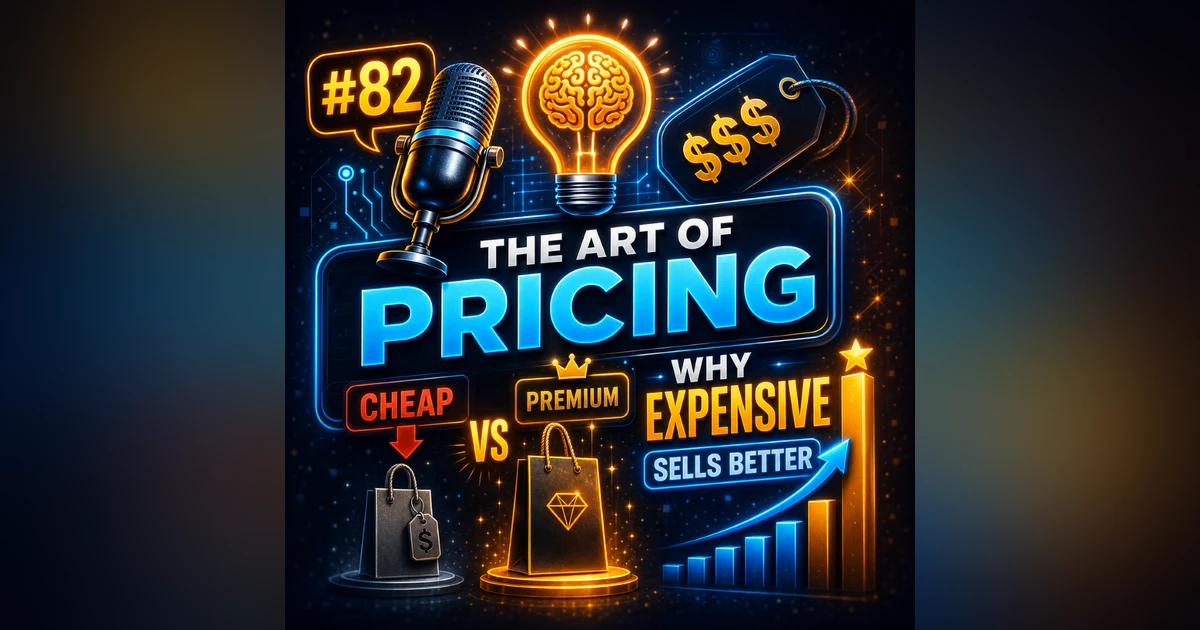


Have you ever wondered why people eagerly pay $5,000 for a bespoke sleep coach when a $10 alarm clock exists? Or why two identical bottles of wine taste completely different depending on the price tag? From a classical economics standpoint, the lowest price should always win. But human behavior consistently proves that framework wrong. In this episode of the Smart Entrepreneur Show, we dive into the fascinating psychology behind premium pricing. We explore why price isn't just a math equation to cover your overhead — it's a powerful psychological heuristic. We break down why expensive options actually feel safer to high-value clients, how to use positioning to stop competing on price, and the exact sequence you must follow to confidently double your rates without losing your customers. Timestamps Timestamp Topic 00:00 Introduction — why traditional economics is wrong about pricing 01:32 Price is a psychological trigger, not just a math equation 02:08 The "heuristic" shortcut: how the brain conserves energy when buying 03:07 The drill analogy: people buy the outcome, not the hardware 03:30 Sleep coaching: buying energy and mental clarity, not a schedule 04:09 The wine study: how high prices literally alter the biological chemistry of consumption 05:27 The counterintuitive truth: why expensive products feel like the "safer" choice 06:08 The hidden costs of failure: why cheap B2B services carry catastrophic risk 07:06 How premium prices act as a boundary to weed out energy-draining, micro-managing clients 07:53 The bridge to premium pricing: Trust and Framing 08:34 Mirror neurons: how case studies massively reduce cognitive friction 09:09 Positioning: framing your product as an exclusive experience, not a commodity 10:02 The graphic designer example: selling "securing investment" vs. "vector files" 10:58 The personal trainer example: selling "pain-free family weekends" vs. "push-ups" 11:28 The sequence matters: you must build the premium experience before you raise the price 11:59 The restaurant analogy: upgrading the ambiance to justify the $30 spaghetti 12:36 The imposter syndrome trap: how your lack of confidence transfers to the customer 13:25 Full recap: step out of the race to the bottom and focus on exceptional results 14:04 Final thought: what is your current price tag already saying about you before you even speak? Contact & Resources Listen to this episode on Podbean: smartentrepreneur.podbean.com Explore more podcasts: Find all podcasts at the PodFather Network Website: RoyCoughlan.com Need help running your business? If you are looking for a Virtual Assistant and get reliable support for your daily operations. Virtual Assistants: VA.world Communities: BrainGym.fitness Learn about a Private Networking Group in 50 US States & 39 Countries with 640+ Members: connectedleaders.academy #SmartEntrepreneurShow #PricingStrategy #ConsumerPsychology #PremiumPricing #BusinessGrowth #SalesPsychology #Entrepreneurship #MarketingStrategy #BusinessTips #ValueProposition #RoyCoughlan #PodFatherNetwork #VAWorld #BrainGymFitness #SmartEntrepreneur
#82 The Art of Pricing Why Expensive Products Sell Better Than Cheap Ones
Welcome to the Smart Entrepreneur Show, the podcast where we share smart ideas, strategies and lessons to help entrepreneurs build better businesses. Today, we're diving into a fascinating topic that can completely change the way you think about business, marketing and sales. Yeah, this is a big one.
It really flips traditional economics right on its head. Exactly. I mean, have you ever wondered why some products cost 10 times more than similar alternatives and still sell incredibly well? Right.
It's wild when you actually stop and think about it. It really is. Why do people buy luxury watches, premium consulting services, expensive courses or high end brands when cheaper options exist? Well, it's definitely not just about the raw materials or, you know, the time spent making the thing.
Right. The answer isn't always about the product itself. It's often about perception, positioning, trust and value.
In today's episode, we'll explore the psychology behind pricing and discover why expensive products often sell better than cheaper ones. And this applies to pretty much everyone listening, whether they realize it or not. Absolutely.
Whether you're a freelancer, entrepreneur, business owner or marketer, understanding pricing can dramatically increase your income and profitability. Let's get started. Let's do it.
Because, you know, from a classical economics standpoint, it feels like a total paradox. Yeah, you'd think the lowest price always wins, right? You would. But human behavior just consistently proves that framework wrong.
Pricing is rarely just about math. It's not just a number you use to cover your overhead. So what is it then? If it's not math, what is happening when someone sees a price tag? It's a psychological trigger.
It actually communicates a message to the buyer long before they ever read your sales pitch. OK, let's unpack this because there's this huge misconception out there, this deeply ingrained idea that lower prices automatically attract more buyers. Oh, yeah.
The classic race to the bottom. Right. We've all been there thinking if I just make my service a little cheaper, everyone will flock to it.
But in reality, customers are using price as a mental shortcut to judge your quality, your service and your expertise. Exactly. What's fascinating here is that you're relying on heuristics.
Heuristics. OK, define that for us. Heuristics are essentially mental shortcuts.
They save our brains from doing heavy computational math on every single decision we make. Because we make, what, thousands of choices a day? Tens of thousands. So the brain constantly looks for ways to conserve energy.
Let's say you're at the grocery store buying olive oil. Evaluating the chemical composition and sourcing of every single bottle takes way too much mental load. Yeah, I do this all the time.
If I'm staring at a wall of olive oil brands, I don't know. I almost never buy the five dollar bottle. I'll just grab the twenty dollar one, simply assuming it won't ruin my dinner.
And that right there is the heuristic in action. Price is the most universally understood shortcut we have. When you see that high price tag, you don't just see a cost.
Your brain instantly processes a promise of better quality. So the price itself actually becomes part of the product's inherent value. You're almost paying for the privilege of knowing you got the good stuff.
Yes, but it's not really about the item itself, is it? It's the famous concept of the drill. People don't buy a drill because they want a piece of hardware. Right.
They buy it because they want a hole in the wall. Exactly. They are buying the outcome.
The physical item or the service is just the vehicle to get them there. OK, give me an example of how that works with premium pricing. Take sleep coaching.
It's a massive industry right now. Why would someone pay a bespoke sleep coach five thousand dollars when they could just buy a ten dollar alarm clock and, you know, download a free white noise app? Because they are buying a sleep schedule. Right.
They're buying the energy to actually play with their kids after work. They're buying the mental clarity to nail a promotion. The bigger and more emotionally valuable that outcome is, the higher the price they're willing to pay.
That makes so much sense. I love that distinction, buying the energy, not the schedule. Let's go back to that wine example, sort of like the olive oil thing, because I think it perfectly illustrates how far our brains take this.
Oh, the wine studies are incredible. Yeah. Imagine you're at a nice dinner party.
Two unbranded, completely identical bottles of wine on the table. The host tells you one bottle costs ten dollars and the other costs one hundred and fifty. Before the cork is even popped, our brains are already assuming the expensive one is going to taste better.
And what's wild is that the underlying neurology proves it. Humans are hardwired to look for signals of quality to ensure we're making safe choices. And price is the loudest signal.
The loudest by far. When you hear one hundred and fifty dollars, your brain genuinely alters its sensory expectations. Wait, really? It alters the actual senses? Literally.
Functional MRI scans actually show that blood flow to the pleasure centers of the brain increases when people believe they're drinking expensive wine. Oh, wow. Yeah.
You savor it more. You look for complex flavor notes. You forgive any slight bitterness, all because the high price tag told your brain to expect a premium experience.
The high price literally changes the chemistry of your consumption. That is mind blowing. So the price changes the biological experience itself.
But if customers are buying the outcome and using price to gauge how good that outcome will be, how does that high price tag alter the buyer's perception of risk? Well, this is where it gets highly counterintuitive. There's a well-documented phenomenon where customers believe expensive products are actually the safer choices. Safer.
Yeah. The internal logic is basically if it costs more, it must be better and therefore it is less likely to fail me. This is incredibly common in business to business environments.
Wait, let me push back on that for a second. Wouldn't a cheaper option feel financially safer? How do you mean? I mean, if a cheap graphic design service fails, you haven't lost very much money. Why does the human brain view the expensive option as the safer bet when there is physically more cash on the line? It's a fair question, but it completely misses the hidden costs of failure.
In business, the cost of a failed outcome is far more dangerous than the literal dollar amount you spent. Ah, OK. Can you break that down? Sure.
Let's say a startup needs an app built. The founder has to choose between a $5,000 offshore team and a $50,000 domestic agency. Huge price difference.
Massive. But if they hire the cheap team and the app is full of bugs, crashes on launch and frustrates users, the loss isn't just the $5,000. Right.
The loss is the time. It's six months of wasted runway. It's a ruined brand reputation, missed investor milestones and potentially the death of the whole company.
Wow. I see. The cheap option carries a catastrophic risk to their actual objective.
Precisely. The stakes are simply too high to gamble on cheap. The high price tag signals expertise and stability.
It acts as an insurance policy. You're paying a premium to guarantee you won't look foolish. Exactly.
And what's interesting is how this dynamic creates an incredible filter for the types of clients a business attracts. Low prices naturally attract cost focused buyers. Oh, anyone who has ever freelanced knows exactly who you're talking about.
Right. Their primary metric for success is how little they spend. They haggle over pennies.
They micromanage every little detail and they demand a discount on top of. On top of the discount they already got. Yes.
It's a race to the bottom. It's exhausting. It really is.
But conversely, premium prices attract results focused buyers. These customers tend to ask fewer unnecessary questions. They intrinsically value your expertise and they respect your time.
Because they're focused on the long term outcome. Exactly. Because they have invested heavily.
They trust your process. They have skin in the game. So the price isn't just a revenue tool.
It's a boundary. It weeds out the energy draining client. Yes.
Here's where it gets really interesting, though. If we know high prices reduce perceived risk and attract to better clients. How does a business actually justify making that leap? You can't just slap an extra zero on your invoice tomorrow.
No, definitely not. You'd scare everyone away. The bridge between a high price and a willing buyer is constructed entirely out of trust and framing.
Trust and framing. OK. Yeah.
Trust makes the actual price tag less of a deciding factor. If a buyer completely trusts that you can deliver the outcome they desperately want, the fee becomes secondary. So how do you actually build that trust? Are we talking about testimonials, case studies, that sort of thing? Exactly.
Case studies, verifiable reviews, your personal branding. It comes down to cognitive load and mirror neurons. Mirror neurons.
Yeah. When a prospective client reads a detailed case study of someone in their exact situation who achieved the desired result, their brain's mirror neurons fire. They mentally simulate that success for themselves.
Oh, so it takes this abstract promise of your service and makes it completely concrete. Right. It massively reduces the cognitive friction we talked about earlier.
They don't have to guess if you're good. The proof is right there. It mitigates the risk of failure, which justifies the premium.
But you mentioned framing, too, like positioning. Yes. Positioning is the idea that two identical products can have completely different prices based entirely on how they are framed.
So if you're listening right now, you really have to ask yourself, is your product presented as a commodity or a premium solution? Because premium brands focus on the experience and exclusivity, not just features. Which is why you should never compete on price alone. Someone will always be cheaper.
You compete on the difficult to copy elements, quality, service, results. Let's ground this in reality, though. Right.
Conceptually, I get it. But practically, let's say I'm a freelance graphic designer listening to this right now. How do I actually shift my positioning from a commodity like I make logos for 50 bucks to an exclusive experience without fundamentally changing the service I provide? If we connect this to the bigger picture, it's about changing conversation.
Changing the conversation. Yeah. You shift the dialogue away from the mechanics of the work and refocus it entirely on the transformation.
Okay. What does that look like? So commodity positioning sounds like I will design a vector logo with three revisions in 48 hours. That's just a featureless.
Right. And the client just opens another browser tab, finds someone offering four revisions for 20 bucks, and you've lost the job. Exactly.
But premium positioning changes the frame. That same designer says, I develop visual brand identities that immediately establish trust with high net worth investors, ensuring your pitch deck gets taken seriously. Oh, wow.
The deliverable is still a logo. Still a logo. But the conversation is no longer about vector files.
The conversation is about securing investment and projecting authority. You are selling the experience of feeling confident walking into a boardroom. That is extremely difficult for a cheap competitor to copy.
Let's do another one. What about, say, a personal trainer? Perfect example. The commodity trainer says, I offer one hour workout sessions where I count your reps and build a meal plan.
And the client compares that to a free YouTube video. Right. But the premium specialist says, I help busy executives rebuild their core strengths so they can finally hike with their kids on the weekends without chronic back pain.
You're selling pain-free weekends and family memories, not pushups. So what does this all mean? You have the positioning, you have the trust, but you still have to execute the jump. How do you practically and mentally make the leap to premium pricing? Well, the foundation has to be real.
The absolute best way to charge more is to create more value first. The sequence matters. You don't raise prices and then figure out how to be better.
No, you become better, which naturally justifies the higher price. Improve your customer support, the delivery speed, the overall experience. When value goes up, asking for a higher price doesn't feel like a stretch.
I love that. Let me try an analogy here. It's like a neighborhood restaurant that suddenly wants to double its menu prices.
You can't just cross out $15 and write $30 next to the spaghetti. No, your regulars would walk right out the door. Exactly.
First, you have to upgrade the ambiance. Put fresh flowers on the table. Swap out the cheap cutlery for polished silverware.
You improve the service, maybe hire a sommelier. Right. The meal becomes an event.
Yes. You have to build the experience first. You make the atmosphere so compelling that when the bill comes, the $30 feels totally justified.
The experience comes first and the price naturally follows. That's a great visualization. And this raises an important question for the listeners.
Are you undercharging right now because the market won't pay it or because you haven't fully convinced yourself of your own value? Oof, imposter syndrome is real. It is huge. So many entrepreneurs drastically undercharge because they lack confidence.
And the seller's genuine belief transfers completely to the customer. If you flinch when you state your price, they feel it. They feel it and they instantly doubt your value.
Price reflects your confidence. If you don't believe your offer is worth a premium, you will never convince a stranger. Which means the goal isn't just to be expensive for the sake of it.
The goal is to create so much undeniable value that the customer looks at the offer and feels like the investment is a no brainer. Exactly. Making the price an afterthought compared to the massive outcome you're delivering.
We've covered a ton of ground today. Let's distill this. The core takeaway here is that pricing isn't just a math equation.
It is a powerful signal. Yes. It dictates exactly how customers perceive your brand, how they judge your expertise, and how safe they feel making a purchase with you.
Don't be afraid to charge what you deserve. You have to step out of that race to the bottom. Focus on exceptional results, trust, and great experiences.
When you do that, customers won't buy because you're cheaper. They'll buy because you're better. Exactly.
Now, as we wrap up, I want to leave you with one final lingering thought to mull over today. If price is ultimately just a signal of value, and value is a mix of perception and trust, then the price you set isn't just a business decision. No, not at all.
It is the very first marketing message your customer will ever read. So before you even open your mouth to sell, what is your price tag already saying about you? Such a powerful question to end on. If you enjoyed this episode of the Smart Entrepreneurs Show, make sure to follow the podcast so you don't miss future episodes and feel free to share your thoughts or experiences in the comments.
Keep learning. Keep creating value, and we'll see you next time.
PodFather
I am a serial entrepreneur who has founded 21 companies across 6 countries. Known in the industry as “The PodFather,” I am a business podcast coach and host who has launched eight successful podcasts—6 ranking in the Top 5%, with four reaching the coveted Top 0.5% globally.
Beyond podcasting, I co-founded brainupgrade.org a platform designed to boost cognitive performance and unlock peak mental potential. I am also the co-founder of VA.World, connecting businesses with exceptional Virtual Assistants tailored to their unique needs.
I also have Sponsorship ads available that are Dynamically inserted into my 8 shows