#77 Why Customers Really Buy 🧠 – The Psychology Behind Every Purchase
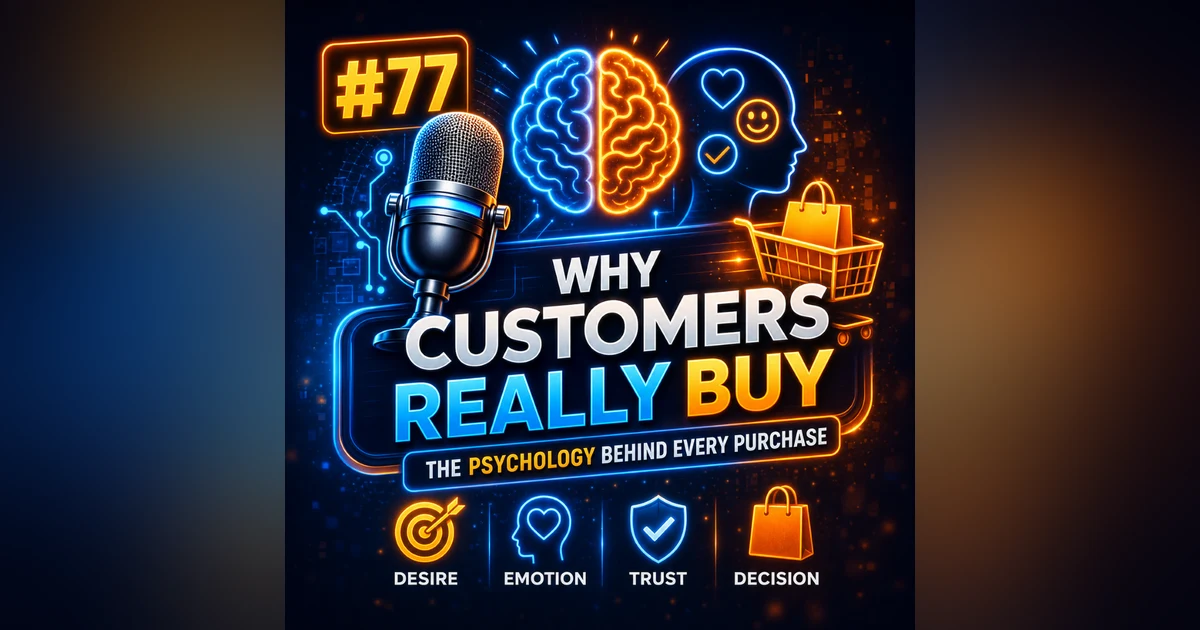


Have you ever wondered why people eagerly buy certain products while completely ignoring others? Why do some advertisements instantly grab attention while others are forgotten within seconds? The truth is that buying decisions are rarely based on logic alone. In this episode of the Smart Entrepreneur Show, we explore the invisible architecture of human decision-making. We break down why the limbic system processes emotional desires milliseconds before your logical brain reads a feature list, why you are never actually selling a physical product (you are selling one of six core emotional states), and how to use simplicity, scarcity, and ethical urgency to turn a hesitant browser into a confident buyer. Show Notes #77: Why Customers Really Buy 🧠 – The Psychology Behind Every Purchase The businesses that understand customer psychology don't just sell products — they create experiences, solve problems, and build lasting relationships. In today's episode, we dive deep into the neuroscience and psychology behind every purchase. We discuss the "logic alibi" (why we buy on emotion and justify with facts later), why even a sterile corporate software purchase is actually driven by deep emotional needs, and the three specific beliefs a customer must hold before they will finally convert. Learn how to stop fighting for every single sale and start creating a system where customers actively want to buy from you. In this episode you'll learn: •[00:00 - 02:24] The Invisible Architecture: Why buying is inherently illogical, and why highly analytical founders struggle with this concept. •[02:24 - 03:03] The Logic Alibi: How the limbic system generates an emotional response (like desire or aversion) milliseconds before the prefrontal cortex reads the feature list. •[03:03 - 05:00] The 6 Core Emotional States: Why you are never selling a physical product, and how even enterprise software is actually a purchase of "security" and "relief." •[05:00 - 06:04] Selling the After Picture: Why customers do not care about your features — they care exclusively about the transformation your product provides. •[06:04 - 07:10] The True Role of Features: Why specs and details (like processor speed) are still necessary as the "logical ammunition" to validate the emotional desire. •[07:10 - 08:34] The Trust Precipice: The three specific beliefs a customer must hold before converting: the product works, the business is reliable, and you understand their needs. •[08:34 - 09:35] The Evolutionary Shortcut of Social Proof: Why herd mentality isn't just a marketing trick, but a mental heuristic to reduce cognitive load and establish safety. •[09:35 - 11:00] Simplicity, Scarcity, and Urgency: Why confused customers never buy (decision fatigue), and why fake countdown timers instantly destroy trust. •[11:00 - 12:11] Helping vs. Selling: The ultimate mindset shift — why the best marketing feels like helping, not convincing. •[12:11 - 12:51] Final Thought: Look at the last non-essential item you bought. What was the underlying emotion you were actually trying to purchase? Contact & Resources: Listen to this episode on Podbean: https://smartentrepreneur.podbean.com/ Explore more podcasts: Find all podcasts at the PodFather Network • Website: RoyCoughlan.com Need help running your business? If you are looking for a Virtual Assistant and get reliable support for your daily operations. • Virtual Assistants: VA.world • Communities: BrainGym.fitness • Learn about a Private Networking Group in 50 US States & 39 Countries with 640+ Members: https://connectedleaders.academy/ #SmartEntrepreneurShow #CustomerPsychology #ConsumerBehavior #MarketingStrategy #SalesPsychology #Entrepreneurship #BusinessGrowth #SocialProof #EmotionalSelling #RoyCoughlan #PodFatherNetwork #VAWorld #BrainGymFitness #SmartEntrepreneur
#77 Why Customers Really Buy 🧠 – The Psychology Behind Every Purchase
Welcome to the Smart Entrepreneur Show, the podcast where we share smart ideas, strategies, and lessons to help entrepreneurs build better businesses. Have you ever wondered why people buy certain products while ignoring others? Why do some advertisements instantly grab attention while others are forgotten within seconds? The truth is that buying decisions are rarely based on logic alone. Most purchasing decisions are driven by emotions, trust, perception, and psychology.
The businesses that understand customer psychology don't just sell products. They create experiences, solve problems, and build lasting relationships. In today's episode, we'll explore what really drives buying decisions and how entrepreneurs can use customer psychology to better serve their audience and grow their business.
Let's get started. Yeah. So to really set the stage for our deep dive today, let's just step past the standard textbook definitions.
You know, when we talk about customer psychology in these sources, what we're actually looking at is the invisible architecture of human decision making. Oh, I like that phrasing. Right.
It's basically the underlying code of how people think, how they feel, and how they behave right before they finally decide to part with their money. Which is huge. It is.
And for the entrepreneur listening right now, this is definitely not some theoretical academic exercise. Mastering the psychological code is basically the difference between fighting for every single sale and creating a system where customers actively want to buy from you. Yeah, that makes sense.
Because the reality, our sources reveal, is pretty stark. I mean, if you don't understand the emotional livers driving your customer, your marketing is really just guessing. OK, let's unpack this, because the foundational premise of these sources, that buying is inherently illogical and emotional, is, well, it's something a lot of highly analytical founders fundamentally resist.
Oh, totally. They fight it constantly. Right.
Like, we all want to believe we are rational actors making logical choices. Exactly. So, for example, think about buying a luxury watch.
You don't buy a $10,000 Rolex just to tell time. Right. Your smartphone tells the time perfectly.
Exactly. That's the logical justification. But what you are actually buying is status.
You're buying confidence. Yes. And that brings us to the core rule across the board in our sources.
People buy emotionally first and then they scramble to justify that decision logically later. It's just so backwards from how we think we operate. It really is.
And, you know, it completely upends the traditional business mindset. But the thing is, it's rooted in basic neuroscience. Oh, really? How so? Well, the limbic system, which is the part of your brain that controls emotion, it processes information significantly faster than the prefrontal cortex, which handles all your logical reasoning.
Wow. OK. So the emotion literally hits you first.
Exactly. When a buyer looks at your product, their brain has already generated an emotional response like a desire or a total aversion milliseconds before they even start reading your feature list. That's wild.
So the logic is just it's like an alibi for the emotion. That's a great way to put it. The logic is just the alibi.
According to the framework we're looking at, buyers are never actually purchasing physical goods or digital services. OK. What are they purchasing? They are attempting to acquire one of six core emotional states.
The sources list them as confidence, security, status, convenience, happiness and relief from a specific problem. Oh, got it. So your product is merely the vehicle that delivers one of those feelings.
OK. I mean, I see the logic there for consumer goods like the watch or maybe a sports car, but I have to play devil's advocate for a second. Sure.
Go for it. Is that really exhaustive? Like, what if I'm an entrepreneur selling something totally commoditized, like bolt-office printer paper or highly technical like enterprise cybersecurity infrastructure? Right. I mean, nobody is buying firewall software for happiness, right? Well, no, they aren't buying it for happiness, but they are absolutely buying it for security and relief.
Oh, interesting. Yeah. Think about the IT director who has to purchase that software.
On paper, sure, they are buying encryption protocols and threat detection. Right. The logical features.
But emotionally, they're buying the relief of not being the guy who let a catastrophic data breach happen. Oh, man. Yeah.
They're buying the security of keeping their job. Exactly. That is a deeply emotional driver.
And even in your printer paper example, the office manager isn't buying paper. They're buying the convenience of a smooth running office and the relief of not having employees whine about the copier being jammed again. That makes total sense.
So even in the most sterile corporate environments, we are basically still just primates trying to avoid stress and gain status. Basically. That is such a fascinating lens to look through.
If I'm an entrepreneur and I suddenly realize my product is just a vehicle for delivering confidence or relief, that completely changes the conversation I need to have with the market. It changes everything. Which naturally brings us to the next major theme in the sources, right? Framing products as outcomes.
Precisely. Because if your customer is secretly shopping for a feeling, then spending all your marketing energy listing technical specifications is just a massive missed opportunity. The sources emphasize a pretty brutal truth for product creators.
Customers do not care about your features. They care exclusively about the transformation your product provides. They want the solution.
Exactly. People don't buy a fitness program. They buy better health.
They don't buy a marketing service. They buy business growth. They are always buying the after picture.
Yeah. And great brands cement this by building emotional connections, right? Like through their stories or missions, because people remember how a brand makes them feel. Spot on.
Oh, wait, let me push back on that a bit. Don't features ever matter? Well, because if I'm buying a new tech gadget, say a laptop to edit audio for our deep dives. Yeah, I'm absolutely looking at the specs, right? You are the details.
Yeah, I'm checking the processor speed, the RAM. If you just pitch me the outcome without the specs, you know, I'm going to bounce. If we connect this to the bigger picture, you'll see that the features absolutely do matter.
But we have to understand their role in the psychological sequence. OK, what do you mean? Think back to the golden rule emotion first, logic second. The specs, like a fast processor, are the logical ammunition your brain needs to justify the emotional desire.
Ah, so the desire is still there first. Right. Your emotional desire is relief from the frustration of a slow, freezing computer.
Yes, I hate that. We all do. So without the specs, your prefrontal cortex throws up a red flag saying, wait, we have no proof this laptop will actually solve our problem.
Got it. So the features validate the transformation. Exactly.
The mistake entrepreneurs make is leading only with the RAM without ever painting the picture of that stress-free, fast workflow. OK, that makes perfect sense. So let's trace the customer's journey here.
Sure. As an entrepreneur, I figured out my client wants the emotional outcome of security. I've pitched the transformation and I've provided the logical features to back it up.
Right. But the sources point out that right at this stage, the customer's brain will naturally ask, can I actually believe you? Yes. And this is the critical juncture.
This necessitates a deep dive into trust and social proof. Because without trust, the sale just dies. Right.
It completely dies. Trust is arguably the strongest buying trigger. When a customer is on the precipice of buying, their brain is constantly assessing risk.
What kind of risk? Well, the sources break it down into three specific beliefs the customer must hold before they'll actually convert. OK, what are they? First, they must believe your product actually works. Second, they have to believe your business is reliable, like you aren't a scammer who will take their money and run.
Right. Nobody wants that. And third, which is the hardest one, they must believe that you deeply understand their specific needs.
OK, so proving the product works is one thing, but proving you understand them, that takes work. Yeah. How do you actively build that kind of trust? Trust is actively built through four main methods.
First is consistent branding. If you look like a professional on one page, but your checkout page looks sketchy, the brain senses danger. Oh, definitely.
Second is providing valuable content. You know, giving away helpful advice for free to prove your expertise. Third is honest, transparent communication.
And fourth is the big one, the principle of social proof. Reviews, case studies, testimonials. Yeah.
Let's talk about social proof, because I know anyone listening to this deep dive relies on it. Just think about your own habits. Oh, absolutely.
I mean, I won't even book a table at a new restaurant without checking the reviews first. I need to see what the herd is doing. The herd mentality is so powerful and the psychology behind it is fascinating.
It isn't just a cheap marketing trick. It's an evolutionary mental shortcut. For a shortcut.
How do you mean? Well, human brains are inherently lazy. Making rigorous analytical decisions burns a lot of cognitive energy. So in an overwhelming world where there are 50 different options for everything, we use heuristics.
Mental shortcut. Yes. Social proof is a shortcut for establishing safety.
If you see case studies and reviews proving that a hundred other people got great results, your brain goes, OK, the herd survived. So this path is safe. Wow.
So you feel confident enough to buy without having to overthink it. Exactly. It reduces the cognitive load.
OK, so the customer now desires the emotional outcome. Right. And they trust the business because of the social proof.
Right. How do we prevent them from just walking away without taking action? Because people procrastinate all the time. They do.
And this is where we have to remove friction and add a timeline. We're talking about simplicity, scarcity and urgency. Oh, simplicity is huge.
I mean, here's where it gets really interesting, because confused customers rarely buy. Right. Never.
Think about going to a restaurant with a confusing 10 page menu with tiny text. It's paralyzing. Oh, decision fatigue.
Yes. Compare that to a simple, curated three item menu where everything looks amazing. Decisions have to be made easy.
Exactly. Clear messaging, explaining the benefits simply and reducing unnecessary complexity. Clarity equals conversions.
But even if it's clear, they might say, I'll just buy this tomorrow. So that's where urgency comes in. Right.
Limited time offers exclusive bonuses. Right. Customers act faster when opportunities are limited.
But this raises an important question, especially regarding the ethics of urgency. Oh, yeah. The fake countdown timers.
Yes. Crucial caveat here. Urgency must always be genuine and ethical.
Fake scarcity instantly destroys all that trust and emotional connection you just worked so hard to build. Oh, I hate that. You see a timer saying offer ends in 10 minutes and then you refresh the page and it starts over.
It's just insulting. It's insulting. And it tells the customer that your business is not reliable.
You've failed the trust test. Totally. So what does this all mean for the entrepreneur listening? When we look at all these psychological principles, what does it look like when people get it wrong? Well, the common marketing mistakes are pretty clear is talking only about features, ignoring customer emotions and overcomplicating offers.
Right. But the biggest mistake is focusing on selling instead of helping. Ooh, say more about that.
The ultimate mindset shift here is that the best marketing just feels like helping, not convincing. That is so liberating for an entrepreneur realizing that selling is actually just helping people solve their problems. Exactly.
Mastering customer psychology isn't about manipulation at all. It's about deeply understanding human needs so you can create better offers and more meaningful relationships. I love that.
So practically speaking, what should our listeners do today? You need to ask yourself some hard questions. What specific problem am I solving? What emotions actually drive my customers? Right. What is the exact outcome they are seeking and how can I build more trust? Once you answer those, you reveal exactly why people buy your product.
That is incredible advice. It's a complete shift in perspective. Which brings us to the final recap.
If you take away anything from our deep dive today, let it be this. People don't buy products because of what they are. No, they don't.
They buy because of what those products help them become, achieve or feel. Beautifully said. And I want to leave you with one final thought to mull over today.
Look around your space right now at the last non-essential item you bought. Oh, this should be good. Yeah.
Ask yourself, what was the underlying emotion you were actually trying to purchase? Wow. That is a great question to end on. I'm looking at my coffee mug right now and rethinking everything.
If you enjoyed this episode of The Smart Entrepreneur Show, make sure to follow the podcast so you don't miss future episodes and feel free to share your thoughts or experiences in the comments.
PodFather
I am a serial entrepreneur who has founded 21 companies across 6 countries. Known in the industry as “The PodFather,” I am a business podcast coach and host who has launched eight successful podcasts—6 ranking in the Top 5%, with four reaching the coveted Top 0.5% globally.
Beyond podcasting, I co-founded brainupgrade.org a platform designed to boost cognitive performance and unlock peak mental potential. I am also the co-founder of VA.World, connecting businesses with exceptional Virtual Assistants tailored to their unique needs.
I also have Sponsorship ads available that are Dynamically inserted into my 8 shows