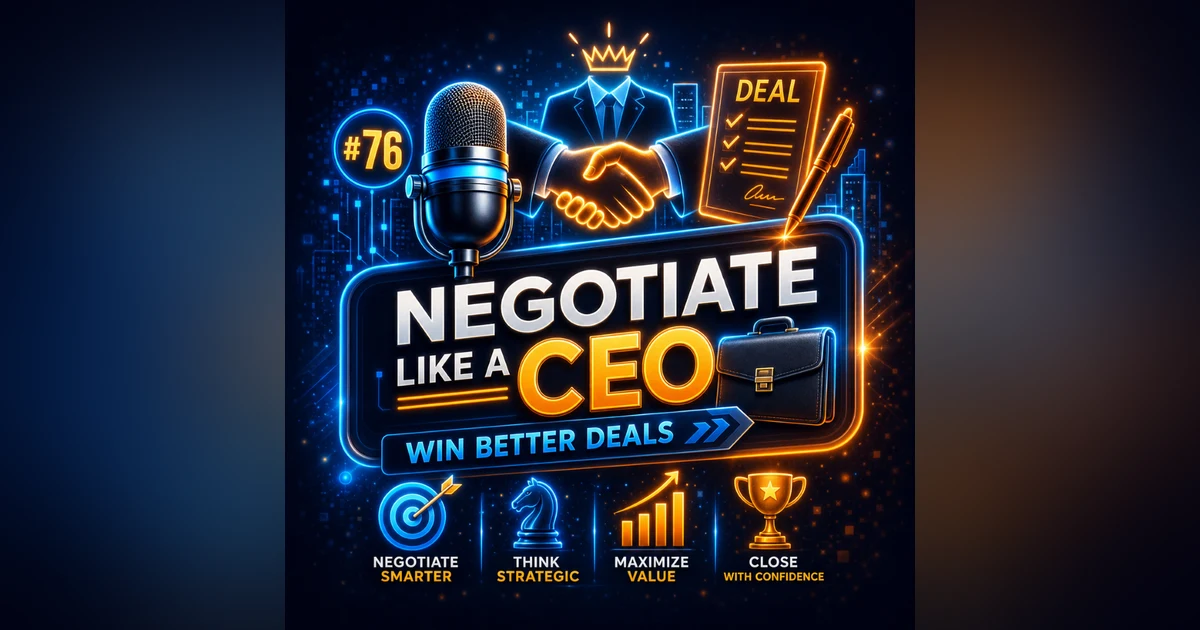
#76 Negotiate Like a CEO 💼 – The Entrepreneur's Guide to Winning Deals


When we think of negotiation, we usually picture a tense, zero-sum battle where one person wins and the other loses. But for professional entrepreneurs, the negotiation table isn't a battlefield — it's a collaborative puzzle. In this episode of the Smart Entrepreneur Show, we break down the value-based negotiation blueprint. We explore why haggling over the last slice of pizza is a mistake (and how to bake a bigger pizza instead), the three crucial questions you must ask yourself before entering any room, and why having the genuine courage to walk away is the ultimate seatbelt protecting your business. Timestamps Timestamp Topic 00:00 Introduction — why negotiation is the most overlooked entrepreneurial skill 00:44 Rewiring how you think: moving from anxiety to value creation 01:16 The zero-sum myth: fighting over the last slice vs. baking a bigger pizza 01:42 Why short-term victories destroy long-term relationships and trust 02:07 The preparation blueprint: the 3 questions you must answer before any discussion 02:29 Q1 — What is my ideal outcome? (be specific, not just "a good deal") 02:41 Q2 — What is my minimum acceptable outcome? (your absolute floor) 02:54 Q3 — What does the other person want? (looking past the money) 03:08 The hidden levers: faster delivery, long-term contracts, and better support 03:37 Why a two-week faster turnaround can be worth more than a 10% discount 03:43 The most powerful negotiation tool: genuine listening 04:00 Why entrepreneurs struggle to listen — we're wired to pitch and fill silence 04:13 Reframing the table: a puzzle to solve, not a battle to fight 04:26 Emotions damage negotiations: how ego and anger eject logic from the room 04:49 True confidence comes from preparation, not aggression 05:04 The fear of the ask: why opportunities vanish when you're afraid to say the word 05:39 "No" is not a closed door — it's an invitation to find a better yes 05:49 The walk-away power: why willingness to leave is your strongest position 05:54 The seatbelt analogy: knowing your floor protects your time and resources 06:15 Desperation is visible — the other side will always sense it and use it 06:33 The 6 common mistakes checklist (rapid fire) 06:43 Mistake 1 — Talking too much (listen more than you talk) 06:47 Mistake 2 — Accepting the first offer immediately (creates suspicion) 07:01 Mistake 3 — Negotiating without preparation (flying blind) 07:08 Mistake 4 — Becoming emotional (keep the ego at the door) 07:15 Mistake 5 — Focusing only on price (look at the whole package) 07:22 Mistake 6 — Being desperate for the deal (goes back to walk-away power) 07:29 The long game: the best negotiations don't end when the contract is signed 07:53 Collaborative deals create a compounding cycle of trust and referrals 08:10 Full recap: preparation, listening, value expansion, emotional control 08:44 Final thought: is a "no" a closed door or a sign you haven't found the right value blend yet? Contact & Resources Listen to this episode on Podbean: smartentrepreneur.podbean.com Explore more podcasts: Find all podcasts at the PodFather Network Website: RoyCoughlan.com Need help running your business? If you are looking for a Virtual Assistant and get reliable support for your daily operations. Virtual Assistants: VA.world Communities: BrainGym.fitness Learn about a Private Networking Group in 50 US States & 39 Countries with 640+ Members: connectedleaders.academy #SmartEntrepreneurShow #NegotiationSkills #BusinessDeals #Entrepreneurship #CEO #Leadership #SalesStrategy #BusinessGrowth #StartupTips #RoyCoughlan #PodFatherNetwork #VAWorld #BrainGymFitness #SmartEntrepreneur
Welcome to the smart entrepreneur show, the podcast where we share smart ideas,
strategies, and lessons to help entrepreneurs build better businesses. When people think
about entrepreneurship, they often focus on products, marketing, or sales. But there's
another skill that can dramatically impact your income, opportunities, and success.
Negotiation. Whether you're closing a deal, setting your prices, hiring team members,
partnering with businesses, or working with clients, negotiation plays a major role in your
results. The good news, negotiation isn't a talent you're born with, it's a skill you can learn
and improve.
In today's episode, we'll explore how to negotiate like a professional entrepreneur and
create win-win outcomes that help your business grow. Let's get started. I'm really looking
forward to this one, honestly.
Same here. So glad to have you with us today as we jump into this deep dive. We're looking
at a fantastic source today, the Entrepreneur's Guide to Value-Based Negotiation.
It's such a crucial read. And, you know, our mission today is really to completely rewire how
you think about business agreements. Because for so many founders, the negotiation table
feels, well, terrifying.
It's full of anxiety. We want to move away from that anxiety and toward actual value
creation. Yeah.
And to do that, we really need to start by busting the biggest myth out there. Yeah. The idea
that negotiation is just, you know, a zero-sum game.
The whole, I win, so you have to lose mentality. Yeah. It's about winning at someone else's
expense.
OK, let's unpack this. Most people view negotiation as fighting over the last slice of pizza,
right? Like there's only so much to go around. Right.
A totally fixed resource. But the source actually argues something completely different. It's
about figuring out how to bake a bigger pizza together.
Yes. What's fascinating here is that great negotiations aren't actually about those short term
victories where you just squeeze the other guy for every penny. Which is what we see in the
movies all the time.
Exactly. But in reality, those conversations are the foundation for long term relationships
and trust. If you burn someone on day one, they aren't going to stick around for year two.
No, of course not. But I mean, baking that bigger pizza, that actually requires a recipe, which
really means preparation. So much preparation.
Professional entrepreneurs never enter these talks unprepared, do they? Never. The source
is super clear on this. You need a blueprint.
And it gives us these three crucial questions that you absolutely must ask yourself before
any discussion even starts. OK, lay them out for us. What's the first one? First, simply, what
do I want? Like, what is the ideal outcome here? Sounds obvious, but I guess a lot of people
don't actually clarify that.
You really don't. They just go in wanting a good deal. You have to be specific.
Then the second question is, what is my minimum acceptable outcome? The absolute floor.
Right. The point where the deal just doesn't make sense anymore.
And then the third question, what does the other person want? OK, wait, how can you
possibly know what the other person wants before you even sit down with them? I mean,
you can't read their mind. Well, no, you can't read their mind. But discovering what the
other side wants just requires looking past the money.
That's the most common mistake. Focusing purely on the dollar amount. Right.
Because if you're only looking at the price, you miss all the other levers you can pull. The
text gives some really great specific alternatives to just haggling over the price. Yeah.
What's a good example of that? Well, things like faster delivery or additional services. Oh,
absolutely. Long term contracts, better support.
Sometimes the absolute cheapest deal isn't actually the best deal for them. Exactly. Maybe
they have an urgent deadline and getting it done two weeks faster is worth way more to
them than a 10 percent discount.
Right. But finding out which of these elements actually matters to the other party requires
the most powerful negotiation tool of all. Which is this? Listening.
Just genuinely listening. Yeah. That rule from the source is huge.
Great negotiators spend way more time listening than talking. Which is hard for a lot of
entrepreneurs, honestly. We're used to pitching.
We want to control the room. Right. We want to fill the silence.
But by actually understanding their needs, their concerns, their goals, finding a solution that
works for everyone becomes a puzzle to solve. A puzzle. Exactly.
Not a battle to fight. Right. Instead of just trading blows, you're fitting pieces together.
But it's easy to listen when things are calm. Right. What happens when the stakes are really
high? That's where it gets tricky.
Because the source gives a pretty clear warning about this. Emotions damage negotiations.
Period.
They really do. When you let ego or anger take the wheel, logic just jumps out the window.
Yeah.
You get offended by a lowball offer and suddenly you're acting out of pride. But successful
entrepreneurs, they remain calm. They are respectful, patient and above all professional.
If we connect this to the bigger picture, true confidence in a negotiation comes from the
preparation you did beforehand. Right. Knowing those three questions.
Exactly. It doesn't come from being loud or aggressive in the room. You don't need to pound
the table if you know your math.
Here's where it gets really interesting, though, because we talk about anger. But what about
fear? The text talks about how many opportunities just vanish because people are simply
too afraid to ask for them. Oh, the fear of the ask is huge.
Right. You can negotiate better rates, better terms, better partnerships, better
opportunities. But you have to actually open your mouth and ask.
And people don't because they're terrified of hearing the word no. The E-N-L means the
relationship is over. But the answer might be no, sure.
But it might just be yes or maybe no. But how about this instead? Right. It's a starting point.
Exactly. And to have the courage to ask, you need the ultimate safety net from the source,
which is knowing when to walk away. The walk away.
Being genuinely willing to walk away from a bad deal is actually your strongest position. It's
funny. It's almost like a seatbelt.
A seatbelt. I like that. Yeah.
You know, not every opportunity is worth accepting. So knowing your minimum acceptable
outcome, which we established back in the prep phase, that protects you. It protects your
time, your energy and your resources.
It keeps you from crashing. That's a perfect analogy, because if you are desperate for the
deal, the other side will sense it. Well, they always sense it.
And they will use that against you. But if you have your seatbelt on and you know you can
safely walk away, you have all the leverage. So what does this all mean? Like, how do we
actually apply this without crashing the car? Let's let's look at the practical side of making
sure you don't sabotage your own deals.
Good idea. The source is a great checklist of common negotiation mistakes to avoid. Yeah.
Let's run through them rapid fire. Make sure the listener knows exactly what to watch out
for. First one on the list.
Talking too much. Huge mistake. Remember, listen more than you talk.
Next up. Accepting the first offer immediately. Right.
Even if it's a good offer, jumping on it too fast makes the other person think they gave away
too much. It creates suspicion. Yeah.
You got to do a little dance first. OK. Third mistake.
Negotiating without preparation. We covered that. If you don't know what you want or your
minimum floor, you're flying blind.
Absolutely. Number four. Becoming emotional.
Keep the ego at the door. Stay professional. Number five.
Focusing only on price. Remember the value. Faster delivery.
Better support. All of that. Look at the whole package.
And the final big mistake. Being desperate for a deal. Which goes right back to the walk
away power.
Don't let desperation force you into a bad agreement. That's a really solid checklist because
ultimately this is about the long game, isn't it? It really is. The source makes a great point
that the best negotiations, they don't end when the contract is signed.
Right. That's just the beginning of the actual work. Exactly.
People want to repeatedly work with professionals who are fair, respectful and reliable.
Yeah. If you squeeze them for every last drop, they might sign today, but they'll drop you for
a competitor tomorrow.
But if you negotiate collaboratively, it creates a cycle of trust. And that trust leads to future
opportunities, referrals and real business growth. It really is a skill that just compounds over
time.
So to bring it all together for you listening, we've covered a lot of ground today. We
definitely have. You've learned that negotiation is absolutely a learnable skill.
It's based on solid preparation, active listening and expanding value way beyond just the
price tag. And controlling your emotions, which we can't stress enough. Definitely.
Controlling those emotions and having the courage to make the big ask or to just walk away
if it doesn't serve you. I think the biggest takeaway is just shifting that mindset from a battle
to a collaboration. So true.
Do you have a final thought to leave the listener with as they head into their next big
meeting? I do. Yeah. Just something to mull over.
Next time you hear a no in business, ask yourself, is this a closed door or just a sign that we
haven't found the right blend of value yet? I love that. A no is just an invitation to find a
better yes. If you enjoyed this episode of the Smart Entrepreneurs Show, make sure to
follow the podcast so you don't miss future episodes.
And feel free to share your thoughts or experiences in the comments.

PodFather
I am a serial entrepreneur who has founded 21 companies across 6 countries. Known in the industry as “The PodFather,” I am a business podcast coach and host who has launched eight successful podcasts—6 ranking in the Top 5%, with four reaching the coveted Top 0.5% globally.
Beyond podcasting, I co-founded brainupgrade.org a platform designed to boost cognitive performance and unlock peak mental potential. I am also the co-founder of VA.World, connecting businesses with exceptional Virtual Assistants tailored to their unique needs.
I also have Sponsorship ads available that are Dynamically inserted into my 8 shows