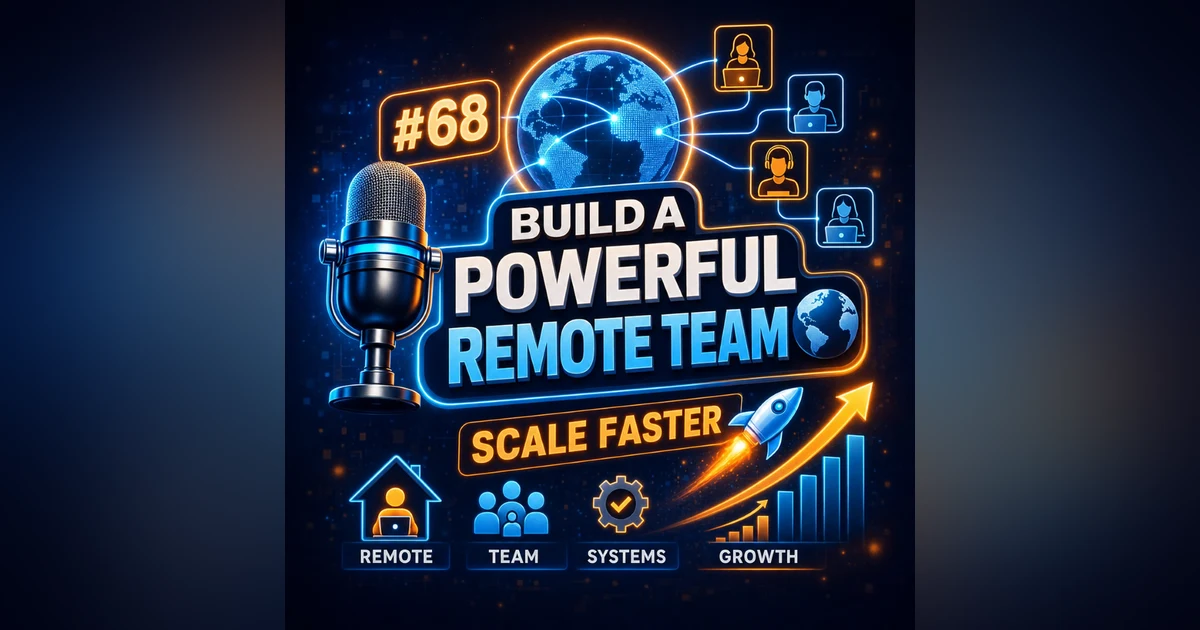
#68 Build a Powerful Remote Team 🌍 – Scale Your Online Business Faster


As your online business grows, you inevitably hit a wall where you simply can't do everything yourself. The overwhelm sets in, and the tasks that actually grow your business get pushed to the back burner. In this episode of the Smart Entrepreneur Show, we explore how to break through that wall by building a powerful remote team — discussing why you should buy outcomes rather than rent someone's day, how to leverage global talent on platforms like Upwork and Fiverr, and the crucial difference between building empowering systems and falling into the trap of micromanagement. Timestamps Timestamp Topic 00:00 Introduction — why you can't scale alone forever 00:35 The breaking point: overwhelm and delayed tasks as your hiring trigger 01:52 The remote advantage: global talent without the traditional office overhead 03:16 What to outsource first: video editing, design, writing, customer support 03:57 You don't need to be an expert in the process — only in the outcome 04:50 Building the digital office: Slack, Zoom, and Trello 05:28 Remote culture: results over hours, deadlines over desk time 05:57 The paradigm shift: managing output, not physical presence 06:38 Common mistakes: panic hiring, poor communication, micromanagement 07:17 Systems vs. micromanagement — the crucial difference 07:54 How building systems removes you from the bottleneck 08:11 Full blueprint recap 08:44 Final thought: are entrepreneurs managing people or managing outcomes? Contact & Resources Listen to this episode on Podbean: https://smartentrepreneur.podbean.com/ Explore more podcasts: Find all podcasts at the PodFather Network •Website: RoyCoughlan.com Need help running your business? If you are looking for a Virtual Assistant and get reliable support for your daily operations. •Virtual Assistants: VA.world •Communities: BrainGym.fitness Learn about a Private Networking Group in 50 US States & 39 Countries with 640+ Members https://connectedleaders.academy/ #SmartEntrepreneurShow #RemoteTeam #Outsourcing #BusinessScaling #Upwork #Fiverr #Leadership #RemoteWork #Entrepreneurship #BusinessGrowth #Systemize #Productivity #RoyCoughlan #PodFatherNetwork #VAWorld #BrainGymFitness #SmartEntrepreneur
#68 Build a Powerful Remote Team 🌍 – Scale Your Online Business Faster
Welcome to the Smart Entrepreneur Show, the podcast where we share smart ideas, strategies, and lessons to help entrepreneurs build better businesses. As your online business grows, one big challenge appears. You can't do everything alone forever.
That's why many successful entrepreneurs build remote teams that help them scale their business from anywhere in the world. In today's episode, we'll explore how to build, manage, and grow a productive remote team for your online business, even if you're just starting out. If you want more freedom, faster growth, and better systems in your business, this episode is for you.
Let's get started. Yeah, let's get right into it. Okay, so let's unpack this.
Today our mission is to really dig into a specific set of notes and strategies about, well, remote teams. We're doing a deep dive into how you actually build this digital machine that runs without you having to turn every single crank yourself. Right.
And just to set the stage here, a remote team is basically just a group of people working online from different locations instead of a traditional office. But we aren't just talking about the basic definitions today. We really want to transform these concepts into a practical, real-world roadmatch for your business.
Because removing geography completely rewires your leverage as an entrepreneur. It's massive leverage. But before we even talk about building a team, there's always that breaking point.
Oh, yeah. The wall. Exactly.
You hit a wall. You realize you just can't keep going solo. Usually this is when you start feeling completely hopelessly overwhelmed.
Right. Or you start noticing that the really important tasks, the ones that actually grow the business, are getting constantly delayed. Yeah, they just sit on the back burner.
Exactly. And that's the trigger. That overwhelm is the signal that you need to step back.
You have to transition from just doing the daily tasks to actually directing the higher level growth of your business. I always picture it like running a solo online business is like trying to row a boat, navigate the map, and like patch a leak all at the exact same time. That is a perfect analogy.
Right. Like you're burning so much energy, but you aren't actually moving anywhere. But wait, I have a question about this.
Sure, go ahead. The sources mention hiring when you feel overwhelmed or when tasks are delayed. But is feeling overwhelmed really the best time to start hiring? I mean, isn't that actually a sign that you waited a little too long? Well, yes and no.
I mean, yes, technically it's a lagging indicator. You ideally want to hire before the fire starts. Right.
But psychologically, that overwhelm is often the exact friction an entrepreneur needs to finally let go of control. It forces the issue. And this is where the power of remote teams really shines.
Because you aren't committing to a massive overhead, right? Exactly. Traditional hiring, renting an office, full-time payroll, all of that, it feels like adding a massive weight to a boat that's already sinking. But with global remote talent, you get this incredible scalability.
Lower business costs. Lower costs, total flexibility, and you get access to a global pool of talent. It essentially solves that overwhelm problem without the traditional office risks, which leads to, well, much faster business growth.
Okay. So that makes total sense on why we need help and when to get it. But that brings up the next massive hurdle.
Figuring out what to actually hand off. Exactly. What do we outsource and where in the world do we actually find the right people? Well, the sources give us a really clear list of ideal tasks to outsource first.
Things like video editing, social media management, customer support. Graphic design, right? Yeah. Graphic design and content writing.
Those are the big ones. And for sourcing this talent, you're looking at platforms like Upwork and Fiverr. Okay.
But here's where it gets really interesting to me. All those tasks you just listed, video editing, design, writing, they are highly creative or specialized skills. They are.
They're the engine of an online business. Right. But let me push back here.
If an entrepreneur is outsourcing things like graphic design or video editing to Fiverr or Upwork, do they need to be an expert in those fields first just to judge if the remote worker is doing a good job? That is the beauty of this whole system. No, you absolutely don't. Wait, really? How does that work? Because leveraging global talent platforms like Upwork and Fiverr allows you to instantly plug specialized skills into your business.
You bypass the need to be the expert. So I don't need to know how to use Adobe Premiere? Not at all. You don't need to be an expert in the process.
You just need to be an expert in the outcome. You know your brand. You know what looks good to your audience.
You're hiring the expert specifically so you don't have to become one. Oh, wow. I like that.
So I'm just judging the final result against my business goals. Exactly. You connect the dots for them and they execute the specialized work.
Okay, so we find this amazing talent on Upwork. But finding them is really only half the battle because, I mean, they aren't sitting in a traditional office with you. Right.
The geography is gone. So how do you actually function as a cohesive unit? We have to build some sort of virtual infrastructure, right? Yes. You absolutely need the right tools for organization and productivity.
Otherwise it's just chaos. The big three that are universally recommended are Slack, Zoom, and Trello. Okay, so basically Slack and Zoom are your digital water cooler and conference room, while Trello is your digital filing cabinet.
That's a great way to look at it. The tools replace the physical office space, but the tools are useless without the right culture. Right.
The culture is the tricky part. Yeah. Building a strong remote culture relies on a few key pillars.
You have to communicate clearly, set rigid expectations, respect deadlines, and crucially focus on results rather than just hours worked. Okay, I have to stop you there. Focusing on results, not just hours worked, that sounds great on a bumper sticker.
But how does an entrepreneur actually track that if they can't physically see their team working? It is a massive paradigm shift. In a traditional office, we conflate physical presence with productivity. Right.
Just because someone is at their desk doesn't mean they're actually working. Exactly. Remote work strips away that illusion.
You have to focus on output the results rather than input the hours. This is the foundation of remote culture. But how do you replace that physical supervision? With those other pillars I mentioned.
Clear communication, setting strict expectations, and respecting deadlines. That becomes the glue. If a graphic designer delivers an amazing logo on Thursday at noon, like you asked- It doesn't matter if they worked on it at 2 a.m. on Wednesday.
Precisely. The outcome was achieved. You manage the work, not the person's time.
That is so freeing. But you know, even with the best talent from Fiverr and the best tools like Trello, I feel like this entire structure can just collapse if the entrepreneur falls into bad leadership habits. Oh, absolutely.
There are some very dangerous zones you have to avoid. The sources outline a few common mistakes, right? Like hiring too quickly in a panic, having poor communication- Trying to micromanage everything, and having no systems or processes in place. Okay, wait.
The notes say we need to avoid trying to micromanage everything, but right next to it, it warns against having no systems or processes. Isn't building a rigid system just another form of micromanaging? Like aren't you just controlling them from afar? That is the ultimate aha moment for most founders. They are completely different things.
Explain that, because it sounds contradictory. Well, think about what a system actually is. A robust system empowers a remote worker to act independently.
It gives them all the answers, assets, and steps they need so they don't have to wait for you. Oh, I see. Micromanagement, on the other hand, stifles them.
It's you standing over their digital shoulder, demanding updates every hour, making yourself the bottleneck. So a system removes me from the equation while micromanaging keeps me trapped in it. Exactly.
When you build systems instead of micromanaging, you actually achieve the final takeaway here. You reduce your stress, and you achieve a much faster scale. Because you're finally out of your own way.
You're out of the weeds, yes. You can focus on what truly grows the business. That is incredible.
So to kind of bring this all together for our deep dive today. Yeah, just to summarize the journey we've been on, it starts with recognizing that feeling of overwhelm. Which is the trigger.
Right. Then you go out and find specialized talent on platforms like Upwork or Fiverr. You don't have to learn the skills, you just buy the outcomes.
Then you build a digital culture using tools like Slack and Trello, based entirely on results rather than hours spent at a desk. And finally, you build systems to avoid the trap of micromanagement. It really is a blueprint for scaling up.
And you know, as we wrap up, I want to leave you with a final kind of provocative thought to mull over. I love these. Let's hear it.
If remote work requires us to measure results rather than time spent at a desk, how does this fundamentally change the definition of an employee? Oh, that's a deep question. Right. Like, are entrepreneurs no longer managing people, but rather managing outcomes? It really makes you rethink what running a business even means.
It absolutely does. You're buying a result, not renting someone's day. Exactly.
Well, if you enjoyed this episode of the Smart Entrepreneur Show, make sure to follow the podcast so you don't miss future episodes. And feel free to share your thoughts or experiences in the comments.
PodFather
I am a serial entrepreneur who has founded 21 companies across 6 countries. Known in the industry as “The PodFather,” I am a business podcast coach and host who has launched eight successful podcasts—6 ranking in the Top 5%, with four reaching the coveted Top 0.5% globally.
Beyond podcasting, I co-founded brainupgrade.org a platform designed to boost cognitive performance and unlock peak mental potential. I am also the co-founder of VA.World, connecting businesses with exceptional Virtual Assistants tailored to their unique needs.
I also have Sponsorship ads available that are Dynamically inserted into my 8 shows