#66 Notion Template Business 💻 – Turn Simple Systems into Passive Income
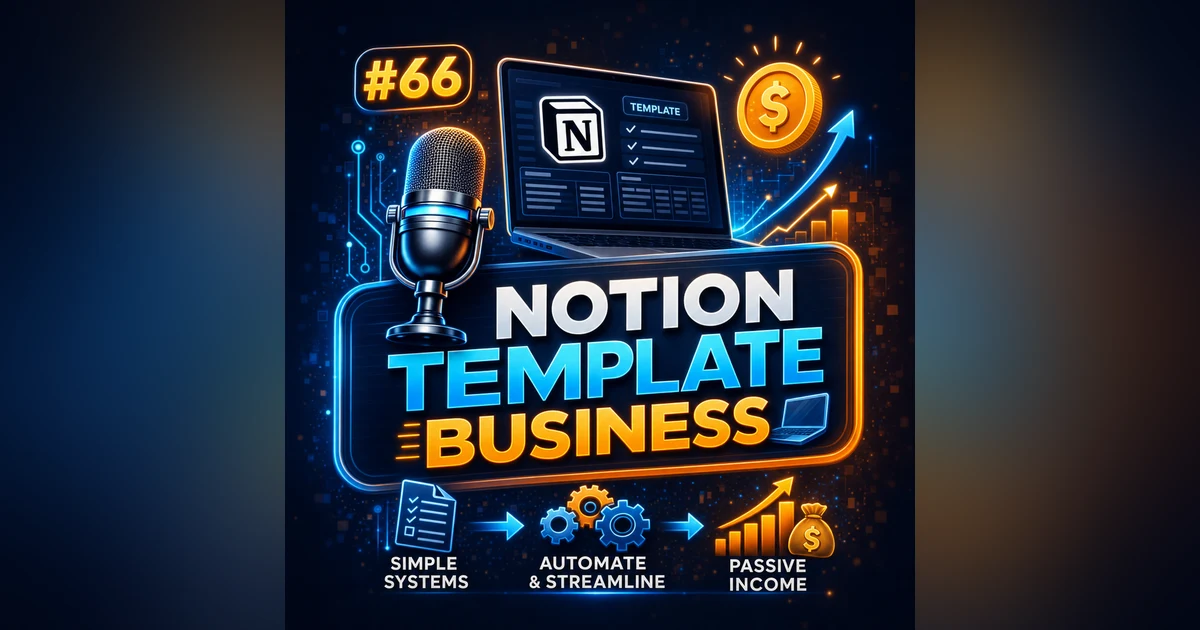


What if you could build a product once and sell it thousands of times with absolutely zero inventory or shipping costs? In this episode of the Smart Entrepreneur Show, we break down the booming digital economy of Notion templates — exploring how everyday people are turning their simple productivity systems, planners, and business dashboards into highly profitable passive income streams, and how you can use the exact same visual marketing funnel to start selling your own digital blueprints today. Timestamps Timestamp Topic 00:00 Introduction — creating a product once and selling it forever 00:35 What Notion really is and why its blank canvas overwhelms most users 02:38 The "architectural blueprint" model — selling the structure, not the software 03:34 Zero-inventory economics vs. the nightmare of physical products 05:11 What templates actually sell: content planners, finance trackers, student dashboards 06:12 Why people pay for free tools — monetising cognitive load and relief 09:14 The complexity trap: why overloading features destroys your product 10:19 The pre-programmed GPS rule: design clean, intuitive, 3-click systems 11:24 Adding previews and embedded tutorials to build trust and reduce refunds 12:35 Selling on Gumroad: a 15-minute storefront setup 13:33 Selling on Etsy: intercepting buyers with intent via search 14:18 The visual marketing funnel: TikTok, Pinterest, and aspirational aesthetics 16:46 Building a genuine audience through content marketing (the 80/20 rule) 18:07 Transitioning from salesperson to trusted advisor 19:16 Full blueprint recap and final takeaway 19:55 Closing thought: your daily systems may already be someone else's solution Contact & Resources Listen to this episode on Podbean: https://smartentrepreneur.podbean.com/ Explore more podcasts: Find all podcasts at the PodFather Network •Website: RoyCoughlan.com Need help running your business? If you are looking for a Virtual Assistant and get reliable support for your daily operations. •Virtual Assistants: VA.world •Communities: BrainGym.fitness Learn about a Private Networking Group in 50 US States & 39 Countries with 640+ Members https://connectedleaders.academy/ #SmartEntrepreneurShow #NotionTemplates #PassiveIncome #DigitalProducts #CreatorEconomy #Notion #ProductivityTools #SideHustle #OnlineBusiness #Gumroad #EtsySeller #AestheticProductivity #RoyCoughlan #PodFatherNetwork #VAWorld #BrainGymFitness #SmartEntrepreneur
#66 Notion Template Business 💻 – Turn Simple Systems into Passive Income
Welcome to the smart entrepreneurs show the podcast, where we share smart ideas, strategies, and lessons to help entrepreneurs build better businesses. What if you could create a digital product once and sell it over and over again? That's exactly why notion templates have become one of the fastest growing digital product businesses today. People around the world are making money by creating simple productivity systems, planners, and business dashboards using notion in today's episode.
We'll break down how beginners can create and sell notion templates for income, even without advanced design skills. Let's get started. I'm really excited for this one.
Yeah. So welcome to our deep dive into the actual mechanics of this whole digital economy for you listening right now. Our mission today is to extract the real actionable problem-solving nuggets from all the research and guides we've gathered, right? Because there's a lot of noise out there.
Exactly. We're going to look under the hood of this booming industry to understand how you can build a passive income stream from absolute scratch and honestly using nothing but your own organizational skills. Yeah.
And for anyone tuning in who might be feeling like a little intimidated by the software side of things, I want to say right up front, the core theme here isn't actually about complex coding or, you know, advanced software mastery. Oh, definitely not. It is entirely about how providing real tangible value through incredibly simple digital products can create these really powerful, reliable income streams.
We're essentially looking at a business model where your primary asset is your ability to bring order to someone else's chaos. Okay. Let's unpack this because I feel like the transition from, you know, I use a to-do list app to I am running a profitable digital product business seems like a massive leap.
It does seem huge from the outside. Yeah. Right.
So we need to define the playground first. For those who haven't used it, Notion isn't just a standard notes app. It is much more like a, like a box of digital Legos.
That's a perfect way to put it. Yeah. Because when you open a fresh Notion account, you are essentially staring at a blank screen, a blinking cursor, and just a bunch of unconfigured data blocks.
You have to decide how to snap those blocks together to build a calendar or a Kanban board or a project tracker. And that blank canvas is powerful, but I mean, it is also the central hurdle for the average user. Most people do not have the time or the patience to figure out how to snap those digital Legos together into a system that actually works.
They really don't. They open the software, feel immediately overwhelmed by all the possibilities, and they just abandon it. And that friction point, that exact moment of overwhelm is the entire basis of the Notion template economy.
Creators are doing the heavy lifting of building those Lego structures in advance. The way I love to visualize this actually is that creating a template is like drawing up the perfect, most brilliantly optimized blueprint for a house. Oh, I like that.
Right. You aren't actually building the house with wood and nails. The buyer already has the land and the raw materials.
That's the free Notion software they download. Right, exactly. What they lack is the architectural knowledge to make a house that doesn't just collapse on them.
So you sell them your blueprint. And the magic of this digital transaction is that the moment the buyer hits the duplicate button, their software instantly constructs the entire house for them. The foundation is poured, the roof is sealed, all in like one second.
What's fascinating here is when you evaluate the business model appeal of selling that blueprint, the economics are almost uniquely frictionless. Completely frictionless. Yeah.
Like if we look at a traditional business selling physical goods, let's say you design and sell, I don't know, premium leather-bound daily planners. The operational overhead for that is staggering. Oh, it's a nightmare.
You have to source the paper. You have to pay for a minimum order quantity of perhaps 5,000 units upfront. And then you have to lease warehouse space to store all of them.
And that's before you've even made a single sale. Exactly. Then every time a customer makes a purchase, you have to pack a box, print a label, and navigate the absolute nightmare of shipping logistics, just hoping the postal service doesn't lose or damage it.
Well, in a physical business like that, your own success actually becomes a massive liability. Oh, for sure. If a video of your physical planner goes viral on a Tuesday and you suddenly get 10,000 orders, you are in a crisis.
You don't have 10,000 planners sitting in your garage. Really scrambling. You have to put your store on backorder.
You're dealing with angry customer emails and you're just begging your manufacturer for a rush order. It's so stressful. But with this digital blueprint model, there is zero inventory to store.
There are no shipping labels to print, no supply chain delays. It is a pure 100% digital transaction. Which is just the dream, really.
It is. You spend 10 hours building that architectural blueprint one time. Whether that template sells five times to a few friends or 50,000 times globally over the next three years, your cost of production remains exactly the same.
The fulfillment is entirely automated by the software. That is the true definition of a scalable passive income generator. So the profit margins on a zero overhead product are undeniably attractive.
But obviously that demand isn't for blank pages or generic tables. People are overwhelmed and they need a specific rescue. So what kind of blueprints are people actually opening their wallets for? I think a lot of people listening might assume you have to like invent some revolutionary new concept, like an algorithm for predicting stock market trends.
Right. They think it has to be genius level stuff. But our sources point out a very specific, almost mundane list of popular template ideas that consistently drive sales.
We're talking about content planners for creators, goal trackers, student dashboards for managing classes, business systems for freelancers, personal finance trackers, things like that. Yeah. And we really have to break down the psychology behind those specific categories because when a freelance graphic designer clicks buy on a client management dashboard or a college sophomore buys a semester study tracker, they are not simply buying a digital file.
They aren't buying a collection of digital columns and rows. They are buying a solution to a nagging, persistent problem. The golden rule for success in this space, heavily emphasized across all the research we looked at, is that your template absolutely must solve a real world pain point.
You are selling the feeling of control. Okay. But I do have to push back on this just a little bit.
Sure. Go ahead. I'm putting myself in the shoes of someone evaluating this market for the first time.
There's so many free tools already built into our devices. Every smartphone has a calendar app, right? Every laptop has notes. Anyone can open up a free Google spreadsheet right now.
Type the word budget at the top and just start typing in numbers. So why on earth would someone pay real money like 20, 30, maybe even $50 for a goal tracker or a student dashboard when those raw tools are completely free? It's a great question. And the resolution to that skepticism really comes down to an understanding of cognitive load and the specialized mechanics of notion databases.
Cognitive load. Okay. Right.
Yes, you could open a blank spreadsheet and try to build a budget tracker, but building a system that actually works requires technical friction. Do you know how to write the specific formulas to calculate your daily burn rate? Definitely not. Exactly.
Do you know how to link your daily expense entries to a separate database that generates an automatic annual overview? And honestly, do you know how to format it so it looks visually pleasing enough that you won't absolutely dread looking at it every morning? I mean, I certainly don't have those database skills off the top of my head. I would have to spend a full weekend watching YouTube tutorials just to figure out how to link two tables together. And nobody wants to do that.
Buyers are paying for the time saved and the immediate organizational architecture. A clean, useful system designed in Notion saves the user the severe headache of building it from scratch. It drastically reduces their cognitive load.
That makes a lot of sense. Consider a student who is completely overwhelmed with midterms. They're working a part-time job, trying to keep track of four different syllabuses.
The absolute last thing they have the mental energy to do is spend six hours inventing and troubleshooting a system to track their exams. No, they're already tapped in. Right.
They want to pay $15 to a creator who has already figured out the optimal relational database structure. They duplicate it, enter their classes and instantly feel a wave of relief. You are essentially monetizing their relief.
Wow, monetizing relief. That actually shifts the entire perspective of the business. You aren't selling a software file.
You're selling a shortcut to a better, less stressful day. And I guess it explains why finance, studying and content creation really dominate the marketplace. Those are areas of life where the pain of disorganization is just so acute.
Like if you mess up your study and you fail a class, if you mess up your freelance tracking, you literally don't get paid. Those high stakes areas drive urgency. When people feel pain in those categories, they actively seek out paid solutions because the cost of remaining disorganized is far higher than the $20 price tag of the template.
So if I'm monetizing someone's relief, my product better actually relieve them. But I imagine the temptation here for a new creator is to pack the template with 50 different features, a dozen interconnected databases, and all these advanced habit tracking metrics just to justify charging $30 for it. Oh, people do that all the time.
Does that kitchen sink approach actually work? It generally destroys the product, honestly. If we look at the creation phase, the overarching goal mandated by the sources is to design clean and useful systems. Overcomplication is the absolute enemy of productivity.
The enemy of productivity. Yes, this is what we call the complexity trap. Many creators believe that adding more features equals adding more value.
But if a buyer purchases your comprehensive life planner and it requires them to read a 20 page instructional manual just to figure out how to input their daily grocery list, you have failed them. Here's where it gets really interesting because the texts explicitly outline how poor design ruins good ideas. It's less like giving the user a highly detailed map to organize their life and more like handing them a GPS that's already pre-programmed with their daily destinations.
That's a great analogy. Yeah, they just have to hit go because if they have to spend an hour programming the GPS before they can even leave the driveway, they're just going to use their phone instead. Right.
The pre-programmed GPS analogy is perfect for understanding user experience. If your template has 15 interconnected databases that break the entire system, if the user accidentally deletes a single tag, you haven't saved them time. You've just given them a very fragile new chore.
A fragile new chore, yeah. A steep learning curve completely destroys the value proposition of a productivity tool. The user should be able to open the workspace and intuitively understand exactly where their eyes should go and what button they need to click to add a task.
Keep it simple. Right. The rule of thumb in interface design is that if it takes more than three clicks to perform a basic daily action, the user will abandon the system within a week.
Simplicity is the ultimate sophistication, as they say. Yeah. You want to build something that runs smoothly in the background, looks clean, and gets completely out of the user's way.
Exactly. And the sources also stress the importance of adding clear previews and embedding native tutorials to combat any lingering confusion, right? Yes, very heavily. Before the sale, clear previews show the buyer exactly how simple and elegant the solution is, which lowers their hesitation.
And then after the sale, a quick tutorial, perhaps the three-minute video embedded right at the top of the template, holds their hand for their first session. And that is so important. It ensures they know how to input their data without feeling that familiar wave of software overwhelm.
Providing that immediate onboarding experience is really what separates amateur creators from professional businesses. It drastically reduces refund requests and builds the kind of trust that leads to five-star reviews. And those reviews, in turn, drive more organic sales.
Okay, so we have established the mechanics of the software, the psychology of the buyer, and the design principles of the pre-programmed GPS. But even if a creator designs the most beautifully simple, perfectly optimized problem-solving template in the history of the world, it generates exactly zero dollars in passive income if it just sits hidden on their hard drive. It's just taking up space at that point.
Exactly. We have to tackle the marketplace and the marketing strategy. According to the research, the digital storefronts used to actually sell these templates are surprisingly accessible.
The ecosystem relies heavily on platforms like Gumroad, Etsy, and personal websites. And the mechanics of these specific platforms lower the barrier to entry significantly. Gumroad, for instance, is practically purpose-built for the digital creator economy.
It really is. For a beginner, setting up an independent e-commerce website with integrated payment gateways and secure file delivery, that can take weeks of frustrating development. But Gumroad eliminates all of that.
You can do it in an afternoon. You can set up a storefront in 15 minutes. You upload your product cover image, paste your Notion template link into the delivery field, and set a price.
That's it. Gumroad automatically handles the credit card processing, the international currency conversions, and the automated email delivery of the link to the buyer. It completely removes the technical friction of becoming a merchant.
Now, Etsy operates on a slightly different mechanical advantage. While Gumroad requires you to bring your own traffic to the checkout page, Etsy is a massive built-in search engine of buyers who are already in a purchasing mindset. Right.
They have intent. Yes. Yeah.
People actively type ADHD-friendly daily planner or wedding budget tracker right into the Etsy search bar. You don't have to convince those users that they need a planner. You just have to optimize your product listing with the right tags and visuals so you show up on the first page of their search results.
Both platforms are crucial, but simply existing on a storefront isn't a complete business strategy. The texts pivot heavily into the necessity of a dedicated promotion engine. To generate consistent, scalable income, you must drive external traffic.
And the specific social media platforms highlighted for converting viewers into buyers are TikTok, Pinterest, and Instagram. Yeah. But if we look closely at that list, we notice a very specific theme.
Like, why not write articles on LinkedIn? Why not post text updates on X? The focus is exclusively on TikTok, Pinterest, and Instagram. If we connect this to the bigger picture, the reason is that those three platforms are inherently aggressively visual. Notion templates, despite being highly functional database tools, are sold almost entirely on aesthetics.
Really? Just aesthetics? Well, buyers want the functional database, sure, but they're initially attracted by the visual harmony of the workspace. Okay, yes. Anyone who has ever scrolled through the productivity side of TikTok knows exactly what this funnel looks like.
It's heavily stylized. And extremely stylized. The video often features like ambient rain sounds, a warmly lit desk, a mechanical keyboard clicking, and a monitor displaying this beautifully organized dark mode Notion dashboard.
It taps into the whole romanticize your life trend. You aren't just selling a spreadsheet. You are selling the aesthetic fantasy of being a calm, hyper-organized, successful person who drinks matcha and has their entire life together.
It is entirely aspirational marketing. Those visual platforms allow a creator to demonstrate the template in action. Instead of just typing out a boring list of features, you show a 10-second loop of a progress bar, satisfyingly filling up as a task is dragged from doing to done.
Oh, that's so satisfying to watch. It is. And that visual trigger is highly effective at driving impulse conversions.
Furthermore, Pinterest operates not just as social feed, but as a visual search engine designed specifically for life planning. Right. People go there to plan.
Exactly. Users go to Pinterest specifically to plan their college semesters, their home renovations, or their fitness journeys. Placing a visually appealing pin of your Notion template in those search results intercepts the buyer at the exact moment they're looking for an organizational tool.
A billion. And a single viral pin can drive daily traffic to a gumroad store for years, unlike a TikTok video that might spike and disappear within 48 hours. The mechanics of the visual funnel are just fascinating.
A user sees the aesthetic video on TikTok or Pinterest, they feel that aspiration, they click the link in the creator's bio, they land on the frictionless gumroad page, and they purchase the template. But the source material drops one final critical strategy for long-term success that goes beyond just posting pretty videos. That's a big one.
It emphasizes the absolute necessity of building a genuine audience around general productivity or business content. Yeah, because relying solely on direct response product commercials is a fast track to burning out an audience. If every single post on a creator's Instagram reel is just, buy my template, buy my template, the algorithm will bury the content and users will just unfollow.
It feels transactional. And spammy. Exactly.
The sustainable strategy, as outlined in the research, involves content marketing. You build an audience by freely sharing high-value general productivity tips. A creator might make videos explaining how to time block a chaotic schedule, how to set boundaries with freelance clients, or even just how to organize a messy computer desktop.
It's the classic digital marketing strategy of providing massive upfront value. You basically give away 80% of your knowledge for free to build trust. You cultivate a community of people who genuinely care about improving their daily workflows.
Then, when you occasionally drop a video saying, by the way, if you want the exact pre-built notion system I use to execute all these time management strategies we've been talking about, the link is in my bio, you are speaking to a primed, hungry market. You're already sold on you. Right.
You have already proven your expertise and solved minor problems for them for free, which makes the $30 ask for the premium template feel like a natural, obvious next step. You transition from being just a salesperson to being a trusted advisor offering a premium tool. The audience buys the template because they trust the methodology behind it.
So what does this all mean? If we pull all these mechanical threads together, we've mapped out an incredibly robust digital ecosystem today. We really have. We started by dismantling the logistical nightmares of physical products to understand a zero-inventory business model where you sell architectural blueprints that essentially construct themselves.
We identify that the secret to a winning product isn't cramming it with complex features, but pinpointing a high stakes, real world pain point like studying or finances and offering a pre-programmed, visually clean shortcut to relief. That shortcut is key. And finally, we decoded the visual marketing funnel, demonstrating how platforms like Pinterest and TikTok use aspirational aesthetics to drive targeted traffic to frictionless storefronts like Gumroad.
It is a comprehensive roadmap from a blank page to a scalable business. Distilling the ultimate thesis from all of the guides and research we've analyzed today, the core truth is this. Simple digital products possess the potential to become incredibly powerful passive income streams, but only when they are rooted in providing real, tangible utility to the user.
Real utility. Right. The financial reward is a direct byproduct of the friction you remove from someone else's life.
The goal is never to trick an audience into buying a flashy file. It is to engineer a genuine time-saving upgrade to their daily routine. It fundamentally changes how you look at the mundane digital tools we interact with every single day.
It absolutely should change your perspective. And I want to leave you with a final thought to ponder after we wrap up today's deep dive. Oh, I love these.
Look closely at the systems, the checklists, or the unique workflows you use every single day to keep your own life, your household, or your professional projects from falling apart. Perhaps you've developed a highly efficient way of meal planning for a family of four or a bulletproof method for tracking invoices as a contractor. Is it possible that the way you intuitively manage your own time, the very systems you take for granted as just how you do things is actually a highly valuable digital blueprint just waiting to be templated and shared with the world of people who are currently struggling with that exact same chaos? If you enjoyed this episode of The Smart Entrepreneur Show, make sure to follow the podcast so you don't miss future episodes and feel free to share your thoughts or experiences in the comments.

PodFather
I am a serial entrepreneur who has founded 21 companies across 6 countries. Known in the industry as “The PodFather,” I am a business podcast coach and host who has launched eight successful podcasts—6 ranking in the Top 5%, with four reaching the coveted Top 0.5% globally.
Beyond podcasting, I co-founded brainupgrade.org a platform designed to boost cognitive performance and unlock peak mental potential. I am also the co-founder of VA.World, connecting businesses with exceptional Virtual Assistants tailored to their unique needs.
I also have Sponsorship ads available that are Dynamically inserted into my 8 shows