#65 No-Code App Business 🚀 – Build & Launch Apps Without Developers
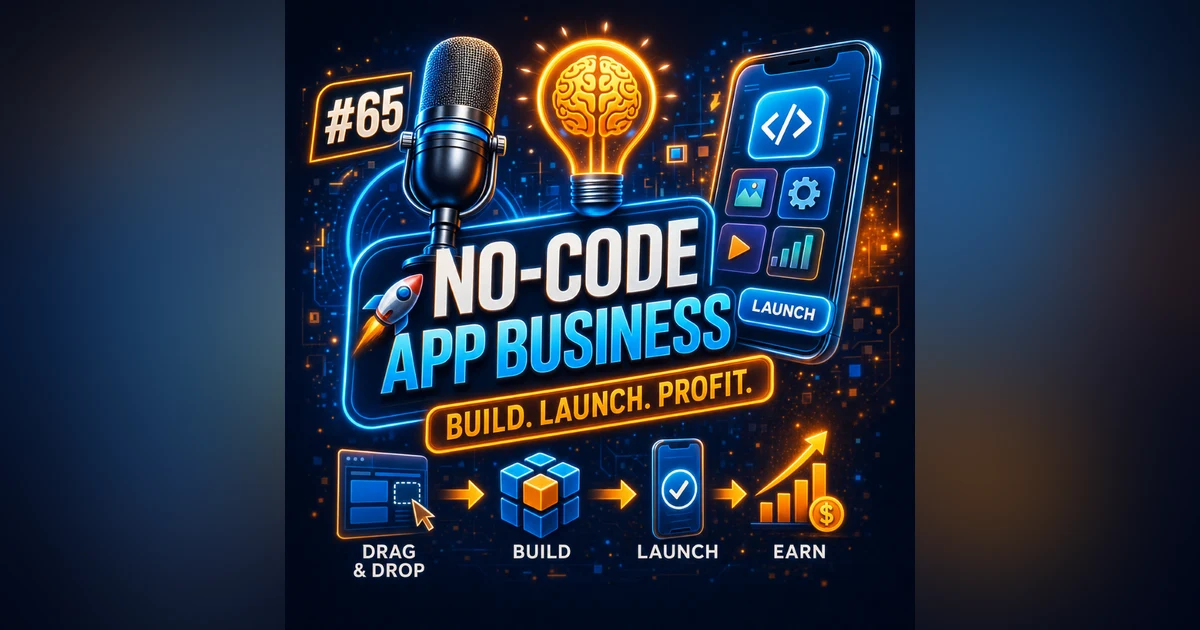


For decades, building software required learning complex code or spending $50,000 to hire a team of engineers. But today, the game has completely changed. In this episode of the Smart Entrepreneur Show, we explore the revolutionary rise of the no-code app business — breaking down how everyday problem-solvers are using visual tools like Glide, Bubble, and Airtable to architect full-scale software businesses over a weekend, and how you can use the exact same step-by-step blueprint to launch your own app without writing a single line of code. Timestamp Topic 00:00 Introduction — the collapse of the tech gatekeeper 00:35 How no-code platforms work: visual interfaces & hidden code 03:06 Building with "digital Legos" — from manufacturer to architect 04:06 Speed of development: napkin sketch to launch in a weekend 04:51 Drastically lower startup costs ($30–$100/month) 06:21 The no-code toolkit: Bubble, Glide, Airtable & Notion explained 09:09 How APIs (like Stripe) handle secure payments in Bubble 10:27 The 4-step launch blueprint: Step 1 — identify a real problem 11:29 Step 2 & 3 — choose a simple idea and build an MVP in 48 hours 13:22 Step 4 — test with users and let the market be your co-founder 14:02 Monetisation: subscription apps and paid memberships 14:49 Selling templates and tools as a secondary revenue stream 15:39 Offering freelance no-code agency services 16:15 User acquisition: building in public on TikTok and LinkedIn 18:07 Why no-code is really a marketing business 19:35 The 3 fatal mistakes: feature bloat, ignoring feedback, no validation 22:14 Final takeaway: execution and persistence are the only differentiators 23:10 Outro Contact & Resources Listen to this episode on Podbean: https://smartentrepreneur.podbean.com/ Explore more podcasts: Find all podcasts at the PodFather Network •Website: RoyCoughlan.com Need help running your business? If you are looking for a Virtual Assistant and get reliable support for your daily operations. •Virtual Assistants: VA.world •Communities: BrainGym.fitness Learn about a Private Networking Group in 50 US States & 39 Countries with 640+ Members https://connectedleaders.academy/ #SmartEntrepreneurShow #NoCode #NoCodeApp #AppDevelopment #SoftwareBusiness #TechStartup #SoloFounder #Entrepreneur #SaaS #Airtable #Bubble #GlideApps #BuildInPublic #DigitalProducts #RoyCoughlan #PodFatherNetwork #VAWorld #BrainGymFitness #SmartEntrepreneur
#65 No-Code App Business 🚀 – Build & Launch Apps Without Developers
Welcome to the Smart Entrepreneur Show, the podcast where we share smart ideas, strategies, and lessons to help entrepreneurs build better businesses. For years, people believed that building an app required coding skills, expensive developers, and a big budget. But today, the game has changed.
With the rise of no-code tools, anyone with an idea can now create apps, launch digital products, and build online businesses without writing a single line of code. In today's episode, we'll explore how entrepreneurs are building successful no-code app businesses and how you can get started step by step. Let's dive in.
Yeah, I mean, we were basically talking about the complete collapse of the tech gatekeepers here. Right. Because for decades, you know, if you wanted to build a software business, you essentially had to pay this massive toll.
Yeah, you had to have the cash. Exactly. You either spent years learning this highly specialized, really complex language of machines, or you had to pony up like $50,000 to $100,000 to hire a team of engineers.
Which most people just don't have. Right. So what we are unpacking in this deep dive is how that massive, imposing wall has effectively been demolished.
I mean, the power in the tech industry is aggressively shifting away from pure programmers and moving directly into the hands of domain experts and problem solvers. Okay, let's unpack this right from the start, though, because that phrase, without writing a single line of code, it sounds almost like internet marketing snake oil if you've never been exposed to this world before. Oh, 100%, it sounds too good to be true.
Right, like what does a no-code business actually look like mechanically? If you're building functional software, but you aren't sitting in a dark room, you know, typing out lines of syntax, what are you actually doing? Well, it's the most important question to answer first, because the mechanics are what make this so revolutionary. At its core, a no-code business is built on platforms that use visual interfaces instead of text editors. Okay, so like a dashboard.
Yeah, basically imagine a digital canvas on your screen. On the left side, you have this menu of pre-built functional components. You've got a button, an image placeholder, a text entry field, a dropdown menu.
Just sitting there, ready to be used. Exactly. You literally click on the button icon, drag it onto your canvas, and just drop it where you want it.
Then, a menu pops up asking you, when a user clicks this button, what should happen? Like, what's the action? Right. And you just select from a list. You say, create a new user account or process payment.
Well, wait, the computer still needs code to understand that command, right? Like, there has to be code somewhere. Oh, it does, and that's kind of the secret here. The code absolutely still exists, but the platform's underlying technology is doing all the heavy lifting for you.
Oh, okay, so it's hiding the code. Precisely. It acts as a real-time translator.
As you drag that button and set that rule in the visual interface, the platform's engine is instantly writing all the complex HTML, CSS, and JavaScript behind the scenes. Wow. Yeah, to make it happen.
You just never see the code. You only interact with the visual logic. So is this essentially like building with digital Legos? I mean, instead of having to manufacture the plastic and design the molds yourself, which requires an engineering degree, you're just snapping pre-built blocks together to make whatever you want.
That is honestly a brilliant way to conceptualize it. Yes. You're taking perfectly engineered blocks, like a login screen block, a strike payment processing block, maybe an in-app messaging block.
And just stacking them. Right, and you are focusing entirely on how to arrange them. It completely changes the job description of the tech entrepreneur.
Because you aren't the manufacturer anymore. Exactly. You are no longer bogged down by the manufacturing process of the raw materials.
You don't care how the plastic was molded. Your only job is the creative architecture of the solution. That makes so much sense.
Yeah, you're just focused on the workflow, the user experience, and the business logic. And according to the sources we're looking at for this deep dive today, this shift from manufacturing to architecting is the engine behind this massive boom. I mean, the benefits they list here are profound, starting with just the sheer speed of development.
Speed changes everything. I mean, think about it. When you are coding from scratch, building a custom login system with password reset emails, database security, user authentication, that could take a developer weeks.
Weeks of just typing. Right, but with a no-code platform, you drag the user authentication module onto the screen and it's fully functional in three minutes. That's insane.
It is. We are literally seeing entrepreneurs go from a sketch on a napkin on a Friday night to a fully functioning launch-ready application by Sunday evening. Because you aren't reinventing the wheel every single time.
Exactly. You're just using a wheel that already works perfectly. Which naturally leads to the next massive benefit they talk about, which is drastically lower startup costs.
Because time is money, especially when you're paying developer hourly rates. Oh, absolutely. So if I don't have to hire a team of software engineers, what am I actually paying for? Well, you are generally just paying the monthly software-as-a-service subscription fee for the no-code platform itself.
So like a standard software sub. Yeah, exactly. Usually this ranges from maybe $30 to $100 a month, depending on how much server space or traffic your app gets.
And this democratizes the entire ecosystem. Because anyone can afford 50 bucks a month. Right.
It makes software development heavily accessible to beginners. You don't need a background in computer science. You just need a deep understanding of a specific problem in a specific industry.
And the logical thinking to build a workflow that solves it. Exactly. And the combination of that speed and that low cost allows for incredibly fast testing.
I mean, if an idea doesn't work out, it's not the end of the world. Not at all. You haven't drained your life savings or wasted two years of your life building something.
You maybe lost a few weekends and 50 bucks. You can just brush it off, pivot, and try the next idea. The cost of failure is almost negligible.
Which is, frankly, a historical anomaly. Until very recently, the cost of failure in software was catastrophic for a solo founder. Now, failure is just cheap data.
So true. Let's get into the actual toolkit though. Because if you're listening to this and realizing the barrier to entry is gone, the natural next question is, how do I actually do this? What are the tools I need to learn? Right, where do you start? Yeah, our sources highlight four major platforms that keep coming up over and over.
Bubble, Glide, Airtable, and Notion. But I wanna push back on a couple of these, starting with Airtable and Notion. Okay, let's hear it.
I've seen these, and honestly, they just look like really pretty spreadsheets or document editors to me. How are people building software businesses on top of glorified spreadsheets? It's a super common misconception, actually. But comparing Airtable to a spreadsheet is like comparing a smartphone to a landline.
Oh, really? Yeah, I mean, on the surface, sure, Airtable presents data in rows and columns. But under the hood, it is a highly sophisticated relational database. Okay, explain that difference.
So in a standard spreadsheet, a cell is just dumb text. It just sits there. In Airtable, a cell can be a live, dynamic link to an entire ecosystem of data.
So things talk to each other. Exactly. You can link a customer's name in one table directly to their purchase history in another table, and then trigger an automated email if their subscription's about to expire.
All from the quote-unquote spreadsheet. Right. Entrepreneurs use Airtable and Notion as the powerful back-end brains of their businesses.
It manages vast amounts of logic, content, and data processing completely automatically. Okay, so that handles the back-end data. But users don't wanna log into a database.
They want a clean, beautiful app on their phone. That's where platforms like Glide come in, right? That's the mechanism, yes. Glide is a front-end builder that is specifically designed to sit right on top of databases like Airtable, or even just Google Sheets.
Oh, wow. So it just reads the spreadsheet. Yeah.
Glide takes your raw data columns, say you have a column for product image, a column for product name, and a column for price, and it automatically maps them to a beautiful mobile interface. So it does the design work for you. Exactly.
It creates the screens, the buttons, the navigation, and the best part is it's a two-way street. Meaning what? Meaning if a user opens the Glide app on their phone and clicks Purchase, the app sends a signal back to your Airtable database and updates the inventory number in real time. That is so cool.
Okay, so then there's Bubble, which our sources mention is basically the heavy hitter of the group. If Glide is for fast mobile apps built on spreadsheets, what is Bubble doing? Bubble is for building full-scale, incredibly complex web applications. It's essentially the closest you can get to traditional programming without actually writing syntax.
Okay, so it's more advanced. Very much so. It allows for intricate logic, custom user account portals, dynamic dashboards, and really deep integrations with other software.
But wait, back up. Bubble sounds powerful, but if I'm building an app that processes money, isn't it dangerous to trust a drag-and-drop tool with people's credit cards? Like, how does that work without custom security code? Trusting a visual builder with credit cards? Yeah, that would be terrifying. But it works through something called an API, an application programming interface.
Okay, I've heard that term. What does it actually do here? When you build a checkout page in Bubble, you aren't building a payment processor from scratch. Bubble is just acting as the visual interface.
So it's just the window. Right. When the user hits pay, Bubble uses an API to securely hand that encrypted data over to a dedicated, highly secure payment giant, like Stripe.
Ah, so Stripe is doing the actual money part. Exactly. Stripe actually processes the money, handles the heavy security, deals with the banks, and then pings an API message back to Bubble saying payment's successful.
And then Bubble just shows the success screen. You got it. You're literally just connecting secure puzzle pieces together.
That makes total sense. So we have these incredible, powerful tools. You've got your relational database, your visual front-end mapper, your API connectors.
But having a garage full of the best power tools doesn't mean you know how to build a house that won't collapse. No, not at all. Our sources lay out a very specific step-by-step launch blueprint for actually building a business with this tech.
Let's walk through it. Step one they list is identify a real problem. This is where that shift from programmer to problem solver really manifests.
Because the biggest mistake aspiring founders make is coming up with a cool app feature in their head, building it, and then wandering around looking for a market to sell it to. A solution looking for a problem. Exactly.
The blueprint flips that. You have to start by observing the real world. You need to find a genuine point of friction in a specific industry.
Like what? Well, go talk to real estate agents or freelance designers or gym owners. Find out what administrative nightmare is eating up five hours of their week. Right, what are they pulling their hair out over? Right, and then realize you can build a no-code tool to automate that exact thing.
A real problem is something people are actively frustrated by. And crucially, they're already spending time or money trying to fix it. Okay, so once you have that problem, step two is choosing a simple app idea, which leads right into step three.
Building an MVP, a minimum viable product. Yes. But I have to stop here and push back a bit.
When you have platforms like Bubble or Glide that let you snap on new features with just a few clicks, isn't the temptation to build something incredibly complex right away? Why is the MVP just creating a pop-up shop version of your app so crucial here? That is a great question because the ease of the tools actually creates a massive psychological trap. Really? How so? Well, think about it. When traditional coding took months and months, an MVP was a financial necessity.
You literally only had the budget to build the bare minimum. Because every new feature was another 10 grand. Exactly.
Yeah. But in the no-code world, when adding a new messaging forum or an analytics dashboard takes 20 minutes, founders go crazy. They use feature development as a shield.
A shield against what? Against the market, against rejection. Yeah, I mean, as long as you are still building and adding just one more feature, you don't have to launch. You don't have to face the terrifying possibility that no one wants to buy your product.
So you just hide behind the building process. Exactly. Building an MVP, a minimum viable product, forces you out of the building.
In the no-code world, your MVP shouldn't take three months. It should take maybe 48 hours. Just a weekend.
Right. It is the most stripped down, ugly, basic version of your app that still solves that core problem you identified in step one. Because every extra feature you build before launching is essentially just an assumption, right? You're guessing that the user wants a messaging forum.
You're guessing they want an analytics dashboard. You are guessing in a complete vacuum. The goal of the no-code MVP isn't to launch a perfect product.
The goal is to get a functional prototype into the hands of real people so they can tell you what they actually want. Which is the fourth and final step of the blueprint. Test with users and improve gradually.
You launch the ugly version, you watch how people try to use it, you listen to their complaints, and then you use those rapid no-code tools to quickly snap on the new features they are actually begging for. Exactly. You let the market dictate the development roadmap.
The market becomes your co-founder. That's a perfect way to put it. The market is your co-founder.
But building the app is actually kind of the trap, isn't it? Because you snap together these digital Legos over the weekend, you launch your MVP, and you suddenly think you have a business. But a product sitting in a vacuum isn't a business. No, it's just a hobby.
Right. A product only becomes a business if it generates revenue and attracts users. And our sources outline several distinct ways to monetize this work.
The first two are subscription-based apps and paid memberships. Yeah, and these are really the holy grail models because they provide recurring revenue. Everyone loves recurring revenue.
Obviously. And using the API connections we talked about earlier, you know, like Stripe, you can easily set up a secure paywall. So users pay 10, 20, or $50 a month to access the app's core functionality.
Or a membership model. Right, they pay for a membership that grants them access to premium-gated content, maybe a private community directory, or specialized workflows you've built into the platform. But what if you don't want to run a traditional software-as-a-service company? The sources also mention selling templates or tools, which I found really interesting.
Oh, this is a fascinating, highly profitable secondary market. It's essentially monetizing your own byproducts. What do you mean by byproducts? Okay, let's say you spend a month building an incredibly efficient, automated project management system in Notion for your own freelance design business.
You've dialed in the relational databases, the client portals, the automatic invoicing. It's perfect. Well, instead of just using it yourself, you can package that exact Notion workspace as a template.
Oh, I see. Yeah, you sell it for a one-time fee of 50 bucks to thousands of other freelance designers who have the exact same problem, but, you know, they don't want to spend a month learning how to build it. I love that.
You solve your own problem and then sell the solution to everyone else. And the final monetization method listed is offering freelance no-code services. Right, becoming an agency of one.
Even though no-code platforms are vastly easier to learn than, say, JavaScript, there's still a learning curve. Sure, it still takes some effort. There is still logic and architecture to master.
Most small business owners do not have the time to learn Airtable. So if you become an expert in these platforms, you can charge traditional agency rates like thousands of dollars to build custom internal tools, inventory trackers, or client portals for growing mortar businesses. Here's where it gets really interesting, though, because whether you're selling a subscription app, a template, or freelance services, you need eyeballs.
You need people to actually know you exist. Absolutely, the build it and they will come myth is dead. Feel very dead.
The sources highlight user acquisition strategies like TikTok, LinkedIn, content marketing, and online communities. But they focus really heavily on this concept of building in public. Yes.
How does that actually work in practice? Are you just posting screenshots of your Airtable base on LinkedIn? Because that sounds awful. No, no, not quite. Screenshots are boring.
People connect with narrative and they connect with struggle. Okay. Building in public means documenting the raw reality of your entrepreneurial journey.
So you post a short video on TikTok saying, hey, I'm trying to build an app for local gym owners. I spent five hours trying to figure out this Stripe integration today. Here's the wall I hit, here's the mistake I made, and here's the workaround I finally figured out.
Oh, so you're treating the development process itself as the content marketing. Precisely. And by doing that, you accomplish two huge things.
First, you build immense trust because you are completely transparent. People love authenticity. Exactly.
And second, you naturally attract an audience of other builders, founders, and most importantly, your target market. They get emotionally invested in your story. So when you finally do launch the product, you aren't launching to crickets.
Right. You are launching to an audience that has been rooting for you for three months. So no-code tools are basically like getting a free printing press.
It's an amazing technological leap, but owning a printing press doesn't make you a best-selling author. No, it just prints the pages. You still have to write a book people wanna read and you still have to convince them to buy it.
Since you're saving so much time and money by not hiring traditional developers, it seems like your main job completely shifts. Is it fair to say that running a no-code app business is really just running a marketing business? That is the most accurate way to view this entire landscape, honestly. In a traditional software startup from, say, 10 years ago, 80% of the budget, the time, and the mental bandwidth went into engineering.
Just making the thing work. Right. Just getting the product to load on a browser was a massive victory.
But with no-code, the development process is streamlined. The heavy lifting is handled by the servers that glide or bubble. Because you aren't bogged down in technical debt, the product creation becomes the baseline.
The easy part, almost. Exactly. Distribution becomes your primary competitive advantage.
As a no-code founder, you are essentially a marketer and a community builder who just happens to be selling software. So what does this all mean for the day-to-day reality of someone listening right now who wants to jump into this? The sources explicitly state that this model is the ultimate advantage for solo entrepreneurs. It creates a level of independence we just haven't seen in tech before.
Because of the speed and the low cost, you don't need to dilute your ownership by bringing on a technical co-founder. And you don't have to give away half your company. Right.
You don't need to spend six months pitching venture capitalists just to raise enough money to build a prototype. You can conceptualize a solution, architect it in Bubble, market it on TikTok, and process payments through Stripe entirely by yourself from your kitchen table. But of course, no incredible opportunity comes without risks.
Naturally. And our sources outline three critical mistakes to avoid. We already touched on the first one, adding too many features too early, the feature bloat trap, which is really just an ego defense mechanism against launching.
Yeah, and beyond the psychology of it, it physically dilutes the core value of your app and just confuses the user. You have to stay relentlessly focused on the single core problem. Which ties directly into the second mistake they mentioned, ignoring user feedback.
Oh, this is fatal. If the fundamental superpower of the no-code model is your ability to launch rapidly and iterate based on reality, then ignoring the feedback of your early users completely neutralizes your advantage. You're throwing away your best data.
Exactly. Those early users are handing you the answers to the test. They will tell you exactly what workflow is clunky, what button is confusing, and what feature they would gladly pay an extra $10 a month for.
Right. If you ignore that data in favor of your original assumptions, the business will plateau and die. And that leads to the final error mentioned in the sources, building without validating demand first.
Just because you can build a beautifully functioning app over a long weekend, doesn't mean you should. The ultimate trap. Yeah.
Validating demand means proving, usually with actual money or deep engagement, that the problem you identified is actually painful enough that people want a solution. How do you do that without building the app first? Well, before you drag a single visual block onto a canvas, you should be talking to potential customers. Try to pre-sell the idea, set up a really simple landing page, and see if people will give you their email address for early access.
Just to gauge interest. Right. If you don't validate that demand up front, you're spending months building a masterpiece of no-code architecture that literally no one wants to use.
It sounds like the biggest risk in the no-code world isn't technical failure anymore, it's human ego. It's the danger of falling in love with your own idea without checking if anyone actually wants to buy it, right? That is the sobering reality of this whole revolution. The technical barriers have been completely removed.
That is a wonderful thing for innovation, but it also removes all your excuses. Yeah, there's nobody else to blame. Exactly.
The no-code platforms will not save you from a flawed business model. They won't generate market demand out of thin air. They simply expose whether your core idea was fundamentally sound or just a personal vanity project.
And they expose it fast. Much, much faster than traditional coding ever could. The only thing standing between you and failure now is your own discipline to listen to the market.
Wow. Okay, as we wrap up this deep dive, if we had to distill all of these articles, notes, and frameworks down to a single core takeaway for the listener, what is the synthesis? The synthesis is that the era of the technical gatekeeper is over. You no longer need to be a programmer to build a highly successful, highly scalable software business.
The gates are open. Totally open. The tools are available, they're cheap, and they are astonishingly powerful.
What you truly need to succeed in this new landscape is a valuable idea rooted in a genuine, painful problem. And the consistency to build an MVP, test it with real people, and relentlessly improve it over time. Execution and persistence are basically the only true differentiators left.
If the technical barrier to creating software is effectively zero, the real currency of the future isn't coding. It's your ability to spot everyday problems that need solving. So what is a frustrating bottleneck you faced in your work or life today that a simple drag and drop app could fix? If you enjoyed this episode of the Smart Entrepreneur Show, make sure to follow the podcast so you don't miss future episodes, and feel free to share your thoughts or experiences in the comments.

PodFather
I am a serial entrepreneur who has founded 21 companies across 6 countries. Known in the industry as “The PodFather,” I am a business podcast coach and host who has launched eight successful podcasts—6 ranking in the Top 5%, with four reaching the coveted Top 0.5% globally.
Beyond podcasting, I co-founded brainupgrade.org a platform designed to boost cognitive performance and unlock peak mental potential. I am also the co-founder of VA.World, connecting businesses with exceptional Virtual Assistants tailored to their unique needs.
I also have Sponsorship ads available that are Dynamically inserted into my 8 shows