#61 Small Creator, Big Deals – How to Land Brand Collaborations Fast
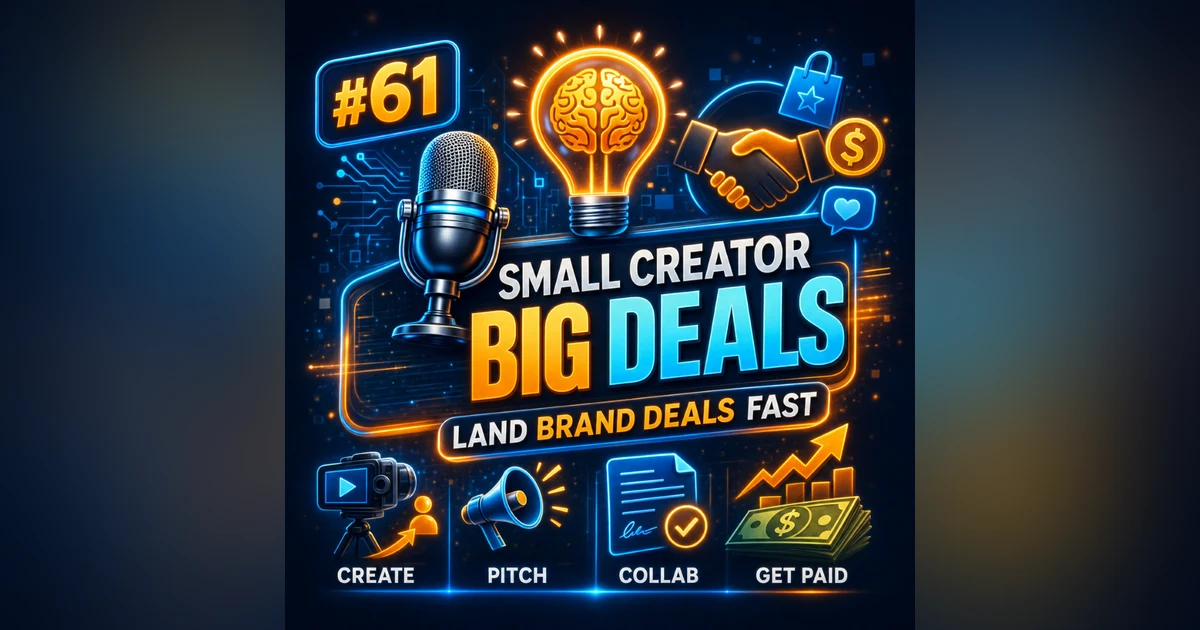


Think you need hundreds of thousands of followers to land paid brand deals? Think again. In this episode of the Smart Entrepreneur Show, we pull apart the micro-influencer blueprint and show exactly how small creators are securing paid collaborations right now — without a massive audience, a PR firm, or a viral moment.
This is the episode that reframes your follower count from a weakness into a superpower.
In this episode you'll learn:
- Why brands are quietly spending millions on creators you've never heard of — and the math that explains it
- The engagement rate shift: why saves, shares, and long-form comments matter more than likes or views
- The CAC breakdown: how a micro-influencer at $500 can outperform a celebrity at $500,000
- Why a niche is a beacon, not a prison — and how to position your profile as a B2B business entity
- The 3 proactive outreach strategies: cold email/DM, influencer marketplaces, and strategic brand tagging
- What a media kit actually needs (just 3 things) — and why creating one is the mindset shift that changes everything
- The anatomy of a value-first pitch that works — versus the generic copy-paste approach that guarantees silence
- Why you should never mention your follower count in a pitch — and what to lead with instead
Need help running your business? If you are looking for a Virtual Assistant, visit va.world and get reliable support for your daily operations.
Explore more podcasts: Find all podcasts at the PodFather Network → roycoughlan.com
#SmartEntrepreneurShow #BrandDeals #MicroInfluencer #CreatorEconomy #InfluencerMarketing #BrandCollaboration #ContentCreator #SmallCreator #PaidPartnerships #MediaKit #InfluencerTips #NicheMarketing #EngagementRate #B2BMarketing #UGCCreator #InstagramMarketing #TikTokCreator #YouTubeCreator #PitchBrands #MakeMoneyCreating #DigitalMarketing #CreatorBusiness #BuildYourBrand #AuthenticMarketing #RoyCoughlan #PodFatherNetwork #VAWorld #VirtualAssistant #SmartEntrepreneur
Welcome to the Smart Entrepreneur Show, the podcast where we share smart ideas, strategies, and lessons to help entrepreneurs build better businesses. Do you think you need thousands of followers to land brand deals? Think again. In today's episode, we'll break down how even small creators can start getting paid collaborations and brand deals using the right strategy without meeting a massive audience.
If you're creating content on platforms like Instagram, YouTube, or TikTok, this episode is for you. Let's get started. Yeah.
And it's such a timely topic, right? Because if you've been paying any attention to the creator economy lately, you have probably noticed this just like massive contradiction going on. Completely. It's like everyone operates under this wild assumption that you absolutely need, you know, a silver play button or a verified check mark to actually make a single dollar.
Right. Exactly. But then behind the scenes, brands are just quietly pouring millions of dollars into creators that you and I have never even heard of.
Yeah, which is exactly why our deep dive today is pulling straight from the micro-influencer blueprint, the art of the brand deal. Our mission is to really map out exactly how smaller creators are navigating this landscape, like not as lucky hobbyists, but as legitimate B2B operations. So to set a quick baseline here, because I know you listening already understand the fundamental mechanics of a value exchange.
When the blueprint discusses brand deals, we are looking specifically at paid collaborations, you know, where companies compensate you for promoting their product or service. Right. So we aren't talking about like securing a multi-year celebrity endorsement or slapping your face on a billboard in Times Square.
No, definitely not. We're analyzing highly targeted, really tactical exchanges of value that entrepreneurs and creators can start structuring right now. The goal is to just strip away all those vanity metrics and focus entirely on practical, real-world tools.
Okay, let's unpack this because before we can even get to the actionable, you know, how-to part of this blueprint, we have to completely tear down the single biggest psychological barrier holding people back. Oh yeah, the great follower myth. Exactly.
This pervasive idea that you need millions, or I mean, at least hundreds of thousands of followers before a brand manager will even bother to open your email. Think follower account like foot traffic walking past a massive mega mall. That's a really good way to visualize it.
Right. Because sure, a million people might walk by the glass doors of that mall, but how many actually stop? And how many bother to go inside? And crucially, like how many actually open their wallets and buy something? Yeah, the conversion rate there is usually terrible. It really is.
On the flip side, having a highly engaged niche audience is a lot more like running a small specialized boutique. You know, you might only get 50 people walking through your door every day, but because you curate specifically for them, almost every single person who walks in actually buys something. What's fascinating here is the underlying psychology of why brands have fundamentally shifted their marketing strategies over the last few years.
Because the blueprint makes it very clear, brands care significantly more about engagement rate, a hyper specific niche audience, and most importantly, algorithmic trust. Algorithmic trust, right. Because that mega mall approach we just talked about is just incredibly inefficient.
It's wildly inefficient. Let's actually define what engagement rate means in this context too, because it's not just about passive likes or views. Brands are looking at active metrics now.
Like what? What are they specifically tracking? Well, they're looking at things like how many people save your post to reference later, or how many share it in a direct message with a friend. Oh, that makes sense because a share is way more valuable than a like. Exactly.
Or how many leave a thoughtful, long form comment asking a specific question about the product. Those actions indicate a community that is actually listening, not just mindlessly scrolling on the toilet. I want to challenge that slightly though, just playing devil's advocate for the traditional marketing mindset here.
If a brand wants to sell, say, 10,000 units of a new skincare serum, wouldn't it still be mathematically easier and just less time consuming for them to pay one massive A-list celebrity to post about it, rather than trying to herd 50 different micro-influencers? You would think so, right. But looking at the raw data, the answer is usually no. And it all comes down to customer acquisition cost, or CAC.
Let's run that hypothetical math really quick. Okay, let's hear it. A brand might pay a massive celebrity, say, $500,000 for a single post.
Which is a huge chunk of marketing budget. Right. But because that celebrity's audience is just a random, diluted mix of people from all over the world with entirely different interests, the conversion rate is shockingly low.
Maybe they only sell 1,000 units. Right. Yeah, so that means they effectively paid $500 to acquire each customer.
Now, take that exact same budget and distribute it. If they pay a micro-influencer $500, and because of that deep trust, that creator sells 50 units. The cost to acquire a customer drops to just $10.
Exactly. Just $10. Multiply that by a roster of 50 niche creators, and the brand is generating exponentially higher sales for a fraction of the cost.
The blueprint emphasizes that deep trust yields tangible influence. It bypasses the filter. Yeah, when a smaller creator recommends a product, it completely bypasses the consumer's advertising filter, because it feels like a genuine recommendation from a knowledgeable friend.
That reframes the entire power dynamic. Yeah. It's the difference between seeing a generic highway billboard for a new restaurant versus your absolute best foodie friend texting you to say, hey, you have to try this place.
I know you'll love the pasta. Right, you're going to trust the friend every time. You are, and you're going to make a reservation.
If trust and a hyper-specific niche are your true currency, how do we package that? That leads us right into the foundation of all of this, your digital storefront. Your profile. Yeah, your profile needs to immediately broadcast those B2B signals to any brand that happens to audit your page.
The blueprint emphasizes that small creators stand out by focusing heavily on that specific niche and then translating that focus into the structural architecture of their profile. I mean, it has to look like a professional business entity. Which means having a clear bio, right? One that tells people exactly what you do, who you serve, and what value you provide.
Exactly. It means your content is distinctly focused on your niche without wild, random deviations. And critically, this is huge, your contact email must be visible and easily accessible.
I hear that, but I have to voice a very real concern that a lot of creators struggle with. Isn't focusing on just one specific niche incredibly limiting? I mean, what about an entrepreneur or creator who has a diverse set of passions? Give me an example. Well, let's say I love ultralight hiking, but I also really love baking sourdough bread, and I'm a massive nerd for vintage watches.
If I just pick one of those to post about, aren't I boxing myself in and stunting my own creativity? That anxiety is so common. But we really have to completely reframe how we think about a niche in a B2B context. A niche isn't a prison, it's a beacon.
A beacon. I like that. It is the exact targeting parameter that makes a smaller creator valuable to a specific brand trying to solve a specific marketing problem.
Think about the brand manager doing the search on their end. They're probably using some kind of database software, right? Exactly. And if a company that manufactures high-end hiking boots is looking to allocate budget for product reviews, they aren't going to type cool person with diverse hobbies into their search bar.
Right, they don't care about the sourdough bread. They don't. They are querying outdoor gear creator Pacific Northwest.
They want the creator whose entire audience is already obsessed with the outdoors. By narrowing your digital storefront, you are signaling to brands in that specific industry that you are the exact right person to speak to their ideal customer. So you can still do all your other hobbies, just maybe not on the main business page.
Precisely. You can absolutely still bake bread and collect watches in your free time, but your public-facing business profile needs to solve a specific problem for a specific audience. A beacon, not a prison.
That makes perfect sense when you look at it through the lens of a search algorithm. It's all about clarity. When a brand manager lands on your page, they shouldn't have to spend three minutes scrolling just to figure out what industry you actually belong to.
Time is money for them. Right. And regarding that visible contact email you mentioned, I look at that like flipping the open for business sign on the front door.
I imagine a brand manager auditing 100 different profiles in a single afternoon if they have to hunt for a way to message you. Or if they have to leave a comment begging you to check your DMs. Exactly.
If they have to do that, they just aren't going to bother. They're just going to move on to the creator who made it easy. That administrative friction kills more brand deals than bad content ever could.
Having an email out in the open removes that friction. You are clearly communicating to corporate partners that you understand this is a professional space and you are ready to receive business inquiries. But having a beautifully optimized profile is only half the battle, isn't it? I mean, you can have the most stunning, highly curated boutique in the world.
But if you just sit behind the counter waiting for foot traffic to magically discover you, you're playing a losing game. You really are. We need to transition from passive preparation to proactive hunting.
And the blueprint outlines the toolkit needed for this exact phase. So how do we actively hunt for these deals? The source material breaks down three primary avenues. First, reaching out to brands directly through cold email or direct messages.
Second, utilizing influencer marketplaces. And third, strategically tagging brands in the high quality content you are already publishing. OK, but before we get into the outreach, the blueprint mentioned something else you need first.
Yes. Before you initiate any outbound strategy, the blueprint insists you absolutely must develop a media kit. Here's where it gets really interesting, because I think a lot of people hear the phrase media kit, and they immediately visualize, like, some complex 30-page corporate dossier created by an expensive PR firm.
Oh, yeah. They totally overthink it. Right.
But practically speaking, your media kit is essentially a targeted B2B cover letter and a data sheet rolled into one simple, visually appealing PDF. According to our sources, you don't need all that fluff. You just need three core data points.
Which are? Your audience demographics, your active engagement stats, and clear examples of your absolute best content. If we connect this to the bigger picture, the creation of that media kit is a massive psychological milestone. I mean, it represents the exact moment you transition from a hobbyist mindset to a B2B professional mindset.
You cross the threshold. You do. You are no longer just an individual posting videos for the front of it.
You are a media company offering a targeted marketing service to another business. Your media kit is your concrete proof of value. It proves you actually know who is watching you.
Exactly. It proves to a brand that you understand your audience's age, gender, and location. It proves you know exactly what your engagement rate is, which, again, is your actual superpower.
And it demonstrates your ability to produce high-quality visual assets. Let's focus on how to present that data, too. Because saying, I have 5,000 followers is just weak.
But putting a stat in your media kit that says 75% of my audience are women aged 25 to 34 living in major urban centers, and my videos average a 12% save rate. Now, that is a language a brand manager understands. Exactly.
It translates your creative work directly into their marketing metrics. Now, you mentioned influencer marketplaces a moment ago. And I have to admit, if I only have 1,000 followers and an amazing engagement rate, my biggest question is, how does a brand even find me in the algorithm to see my email in the first place? It can be tough organically.
Right. So marketplaces seem to solve that. How exactly do they function? Influencer marketplaces are essentially B2B matchmaking algorithms, or think of them like RFP boards request for proposal boards.
Oh, okay. So instead of you randomly guessing which brands might actually have a marketing budget this month and sending a cold email into the void. You log into a platform where brands have actively posted their current campaigns.
A brand might post, hey, we have a $5,000 budget, and we are looking for 10 micro-influencers in the sustainable living space to review our new biodegradable soap. Oh, wow. That flips the traditional dynamic entirely.
It completely removes the guesswork. You read the brief. And if your audience aligns with their target demographic, you just submit your media kit and your proposed rate directly through the platform.
That is incredibly empowering. It significantly lowers the barrier to entry because you already know they have money to spend, and they are actively looking for creators exactly your size. Exactly.
And then there's the tagging strategy. The blueprint mentions tagging brands in your high-quality content. I want to clarify for the listener that this isn't just desperately tagging a brand in your caption saying like, notice me, please sponsor me.
No, please don't do that. It looks so unprofessional. Right.
It's about creating an amazing piece of content, featuring a product you already use and love, tagging them, and effectively saying, here is a free sample of the high-quality user-generated content I can produce for your brand. It's a portfolio piece happening in real time. That distinction is crucial.
You are providing value up front. By giving them a piece of content, they might actually want to repost on their own channels. But, you know, whether you are applying through a marketplace, relying on an inbound lead from a tag, or reaching out directly via email, you are eventually going to have to communicate with another human being who controls that brand's budget.
The dreaded pitch. Yes. And that brings us to the most critical juncture of the entire blueprint, the pitch.
So what does this all mean in practice? Because I have to be completely honest here. For a beginner, the idea of sending a cold pitch to a brand manager seems incredibly intimidating. You are putting yourself out there, essentially asking a stranger for money or free products.
It's scary for a lot of people. What if they just ignore you? Or what if they reply and say your audience is just too small? It feels like a massive emotional hurdle to get over. This raises an important question about resilience and setting proper expectations in business.
The source material highlights that the single biggest mistake a creator can make is simply waiting for brands to come to them. Rejection, or honestly, more commonly, absolute silence, is just a standard part of any outbound sales process. So if a brand ignores your pitch, it's not a reflection of your worth? Rarely.
It rarely has anything to do with your worth as a creator. It might just mean they exhausted their quarterly marketing budget three weeks ago, or the manager was on vacation and your email just got buried. You have to detach your ego from the outcome.
That makes sense. However, the blueprint also points out that while silence is normal, sending generic, copy-paste messages is what will absolutely guarantee failure. Oh, you mean the classic, dear brand, I love your products, I have 3,000 followers, please send me free stuff.
That is the exact trap. When a brand manager opens their inbox and sees a generic template where you clearly just swapped out the company name and BCC'd 50 other brands, they delete it within two seconds. Because it shows you didn't do your homework.
It demonstrates zero effort and, more importantly, zero understanding of their specific business goals. This brings us back to the golden rule of the blueprint. Deliver value first.
Your pitch should never be focused on what the brand can do for you or how much you really want their product. It must be entirely focused on the specific problem you can solve for them. Exactly.
I really want to double click on that. Deliver value first. That is the mindset shift that separates the amateurs from the professionals.
So let's dissect what a good pitch actually sounds like compared to that generic one. Let's hear it. A highly targeted value first pitch would sound more like, Hi Sarah, I've been exclusively using your organic fertilizer in my indoor gardening video series for the last six months and my community is constantly asking for the link.
Great hook. I noticed your company is launching a new soil mix next month. I'd love to pitch a dedicated review video highlighting exactly how this new mix solves drainage issues for tropical plants, which is the number one pain point my audience struggles with.
I've attached my media kit showing my 15% engagement rate in the houseplant niche. Let me know if you have five minutes next week to discuss a collaboration. The psychology behind that pitch is absolutely flawless.
Let's break down why that works from the brand manager's perspective. First off, you use their actual name. Right, no dear sir or madam.
Second, you proved you are already a genuine consumer of their product, which basically guarantees authenticity. Third, you identified a specific gap in their marketing promoting an upcoming product launch. You did the research.
You did. And fourth, you demonstrated a deep understanding of your own audience's pain points and exactly how their product solves it. You didn't just ask for a handout.
You submitted a targeted business proposal. You've made it incredibly easy for the brand manager to look at that email and say, Yes, this person gets it. This will save me time.
And notice one glaring omission from that pitch. I didn't mention my follower count once. Not a single time.
Nope, you didn't need to. Because you are leaning entirely on your niche expertise, your engagement rate, and the specific strategic value you bring to their launch. And that touches on the final pitfall the blueprint warns against.
Focusing your own mindset on your follower count. It's self-sabotage. It really is.
If you walk into a pitch leading with, I know I only have 5,000 followers, but perhaps you are immediately devaluing your own inventory. You are apologizing for your size instead of leaning into your superpower, which is that deep, highly engaged algorithmic trust. You have to own your space and recognize the unique value of a tight-knit community.
Which really brings us to the ultimate summary of the source text. Let's bring it home. If we distill this entire micro-influencer blueprint down to its absolute core thesis, it's this.
Small creators can, and do, land massive opportunities by building trust, not just accumulating numbers. Brands are desperately searching for authentic voices that can genuinely influence purchasing decisions within specific, walled-off communities. You don't need a stadium full of disinterested people.
You just need a small room full of people who implicitly trust what you have to say. It's quality over quantity, executed with a B2B strategy. That shifts the whole paradigm, doesn't it? It completely changes the game.
It takes the exhausting pressure off of trying to go viral every single day and puts the focus back on creating really great, highly helpful content for the people who are already sitting in the room with you. When you combine that mindset with the practical tools, an optimized digital storefront, a data-driven media kit, and a proactive value-first pitching strategy, you completely bridge the gap between being a casual content creator and operating as a successful digital media business. It really is a comprehensive blueprint for the modern creator economy.
It really is. And as we wrap up this deep dive, I want to leave you with a final thought to mull over as you audit your own content strategy this week. What if the most valuable asset you own isn't actually your video library or your carefully curated aesthetic or even your follower count, but rather the deep, highly specific trust you've cultivated with your community? How differently would you treat your business if you truly believed that trust was your primary product? That is a very powerful question to ask yourself.
If you enjoyed this episode of The Smart Entrepreneur's Show, make sure to follow the podcast so you don't miss future episodes, and feel free to share your thoughts or experiences in the comments.

PodFather
I am a serial entrepreneur who has founded 21 companies across 6 countries. Known in the industry as “The PodFather,” I am a business podcast coach and host who has launched eight successful podcasts—6 ranking in the Top 5%, with four reaching the coveted Top 0.5% globally.
Beyond podcasting, I co-founded brainupgrade.org a platform designed to boost cognitive performance and unlock peak mental potential. I am also the co-founder of VA.World, connecting businesses with exceptional Virtual Assistants tailored to their unique needs.
I also have Sponsorship ads available that are Dynamically inserted into my 8 shows