#58 Build a Loyal Community – Turn Followers into True Fans & Buyers
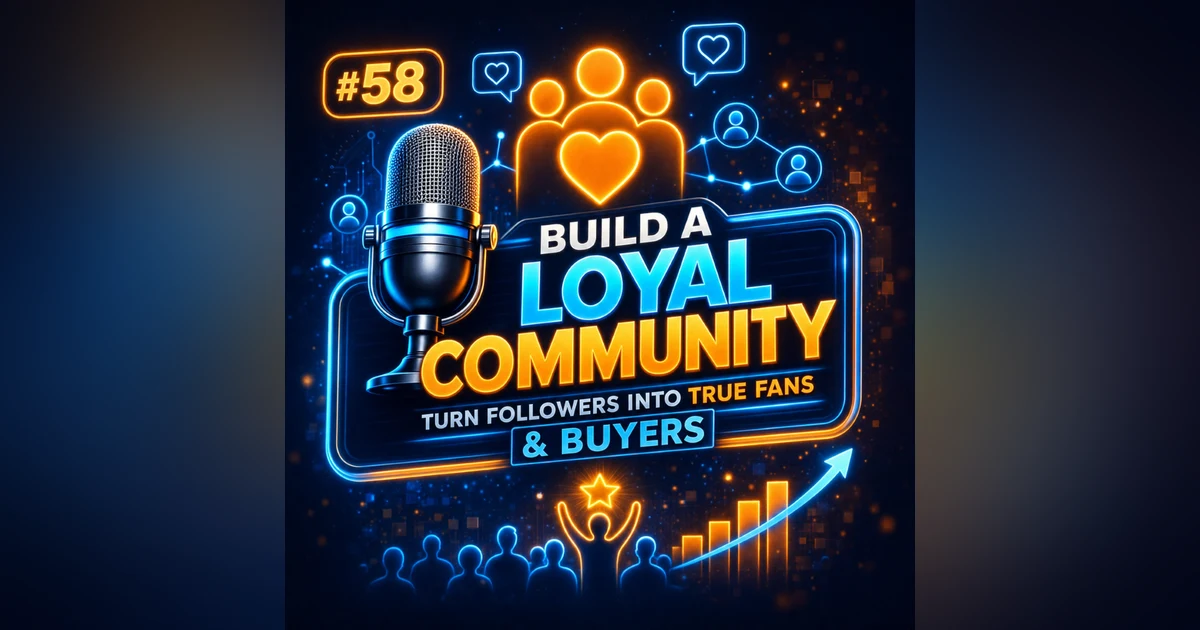


You can have thousands of followers and still struggle to make money or create real impact. Why? Because followers don't equal trust — and trust is the only currency that actually converts. In this episode of the Smart Entrepreneur Show, we break down how to stop chasing vanity metrics and start building a community-based business that genuinely supports, engages, and grows with you.
From getting people off the algorithmic highway, to creating psychological safety inside private channels, to turning community conversations into your next product launch — this is the blueprint for sustainable digital business.
In this episode you'll learn:
- Why discovery platforms (Instagram, TikTok, YouTube) are billboards, not destinations — and how to get people to take the exit
- The digital architecture shift: why Discord, Telegram, and Facebook Groups support community in ways that algorithmic feeds actively destroy
- The "broken sauce" principle: how vulnerability and behind-the-scenes authenticity builds deeper trust than polished content ever can
- How to balance personal storytelling with interactive problem-solving — so it's never just a diary entry
- How an engaged community literally hands you your next product, course, or coaching offer
- The 3 silent killers of community: chasing numbers, ignoring feedback, and inconsistency
- The ultimate diagnostic test: can your community survive a month without you?
Need help running your business? If you are looking for a Virtual Assistant, visit va.world and get reliable support for your daily operations.
Explore more podcasts: Find all podcasts at the PodFather Network → roycoughlan.com
#SmartEntrepreneurShow #CommunityBuilding #TurnFollowersIntoFans #OnlineCommunity #DigitalBusiness #TrustMarketing #AudienceBuilding #DiscordCommunity #TelegramMarketing #FacebookGroup #ContentCreator #AuthenticMarketing #Entrepreneur #CourseCreator #MembershipSite #OnlineCoaching #DigitalProducts #VanityMetrics #SocialMediaStrategy #CommunityOverAudience #CreatorEconomy #EngagementStrategy #BusinessGrowth #PeerToPeer #BuildYourBrand #RoyCoughlan #PodFatherNetwork #VAWorld #VirtualAssistant #SmartEntrepreneur
Welcome to the Smart Entrepreneur Show, the podcast where we share smart ideas, strategies, and lessons to help entrepreneurs build better businesses. Today we're talking about something most people get wrong, focusing only on followers instead of building a true community. You can have thousands of followers on platforms like Instagram or YouTube but still struggle to make money or create impact.
Why? Because followers don't always mean trust. In this episode, we'll break down how to build a community-based business that actually supports, engages, and grows with you. Let's dive in.
I'm really excited for this one. Yeah, me too. Okay, let's unpack this because we all know the old cliche by now, right? Oh, for sure.
Like every smart entrepreneur listening to this deep dive understands, at least on some level, that vanity metrics are a total trap. Yeah, they are. They really are.
We know a million followers doesn't automatically equal a million dollars in the bank. We get that. Right.
It's not a direct translation at all. But yet, despite knowing this, it's like we're all still completely addicted to the dashboard. Oh, absolutely.
It's an addiction. We still chase the viral reel. We still obsess over the subscriber count.
And I guess my first question is, why is it so incredibly hard to break that habit? Like, why do we gather passive watchers when we know we should be building active trust? Well, I mean, it really comes down to how these platforms have fundamentally rewired our brains, right? Both as consumers and as business owners. Yeah. What's fascinating here is the underlying psychology of the algorithmic feed.
Platforms like Instagram or TikTok or YouTube Shorts, they are engineered for frictionless, infinite discovery. Frictionless, that's a good word for it. Right.
Because they flood our brains with dopamine by showing us something completely new, like every three seconds. It's like a slot machine in your pocket. Exactly.
It's a slot machine. And as a creator, when you hit that algorithm right, and you get that massive spike in visibility. Oh, man, it feels amazing.
It feels like success. But the trap is that it's an illusion of progress. Because passive consumption requires absolutely zero emotional or cognitive investment from the person who's scrolling.
Right. They're just swiping. Yeah.
They are just in a state of continuous intake. They aren't investing in you. They're just passing the time.
I see the logic there. But let me push back a bit on this. Sure.
Go for it. Because capturing 50,000 eyeballs with a trending video might only take me, I don't know, an hour of work. Right.
If you're lucky. Yeah. Right.
But building deep, meaningful trust with a core group of people, that takes months, maybe years of just grueling, unglamorous effort. It's definitely harder work. So are we saying those discovery platforms are just entirely useless? Because ignoring that kind of reach, frankly, it feels like bad business.
No, no, they aren't useless at all. But treating them as the final destination, that's where businesses fail. Okay.
So how should we look at them then? Think of discovery platforms as a massive, noisy highway. Right. You have a billboard on that highway.
Okay. I'm with you. A viral video is just a really catchy billboard.
Millions of cars drive by, and maybe a few honk their horns. Right. And that's your follower count, the honks.
Exactly. But the thing is, no one lives on a highway. Oh, wow.
Yeah. You can't build a relationship with someone driving 70 miles an hour past your sign. To build a business, you have to give those drivers a compelling reason to actually take the exit.
To get off the highway entirely. Yes. They need to take the exit, park their car, and basically walk into your living room.
I love that visualization. I really do. It's like chasing followers is like performing in a parade.
Oh, yeah. The parade analogy is perfect. People stand on the sidelines, they watch you go by, they clap.
But they don't help you. Right. But building a community is like inviting those people to actually help you build the parade float.
They are invested in the outcome. That's spot on. And honestly, look at your own habits right now as a listener.
Yeah, think about it. Think about the creators you just scroll past versus the ones you would actually trust with your money. Which category does your business fall into for your audience? That is a harsh reality check.
It is, but it's necessary. So, okay, that perfectly frames the next hurdle. Let's say I've got the billboard working, I'm getting traffic, people are taking the exit.
Okay. Where am I actually putting them? Oh, the digital real estate question. Because a common instinct is just to say, hey, talk to me in the Instagram comments or subscribe to my channel.
Which is still on the highway. Exactly. Moving from a spectator to an active participant seems to require a totally different environment.
We hear a lot in these sources about Facebook groups, Telegram channels, Discord servers. Yes, dedicated spaces. But why those specific tools? Why pull people away from the apps they already spend hours on every single day? It seems counterintuitive to make them open a new app.
Well, this raises an important question about digital architecture. Digital architecture? Yeah, because the architecture of a platform dictates user behavior. Okay, explain that.
An Instagram feed or a YouTube homepage is literally architected for distraction. Because they want to keep you scrolling forever. Right.
The second someone finishes watching your incredibly valuable, insightful video, what happens? The algorithm instantly serves up 10 other videos. Exactly. And probably from your competitors.
You have zero control over the environment. You are constantly fighting for their attention against the smartest AI in the world. So you are saying the friction isn't just in the content you make, it's in the actual software itself.
Precisely. The software is working against community building. So when you funnel your audience into a closed platform, like a dedicated Discord server or a private Telegram channel, you change the architecture of the interaction.
You change the rules of the game. Yeah, you are removing them from the noisy highway and bringing them into a dedicated, focused room. And there's no algorithm in there.
Right. There is no algorithmic feed in a Telegram channel constantly trying to distract them with a random meme. They open that app specifically to hear from you.
And actually, more importantly, to hear from each other. That peer-to-peer element is huge. It's the whole point, really.
Because if I'm just broadcasting to them on a feed, it's a monologue. It's just me talking at them. Exactly.
But if they are in a Discord server chatting with each other about a problem that my business solves, that's an ecosystem. Yes, that's a true community. But let's test the reality of this for a second.
Let's be practical. Let's do it. I set up a Discord server, I drop the link in my bio, people click it, and they join.
Okay, you've got people in the room. Now, I have a digital room, but an empty room with no furniture doesn't magically create a thriving community. No, it just creates awkward silence.
Right. So how do I actually act in that space to get people talking? Because honestly, managing a community sounds suspiciously like a 247 customer service job. Oh, and that is the exact fear that stops most entrepreneurs from taking this step.
Because nobody wants another full-time job. Exactly. They imagine having to be on every hour of the day to keep the chat alive.
But true community building doesn't about constant noise. It's not just posting memes all day. No, it's about intentional value and psychological safety.
You have to establish the culture of the room the moment they walk in the door. Okay, and how do you do that? You do this through consistency, direct engagement, and a very specific type of authenticity. Now, authenticity is such a buzzword right now.
Oh, it's totally overused. Everyone says just be authentic, but practically speaking, what does that actually look like inside a private channel? I imagine it's very different from the highly polished, perfectly lit content that goes viral on the main feeds. It is entirely different night and day.
Viral content is designed to appeal to the broadest possible demographic. It has to be to get the number. Right.
It is slick. It's fast. And let's be honest, it's often pretty superficial.
But community building content is intimate. Intimate. Okay.
It relies heavily on vulnerability. This is where personal stories, raw behind the scenes glimpses, and honest problem solving become your most valuable assets. You know, that makes me think of the restaurant industry.
Oh, I love a good food analogy. Where are you going with this? Well, think about it. If you go to a high-end Michelin star restaurant, the experience is incredibly curated, right? Oh, absolutely.
Every detail is planned. You sit in a quiet dining room, and the waiter brings out this flawless, visually stunning plate of food. You never see the chaos of the kitchen.
Right. You just see the result. That's your Instagram feed.
That's the polished content. Okay. I see it.
But building a community feels more like the chef actually walking out of the kitchen, taking off the apron, sitting down at your table and saying, man, the sauce totally broke tonight. We had to pivot and do something totally different. Yes.
Yes. And consider how that changes your relationship with the chef. It totally changes it.
Right. When you are served the perfect plate, you admire the chef's skill from afar. But when the chef sits at your table and admits the sauce broke, you feel a bond.
You feel like an insider. You feel like an insider. Sharing the messy behind-the-scenes reality, the failed product launches, the stressful days, the unedited thoughts, that acts as a psychological safety mechanism.
Gives them permission to be messy, too. Exactly. It signals to the audience, I am human, just like you.
You don't have to be perfect to be in this room. And that builds trust. That vulnerability is the fastest track to creating a deep, genuine sense of belonging.
Well, wait, where is the line? What do you mean? Well, if I'm an entrepreneur running a business, how do I balance sharing authentic, vulnerable stories with actually providing value? Ah, that's the trick. Because if I just treat my Telegram channel as a personal diary where I complain about my broken sauce every single day, I might be highly authentic, but I'm making it all about me. Right.
And the community isn't getting anything out of it to help their own lives. That is the crucial tightrope walk of the modern entrepreneur. Yeah.
You cannot just be a diary entry. You have to balance the vulnerability with interactive problem solving. Okay.
What does that look like in practice? Well, the personal stories build a bridge of trust. But once that bridge is built, you immediately turn the camera back around to the audience. With the spotlight on them.
Exactly. You follow up the vulnerable post with a poll. You host a live Q&A.
You ask them, hey, here is what I struggled with this week. What is the biggest bottleneck in your business right now? Oh, I see. So you use your own story simply as the icebreaker.
Yes. To get them to open up about their problems. Exactly.
The interactive content ensures that the focus constantly shifts back to the audience's needs. Because a community isn't a fan club worshipping an entrepreneur. Right.
That's just an audience. Yes. A community is a group of people united by a shared goal or a shared problem with the entrepreneur basically acting as the facilitator.
Which brings us to the payoff. Because at the end of the day, we are talking about building better businesses here, not just making internet friends. Right.
We have to keep the lights on. Let's say I've done the work. I've moved people off the algorithmic highway.
I've invited them into the living room. I've shared the messy kitchen, built the trust and facilitated these great conversations. You've done everything right.
How does this actually translate into sustainable income? How does trust remove the friction of buying? Well, if we connect this to the bigger picture of consumer behavior, people buy from those they believe understand their problems. Right. Empathy sells.
It really does. When you have an engaged community, the monetization methods, whether that's selling digital products, launching a paid membership or offering high ticket coaching, they all become incredibly straightforward. You aren't guessing what the market wants anymore.
Right. Because you don't have to do massive market research campaigns. You literally just read the chat.
Precisely. Your community will literally tell you what they're willing to pay for. They just hand you the blueprint.
They really do. If you notice the same question popping up in your Discord server 10 times a week, guess what? That is your next digital product. Build a course around it.
Exactly. If people are constantly asking for more direct access to your time to review their specific situations, that is your premium coaching tier. That makes so much sense.
The friction is removed because the product is co-created with the audience. When you launch it, it's not a cold pitch. It's a warm invite.
It is you saying, you all told me you were struggling with X. I built Y to solve it. They essentially write the sales page for you. They do.
But, you know, this process isn't foolproof. It's actually incredibly fragile. If trust is the ultimate currency, it can be bankrupted in a single day.
Faster than a day. Right. So what are the fatal errors? What are the mistakes that entrepreneurs make that destroy these communities once they've finally built them? Based on the sources, there are three silent killers that will destroy community from the inside out.
Okay, what are they? Chasing numbers instead of connection, ignoring audience feedback, and being inconsistent. And honestly, the most dangerous of those is the first one. Chasing numbers.
Yeah. So what does this all mean? The irony there is staggering. Chasing numbers is the exact mindset we are conditioned to have from day one on social media.
It's all we know. Right. We want the graph to go up and to the right.
We want more people in the Telegram channel, more people in the Facebook group. How does wanting your community to grow actively destroy it? Because scale breaks intimacy if it isn't managed carefully. Scale breaks intimacy.
Yeah. When an entrepreneur brings that highway billboard mindset into the private living room, they completely change the culture. They start shouting again.
Exactly. They start focusing on acquiring new members instead of nurturing the ones who are already sitting there. Wow.
Yeah. The content shifts from deep problem-solving vulnerability back to broad, viral-chasing, shallow posts designed to get shares. And the existing members notice that immediately.
They absolutely do. They feel that shift. They realize they're no longer viewed as peers in a shared space.
They are back to just being numbers on a spreadsheet. I've seen that happen so many times. You join a community because it feels exclusive and tightly knit.
Yep. Then the creator decides they want to, like, 10x their revenue. They open the floodgates, the quality of the conversation plummets, and the core members all leave.
It's a tragedy. It really is. And that ties directly into the second fatal mistake you mentioned.
Ignoring audience feedback. They go hand in hand. Because if you are focused on the raw numbers, you stop listening to the actual humans.
If we connect this to the bigger picture, if you stop listening, your monetization strategy collapses. Because you're not co-creating anymore. Right.
A membership model only works if it provides ongoing adaptive value to the members. Coaching only works if you are accurately addressing the specific evolving problems they face today. Yeah.
If you ignore their feedback, you end up building products nobody wants, no matter how big your community is. Okay, let's talk about that third killer. Inconsistency.
Because earlier, I brought up the fear of having to be on 24-7. Does avoiding inconsistency mean I have to post in my Discord every single hour? Not at all. That's a huge misconception.
Yeah. Inconsistency isn't about frequency. It's about reliability.
Reliability. Okay, unpack that. If you promise a weekly Q&A and you miss it three weeks in a row, you break trust.
Right. If you showed up full of energy for a month, posting every day, and then disappear without a word for two months because you got busy, you break trust. You essentially ghosted them.
Exactly. A community needs a steady heartbeat. That heartbeat can be one deep, thoughtful post a week, or maybe a daily 10-minute audio note.
It's whatever works for you. The cadence matters less than the commitment. You have to establish a rhythm that your audience can rely on, and honestly, more importantly, a rhythm that you can actually sustain without burning out.
That makes total sense. It's about setting an expectation and then fiercely protecting it. Precisely.
We have covered some massive ground today, completely rethinking the foundation of digital business. A lot to take in. It is.
We started by confronting the illusion of the infinite scroll, the realization that algorithmic discovery platforms are great for billboards, but terrible for building relationships. Right. Getting off the highway.
Yep. We explore the mechanics of moving that audience into intentional closed spaces, like Discord or Telegram, where the architecture of the platform actually supports deep focus instead of distraction. And we dug into the messy reality of what it takes to foster psychological safety in those spaces.
The broken sauce. The broken sauce. Moving past polished perfection to share real vulnerable struggles while constantly turning the spotlight back onto the community to solve their problems.
Finally, we mapped out how that profound level of trust effortlessly translates into a sustainable business model, whether through digital products, coaching, or memberships, provided we don't fall back into the toxic trap of chasing vanity metrics and ignoring the very people who support us. That's the blueprint right there. It really all boils down to one undeniable truth from our deep dive today.
Don't just build an audience, build relationships. That is where the real enduring growth happened. It is a rigorous, demanding process, but it's really the only way to build a business that can survive algorithm changes and platform shifts.
Because the algorithm will always change. Always. And as we wrap up this deep dive, I want to leave you, the listener, with a new angle to ponder.
Let's hear it. We have focused heavily on your role as the entrepreneur in initiating and guiding this trust. But if a true community relies on mutual interaction, shared belonging, and peer-to-peer connection, what happens to your business if you step away for an entire month? Oh, wow.
That's a terrifying thought for most founders. It is, but it is the ultimate diagnostic test. Can the community you have built sustain itself without you constantly driving every single conversation? Will they still talk to each other? Exactly.
Have you fostered an environment where the members rely just as much on the connections they have built with each other as they do on their connection with you? Because if they don't. Because if your community falls silent the moment you stop speaking, you haven't built a community yet. You've just built a private audience.
Cultivating that level of independent peer-to-peer value is the true hallmark of a resilient modern business. That is such a powerful question to end on. If you enjoyed this episode of The Smart Entrepreneur Show, make sure to follow the podcast so you don't miss future episodes.
And feel free to share your thoughts or experiences in the comments.

PodFather
I am a serial entrepreneur who has founded 21 companies across 6 countries. Known in the industry as “The PodFather,” I am a business podcast coach and host who has launched eight successful podcasts—6 ranking in the Top 5%, with four reaching the coveted Top 0.5% globally.
Beyond podcasting, I co-founded brainupgrade.org a platform designed to boost cognitive performance and unlock peak mental potential. I am also the co-founder of VA.World, connecting businesses with exceptional Virtual Assistants tailored to their unique needs.
I also have Sponsorship ads available that are Dynamically inserted into my 8 shows