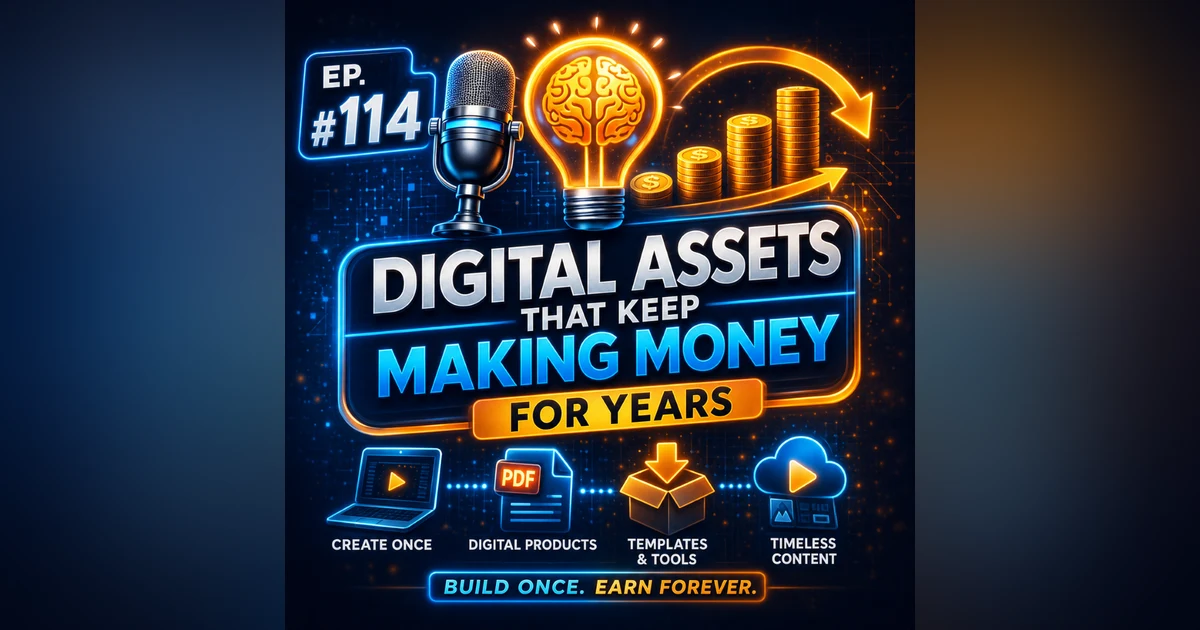
#114 Digital Assets That Keep Making Money for Years – Build Once, Earn for the Long Term


Most people earn money by trading time for income. Work today, get paid today, repeat tomorrow. In this episode of the Smart Entrepreneur Show, we break down a completely different equation — how to build digital assets that generate revenue long after the work is done, stack multiple income streams onto a single well-maintained asset, and use AI as an architectural assistant without losing the human soul that makes your work worth paying for.
In this episode you'll learn:
- The zero marginal cost of reproduction: why delivering your digital asset to the two millionth customer costs exactly the same as delivering it to the second
- The baker vs. the template creator: why a viral TikTok moment would crush a physical business — and why the digital creator just watches the downloads roll in
- The three categories of digital assets grouped by skill architecture: written assets, visual/audio assets, and structural/systemic assets — and how to choose the one that matches how your brain actually works
- Why launching a multi-platform flywheel on day one almost guarantees failure — and the one-asset-first rule the sources are rigid about
- Traffic vs. trust: why traffic is a vanity metric and an owned email list is the actual currency of the digital economy
- Revenue stacking in action: how a freelance design newsletter goes from free content → sponsorships → affiliate marketing → a $50 digital product — all built on a single trust reservoir
- The value-to-ask ratio: why 80% promotion kills open rates and destroys the asset — and what monetisation that feels like a favour actually looks like
- The right way to use AI: not as a writer, but as a structural editor that organises your messy voice memo into a three-act course module — keeping your lived experience, removing the blank-page paralysis
- The asset builder mindset: why almost nothing you do professionally needs to be single-use — and how a detailed client email becomes a blog post, becomes a guide chapter, becomes a product
- Why your first digital asset is probably already sitting on your hard drive — it just needs to be structured
- The closing homework: open your sent folder and find one piece of knowledge you already shared that could become your first income-generating digital asset this week
Contact & Resources
Listen to this episode on Podbean: smartentrepreneur.podbean.com
Explore more podcasts: Find all podcasts at the PodFather Network
Website: RoyCoughlan.com
Need help running your business? If you are looking for a Virtual Assistant and get reliable support for your daily operations.
Virtual Assistants: VA.world
Communities: BrainGym.fitness
Learn about a Private Networking Group in 50 US States & 40+ Countries with 650+ Members: connectedleaders.academy
#SmartEntrepreneurShow #DigitalAssets #PassiveIncome #BuildOnceEarnForever #ZeroMarginalCost #RevenueStacking #DigitalProducts #OnlineCourse #NewsletterBusiness #EmailList #AssetBuilderMindset #DigitalWealth #AIForCreators #ContentMonetisation #AffiliateMarketing #DigitalTemplates #SoloEntrepreneur #OnlineBusiness #PassiveIncomeIdeas #DigitalEconomy #Bootstrapping #MakeMoneyOnline #WorkFromAnywhere #ScalableBusiness #RoyCoughlan #PodFatherNetwork #VAWorld #VirtualAssistant #SmartEntrepreneur
#114 Digital Assets That Keep Making Money for Years (Build Once, Earn for the Long Term)
Welcome to the Smart Entrepreneur Show, the podcast where we share smart ideas, strategies and lessons to help entrepreneurs build better businesses. Yeah, we've got a really great topic to dive into today. We really do.
Today we're going to talk about one of the smartest ways to build long-term wealth in the digital age, creating digital assets that continue to generate income for years. It's honestly a total game changer once you grasp it. Right.
I mean, most people earn money by trading their time for income. They work today, get paid today, and, well, repeat the cycle tomorrow. Yeah, that classic linear income trap that so many of us get stuck in.
Exactly. But successful entrepreneurs often think differently. They focus on building assets that continue to create value and generate revenue, even when they're not actively working.
Which is, you know, the ultimate goal, decoupling your time from your earning potential. So what exactly are digital assets and how can you start building them? In today's episode, we'll explore the different types of digital assets, why they're so powerful, and how you can create your own long-term income streams. Let's get started.
I am super ready for this. Where do we begin? OK, let's unpack this, starting with, like, the underlying physics of the digital economy. Because it really does completely rewrite the rules of wealth creation, doesn't it? Oh, absolutely.
To understand why this shift is so profound, we have to look at the concept of marginal cost. Like, in the physical world, scale is expensive and it's just fraught with friction. Right, because every time you sell something physical, it costs you something to make the next one.
Exactly. If we connect this to the bigger picture, let's say you manufacture a physical product. For every new customer you acquire, your costs increase.
You need more materials, more storage space. Shipping logistics, hiring more people. Yeah, all of that.
Your revenue goes up, sure, but your operational drag goes up right alongside it. But digital assets, they operate in a completely different reality. They possess what autonomists call a zero marginal cost of reproduction.
Zero marginal cost. So, meaning once the initial asset is built, whether that takes you five hours or, you know, 500 hours, the cost to deliver it to the next customer is basically nothing. Precisely.
Delivering it to the second customer or the two millionth customer, it's effectively zero. The heavy lifting is entirely front-loaded. You're doing all the labor before the market even sees the product.
Right, which sounds risky, but the payoff is insane. It is. Because once that asset is live, say it's a specialized software script or a comprehensive digital guide or maybe a premium video course, it exists independently of your time.
The server distributes it. The payment gateway handles the transaction. Yes.
The asset scales to meet demand without requiring a single extra ounce of your physical energy. Let me contextualize this with an analogy for you listening, because the difference in leverage here is just staggering. Let's compare a traditional baker to a digital template creator.
Oh, I like this. Go ahead. So, if a baker suddenly goes viral on TikTok and wants to sell a million loaves of bread this week, they are in deep trouble.
Yeah, the logistics alone would crush them. Right. They have to secure a million times the flour, hire 100 new bakers, buy 10 industrial ovens.
The physical infrastructure just breaks under the weight of that scale. But if you're in the digital space... Exactly. But if you create, say, a complex project management template for Notion and a million people want to download it tomorrow, your production cost is the exact same as if one person downloaded it.
Because you don't build a million physical templates. Nope. You just build the file once and the internet handles the rest.
That is the exact mechanism that makes this whole thing so powerful. Your labor remains fixed, but your assets reach is global and instantaneous. It's incredible leverage.
And what the sources emphasize for our deep dive today is that these assets actually become more valuable as your audience grows. With a traditional business, complexity eats into your profits. Because more moving parts means more things can break.
Right. But with digital assets, growth creates a network effect. More users lead to more feedback, which allows you to refine the asset, which then attracts even more users.
OK, that structural advantage is really clear. But looking at the source material, the sheer variety of what constitutes a digital asset is massive. I mean, we aren't just talking about e-books anymore.
No, not at all. The ecosystem is huge now. The sources map out all these assets, but rather than just listing them, it seems more useful to group them by the underlying skill architecture they require.
I completely agree. Grouping them by skill architecture is the exact right approach. So we have written assets like niche newsletters and guides.
We have visual and audio assets like specialized YouTube channels or deep dive audio series. And then we have these structural or systemic assets. Like workflow templates, software plugins, mobile apps, that sort of thing.
Right. So how does someone even choose? Well, the strategic selection of your first asset is where most aspiring builders make their first critical error. You cannot choose a medium simply because it's currently trending.
Or just because you saw some influencer make a ton of money doing it. Exactly. The medium has to match the data structure of your own brain.
If you naturally think in systems, logic, and optimization, then building an organizational template is your high leverage play. But if you synthesize information through narrative, like if you're a storyteller, you should probably be building a written asset or a podcast. Right.
Play to your actual strengths. But wait, I have to challenge this a bit. Looking at all these domains, the temptation for an ambitious entrepreneur is to build a marketing flywheel right out of the gate.
Whoa, with a multi-platform launch? Yeah. Like why wouldn't I launch a video channel to capture that specific audience, use it to drive traffic to a newsletter, and then sell a digital template through that newsletter? Right. Doesn't the modern digital ecosystem almost demand an omni-channel presence? It demands an omni-channel presence only after you have established authority.
And that is a crucial distinction. Okay, so you have to earn it first. Yes.
If you attempt that multi-platform launch on day one, you are almost guaranteed to fail. The sources are incredibly rigid on this rule. You must build one single asset first.
Just one. Because the algorithms demand depth. Let's look at the mechanics of why.
Algorithms on any platform reward depth, consistency, and highly specific signaling. If you are splitting your limited cognitive bandwidth across writing a newsletter, filming video, and coding a template... You're diluting your signal. You're spreading yourself too thin so you never reach the threshold of quality required to actually capture attention in any of those arenas.
Exactly. You don't end up with three good assets. You end up with three mediocre ones that the market just completely ignores.
You have to earn the right to expand by mastering the first domain. That makes a lot of sense. So you build one high-quality asset.
You optimize it. You build an audience around it. And only when that single engine is running smoothly do you introduce a second variable.
Because a mediocre asset can't attract an audience, which is the actual engine of this entire model. I mean, without the audience, you just have a file sitting quietly on a hard drive. A very lonely file.
Yeah. Right. So let's transition into the mechanics of that audience, because the sources make this fascinating distinction between traffic and trust.
This is huge. Traffic is basically a vanity metric. Trust is the actual currency of the digital economy.
Because you can always just buy traffic. Right. You can buy traffic, or you can game an algorithm to get a temporary spike in page views, but that doesn't create a long-term asset.
The sources define a strong digital asset as one backed by an owned audience. An owned audience like an email list. Exactly.
Like an email list of highly engaged subscribers. These are people who have explicitly opted in to hear from you because you consistently solve a specific problem for them. Here's where it gets really interesting though.
Because once you have captured that intent and built that trust, the sources outline this concept called revenue stacking. Revenue stacking. It's the holy grail of digital assets.
Yeah. It's not about finding just one way to monetize. It's about layering multiple income streams onto a single, well-maintained asset.
Let's walk through a practical case study based on the principles in the text, just to see how this mechanism actually works over time. Yeah. Let's hear it.
Imagine an entrepreneur who spends six months building a highly specialized weekly newsletter for, let's say, freelance graphic designers. The newsletter solves real problems. How to price contracts.
How to manage client feedback. How to organize all those massive design files. Right.
So for six months, the initial asset is just pure, free value. They are building that trust reservoir. They're proving they actually know what they're talking about.
Yes. Now, in month seven, they introduce the first layer of monetization. Targeted sponsorships.
A design software company pays to place a native ad in the newsletter because that audience is highly concentrated. And highly relevant to the sponsor. So that's stream one.
Stream one. Exactly. Yeah.
Then in month nine, they add affiliate marketing. The creator recommends a specific brand of ergonomic chair they actually use, and they earn a commission on every sale. That's stream two.
Okay. And then, because they've been listening to their audience for a year, they realize all these freelance designers struggle with, like, tracking their invoices. It's a huge pain point.
So the creator builds a $50 custom digital tracker in Excel or Notion. They launch it directly to their email list. That's stream three.
And boom, that is a fully realized digital asset ecosystem. The newsletter acts as the distribution channel. The sponsorships and affiliates provide recurring cash flow.
And the owned digital product provides high-margin, scalable revenue. Exactly. It's a beautiful system when it works.
But hold on. Isn't there a massive risk of alienating your audience? Like, if you suddenly start hitting them with three different monetization streams in a single email, how do you balance revenue stacking with actually maintaining the trust you spend a year building? That is the tightrope walk of asset management. The mechanism that protects your asset from degrading is what we call the value-to-ask ratio.
The value-to-ask ratio. Like, how much you give versus how much you take. Exactly.
The sources highlight that if your content becomes, you know, 80% promotion and 20% value, the trust evaporates. The open rates plummet, and the asset just dies. People unsubscribe so fast when they feel like they're just being treated as a wallet.
Right. The monetization must feel like a natural extension of the value you provide. The sponsor has to be a tool they actually need.
The digital product has to solve a pain point they're actively complaining about. It shouldn't introduce friction. It should offer solutions.
Monetization should honestly feel like you're doing them a favor by offering it. It's like building a beautifully coded app for iOS when your entire community uses Android. It doesn't matter how flawless the code is, the distribution is broken because you didn't listen to the environment you were building for.
You have to align what you sell with what they actually need. Which brings up the sheer operational reality of this. Building the audience, maintaining that value ratio, stacking the revenue streams.
This requires a relentless level of consistency. It really does. It's a lot of work.
So for a solo entrepreneur, how is this actually executable without just totally burning out? Well, this is where the strategic application of AI becomes pretty much non-negotiable. But we have to be very precise about how AI is used in this context. Right.
Because the market is currently flooded with generic AI generated garbage. Yes. Which the sources explicitly warn against.
Using AI to write your final output is a fast track to destroying trust because it strips away your unique perspective and your voice. Right. It's the trend chasers.
People who see a topic trending, prompt an AI to write a 50-page e-book in 10 minutes and throw it online hoping to make a quick buck. And it has no soul. No soul, no actual insight.
And the market recognizes that immediately. It's practically unreadable. Because that approach completely misunderstands the tool.
These sources advocate for using AI not as a writer, but as a high-speed architectural assistant. An architectural assistant. I like that phrasing.
You leverage it for the structural heavy lifting, so you can reserve your cognitive energy for the actual human insight. Walk me through what that workflow actually looks like in practice. How do we use it structurally? Let's say you are building a module for an online course.
Instead of staring at a blank page trying to format everything perfectly, you just do a brain dump. Just talking out loud. Yeah.
You talk into a voice recorder for 20 minutes on your commute, outlining all your messy stream-of-consciousness thoughts on the topic, along with specific anecdotes from your own career. Okay. So you capture the raw human experience first.
Right. Then you take that raw transcript, feed it into an AI, and give it a prompt like, act as a structural editor. Organize these thoughts into a clear three-act progression.
Identify where my logic is weak, and suggest where I need more concrete examples. Oh, wow. That is brilliant.
So you aren't asking the AI to invent the ideas. You're asking it to organize your ideas. Exactly.
You're giving it the raw material of your lived experience, and asking it to build the scaffolding. It spots the logical gaps that you are just too close to the material to see. Yes.
You can also use it for workflow automation, like having AI automatically tag and sort incoming audience questions from your email list, so you can instantly see which topics are being requested the most. Which accelerates your research and development phase exponentially. It allows a solo builder to operate with the efficiency of, like, a five-person team.
It's the ultimate leverage. So what does this all mean for you, the listener? We've explored the economic theory of zero marginal cost, the strategy of matching assets to your cognitive strengths, the mechanics of revenue stacking, and the architectural use of AI. Which covered a lot of ground today.
We have. How do we synthesize all of this into a daily practice? This raises an important question, and it's really the core philosophical shift of this entire deep dive. How do you view your daily output? What do you mean? The ultimate takeaway from these sources is a concept we can call the asset builder mindset.
It is the realization that almost nothing you do in a professional capacity needs to be single use. The asset builder mindset. Okay, break down the anatomy of that for me.
How does that change, say, a regular Tuesday morning? It changes how you value your own problem solving. Most people treat their daily work as completely disposable. You figure out a complex workflow.
You write a detailed email to a client explaining a new strategy, or you build a spreadsheet to track your own expenses. And then the task is done, you check the box, and that effort is lost to the void. Exactly.
But the asset builder mindset demands that you recycle that effort. You treat every single output as a potential digital brick. Yes.
That detailed email explaining a strategy, that isn't just an email. That is the rough draft of a public blog post. Oh, I see.
When you publish that blog post, you gather audience feedback. That feedback allows you to refine the concept, which then becomes a dedicated chapter in a premium digital guide. And what about that spreadsheet you built for yourself? You clean up the user interface, add a quick tutorial video, and it becomes a $20 digital product.
That is an incredibly powerful reframe. It means you are constantly decoupling your effort from a single moment in time. You stop investing your energy into things that disappear the moment they are completed, and you start actively building a digital estate.
Exactly. Every time you solve a problem for yourself, you are potentially solving a problem for 10,000 other people. And the internet provides the zero-cost distribution to reach them.
And that is how long-term digital wealth is actually generated. It's not about getting lucky with some viral hit. It is the slow, methodical process of digitizing your specialized knowledge over and over again until you have an entire ecosystem of assets working on your behalf 24 hours a day.
So to synthesize this journey for you listening, the traditional model demands that you trade your finite time for linear income. But building digital assets flips that equation entirely. It really flips the script.
You leverage the zero marginal cost of the internet to build things once and distribute them infinitely. The strategy is to start small, pick one domain that matches your natural skills. Build an audience by providing relentless, authentic value.
Right. Stack your revenue streams carefully without breaking that trust. And use AI to handle the architecture, not the soul of your work.
As we close out, I want to leave you with a final practical thought to explore on your own this week. Yeah, give us some homework. Open up your Scent folder or look back at the friction points you solved in your own work over the last month.
What is one highly specific piece of knowledge you shared or one internal system you built just to make your own life easier that you could polish and turn into your very first digital asset? I love that. The raw material for your first income generating engine is almost certainly sitting on your hard drive right now. It just needs to be structured.
I couldn't agree more. Your first breakthrough asset doesn't need to be a revolutionary piece of software. It might just be the exact notion template you built on a Sunday afternoon to organize your own chaotic calendar.
It really is that accessible if you make the mental shift. So if you enjoyed this episode of The Smart Entrepreneur Show, make sure to follow the podcast so you don't miss future episodes. And feel free to share your thoughts or experiences in the comments.
Step out of the linear income trap and start building the digital engines that will work for you long after you've logged off. Thanks for listening, and we'll see you next time.

PodFather
I am a serial entrepreneur who has founded 21 companies across 6 countries. Known in the industry as “The PodFather,” I am a business podcast coach and host who has launched eight successful podcasts—6 ranking in the Top 5%, with four reaching the coveted Top 0.5% globally.
Beyond podcasting, I co-founded brainupgrade.org a platform designed to boost cognitive performance and unlock peak mental potential. I am also the co-founder of VA.World, connecting businesses with exceptional Virtual Assistants tailored to their unique needs.
I also have Sponsorship ads available that are Dynamically inserted into my 8 shows