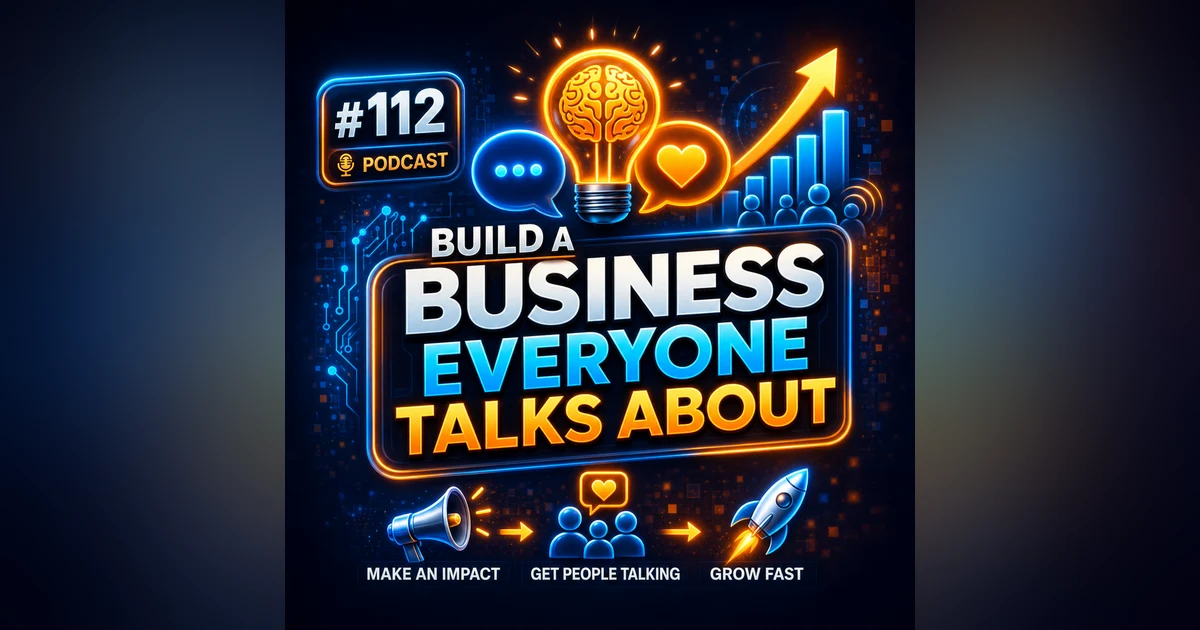
#112 How to Build a Business Everyone Talks About – The Secret to Word-of-Mouth Growth


The most talked-about businesses aren't the ones with the biggest ad budgets. They're the ones that solve real problems so effectively, so memorably, and so consistently that their customers can't stop telling people about them. In this episode of the Smart Entrepreneur Show, we break down the 10-principle blueprint for engineering organic word-of-mouth growth — and why it's the most powerful, most durable, and most cost-effective marketing channel available to any entrepreneur.
In this episode you'll learn:
- Why word-of-mouth isn't lucky lightning in a bottle — it's a deliberately engineered operating system
- Why prioritising acquisition marketing over product quality is funding a leaky bucket — and how one bad experience turns customers into anti-advocates
- The social capital mechanism: why people recommend your business to look smart, resourceful, and helpful to their own network
- Why meaningful solutions don't have to be glamorous — the pest control company that "saved the wedding" and generated instant word-of-mouth doing it
- Vending machine vs. barista: the critical difference between a transactional business and one that creates an experience worth talking about
- Expectation violation and dopamine: the neuroscience of why surprising customers positively tags your brand in their long-term memory
- Why a referral code feels slimy at the vending machine stage — and what it feels like when you've built a genuine community first
- How to give your customers the vocabulary to talk about you: why they'll never recite your spec sheet but they'll always repeat your story
- The amplification engine: stories, community, and frictionless word-of-mouth working together as one system
- Why fans defend you in a crisis, forgive occasional missteps, and actively recruit on your behalf — and consumers don't
- Why aggressively discounting to chase the quick sale is burning your foundation for firewood — staying warm one night, losing the house tomorrow
- The compounding interest of loyalty: why trust lowers your acquisition costs the longer you stay in business
- The shift that changes everything: stop asking "how do I force more people to buy today?" and start asking "how do I eliminate so much friction that my customers feel compelled to talk about it?"
Contact & Resources
Listen to this episode on Podbean: smartentrepreneur.podbean.com
Explore more podcasts: Find all podcasts at the PodFather Network
Website: RoyCoughlan.com
Need help running your business? If you are looking for a Virtual Assistant and get reliable support for your daily operations.
Virtual Assistants: VA.world
Communities: BrainGym.fitness
Learn about a Private Networking Group in 50 US States & 40+ Countries with 650+ Members: connectedleaders.academy
#SmartEntrepreneurShow #WordOfMouth #WordOfMouthMarketing #OrganicGrowth #BrandBuilding #CustomerExperience #ReferralMarketing #CommunityBuilding #BrandLoyalty #CustomerRetention #MarketingStrategy #ExpectationViolation #SuperFans #ProductQuality #StorytellingMarketing #CustomerLifetimeValue #BrandIdentity #SmallBusinessMarketing #Entrepreneur #BusinessGrowth #TrustMarketing #AuthenticBrand #FlyWheelEffect #CompoundingLoyalty #RoyCoughlan #PodFatherNetwork #VAWorld #VirtualAssistant #SmartEntrepreneur
#112 How to Build a Business Everyone Talks About (The Secret to Word-of-Mouth Growth)
Welcome to the Smart Entrepreneurs Show, the podcast where we share smart ideas, strategies, and lessons to help entrepreneurs build better businesses. Absolutely, it's great to be here. Yeah, and today we're gonna discuss something every entrepreneur dreams of, a business that people naturally recommend, share, and just talk about all the time.
Right, the holy grail of business. Exactly, I mean, think about the brands you hear about constantly. Most of them don't rely only on advertising.
Instead, they create these amazing experiences, solve real problems, and give people something actually worth talking about. Yeah, they engineer it. Right, so the question is, how can you build a business that customers promote for you? In this deep dive, we'll explore the key principles behind creating a memorable brand, delivering exceptional value, and really turning satisfied customers into your biggest marketers.
Which is so crucial right now. It really is. Whether you're starting a new business or growing an existing one, these ideas can help you build a business that stands out.
Let's get started. I'm ready when you are. So picture this, right? Instead of pouring like half your operating budget into Facebook ads, and battling the ever-changing algorithms.
Ugh, the algorithms. Right, shouting from the digital rooftops just to get a sliver of attention, your customers are doing all the heavy lifting for you. Yeah.
They're naturally recommending your product in their group chats, they're sharing your content, they're bringing you up at dinner parties. You've essentially built a business that people simply cannot stop talking about. It's the ultimate scenario.
Because when you look at the truly iconic brands, you know, the ones that just dominate their categories, they rarely rely solely on brute force advertising. Right, they don't have to. Exactly.
They rely on something much more organic, much harder to fake, and infinitely more powerful. They architect experiences, they solve really highly specific problems, and they give their customers a narrative that is actually worth repeating. Okay, let's unpack this.
Because today, we're looking at a really comprehensive strategic guide. It outlines 10 core principles for creating a highly memorable, recommendable brand. Yeah, it's a fantastic source.
It really is. And our mission today is to extract the smartest ideas and strategies from this guide to help you, the listener, build a better business. Whether you are literally sketching out a new venture on a coffee shop napkin right now.
We've all been there. Oh yeah. Or maybe you're an operator trying to scale an existing team.
These ideas really form the blueprint for turning satisfied customers into your absolute most effective marketing channel. What's fascinating here is that the word of mouth phenomenon that seems so spontaneous from the outside, you know, it looks like lightning in a bottle. Right, like they just got lucky.
Exactly. But it is almost never an accident. It's actually a highly deliberate operating system.
It's built systematically. And the source material is very clear that this entire system just completely collapses if you don't start with the bedrock. The foundation.
Yes, solving a real problem and delivering undeniable value. I mean, before anyone is going to advocate for your business, you have to give them the raw material to talk about. Which means we have to start with the product or service itself.
The non-negotiable foundation. Right. The guide emphasizes that great businesses begin by eliminating a meaningful customer pain point.
And it pushes really hard on prioritizing quality over acquisition marketing. Oh, massively. Because like marketing might convince someone to open their wallet once, right? But the underlying quality is the only mechanism that actually keeps them coming back and guarantees long-term survival.
Yeah, because if you prioritize the acquisition phase, getting the customer in the door over the actual product quality, you aren't building a business, you're just funding a leaky bucket. A leaky bucket. That's a great way to put it.
You might get a massive spike in initial revenue from a clever, aggressive ad campaign. But if the product fails to actually solve the promise problem, that customer turns. And worse, they actively tell their network to avoid you.
Precisely. The psychological mechanism driving this is social capital. Human beings are hardwired to share things that elevate their status, right? Things that make them look smart, resourceful, or exceptionally helpful to their peers.
So they want to be the hero who found the cool new thing. Exactly. When they recommend a high-quality solution to a friend's problem, they are essentially borrowing your brand's credibility to boost their own social standing.
Wow. I want to look at a personal example of this, actually. Years ago, I launched this little side project.
I poured all my energy into the branding, the logo, the ad copy. The fun stuff. The fun stuff.
It looked beautiful. And we got a huge spike in initial traffic. But our retention was practically zero.
Why do you think that was? Because the core product didn't actually eliminate the friction for the user. It just masked it behind a slick interface. I realized then that building a business is less about the flashy paint job and much more about the underlying architecture, like building a house.
If the pipes leak every time you turn on the water, nobody cares how nice the cabinets look. Product quality is that plumbing. You can't paint over a crumbling wall.
That is a critical realization. The infrastructure of your business is invisible when it's working perfectly, but it's the only thing that keeps you standing when the market gets volatile. Your ability to solve a real problem reliably is your ultimate defense against competition.
But let me play devil's advocate here for a second. Because when we use words like meaningful solutions and architecting experiences, it is so easy to immediately picture like disruptive tech startups or gorgeous direct-to-consumer lifestyle brands. Right, the flashy ones.
Yeah. But what if the problem you're solving just isn't sexy? What if you operate a highly boring business? Say you run a B2B paper supply company or a local pest control service. Can a business like that still engineer this kind of word of mouth? That is one of the most important distinctions we can make today, I think.
And it forces us to redefine what meaningful actually means in commerce. Okay, how so? Well, a meaningful solution does not have to be glamorous, aesthetically pleasing, or world-changing. Meaningful simply means removing friction in a high-stakes moment.
Oh, interesting. Let's take your pest control example. Imagine a homeowner who is hosting a major family event.
Maybe a wedding rehearsal dinner at their house this weekend. Oh man, stressful. Right, and on Wednesday, they discover a massive hornet's nest right above their front door.
Nightmare scenario. The friction here isn't just bugs. The friction is panic.
It's the potential ruin of a highly emotional, significant life event. Stakes are suddenly incredibly high. Exactly.
So if a local pest control company answers the phone on the first ring, shows up within two hours, communicates clearly, and safely eliminates the problem before the guests ever arrive, they haven't just killed hornets. They saved the wedding. They rescued the weekend.
They delivered incredibly meaningful value by removing a high-stress pain point. Real value is rarely about being flashy. It's about being ruthlessly effective and highly dependable when the customer feels vulnerable.
That completely reframes everything. The relief from that panic is the actual product they're buying. Yes.
And that relief is the story they're gonna tell at the rehearsal dinner. Yeah. Like, you wouldn't believe what happened on Wednesday, but you have to call my guy.
He literally saved the weekend. And there's your word of mouth. Which brings us to a crucial pivot in the source material.
Because once you have that concrete foundation, a highly effective solution to a real problem, you need a mechanism to ensure the customer actually remembers who solved it for them. Right. They have to remember your name.
Yeah. You have to craft an identity and an experience that elevates the interaction above just a simple transaction. And the guide outlines two intertwined principles here.
First, you must create an outstanding customer experience by deliberately delivering more than the baseline expectation. Always over-deliver. Exactly.
And second, you have to build a unique brand identity anchored by a clear mission. You have to stand for something legible, and you must execute that identity consistently across every single touchpoint. Here's where it gets really interesting to me.
Because I like to think of this as the difference between a vending machine and a phenomenal local barista. Oh, I like that. Right.
Both of them technically solve your immediate problem. Yeah. You're tired and you need caffeine.
Right. But a vending machine is a purely transactional operating system. You input currency, you extract the product, you walk away, and you literally never think about that metal box again unless it steals your dollar.
Which happens way too often. Exactly. But a great barista, the cafe has a specific atmosphere.
They remember your face. Maybe they source their beans from sustainable cooperatives which aligns with your personal values. Yeah, there's a connection there.
You aren't just buying coffee. You are opting into an experience and an identity. The vending machine gives you caffeine, but the barista gives you an experience that makes you want to bring a friend with you the next morning.
If we look at the psychological mechanism behind that barista analogy, we are talking about a concept called expectation violation. Expectation violation. Yeah.
The human brain is essentially a prediction engine. We go through life predicting what will happen next. When a business does exactly what we expect it to do, like the vending machine, our brain filters it out as background noise.
It's just routine. Exactly. It doesn't commit it to long-term memory because it isn't novel.
But when you violate a customer's expectations in a positive way, when you're faster, significantly more empathetic or just more helpful than the baseline prediction, the brain actually releases dopamine. Wow. It tags that specific interaction as important and worth remembering.
So you are literally hacking the customer's memory by surprising them. Yes, you are. And when you combine that positive surprise with a clear brand identity, something incredibly powerful happens.
The experience acts as the physical proof of your brand's mission. Right. If your brand identity claims to be, you know, radically customer first, but your support system forces people to navigate an endless, awful phone tree.
Press one for more waiting. Exactly. Then your identity is broken by the reality of the experience.
But when every single touch point, no matter how trivial, reinforces a unified mission, the customer begins to feel a sense of alignment. They feel understood. Right.
They aren't just saying, this product works. They're saying, this brand understands me and shares my worldview. Okay.
So let's take inventory of where we are. Just do it. We have the foundation.
We're solving a high stakes problem and delivering real quality. We have the identity. We are the barista, positively violating expectations, not just acting as a cold vending machine.
Yep. Now the million dollar question, how do we actively pour gasoline on this fire? How do we encourage people to advocate for us without coming across as, well, desperate or needy? That's the trick, isn't it? It is. And the source material points to what it calls the amplification engine, stories, community, and active word of mouth.
This is the transition from organic passive growth to intentional amplification. The strategic guide lays out some specific tools. First, it emphasizes telling powerful stories over publishing standard advertisements.
Like founder stories. Yeah. Sharing the founder's journey, highlighting customer success narratives, and really articulating the deeper purpose behind the work.
Okay. Second, it advises making word of mouth marketing frictionless by actively asking for reviews, testimonials, and referrals. And third.
Third, it stresses the importance of community. Shifting the paradigm from extracting value through transactions to building real relationships through shared values and ongoing conversations. Okay.
Let me stop you right there because I have to be completely honest with you. Go for it. Whenever a brand emails me a link that says, refer a friend for a $10 credit.
Yeah. My immediate instinct is to hit delete. Really? Yeah.
It often feels incredibly cheap, very transactional. And frankly, it feels like I'm being asked to monetize my personal friendships for a microscopic discount. That's fair.
It completely shatters that cool values driven identity we just spent so much time talking about building. So how does this source reconcile building an authentic community with explicitly asking your customers to chill for your product? Right. This raises an important question and it's an exceptionally valid critique.
It really highlights the danger of executing a strategy without understanding the underlying context. Right. Because if your relationship with the customer is still at the vending machine level, if it is purely transactional, then yes, a referral code feels like a cheap bribe.
It feels slimy. It feels like you're trying to extract just a little more value from them before they leave. But if you have genuinely built a community and you've consistently shared stories that resonate with their identity, this psychological dynamic shifts completely.
How so? Because a discount code is still just a discount code, right? Because you aren't offering a bribe, you are providing a tool for a mission they already want to advance. Think about the difference between a generic $10 off email and a brand that says, we are trying to change the way this industry operates. Who else in your network needs to be rescued from this broken system? Here's a way to invite them in.
Oh, wow. That's a huge framing difference. When you focus on narratives rather than features, you are actually equipping your customers with the vocabulary they need to talk about you.
Ah, so you are giving them the script. Exactly. When your customer talks to a colleague, they aren't going to recite your spec sheet or your feature list.
They're going to tell the story you told them. Right. They'll say, I love this software because the founder built it to solve the exact nightmare we deal with every Tuesday.
Yes. By giving them the story, you empower them to be your advocates. And in that context, asking for a review or a referral isn't pushing a sale.
It's simply removing the friction from a behavior they are already highly motivated to perform. I see the distinction now. It's the difference between asking for a favor and inviting them into a movement.
Exactly. And building that community is really the ultimate safety net. It transforms your business from a one-way megaphone where you're just yelling at an audience into a central gathering square where your customers are actually talking to each other.
And when people feel that sense of belonging, they become fiercely protective of your brand. They transform from consumers into fans. And fans will defend you during a crisis.
They'll forgive occasional missteps and actively recruit on your behalf. Yes. But the source material is very explicit that this engine requires maintenance.
You cannot simply build a community, launch a referral program, and then just walk away. To remain highly recommendable over a long time horizon, you have to run the marathon. Right.
Which brings us to the final phase of the guide, consistency, listening, and playing the long game. The marathon. Yeah.
And the audience listening right now already knows the reality of the current landscape. Customer acquisition cost caps are constantly rising. It's great a roof.
Privacy changes have basically destroyed cheap ad targeting, feeds are totally saturated, and buying attention is an exhausting arms race where margins are continually shrinking. It's brutal out there. So what does this all mean for the everyday operator, someone who might be stressing about making payroll on Friday? How do they justify the slow burn of community building? It's tough.
It sounds phenomenal in theory, but when the rent is due, the temptation to just blast out a 40% off coupon and chase the quick sale is overwhelming. It is the most common tension in business and it is a completely valid stressor. But we have to look at the mathematics of customer lifetime value versus the hamster wheel of paid acquisition.
Okay, break that down for me. If you constantly chase the quick sale by aggressively discounting, or if you compromise your product quality to pad your margins this month, you are systematically destroying the trust you need for long-term survival. You're burning your own foundation for firewood.
You'll stay warm for one night, but you won't have a house to live in tomorrow. Wow, yeah. That is the grim reality of it.
The businesses that survive the changing algorithms and the rising ad costs are the ones that actively listen and adapt. The guide emphasizes regularly asking for feedback, but the crucial step is actually implementing it based on what your customers genuinely need. Not just what's easiest for you to sell.
Exactly. When you pivot your product based on user feedback, you prove to your community that their voice has tangible power. That builds an unshakable reservoir of trust.
And mechanically, that trust is what lowers your acquisition costs over time. Precisely. If you rely on the compounding interest of a loyal, highly vocal customer base, your marketing actually becomes cheaper and more effective the longer you stay in business.
Your reputation begins to do the heavy lifting for you. But that only happens through the ninth principle in the guide, ruthless consistency. Consistency is hard.
It is. Because one massive bait and switch, one terrible customer service experience that goes unresolved, and the entire flywheel shatters. Consistency is the repeated daily evidence that you are exactly who you claim to be.
Which brings us full circle right back to the scenario we started with today. Yeah. The most talked about businesses, the ones that dominate dinner party conversations and group chats, are rarely the ones with the most aggressive, well-funded ad campaign.
No, they're not. They are the businesses that consistently deliver meaningful value in high stakes moments. They are the ones that positively violate our expectations, give us a compelling narrative to share, and genuinely care about the people they are serving.
They don't just sell products, they solve problems. It requires a fundamental shift in your daily operating perspective. Instead of waking up and asking the spreadsheet, how can I force more people to buy this today? You start asking, how can I eliminate so much friction and create so much value that my customers feel compelled to talk about it? I love that.
When you solve real problems, build trust through unwavering consistency, and craft an experience that resonates on a human level, you stop pushing your business onto the market. The market starts pulling your business forward. That is the ultimate leverage.
If you focus on architecting that foundation, and building that unshakable trust, your customers won't just transact with you. They will become your most powerful marketing channel. Without a doubt.
Your loudest advertising will simply be the voices of the people you have already helped. Beautifully said. Thank you.
And if you enjoyed this episode of the Smart Entrepreneur Show, make sure to follow the podcast so you don't miss future episodes. And feel free to share your thoughts or experiences in the comments. We'd love to hear how you're applying these principles in your own ventures.

PodFather
I am a serial entrepreneur who has founded 21 companies across 6 countries. Known in the industry as “The PodFather,” I am a business podcast coach and host who has launched eight successful podcasts—6 ranking in the Top 5%, with four reaching the coveted Top 0.5% globally.
Beyond podcasting, I co-founded brainupgrade.org a platform designed to boost cognitive performance and unlock peak mental potential. I am also the co-founder of VA.World, connecting businesses with exceptional Virtual Assistants tailored to their unique needs.
I also have Sponsorship ads available that are Dynamically inserted into my 8 shows