#110 The Solopreneur Blueprint – Build a Million-Dollar Business Without Employees
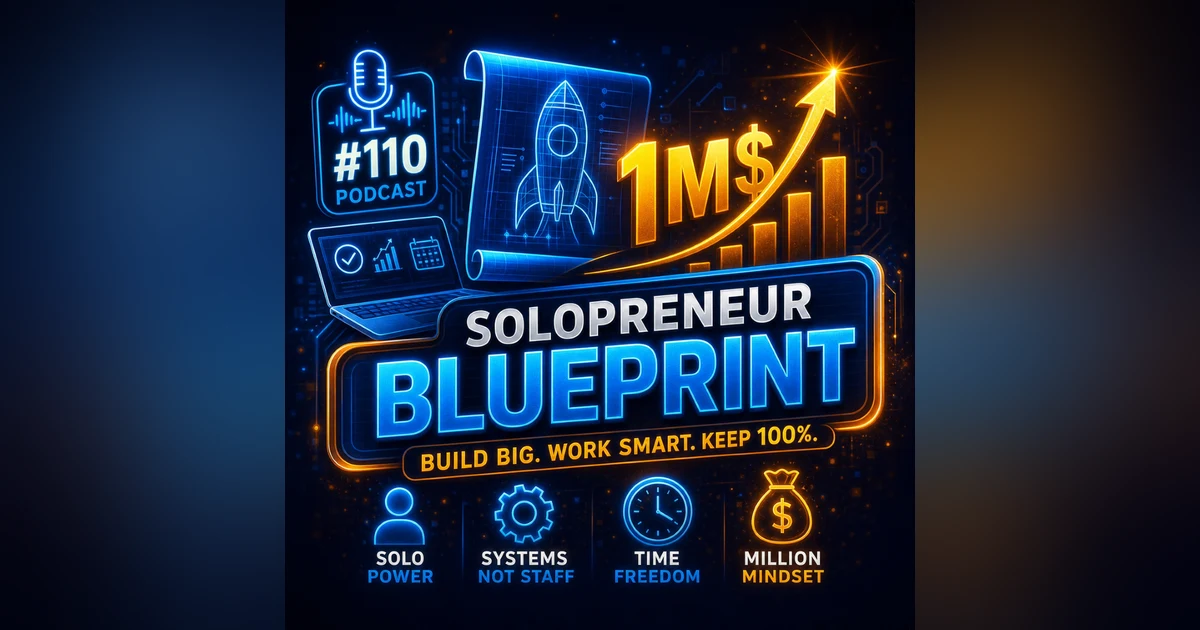


A decade ago, a million-dollar business meant dozens of employees, an office lease, and a management layer that consumed half your week. Today, one person with a laptop, the right model, and a smart automated backend can match the output of an entire traditional department — while working fewer hours than the average corporate manager. In this episode of the Smart Entrepreneur Show, we break down the complete solopreneur blueprint from choosing the right engine, to building your secret workforce, to adopting the CEO mindset that keeps it all from collapsing.
In this episode you'll learn:
- The DJ vs. the orchestra conductor: why a solopreneur isn't running a stripped-down business — they're producing the same volume of music with a digital mixing board
- The 4 scalable engines: freelancing/consulting, digital products and courses, SaaS, and content subscription — and how to choose the one that matches your natural skills
- Why every service-based model eventually hits a revenue ceiling dictated by your human need to sleep — and what the transition to decoupled models looks like
- The secret workforce: how AI and automation replace the marketing team, the copywriter, the social media manager, and the customer support inbox
- Why AI destroys the blank page but your brain does the refining — and how that compresses a 4-hour writing task into 45 minutes
- The compounding interest of time: why spending 15 painful hours building an onboarding system that saves 3 hours a week for 3 years is one of the best investments you'll ever make
- The perfectionism trap: why a 90%-functional system that needs a 5-minute manual fix once a month beats a perfect system that takes 6 months to build
- Why long-tail SEO ("kettlebell workouts for traveling software engineers with bad lower backs") beats a massive ad budget every time
- Why social media audiences are rented and email lists are owned — and why the email list is the real linchpin of the solopreneur model
- The multiple income streams misconception: why you aren't running 6 businesses, you're running 6 checkout lanes into the same house
- Adopting the CEO mindset: ruthlessly tracking cash flow, auditing tool subscriptions, and reinvesting profits into time-buying assets rather than lifestyle upgrades
- The 3 solopreneur killers: ignoring marketing, skipping automation, and polishing every brick before building the wall
- The speedboat vs. the cruise ship: why a solopreneur can pivot their entire business model in an afternoon while a corporation convenes a board meeting
- The closing provocation: AI-to-AI commerce — when your AI sales agent negotiates directly with your client's AI procurement agent, the limit of what one person can scale is entirely removed
Contact & Resources
Listen to this episode on Podbean: smartentrepreneur.podbean.com
Explore more podcasts: Find all podcasts at the PodFather Network
Website: RoyCoughlan.com
Need help running your business? If you are looking for a Virtual Assistant and get reliable support for your daily operations.
Virtual Assistants: VA.world
Communities: BrainGym.fitness
Learn about a Private Networking Group in 50 US States & 40+ Countries with 650+ Members: connectedleaders.academy
#SmartEntrepreneurShow #SolopreneurBlueprint #OnePerson Business #Solopreneur #NoEmployees #DigitalLeverage #AIAutomation #PersonalBrand #DigitalProducts #OnlineCourse #SaaSBusiness #EmailMarketing #PassiveIncome #MultipleIncomeStreams #CEOMindset #ContentCreator #LongTailSEO #WorkflowAutomation #BusinessSystems #ZeroMarginalCost #Bootstrapping #OnlineBusiness #ScaleWithAI #FutureOfWork #RoyCoughlan #PodFatherNetwork #VAWorld #VirtualAssistant #SmartEntrepreneur
#110 The Solopreneur Blueprint Build a Million-Dollar Business Without Employees
Welcome to the smart entrepreneurs show the podcast, where we share smart ideas, strategies, and lessons to help entrepreneurs build better businesses. Today, we're diving into a topic that's becoming more relevant than ever before. The rise of the solopreneur years ago, building a million dollar business usually meant hiring dozens of employees, renting office space and managing a large organization.
But today, thanks to technology, AI, automation, and digital platforms, one person can build an incredibly successful business from a laptop. So how do solopreneurs achieve this? What systems, habits and strategies do they use to grow without a large team? In this episode, we'll explore the blueprint for building a highly profitable one person business and the mindset needed to succeed. So let's get started.
Glad to be here for this deep dive. You know, when you actually look at the data on successful one person businesses today, the really surprising thing isn't just that solopreneurs are generating million dollar revenue. Right.
It's how they're doing it. Exactly. It's that many of them are working fewer hours than like your average mid-level corporate manager to do it.
So our mission today is to pull apart the exact engine that makes that possible. For everyone listening, we are going to unpack a comprehensive blueprint that breaks down exactly how modern solopreneurs are replacing traditional, you know, heavy corporate structures with incredible digital leverage. Yeah, and I think if you're spending your days putting out fires, managing a massive HR department and trying to keep 50 people aligned, you're just playing the traditional game.
The solopreneur is a totally different species. I actually like to think about it this way. Traditional entrepreneurship is like conducting a massive orchestra.
Oh, that's a good way to put it. Right. You need 50 people playing in sync and they're all watching you for the cue.
But a modern solopreneur is like a master DJ with a complex digital mixing board. You're producing the exact same volume of music and it sounds just as rich, but you're controlling all the instruments yourself through technology. You hit a loop pedal and that beat plays flawlessly on repeat while you layer like a synth track over it.
That DJ analogy captures the mechanics perfectly. You are the DJ. But to make that music, you have to choose the right mixing board right from the start.
In business terms, you have to pick a vehicle, a business model that inherently scales without requiring a massive human team. Because if you choose wrong. Yeah, if you choose a model built around heavy manual labor or physical supply chains, complex logistics, that DJ model completely breaks down.
You'll just quickly hit a ceiling where your time becomes the bottleneck. So what are the mixing boards that actually work for the sole operator? Like we look at the landscape. There's a clear progression of engines you can choose from.
I feel like most people start with service based models, right? Like consulting and freelancing. Yeah, those are excellent launch pads because the barrier to entry is literally just your own expertise with freelancing or high level consulting. You are directly monetizing a specialized skill that you already have.
You don't need inventory. You don't need a warehouse. You just need your brain.
Exactly. Your brain, an Internet connection and a client whose problem you can solve. The overhead is virtually zero, which means your profit margins are incredibly high.
But there is a pretty big catch. The catch is that you're still trading time for money. Precisely.
Even if you're charging a super premium rate, there are only so many hours in the day that you can actively consult. You eventually hit a revenue ceiling dictated by your basic human need to sleep. Right.
Which is why the blueprint demands a transition into scalable, decoupled models. This is where a solopreneur might introduce things like digital products and online courses. The strategy here isn't just about making passive income.
It's about packaging your knowledge into an asset. Like an e-book or a workflow template. Yeah, an e-book, a template or a really comprehensive video course.
You expend the energy to build it once. After that, whether one person downloads it or, you know, 10,000 people download it, your workload remains exactly the same. The digital asset handles the delivery.
And for those with technical chops, that principle applies perfectly to sauce. Right. Software as a service.
Oh, absolutely. You aren't just selling your time. You're writing code that solves a specific problem for an industry.
And that code goes to work for you 24-7. Your customers paid a recurring monthly fee for access. So the labor is in the initial build and, you know, occasional updates, not the daily fulfillment.
That's the ultimate form of leverage. But you can also achieve a similar recurring revenue model without writing a single line of code. Wait, really? How so? Through content creation and subscription based businesses.
By building a dedicated audience through a highly focused newsletter, a video channel or a private community, you can offer a premium subscription tier. It provides that beautiful, predictable, monthly recurring revenue. The key is just choosing the engine that aligns with your natural skills.
Whether that's writing, coding, teaching. Exactly. Finding what you're good at and optimizing it for zero marginal cost of reproduction.
OK, let's push into the mechanics of this, though, because we're throwing around the idea of running a sauce company or a massive paid community as a solo operator. Yeah. But even if the product delivery is digital, the back end administration of a company, I mean, marketing, customer support, onboarding research that is traditionally a multi-person job.
Yeah. How does one person physically handle the workload of an entire company without just drowning? Well, they don't handle it physically. They handle it digitally.
This brings us to the secret workforce, AI, automation and systems. The secret workforce. Right.
Automation and AI are the fundamental building blocks that allow you to act as that DJ we talked about. You are essentially shifting your mindset from delegating tasks to human employees, to delegating tasks through software. Let's get really specific on how this looks in a daily workflow, because like take writing, for example, if you're building an audience, you need to produce a lot of content, draft client emails, write sales pages.
A traditional company hires a copywriter. But a solopreneur uses an AI language model not to completely write the final product, but to destroy the blank page. That is such a crucial distinction.
The AI acts as your junior researcher and your first draft generator. You give it a rough outline of your thoughts and in seconds it structures a draft. So your brain energy is then spent on editing, injecting your unique voice and refining the strategy rather than the exhausting manual labor of just typing out first drafts.
You've basically just compressed a four hour writing task into 45 minutes. Exactly. And it extends way beyond writing.
Think about marketing distribution. You don't need a social media manager sitting at a desk hitting publish at 9 a.m. Right. You build automated workflows.
Yeah. Using scheduling tools. You load your content once a month and the software analyzes the optimal engagement times, formats the posts and distributes them across multiple platforms while you are literally asleep.
That's wild. And customer support has to be another area where solopreneurs traditionally get bogged down, right? Oh, it's a huge time sink. But instead of living in your inbox, answering the same ten pricing or access questions every single day, you implement intelligence systems.
Like an A.I. chatbot. Exactly. You use an A.I. chatbot on your site to triage support tickets or you build automated email onboarding sequences so that when someone buys your digital product, the software automatically sends them their login credentials, follows up three days later to ask how they like it and pitches them an upsell.
All without you ever clicking a button. Without you ever lifting a finger. OK, hold on, though, I have to call a time out here because this sounds incredibly smooth in theory.
But setting up 15 different automated workflows, training an A.I. chatbot and connecting all these different software platforms, doesn't that take a massive amount of time? It does. Isn't there a huge risk that a solopreneur just ends up playing I.T. guy all day, getting so bogged down and building the perfect automated system that they forget to actually do the core work that brings in revenue? You're highlighting one of the most dangerous traps in this entire model. Yes, setting up systems is a massive time sink.
Initially, it can feel like you are doing everything except your actual job. But you have to view this through the lens of compounding interest on your time, meaning the upfront cost pays off exponentially later. Precisely.
Spending 15 tedious hours this week building and troubleshooting an automated client onboarding system feels painful. But if that system successfully handles onboarding and saves you three hours a week every single week for the next three years, that's a massive return. That is an incredible return on your time investment.
However, to your point about playing I.T. guy, you avoid that by completely abandoning the idea of the perfect system. The perfectionism trap. Right.
The software doesn't need to be flawless. It just needs to be reliable enough to prevent the business from relying solely on your daily manual hours. A functional system that works, say, 90 percent of the time and requires a five minute manual fix once a month is infinitely better than a perfect system that takes you six months to build.
OK, so the A.I. is doing the heavy lifting. The back end is automated. The digital products are built.
The automated emails are ready to fire. But an automated back end is completely useless if no one knows you exist. Very true.
How does a one person business get people to actually notice them and buy from them? Because, you know, you don't have a massive corporate marketing budget to run Super Bowl ads. No, you don't. But in today's digital landscape, trust is a much more valuable currency than a massive ad budget.
And for a solopreneur, the absolute most effective way to build that trust is through a highly focused personal brand. So you become known for one specific thing. Exactly.
You aren't trying to be a generic lifestyle brand. You're trying to be the absolute go to authority in a very targeted niche. You create valuable free content that genuinely helps people solve problems.
And that targeted approach has to completely change how you market. Like, let's look at SEO search engine optimization. A solo operator cannot outspend a multinational corporation to rank on Google for a broad keyword like fitness.
No, they can't. But that's not the game you play. All right.
You play the hyper specific long tail game. Exactly. You don't try to rank for fitness.
You create deeply valuable content that ranks for, say, kettlebell workouts for traveling software engineers with bad lower backs. That is very specific. Right.
The search volume is much lower, but the intent is incredibly high. When those specific people find your content, they instantly realize you are speaking directly to them. That builds immediate trust without you spending a dime on advertising.
And I imagine that organic marketing engine extends to social media and networking, too. It does. You share your journey, your insights, your unique frameworks.
You build a real community around this niche. You network with other creators. But the real linchpin here, the ultimate asset is email marketing because you actually own the list.
Exactly. When you build an audience on a social platform, you are essentially renting space. An algorithm change can wipe out your reach overnight.
But when you move that attention to an email list, you own that audience. You have a direct line to their inbox that no one can take away, which sets the stage perfectly for the next phase of the blueprint, which is creating multiple income streams. Once you have an owned audience that trusts your specific expertise, you don't just offer them one single way to pay you.
You build an entire ecosystem. The options are endless once the trust is there. Right.
You have your core digital products, but you can also integrate affiliate marketing where you recommend the software tools you actually use in your business and earn a commission. Yeah. Or you could create a paid membership tier for exclusive community access and direct Q&A.
You might offer a few slots of high ticket one on one coaching for people who want highly personalized help. You can even secure sponsorships for your free newsletter or license your frameworks to other businesses. It's all about leverage.
But wait, let's step back into reality for a second. What does this actually mean for someone's daily routine? Like if I'm a solopreneur, I'm now supposed to create free, high value community content for marketing, optimize my website for SEO, run an email list while simultaneously managing six different income streams like coaching, affiliate links and digital product updates. It sounds like a lot.
Doesn't that just lead right back to the exact burnout this whole model was supposed to prevent? If you view those as six separate businesses, yes, it will completely crush you. But that's a misunderstanding of how the architecture works. Your personal brand is the single marketing engine that feeds everything else.
You aren't running six different companies. You are running one brand centered around your core expertise. So they're just different doors into the same house.
Precisely. The multiple income streams aren't separate entities. They are simply different ways for your audience to access the exact very expertise, just packaged differently depending on their budget and needs.
For example, a follower might read your free weekly newsletter for a year. Then they buy your $50 digital template to solve a quick problem. Six months later, their business scales and they hire you for a $5,000 coaching package to implement your system.
It's one cohesive ecosystem, all fueled by the exact same piece of free content you put out on Monday. You aren't doing six times the work. You're just providing six different checkout lanes.
That makes total sense. But managing that ecosystem requires a massive shift in identity, like generating the attention and building the products is the creative fun part. But keeping the business alive requires the solopreneur to stop thinking like a worker bee or even a creator and start thinking like a CEO.
This is a harsh reality check for a lot of incredibly talented people. You might be the best coder, the most insightful writer or brilliant designer. But if you lack the CEO mindset, the business will fail because the primary function of a CEO is resource allocation.
Exactly. And for solopreneur, your two most vital resources are your money and your energy. Let's talk about the money first.
Managing money like a CEO means you aren't just looking at your bank's account balance and guessing if you're profitable. You actually have to track it. You are meticulously tracking income and expenses.
You understand your cash flow. And more importantly, you are strategically reinvesting profits back into the business. You aren't just taking all the cash out to buy a nicer car.
You're buying back your time by upgrading to a better AI software or investing in a specialized course to learn a new high leverage skill. At the same time, you have to relentlessly protect your profit margins. Solopreneurs are notorious for falling victim to shiny object syndrome.
Absolutely. You convince yourself you need 20 different premium SaaS subscriptions to run your business, and suddenly your overhead is thousands of dollars a month for tools you barely even use. A CEO audits those expenses ruthlessly.
If a tool isn't saving you time or making you money, you cut it. It's about extreme discipline. And the pitfalls aren't just financial either.
When you look at why solopreneurs fail, there are some glaringly common mistakes. People ignore marketing because they just want to hide in their cave and build the product, assuming if I build it, they will come. Which they never do.
Right. They don't. Or they fail to build those automated systems we talked about relying entirely on their own willpower until they break.
But honestly, the most insidious mistake is perfectionism. I always explain it like this. Trying to do everything perfectly as a solopreneur is like trying to individually polish every single brick of a house before you even build the walls.
That is a phenomenal visual. Right. It might look fantastic up close, but it guarantees you'll never actually finish the house and you'll completely exhaust yourself in the process.
Burnout and perfectionism are the ultimate enemies of the solopreneur because you have a single point of failure. When you're the only employee, if you go down, the entire company goes down. There is no backup team to cover your shifts.
This is why adopting the CEO mindset means learning to accept good enough in certain areas. You just have to keep building the walls. Exactly.
An email newsletter with a slight typo that goes out on time, nurtures your audience, and generates revenue is infinitely more valuable to the business than a perfectly polished, flawlessly formatted email that sits in your drafts folder for three weeks because you were obsessing over the font choice. Right. You have to prioritize momentum over perfection.
Okay, so let's zoom out for a second. We've laid out the entire blueprint. You choose the right scalable model.
You leverage AI and automated systems to act as your workforce. You build a targeted personal brand to generate trust and feed multiple income streams. And you adopt an unsentimental CEO mindset to manage your resources.
But why is this happening now? Is this just a temporary post-pandemic trend? Yeah. Or is this the actual future of business? The macroeconomic data is undeniable. This is a fundamental permanent shift in how commerce operates.
And the primary catalyst is artificial intelligence. AI is doing two things simultaneously. It is radically lowering the barrier to entry while exponentially raising the ceiling of what one person can achieve.
Right. It's a multiplier. As AI agents become more sophisticated, the volume and quality of output a single individual can produce will continue to multiply.
We are going to see a massive proliferation of one-person businesses doing tens of millions in revenue. Because the cost of scale is approaching zero. Exactly.
And in that future landscape, the single biggest competitive advantage a business can have is adaptability. Think about a traditional heavy corporation. It's like a massive cruise ship.
If the market shifts or a new technology disrupts their industry, it takes them months, sometimes years, to turn that ship around. They have to convene boards, change HR policies, restructure whole departments. But a solopreneur is on a speedboat.
Precisely. You are on a speedboat equipped with the latest radar. You spot a new trend, a breakthrough AI tool, or a sudden shift in consumer behavior, and you can pivot your entire business model, update your products, and change your marketing messaging in a single afternoon.
That lean, hyper-adaptable nature is your absolute superpower in a world where the only constant is racket technological change. The speedboat versus the cruise ship. It really makes you realize why the big corporations are kind of terrified of this shift.
Okay, let's bring it all together for you, the listener. If we synthesize everything we've explored today, what is the ultimate core takeaway? The core message is total empowerment. You do not need a massive office building.
You do not need to manage dozens of employees. And you certainly don't need millions of dollars in venture capital to build a highly profitable, resilient business today. No.
What you actually need is a valuable skill, a crystal clear strategy for how to package it, the right automated systems doing the heavy lifting in the background, and the CEO discipline to stay consistent day in and day out. It's really just about working with massive leverage. It is.
And before we wrap up, I want to leave you with a final provocative thought to mull over something that points to where this is all heading. Let's hear it. We've talked a lot about you using AI to do your work, but the next frontier of the solopreneur empire is AI to AI commerce.
Imagine a near future where your automated AI sales agent is negotiating a high ticket consulting contract directly with a corporate client's AI procurement agent. You and your client simply review the final terms and sign. When your software is actively doing business with other software, the limit to what one person can scale is entirely removed.
The future really belongs to those who leverage technology, automation, and continuous learning. So if you've been waiting for the perfect time to start your own business, this might literally be your moment. That is wild to think about.
You really are just the DJ overseeing the entire club. If you enjoyed this episode of the Smart Entrepreneur Show, make sure to follow the podcast so you don't miss future episodes and feel free to share your thoughts or experiences in the comments.
PodFather
I am a serial entrepreneur who has founded 21 companies across 6 countries. Known in the industry as “The PodFather,” I am a business podcast coach and host who has launched eight successful podcasts—6 ranking in the Top 5%, with four reaching the coveted Top 0.5% globally.
Beyond podcasting, I co-founded brainupgrade.org a platform designed to boost cognitive performance and unlock peak mental potential. I am also the co-founder of VA.World, connecting businesses with exceptional Virtual Assistants tailored to their unique needs.
I also have Sponsorship ads available that are Dynamically inserted into my 8 shows