#108 Build a Legacy, Not Just a Business – The Entrepreneur's Long-Term Success Blueprint
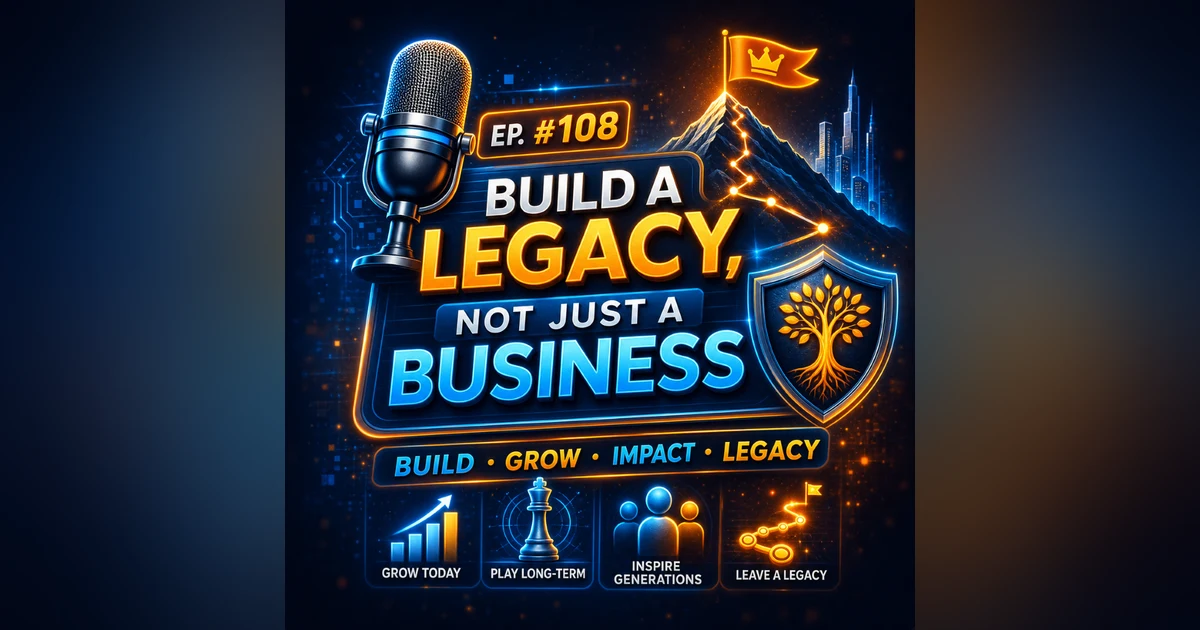


Social media makes entrepreneurship look like a race for fast money. But the world's greatest businesses weren't built overnight — and chasing quick profits isn't just a strategic mistake, it's an active vulnerability. In this episode of the Smart Entrepreneur Show, we break down the operational blueprint for building a legacy business: one that earns compounding trust, outlives its founder, and creates value that radiates outward for decades.
In this episode you'll learn:
- Why survival mode is seductive — and why it's not a growth strategy, it's just layering patch over patch until the whole architecture collapses
- The Vision Test: the 3 filters that replace "what makes me the most money this quarter?" with a decision-making algorithm built for the long game
- Why short-term extraction destroys LTV — and how one alienated customer costs you exponentially more next quarter in replacement marketing spend
- The hidden mathematics of trust: why revenue is the fuel but trust is the engine — and why you can lose revenue for a year and recover, but lose trust and it's game over
- How micro-promises — a proposal in the inbox at 8:55am instead of 9:00am — stack into an impenetrable competitive moat over years
- The service recovery paradox: why a customer who experiences a problem you fix generously ends up trusting you more than one who never had a problem
- Why the legacy framework shifts the morning question from "how do I make more money today?" to "how do I make people's lives better today?" — and why profits become the inevitable byproduct
- Core values as a corporate immune system: why integrity on a frosted glass wall is marketing, but genuine values are the algorithm that protects you during high-stress, low-information crises
- The ecosystem mindset: why suppliers you squeeze for pennies won't prioritise you during a supply chain shock — and why loyal partners will
- "People remember how your business made them feel, not just what you sold" — the psychological anchor behind every legacy brand
- How to scale empathy without the founder in the room: CRM systems that arm a 22-year-old rep with the context to deploy their own genuine human connection
- The duality of legacy: rigid in values, infinitely flexible in methods — and why falling in love with your current vehicle is how you become the next Blockbuster
- The 5 traps that build permanent ceilings: chasing fast money, sacrificing quality, ignoring relationships, short-term vision, and refusing to build systems
- The closing challenge: if your business disappeared tomorrow, what is the exact specific void it would leave in your community?
Contact & Resources
Listen to this episode on Podbean: smartentrepreneur.podbean.com
Explore more podcasts: Find all podcasts at the PodFather Network
Website: RoyCoughlan.com
Need help running your business? If you are looking for a Virtual Assistant and get reliable support for your daily operations.
Virtual Assistants: VA.world
Communities: BrainGym.fitness
Learn about a Private Networking Group in 50 US States & 40+ Countries with 650+ Members: connectedleaders.academy
#SmartEntrepreneurShow #BuildALegacy #LegacyBusiness #LongTermSuccess #TrustIsEverything #ServiceRecoveryParadox #CustomerLTV #BusinessValues #VisionTest #EntrepreneurMindset #CustomerFirst #CompanyValues #CompoundingTrust #BusinessFoundation #ScaleWithSystems #FounderMindset #BusinessGrowth #Entrepreneur #ImpactOverProfit #WordOfMouth #CustomerRetention #LegacyBlueprint #BusinessStrategy #PurposeDrivenBusiness #RoyCoughlan #PodFatherNetwork #VAWorld #VirtualAssistant #SmartEntrepreneur
#108 Build a Legacy, Not Just a Business 🌟 – The Entrepreneur's Long-Term Success Blueprint
Welcome to the Smart Entrepreneurs Show, the podcast where we share smart ideas, strategies, and lessons to help entrepreneurs build better businesses. In today's world, it's easy to get caught up in chasing quick profits, viral success, and overnight results. Social media often makes entrepreneurship look like a race for fast money.
But the world's greatest businesses weren't built overnight. They were built with vision, patience, trust, and a commitment to creating lasting value. The question every entrepreneur should ask is, am I building a business for today's income or for tomorrow's legacy? In today's episode, we'll discuss how to build a legacy business, one that creates long-term impact, earns customer trust, and continues growing for years to come.
Let's get started. I am so ready to get into this one. Yeah.
And honestly, whether you're a seasoned founder who's been in the trenches for years, managing huge teams, or maybe you're just insanely curious about the behind-the-scenes mechanics of how these century-old companies actually survive, this deep dive is for you. We're not here to just throw around corporate buzzwords today. We're going to really extract the exact structural blueprints that separate the companies that just survive one single market cycle from the ones that define an entire industry.
And I think that's the core mission for us today, really, because that concept of fast money, it's not just some toxic myth on social media, right? It's actually a massive operational vulnerability. Oh, totally. The source material we're analyzing today, it completely dismantles that myth.
We're going to look under the hood of these enduring businesses to see how prioritizing long-term value over short-term extraction, it's actually the ultimate risk mitigation strategy. Yeah. It's not just about feeling good.
Exactly. It's about building a fortress around your market share. Yeah.
Okay. Let's unpack this and get a little ruthless for a second, because I want to look at what this legacy concept looks like on paper. Let's do it.
It's a heavy word, right? Legacy. It sounds like something you only worry about when you're, I don't know, 80 years old and writing a memoir. Right.
Sitting in an armchair somewhere. Exactly. But the framework we're looking at defines a legacy business as an active, daily operational model.
It prioritizes long-term success over short-term profit, sure, but more importantly, it distributes that success. Yes. It doesn't just hoard value for the founder.
It operates as an expansive ecosystem. The data shows that lasting value radiates outward. Yes, obviously it serves the customers and the founders, bottom line.
Of course. But it also fundamentally supports the employees, the surrounding communities, and even future generations. A legacy business embeds itself so deeply into the fabric of its environment that, well, its success just becomes intertwined with the success of everyone it touches.
But okay, I can already hear the pushback from the founder listening to this right now, the one who was staring at a cashflow spreadsheet. The panic is real. It is, because it is really easy for us to sit in a studio and philosophize about future generations.
But a founder has to keep the lights on today. Payroll is literally due on Friday. It's like building a house.
You could pitch a tent today for a quick profit and have shelter, or you could pour a concrete foundation for months before ever having a roof. If you don't have immediate sales, there is no tomorrow to build a legacy for. So isn't prioritizing short-term revenue just a basic biological survival instinct? Oh, it's entirely instinctual, and that is exactly why it is so dangerous.
Wow, really? Yeah, because survival mode is incredibly seductive. It provides an immediate dopamine hit of cash. Right.
But survival is not a growth strategy. The fundamental difference here is intentionality. If you only operate in survival mode, you're constantly just putting out fires.
You never actually step back to build a fireproof building. That makes total sense. It actually makes me think of the concept of technical debt in software engineering.
Oh, that's a great analogy. If there's a bug in your code, the survival instinct is to just write a quick, messy patch to get the software working today. You get the quick profit, the immediate sale.
Right. You survive the day. Exactly.
But you've just accumulated technical debt. And if you keep doing that layering, patch over patch, the entire architecture becomes so fragile that eventually the whole system crashes. Yes.
So building a legacy is basically the discipline of minimizing your operational technical debt. You take the time to refactor the code properly, even if it takes a lot longer. That is a brilliant way to conceptualize it.
The quick patch is the immediate sale. The clean, scalable code is the legacy. And to help founders actually navigate this in real time, the sources introduced this specific diagnostic tool called the Vision Test.
Okay. The Vision Test. Yeah.
It forces a complete shift in the decision-making algorithm. Instead of a founder looking at a crossroads and just asking, which path makes me the most money this quarter? The Vision Test demands a completely different set of filters. So what are the specific filters in that test? What are they actually asking? They're asking things like, will this decision strengthen the core equity of my brand? Or will my customers trust me more in five years because of the action I take today? Am I creating lasting value or am I just extracting capital? It requires a deliberate delay of gratification.
But what is the actual quantifiable cost of ignoring that test, of just grabbing the quick buck? Because we see companies do it all the time and they post massive quarterly gains. They do, but the cost is paid in cat customer acquisition cost. Short-term extraction destroys your lifetime value, your LTV.
If you push a substandard product just to artificially inflate this quarter's numbers, you will get that cash. Right. You get the bump.
But you fail the Vision Test because that customer is never coming back. And worse, they're going to tell 10 other people not to buy from you. Which means next quarter.
Exactly. Next quarter, you have to spend exponentially more on marketing just to replace the customer you alienated. The quick buck actually creates a mathematically unsustainable business model over a five-year horizon.
Which brings us to a massive pivot point in our deep dive today, because you just touched on the exact mechanism that dictates whether a business lives or dies over decades. The math behind it. Yeah, the hidden mathematics of trust.
One of the central theses we found in the sources is that while revenue is the fuel of a business, trust is the actual engine. Revenue is important, obviously, but trust is priceless. It's the ultimate appreciating asset.
You can lose revenue for a quarter or even a year and bounce back. Markets fluctuate all the time. Yeah.
But if you lose trust, the structural integrity of your entire business collapses. It's game over. Pretty much.
Right. It's a very simple equation. High trust equals low friction.
When customers trust you, they forgive minor mistakes. They buy your new products without needing a massive expensive advertising campaign to convince them. Right.
They become a volunteer sales force for your brand. Exactly. But how do you actually manufacture that trust? Because it's not something you can just buy a monthly subscription for.
No, definitely not. The operational blueprint we are looking at gets highly specific about this. It doesn't rely on warm, fuzzy feelings.
It relies on very rigid behaviors, delivering consistent quality, operating with honesty and transparency, and above all, keeping your promises. Keeping promises is the absolute bedrock of commercial trust. And I really want you to notice that keeping a promise doesn't actually cost capital.
What do you mean? Well, if you tell a client a proposal will be in their inbox at 9 0 a.m. on Tuesday, and it arrives at 8 5 a.m., you have manufactured trust. You've proved that your words align with reality. Oh, I see.
You stack thousands of those micro promises over years, and you build this impenetrable moat around your business. Competitors can offer a 10% discount, but your clients won't leave, because the competitor is an unknown variable, and you are a proven constant. OK, but let me push back on that a bit, because the reality of entrepreneurship is messy.
Very messy. What happens when keeping a promise to a customer directly conflicts with keeping a promise to your investors, like protecting your profit margins? Let's say a huge shipment gets damaged. Replacing it at your own cost protects the customer promise, but it totally tanks your margin for the entire month.
That is the exact crucible where legacy companies are forged. The legacy framework dictates you take the financial hit to protect the relationship. Even if it hurts today.
Especially if it hurts today, because of something called the service recovery paradox. Psychologically, a customer who experiences a problem that you transparently and generously fix will actually end up trusting you more than a customer who never experienced a problem at all. Wow, really? Yes, you've proven your integrity when it was expensive to do so.
Investors might be angry for a month, sure, but they're going to be ecstatic in three years when that customer has tripled their spend with you. Here's where it gets really interesting. This requires a total paradigm shift in the fundamental question an entrepreneur asks themselves every morning.
It really does. The default setting, the one they teach in a lot of traditional business schools, is to wake up and ask, how can I make more money today? Right. But the legacy framework forces a complete translation.
You have to wake up and ask, how can I make people's lives better today? What's fascinating here is how the market responds to that psychological shift. Consumers possess an incredibly highly tuned radar for authenticity. They know when they're being viewed purely as an ATM.
Oh, absolutely. We all feel it. Exactly.
Businesses that survive for decades view themselves as problem-solving engines, not wealth extraction machines. When you shift your focus entirely to removing friction from your customer's life, you stop being this adversary trying to separate them from their wallet. Right.
You become a vital partner in their success. And the ultimate irony of this entire model is that when you become obsessed with solving real problems, profits cease to be the target you're aiming at. They just become the natural, inevitable byproduct of the value you're injecting into the market.
Precisely. Money follows value. It is simply a receipt for the usefulness you provided.
If you focus on maximizing the usefulness, the receipts take care of themselves. But here is the catch. You cannot consistently solve complex external problems for your customers if your internal operational foundation is crumbling.
No, you can't. Which brings us to the internal compass of a legacy business. Company values and relationships.
This is where we have to connect the external output to the internal reality. You cannot fake making people's lives better if your internal culture is toxic or cutthroat or totally directionless. The market will eventually see the cracks.
And the framework lists several clear values that almost all enduring companies share. We're talking integrity, innovation, customer first thinking, excellence, and accountability. Right.
The classics. Yeah. I have to be completely honest here.
I've walked into plenty of bankrupt corporate lobbies and seen those exact words etched into beautiful frosted glass. Haven't we all? Right. It's incredibly easy to hire a consultant to write integrity on a wall.
How do these abstract concepts actually translate into business survival? Like, really? It's a crucial distinction to make. Words on a wall are just marketing. Actual core values function more like a corporate immune system.
An immune system? Yeah. When the business is perfectly healthy and margins are high, you don't really notice the immune system. It's super easy to have integrity when you're incredibly profitable.
But values are not designed for peacetime. They are algorithms designed specifically to guide your decision making during high stress, low information environments. OK, let's run a stress test on that.
Say the economy crashes. Global supply chain costs double overnight. The quick buck pathogen enters the company's bloodstream.
A manager says, hey, let's quietly switch to a cheaper, inferior raw material. The customer probably won't notice and we can save our quarterly bonus. Exactly.
The survival instinct screams to take the shortcut. But if the genuine operational DNA of the company contains the value of excellence or transparency, the immune system attacks that idea. It forces the harder but healthier choice.
Which is what? You either take the hit on your margin or you write a really difficult, transparent letter to your customers explaining exactly why prices have to increase by 15 percent to maintain the quality they rely on. Oh, man. But that's agonizing in the short term.
You might lose a fraction of your highly price sensitive customers. You might, but you preserve the trust of your core audience. The values act as guardrails, protecting you from your own worst short term impulses.
They prevent you from making a decision out of panic today that destroys your reputation tomorrow. And extending outward from that internal immune system is the broader web of relationships. It's not just the buyer.
We are talking about treating business as an ecosystem rather than a series of isolated transactions. Yes, exactly. A legacy founder invests deeply in employees, partners, suppliers and the local community.
Think about it. If you operate with a transactional mindset, you'll view your suppliers as vendors to be squeezed for every last penny. What happens during that supply chain shock we just talked about? Oh, they're not going to help you.
Exactly. When inventory is scarce, who does the supplier prioritize? They fulfill orders for their actual partners and they ignore their transactional buyers. And the same goes for employees.
Oh, totally. If you treat your team purely as an expense on a ledger, your most talented people will leave the second a competitor offers them a 5 percent raise. There is a vital truth embedded in this framework that I want you to actively think about the next time you interact with a client or a team member.
And it's a quote from the source material that really stuck with me. Let's hear it. People remember how your business made them feel, not just what you sold.
That is the psychological anchor of a legacy right there. Human beings, we rationalize with logic and spreadsheets, but we make our actual decisions based on emotional resonance. Right.
If an employee feels genuinely valued and protected by their leadership, they will deploy discretionary effort. They'll go the extra mile without ever being asked. If a customer feels deeply respected, especially when a mistake is made, they transition from being a passive buyer to an active evangelist for your brand.
But this creates a massive operational paradox for me. How so? Well, we've just spent the last 10 minutes talking about highly personal relationship, founder integrity and how you uniquely make people feel. But by definition, a legacy business must outlive its founder.
Yes, it has to. So how on earth do you scale a feeling without the founder being in the room? If your entire competitive advantage is the founder's unique charisma, your business dies the day the founder retires. How do you digitize empathy? This is the exact bottleneck where thousands of brilliant, profitable companies fail to cross the threshold into legacy.
Because they can't let go. Right. The founder remains an operator instead of becoming an architect.
To scale empathy, you have to extract the founder's intuition and codify it into systems, documented processes and leadership training. You have to build future leaders. So what does this all mean? Doesn't that just turn a warm, human business into a cold, robotic bureaucracy? Like if the customer is used to the founder remembering their kid's name and suddenly they're dealing with an automated standard operating procedure, that feels like a huge downgrade.
It feels like a downgrade if the system is designed poorly. A great system doesn't script the human interaction. It provides the context for it.
Give me an example. Okay. So building a world-class CRM system that logs a client's preferences, their past issues, and yes, maybe even their kid's name.
That isn't about turning your employees into robots reading a script. Okay. It's about arming a brand new 22-year-old customer success rep with the exact information they need to deploy their own genuine empathy.
You're building an information architecture that manufactures that positive feeling consistently, regardless of who is on shift. So the ultimate goal is a machine that grows and delivers excellence completely independent of the founder's personal energy levels. Precisely.
But that raises another question. If you spend years locking everything down into rigid, documented systems so the founder can step away, doesn't that make the company too stiff to survive a changing world? It's a very real danger, which is why the legacy framework balances systems with the absolute imperative of adaptability. Markets are going to change.
Technology is going to evolve. Customer expectations shift constantly. Yeah.
Look at the last five years alone. Exactly. Legacy businesses survive because they master a very specific duality.
They are rigid in their values, but infinitely flexible in their methods. Rigid in values, flexible in methods. Let's ground that.
The mission, say, providing the fastest, most reliable logistics in the world, is your fixed destination on a map. Your documented systems are your current vehicle. But adaptability means you don't fall in love with the vehicle.
If a new technology emerges, you're completely willing to scrap your current SOPs and build a new engine as long as it gets you to that exact same destination faster. Yes. If you become rigidly attached to your methods, you become obsolete.
Think of all the legacy video rental stores that refuse to adapt to streaming. Classic example. But if you remain completely rigid in your core mission while aggressively innovating your processes, you become a legacy.
I want to make sure we don't just talk about the idealized version of this. Before we wrap up, I want to look at the failure modes. Give everyone a clear what not to do guide.
Oh, the traps. Yeah. The blueprint actually lays out a clear map of the common traps entrepreneurs fall into.
And what's fascinating to me is why incredibly smart, capable founders build these permanent ceilings over their own heads. They fall into these traps because the feedback loop for a bad decision is often delayed, while the reward is instant. The first major trap is chasing fast money over customer value.
Right. And closely related to that is trap number two, sacrificing quality for quick profits. The mechanics of this are so insidious.
Oh, so? You swap out a premium component for a cheap one. Your profit margin spikes for two quarters. You look like an absolute genius to your board.
But you have secretly spiked your churn rate. By the time the revenue actually starts falling, the damage to the brand's reputation is almost mathematically impossible to reverse. It's brutal.
Yeah. And trap number three is ignoring customer relationships. When you optimize purely for efficiency rather than connection, you strip the emotional resonance out of the brand.
You just become a commodity. And the moment you're a commodity, your customer will leave you for someone offering the exact same thing for one dollar less. Exactly.
Which leads directly to trap four, focusing only on short-term goals. If your strategic vision extends no further than the end of the current fiscal year, you are completely blind to the macro shifts happening in your industry. You don't see the iceberg coming.
Not until you hit it. And the final trap, trap five, brings us back to the architect versus operator problem, failing to build systems for growth. If a founder insists on being the ultimate bottleneck for every major decision, because nobody can do it as well as I can, they are actively suffocating their own company.
The ultimate takeaway from analyzing these traps is realizing that while they might artificially inflate your metrics today, they act as a permanent, unbreakable ceiling on your long-term success. You might get a burst of cash, but you are trading away your equity in tomorrow. Which is why we have to constantly return to the core theme here.
Highly successful entrepreneurs build businesses that people trust, remember, and recommend for years. Money absolutely matters. It's the oxygen that allows the business to breathe.
But oxygen isn't the purpose of life. Exactly. Impact, reputation, and the relentless accumulation of trust.
Those are the true architects of a legacy. If value is built consistently, profits will follow. Thank you for listening to the Smart Entrepreneur Show.
I hope today's episode encourages you to think beyond short-term profits and focus on building something meaningful that lasts. Remember, great entrepreneurs don't measure success only by how much money they make. They measure success by the value they create, the people they help, and the legacy they leave behind.
Before you jump back into the daily grind of your business, I want to leave you with one final, very practical question to mull over. Ask yourself this. If your business completely disappeared tomorrow, what is the exact specific void it would leave in your community? Figuring out the precise shape of that void is the very first step to building your legacy today.
If you enjoyed this episode of the Smart Entrepreneur Show, make sure to follow the podcast so you don't miss future episodes, and feel free to share your thoughts or experiences in the comments. Until next time, keep creating value, keep serving people, and keep building your legacy. See you in the next episode.

PodFather
I am a serial entrepreneur who has founded 21 companies across 6 countries. Known in the industry as “The PodFather,” I am a business podcast coach and host who has launched eight successful podcasts—6 ranking in the Top 5%, with four reaching the coveted Top 0.5% globally.
Beyond podcasting, I co-founded brainupgrade.org a platform designed to boost cognitive performance and unlock peak mental potential. I am also the co-founder of VA.World, connecting businesses with exceptional Virtual Assistants tailored to their unique needs.
I also have Sponsorship ads available that are Dynamically inserted into my 8 shows