#103 Why Attention Is the Most Valuable Currency Today
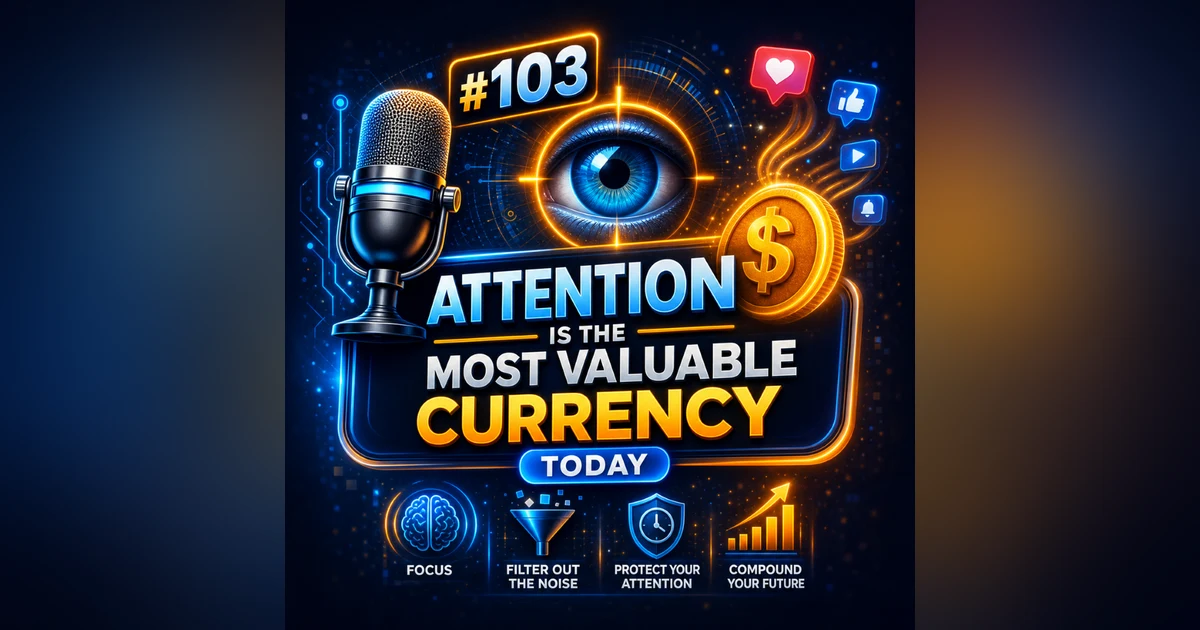


Knowledge used to be power. Now, attention is the most valuable currency in the world — and multi-trillion dollar tech companies are mining yours every single second. In this episode of the Smart Entrepreneur Show, we break down the architecture of the attention economy, the biological toll of distraction, and the exact strategies to reclaim your focus and turn it into your most powerful competitive advantage in the age of AI.
In this episode you'll learn:
- Why the business battleground has completely shifted from product quality to attention capture — and why quality is now invisible without a spotlight
- How Netflix, Instagram, TikTok, and the infinite scroll are engineered to bypass your prefrontal cortex before you can decide to stop
- The slot machine psychology behind the TikTok swipe — and why variable reward systems are identical to a casino floor
- Why a mediocre product launched by someone with millions of followers will always outsell a brilliant product with zero audience
- The new law of modern economics: where attention goes, money follows — and why every celebrity suddenly has a tequila brand
- Attention residue: why a two-second glance at your phone costs your brain up to 20 minutes of deep focus recovery time
- Why chronic context switching weakens creativity, makes complex learning harder, and spikes cortisol until you're in decision fatigue by 2pm
- How AI amplifies this dynamic: why technical execution is now commoditised — and why the ability to focus deeply is becoming the rarest, most lucrative human skill
- Why willpower alone will never beat a phone designed by thousands of engineers specifically to break it
- Attention architecture: how to design a physical and digital environment where distraction requires active effort instead of passive surrender
- Batched communication: how to set up proactive inbox windows (10am, 1pm, 4pm) that eliminate reactive chaos without becoming unreachable
- Why reading long-form books is the most effective rehabilitation tool for a fractured attention span
- The golden filter question: before you open any app or agree to any low-priority task — does this move me closer to my goals?
- The closing challenge: you would never leave your wallet open on a park bench. What if you tracked your attention with the same ruthlessness you track your bank account?
Contact & Resources
Listen to this episode on Podbean: smartentrepreneur.podbean.com
Explore more podcasts: Find all podcasts at the PodFather Network
Website: RoyCoughlan.com
Need help running your business? If you are looking for a Virtual Assistant and get reliable support for your daily operations.
Virtual Assistants: VA.world
Communities: BrainGym.fitness
Learn about a Private Networking Group in 50 US States & 40+ Countries with 650+ Members: connectedleaders.academy
#SmartEntrepreneurShow #AttentionEconomy #AttentionIsTheCurrency #FocusMatters #DigitalDistraction #DeepWork #AttentionArchitecture #AttentionResidue #ContextSwitching #DigitalWellbeing #MindfulnessForEntrepreneurs #ProductivityHacks #AIandHumans #CognitiveFocus #ScreenTime #InfiniteScroll #SocialMediaAddiction #FocusIsAPower #Entrepreneur #PersonalDevelopment #BuildBetter #TimeManagement #HighPerformance #RoyCoughlan #PodFatherNetwork #VAWorld #VirtualAssistant #SmartEntrepreneur
#103 Why Attention Is the Most Valuable Currency Today
Welcome to the Smart Entrepreneur Show, the podcast where we share smart ideas, strategies, and lessons to help entrepreneurs build better businesses. We live in a world where, you know, information is everywhere. Oh, absolutely everywhere.
Right, every day we are exposed to thousands of videos, advertisements, social media posts, emails, and notifications. The challenge today is no longer finding information, it's deciding what deserves our attention. Yeah, that is the real bottleneck now.
Exactly. Years ago, people used to say, knowledge is power. While that is still true, there is another statement that has become even more relevant today, which is, attention is the most valuable currency in the modern world.
It really is a currency. I mean, money can be earned, right? Businesses can be built, technology can be developed, but without people's attention, none of these things can truly succeed. Yeah, totally.
Whether you're an entrepreneur, a content creator, a student, a professional, or simply someone who wants to improve your life, understanding the value of attention can completely change the way you think and work. For sure, it's foundational. So, in today's episode, we'll explore what the attention economy is, why attention has become more valuable than ever, how companies compete for your attention every single day, and most importantly, how you can protect your attention and use it to build a better future.
Let's get started. I'm really excited to get into this deep dive today because, well, the reality is that most of us are just hemorrhaging this currency without even realizing it. Right, like we don't even track it.
Exactly. For generations, the baseline societal rule was always that knowledge was the ultimate power. If you had the right information, you held all the cards.
But what these sources make undeniably clear is that the paradigm has completely inverted. Information is infinite now, it's cheap. Yeah, you can just Google anything in two seconds.
Right, so what is scarce and therefore infinitely valuable is the human capacity to actually focus on any of it for more than a few seconds. Okay, let's unpack this because I was thinking about it and it's like we used to have an economy based on who built the best mousetrap, right? But now, the economy's basically based on who can hypnotize the mice. That is such a perfect analogy because the battlefield really has entirely shifted.
I mean, let's look back, say, 20 years. Sure. If you were a business, you competed primarily on the physical merits of a product.
If you engineered a more durable washing machine or, I don't know, a faster computer, you won the market share. Because it was objectively better. Exactly.
But over the last two decades, the most lucrative companies on Earth realized that competing on physical products has a ceiling. Human attention, though, that is a highly monetizable resource and it can be extracted continuously. So they aren't even really selling us a product anymore, they're selling us to the advertisers.
And the architecture of the platforms dominating our daily lives reflects that perfectly. Netflix doesn't just give you a catalog of movies. The platform auto-plays the next episode in, what, five seconds? Barely enough time to blink, yeah.
Right, because they are specifically bypassing your prefrontal cortex, the decision-making part of your brain, before you can consciously choose to turn off the TV. They're removing the psychological stopping cue. I mean, Instagram and Facebook pioneered this with the infinite scroll.
Oh, the endless scrolling. It's brutal. It is, because in the physical world, a newspaper has a last page, a book has an ending.
Your brain gets this natural signal that a task is finished, which allows you to transition your attention elsewhere. But the infinite scroll completely eliminates that boundary. Right, and then TikTok took it a step further.
They added that frictionless swipe that taps directly into the brain's variable reward system. It's operating on the exact same neurological principles as a casino slot machine. Wow, okay, I wanna push back on this a little bit, though, because, I mean, I understand the mechanics of attention harvesting, but is this really a permanent shift in economics? What do you mean? Like, if an influencer with millions of followers sells a terrible, low-quality product, won't the market eventually punish them? Does attention really replace quality permanently, or is it just a short-term trick? What's fascinating here is that the sources make a really vital distinction.
They do not argue that quality is entirely irrelevant, right, but they propose this thought experiment that fundamentally reorders the whole hierarchy of business. Okay, I'm listening. Imagine you spend five years engineering the most brilliant, affordable, life-changing piece of software.
It functions perfectly, but you have zero attention. Nobody knows you exist. How many units do you actually sell? Well, none.
I mean, you just sit in your basement with a great product and go bankrupt. Exactly. Now, take a completely mediocre product, maybe some generic dropship T-shirt, but it's launched by someone currently holding the attention of millions.
Right, like a massive influencer. Even if only 1% of their audience converts, they've built a multi-million dollar business overnight. The traditional model dictated that you build a great product, which then generates attention through word of mouth.
The old build-it-and-they-will-come mindset. Yeah, that is dead. The new law of modern economics outlined in these notes is pretty blunt.
Where attention goes, money follows. Quality acts as a retention tool once a customer is already acquired, but attention is the absolute prerequisite for existence in the market. Wow, so in a world of infinite options, quality is basically invisible without a spotlight.
That's exactly it. Which means the cost of acquiring a customer, just getting someone to look at your product, is skyrocketing for traditional businesses, while the people who already control attention can launch products with a customer acquisition cost of basically zero. Right, which explains why every celebrity suddenly has a tequila brand or a skincare line.
Oh, that makes so much sense. They're just monetizing the attention they've already trapped. Yes, but that brings us to the actual cost of this war for our focus.
Because if multi-trillion dollar tech conglomerates are actively mining our attention, what is the physical and mental toll on the individual? Yeah, we tend to treat distraction like it's just a minor inconvenience. We look up, realize we spent an hour scrolling, and just call it a bad habit. We do, we brush it off.
Here's where it gets really interesting, though. Have you ever opened your phone just to check one single message, and suddenly an hour has completely vanished? Oh, absolutely, countless times. Right, we usually just call this wasting time.
But looking at the sources, the cost is much darker than that, isn't it? We aren't just losing 60 minutes on the clock. No, we are actively degrading our cognitive hardware. The platforms run these incredibly sophisticated algorithms that analyze your specific behavioral data in real time.
Like how long I look at something. Even how long your finger hovers over a video before scrolling. They learn whether joy, political outrage, or fear keeps you engaged.
And then they field you a relentless, tailored loop of that exact stimuli. You're literally being chemically manipulated to stay on the platform. That is terrifying.
Let's get into the biological mechanics of that, because there is this concept in our sources called attention residue, that completely changed how I view a quick glance at my phone. Oh, attention residue is huge. Because I always assumed, you know, if I'm writing a proposal and my phone buzzes, I can just look at a text for two seconds, put it down, and go right back to work with no harm done.
Yeah, that is the illusion of multitasking. Neurologically, it is not a clean break. When you shift your focus from a complex task to a text message, a significant portion of your cognitive processing remains stuck on the new information.
Which is the residue. Exactly. Your brain is trying to resolve the context of that text message, even after you have physically returned to your computer screen.
So my eyes are looking at the work proposal, but a massive chunk of my brain's processing power is still, like, debating how to reply to my friend's text. Right, and the research indicates it can take your brain up to 20 minutes to fully clear that residue and reengage the deep neural pathways required for intense cognitive work. Plus, context switching rapidly drains glucose in the brain.
Wait, 20 minutes just to recover from a two-second interruption. When you multiply that by the dozens of notifications we receive every single hour, it means most of us are never actually entering a state of deep focus. Like, ever.
We aren't. We are spending our entire day operating in a continuous, exhausting state of fragmented, shallow thinking. And the compounding effects of that are severe.
What happens long-term? Well, chronic context switching actively weakens your ability to think creatively. It makes complex learning way harder, and it spikes your cortisol levels, which leads to chronic stress and decision fatigue by, like, two o'clock in the afternoon. Man, if human focus is already this compromised across the board, the rabid rise of artificial intelligence has got to act as a massive accelerant to this entire dynamic.
Oh, without a doubt. Because if the baseline human condition is now chronic distraction, then the ability to focus isn't just a good habit anymore. It is a rare, highly lucrative superpower.
It's the ultimate competitive advantage. I mean, if we connect this to the bigger picture, AI is currently automating the execution of routine work at an unprecedented scale. We are looking at software that can write complex code, analyze massive data sets, generate marketing copy, and create photorealistic images in literally seconds.
The busy work that used to define productivity for millions of professionals is just being outsourced to machines. So the best way to visualize this dynamic from our notes is, well, it's like AI is having a fleet of brilliant interns, right? That's a great way to look at it. You can hand them almost any technical task and they will execute it instantly.
But an intern only executes the prompt they are given. They can't tell you what the company's ultimate goal is. Your attention is the steering wheel.
Exactly. If you are distracted, overwhelmed, and constantly reacting to notifications, your interns are essentially driving blind. AI can generate a thousand different options, but it cannot decide what goals actually matter.
It lacks the vision. Right, it lacks vision, purpose, discernment. In an age of infinite automated execution, the technical skills themselves become commoditized.
What becomes exponentially more valuable is the human ability to concentrate deeply enough to synthesize complex information, set a strategic vision, and direct these AI tools effectively. So basically, if you can sit in a room for two hours, synthesize information, and think critically without touching your phone, you are already operating on a cognitive level that 90% of your competition just cannot reach. You are steering the ship while everyone else is just swapping the deck and checking Instagram.
Yeah, and you might be listening to this right now thinking, okay, that sounds great in theory, but I can't just throw my smartphone in the ocean, right? Right, people have jobs. Exactly. My boss expects immediate replies on Slack.
I have clients who need me. I have a family. So how do we actually implement the defense mechanisms from our sources without getting fired or going completely off the grid? We really need to move past entry-level advice like just try to use your phone less.
Oh, totally. And the sources specifically acknowledge this modern friction. The goal is not isolation, you know? The goal is building what behavioral researchers call attention architecture.
Attention architecture, I like that. Yeah, you have to design a physical and digital environment where distraction requires active effort. Because willpower is a finite biological resource.
If you rely on willpower alone to ignore a phone sitting face up on your desk, you will eventually lose that battle. Right, because that phone was designed by thousands of engineers specifically to break your willpower. Exactly.
So what does this all mean? How do we practically architect a better environment starting today? Well, first, you transition from reactive communication to proactive communication. Instead of leaving your inbox and messaging apps open on a second monitor all day, you batch process your communications. Okay, so checking at specific times.
Yes. You train your colleagues and clients by setting expectations. Let them know you check and respond to messages at specific intervals, say 10 a.m., 1 p.m., and 4 p.m. And if there is a genuine house-on-fire emergency, they can physically call you.
I love that approach because it addresses that fear of being unreachable. Nine out of 10 messages aren't actual emergencies. They're just other people offloading their cognitive tasks onto you.
But what about the internal interruptions? Because I know I've sat down to work, felt a tiny bit of friction on a project, and instinctively opened a new tab to check the news without even consciously deciding to do it. That is the dopamine craving kicking in. To combat that, the sources suggest building dedicated, distraction-free work blocks of about 30 to 60 minutes.
But you have to start small. Like training a muscle. Exactly.
You create a 45-minute block where your phone is physically in another room. Yeah. And you use software to block all non-essential websites on your computer.
You really have to treat this like physical therapy for your brain. Oh, that makes sense. Because if you have spent the last 10 years fracturing your attention every three minutes, you cannot expect to suddenly sit down and focus for four straight hours.
Right, the biological resistance is gonna be super intense those first few days. Your brain is gonna be screaming for that quick hit of novelty. It will feel deeply uncomfortable.
But as you practice, you rebuild the cognitive muscle. Also, the sources highly recommend reading long-form books as an incredibly effective tool for this specific rehabilitation. Because reading a dense book forces you to follow a single linear argument for hours.
Yes. It trains your brain to sustain focus and actively ignore the craving for a quick context switch. I mean, it is literally the opposite of the infinite scroll.
Exactly. You are rewiring the neural pathways to tolerate sustained effort. Also, taking digital breaks, practicing mindfulness, and just getting good sleep because a tired brain physically cannot focus.
Yeah, that makes sense. There is one filtering strategy from our notes that I found incredibly confrontational, but absolutely necessary. Which one? Before you engage with a new app or agree to a new low-priority project or open a social media feed, you ask yourself one golden question.
Is this activity moving me closer to my goals? It is a brutal filter. But if you do not actively dictate your own goals, the algorithms will happily dictate them for you. And their only goal is to maximize your time on their platform so they can serve you more ads.
Wow. The chain reaction detailed in the research is profound, and it happens whether you are aware of it or not. Your moment-to-moment decisions dictate where your attention goes.
Over time, where your attention goes shapes your daily habits. Those habits eventually forge your character, and your character determines your future. It is literally a direct pipeline from a single push notification to the overall trajectory of your life.
It really is. Dedicating just one fiercely focused hour a day to a high-leverage goal, whether that's learning a new skill, building a business, or even deepening a relationship, it can completely alter a life over the course of a year. Small, compounding improvement.
Driven by undivided attention, it yields extraordinary results. The stakes genuinely could not be higher. Money can be lost in the market and earned back the next year.
Technologies are gonna continuously evolve, and entire industries will be disrupted. But your attention is the single resource that, once spent, is gone forever. You can never buy back an hour.
Stop helping others profit off your distractions. Which leaves us with a final thought to consider, something that really crystallizes the gravity of this dynamic. Let's hear it.
If you were sitting on a park bench, enjoying the afternoon, you would never take your wallet out, leave it open on the bench next to you, and allow any stranger walking by to reach in and take a few dollars. No, you would guard it with your life. You'd call the police if someone tried it.
Yet we leave our minds completely unguarded every single day. We allow every app, algorithm, and pinging notification to reach into our brains and steal a piece of our focus all day long. What if, starting tomorrow morning, you tracked your attention with the exact same ruthlessness that you track your bank account? Man, now there is a challenge worth taking on.
Guard your focus and spend your attention on the things that actually matter. If you enjoyed this episode of the Smart Entrepreneurs Show, make sure to follow the podcast so you don't miss future episodes. And feel free to share your thoughts or experiences in the comments.


