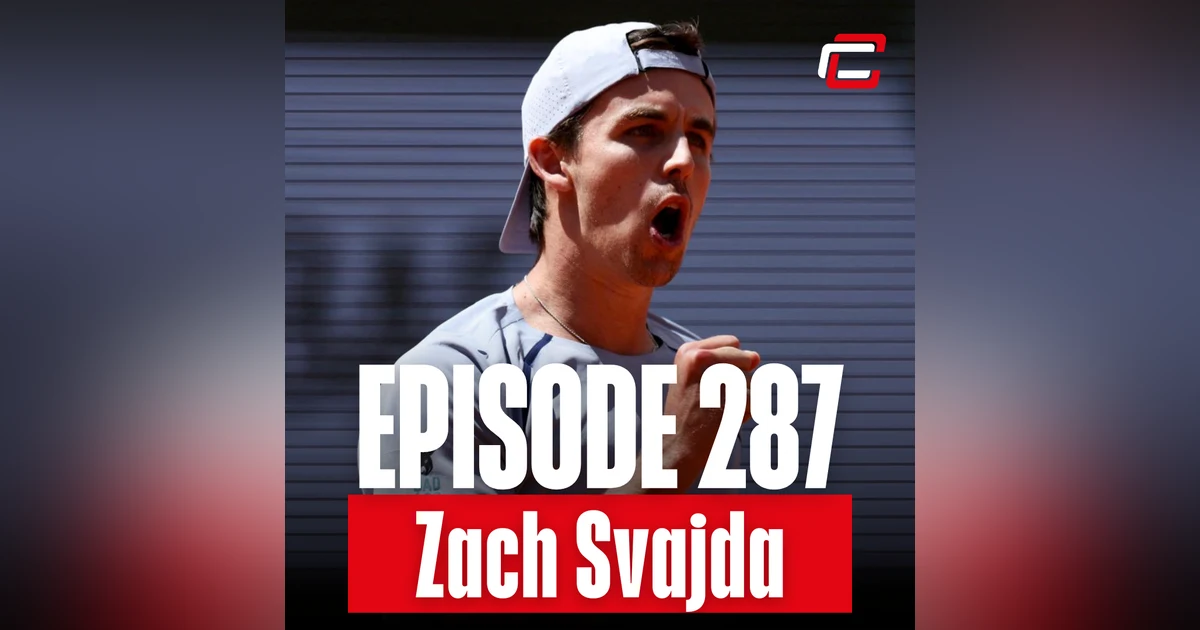
Zach Svajda: The Tennis Myth Buster

 Apple Podcasts
 Spotify
 Overcast
 Castro
 RSS Feed
 This week Dan is joined by ATP pro Zach Svajda, fresh off a stunning run to the last 16 of Roland Garros 2026.
There he beat the heat, the occasion and a host of higher ranked players before falling to eventual finalist Flavio Cobolli in a fourth set tie break. Currently ranked 69 in the world with a career high of 62, Zach is 23 and only just getting started.
This is a genuinely special and emotional conversation. Zach opens up about the unconventional path that got him to top level tennis, from using a full size racket at age two to taking nearly five years away from junior tournaments, busting a host of tennis development myths along the way.
Zach also reflects movingly on the loss of his father to cancer and how that continues to shape why he plays.
Key talking points:
- Zach's remarkable Roland Garros run to the last 16 despite his lack of clay court experience.
- What it felt like inside the locker room in Paris the day Sinner went out.
- The unconventional development path set by his father
- Zach talks about the impact of the passing of his father and how he carries his memory and lessons with him on court.
- He tells us what is was like playing Novak Djokovic on Arthur Ashe at the US Open.
- His relationship with younger brother Trevor, a rising college star, and the prospect of the two one day facing off on tour.
A brilliant and honest conversation with a player on the rise. Make sure to give this one a listen.
Read full shownotes here.
Links Mentioned in this Episode:
- Connect with us: Instagram | Website | Email
- Follow Zach on Instagram: @zachsvadja
- SotoTennis Academy
Mentioned in this episode:
Train Smarter Anywhere: Strength & Conditioning for Tennis Players On the Go 🎾
For players who don’t always have access to in-person coaching, progress doesn’t have to stop. TennisAthlete is an online Strength & Conditioning platform, designed specifically for tennis players who want structured, affordable and flexible training. Wherever they are in the world. TennisAthlete helps you stay consistent, improve performance, and train with purpose. Train smarter. Anywhere.

Episode 287: Zach Svajda
DISCLAIMER: Please note we use a transcription service, so there may be some errors in the following transcript for the episode. If you can, refer to the audio for the exact quotations.
Dan (00:00)
Welcome to episode 287 of Control the Controllables. And we have a young man, who made the last 16 at Roland Garros this year in Zach Svajda. Zach, I mean what a story. This is the one you want to listen to. You know someone who didn't really play tournaments when he was younger, you know someone who used a full-size racket age two.
You know, someone who has gone on already to play the greatest male player of all time in Novak Djokovic second round at the US open in 2025 and won the first set against him, which actually happened to be a very special match in his life. And he's also played Jannik Sinner, he's played Taylor Fritz. He's only 23 years old, but he's already putting together a fantastic career.
He's currently 69 in the world. He's been a career high of 62, but he's growing, he's building and he's a brilliant guest that you are going to thoroughly enjoy. So I'm going to pass you over to Zach.
Dan (01:14)
So Zach Svajda, a big welcome to Control the Controllables. How you doing?
Zach Svajda (01:19)
I'm doing well. Thank you for having me here.
Dan (01:21)
It's an absolute pleasure. And I know we've been talking for a while, Zach, about making this happen. But I was like, I'm not going to get him on until he gets at least a last 16 in a major championship. You know, I thought, you've got to really earn the right for Control the Controllables. And as much as I want to hear your story, and we will delve into all of that, I have it on good account that you were an incredibly good two-year-old.
Zach Svajda (01:33)
Mm-hmm.
Mm-hmm.
Dan (01:49)
So I wanna get into your top spin forehand at age two, but I have to start with Roland Garros, I have to start with Paris, an incredible tournament and you're obviously a big part of that. Last sixteen, a real run, obviously lost to Cobolli in a very tight match before he went on and made the final. What are your reflections on your Roland Garros this year?
Zach Svajda (02:13)
Roland Garros this year was such a special tournament for me and honestly very unexpected from how much I grew up on the clay, which I never did. I haven't played many clay court matches at all. And I also didn't do too well leading up to Roland Garros. I had one match win, I think, out of five tournaments.
And so I just tried to stay positive and my team and I were putting in a lot of hard work and when I played my first round and I started to feel much better on the clay once I got there. And when I won that, I was like, wow, like okay, I could like win a match or two on the clay. And then the rest, like, I just started to work my way through, started playing better each day and it was just so special.
Dan (03:01)
And in terms of 'cause this tennis player thing around I have to feel confident, I'm not feeling the ball, I don't feel confident, I'm not so sure, you know, we're very feely. We love the touchy feely chat, you know. How much emphasis do you put on that? Or how much emphasis are you able to switch away from, actually you know what, I don't need to be confident, I just know I have my certain processes that I need to stick to.
Zach Svajda (03:29)
Right. When I was younger, I would always think like, okay, I have to win to stay confident or I need to be feeling the ball well. Like a lot of times, how I do in practice, to really, you know, try to just have a good result. And then now as you know, my fifth or sixth year now like on tour, and I've learned like we could all hit the ball well on any day.
And we put in so much hard work, like I said, and I know on any given day if I play well or have given it my all, anyone could win, especially at our level now. And so I just try to keep that in the back of my head. And that's really what happened in the French Open, at Roland Garros.
Dan (04:12)
And what about the court surface thing? Because again, I know you're someone who likes to take the ball early, you like to, you know, you have had some good results on grass courts and, you know, the hard courts. Do you think nowadays maybe we're going away from just traditional clay court tennis, you know, and how much do you think tennis is changing on the back of that?
Zach Svajda (04:34)
I definitely think it's changing a lot. I mean, people as you can see watching are being so much more aggressive. They're coming in a lot more and I feel like the court speeds are getting a little faster. And so I told myself, what were you gonna say?
Dan (04:51)
I was gonna say especially week one with that heat.
Zach Svajda (04:55)
Yeah, with the heat, Roland Garros in Paris, it was so hot the first week. And my coach said too, like it's literally playing like a hard court, which was like it helped me in a way, 'cause I grew up on hard court my whole life. So yeah.
Dan (05:07)
Yeah.
And I was there as a coach but I am a big tennis fan. You know, I love tennis and know, in and amongst these grand slams, yes, I'm coaching and I'm doing my job, but I am also a tennis enthusiast who's watching these great matches and feeling the event. And I know that when Jannik Sinner lost, I was saying on the podcast beforehand, no disrespect to Jannik Sinner, but I am finding it a bit boring.
I'm a little bit sick of him just beating people three and three and winning in straight sets. And Jannik's won again and nobody's testing him. But when he went out, it felt there was a complete shift, a complete shift in just how the tournament was viewed. I think the next round we went on, and I think there was like the next two or three days, there was 12 out of 18 of the men's matches went to five sets.
You know, it felt like wherever you were watching was these five set battles. As a player who was in that event, how did that make you feel? What impact did that have on you when you see Jannik Sinner going out the event and you now know there is gonna be a first time winner at Roland Garros?
Zach Svajda (06:01)
Mm-hmm.
You know, when I found out about that, I could I think speak for everyone here in the locker room and all around the players area, it really got quiet for many days. And I felt like we are so much, we're obviously focused and wanting to win this tournament, but when he was out, like even a few of my friends on tour weren't really speaking to anyone and we were just so locked in because we know like, you know, it's a little bit easier now since he's out, we could, anyone could, it's up for grabbing, taking the title.
And I just told myself, you know, just take it day by day and try not to even think about getting to the finals, try to take it match by match. But I could definitely feel the tension in the locker room walking or in the players' cafe, just like it's way more like quiet and focused and everyone's just so surrounded by their team only.
Dan (07:05)
Mm-hmm.
Zach Svajda (07:09)
But it was definitely, you know, cool to have that experience and to be a part of it too.
Dan (07:14)
Did you believe you could win it?
Zach Svajda (07:16)
I did for sure. You know, I didn't think so, honestly. Like when I first arrived there, I was just hoping to really win a few sets and hopefully a match. But then as I started to feel more comfortable, got the first round or two, I like I knew like, okay, I'm feeling good and Jannik's out, or even if he was still in, you know, I always have that believance in me, like I could win against anyone.
Dan (07:41)
I guess you were only a set or two away potentially from the final if you look at what happened to Cobolli, right? You know, Cobolli, I know who did Cobolli play after you? He played—
Zach Svajda (07:53)
Believe it was Felix.
Dan (07:54)
So that's right. So he played Felix and then he got the walkover in the semis. But you know, you lost a very tight match with Cobolli. Tell us a little bit about that and how did you feel after losing a tight match like that in a fourth round of a French Open?
Zach Svajda (07:57)
Yeah.
After losing that match, it definitely gave me a lot of confidence, knowing that I could, like I said, could hang against some of the best players and if not beat them if I'm playing really well. And that match was really special. It was my first time there on center court. And the first set or two, I was a little nervous, wasn't playing at my best, and a little bit more passive, and he really took it to me.
He has his big forehand, big kick serve, and then I told myself, okay, I gotta be more aggressive and just play like how I normally do. And that's how I got the third set, then the fourth set could have gone anyway. It was so close. It came down to just a few points in the tiebreak.
Dan (08:53)
And who was physically more ready for the fifth, do you think?
Zach Svajda (08:56)
Honestly, I felt pretty good out there, even with the clay, 'cause clay's a little bit more physical, but I felt good and I was ready for a fifth, definitely.
Dan (09:06)
Okay. We needed another, we needed another five set match in that. Now a slightly more emotional direction. You know, I’m as you know I'm good friends with Matt who I'm sure we will talk about Matt Hanlon, who's been a big part of your tennis from an early age. But I also know that the biggest influence of your tennis was your father, you know, and I was watching tennis channel.
Zach Svajda (09:08)
Ha ha.
Mm-hmm.
Dan (09:35)
Clips the day that you beat Cerundulo, you know, and you very bravely and openly shared your emotions on that, was one year to the day of your father's tragic passing. How's that been? You know, I know he's been an incredible influence, but—
Zach Svajda (09:39)
Yeah.
Dan (09:57)
You know, kind of a year, yeah. How has that last year been? How have you been able to, I guess, bring the spirit of your dad alive through your tennis and how much did that mean during Roland Garros to have that run with him watching down on you?
Zach Svajda (09:59)
It was actually his birthday, the day I won. So that was just like more special. It was crazy. And I was thinking about that too, like before the tournament. And I was literally mapping out on the dates. Like if I win in round three on May 30th, that's his birthday. And like I was like, wow, it actually came true. But back to the last—
Dan (10:16)
His birthday, right.
Right, okay.
Wow.
Zach Svajda (10:39)
Year or honestly two years because he passed away of cancer and you know it was so sad. Once we found out and at first like I didn't want to play tennis anymore. I just wanted to take care of him where I grew up back home in San Diego and he wanted me to go out there and play. And that's you know, he started with me when I was two years old and that's what made him happy when he could stay in bed and just watch me on TV at any tournament.
And so I try to take that with me and even still and knowing that he's watching. And it was actually last year after US Open when I lost to Djokovic in the second round. That was his last match, tournament, he ever saw before his passing. And that was really so like it was so sad but so special we got to, you know, out of all the matches see that one, US Open playing in front of Novak.
Dan (11:39)
Wow.
And what were his last messages in regards to your tennis? Because sometimes, I'm a dad. My son plays tennis. I'm a part of his tennis. I'm not the coach per se. But when you have these special bonds, you know, and in a sport like ours, you know, what are you playing for now? You know, what are those things that he
taught you and the last couple of things that he's really wanted you to take now into your tennis that will inspire you throughout the rest of your career?
Zach Svajda (12:17)
Mm-hmm. He's taught me so much. Like he started with me when I was two years old. And I know he just wants me happy on court. And he has always told me, like, if I'm not happy, don't if I'm not doing well mentally, don't go to that practice. Or, you know, I need to be fully locked in as much as I can in that practice or in the match. And now I always just take that with me. And we put in so much work together at a young age and all the way through so far like my career.
And I always just think of him now in the back of my head when I'm playing and one of the main reasons why I play now is to play for him. And I think that's honestly why I've had a good year so far this year and just keeping that in the back of my head. Like obviously I want to do well like for myself, but I think about him every single moment, every second. And it just helps me in the back of my head.
Dan (13:15)
The late great Jim Loehr, who we, I don't know if you have come across Jim or his work as a sports psychologist, but Jim worked with many, many tennis players over the years and you know, unfortunately we lost him a couple of months ago. But I was fortunate enough to have him on the podcast and he spoke about what he called the hidden scorecard, which is a purpose bigger than tennis.
You know, in terms of for athletes having the athletes he'd worked with, when they had this hidden scorecard that nobody else really knew about or needed to know about, it really drove them on to achieving so many great things rather than just being locked into I want to win this tournament or to improve my ranking or whatever it might be. And it’s incredibly special that you've got that.
And certainly from me, even though we don't know each other but through Matt, I've certainly been kind of cheering you on through that hidden scorecard as well over the last few months as well. So thank you for sharing, Zach. But in terms of taking you back to age two, which is not that long ago because you're not that old, you know, I did speak to Matt over the last few days and Matt talked to me about how he was walking past the park and you were playing with your dad and—
Zach Svajda (14:24)
Mm-hmm. I did I did.
Dan (14:37)
He just stopped and was like, what is going on with this kid. Was just like cleaning the ball, age two, like time and time and time again. And also yeah, well, we all that's a feeling I wish I could ever have had. But almost the more impressive thing that he said was it's very rare that you see a two-year-old that has that level of focus.
Zach Svajda (14:43)
I wish I could remember that. Yeah.
Dan (15:04)
You know, in terms of just being able to do that. So take us back to that time. Maybe not back to what you were thinking then, because that's asking too much. But take us back to that childhood, you know, tennis becoming this amazing sport that's in your life and is doing so much for your life now as well. Take us back to what, two thousand and four, I guess it would be.
Zach Svajda (15:27)
Mm-hmm.
Yeah, I'll try to remember as much as I can. But I do remember starting off actually in the living room with like pans from the kitchen, and my dad would make me like volley against him with like balloons, like really light balloons.
And I guess my hand-eye coordination. I mean we worked on it a lot in the living room, so I guess it got all right. And then he took me out on court when I was age two, which I don't really remember that. But I always knew, I know, from what people said, like I've always had a full-size racket, which I don't know how I had that because it was like dragging on the ground. I don't know how like I could actually hit the ball. That's what my dad always said. We have to ask Matt on that.
Dan (15:57)
Yeah.
So full size racket at two.
He did say the racket was dragging actually. He did say that. Yeah.
Zach Svajda (16:17)
Okay. Yeah.
But as far as I can remember, I never used a smaller size racket. My dad always wanted me with the full size, just a smaller like grip size. But yeah, so he started with me and we were just playing mini tennis a lot. And then that's when Matt, like you said, came into my life and I guess saw me play and asked, like, I want to coach Zach and like in front of my dad. And I think my dad was like—
Dan (16:27)
Yeah.
Zach Svajda (16:44)
Like why Matt, he's only two years old. But Matt was like, I see something here, like something different. And I guess we, I don't remember, but obviously we took him on that. I'm like, okay, let's have Matt be a part of the team. I guess when I'm two, three years old, which is crazy.
Dan (16:59)
And then because again I imagine I don't know because I've heard it, but full size racket, never used mini tennis balls, just kind of went through this almost development as if you were almost a pro player at that young age. And then obviously we'll get into the competitions as well, but didn't play a whole lot of competitions either.
Zach Svajda (17:25)
Fine.
Dan (17:26)
Tell me about that. And I guess I suppose tell me about what happened in those development years. And then I'll ask a couple more questions. Cause I'd love to kind of also understand what you were thinking at that time. Because I think for kids who are so influenced by other people and peer groups and, you know, those type of things, it's very easy to then say, but hold on a minute, they're doing that. Why am I doing this? And that type of thing.
So give us more of like the reality of what your tennis development was from that age of two up till twelve, thirteen, fourteen.
Zach Svajda (18:03)
Mm-hmm. Growing up with my age and all the way through I guess Kalamazoo when I was sixteen, I didn't really play many tournaments at all. I also played baseball growing up until I was like eleven.
And then I had to decide like, do I choose tennis or baseball? And my dad let me pick. He was like, you could choose baseball, or he did then, he just wants me to be happy. And then I chose tennis because it's an individual sport, a little more fast pace. And I kind of was doing it more at a younger age. And I just fell in love with it. So then when I was like ten or eleven years old, I never really played many tournaments. I played a couple junior tournaments, like in SoCal and I was always playing up in my division. And then once I got to I believe eleven through fifteen, I took about like four years off, four and a half years off, almost five years, to not play any tournaments. And that was my dad's decision. And he obviously asked me and I was like, yeah, I want to do this too.
And we thought the reason, or my dad thought the reason was that we don't get like burnt out at such a young age. And I really think looking back on that has helped me so much that, you know, not playing tournaments like every week. And for not really many, you know, just to win a trophy, I feel like the development side was so important, like practicing and just working on the game. We also had a college guy from San Diego live with us for a year and a half once he graduated.
And we said, like, you can live with us for free, we'll pay for your food as long as you just practice with Zach and Trevor, my younger brother. And he was like, of course, like I'll take that and he was so happy and that really helped me a lot. So yeah, there wasn’t really many tournaments at all.
Dan (19:58)
Because this challenges my philosophies you know, which I like. I like being challenged, you know, like I'm telling players that I believe if you don't compete from a younger age, then you don't understand the game almost. It's like you don't there's no purpose. I find that I found that players then don't understand what the real purpose is and that it's hard to then go into practice and—
Zach Svajda (20:16)
Yeah.
Dan (20:25)
Have that inspiration and content that okay, I need to work on this because when I play the match, that gets exposed. And then I've also had a belief that I think players should have like a two to one or three to one win-loss ratio because then you get used to winning matches, but your scheduling's not too easy that you're winning all the time and you get challenged and you do the do these type of things. So—
Zach Svajda (20:33)
Mm-hmm.
Yeah.
Dan (20:51)
You're kind of blowing all my philosophies out of the water here, you know, sitting sitting at 60 in the world and you know, so do you think that would work for everybody or do you think it works specifically for you because you had a certain gift and a certain way that you played or a certain setup? Like I feel I need a little bit more here to understand it.
Zach Svajda (20:54)
No.
Mm-hmm.
I think everyone has their different routes. And I don't think this could work for everyone, to be honest. With the route I took, I think it helped us a lot just to, we also couldn't afford to travel all around the world and go play ITFs and do that route. And so that was the other reason too why we decided to stay back and just practice and work on the game.
Now obviously practice is so different. We try to do it at like practice matches and try to have like a tournament situation, but obviously it's so different with practice matches and actual matches. But I think with me not doing the college route as well, like I had time to be home and just work on the game, be surrounded by my family and loved ones.
And then once I turned pro when I was 16, then that's when the matches started to slowly creep in with the smaller like pro tournaments. But you know, everyone has different routes and yeah, it's just a little different route that I took.
Dan (22:18)
How are you so bloody good though? Like you like won Kalamazoo like three years early. Kalamazoo again for somebody listening might not know, but it's the USA national event basically. So like when you're going in to play Kalamazoo, 'cause another one of my philosophies is before you go and play a big tournament, play a couple of other tournaments, get some wins under your belt, get some and you kind of said that a little bit about the grass off-air, that you know you're getting used to the grass.
When you're going into play those events and you've not played a tournament for three, four years, how did you handle the nerves? How did you handle the 30-40s, the 30 alls, the you know, you're basically doing a Serena Williams, right? Serena Williams is doing it now. Like how are you able to do that at such a young age?
Zach Svajda (22:58)
I think like the practice like plays a big play in it when I was playing these practice matches. Like we would also put stuff on the line, like if that's for butts up when I was younger or for money or something, or like suicides or sprints. And so like I just try to tell myself, like, play like how I do in practice. And so when I played my first Kalamazoo, I was nervous for sure. And it's actually, I actually didn't want to play the tournament. I wanted to—
Dan (23:16)
Okay.
Zach Svajda (23:36)
Play like a smaller future instead. But my dad said like it's a good shot to get into US Open. And I was like, okay, like maybe I'll do it, maybe I'm not, or I won't. And then the last week it came down to they gave me a wild card, the USTA, that automatically got me into Kalamazoo. And I was like, okay, like I'll play, why not? And that's kind of how my career started and it kind of changed my life.
I had to decide to at that tournament, once I won it, if I go to college and take the prize money, or go to college and don't take the prize money, or take the prize money. So it's just you know, a little different.
Dan (24:19)
Because you're massively underplaying this, but you won the tournament. You not only just played it, you won it. Then you got a wild card into the US Open, age sixteen.
Zach Svajda (24:24)
Mm-hmm.
Yeah.
Yeah. That was crazy. Yeah, looking back on that. Wow.
Dan (24:33)
You're pissing a lot of people off here, how easy you're making tennis seem. And it is, it is, but you've already done incredibly well and I know there's a lot more to go. But I wanna just take you back a little bit 'cause I do wanna I wanna nitpick on things like again, we have these opinions in tennis that if you use big rackets then you're gonna get injured.
Zach Svajda (24:36)
No, it's so hard this sport, it’s brutal.
Dan (25:02)
If you don't play with soft softballs, this red, orange, green setup, then your technique's going to have dodgy technique and you're going to end up playing with bad grips and then you're going to get bad injuries and then you're not gonna be able to learn the game because tennis played on a big court with a bouncy ball too early, you're just surviving and staying in the point.
How did your dad and Matt and the great people around you, do you remember that period of how did a session look? You know, so like age four, five, age six, age eight, what did your sessions look? How technically based were they? How much was it about learning the game? You know, were you able to always, to use the analogy developing a tennis player's like a fifty thousand piece jigsaw puzzle? And it's, you know, you have to have obviously clarity of what that picture looks like.
And then we put, to then be able to then put all of those pieces together. But it's a hell of a job, right? It's a big message and we get on but it's a hell of a job, right, old job and, you know, you're taking some of the traditional tools out in the way that you did it. So it would be great to understand that a bit more.
Zach Svajda (26:15)
Yeah, looking back, obviously it was I think it's pretty rare having two coaches at two years old. So I give my dad and Matt so much credit just for getting me started. And I remember we did a lot of patterns and hitting. It wasn't so much point play, especially at, you know, five years old or so. Point play got more when I was older. And I remember with Matt—
Dan (26:23)
Yeah.
Zach Svajda (26:44)
We would rally a lot cross court. We would work on the angles and a lot of shots I feel like you practice later on when you're older, once you develop. But I think we kind of flipped it around and we did the harder shots and we worked on that early on. I remember like I think there's a video somewhere I was like five years old hitting angles like with Matt back and forth, back and forth. And I was like, I don't know if like five year olds really did that. So I know we did a lot of specifics and also with grip and technique just to make sure like it's, you know, smooth for later on in my career.
Dan (27:23)
How would you describe your tennis now?
Zach Svajda (27:26)
Now I would say my game style, like, you know, solid, aggressive. I try to stay aggressive. I do think I'm far from my peak right now. So I have a lot more to work on. But yeah, like solid baseliner, I would say with my serve, my serve definitely has improved a lot in the last two years especially for my height. So that's a big thing that's helped with my game.
Dan (27:52)
Was that your game style at eight and nine as well? Would you say how much has your game style changed or would you say that already that was being put in place at a very young age?
Zach Svajda (28:02)
I would say that's been put in place, honestly. Like I'm trying to think when I was ten years old, looking back on my game, it was the same. I always stayed close to the baseline and try to take time away when I can. And then as you get older and stronger, you know, you'll start to come in more, do the transition part and just build more off of it. But I would say it's pretty similar. There wasn't much of a big change. I wasn't really hitting high and heavy when I was younger. It was always still just—
Dan (28:31)
Yeah.
Zach Svajda (28:33)
How I play now.
Dan (28:34)
And I love it. And what I love about it is like it's different, right? You know, we hear many, many stories that are quite the same and we've got this almost kind of cookie cutter way that a lot of tennis is set out nowadays. Whereas to see and I have to ask you, there's not just one of you, there's two of you, right? There's you know, you know, Trevor who–
Zach Svajda (28:56)
Mm. Yeah.
Dan (28:59)
I know as you know NCAA number one already, four hundred and twenty in the world ATP, and was that same system, I guess used with him as well?
Zach Svajda (29:11)
It was, yeah, the exact same system. We both didn't grow up playing any tournaments, especially from that age gap from like ten to fifteen. And he was, as I got older, who I was practicing with every day with the college people from University of San Diego. But Trevor was my main hitting partner and we were both homeschooled our whole life, so we didn't really have like
Dan (29:14)
Well—
Zach Svajda (29:37)
A lot of friends to go hit with or we were never really in an academy. We had a little clinic when we were younger where we would go to, but it was more just us two, like practicing every single day with my dad on the court.
Dan (29:52)
How many years younger is he?
Zach Svajda (29:54)
He is three years younger. Yeah.
Dan (29:57)
So surely that advantaged Trevor getting to hit with older brother.
Zach Svajda (30:00)
Yeah.
Mm-hmm. I think so for sure. Yeah. And then as we got older, like in our teen years, I would say like the level was always pretty similar. Like it was good practice for both of us.
Dan (30:15)
Because that's again what we find in academies around I can't hit with someone three years younger than me.
Zach Svajda (30:21)
Mm-hmm. Right. Yeah.
Dan (30:23)
You know, that's kind of the attitude. You're disproving a lot of myths in tennis. Because it's like, I'm not gonna ever be a player if I'm practicing with people three years younger. I need to, I'm playing under fourteen tennis now. I need to be playing with fourteen year olds, I'm playing under sixteen, you know, that's very much the attitude. And how's your relationship with Trevor?
Zach Svajda (30:42)
Mm.
Trev and I are super close. We talk every day. I don't see him as much anymore because he's at SMU. But I see him occasionally at some tournaments or I try to go visit him in Texas or he'll come to LA. But yeah, we're very close and he's actually playing right now in a tournament. So we talk today and yeah.
Dan (30:53)
Yeah.
And how good is he?
Zach Svajda (31:09)
I think he's very good. I think he has high potential for sure. He kind of plays similar to me, but the scary part is which in a good way, he's more I guess flashy, more aggressive. And so when he's on, I feel like later on the road like he could be very dangerous.
Dan (31:27)
And mentally you're similar, you have similar outlook, similar levelness on court, or younger brothers sometimes are a bit more, they have a bit more going on?
Zach Svajda (31:36)
Mm-hmm. You got it. Yeah, I think he has a little bit more going on. But it's I will say it's tough matching with me because when I'm on the court, I stay very calm. It was actually like the first time ever at Roland Garros this year, I was actually showing some emotion with like fist bumps and stuff. Normally nobody could tell if I'm winning or losing. But with Trevor, he likes to show that emotion, which I love to see it. It’s just harder—
Dan (31:54)
Yeah.
Zach Svajda (32:05)
For me to come naturally. But yeah, he'll definitely show the emotion more, be more angry at times or be more positive. It's kind of funny.
Dan (32:14)
And you worked on that, Zach? Is that an area that you've worked on over the years to be like that? Or where does that come from?
Zach Svajda (32:21)
I've worked on it for sure, especially with my dad. He always said, like, you know, there's always a point right after, you know, if you lose that point. And I always try to stick that in my head too. Like try to forget about it as quickly as possible and then just move on. Same with matches. Like you lose almost every week in tennis. Unfortunately, you can't win all of them. And I just try to tell myself there's always gonna be another tournament, another point, and just try to get back to it. And so I keep that a lot in my head.
Dan (32:56)
Your dad was a very, very wise man. That's for certain. And what happens the first time you and Trevor play each other on the tour? How would you guys handle that?
Zach Svajda (32:59)
I know that's gonna be weird. We've been close before, for sure, yeah. I mean, we'll see. If he's playing really well and if I am too, I don't know who would win right now. But we've been close for sure. But we haven't played each other yet, but it's gonna happen.
Dan (33:11)
Would you go at it? Would you go at it?
'Cause there was always talk when Serena played Venus that one of them let the other one win, or you know, that was the talk, they never really went at it. You never really felt this like, but you two would be able to go at it, fight and then shake hands and all's done afterwards.
Zach Svajda (33:36)
Mm-hmm.
We'll go at it for sure. Yeah. I'm definitely looking forward to that day.
Dan (33:51)
I will have my eye on that. And what about doubles? Are we gonna see you guys on the doubles court together as well?
Zach Svajda (33:57)
For sure. Yeah. I don't play much doubles right now. Trevor does a lot because he's in college, so he has to. So I will say he's definitely much, much better at doubles than I am. But yeah, hopefully the opportunity comes around hopefully soon this year. And we played a few on the Challenger tour, but really not much at all. So I'll definitely be playing with him.
Dan (34:18)
I've just got the I always 'cause my my wife edits these podcasts and she always says to me, what should we call this one? What should we call it? What should we call it? And I'm going to call this one I think the myth buster, you know, because another myth that you're kind of busting is average age on ATP, average age, average height on ATP tour is six foot two. You're five foot nine.
Zach Svajda (34:24)
Mm-hmm.
Okay.
Dan (34:47)
How have you been able to compete with these guys? What's the, how have you been able to, I guess, reframe that? You know, we hear all the time, you can't be a tennis player unless you're a certain height. It's a tall, it's a tall man sport, all of those things. How are you able to disprove that? How have you and how have you been able to kind of get one for the slightly smaller guys?
Zach Svajda (35:11)
With me, I think with my movement on court and my ball striking ability, I feel like those two things are really important for my height. And so I've worked on that a lot growing up. And when you're not super tall, you want to try to get back every ball, be the fastest person you can on court. And so that's definitely helped.
And I will say the last two years, three years working my ranking up to where I am now has been the serve. The serve has been a big plus in my game, a big ad where I'm actually getting those free points and those aces, not all the time, but it just sets me up for a good plus one shot. And that's definitely helped me a lot the last two years.
Dan (35:41)
Yeah.
What's next for you? I know you mentioned that you're only getting started. There's lots to still improve. What can we expect to see next over the next six, twelve, eighteen months from you?
Zach Svajda (36:08)
Next with my game, just keep developing and looking to be more aggressive. Like we were talking about the game, I feel like it's becoming way more powerful and aggressive. People are coming in more. And so just trusting that and focusing on my transition. Cause there's times where I don't like to get passed and people hit it by me when I come in. So I just need to get that out of my head and just trust it and go in.
Dan (36:33)
It feels to me that and you've mentioned these things, but like the game used to be more tactical, maybe. You know, you used to have these, I have a bit of a theory around, I have an academy in Spain and I've been in Spain for sixteen years and I've seen it for quite a long time that almost that traditional Spanish way of playing, which is very tactical, you know, very patterned around the forehand, around getting the forehand high up to the backhand, the serve not being overly dominant, almost a bit of a shot, a bit of a point starter.
Where it feels to me tennis more and more is just about movement and ball strike. You know people are pulling the trigger from all sorts of places on the court now. And it almost feels that you can't not be aggressive in men's tennis nowadays.
Zach Svajda (37:22)
I totally agree with that. And I've learnt a lot on tour these last couple of years, especially playing the top five guys ranking. Like when I played Jannik and Novak and even Fritz at the time when he was top five, I could see a difference playing those guys compared to a top twenty guy, which really isn't far off.
But I've noticed like when I hit a shorter ball or even a midcourt like rally ball, those top three, four guys will take it to you and really get you on the run. And they'll come in compared to and they'll do that all the time compared to obviously someone insanely good, top 20, but they could like sometimes rally it back and it lets you get away with it and restart the point. And so that's one thing I've learned a lot and that I'm still trying to work on like any opportunity that I get, I need to take it to the opponent.
Dan (38:21)
Very good. That was one of my questions I was gonna ask. Who was your toughest ever opponent?
Zach Svajda (38:25)
I would probably have to say Novak. Yeah, that was a tough match. That was close. I got the first set, but yeah, he upped his level and I got a little nervous and that was a great match though.
Dan (38:28)
Yeah. A set.
Yeah, won the first at seven six, I believe, and had the crowd going crazy. Is that part of Novak's thing that he almost, like not that he allows it, but just those it's amazing how when people win those sets against him, how quickly he seems to get ahead in the next set.
Zach Svajda (38:41)
Yeah, seven six.
Mm-hmm. Yeah. I knew like when I got that first set, I'm like, this is far from over right now. Like it's great I got the first set, but I need to stay locked in as much as possible.
Dan (39:04)
Yeah.
And tell us about that experience. I know you talked about the emotional aspect of that with your dad, you know, and having that, which is an incredible experience to have. But the actual experience of playing Novak Djokovic, whether people like him or they don't like him, he's going to go down statistically as the greatest ever male tennis player, you know. I actually commentated on his match with Fonseca at French Open and it felt like I was witnessing—
Zach Svajda (39:13)
Mm-hmm.
Dan (39:36)
Two very special things I was witnessing. I believe I was witnessing the—
Zach Svajda (39:37)
I think I believe totally.
Dan (39:41)
The growth and almost a new star was being born. Even though we've heard about Fonseca for many years. It's like it felt like that was a match that will go down. It's like that was the day he came out on the big stage. But it almost also felt like I was watching this greatness, maybe playing his last match at Roland Garros.
Zach Svajda (39:48)
Yeah. Mm-hmm.
Dan (40:01)
And even then just like seeing him firsthand, how he navigated that match, even though he was physically struggling, was just mind-blowing how smart he was. How he used time, how he used change of rhythms with in-between points and during points and the aura that he carries. So talk me through that day. You're playing in your home slam against Novak Djokovic, second round on Ashe.
You know, I'm sure family, friends, lots of people there, you know, the kind of the talk of your world, inner circle world. No one wants to think about anything else but you and that match that day. Almost bigger than a wedding day, right? You know, talk us through how that how that day was and then how you maybe felt at the end of it and how tired you maybe felt after going through such an emotional roller coaster.
Zach Svajda (40:55)
Right. Yeah, that was one of the most special days of my life, just playing on Ashe and playing against him. And I've always wanted to play him before he retires. I didn't know when he was going to, when the last match was going to be. And so when I won my first round in the main draw, I could, I had like two days off to prep and prepare. Then the night before I didn't really sleep well. I was pretty nervous. I'm like, my gosh, like I'm playing Novak, on Ashe tomorrow and in front of my home slam.
And thankfully I got a couple hours of sleep and I felt good waking up, going to the site. And that was my first time playing a match on Ashe too. And so I did my warm-up on the stadium and I got to have a feel of the court. And I remember just thinking about it like, wow, this is a really big court. I think it's the biggest one we have in tennis.
And playing Novak walking out on court, I was pretty nervous from the beginning. Like even just seeing him, it's different. You know, I look at Carlos or Jannik in the locker room. I know how good they are but when I look at Novak, I just like almost get the chills in a way. Like wow, it's like Novak. But I try to just, you know, trust my game, believe in myself and I started, I told myself to from the beginning, try to get off to a good start, play my game.
Don't get too tight and try to be aggressive. And thankfully I played well. I got the first set. And I remember like in the tie break, I looked up and that's when the stadium was completely full. And I have a video on my phone too. I look back on it like a lot and just like, wow, like I never thought I'd be playing Novak on Ashe in front of a full stadium. So that was so special.
And the whole match was a good level all around. I got pretty nervous and I started to cramp up a little bit because of the nerves. And then it kind of went away. It was kinda like a roller coaster match, but it was a great opportunity and I'm glad I left all of it out there.
Dan (43:05)
Amazing. And then and how did you feel afterwards?
Zach Svajda (43:08)
Afterwards I was pretty sore for sure, especially like I think with the nerves and the emotions, like your body takes that on a toll more. And I had a good time to recover and all. But looking back on it, it was just so special. And just knowing I could compete and get sets off of, you know, who I think like the GOAT, like, you know, one of the greatest players of all time. It's just like a nice feeling and it gave me a lot of confidence moving forward after that tournament.
Dan (43:37)
Was he your favourite player growing up, Novak?
Zach Svajda (43:40)
He was for sure, also with Roger and also Isner because I spent some time in Dallas too with him. But yeah, Novak now after the match, like we've gone to know each other and he's a really nice guy, great friend.
Dan (43:46)
Yeah, okay.
Yeah, I mean well and he's had an okay career. Does he get number twenty five?
Zach Svajda (44:01)
Yeah, not too bad.
You know, I would never hold it against him. I could see it happening. Like I can't say no, but we'll see.
Dan (44:13)
Yeah.
It has to happen quick. It has to happen soon. But it felt, I actually felt it at the French Open he was potentially, he had that feeling and people need to watch out at Wimbledon actually. I think Wimbledon I think he's won because I think as long as you get through some matches a little bit easier than he has done in some of the last slams.
Zach Svajda (44:16)
It does. Yeah.
Mm-hmm.
For sure, yeah.
Dan (44:39)
But it feels to me like if you get a fresh Novak Djokovic to the quarterfinals of Wimbledon, I think there's going to be a force behind it. You know, I think it's going to be, you better hope you're in the quarterfinals in the other half, you know, because, I think Novak’s fresh, a fresh Novak at that point. And before we move into our quick fire round, which Zach, is our tradition that we do here, at Control the Controllables.
Zach Svajda (44:55)
Totally. Yeah.
Dan (45:06)
You, your career. I know you're still very early into your career. I think my question is what do you want to be remembered for at the end of your career? You know, and it's not to wish your career away, but when people look back at Zack Svajda’s tennis career, what do you want people to say about it?
Zach Svajda (45:29)
Just inspire people all around the world and knowing that anything could happen at any given time if you put your heart into it and no matter the circumstances, how hard life gets, like off the court, like anything is possible.
Dan (45:45)
Very good. And you've been an absolute star. Are you ready for our quick fire round?
Zach Svajda (45:50)
Let's do it.
Dan (45:52)
And this can be as quick or as slow as you want, but if you want it to be ultra quick, it can be very quick. What does control the controllables mean to you?
Zach Svajda (45:55)
Right.
To me, control the controllables means that, I was actually talking about it the other day to my friend, like you have to control what you could control only. If it's out of your control, don't let it get to you. And so I always have that in the back of my head as well.
Dan (46:16)
What things are in your control as a tennis player?
Zach Svajda (46:19)
My control as a tennis player is how I prep for my match and just how I feel on the court and just let that you know, I'm playing the ball, I'm not playing anything else. So yeah.
Dan (46:34)
Zach Svajda (46:37)
I have to go Roger.
Dan (46:38)
Carlos or Jannik?
Zach Svajda (46:40)
Say Carlos.
Dan (46:42)
Who are the most aesthetically pleasing tennis players in your eyes, and male and women, male and female tennis?
Zach Svajda (46:52)
Right now I'll have to say Novak, Roger and Serena.
Dan (46:59)
And who's the funniest player on the tour?
Zach Svajda (47:02)
Dan (47:04)
Yeah. That's and should there be a medical time out or not?
Zach Svajda (47:10)
I think so, yeah.
Dan (47:12)
Let cords, net cords or not.
Zach Svajda (47:15)
I'll say no.
Dan (47:16)
But college rules?
Zach Svajda (47:18)
No.
Dan (47:19)
You so you'd prefer to, if it hits the net, you replay the point.
Zach Svajda (47:23)
Yeah. You know, I was thinking about it, but yeah, I'm have to say yeah, just keep it how it is for now.
Dan (47:29)
And what's one rule change you would have in tennis?
Zach Svajda (47:32)
Probably season being shorter.
Dan (47:35)
Which end? Both ends? Should it just finish after the US Open? It feels right, doesn't it?
Zach Svajda (47:38)
Maybe the finish after the US Open. Exactly, yeah, it does, for sure. Yeah. I think after the US Open we should be able to shut it down until Australia.
Dan (47:51)
And our last question we always ask, and you gotta think about this, because as part of the small print of signing up to come on Control the Controllables, you are responsible for this person that you say. And the question is, who should our next guest be on Control the Controllables?
Zach Svajda (48:10)
Next guest. This is a good one.
He's a good friend. What are you gonna say?
Dan (48:14)
No, I was going to say when we get a player like you on, we gotta unlock some doors here, you know, we gotta use your, we've gotta use your power, your peer power.
Zach Svajda (48:25)
Mm-hmm. He's a good friend and we grew up together. I'm going to have to say Brandon Nakashima.
Dan (48:30)
I like it. So that means you are now responsible for passing the baton on to Brandon. But Andy Murray said Daniil Medvedev and he still hasn't got him on, you know. So Andy, if you are listening, come on, get your act together. Zach, you've been a star. I love following your career. I know it's still relatively early stages, but—
Zach Svajda (48:39)
Okay, perfect. I will.
No, yeah.
Mm-hmm.
Dan (48:58)
Very excited for what you have to come. I am very grateful you're coming on, giving your time, sharing the emotion, sharing the story, right. I think it's a fascinating story. I love that there's so many ways to skin the cat in tennis. You know, I love that it's not one of these sports where it's just do that, do that, and that's it.
It's like the entrepreneurial way of tennis, is what really attracts me to the sport and a story like yourself and obviously your brother as well, who we might have to get on the podcast at some point so he can tell his. We can find out how he's got a bit more emotion than you. But big well done. Good luck the next few weeks and thank you again for coming on.
Zach Svajda (49:35)
Thank you. Thank you for having me.
Dan (49:47)
Wow. A very powerful episode with Zach and you know, how brave he is to have those conversations. You know, the hidden scorecard, you know, we talked about it a few weeks ago, Dr. Jim Loehr, as we celebrated his incredible life.
And we had our podcast short, our CTC short about the hidden scorecard, about something that's bigger than just winning and losing the match. What is that? And when players find that in any sport, athletes find that in any sport, that's when they become really dangerous. When they get that real freedom to be able to go and play the game, you know, and play it for something that's bigger than them.
And you can just hear it through speaking to Zach, you know, what an incredible dad he had. His dad is absolutely living very close to him, you know, in the back of his mind, all of those words of wisdom, all of those incredible lessons and all of that love over the years is absolutely coming through loud and clear. And it was really, really special for me to be able to experience that conversation with Zach. And I thank him so much for having that conversation with me. I know I feel very inspired by it. I had goosebumps as he was talking.
I'm sure you listening will also have that as well. And how interesting, right? You know, the way that he learned to play the game of tennis, the way that he has gone against all of the myths really of the sport. And, like I said, during the show, the conversation challenged a lot of my beliefs. You know, it doesn't mean now I just changed my beliefs at all, you know, and as Zach said himself, everyone is different and that is the beauty of this incredible sport.
There are many ways to do it, it’s very personalized. It's also the challenge because we need to try and personalize it for every single person when it's just a bit easier, right, to just chuck everyone in the mix a little bit. And that's not quite the way that it does work. And obviously there's financial implications, there's time implications of that, but finding the thing that works for that individual. And not only is there one, there's also two in Trevor who's now coming up and who is one hell of a player as well.
And I think it's an incredible story. I didn't get the privilege of meeting his father, but what a special man. Someone who can be very, very proud of his sons and they're taking that legend and that name and all of that wisdom forward. A shout out to Matt Hanlon as well. We mentioned Matt, you would have heard us talking about Matt. Matt's a good friend of mine, someone who goes back years, with me and my wife, Vicki.
I've known Matt for many, many, many years and, know, good tennis person and someone who's doing really good things in Dallas now. Someone who I've got lots of tennis stories with. I know Matt played a major role with the family over, over many years. Know he's the godfather to Trevor and we've had lots of conversations on the boys over the years and well done to Matt alongside Mrs Svajda as well on
the decisions they make and are made to be able to develop the boys the way that they have.
Yeah, wishing them all the very best. On behalf of us as well, Brandon Nakashima sounds good, doesn't he? You know, that sounds like a great guest. So we'll certainly be speaking to Zach to get that one up and running as well. We do have a few more guests, you know, in mind, a few guests that I've been speaking to and it won't be long before we're bringing the Wimbledon episode where we're well and truly in the grass court season now.
The sun wasn't shining, but it now is shining. I'm at Queen's right now, you know, ready to go back to Spain for a few days before coming back for Eastbourne and Wimbledon. Come and say hello to me if you see me at those events. And we look forward to bringing lots through.
Harry, our producer is going to be at Wimbledon for the two weeks as well. So we're going to try and bring Control the Controllables alive throughout Wimbledon. Any ideas you have, let us know. We'll be trying our best and wishing you all the very best wherever you are in the world. But until next time, I'm David Kiernan and we are Control the Controllables.


