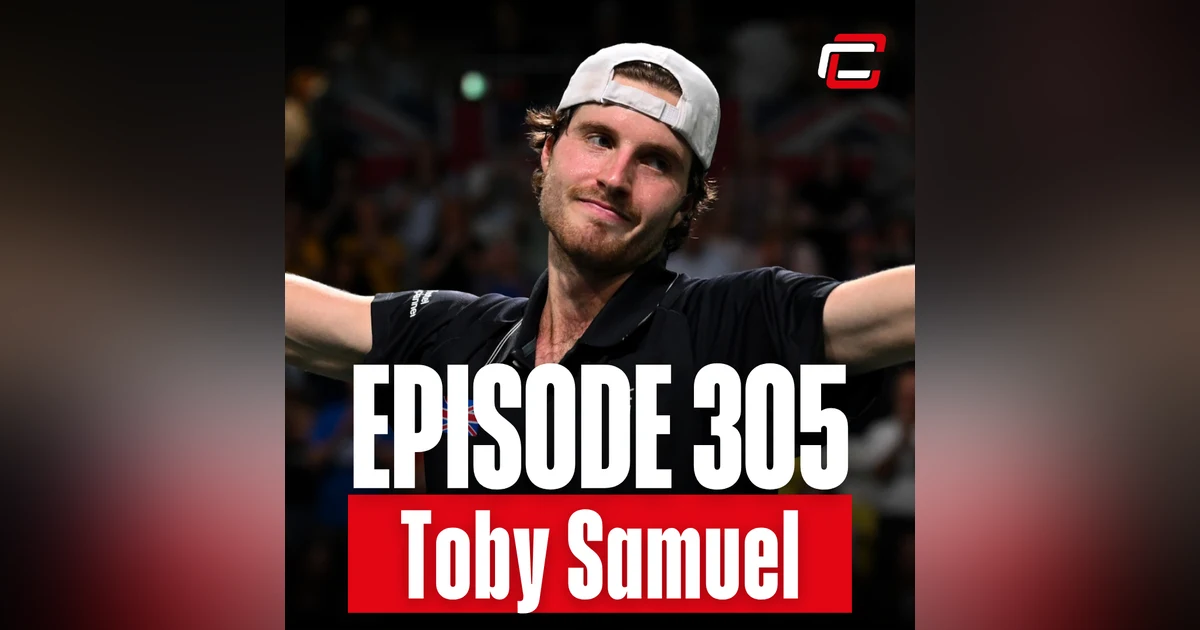
Toby Samuel: “Everything’s a Choice” – The Mentality Behind His Top 100 Breakthrough


 Apple Podcasts

 Spotify

 Overcast

 Castro

 RSS Feed
Fifteen months ago Toby Samuel was ranked 1,870 in the world, injured, out of college, and unable to get into the qualifying draw of a 15K.
This month he broke into the ATP top 100, made his Davis Cup debut at the Copper Box and won the first rubber for Great Britain to help them qualify for the Davis Cup Finals.
In 2025, Toby won 62 matches and climbed further up the rankings than any other male player in the world. He did it without fanfare, without headlines and by his own admission, still staying in the bedrooms at the National Tennis Centre.
This is a conversation about the mental side of the game more than anything else, and Toby's answer on competing is one of the best things we've had on this podcast. If you have a junior in your house, play them that bit twice!
In this episode:
- The Davis Cup call-up he wasn't expecting, and the most nervous he has ever been before a match.
- Losing the first set and finding a way back, and why that is now a pattern rather than a panic.
- "Everything is a choice." Toby on how he transformed the mental side of his game.
- What he says to his coaches before every single match, and why it has nothing to do with how he is hitting the ball.
- Why he has always preferred being the favourite, and what that has cost him against the top guys.
- Going from 1,870 in the world to the top 100 in fifteen months
- The bone bruising injury that wiped out his ranking, and the ATP Accelerator wildcard that turned it around
- Choosing South Carolina over Florida State, the decision that changed his career.
- What NIL money has done to college tennis, and why he thinks it needs a limit
- How he actually uses data, and the six-monthly meeting that shapes his development
- His honest view on the proposed ATP doubles changes
- The Quickfire Round
"I don't know how I'm going to be hitting the ball on the day, but I can always choose to compete and be tough"
Links Mentioned in this Episode:
Follow Control the Controllables: Instagram | YouTube | Website
Check out Tennis Athlete Here: https://www.sototennis.com/tennisathlete
Follow SotoTennis Academy Here: https://www.instagram.com/sototennis
Email us: ctc.podcast@sototennis.com

Episode 305: Toby Samuel: “Everything’s a Choice” – The Mentality Behind His Top 100 Breakthrough
DISCLAIMER: Please note we use a transcription service, so there may be some errors in the following transcript for the episode. If you can, refer to the audio for the exact quotations.
Dan Kiernan (00:01)
Welcome to episode 305 of Control the Controllables. And what an exciting guest we have today. Fresh from his Davis Cup debut in the copper box in London for Great Britain as they qualify for the World Finals with their win over Ecuador. And it's Toby Samuel. Not only fresh from that, winning his first ever match.
His first ever tie for Great Britain, but also recently just moved into the world's top hundred ATP singles players. And what a story it's been. You know, he's he's a decent junior player, you know, went on to college, South Carolina, where you know, transformed his whole his whole tennis during during that period, came out, everyone saw the potential, got injured.
And then he's made his way like incredibly over the last 15 months from from from the the ranking of about 1800 in the world to now sitting in the top hundred in the world. Now Toby's someone who I'm fortunate to have met and and spent some time over the years. He came to SotoTennis Academy when he was younger. He was also out at the academy earlier this year as he was preparing for some tournaments. He is a delightful young man, got a great family.
Got great people around him. And I think you're gonna really enjoy this one. So I'm gonna pass you over to Toby Samuel.
Dan Kiernan (01:32)
So Toby Samuel, a big welcome to Control the Controlables. How you doing?
Toby Samuel (01:37)
Yeah, agree. Thanks. Thanks thanks for having me on the show. I'm really looking forward to this chat.
Dan Kiernan (01:41)
It's hi toby it's it's the the honor is all ours the I don't know if you're the latest entrant or first time entrant into the top 100 singles, but I would imagine you're going to be close to that So firstly a big congrats on that and we'll we'll jump into that and the story Of you getting there, which which is which is a lovely story but also a big congrats on on representing great britain and helping them to the
to the finals the copper box. How was that? How was your first Davis Cup experience? then, you know, for you to be straight
Toby Samuel (02:15)
Yeah.
Dan Kiernan (02:16)
on court as well in the first match.
Toby Samuel (02:18)
Yeah, I mean it was sort of such a crazy experience for me. You know, I obviously leading up to the Davis Cup, I wasn't sort of sure if I'd get picked 'cause you obviously had Jan Choinsky ahead of me in the rankings, you had Jake Fernley who sort of played a couple of Davis Cups before around my ranking as well. So I was was sort of like hoping I'd get picked, but I wasn't sort of banking on it. And then I got the call up and, you know, I I knew I was sort of a third pick, you'd Cam and Arthur ahead of me.
And so I was sort of expecting to sort of, you know, be there, get to get used to Davis Cup, maybe not play a live match, maybe get on the last day. And then obviously Cam pulls out and then I have to sort of step up on the foot the first match, the Davis Cup. And it was it was an unbelievable experience. I think the one thing I would sort of say from that is that's the most nervous I've ever been before a match. I mean, way more than I was for the slams, even. I I think it was just the representing your country and sort of
playing for the whole team and for great obviously be from college, but it's different. Like, yeah, it was a completely new experience and I mean I'm so happy that I managed to get the win there because obviously w winning that match, the the joy I sort of got from that and sort of, you know, sharing that with everyone in my family, that was it was amazing.
Dan Kiernan (03:28)
And like, when you hear that Cam's not playing and you are, you are playing, tell us about that moment and, and, and I guess how you then maybe share that with your team, with your family, you know, how have you watched Davis Cup growing up? Like how did you play for Great Britain in juniors? I would imagine you did at some point, you…
Toby Samuel (03:45)
Yeah.
Dan Kiernan (03:46)
know, like how, important is that kind of representing Great Britain for you and your family?
And how did you deal with that moment when you found out that you were going to be kind of tying them up to go first match?
Toby Samuel (03:58)
Yeah, I mean, I sort of found out a couple of nights before the first match play on Saturdays. I think it was Thursday night. I think Cam made the decision to to pull out the weekend and it was all it was it was tough 'cause I was you had to keep it like under wraps but low key because obviously you hadn't released it yet.
But I sort of you know told my coaches like gonna play. I think when I first I knew that he had some issues going on, but I think when I first heard it, like obviously I was already getting like butterflies days before the match, which has never happened to me really.
I'm, I'm usually a pretty laid back, like relaxed person. And when I sort of start to feel that, I was like, okay, yeah, this means a lot to me. and I think definitely obviously I played a bit in Juniors for Great Britain and obviously I think I love watching Great Britain and England play in all sports and I think it's just a huge part of sort of my family and me just growing up is watching England and Great Britain. It's like the that's the pinnacle of sports, like the Olympics and everything like that, as like sort of what I wanna do and represent.
So I think being caught up at short notice, obviously not sort of expecting to play, and then sort of having to get over the fact that I am gonna play. And then it's in, you know, it's a pretty big arena. I'm still not a hundred percent used to play in those big stadiums yet. I've played a few matches. I'm definitely sort of more comfortable than I was, but it's I'm still not like used to it compared to some of the other players playing. so there's obviously a lot of sort of nerves, like thoughts going round…
I had to sort of try and get over and especially with, you know, the slow start I had, I had to really like get myself going quick 'cause otherwise it could have could, have gone badly that quickly on that, on the match day. So…
Dan Kiernan (05:30)
And how do you work through that? Guess, you know, I you lost the first set six four and then, but,
Toby Samuel (05:34)
Yeah.
Dan Kiernan (05:34)
but how, like pretty much, how do you work through nerves like that? And then as the match is going on, how do you find a way of turning that match around?
Toby Samuel (05:44)
Yeah, I mean obviously pre match for me I can only really do everything I can to prepare the best I can. You know, I did a really good warm up, you know, did everything I usually do before matches, just kept the same routine. and then I think during the match, obviously I mean, for me this last year, the biggest thing that I've sort of improved at is just the mental mental side of the game, like the toughness I have on the court and it's like, you know, even though I lost that first set six four, I mean
looking back to the US Open, which is recent, my fur my all my qualifying matches, I lost the first set in them and I knew in my head it's like, you know, tennis is a matches a long time. You you don't win or lose matches from the first set. And I knew that I had the experience and that sort of belief in myself that, you know, even if I lose the first set, I I'm have the endurance and the the game and the belief that I can come back and win in three sets. And I think obviously you won that second set and
I think after won that set I knew I was gonna win. Just just in myself and I think in the third I just locked it down and I feel like I hardly missed the ball in that third, which which isn't which is really nice to do but
Dan Kiernan (06:46)
And how was that feeling when the last ball went out and the match is over? You've won the first rubber for Great Britain. And a big match, an important match.
Toby Samuel (06:55)
Yeah. I that was one of the best feelings I've ever had. I mean, in tennis especially, is sort of just that sort of like happiness, like emotional release that you sort of have. You like you did it like I did the job that I was meant to do on the day and also just having all my friends and family like in there in the crowd and all the team on the side, it was really special. I I can't wait to describe it, but
Dan Kiernan (07:17)
Who's your football team?
Toby Samuel (07:19)
Southampton, the Saints.
Dan Kiernan (07:21)
Okay. So I was going to say the saints and the playoff finals, but they didn't, they didn't make that, but it—
Toby Samuel (07:26)
Kicked out.
Dan Kiernan (07:28)
—but I was, but let's take the saints in a big match…
Toby Samuel (07:31)
Yeah.
Dan Kiernan (07:32)
last minute goal. You're—
Toby Samuel (07:34)
Yeah.
Dan Kiernan (07:34)
—there that feeling. How does the feeling of you winning the Davis cup rubber compared to the saints scoring a last minute winner in a big match.
Toby Samuel (07:45)
I think probably the Davis Cup felt better. think I think I mean obviously in the moment in the f in the Saints match, like it'd be crazy, like really high, but I think it was more the that whole day after the match was also like just having all that sort of like emotional release and thinking that wow, like that was a really cool moment in my life. I can always sort of look back on that and be like, Yeah, I've I've played Davis Cup, I've won a match there. Like just being able to look back on that, I think is the the real positive that I took from it, you know, I I can never let that go.
Dan Kiernan (08:16)
And I want to, I want to just ask you, Toby, because you said something, you said one of the things I've done the best this year is I've improved so much mentally. How's that happened? Is that, is that happened just through experience and just having experiences? Is that an area that you've worked on? You know, how, how, how have you made such, such big improvements in that area?
Toby Samuel (08:37)
Yeah, mean mental. I think the mental side of the game is one of the most un underworked parts of the game. I think, you know, that is sort of where I've made my biggest jumps. It's not obviously the tennis comes, but I think it was that sort of the mental side of the game that really got me to the top hundred. And I think obviously it all started, I think, probably from when I went to college, US college. And I think that US college style of coaching where it's just like toughness, fight, like, you know, the ball goes in when it has to, like, compete for every point.
That's where I really started that becoming tougher mentally in matches. And I think I went obviously this year I've gone through I've had really tough moments, you know. I I've had I've had bad losses in front of crowds and stuff and that's not nice. But I think I've been really good at like bouncing back quickly and not letting that affect me. And I've and I think that's a huge thing is like, you know, when things aren't going well, it's like being able to bounce back really quick and you know, like obviously take, take the learnings from it, but also, you know, don't—
Dan Kiernan (09:35)
Yep.
Toby Samuel (09:36)
—dwell on it and just keep that belief in myself. I
Dan Kiernan (09:39)
Yep.
Toby Samuel (09:39)
think that's one of bigger things that I've been able to do.
Dan Kiernan (09:41)
Because I think we know it right. It's the sport that we're playing. It's like—
Toby Samuel (09:45)
Yeah.
Dan Kiernan (09:46)
—I talk all the time to the kids at the academy about it. It's your percentages. You're in a sport where your percentages are just so, the difference is so small. The margins are so fine that—
Toby Samuel (09:58)
Yeah.
Dan Kiernan (09:59)
—there's the not succeeding and losing and losing points and losing break points and missing serves and missing shots.
Toby Samuel (10:05)
Yeah.
Dan Kiernan (10:06)
It's the reality of the sport. So we know it, but
I guess the bit I'm really interested in maybe is the coaching me. Like how, what are you doing to work on that? Is that, is that like a specific, you know, we hear Djokovic is doing like three, four hours of work on that side of the game every single day. that, are you doing particular things that are working on that? Or is it just every day when you're on court, how you're reflecting on matches, how you're, how you're, what your outlook is.
What's your, if you don't mind sharing what—
Toby Samuel (10:37)
Yeah.
Dan Kiernan (10:38)
—you do, that would be, I think it would be really helpful for lot of juniors listening as well.
Toby Samuel (10:42)
Yeah. I mean, yeah, for me, obviously parts of this year I've sort of brought somebody in like to help work on that sort of side of the game. But I think honestly for me, what works best, I mean, I think Josh, my college coach, he's really on the mental side—
Dan Kiernan (10:56)
Yep.
Toby Samuel (10:57)
—of game. But he I mean, for me it's everything's a choice. You know, it's like it's not an easy choice, but everything's a choice. It's like if you if you miss a ball, you choose
can choose how to respond to that. You know, it's and it's sometimes it's really hard to make the right decision, but it's like in my head it's it's like how badly do I want to, how badly do I want to compete and fight today? I can easily choose to, you know, throw in the towel and let this guy take—
Dan Kiernan (11:20)
Yep.
Toby Samuel (11:20)
—his match and succumb to myself, my own like fears and nerves. And it's like, but all I could I can choose to step up and be tough and be like, no, I'm I'm I'm gonna make a stand here and I'm gonna really fight and compete. And I think I think everybody has the ability to make that…
choice but obviously there's times where it's really hard to make the choice because of all the external things going on. And I think that's sort of how I've tried to view the mental side of the game and competing. And it's like if I'm obviously there are days where I don't do as well and I face the consequences for that and I like lose some matches. But before every match that is the first thing I say in my like pre-match chat with my coaches like today…
I'm gonna compete as hard as I can and make it as hard as I can for the opponent across the net. And I'm gonna I'm gonna sort of choose choose to do that rather than focusing on, you know, how I'm gonna hit the ball with 'cause I could play I could be hitting the ball terrible. II don't know how I'm gonna be hitting the ball in the day, but I can always I always have that choice to to compete and be tough.
Dan Kiernan (12:18)
God, I love that answer. Honestly, man, like that's
Toby Samuel (12:22)
Yeah.
Dan Kiernan (12:23)
Like, is an absolute gem of an answer. Like that, like right there. Like if, if, if every junior tennis player out there can listen to that, it's, it's, it's unbelievable. So, so thanks for sharing that. That's like that honestly, really, really good in terms of the bit on the top hundred. And I mentioned it—
Toby Samuel (12:44)
Yeah.
Dan Kiernan (12:44)
—to you before I pre we press record. It's like. It's unbelievable how understated you've become a top 100 tennis player in the world, you know, and like…
Toby Samuel (12:53)
Yeah, just
Dan Kiernan (12:54)
And I know you've won a shed load of matches, you know, and
Toby Samuel (12:57)
Yeah.
Dan Kiernan (12:57)
You've gone from, we'll get to that and, know, and I'm always following you, your tennis always have. And it's like, I don't know how many matches, but like last year, think what 65 wins or something like that. There's a lot of tennis matches that you've won—
Toby Samuel (13:08)
Yeah. Yeah.
Dan Kiernan (13:12)
—to get there. So it hasn't just happened. And I know that, you know, and you've been through, been through a lot.
Toby Samuel (13:14)
Yeah.
Dan Kiernan (13:18)
But the bit that I want to ask you about is, guess, a bit specific to British tennis, probably, because
Toby Samuel (13:22)
Yeah.
Dan Kiernan (13:23)
I think if we go back a few years, if we had a young player break the top hundred in the world—
Toby Samuel (13:28)
Yeah.
Dan Kiernan (13:31)
—It would be all over every newspaper. It would be everywhere. It would be because it just, it just wasn't normal. Yet this kind of certainly a little on the outside. I'm not part of your part of your—
Toby Samuel (13:44)
Yeah.
Dan Kiernan (13:45)
—your tennis on a daily, weekly basis. You know, I see you some tournaments and, know, it's always great the odd time that you come to the Academy and things like that. But just feels kind of normal that there's another British—
Toby Samuel (13:55)
Yeah.
Dan Kiernan (13:56)
—tennis player that's broken top 100.
Toby Samuel (13:58)
Yeah.
Dan Kiernan (13:58)
And you're gonna continue having a career. you feel that and do you think that that culture has helped you almost as well? Like, because if I go back to my time…
Toby Samuel (14:10)
Yeah.
Dan Kiernan (14:12)
It felt like we all set ceilings and we set ceilings to try and get wild cards to get into the events. Whereas it seems that you guys aren't really set in ceiling this you're just you're just kind of going and all all just going along on in your careers. Tell me a little bit about that.
Toby Samuel (14:27)
Yeah, I mean yeah, for me it's like I sort of I broke top hundred, which was a big goal of mine, but I mean being ninety five or a hundred and two, it doesn't actually like change anything for me with like getting into tournaments or anything like that really. I think it's a really cool thing to have to say. I've I've been top hundred, but in the at the end of the day obviously my goals is higher than that.
So it's it's something to be like proud of, but it's not something to be satisfied with, I think. especially with, you know, you got guys like Arthur suddenly, he's he's top forty, you know, you got Jacob Fearnley been in the top hundred recently, like being a high he's been high Draper, Jan Choinski top hundreds. I think definitely having a bunch of other sort of players doing that as well makes it more normal and sort of motivates you to carry on pushing and not just be like, you know, I'm the only guy that's got top hundred in last five years.
You know, I'm a great player, like I can sort of relax now, I can sort of take it easy, like celebrate a bit more. I think it's, know, I've got to a hundred, like what more can I do now? how do I get to that top of the game where some of the other guys are? I think that is that is the big thing for me now is sort of how do I improve myself to get to that ranking, you know, where you know Arthur is, where Cam, all those guys are sitting at.
Dan Kiernan (15:45)
How good do you think you can be?
Toby Samuel (15:46)
I think I think I can be very I mean, it's exciting for me because I know I've got so much more I can get better at in my game. I think I've got really good strengths that can get me have got me to this point with still a lot I can improve. I 'cause I I think obviously I've got some big weapons, you know, serve, forehand are really big and then I can move really well.
I think but I think also there's so much to improve in those on those shots still, you know, like serve placement, I can get way better. You know, just like reliability and consistency of my my ground strokes I can I can still get way better. I mean there's I think there's a lot of things I can and I think if I can keep improving those I I think I can reach near the top of the game.
Dan Kiernan (16:26)
And, and, and with you now having an experience of playing De Minaur, Mensik, you know, these sort of players.
Toby Samuel (16:33)
Yeah.
Dan Kiernan (16:34)
Where do you see, was that a shock to the system to play those sort of guys that are like top 15, top 10 in the world? And, and, or did you come away also going, okay, that was, but I, that's that motivates me, but also makes me feel actually, I feel I can get there.
Toby Samuel (16:51)
Yeah, I mean playing those guys, I think in my head, thought they were gonna like smoke the ball and hit me off the court and won't be have a chance. But it's not. I think they're just so used to playing at that level and they're so like experienced. They can play that level and be w complete with it like fully within themselves. I think the mistake I've been making and playing up t to the top guys in the sport is I've been trying to overplay.
And I haven't been doing what's got me to the place that I've been able to play them, I guess. You know, it's like
Dan Kiernan (17:22)
Yeah, yeah.
Toby Samuel (17:23)
I think for example, I play Machac first round US Open and I miss three balls in the first two sets, I'm for Steras. And it's like if I can bring that level of sort of tennis to the Lehecka, you know, I can I don't know, I could maybe win, I could get s a couple sets, who knows? But I think then against Lehecka, I try to, you know, play bigger than I than I can do reliably.
And I start spraying and miss my balls and let him let him have like that matching straights when I could have made it way tougher if I just sort of trusted my game more and just play you know seven out of eight out of ten and be like, let's see what you have. And if I lose, then it's like okay, I can work on few work on these things to become more reliable, and then I can you know raise my base level, raise my seven out of ten to match his more. So I I think that is something that I've learned playing against them. And I think that's I mean, for me as well.
For my game, I've always preferred playing guys around my level or slightly like lower, because I know I can play my seven out of ten, be comfortable and win. I think some guys are the opposite, they like playing up against like high-ranked players, they can play three and just let it go. But I've always, you know, had that security of sort of playing, being comfortable at the level I'm playing at.
Dan Kiernan (18:32)
From a young age, like when, if you go back, cause if you go back to you, guess the start, right? You know, I know you started playing—
Toby Samuel (18:40)
Yeah.
Dan Kiernan (18:40)
—and it's fairly early. you know, I always, I always crack up when I, I tell the story of you, you winning an online, online entry to—
Toby Samuel (18:51)
Yeah.
Dan Kiernan (18:51)
—online competition for a week at SotoTennis Academy. Mean you have been maybe—
Toby Samuel (18:55)
Yeah.
Dan Kiernan (18:55)
—14 then maybe some one or something—
Toby Samuel (18:57)
Yeah.
Dan Kiernan (18:59)
—you know, but which, was, it's like, we're all very proud when we, when we look back at that moment to see how far you've come, it would go back to the very start and your, guess, beginning, you're not playing or ball move. Played at West Hants for many years and—
Toby Samuel (19:14)
Mm-hmm.
Dan Kiernan (19:14)
—she might want to give a shout out to other places as well. But were you always like that even in like say squads?
Were you a kid that liked to be almost the best a player in the squad rather than a player who wanted to always be playing up? Cause I see that as a coach, you have different kids. some, some—
Toby Samuel (19:32)
Mm. Yeah.
Dan Kiernan (19:35)
—kids, most parents want their kid to play up all the time, but actually some kids don't want to. Some kids—
Toby Samuel (19:38)
Yeah. Yeah.
Dan Kiernan (19:41)
—actually feel like, like I would even say my son, when my son was younger, he, I remember we put them against a player that was a couple of years older. he said, why are you doing that? You're doing that to embarrass me. You know, like it was all like, he didn't like it. He preferred—
Toby Samuel (19:52)
Yeah, yeah, yeah.
Dan Kiernan (19:55)
—being in what was, what was your, take us back to the, to the very start. Give us a little bit about your, your, your start into tennis and maybe that mentality that you had when you were, when you were younger.
Toby Samuel (20:05)
Yeah, I mean I I think I think back obviously all the way back to Orange Ball, I think Shane told me a good story of when I was the one seed to think for National was an Orange Ball.
And he was said he went to me, he was like, y you're nervous this week, you know, you're one seed, like how you feel about it. I was like, it I'm I'm fine because I'm meant to win on the best here. So in my head, it's always been sort of I've been always more comfortable when I'm like
Dan Kiernan (20:30)
But thanks for thanks for trying to make me nervous Shane though.
Toby Samuel (20:34)
Yeah, yeah. Yeah, so I I think I've I've obviously like from a young age been pretty high up like ranking in the country. I think like Green Boys won the country, Orange Boys up there like won the country pretty much. I think I've always been used just think about winning a lot, but I I've always been near the top and I think I don't know if that's like shaped the way I sort of think a little bit in tennis, where it's like I prefer being the guy that knows he's, you know, the highest seed, whatever, like he's more secure in the in the event, rather than always sort of playing up against better people.
I think obviously grew up through the through your levels like that. And think also just from college, I think you just win so many more matches than you do on the tour, like percentage wise. yeah, I th I think I just sort of became used used to that feeling of sort of just playing
playing secure, playing within myself and just being tough and getting the job done. I think that's obviously why I've been able to win so many matches on tour as well, a lot like this year or last year, especially this year especially. I think just going back to back weeks in 50Ks, whatever. And it's like in those events, it's like I don't see anybody on this on this event that who will beat me if I just bring my seven out of 10 in good level. If I can do that, I'm going to win this week. And that's how I sort of thought in my head,
And that's how I was able to sort of get so many wins. And I think it's whenever I sort of move to the next level, I'm not sort of confident in that. I'm not secure in that. That's when I sort of, you know, start playing, like spreading a little bit, start missing a bit more, being like less comfortable on the court.
Dan Kiernan (22:06)
And do you think that happened at US Open against Lehecka?
Toby Samuel (22:08)
Yeah, for sure. I mean, that happened a bit against De Minaur, against Lehecka. I think when I first went up to like a challenger level as well, I was the same thing. You know, I'd play a guy two fifty and I'd be like, I don't think I'm good enough to beat this guy and I'll miss loads and so it's I think Josh, my head coach, always said, like when I I'm sort of personal, when I get comfortable at a level, that's when I can get really good. So I think obviously exposing—
Dan Kiernan (22:28)
Yeah.
Toby Samuel (22:30)
—myself to higher levels is is good for me, even though I'm don't like it. I think it's really good for my development, to be able to get comfortable in that situation.
Dan Kiernan (22:38)
So interesting. Are you the oldest child?
Toby Samuel (22:41)
Middle.
Dan Kiernan (22:42)
Or you're middle? Okay. Cause that sounds... Yeah. Okay. So maybe is that why? I'm trying to work out—
Toby Samuel (22:50)
Yeah.
Dan Kiernan (22:51)
—the psychology of it.
Toby Samuel (22:53)
Yeah, I dunno, it's interesting.
Dan Kiernan (22:55)
It is interesting. And do you know what's the most interesting thing for me on that, is your acute awareness of it.
Toby Samuel (23:03)
Yeah.
Dan Kiernan (23:04)
That's pretty cool as well, because like, in fact, that you're aware of that means that you can action it, you know, and that you—
Toby Samuel (23:11)
Yeah.
Dan Kiernan (23:11)
—can, you're able to do things and you and your team are able to, you know, work on acceptance and then, and then come up with strategies around it. You know, I would imagine that quite a few people get towards the end of their career, or if not the end of their career and not really have understood themselves from, from that position.
Toby Samuel (23:30)
Yeah.
Dan Kiernan (23:31)
So, so that is cool in terms of your, I'm still keeping you a little bit as a youngster here.
Toby Samuel (23:39)
Yeah.
Dan Kiernan (23:40)
I don't, the word regrets the wrong word, but I—
Toby Samuel (23:44)
Mm.
Dan Kiernan (23:44)
—think we all have certain things. Like if you were to do your journey, like I always got the impression from from your family that you quite balanced. I know you were a decent footballer, know—
Toby Samuel (23:55)
Yeah.
Dan Kiernan (23:56)
—your family,
always, you know, came across very, and even actually now, like we're having this conversation and you're like, I'm thinking he's top 100 in the world now. You'd be staying in a nice hotel somewhere, but you're staying in NTC's bedrooms. Do know like that, like very—
Toby Samuel (24:10)
Yeah. Yeah. Yeah.
Dan Kiernan (24:12)
—very humble, very, down to earth, you know, all, all, all of those things. Do you have any, when you look back, regrets or anything that you would do different in your journey? Or do you, or do you, or do you, I like actually we kind of nailed this.
Toby Samuel (24:29)
Yeah, I mean, obviously in a way it's like my whole journey and experiences have led me to the to who I am today and I don't—
Dan Kiernan (24:37)
Yeah.
Toby Samuel (24:37)
—without them I don't know if I'd be the same player. I could be better or worse. I'm not sure exactly how it'd end up. but I think I think the one thing I'd probably like to do was when I was slightly younger, probably do a bit more fitness and strength work and sort of get stronger from it because I felt like until I sort of got to college I was pretty like undeveloped physically compared to a lot of the other players and I think that that affected, you know, how much I was winning like right before I went to college for the for the few years.
I think I had a few years in greet yellow ball. I think it was the last couple of years juniors and I've always been sort of top in the country. I think the last two years juniors I started struggling a little bit. I was I was still like pretty top ten in UK but like I was…
not wanting as much, I was sort of not as happy playing tennis. And I'm not really sure what the reason was for those few years, like why that was happening, but I was definitely struggling a bit bit more those few years. And I don't know if that's just because, know, I was I wasn't strong enough. I wasn't sort of physically good enough or if it was just like I know, if it was just to do with like how well I was playing.
But I think actually the the COVID I was able to take a few months off tennis completely during COVID and be at home with my family, my brothers. And I think like we just did loads of fitness. We had a good time. I think that completely sort of saved my tennis almost before I went to college. I
Dan Kiernan (25:58)
Okay, that's interesting.
Toby Samuel (26:00)
And I think without that, I wouldn't without that sort of mental reset. I don't know like if I'd be like if I'd still enjoy playing as much or if I still would have carried on to the level I am now. So I'm not sure like if obviously got a bit lucky with like that whole timing situation but obviously those few years leading up to college, I'd have probably liked to don't know, change stuff, but I definitely could have done those years slightly better, I think.
Dan Kiernan (26:23)
So interesting, my perception of you, when I saw how well you were doing in college, I definitely had a thought of like, wow, like he's really doing well. Because—
Toby Samuel (26:36)
Yeah.
Dan Kiernan (26:36)
—probably last couple of years, juniors, you weren't tracking to do as well as that probably.
Toby Samuel (26:41)
Yeah. Yeah. Yeah, that's true. Yeah.
Dan Kiernan (26:43)
You know, that was definitely without, I don't, I don't sit at night reading about Toby Samuel every night, you know, but I've, I've got—
Toby Samuel (26:49)
Yeah. Yeah.
Dan Kiernan (26:50)
—a, I've got a personal interest in that. like you and—
Toby Samuel (26:52)
Yeah.
Dan Kiernan (26:52)
—I, and I want you to do very well, but that was, that was my, that was, suppose, my kind of loose perception because it felt like, it felt like college went pretty well, pretty quick, you know, and it was—
Toby Samuel (27:04)
Yeah.
Dan Kiernan (27:04)
—like, know, and so tell us about that. And, I guess specifically on Josh, you mentioned Josh, Josh Goffey who Josh is a friend of mine, think.
Josh is brilliant, but you know, we've had Paul Jubb on the podcast as well, who obviously was with, was with Josh as well at South Carolina. Tell us about that decision-making process, one of going to college and two of getting the right college and the importance of getting the right coach within, within that setup as well.
Toby Samuel (27:33)
Yeah, I mean, getting the right sort of coach and the right teammates for you is I think the the biggest thing about college. You know, you can you can go to like a better school on paper, but actually do a lot worse because you don't actually fit in with the team or the coaching styles or whatever. So especially when I was younger and choosing colleges, it was really hard to know what the colleges were actually like. You sort of you don't I mean now people have a better idea, but when I was going, I didn't…
I knew nothing about the colleges. I was sort of just going in blind and obviously I had the visits, but you sort of go there, they take you to like some parties, you just choose the best party school, whichever one gave you the best time on the visit and sort of choose their but so I actually when I was getting recruited, I committed verbally to FSU, Florida State University. And Josh, I think Josh called me up that night after I told him and he was like, Look, like…
I think for you, I can I can do great things with you and I think we we'd have a great relationship in college. I think you should love it here. And I think if you reconsider your choice, it would it would be like amazing for both of us. And I think we could yeah, we could do great things. And I think when he did that, I was like, This guy really believes in me as a player and I was like, I feel like I have to just change and go with him. he sort of connected with me on that level. I think from then on it was like our relationship, my mine with Josh has been amazing and he's...
been yeah, he is I think one of the best coaches in in the world and in college. I mean, he's unbelievable. He sort of grew up around his dad, Carlos, and I—
Dan Kiernan (29:02)
Yep.
Toby Samuel (29:03)
—think Johnny Mac as well. So he he's sort of been around that top of the game and mentally I think he's the one that transformed me into the sort of person like player and person I am today. So…
Dan Kiernan (29:12)
Amazing, How's your relationship with the FSU coach?
Toby Samuel (29:19)
I don't I don't no I don't know. I haven't I haven't spoken to I'm sorry, if you listen, I'm sorry, I'm sorry for decommitting. I was young, I didn't know what was going on really. Yeah, it's…
Dan Kiernan (29:30)
But at the end of the day, do know what I mean? And I'm sure, I don't know who the FSU coach was, but I'm sure he—
Toby Samuel (29:36)
Yeah.
Dan Kiernan (29:37)
—must, you know, at the end of the day in tennis, once you're a coach in tennis and you're involved in development coaching, which we're all developing—
Toby Samuel (29:46)
Yeah.
Dan Kiernan (29:46)
—we're developing players all the way through, you know, you're still being developed right at top hundred in the world. Ultimately we want the best for the players, you know, so I'm sure he's—
Toby Samuel (29:57)
Yeah.
Dan Kiernan (29:57)
—very happy that, you know, you're having the career that you're having. I do want to ask you, what do you think of college now with everything going on? it's gone wild.
Toby Samuel (30:09)
I'm just sad I missed all the NIL money. I was I went two years too early.
Dan Kiernan (30:11)
Yeah, seriously. have some.You might not be staying at NTC if you'd got that NIL money. Yeah, it's crazy.
Toby Samuel (30:19)
I might I might go back though, actually. I think I'm I still got a few years eligibility. No.I yeah, I'm not sure because I think my younger brother, Rafe, he's actually just started at Denver University. So he's just in his first semester—
Dan Kiernan (30:29)
Yes. Okay.
Toby Samuel (30:32)
—now. And I'm looking at him going, if he wants to get to the top of college, he's gotta compete against, you know, guys top four, top 400, top 300 in the world now. And he's top—
Dan Kiernan (30:42)
200, 200, one guy.
Toby Samuel (30:44)
—top two. Yeah. And I'm like,
He's a he's a great player and he's sort of just starting his college journey. It's like I don't think it I don't think it's right that you have like twenty six year olds coming back from the tour who have been on the tour for years and just like throwing him in there. Like I it it's it's it I think should be a limit at least. 'Cause you have some of the top schools who have the most money just buying players. At that point it's like a lot of the schools just can't compete.
Because don't have the money to to compete with the top schools. So it's literally just whoever has the most money wins. I think before, obviously it was when there was every school the same amount of scholarships. It was about the coaches, the culture, the team. Now you have a lot of players being like, who wants to offer them offer me the most? I don't care what the team's like, I don't care who I was a coach. I'm gonna go there, get payday, and go back on tour. And I think it I think you know, the whole reason why players were developing in college is because they'd always…
choose the right college for them, not they didn't go to colleges for the money. So I think that'll be interesting to see how well players like actually I mean, you've seen a quite a few players who've taken big big checks but not actually got that much better. I think that's one of the reasons why they are they are haven't actually connected with the team or coaches. They've just gone there for the money.
Dan Kiernan (31:54)
Did you have an ATP ranking when you went to college? Yeah.
Toby Samuel (31:57)
no.
Dan Kiernan (31:58)
So do you know what it like? I think your story, always Neil Skupski, I always think of Neil Scott, like Neil Skupski would, there's no way Neil would get to LSU now. You mean he was—
Toby Samuel (32:07)
Yeah.
Dan Kiernan (32:08)
—was by his own admission. He was a very average junior. You know, there's so many stories. had Dominik Koepfer on here who—
Toby Samuel (32:17)
Yeah.
Dan Kiernan (32:17)
—he ended up, I he went, started at number six at Tulane.
You know, and he ended up, he's been top 60, top 50 in the world. You know, you could go through like time and time and time. There's an argument that, you know, even though you were very good, maybe you wouldn't have got one of the better colleges now the way it is like.
Toby Samuel (32:34)
No yeah.
Dan Kiernan (32:34)
Just, then all the young Americans, all the, dunno, it doesn't, I spoke to someone on it today and I just like,there's so many, could talk for hours on it, but just the one thing I would say—
Toby Samuel (32:44)
Yeah.
Dan Kiernan (32:45)
—is like, there's not true value. you're paying all this money for somebody—
Toby Samuel (32:49)
Yeah.
Dan Kiernan (32:50)
—I get it. If it's an American football player, because they truly bring that money in through name, image and likeness through ticket sales, through merchandise.
Toby Samuel (32:55)
Yeah, yeah, that's that's yeah. Yeah.
Dan Kiernan (33:00)
They do it. But little Charlie from some little village in Romania with 70 followers on Instagram is, is not—
Toby Samuel (33:07)
Yeah.
Dan Kiernan (33:08)
—able to commercially bring in the value of half a million of 300,000 or 200,000 or even 50,000. You know, and it's it's almost like the waters—
Toby Samuel (33:16)
Yeah, no.
Dan Kiernan (33:19)
—have dirtied between what—
Toby Samuel (33:20)
Yeah.
Dan Kiernan (33:21)
—probably is a good rule for professional sport or people that are commercially viably bringing stuff in. Then, but I think people probably, and what I said to the person I was speaking to, said, I think people probably underestimated the wildness of tennis.
Toby Samuel (33:37)
Yeah.
Dan Kiernan (33:38)
I'm not sure it's happening in golf and other sports. think it's literally—
Toby Samuel (33:41)
No, yeah.
Dan Kiernan (33:42)
—tennis is we're just nuts in tennis. We've seen it like around the world and it's just like what we compare people right?
Toby Samuel (33:44)
Yeah. Yeah.
Dan Kiernan (33:49)
He gets this amount. Anyway, completely crazy. I want—
Toby Samuel (33:52)
Yeah.
Dan Kiernan (33:53)
—to take you into just into your pro career out of college.
Toby Samuel (33:56)
Yeah.
Dan Kiernan (33:57)
And the one thing actually that was interesting when I was looking into some things and I know, you know, ultimately 15 months ago, you were 1870 in the world. You weren't, you were by ranking, but you know, I know that—
Toby Samuel (34:06)
Yeah, yeah, yeah.
Dan Kiernan (34:10)
—you know, and it's incredible how you, you know, you move up. And I think in 2025, you had the biggest, biggest move up. But when you came out of college, I think it was quite interesting. This kind of six challenger main draw spots on the ATP accelerator program, which I don't think it's talked about that much. How, how important—
Toby Samuel (34:25)
Yeah.
Dan Kiernan (34:29)
—was that for your tennis and how, how, how much of a help do you think that program is?
Toby Samuel (34:34)
I mean that that was so key for me because obviously out of college, my last sort of semester at college I was suffering with bone bruising in my arm. It's—
Dan Kiernan (34:43)
Okay.
Toby Samuel (34:44)
—the same thing that Jack Draper has now. So I was suffering with that and then I came out of college and I actually didn't play for four, five months, I think, I was out injured and I lost tried to play one match.
I'd play the match, withdrew the next days, I couldn't play again. So I lost all my ranking points. I think I was like 450 coming out of college. And then obviously with an injury, I lost all my points. I couldn't play. Dropped down to 1800. So I was in the qualify, I was struggling to get into qualifying for 15Ks at some tournaments. I'm—
Dan Kiernan (35:16)
Yep.
Toby Samuel (35:16)
—there going, like, how's this like? What's happened here? Like I've just lost all my points. Like, and then ATP wildcard challenges from the college. I think I got four.
'Cause I I missed the first half of it. So second half, I got four main draw challenges. And I lost three first rounds. first three I played. I lost some like really tight matches. Or like one of one of the first two like were tough. I lost a tight one to Martin Down, third one, fourth tournament Moldova. It was my sort of in my head it was like I have to do well here. It's my last shot to get points to be able to, you know, get into the main draws of futures at least. Cause at this time still, I was still suffering with arm issues and I couldn't—
Dan Kiernan (35:55)
Okay.
Toby Samuel (35:55)
—play more than three or four matches in a week, pretty much. My serve, my serve would like go after three matches. I couldn't hit a serve and like this by semifinal and final day. so I knew I had to get some points. I couldn't afford to have to play through quallies to get to the main draw and in tournament. So I'm going to play main draws pretty much. So I managed to get semifinals in that tournament, which got me, I think, 14 points. And that got me into main draws and that sort of turned my year around, I think.
And that sort of gave me gave me the confidence and the platform to be able to do it. But I think that college wildcard thing is is huge. It's given a lot of players like that jump in, like you'd be able to like leap over the futures qualifying, which I think is really tough. Like no matter how like how good you are really, it's really tough to go through the that experience and you have to really grind.
Dan Kiernan (36:40)
And that's, mean, there's a story actually, true, I know the story's true because it was, it was actually, it was years ago at Wimbledon, Novak Djokovic was speaking to, I think it was Ben Haran and a couple of other guys he was hitting with, hitting with Evan Hoyt at the time. And he basically, what he said is he said, this guy's as good as me that didn't get through.
Toby Samuel (37:03)
Yeah.
Dan Kiernan (37:04)
Maybe a bit of a humble thing to say, you know, when it's Novak Djokovic. However,he talked about this story where he was losing it. He was struggling big time. And then his dad was like, we're going to go and play this challenger. And he said, why am I playing a challenger? I'm ranked like a thousand in the world. I'm never going to get the challenger. Let's—
Toby Samuel (37:22)
Yeah.
Dan Kiernan (37:23)
—go home. And his dad like get in the car. We're going, you know, like they drove like overnight from some futures to this challenger, got to the challenger and—
Toby Samuel (37:30)
Yeah.
Dan Kiernan (37:33)
—and he ended up getting in like lasting qualities qualified won the event. Then, you know, kind of got on got on—
Toby Samuel (37:40)
Yeah.
Dan Kiernan (37:40)
—his got on his run. And I guess someone would just say, Well, if that didn't happen that week, it would have happened a couple of weeks later with Novak Djokovic. But there is a certain there—
Toby Samuel (37:49)
Yeah.
Dan Kiernan (37:49)
—is a certain timing and a little bit of luck and little things that fall into place that have to happen. And there is some really, really good tennis players that don't get through because they get a bit stuck and financially and then mentally. then it's, it, the grind just gets them, right. It gets them pretty good.
Toby Samuel (38:06)
Hundred percent. Yeah.
Dan Kiernan (38:07)
You know, unlike if we, if we take this like you, yes, you you were 62 and 17 in 2025 and went from one eight, six one to two six two, which was the biggest ranking—
Toby Samuel (38:17)
Yeah, you could.
Dan Kiernan (38:18)
—rise of any male play in the world in 2025. winning it, it titles. And—
Toby Samuel (38:24)
Yes.
Dan Kiernan (38:25)
—then you've just obviously just continued. feels like you've done it the right way. You've, you've, you've managed to get on the treadmill and just, just go.
What, would you, what would you put that down to? Would you put that down to, yeah, is that, is that your, just the way that you're built? You play lots of matches, you start winning and you just kind—
Toby Samuel (38:44)
Yeah.
Dan Kiernan (38:45)
—of, kind of, you kind of go with it. Is that, that's a big part of who you are.
Toby Samuel (38:48)
Yeah, I mean definitely. I I mean tennis is such a sort of confident sport. It feels like, you know—
Dan Kiernan (38:52)
Yeah.
Toby Samuel (38:53)
—you you win one week and suddenly in your head you're the you're the best player in the world. Like and
then you lose a match first round, you're like, I'm so bad at tennis, like what what am I doing it? Like but I I think definitely for me it's like when I sort of get going and start winning a lot of matches, that sort of brings my level up more than any sort of training can do. And that's the sort of way I've been. It's like I've just…
got all my confidence from from playing matches and and competing and sort of winning events. And I sort of learned how to just carry like use that sort of momentum and just sort of c carry it on as long as I can. I think it's key, you know, some players, you you win a week and then you like relax and laugh on the week. You know, like next week I but you lose first round, whatever, the classic. But in my head it's like, I win a week. I'm tired. But it's like this is when I'm actually playing my best tennis. You know, I've just won I've just won the week.
It's like, why would I take a rest now? This is when I want to actually push, you know, and this is where I want to get all all the sort of results from the harder week I've hard work I've done to win that last week. Now I get to enjoy the benefits of being really confident on the court.
Dan Kiernan (39:55)
Very good. like that.
Toby Samuel (39:56)
Right.
Dan Kiernan (39:56)
What about the difference between confidence and when, when did you, if you take yourself back to being a junior player, do you think you had a strong inner belief that you were going to be a tennis player? Did you want to be a tennis player?
Toby Samuel (40:13)
Yeah, yeah, I mean I always wanted to be tennis, but I think when I was younger the belief definitely went up and down a lot more than it does now. I think especially those two years I said before college, I think that.
Dan Kiernan (40:25)
Yep.
Toby Samuel (40:26)
But my belief was getting affected and hit, which was like making me not as happy playing. And I think especially in your sort of you know, younger teenage years, like your belief can can get hit a lot easier than it obviously you're young when you're younger kid it's like you're just doing it for the fun of tennis. So you just loving…
and then it starts to get more serious and you start losing a bit and your belief can go down. But I think now, mean, I think most sort of top players have that inner belief. And I obviously have that really strong belief myself now. And I think it's like even if it'd be a bad day, you know you're a great tennis player. It's like you've proven it. It's like nothing can sort of take away that belief in you having yourself. But I think confidence, obviously, you go through patches of feeling amazing on the ball, and then some some weeks you'd be like,
I'm not playing well, but I think in those weeks is really important to that's when you have to be tougher and that's where you have to push through those those tougher patches to to get to the good stuff.
Dan Kiernan (41:16)
Make those choices.
Toby Samuel (41:18)
Yeah, make those tough choices. And when you
get through when you get through those moments and it's like, okay, like the good stuff is gonna come. And then it's about running with that good stuff as long as you can and you…
Dan Kiernan (41:29)
Yep.
Toby Samuel (41:29)
And just keep going un until it's sort of until it hits a tough patch again. But that's sort of how I've how I've done it.
Dan Kiernan (41:34)
And believe in terms of was there a moment or was there a, when do you think you truly believed that? You know, I can, it might take me a bit of time, but I can, I'm going to do this. I can do this.
Toby Samuel (41:45)
I think it was after I went back to back fifties, end of twenty twenty-five. And I think I sort of like I think it was actually…
Dan Kiernan (41:51)
Was that in Greece? Was that in Greece?
Toby Samuel (41:53)
No, that was Egypt and then Bahrain, end of the year,
Dan Kiernan (41:56)
Okay.
Toby Samuel (41:57)
Twenty twenty five, last two tournaments of the year, and I think I'd I just won think I went final fifteen K, win fifteen K, win fifteen K, fifteen K, I think, before those two. Or something like that.
I'd I'd won a lot of matching. I think I was playing number two seed first round. And in my head, I think I start week I just knew I was gonna win the week. I don't know, like I don't know why, but I was like sort of in the shower and I was like had I had music on, I was like, I just felt it. I was like, yeah, this is my week, I'm winning it. And then I yeah, and then I Yeah, I don't know why.
Dan Kiernan (42:27)
Nice feeling. I imagine I never had it, but I would imagine it's a nice feeling.
Toby Samuel (42:34)
I felt it. It just sort of happened, and then I think.
Those two weeks, I think I lost one set. I think it was the final against Jay Clarke. I lost the first set. But apart from I think I lost one set those two weeks in the challenges.
know if that was confidence or belief, or that was like just the my inner sort of belief that s okay, like I am a good tennis player. Like I believe I I'm better than people here.
Dan Kiernan (42:52)
Yeah, cause I watched you play a little bit in Greece on, on streams.
Toby Samuel (42:56)
Yeah.
Dan Kiernan (42:57)
And I was like, this just looks really easy for you. You were winning every match. Like, so I—
Toby Samuel (43:02)
Yeah.
Dan Kiernan (43:03)
—think you were like two, what did you went back to back there? And then, then.
Toby Samuel (43:06)
Yeah, I don't I don't need to set there and those two either.
Dan Kiernan (43:09)
And it was like in the finals, I was like, my God, he's winning the finals, like two and one. Was just like, and that, and again, I just got, I, you get a feeling from following players. What they're going to do. that, when I was following that, was like, well, if you, doing that at challenges, you're, you're, you're a player, right? You—
Toby Samuel (43:28)
Yeah.
Dan Kiernan (43:29)
—you know what I mean? It's like, that's not, know, if you're, some players can win a challenge at once in their career and they were like, I, I would want futures in my singles career. I was, a breakdown of the third last round qualities. won, I won six in the third, first round main draw, six in the third, second round.
Toby Samuel (43:47)
Yeah.
Dan Kiernan (43:47)
Six and five court, you know what? I was literally having—
Toby Samuel (43:50)
Yeah.
Dan Kiernan (43:50)
—one of those weeks where I just, I was winning every tie break to just—
Toby Samuel (43:55)
Yeah.
Dan Kiernan (43:56)
—to just win the futures, you know, like,
Toby Samuel (43:58)
Yeah. Yeah.
Dan Kiernan (44:00)
So that, that, and actually it was that night I actually realized I wasn't going to be a player actually. Cause I, because I sat there and I was like, that was too tough. Like that whole week to win those matches in that way, if I'm going to be like a proper player, I'm going to have to do that like 20, 25 weeks a year. And that's not repeatable.Whereas what you were doing in those challenges was just so repeatable. Right. And that's—
Toby Samuel (44:26)
Mm.
Dan Kiernan (44:26)
—I think quite a, quite a good thing. Toby, I like to do this quick fire round at the end, but I just want to ask you on a couple of topics. Because I find them interesting more than anything. The one topic I want to ask you on is just, is, is, is around data. You know, you—
Toby Samuel (44:42)
Yeah.
Dan Kiernan (44:42)
—know, think, you know, data is something that tennis was way behind. It's obviously become more and more prevalent and available.
Toby Samuel (44:49)
Yeah.
Dan Kiernan (44:50)
You know, for you as a player, how do you like to use data? Do you like to get into it? Do you just like your coaches too, and then just feed stuff in? Do you like it during matches? Where, where's your stance on it?
Toby Samuel (44:59)
Yeah. I don't look at data before matches. So I for my sort of prematch thing, like Tiarnan, my coach, he'll he'll watch my opponent, he'll get some data on them from from the stats, like stat man, whatever, who gives it to him or he finds it. And then he'll sort of take that data and from watching the matches on video.
He'll sort of give me some some pointers and be like, you know, if if a guy's 'cause obviously data's good, but you know, you on the day, everything can be different. So I if his if the date is like he serves wide and the juice a lot more, it's his favorite serve. Obviously, and then you watch the match and the guy's like serving wide that week, he'll be like, Yeah, this guy likes likes to serve wide, sit on that and bigger points more. But it's not Yeah.
Dan Kiernan (45:43)
Dangerous though. The serving is the dangerous one with players.
Toby Samuel (45:47)
Yeah, so and that's the thing that like it's good but also the same time it's like it's also you have to get a feel for yourself in a match. So I think it's ch I think in the future start to use it more. But I think I haven't really dived into the data side of tennis yet.
Dan Kiernan (46:03)
What about for development yourself? Cause I guess there's two ways, right? You can, you can look at it from a scouting perspective.
Toby Samuel (46:08)
Yeah. Yeah.
Dan Kiernan (46:10)
And I know it's all like, as a coach, the players that I've coached has been multiple players that I've coached in doubles that are kind of top 10, top 15 in the world. And, and some of them love it and want to know stuff. Some of them you've got to really dissect it almost into one word.
The art of delivery will always be the place, but that's from a scouting perspective. would you say, let's go into pre-season, would you be looking, would you be taking data, will your team be taking that data to then look at the next areas of development for you as well? That, because it's already…
Toby Samuel (46:49)
Yeah.
Dan Kiernan (46:49)
…readily available now.
Toby Samuel (46:50)
Yeah. So I think I've used that, for example, on my surf spots is I think—
Dan Kiernan (46:55)
Yeah.
Toby Samuel (46:55)
—it was after those those start early in the year I sort of played those degrees tournaments and I got the data back and I was just not I was not hitting my spots on my first serve enough. I so I think I got that feedback back and then we were able to sort of work on that the next few weeks to really focus on that sort of area of the game. So I think in that sense it's it's good…
to highlight some areas of the game I can work on. So I think every sort of six months we have a sort of meeting and I say, can you track these few things in my game? It could be like f surf spots, like points well like points one transitioning forward. And then—
Dan Kiernan (47:28)
Yep.
Toby Samuel (47:29)
—I'll get those stats back from like 10, 15 matches, whatever. And then we can—
Dan Kiernan (47:33)
Yep.
Toby Samuel (47:33)
—look at sort of my averages compared to the tall average or compared to my averages from the last six months.
Dan Kiernan (47:39)
Yep.
Toby Samuel (47:39)
And sort and we can sort of see if there's improvement there, if there needs to be more work or if it's good and we can sort of focus on other sort of areas of the game to look at. so that's what I'm sort of using the stats of my own sort of development for.
Dan Kiernan (47:50)
Okay, good. The second topic, I don't know how involved or how much you've heard on this, but there was obviously a hot topic last couple of months has been the potential ATP doubles changes. Is that something as a player that you are aware of? Is that something that you've kind —
Toby Samuel (48:08)
Yeah.
Dan Kiernan (48:09)
—of got clear? is there any thoughts or stance you have on that?
Toby Samuel (48:13)
I think it I think it's a bit stupid because what's gonna happen is when they do that, then they're gonna want to cut it down even more on singles after that as well. And then you're gonna they're gonna they're you're gonna have like a much smaller pool of players able to sort of play and earn money in tennis. And I think the beauty of tennis is the amount of different players you get to watch and see play. And I think…
obviously if you if you cut doubles you're losing so many players that people can come out and watch and see different styles of tennis and how different matchups work. And I think, I mean, for me as well, I haven't actually played much doubles in the last year and a half, two years. And if I stepped out on a dub—
Dan Kiernan (48:51)
I'm gonna a bloody good doubles now.
Toby Samuel (48:52)
—yeah, if I stepped out on a dubs court now, I did in Ilkley, I couldn't put a return in the court past the net guy. It's, it's a different it's a different sport and it's completely different skill sets.
And I think that it's like you shouldn't like compare the two and be like this is this is better than the other. just it's different. And I think it they should focus on marketing it better be able to showcase the skills to generate more money for doubles instead of just cutting it, I think, because they don't market it well enough.
Dan Kiernan (49:22)
Good. mean, I'm not going to I've given my opinions many times on this podcast. It's it's I appreciate you giving yours as a player, and I guess you've kind of moved in those rankings in the last few weeks more, but how how much communications happened with you as a player on those on on on those rule changes, are you just kind of generally getting given that is that happening is that as players? Because it gets my, my…
Toby Samuel (49:46)
I'm yeah. I I'm just hearing it from word of mouth from other players really. Like I haven't been i’m not like receiving information directly from ATP. I'm just sort of hearing it from other people around tournaments and stuff and people who maybe more dialed in than I am.
Dan Kiernan (50:00)
Okay. Yeah, because the, the, the, was at some meetings in New York and there's in short, this is, it's quite interesting having you on talking about it because you're one of the players that fits now into this area. So, so you've got, there's 30 million coming in, in 2028 from a big commercial—
Toby Samuel (50:21)
Mm.
Dan Kiernan (50:22)
—partner and or every single penny of that 30 million is going to the top eight players in the world. Every single penny. So, so as of 2028, the number one in the world will get two million if they play—
Toby Samuel (50:35)
Yeah.
Dan Kiernan (50:35)
–a Masters 1000 event, the number two player. So, hi, there's, some money for you to earn young man. If you can get your ranking up there, number two will get 1.2 million just for playing, not for, not for—
Toby Samuel (50:45)
Yeah.
Dan Kiernan (50:46)
—not for any result. So—
Toby Samuel (50:47)
Yeah.
Dan Kiernan (50:48)
—what I, what, what seems kind of to happening is understandably the next guys ranked in singles between 10 and 100, which you now come into that, were pissed off because that 30 million's not touching them. So—
Toby Samuel (51:02)
Yeah.
Dan Kiernan (51:02)
— what they're doing is they're transferring this percentage that the doubles players are getting, or 10 % of that, which is 25 million, to feed into the singles players ranked between 10 and 120 so that the prize money goes up.
Toby Samuel (51:18)
Yeah.
Dan Kiernan (51:22)
It's dressed up in lots of different ways, but that seems to be almost this transfer of wealth, almost—
Toby Samuel (51:30)
Yeah.
Dan Kiernan (51:31)
— in a sport where we're already so elitist and we're quite an elitist—
Toby Samuel (51:35)
Yeah.
Dan Kiernan (51:36)
— sport. It seems to be this kind of craziness of why we're trying to make, I'm sure Yannick Sinner doesn't want to be any richer than he already is, right? But...
Toby Samuel (51:44)
Yeah, I mean that's that's the classic thing where it's like obviously the top guys make so much money already, but it's like obviously th they've they've earned they're the ones that bring the money into the sport. So obviously they, they deserve a lot of money. Then at a certain point it's like if you want you guys coming through and other people coming through, you have to put money in the lower levels of the sport. Like you—
Dan Kiernan (52:03)
Yep.
Toby Samuel (52:04)
— said, like there's so many players that could have been unbelievable, but they just didn't they couldn't do it financially. They couldn't support the journey. And—
Dan Kiernan (52:11)
Yeah.
Toby Samuel (52:11)
—I think I'm sure like a lot of the top players would be okay with taking that money and giving it to the futures tour, the challenger tour and whatever, to get obviously like the new generation of players coming through. I don't I don't think they necessarily need that money. I if I was making extra money that much money, I wouldn't I wouldn't need that extra money, like extra two million. Like th it's just a six King slam. They're making millions just from going there. And it is I mean, it is is tricky because…
Obviously they want to keep the top of the game as happy as they can 'cause that's where they're making the most money from. then it's also you gotta think like as a business as a whole, if you get rid of everybody else apart from the top guys, it'll become a bit stale, I think, if you just see the top guys playing—
Dan Kiernan (52:51)
Okay.
Toby Samuel (52:51)
—each other every single week. You need fresh people coming through, you need new stories, you need different different parts of the sport. That's why tennis is so good.
Dan Kiernan (53:00)
Hi, need come on, we're all behind you now. Toby Samuel top, top it in the world. This is the sort of spokesperson we need. you honestly met what a legend you are coming on and I've loved chatting with you like so, so pleased for you, for your family, for your coaches, for everyone involved. You know, it's such a, it's such a lovely story. The way that you've gone about it, you, the humility that you've shown and, and it feels to me, you're just getting started. It really does.
Toby Samuel (53:26)
Thanks.
Dan Kiernan (53:27)
Before we finish, are you ready for our quick fire round?
Toby Samuel (53:30)
Yeah, let's do it.
Dan Kiernan (53:32)
Me see what I've got here. What do we have? have all sorts of things here.
Roger or Rafa?
Toby Samuel (53:37)
Roger.
Dan Kiernan (53:38)
Biggest role model in your career?
Toby Samuel (53:41)
I'd probably say my parents.
Dan Kiernan (53:43)
Who's the most famous person in your phone who isn't a tennis player?
Toby Samuel (53:50)
No one. I I don't I don't think of anybody famous as the no tennis player, genuinely.
Dan Kiernan (53:57)
Most famous tennis player?
Toby Samuel (53:58)
Jack Draper. Yeah.
Dan Kiernan (54:00)
I've got Jack actually, I did have Jack's because he's been on the podcast, but I actually like I was going through this with my kids the other day and they were like, it was not that I not that I'm kind of prank calling any of these people. And they were like, well, got Andy Murray's number. My God. Andy Murray's number. If—
Toby Samuel (54:20)
Yeah.
Dan Kiernan (54:21)
—you got Jack Draper's. my God.
And actually, when I went on it, said, it actually said, Jack, this number no longer exists or something. I don't think I've got, I don't think I've got Jack's latest. I don't think I've got Jack's latest one. But I—
Toby Samuel (54:30)
You got the old one? Yeah. Yeah.
Dan Kiernan (54:34)
—don't, I don't need it. You know, I'm I'm not asking for it. That's, that's for sure.
Who do you think are the most aesthetically pleasing tennis players on the eye on the tour? Men, men or women.
Toby Samuel (54:45)
Tommy Paul. He's a he's a good he's a good look he's a good looking guy. I also I have a girlfriend, so I'm not gonna say any woman.
Dan Kiernan (54:46)
Okay, yeah.
What I'm talking about technique, I wasn't talking about good looks, I was talking about technique, this
Toby Samuel (54:55)
yeah.
Dan Kiernan (54:59)
is the headline, Toby Samuel fancies Tommy Paul, we got it, we got the headline.
Toby Samuel (55:04)
And I I meant because Tony Paul's very good looking backhand and forehand. No, I I'd say technique wise.
Dimitrov, I was watching Dimitrov hit and it's just—
Dan Kiernan (55:16)
Beautiful,
Toby Samuel (55:17)
—it's so it's so clean. So I think I think he…
Dan Kiernan (55:20)
He's not bad looking either.
Toby Samuel (55:23)
No comment. No, it's just gonna come. But
Dan Kiernan (55:26)
So you can give us an aesthetically pleasing female player technically. You read the question wrong.
Toby Samuel (55:34)
yeah, yeah.
Dan Kiernan (55:36)
Anyone that jumps out? It's not Sabalenka. It's ugly when Sabalenka hits the ball.
Toby Samuel (55:40)
No. I'm trying to think who's t I I tell you who I actually watched some of the day and I thought it was very nice technique is Sonay Kartal. I watched some of her ten—
Dan Kiernan (55:49)
Yeah, yeah.
Toby Samuel (55:51)
—tennis of the pillage. She hit her technique is actually really nice.
Dan Kiernan (55:55)
She is, yeah, she's smooth, yeah. She.
The greatest of all time? The greatest male player of all time first?
Toby Samuel (56:04)
I about Djokovic.
Dan Kiernan (56:05)
Greatest female player of all time?
Should there be a medical time out or not during matches?
Toby Samuel (56:14)
I think it should be just changeover.
Dan Kiernan (56:17)
So you just have the one and a half minutes. like it. If you could, redo or recreate one moment in your career so far, what would it be? Something that you loved and you would love to experience it again, or you had and you wished to have another go at it because you maybe didn't quite do as you'd hoped.
Toby Samuel (56:39)
That's yeah.
Fifth set tie break against Mensik Wimbledon.
Dan Kiernan (56:43)
I was watching on the balcony. What would you do different?
Toby Samuel (56:46)
I'd go through more.
Dan Kiernan (56:48)
How did you feel after that match?
Toby Samuel (56:49)
Pretty heartbroken.
But obviously I was I was proud I was proud of how I did and how far I pushed him, but mean ultimately it's like loss is a loss and I could have lost no and I would have been the same result. But I think like I wish I in that moment against against him, couldn't just try and put the ball in. I had to actually go and take the match there.
Dan Kiernan (57:09)
Yep. I just lost your first server. My memory was all of sudden the first serve—
Toby Samuel (57:13)
Yeah.
Dan Kiernan (57:13)
—went.
Toby Samuel (57:14)
Yeah. It's just that yeah. It's it's small margins. But I if I had a chance I'd probably do read try and redo that one.
Dan Kiernan (57:20)
But what I like about that answer as well is go back and sorry guys, if they're listening, I'm not, I'm not criticizing, but there's a guy called Chris Bailey, like many years ago, Chris Bailey played Goran Ivanisevic and Goran had a, Chris had a match point Goran served a second service. Barry Cowan went five sets with Pete Sampras. You know, that there's, was, and it all, it almost felt like in those days.
British tennis players made their names by losing. And, and, those guys never probably had those results after, but, but then went into commentary or broadcasting and—
Toby Samuel (57:55)
Yeah.
Dan Kiernan (57:56)
—it was almost, and that's also where it feels different. It's like, I like that you, it was heartbroken, you're heartbroken, know, like you're about to—
Toby Samuel (58:04)
Yeah.
Dan Kiernan (58:05)
—about to potentially beat this, this guy who's just been, I think he just made semis and Roland Garros 15 in the world, Jakub Mensik, known as like one of the best, if not the best up and coming player in the world. And that mindset is, you know, cool. And you take that pain, right? Take that pain.
Toby Samuel (58:22)
Yeah.
Dan Kiernan (58:23)
And then you put it into the next phase. And I think that's a cultural difference to my day as well, that you guys, and—
Toby Samuel (58:32)
Yeah.
Dan Kiernan (58:33)
—I love to hear that.
What would be one rule change you would have in tennis?
Toby Samuel (58:37)
I think I was gonna I was a year ago even now, I was gonna think you the crowd can make noise during matches. Just because I feel like the way sport is evolving, obviously to get the younger generation more into tennis, if you had that rule, it would bring a lot more like newer audiences in. But then I don't know how much that would affect the actual sport, level of the tennis.
Dan Kiernan (59:01)
I tell you my college career at LSU, was noise all the bloody time.
Toby Samuel (59:04)
Yeah. That that's all what I the thought I had of like the more like a college atmosphere sometimes. But then obviously yeah, that could be interesting.
Dan Kiernan (59:14)
Where the boundary is maybe. Some people—
Toby Samuel (59:15)
Yeah, that's the thing.
Dan Kiernan (59:18)
—aren't so good with boundaries.
Toby Samuel (59:20)
Yeah.
Dan Kiernan (59:21)
What does control the controllables mean to you?
Toby Samuel (59:25)
I think it's doing everything you can to sort of be the best version of yourself you can be. That's like obviously there's gonna be things out of your control that affect you, but if you can try and get everything that you can control the best do to the best of your ability, you're gonna put yourself in a great place and you're gonna give yourself a lot of good opportunities in life.
Dan Kiernan (59:46)
Very good. And last question. I don't know if you're familiar with this question, but the answer to this question is a little bit like passing the baton. And you then have a responsibility to help get this next person on the shore.
Toby Samuel (59:57)
Yeah. okay.
Dan Kiernan (1:00:01)
Who should be our next guest on Control the Controllables?
Toby Samuel (1:00:06)
Next guest.
Dan Kiernan (1:00:07)
Who've you got? gotta keep the player. If we can, not to influence, but we gotta keep the player thing. Coaches are easy to get, but players are a bit harder.
Toby Samuel (1:00:16)
Yeah. Who would be good for an interview? Not not Adam Jones.
Dan Kiernan (1:00:22)
him. was...
Toby Samuel (1:00:22)
You'll be you I tell what. You get a good, you get a good combo with him about him being around the top players in the world. really?
Dan Kiernan (1:00:28)
He was on, he was on a few weeks ago. Yeah. He's been, he's yeah.
Toby Samuel (1:00:33)
Player. Have you Jake Fermi?
Dan Kiernan (1:00:36)
Yes.
Toby Samuel (1:00:37)
the yarn.
Dan Kiernan (1:00:38)
No.
Toby Samuel (1:00:38)
I think Jan would be very interesting just because of he's been really I think under the radar and suddenly he's sat at you know top eighteen in the world. Especially at his age.
Dan Kiernan (1:00:47)
It be great.
Toby Samuel (1:00:49)
Sort of like sort of seeing how he's managed to make that breakthrough like now.
Dan Kiernan (1:00:54)
Great. you, hey, if you can make the intro, we'd love to get Jan on the show. Jan Choinski. He's got a great story, but Toby, I'll be in touch on that. We'll be in touch on different things, but once again, a massive thank you for coming on. The very best of luck—
Toby Samuel (1:01:09)
No, it's
Dan Kiernan (1:01:10)
—the rest of the year as well. You know, just keep, keep doing your thing, young man. Fantastic.
Toby Samuel (1:01:14)
Yeah. Thanks for having me. It's good fun.
Dan Kiernan (1:01:16)
Thank you.
Dan Kiernan (1:01:18)
I said at the start that you'd enjoy it. Now come on, be honest. That was that was good, right? You know, how how good was Toby? And I said it to him afterwards, actually, is I get the the the privilege and it is a privilege to to have these conversations. I never take it for granted. I feel very lucky to to have these conversations with these amazing people in our sport. And not just through this podcast, but other podcasts through…
interviews I like watching athletes being interviewed and and managers, football managers, coaches. I think you can tell so much. There's a lot of subtle ways that people present themselves that I think say so much about where their mindset is. And and for me, I I just saw an assured, confident young man who who absolutely has belief that he is gonna go right up these rankings, ATP rankings.
You know, if he can stay healthy, you know, there's there's no doubt coming away from that conversation for me that he's got a really, really long and bright future in this game. And I just love, yeah, I love that he's he's he's at that ranking, but it's like okay, yeah, whether I'm there or I'm not there, whatever. But I I know that I can compete with these players. I know that I have the game. I know I have areas to work on. I was devastated when he didn't beat Mensik.
You know, number 15 in the world on a on a on a big court at Wimbledon. You know, he's not satisfied. He's he's doing the work, he's doing the work on on the mindset. And I I see nothing but a bright future. And I'm a big fan. I'm a big fan. I'm a big fan of of him. I'm a big fan of the people that are are around him. He's coaches, he's agent. You know, I know he's got really good, strong people around him that are going to be giving him…
The best the best support which you know you you need and you need in this sport. And I just I just found that so interesting. I found it so I loved, I absolutely loved the the the stuff on the mindset on making a choice. You know, it starts with a choice and you know you can make that choice to suffer or you can make that choice to to not, you know, but you know starting that and the prematch plan, always having that in the conversation.
So many things I took from that. I I I hope you did as well. Absolutely loved it. more more to come. we do have conversations coming up. We with Donna Kelso. Donna, Donna's awesome. Anyone that knows in the world of tennis, she's been a WTA supervisor now for 28 years. she was also an umpire for for many years, did some pretty special matches, umpiring from Olympic gold medal matches to to Crown Slam finals to Monica Seles' first match back after she was stabbed.
Now that's that's going to be really interesting to to talk about. So that's going to be another great guest. There is more coming. I will be making my way to China for the for the WTA 1000 events. How good Wi-Fi is over there is sometimes debatable. And how much we can use the software that we do to record podcasts is also sometimes debatable. But if we can we will.
And we will absolutely aim to continue bringing more to you over the neck over the next few weeks. Tennis has a lot more to come this year. Some people say, including myself, it maybe feels like it should end after US Open. But we've had a couple of weeks away and we're back to try and finish the year with a bang.
Please do reach out. Thank you for listening. We absolutely love our Control the Controllables community. Anybody wants to reach out, you know where to find us. You'll see that in the show notes. Like, share.
Don't forget, this is all on YouTube as well. so get yourself on YouTube, subscribe. It doesn't cost you a penny to subscribe on there, just clicking a button. And all of the people that know more about podcasts than me tell me that it helps. So I'm in for that as well.
But until next time, I'm Dan Kiernan and we are Control the Controllables.


