DEBATE: ATP Doubles Proposals + Wimbledon 2026 Review

 Apple Podcasts
 Spotify
 Overcast
 Castro
 RSS Feed
 Follow the Podcast Here: https://www.instagram.com/ctc.podcast/
Follow Tennis Athlete Here: https://www.instagram.com/tennisathlete_sta/
Follow SotoTennis Academy Here: https://www.instagram.com/sototennis/?hl=en
Email us: info@sototennis.com
Meet our panellists:
- Denmark's Davis Cup Captain and 2012 Wimbledon Doubles Champion, Freddie Nielsen - currently coaching August Holmgren, who is in the final round of qualifying as we record.
- GB Coach Calvin Betton who is currently working with Henry Patten & Harri Heliövaara.
- Top S&C Coach Kieron Vorster who has worked with Liam Broady, Dan Evans, Tim Henman and Wayne Ferreira.
- Sports broadcaster and former CNN anchor Candy Reid, Tennessee Vols alumna and one of the great voices of tennis.
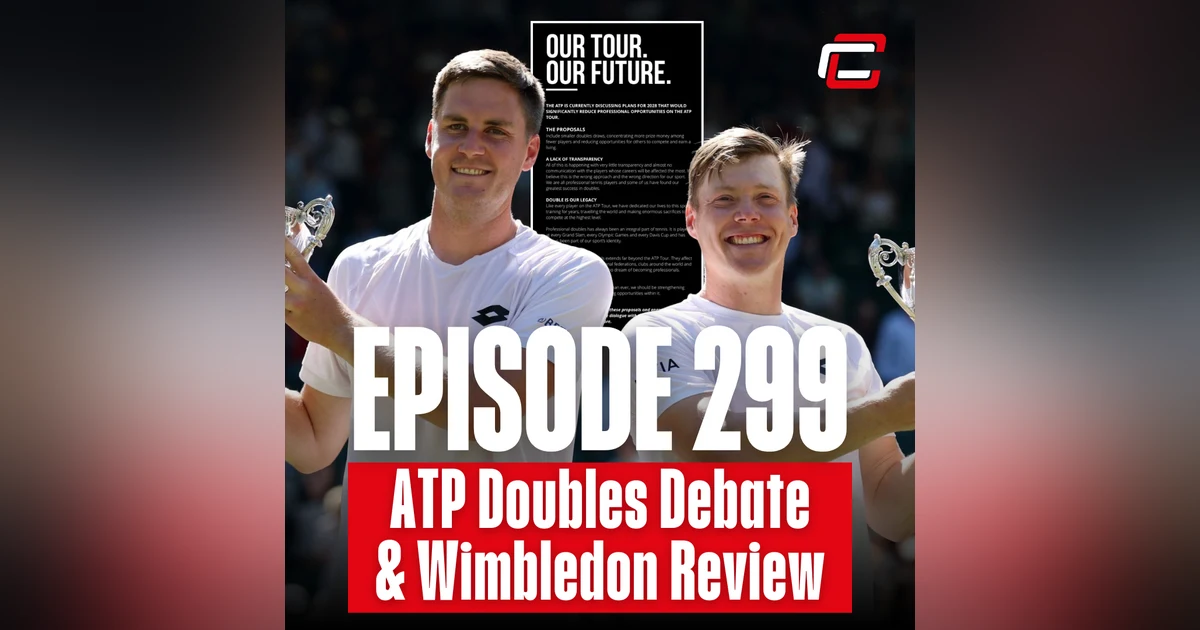
The ATP is proposing to reshape men's doubles from 2028. Halved draws. Halved prize money. Doubles specialists effectively pushed out of the sport. In this episode, Dan takes on the proposals in a full debate segment, then reviews the fortnight at Wimbledon 2026 that has just wrapped up. Recorded after the Wimbledon Live series ended.
THE MAIN DEBATE: Should the ATP be allowed to kill men's doubles?
- The 2028 proposal in detail: doubles draws halved at Masters 1000s, prize money split shifted from 80-20 to 90-10 in favour of singles, Challenger Tour entry handed to singles players ahead of doubles specialists.
Our panelist discuss these proposals in depth.
In the Wimbledon 2026 Review:
- Sinner defends his title, 5th career Grand Slam, only 10th man in the Open Era to defend Wimbledon
- Linda Nosková becomes the youngest women's champion since Kvitova in 2011, in the first all-Czech final in the Open Era
- Arthur Fery's historic wildcard SF run, the deepest British men's Wimbledon run since Cameron Norrie in 2022
- Djokovic equals Federer's all-time record of 105 Wimbledon match wins
- Alfie Hewett and Gordon Reid win their 7th Wimbledon men's wheelchair doubles title
- The 3 Czech Wimbledon women's champions in the last four years: Vondrousova (2023), Krejcikova (2024), and now Nosková (2026)
- The women's draw wide open: 10 different champions in 10 years, the longest streak in Wimbledon history
Timestamps
- 05:21 -Inside Sinner's fifth Slam: why he wins even when he's not at his best, and Vozzi breaks down his movement
- 09:06 - Arthur Fery's fairytale run: turning heroic losses into gritty wins, and what his future really looks like
- 16:36 - A new Alexander Zverev? How Roland Garros changed him, and dissecting that stunning first set of the final
- 22:14 - Djokovic at 39: the chase for 25, why his body can't do back-to-back matches anymore, and the Sinner semi
- 27:53 - Nosková's astonishing comeback from 6-2, 5-2 down, plus the truth about her "friendship" with Muchová
- 36:20 - The Doubles Debate Begins
About Control the Controllables
Hosted by Dan Kiernan, Director of SotoTennis Academy and coach to top ATP and WTA doubles players. Control the Controllables was voted x3 Best Tennis Podcast.

Episode 299: ATP Doubles Proposals Debate + Wimbledon 2026 Review
DISCLAIMER: Please note we use a transcription service, so there may be some errors in the following transcript for the episode. If you can, refer to the audio for the exact quotations.
Dan Kiernan(00:01)
Hello and a big welcome to Control the Controllables and our Wimbledon review 2026. And big apologies. know that some of you have been waiting. We normally get these done a couple of days after the event. But just on a little bit of a personal note, I...
We've had a difficult week in our family as my amazing mam, as we always call up in the Northeast, passed away earlier this week. And I just want to, I want to dedicate this episode and I guess a little, story on when I set the podcast up, like she was diagnosed with dementia, eight years ago, seven, eight years ago. And one of the things she used to do in, the early stages of dementia is.
she would sit and listen to the podcasts. And that was something that, you know, kept her very connected to me when she told me, you know, my kind of heart sank that that's what she was doing. And that was always a big driver for this podcast that when I was speaking, was always speaking to ma'am, you know, living in Spain and traveling the world as a coach, never got home quite as much as I would like. And I guess it's very fitting that
in a week that we've had as a family, as we've said our goodbyes to her, that this episode is absolutely dedicated to her. She loved the podcast, she loved tennis, she loved Wimbledon and the fact that it's the Wimbledon review is all the extra special. So rest in peace to my amazing mom and I hope you enjoy what is an incredible episode.
It's an episode that does get a little bit fiery as we are talking about a passionate subject of ours, which is tennis and how we continue to develop the sport of tennis in the news that happened during Wimbledon as they were talking about the getting rid of doubles type narrative that has been put in place. That is a big part of the discussion that we have on this episode today.
as well as talking about the great champions, the Czechs that are taking over once again at Wimbledon. And then Jannik Sinner's first Grand Slam win of 2026, his fifth Grand Slam, and playing a final against Alexander Zverev, a much improved Alexander Zverev. It's amazing what getting Roland Garros under your belt does. Then, course, Arthur Fery and his run, which was, as everyone kept on calling it, a fairy tale run for a British player.
I think this is a good one. It's Calvin Betton is with us. He comes in a little bit late into this conversation. Freddie Nielsen, an ever present on the show and Kieron Vorster as well with a little bit of a towards the end, Candy Reid jumped in and joined us as well. So always thank those guys for their time. And I hope you enjoyed it. Our Wimbledon 2026 review.
Dan Kiernan(03:12)
Sal Wimbledon 2026 review panelists. How we doing?
Freddie Nielsen (03:19)
Good, thanks. How are you?
Dan Kiernan(03:21)
Yeah, good, thank you. I know, sorry, we're a few days late, guys, but I think it could be interesting for us to look at this one with a week's reflection. Sometimes we only have 24 hours reflection. Looking back on Wimbledon 2026, where we're going to start?
Freddie Nielsen (03:40)
I think my takeaway is a little bit the same from French Open. It seems like the ones that have been dominating are starting to maybe show a little bit of weakness and running out of steam. And it's going to open up for a little bit. We talked about it in Paris, the Wild West, which results in it makes a little more interesting and on men's and women's sides. So it seems like the days where you go into a slam and, basically all the match are open are coming back.
So for me, it makes it a little bit interesting if you look at it from a non-analyzing spectator view. Obviously, analyzing the tennis and I think the quality is a little more random, but I don't mind it as a spectator because I found it to be a little bit boring at times as well that it was so stale. But yeah, I think it's interesting. I like it.
Dan Kiernan(04:28)
Even on the men's side?
Freddie Nielsen (04:29)
Yeah, think Sinner didn't look great. I think he got away with a few scares. Obviously he played his best tennis when he needed to. But my takeaway was he was such a big favourite in Paris and in Wimbledon and he had no physical scares in Wimbledon. But I wasn't convinced by his tennis in the first few rounds. He got away with a few and it left me with the, hmm, if I were another player I would be thinking that he might be there for the taking even though he ended up winning.
If guy like Zverev is starting to make Wimbledon finals, he might be going into a few years where he has his best years. He could…
Be potentially disrupting the top two a little bit if they continue showing weaknesses, but they might not be as consistently good as they have been for a few years now.
Dan Kiernan(05:21)
And Vozny on Sinner. It is his first Grand Slam title of 2026. You know, I think we've talked about his dominance, but hasn't dominated certainly the Grand Slams. I know he has the Masters 1000s and I think that's an interesting storyline to look out for the rest of 2026. Can he win all of them this year? You know, I certainly think he'll be trying to give it a good go.
But what makes him so good? Because we've, Freddie used the word boring, but I've used the word boring. It's not a diss of Jannik Sinner. And then even Freddie spoken there.
Freddie Nielsen (05:59)
I meant more to the fact that the results were pretty much given beforehand.
Dan Kiernan(06:03)
Yeah, that's what I know. And that's what I've said. It's not this is not a diss of Jannik Sinner being boring, but like it's it's almost like and we've all you've also said there, Freddie, that he looked like he was a bit vulnerable. Yet he didn't drop a whole bunch of sets. I think he dropped three sets in the whole tournament. So so it.
Freddie Nielsen (06:21)
But he won his first round in five sets as opposed to down two sets to one.
Dan Kiernan(06:25)
Yeah but you know but my point is what is it that makes him so good Vozzy because even when we're talking about not being in his best he's still come away winning Wimbledon.
Kieron Vorster (06:35)
Yeah, I mean obviously I think your great champions know how to win when they're playing badly.
I was lucky enough to actually go and watch the final live and the level of tennis that they both played incredible. For a set and a half, Zverev was a joke. He was serving out of mountain. He was ripping the ball, ripping the forehand, ripping the backhand. And I think, like it said, Sinner didn't know what to do.
But then one thing I noticed was Sinner was, he then started playing with the real estate on the return, so he started standing like right way back, like five, five, six feet behind the baseline. And then he would step forward and you know, he was just trying to break up the rhythm of Zverev serve. yeah, he was just his quality of shot, like his lateral movement.
His quality of shot, the way he hits that forehand and backhand and the way he just dominates in a rally, like standing so close to the baseline, forcing the player back. And yeah, he mixed it up a lot to Zverev forehand and then Zverev started making mistakes. He played, he mixed up the drop shots and then, you know, obviously he served incredibly well.
I thought,I thought that the standard of tennis in the final was exceptionally high and he saved his best tennis till last. you know, having seen it, I mean, yeah, he struggled at the start of the tournament, but that center court is very different on day 13 than it is on day one. And it was greasy, was slippery and also is a tough player for him to play. Because Kecmanovic plays fast as well and you know, hits, he hits.
Dan Kiernan(08:05)
Yeah.
Kieron Vorster (08:15)
To a certain degree, similar to Sinner in terms of the ball flight, but Sinner's just a better tennis player. So it was no surprise. think one of the big things for me is actually what Freddie said was it was going to be the year of the Brits. And he started with zero for 10 on day one, so we were having a laugh on the group chat. But actually what Arthur did was incredible.
Kieron Vorster (08:41)
I think yes, for the year of the Brits. A guy called Henry.
Freddie Nielsen (08:41)
Who won men's doubles?
Right.
Kieron Vorster (08:47)
Yeah, a guy called Henry Patten. But that's another conversation we could talk for ages about on doubles.
Freddie Nielsen (08:54)
It wasn't a vintage call, but I will say that the Brits still had some of the best results they've had in a long time. I wasn't there for the tournament, but surely it was a big story that Fery was doing well.
Kieron Vorster (09:06)
That was huge. It was huge. was in the manner he did it in the in some of the results he had along the way, especially down against Bergs, in the fourth and the fifth, but I think the match against Dimitrov, I think it's fair to say that Dimitrov choked. Three to upper break, four, three upper break and the four, three game that Dimitrov played was atrocious. It was horrendous.
But that's not taking anything away from the performance of Arthur and what he did in order to to get to where he was and you know Zverev was a better player in the final but in the semi-final But you know his feeling of belonging and knowing that or wanting to be there I think he has great that self-belief so it'll be interesting to see how how he is For the next year because he's got a free shot at it for a year.
He was gonna be in all the all the big big events and where the players now obviously will pay more attention to see if they can work out how to play and what they need to do. But I think he'll be fine. I think he'll be fine out there.
Dan Kiernan (10:06)
Yeah, mean, think Cobolli was interesting. Cobolli obviously had the word on Fery as good after his forehand, right? He's got a beautiful backhand. He times the ball fantastically well. And Cobolli was looking up at his box and saying, the old classic tennis player one, he was serving to the forehand and Fery was just hitting forehand winner after forehand winner. And it was like the old thumbs up to the box. Yeah, good one. Yeah, good one. Yeah, yeah, yeah.
Freddie Nielsen (10:32)
Hehehehehe
Dan Kiernan (10:34)
The old classic that tennis players do. Now, I mean, I think just a quick one on Ferry, but I do want to bring you back, because I want to ask you, Vozzi, in particular, something about Sinha. And then I want to just have one quick conversation about Zverev as well we fully move on into kind of the rest of the tournament. Know, Fery, think the most impressive thing for me is how we produced the moments.
I think, where Freddie, where we've been used to the great losers, we're good losers at Wimbledon, the Brits. Obviously taking out Andy Murray, taking out Tim Henman and the players that have been pushing to win the events. These lower ranked Brits over the years have traditionally had these incredible matches at Wimbledon where they've lost 7-6 in the fifth set or they've had a match point and then they've lost Goran Ivanisevic who has served as second surveys.
And it was just the heroic loss or Barry Cowan playing against Sampras and went to five sets. So, you know, we're good at that. We've done that. Whereas Fery came out of a couple of matches and that's against Bergs, who's actually two sets to one, four, one double breakdown. And he was also then four, one down again in the fifth set, you know?
Kieron Vorster (11:48)
Okay.
Dan Kiernan(11:48)
You know, the fact that he turned those matches around, and the same with Dimitrov, turned those matches around and was able to stay composed on the biggest of stages, in the biggest of matches, and wasn't content just losing those matches, I think says so much about Arthur Fery, what he's gonna bring in his future.
And I think, I think he probably is a legit top 50, 60 player in the world. You know, is he a legit top 20 player in the world? I'm not so sure about that. But I think he probably is a legit top 50, top 60. You follow his story, you see the way he's gone. He was probably ready to go pro when he was younger, but decided not to because he's got his head on his shoulders. He wanted to go and get, you know, go to Stanford and experience the US college life. Now this is good timing that Calvin's come in and a big welcome Calvin Betton than.
Big congrats again from all of us on this guy just kind of Wimbledon and Grand Slam titles. And I'm sure we're gonna get to plenty of doubles discussions in a bit, but I was actually about to throw it to Vozzi because we were talking about Jannik Sinner, Calv. I remember you saying about a year or two back on here that Jannik Sinner is not an elite mover on the court.
And I wanted to throw that to you, Vozzi, we're talking about Sinner because I think, I don't think we often give Sinner the credit that he deserves. Like he serves beautifully in the final and he serve is much more than we often give him credit for. What's your take, Vozzi, in terms of Yannick Sinner as a mover, as a mover on the tennis court?
Kieron Vorster (13:30)
His movement and lateral movement, it's like, I call it flow. It flows like water.
Yes, unbelievable balance. He doesn't give any real estate away on the on the baseline when he's in a rally. And yeah, I think I think he moves I think he moves exceptionally well. I think he can get better maybe at the at the moving moving forward. But his his lateral movement and ability to to to to get offense defense into offense is incredible. You know, among times, you know, that final where I watched
You think Zarev has him and then he just turns defense into offense just based on what he can do. And he's also really, really low. he stays very low on the court on the baseline and he has very wide base and his lateral movement is incredible.
Calvin Betton (14:19)
How's it going lads? glad to be on. blah blah blah. I I sh I should clarify that I I I said I thought he was I didn't think he was an elite mover, I thought he was a good mover. Now I'll say a couple of things there that I I think since then I actually think he's improved greatly as a mover.
But I think what I was saying was like in terms of like if I if I put in people like Djokovic, Nadal, Federer, peak Murray as the real elite movers of the generation that I've just watched. I'm I'm still I mean Vozzi's line of work he'll know better than me. I'm not sure he falls quite in that category of the very truly elite, but I I as I I he'd he'd he has certainly proved me wrong and that he's he started moving a lot better than I thought he was capable of.
Kieron Vorster (15:08)
Yeah, I mean, I mean watching him watching him up is incredible. I don't understand how those little skinny legs can do what they do. It's incredible. I mean, he I just like wow, you know what his ability his ability of the backhand side when he's pulled wide how he gets that with an open stance, but it's strong, he holds it strong, you know, so strong in the core and then able to to recover is incredible. So yeah, I think
Calvin Betton (15:29)
Yeah, yeah.
Dan Kiernan(15:33)
Send your kids to the ski slopes folks.
Kieron Vorster (15:36)
That's it, Mike? That's it.
Dan Kiernan(15:39)
And the other one before we do move in, so Calv, we started off, we actually started a bit later, so you're not too far away, so thanks for jumping on. But Freddie, I'll throw this to you as well, but I'll also use it, the thing I, Calv is made for podcasts because he does have comments that kind of stand out, you know, like it's like, so I also obviously, Calv's been quite outspoken on Zverev over the years, you know, and I think.
I think we all have to a degree and I the whole tennis world kind of saw him as this basically choker, right? He was someone who was a choker, didn't, know, second serve let him down for a long time, ability to kind of hit his way out of a paper bag on his forehand side, you know, under any kind of score stress kind of went away. But it just felt to me that we had a different Alexander Zverev at Wimbledon this year. It felt like Roland Garros had kind of—
Calvin Betton (16:15)
Yeah.
Dan Kiernan(16:36)
— added a couple of inches to his, better be careful what I say here, a couple of inches to his height and a couple of inches to his chest as well almost. was a little bit more of and I think Darren Cahill said it after the final as well, all of a sudden, and Fozzie talked about it there, that first set and a half, couple of sets,
there was a different Alexander Zverev, someone who was kind of playing more proactively, taking the game.
To sin and not just kind of lying down and taking it six, two, six, one loss like we saw in Rome a few weeks earlier. What should take is this now to be sees Zverev going to a bit of a different level now.
Freddie Nielsen (17:18)
Yeah, I think he will definitely take belief in it. I think also that what we've been talking about throughout the years with him, the reason why he's doing better is because he's improved outside. I think that even though he showed a little bit of weakness on the forehand side in Paris, I think one of the reasons he did well was he was definitely hitting it bigger than I've seen it before. And the same in Wimbledon. remember Cal also said that his ability to put away forehands was a liability to him. And he does that so much better.
So I think we've been pretty fair saying that he's a good player, the,
stuff that held him back, think that is what has improved his level and given him a chance to compete at slam level, winning slams. he's taking, I think, obviously I don't know about this, but I would think that he's the kind of player that takes a lot of gusto and belief out of winning a slam.
And kind of thinking, okay, I'm here now and build on it and not making it, I did it and be happy. I think he's going to cement himself. think he's got the personality to build on it and seeing that, okay, he almost beats in and Wimbledon. The guys are maybe not as strong as they have been. Even just a small thing, like he won very comfortably against Fritz who completely has his number. And I think he's,
like I said earlier, might be coming into his best years coming up because I think he's pretty good at improvement. The second serve, like you spoke about, is not the same liability. And he seems like he's taking it more to the opponents and trying to take the outcome more in his own racket. And I think it's a positive thing for him.
Dan Kiernan(18:59)
You see in the same curve?
Calvin Betton (19:01)
I thought in the final I thought for the first hour of the final he hit his forehand as well as I've ever seen him hit it. And I thought was gonna eat my words. And that's a few people were texting me and I was there watching it with Henry and Louis was actually with us as well, in the house that Henry and I was staying in. and and I kept saying, although I wasn't entirely confident as I was saying it, I was going, let's see how it is in an hour.
As it gets to the business end of the match and it went it reverted to type. that's the thing that was the change in the match for me. Well in the in the first the first set and a half, he was absolutely leather in his forehand. And then after that he he went back to doing what he tends to do on his forehand, which is not miss a whole lot and not do any damage on it.
And when you start doing that then Sinner will start eating you up. But, but yeah, you know, he's he he's improved certain areas of his game. Like without a doubt. You know, he's he's his second serve's the biggest his backhand's still a great shot. I still don't think he can volley. And he doesn't miss many forehands. That's the thing. He does you know, he doesn't he can he can just repeatedly put fore runs in court, but I still don't think he has the capacity to to put the ball away often enough for the,the very, very top of the men's gap.
Dan Kiernan(20:12)
Yeah, we're also saying he almost, what he did, he lost him for Seth, right? So it wasn't—
Kieron Vorster (20:16)
Yeah, but
—what I found, when Sinner started playing him, not floaters, but gun to the forehand, and then he shanks a lot. But if you're hitting hard to the forehand, you'll use that pace. And I think Sinner started mixing it up a little bit in the fourth and fifth set, and, yeah, he started missing a bit more. Nothing, it should not take away from the level that Sinner played that final. was exceptional.
Calvin Betton (20:43)
I I think as well in it, I think what it showed is that and something for a lot of players to take note of that it's not always you start great on the day and it just carries on that way. He he he was he was out of sorts in the first set and half of the second and then he he found another level.
Kieron Vorster (20:59)
I thought Zverev's level in the first two tools for a set and a half was exceptional.
Calvin Betton (21:04)
It was Fuzzy, but I think that there was like there were a few points where like Sinner had like you know, he'd have like a midcourt ball and he'd he'd miss it and you know, balls that you don't think he normally misses. Zverev was playing great, there's no doubt, but it was more the balls that Sinner was missing during that first set and then specifically during the tie break, and then for the first half of the second set, I thought like, yeah, he's he looks like a bit shaken up here, but you know, he steadied himself and brought and the last hour of the match he was phenomenal.
Dan Kiernan(21:31)
What's with five sets is, five sets is nicer for a player like You if you play best of three, that match can go, it's like we see on the doubles side, right? It's like when you're playing the match tie breaks, it's like, anything can happen here. Sudden death match tie breaks, but you play the long form of three sets, you kind of feel a little bit that you can.
Calvin Betton (21:35)
Yeah.
Kieron Vorster (21:35)
Yeah.
Dan Kiernan(21:54)
You can get your foot in the door and that's only an added extra. I do want to mention Djokovic because we did them every night apart from the last two, which I apologize to you avid listeners for that, but hopefully at the start of the podcast, that'll make sense to you. If you listen at the start of the podcast, why, but–
Kieron Vorster (21:54)
Okay.
Dan Kiernan(22:14)
—every night I was building Djokovic up to 25. It's a big story in the sport, but it just did. Felt to me that it was going in that direction. It almost was a non-match really in the semis for Eddie.
Freddie Nielsen (22:34)
I was expecting a lot more from him and maybe he was himself. Maybe he saw what I saw, that there was an opening for him against Sinner even though he was winning his matches. I wasn't completely convinced by it but then Sinner came out and pretty well and I felt like he knows now that he can't beat those guys when they hit close to home.
He looked defeated to me in a way that he would never have taken it like that 10 years ago. was a little bit surprising to me, especially after that match against Felix. thought two days off he was going to come back firing, thinking here's my chance, but I was very surprised by how it went down.
It seemed like he didn't believe he could win it, which is pretty much the opposite of what he's been all of his career. This disrupted this. I am. Nobody's telling me what I can and cannot do.
Dan Kiernan(23:27)
And a couple of other little shout outs on the men's side. Mochizuki making fourth round. Pretty impressive, pretty impressive run. I don't know if that's a player that any of you are familiar with.
Freddie Nielsen (23:40)
Also that match against Sinner, that wasn't particularly good match from Sinner either, even though he ended up winning in straights.
Kieron Vorster (23:49)
Look, I think the Novak going back to Novak is that listening to his interviews, he just said, my body doesn't recover like it used to. And that quarterfinal match took too much out of him. And I still stand by that. If you've got Novak playing two matches a week, he's top two in the world. I can't see him doing it anymore. It's just too tough.
He said it's a biological age now, that it's just taking too much out.
Freddie Nielsen (24:23)
Yeah, it certainly looks
like it.
Dan Kiernan(24:25)
When you watch, have you guys seen the Nadal Netflix? When you watch that, I actually watched it on the flight yesterday. It was like, that was ages ago when Djokovic was doing all those things. It was a long time ago. It puts in perspective the age, I think we hear an age and we hear, how old is he now? 38? Is it 38? 39 this year?
Freddie Nielsen (24:44)
Yes. 39.
Kieron Vorster (24:54)
Only mine.
Dan Kiernan(24:55)
Yeah, 39, we hear 39, but then when you actually put the perspective on what 39 means and he's playing these like unbelievable matches of this period, like around 2010, 2011, you know, we're talking years and years and years and years, like what that takes out.
So when you looked at it, and this is incredible, since Roland Garros 25, Carl, I don't know if you know this, so you've got Roland Garros 25, you've got US Open 25, and then you've got the three slams that have happened this year. How many other tournaments has Novak Djokovic played?
Calvin Betton (25:39)
Oof. since the US Open twenty five.
Dan Kiernan(25:42)
Since Roland Garros 25.
Calvin Betton (25:44)
Since Roland Garros twenty five. Right, so he played Wimbledon. He played…
Dan Kiernan(25:48)
So he's played five, so we're talking six slams. So he's played six slams. How many other ATP, how many ATP events has he played in that time period?
Calvin Betton (25:52)
Yeah. Right. Right,he played Shanghai, he played Athens randomly, didn't play Turin.
Dan Kiernan(26:03)
Yep.Yep.
Calvin Betton (26:09)
He played Indian Wells, didn't play Miami.
Dan Kiernan(26:11)
Yep.
Kieron Vorster (26:11)
You this.
Calvin Betton (26:13)
I don't know if you played another Clay court tournament this year. Yeah.
Dan Kiernan(26:17)
Four. He's played four. Four tournaments. So like this undercooked thing, he's been doing this for like a couple of years now where it's like he just plays the slams.
Calvin Betton (26:21)
Yeah, yeah.
Yeah, I mean he's i it's a strange position he's in now as well, 'cause when he plays the slams, like the level is still there, but he's almost not playing best of five. He has if he has to if he has got any chance of like winning another, I d I don't think he can go five sets in any match. It's like he has a finite amount in the locker and it just takes too much out of him. The match he lost he lost this year's Wimbledon in the match against Felix, in that even though he won, he actually lost, I think.
Dan Kiernan(26:57)
Yeah, even the two days wasn't enough, was it?
Calvin Betton (27:00)
Yeah. It it's it's just not, you know, as we as all of us know, it's just not at that age. Like, you know, you know, it's like you need a you need a bit longer, don't you?
Freddie Nielsen (27:10)
Yeah, but I think also was so maybe I'm ignorant to this, it was also a late match. So you would have gone to bed late. Maybe if it been early in the day or something like that.
Dan Kiernan(27:21)
None of us got Noskova right. What's wrong with you guys?
Calvin Betton (27:28)
I wasn't on, I didn't pick so I would have picked Noskova actually.
Freddie Nielsen (27:32)
Ha ha.
Dan Kiernan(27:34)
Like, come on, fuzzy, What's your deal?
Kieron Vorster (27:38)
Buh-bye.
Freddie Nielsen (27:38)
Yeah, but what's your deal then? I mean, she wasn't one of your 45 names.
Calvin Betton (27:43)
Mm.
Dan Kiernan(27:45)
I'm sure I mentioned it at some point over the last six years.
Freddie Nielsen (27:49)
Yeah, exactly.
Dan Kiernan(27:53)
I'm sure we can find a clip of me mentioning Noskova. I mean, she's actually someone who I've scouted a lot. she did, Emily mentioned her a lot when she was coming through, but she is someone who I've scouted a lot because the girls have played her a lot in doubles. And I watch her and I'm like, mean, she hits them all beautifully, but she looks so unbothered with playing tennis every time I watch her. I'm like, what is going on?
Freddie Nielsen (27:59)
Emily used to Emily used to mention her love.
Dan Kiernan(28:20)
What an effort that was in the final by the way, Fuzzy. I mean, 6-2, 5-2 up, to have all of those match points, talk about like the definition of head in the shed. Like the towel was over her head. She was completely gone. We all know that feeling. We've all seen players with that feeling. And you're thinking, oh no, oh no, how is she going to get over this? This is horrendous.
This is horrendous and then she's come out and she's stepped up and won the third set.
Kieron Vorster (28:52)
Yeah, and she was match points down against Sorana Cirstea in the third round, beat her 7-6 in the third. Yeah, so she's had some adversity to deal with, yeah, great effort. I saw bits of the final, great serve. Yeah, it's one of them that being able to turn that around, well done to her. I did like Muchova, I like Muchova game. I think it's well suited for grass and a good effort by her, by the way, coming down from 6-2, 5-2. Yeah, well done to her in the end, the Alden champion.
Dan Kiernan(28:55)
Third round.
Kieron Vorster (29:21)
Not too sure how the All England club are going to approve of a full member of the ring through her nose, but that's neither here nor there. But yeah, I mean, it was brilliant. Well done to her.
Dan Kiernan(29:34)
Czech tennis for any year. I that's, I think it's three out of last four champions, women's champions.
Freddie Nielsen (29:37)
It keeps them. Absolutely.
My takeaway from my, with my, you know, being a national coach and stuff, I'm thinking why.
If Noskova can win, let's get Klara on there. That's my takeaway. If players like this start to win, why can't Klara? That's my takeaway. You're right. Czech tennis. They just keep making each other better. I agree with you, You move over as a great player. I was very surprised that she didn't win, especially coming through the semi-final. Maybe there's something personal there. They're great friends. It's always weird playing your friends. I'm sure it's even weirder if in the Wimbledon final.
Calvin Betton (29:53)
Yeah.
Freddie Nielsen (30:18)
I haven't really played many of my friends in bigger events than the club championships or something like that.
Calvin Betton (30:23)
I'll I'll j on on that one, that was something quite interesting. I'm not convinced that they are actually great friends, you know. Because well at the Wimbledon final, she even kind of suggested so because Marcus Buckland, who's hosting, kept referring to playing your great friend and and Noskova sort of I don't know if it's a language barrier thing or what, but she kept correcting him to, Well, we know each other very well.
And I think it might be I'm not saying that they're I'm not saying that they,they don't like each other a lot, but I think it might be one of those they're both from Czech and they've played doubles together.
Freddie Nielsen (30:55)
A better narrative and it sounds like a better sell for the story for the neutral fan who might not be completely into who they are.
Calvin Betton (30:57)
Yeah.
Kieron Vorster (30:58)
you you.
Calvin Betton (31:00)
Yeah, but it it was interesting.
Yeah,it was interesting though she didn't let it go with that. She was like, Well, you know, then, you know, she said, like, what was the talk after? And and then she goes, Well, she hasn't spoke to me since the match. so I don't hopefully she will.
Dan Kiernan(31:13)
Yeah, again,
It's the narrative, isn't it? I certainly haven't seen them hanging out with each other at tournaments. Like it's not. think that was the... Or she said, wasn't, Muchova said the ex-friend anyway, I think was what she said after in her speech. And then obviously just a couple of other mentions certainly on the women's side. Sabalenka, first time out of 14 Grand Slams that she's not made the quarterfinals.
Calvin Betton (31:16)
Yeah.
Yeah. Yeah, yeah.
Freddie Nielsen (31:27)
Yeah.
Dan Kiernan(31:40)
You know, losing to Osaka who made her first ever Wimbledon quarterfinal. Not that I'm asking anybody to start changing coaching teams because you're not getting the results that you want or you go through a little bit of a period, but I guess the media, not that we're media doing a podcast, it's the sort of questions that people start to ask, maybe Cal.
Sabalenka seems to have had a little bit of a glitch over the last few months. She doesn't seem to me somebody that's overly happy when she's losing. Do we all of a sudden see her throwing her toys out of pram and changing her coaching team over the next few months or is this just a little glitch in her year?
Calvin Betton (32:28)
I mean, I've seen her have some almighty tantrums. Particularly after last year's Australian Open. I saw a destroyer runners up trophy against the wall in the gym. you know, I don't think that's anything new. I think what is interesting with with Sabalenka is that she's for a few years now she's had the sort of when you play that start style of play where it's ultra aggressive, she's just going all out, leathering everything. That's kind of like I'm not saying it's easy, but it's easier to do that when you're in good form and full of confidence and
Losing the odd match doesn't really affect you that much. But then when you start having not won anything in a while, not won anything big, you start questioning the shots a bit, and then you can't play that style all the time. And I kind of think that's where she's at. She, this is the
style of play she has, but she doesn't have the unwavering self-belief, I don't think. She's still a very confident player, but it's not that unwavering self-belief that she previously had.
Freddie Nielsen (33:21)
I kind of agree with that because she was also pulling out some serve and volley and stuff and that to me is obviously it's great that you're trying to be proactive but maybe she shouldn't be serve and volleying she just like you said Kel just annihilate the ball.
Calvin Betton (33:35)
Yeah.
Dan Kiernan(33:36)
Is the bigger issue right now, EGIS Fjondtek Vossi?
The coaching change hasn't made any difference to her, it seems.
Kieron Vorster (33:44)
I don't know. I mean, don't know the answer. I think there's been some strange ones. thought Felix has changed as well. Medvedev changing as well. Yeah, I don't get those two, yeah.
Freddie Nielsen (33:57)
Le Hedge Catoo, right?
Calvin Betton (33:59)
Yeah, yeah. I think I mean w Vozzi's tucking into what looks like a fantastic ice lolly there. but.
Kieron Vorster (34:05)
That's right.
Freddie Nielsen (34:06)
hahahaha.
Dan Kiernan(34:09)
He wanted out of that question, he? I asked him just as he tucked in and he was just like, yeah, whatever, psychologist and then get me out of there.
Calvin Betton (34:11)
Yeah.
Freddie Nielsen (34:20)
Hahaha.
Calvin Betton (34:20)
I think as well.
Kieron Vorster (34:20)
God.
Calvin Betton (34:21)
Like, what look, one of the things with Sabalenka is like and again, like this might I might be s completely speculating here, but she's she's had quite she's had quite a lifestyle change in the last year. You know, so like you wonder whether the the hunger is still absolutely there.
Dan Kiernan(34:30)
That's what we do.
Kieron Vorster (34:41)
I think the hunger's still there.
Calvin Betton (34:43)
But yeah, maybe maybe, but then things have changed though. You know, it'd be it'd be miss of us to say, you know, to pretend that nothing has changed. She's I mean, she's not l listen, I maybe she's always been financial she's always been independently wealthy herself, but you know, maybe it's not entirely a financial thing. You know, priorities sometimes change.
Freddie Nielsen (35:04)
there's a lot of people in her team now.
Calvin Betton (35:06)
Do find that we don't you find that weird with the singles guys now? They've got like two, sometimes three coaches. I just wouldn't fancy it me.
Dan Kiernan(35:12)
Think
they need more money. We will get on to that. Maybe that's why they need more money to be able to bring in all of these extra coaches.
We are going to jump into a topic that I think all of us have strong opinions on it.Ozzy. I actually don't know your stance on it, which could be interesting for the sake of this conversation. But, you know, we spoke about it a lot on the Daily Pods. I know myself and Calvin have been on a couple of podcasts talking about it as well. I actually, I don't know if I told you, Calvin, this, think I did. Reilly Opelka appeared in my DMs at one o'clock in the morning, one night during Wimbledon. I had a big chat with Reilly.
Calvin Betton (35:50)
Yeah.
Dan Kiernan(35:55)
On this, there's obviously been a lot of conversation for a lack of a better way of putting it at the of proposing that they're gonna basically edge out double specialists seems to be the process that they're working towards. The best way that I've kind of explained it in my head is some countries that wanna get rid of smokers, they have the age of...
2019 smoking one year then you have to be 20 the following year 21 the next year 22 the next year until eventually nobody can Have the normal has the age to buy cigarettes It's going to be a quicker process than that. But ultimately they they don't want to have a pathway in third place to just be doubles specialists Getting rid of jobs. We've had Henry Patten call on the proposals elitist and shambolic.
We'll get to Henry's what I thought was amazing speech that he made after winning Wimbledon, as well as what he said about his fiance, which has gone viral as well. He's got, he's the heartthrob after what he said about his fiance as well. know, everyone's come here and green flags everywhere for Henry Patten on that. But I want to start with Vozzi if he's not getting himself another ice lolly.
Because I think, I think me and Carl certainly quite clear on our thoughts on all of this but what's your take Vosie, someone who's been around the sport for many many many many years, what's firstly your understanding of what is being proposed because I think that's really important in this discussion and secondly what's your take on all of this.
Kieron Vorster (37:41)
I think my understanding is obviously that they're cutting the draws by half. And my understanding is that the player council were not communicating with the players in question and proposal was done by the board without proper notification. And so a lot of the players were hearing it without being informed. So they heard the end result without the information being given to them.
Now look, I think I've spoken to a few people on the board. I've spoken to a lot of people and I think the products needs a revamp and you can't compare Grand Slams with current ATP events. Grand Slams for example, people are buying tickets for Court 1, and I know you put a tweet out on the stand, people are buying those tickets months and months and months months in advance because they're going to Wimbledon and they will happily watch whatever is on Court 1 on that given day.
So, you know, they're not, someone's not buying a Friday ticket at court one going, can't wait to watch wheelchair tennis or I can't wait to watch whatever doubles put on there or mixed or whatever. They happy just watching that. Now, problem you've got in any walk of life is that if you, I'm gonna try and articulate this as best as I can.
If you're running a business, and let's just say an ATP250 business, you as the owner of that event are surely not running that event to make a loss. So you want to look at all aspects of the business, like you would do if you're running your tennis academy. So you look at all aspects of the business and you look at, where can we cut costs in order to streamline our business?
Calvin Betton (39:34)
Okay.
Kieron Vorster (39:39)
And so if the first thing is, okay, so let's look at the doubles. let's say there's 16 people in the draw. That's another 32 rooms. But let's say that's another 20 hotel rooms that we pay for because they're coming just to play doubles. Then the expense of having those players there and then the prize money going towards. if they were, okay, we streamlining costs. Unfortunately, in the world we live in,
redunDancies are very strong part of what we do across all businesses but it seems like in in the world of sport the word redunDancy is not allowed to be used it's it's um it's it's well you got to grow you got to growth grow grow doubles i think you got to grow the sport as as tennis not just a specific within that so i think and then and then what if you streamline it and and you're still losing money
but you're that actually the doubles is now the pro and then looking at that product. for example, on that product at ATP events, let's just say you went down the college route where there's no warmup, match goes on at two and you're playing one set. And on that set, it's no ads, let calls, blah, blah, blah, blah, blah. You know your timeline on the court is 30 minutes. So most college matches start at two, they are finished by 2.30 in the doubles and it's exciting.
I've seen it firsthand, I've been at college matches. And I'm not saying that's the answer, but the product needs a revamp that is going to, and whether this is right or wrong, you know, if all of then all of a sudden you've got, say, Sinner and Alcaraz playing, I'm not saying they're playing better doubles than Henry and Harry, but you're going to fill the stadium. Now they've tried the product, the mixed doubles product
And for me now Grand Slams are three week events, they're not two week events. So they've tried the product at the US Open, I think it was successful with the mix. And then you've also got then another revenue stream coming in. Now I know Calvin, you put something out there about Craig Tiley. Craig Tiley's never run a tour event. So he's talking from the pinnacles of sport. It'll be interesting to see what he suggests.
Calvin Betton (41:34)
Yeah.
Kieron Vorster (42:02)
about the products at Grand Slam level. So I think that's just a couple.
Dan Kiernan(42:09)
Vozi, can I ask you a question? I think there's a lot to unpack here. I think these are good discussions. Part of me actually listening to you, as much as I do respect you, I think we're missing a couple of bits which will maybe get to the starting points for these because there's some assumptions that I think we're still making. But who have you spoken to on the board?
Calvin Betton (42:28)
Yeah.
Kieron Vorster (42:36)
I don't want to mention names in terms of that because that's…
Dan Kiernan(42:40)
But it's just not the problem because let me say this, this is where I think the problem is, or one of the big problems is, and by the way, Candy, hello and welcome. Thank you for, so you've come in at a good time as we're talking about the doubles proposals or what they are, but there's a lot of assumptions and there's a lot of hiding that's happening here. And let me just start off and then please, I'm sure Carl, Freddie, Candy, you guys jump in.
Candy (42:49)
Hello Dan, hi everyone.
Kieron Vorster (42:51)
Candy, how are you?
Freddie Nielsen (42:53)
Hey, Candy.
Dan Kiernan(43:10)
I just want to say probably quite passionately, let's cut the bullshit and let's cut the assumptions. We're making a lot of assumptions here and it's very dangerous because there's absolutely no transparency here. We're not getting any transparency on who you're talking to, not you, Vozzi. We're not getting any transparency on numbers. We're getting people like Alex de Miñaur in press conferences, nothing against Alex de Miñaur—
Kieron Vorster (43:31)
Yeah.
Dan Kiernan(43:38)
—being asked the question, where the danger in this, and this would be the danger in any business or any relationship, Fozzie. There's a big, big danger here we have to be very careful of. Alex de Miñaur , whose response to ask about the doubles is, I've got lots of friends who play doubles and I feel really bad for them, but ultimately the numbers need to add up. You show me one place where we can see complete transparency on the numbers.
Where we can understand that doubles product as part of what is happening in the world of tennis is not sustainable. If it's not and it can be shown, that's a different conversation to be had. But let's not base this on assumption. We're basing this on propaganda and assumption is what's happening first and foremost. And then the problem is intelligent people like yourself, Fozzie, and other people in the tennis world.
We are assuming that that is accurate. Doubles is not sustainable is what we're being told. But who are we being told by? We're being told that by the ATP board. Who's the ATP board? When you dig a little deeper, it's actually a couple of relatively failed singles players that have got some serious agendas here. Now, there's obviously the tournament side of it as well, which I think that is a conversation that's worth having as well to have a balanced view.
The second part for me, which is really important here, is what is the intent? Is in any relationship, if you have intent to have that relationship, then you come up with strategic plans to try, if you then know that something isn't working, do you want it to work? And then let's bring strategic plans in place to try and make it work if we want to.
Kieron Vorster (45:31)
Which is what we talk about the product. Which we talked about the product. Yeah.
Dan Kiernan(45:33)
Which, yeah, exactly, but I think we're ahead to the product and the marketing of the product before we have the facts. We don't have the facts. And if you go to Indian Wells, someone's paying $200 to go to Indian Wells to watch tennis. That's what they're doing. They're paying $200 to go to Indian Wells to watch tennis, and then they're spending 250 in Norbu, and they're buying the t-shirts, and they're buying the hats.
And they're buying the giant hands and probably their kids have 15 hot dogs or whatever they do with the big gulps. It's very, very difficult to decipher into those numbers. we make, seems unless we're shown those numbers and there's something tangible, that is actually not factual what people are saying. The second one which is…
Kieron Vorster (46:21)
Yeah.
So sorry, sorry, then it's just interesting how you brought up Indian Wells and I think I think Indian Wells is a really bad example. It's what? No, no, no, it's not. No, it's what's happening. It's what's happening at ATP 250 level and ATP 500 level, because those those are the tournaments that lose money, massive amounts of money. And so there needs to be a that's where the transparency needs to come out.
Dan Kiernan(46:37)
Madrid, Rome, Cincinnati, all of them.
Kieron Vorster (46:55)
Because if the transparency comes out that we're losing X million or X hundred thousand or X thousands and we're looking at the bottom line to break even, we need to make these cuts in order to break even. It become a business. But I do agree with you in terms of the transparency, the IT, the grand slams and probably the master series are bad examples.
But we need to find out numbers of what's happening at the 250 level and 500 level. that is where I think there's cost to the business. And whatever that cost is, I'm saying, like if I said they're re-backed the product, they may even go, we've got too many single suppliers. We need to look at cutting that as well. I'm throwing it out there as, but in life.
Unfortunately there are redundancies in the world we live in today. It's really, hard. And I'm not saying it should be looked across the board, but there's always going to be the easy targets first. Well, where can we cut costs? And it's the same in business. Where can we cut costs? It's middle management. Let's get rid of middle management and we're going to save ourselves a million quid a year. So that's what I'm saying. So when you bring up examples, think the numbers, and it would be great to get a talk director on—
Dan Kiernan(47:52)
Yes.
Kieron Vorster (48:19)
—this part who's a tournament director of say, a Bostard, a Gushdard or the event that was in Tel Aviv. And actually they can talk about the numbers because when Wayne Pereira was on the player council, I remember him saying to me, guys lose money. It's just not sustainable. They're losing money every single year. It's not sustainable. because this is when it came out that the players wanted more in prize money. And they said, we can't give you anymore. We're losing money.
So I think what needs to happen and the narrative of the conversation and the key part of this is what is the vendetta? What are they trying to get out of it? And so if they're trying to eradicate double specialists, they better validate that reason and be very, very clever on how they're doing it. But if they're saying, we are looking to cut costs, but unfortunately—
Calvin Betton (48:58)
What are you just going to do?
Kieron Vorster (49:17)
—the first people we're going to are the easy targets, which is the doubles.
Calvin Betton (49:23)
I th I think a few things on that, and Vozzi's put his point across very eloquently there. I mean, there's a couple of things I would come back on. Like one, I've got a Twitter thread. I'm sure everyone's seen it. I don't know whether Vozzi's seen it. Basically I've just and around about seventy percent of those videos are from ATP five hundreds and and hundred fifties. Like Barcelona, I've been at two years running. They have a doubles only court, always packed, can't get on there. Bestad last week, I wasn't there, but somebody sent me a—
Kieron Vorster (49:35)
Yes, in it.
Calvin Betton (49:51)
—of a a video and a picture of the doubles court, can't get on the court, no seats available. The problem is when we talk about numbers, and and I think there's two points to this. I'll and I'll a c a couple of points. So the the ATP is not a business. The ATP is a governing body, even though it makes a fortune, it's there to refinance, re reintegrate that money into the sport. It made fifty two million pounds last year. or fifty two million dollars, one or the other, I can't remember what it was.
The tournaments are of business. I have some sympathy there. But I fail to see where even if you that these tournaments that are losing money, and they are, they're not losing that you can shave the doubles off and it doesn't make hardly any difference. They're paying fortunes in appearance fees for singles guys. The hotel rooms is used as an example a lot. Doubles players, I don't know whether any listeners know this, doubles players get one hotel room for the duration of the tournament plus two nights.
Singles players get four hotel rooms for the duration of the the tournament plus ten nights at ATP events. And we're talking about doubles players are the reason why these tournaments are losing money. If it's just doubles that
they're losing and it's just hotel rooms, it takes nothing for the ATP to go, I'll tell you what, we'll cover we'll cover those hotel rooms. And that's the only cost that it can be. The prize money is barely anything compared to and
They're not saving the prize money, by the way, so they can't use that. They're just reintegrating it. And that comes to my my key point. And and I know through the conversations that I've had with people and the conversations that Henry's had with people, and it's becoming more and more apparent, this business rationale is not the reason.
Kieron Vorster (51:27)
Okay. .
Calvin Betton(51:34)
Why we're doing this. It's really not. This is a this is a transfer of wealth. The player council is using it in order to, because they don't want to have the conversation.
That they're having with the with the singles players, the the the ATP, the player council don't want to have that conversation about percentage of revenue that the that the Grand Slams are having. So they think they're gonna pacify them with we're gonna move the doubles on and we're gonna transfer that money to the singles players. And that is what I find is a is a there is a great dishonesty in this. I think they're using the business.
Kieron Vorster (52:07)
So
is that the assumption or again lack of transparency from all parties? Or is that more common knowledge?
Calvin Betton (52:13)
No, that that is what that that that's part of the that's the
no, that's that's common knowledge. That's part of the the proposal. The the money that they s
Kieron Vorster (52:19)
So basically the council are too scared to actually squeeze the tournament so they just go the easy way to do this is get rid of the doubles and transfer it over to singles and there you go guys.
Dan Kiernan(52:25)
Yeah.
Calvin Betton (52:28)
Well, it's not even that. It's not even just that. It's not even just that though, was it? The players on the player council are the players who are going to benefit financially from this. So when you're asking these the player council are going to vote on right, what's what's the best for tennis as a whole for the tournament?
And you've got the players on the player council, because it's specifically going to be reintegrated. That money that they save on doubles prize money is going to go to players ranked between fifty and a hundred. That's where it's all going to be reinvested. And the player council is largely made up of players ranked fifty to a hundred.
And the players we know, the players who are ranked fifty two hundred on the player council, are the players who are pushing for this change in the extremity. So that's what it's becoming clear about. And the business element there's y as as Keano said, it's it's actually impossible. The idea that the numbers don't add up, and that's what really annoyed me when De Miñaur said it and when I think Taylor Fritz said it as well. Because.
Kieron Vorster (53:06)
Right.
Calvin Betton(53:21)
And I know that the doubles players have specifically asked for the numbers. It's impossible. It's gonna be impossible to actually get the numbers. Like how much money does doubles bring in? Because as as Keno pointed out there, it's mainly we're talking about grounds passes here. People buying grounds passes. And then the secondary sell, the the beers, the cocktails they buy at these tournaments, the t shirts, the caps, the burgers, the hot dogs, everything they buy while they're there. What is that bringing in? Things like proams.
And again, when the programs are basically run for the sponsors of the event, the people who they get to do those are the doubles players. So when you're bring when you're bringing in fortunes and fortunes from from sponsors and they want to do a program, it's the doubles players that do those. So it's it's g I can't see any way that you're ever going to be able to say, This is what doubles brings in, this is what singles brings in. The only way you can actually tell that there's certain elements of singles how much does the how much money do we make from centre court tickets? That's one thing.
But the rest of it, it's just such a muddle. And it's because people are paying to watch tennis. And you've got to have tennis on the courts for them to pay for that. And unfortunately, with the the nature of tennis, the draw halves every single day. You just don't have enough t there's not going to be enough tennis to watch come like in a two week Masters now. Just look at two week masters. By the time you get to Wednesday of the second week, or there's only one Wednesday in most of these Masters, but by the time you get to Wednesday—
Kieron Vorster (54:28)
Yeah.
Calvin Betton (54:50)
—there are only four singles matches. And that is in a that's in a mixed event. That's men's and women's. So the f the all the all the two-week masters we've had this year, by Wednesday, you've only got four singles matches. And you want to sell grounds that they all go out, they all go on on the center court. And then you want to send grounds passes on those days. You're going need some tennis. What you where are you going to get tennis from if you're not doing this? And that's where I've I think that the business argument just doesn't add up. It's impossible to get the numbers.
The ATP have been asked to produce them on numerous occasions and they haven't. The tournaments, I I do have a bit of sympathy with the tournaments directors in that they're they're they're losing money and that they're being told that this is the reason why. Although I think if you look at the series what where it goes, it goes on to things like paying for hotel rooms for the singles players and all their crews who choose to stay on when they're out of the tournament.
I've been to tournaments, I've remember tournament last year, Frances Tiafoe had his whole team there staying for a full 10 days and he lost first round. And that's an expensive hotel. Because he didn't move elsewhere. Now, that's the kind of reasons why you lose money. But I think I do think, and and I know that everyone on this side of the debate is quickly coming to the realization this has nothing to do with business. It's a transfer of wealth from doubles players to singles players. That and and and…
Dan Kiernan(56:11)
And let me just jump on that cow very quickly just to give a... this is vozy fact that it has been said is one example that was given was by people on the board who were making these decisions. We can't have Cabral ranked 20 in the world in doubles making more money than Rocher who's ranked 150 in the world in singles. That's not acceptable.
And we can't have, and Reilly Opelka said this to me, we can't have Lloyd Glasspool making more money than Darderi. So this is around, it's personal, this is personal, that's what this is. And the thing that makes me sad on this is this is not, there's bigger, the way that I also see this, and I know this is a big job, but like—
Kieron Vorster (56:50)
There's a personal vendetta then against.
Dan Kiernan(57:06)
—tennis as a whole, a brand, an industry could be so strong together, but we've got seven governing bodies that has worked separate. So we don't end up fighting the good cause of tennis and everything that could be done, the brand of all that, because everyone's looking after their own little part of that.
But then you go down a step and you've then got the ATP working in their silo on their things, but they aren't fighting those bigger battles of how, okay, how do we, because if we take the whole ATP tournament structure, the 250s, 500s, you might have some loss-leading tournaments. So if we take like a clay court season, you might have two 250s, a 500 that then goes into role masters. Well, if they're all under the ATP banner that should be working, okay?
You might lose a little bit of money in the 250s, but that's okay. The ATP is making up on that because they're making a shitload in the 1,000. You know, like it has to be viewed a little bit more together. I don't know all of the details on this because it's not, the transparency is not out there, but it's like, rather than having that argument and that push, what we're doing is we're then going down and we're splitting the players up.
And when that, what this basically is, this is just, this is male ego. This is not happening in the WTA. This is male ego that is getting involved in this person shouldn't be making more money than this person. So we need to do this in the transfer of wealth like Calvin says. And these are the things that have been said. These are the reasons that have been given. And I'm sorry, I just don't, I don't see that. Forget everything else. We surely in our sport want to be growing opportunities.
Kieron Vorster (58:57)
Yeah, but it back to that same conversation, I remember I was listening to Steve Johnson and they were talking about college places have been taken from foreign players actually Steve Johnson just went, well the Americans need to get better. On that argument, then Darderi, he just needs to get better and then you learn more money than Glasspool,
Dan Kiernan(58:58)
for more people not taking it away and...
Kieron Vorster (59:19)
But his argument is that you can't have glass bowl any more than Darderi, okay fine, Darderi just get better and he'll learn more than glass bowl. You know, you can have that argument. You can counter that.
Calvin Betton (59:27)
I just can I just come in with one last thing that Kierno?
And again I think this this argument can't be made strongly enough that when we talk about sustainability, sport in general isn't sustainable. No sport is. It's it's paid for by the very top, and that's how it should be to sustain the sport. If you look at, you know, look at look listen, there's about four players in the world who sell tickets and they keep the sport going. Like Sinner and Alcaraz and Djokovic and maybe Zverev and I don't know, Ben Shelton, people like that, the ones who sell the tickets.
Like all due respect, and and I and I I I I don't I'm not disrespecting him as a player or a person at all. Darderi doesn't sell tickets. You know, so so this idea that we need to move those guys on, Vit Kopriva, Reilly Opelka, they don't sell tickets. Even players like Tommy Paul don't sell tickets.
People come to watch tennis and they like to watch them. But if you go in any sport, the Premier League plays pays for all of the football in Britain. Like that that that's what pays for football in Britain. You look at cricket in the UK, county championships, every single club loses money. They're they're not sustainable. That nobody goes to watch them. It's paid for by test cricket because that's how it should be.
Kieron Vorster (1:00:39)
No it's not Mike, the Indian BCCI control tennis, control cricket globally. They control everything. And that's all because of the IPL, all because of the IPL that came out. They control everything. They control everything.
Calvin Betton (1:00:47)
Well then but then they're paying for it then.
Well th no that that's f fair enough then, Fozie, but then but then they're paying for it. It's like Yor Yorkshire Cricket Club and y you know, but you don't just go, Well, they're not bringing any money in, so we've got to get rid of that because you you have to have any sport wants people competing. They want visible sport. They want you reinvest the money into the sport. Otherwise and I know and this is my concern, I was told by somebody in the know not not in the know, I was told by somebody—
Kieron Vorster (1:00:57)
Yeah, yeah, I get what you're saying. Yeah, yeah, yeah, I get it. get it. get it. Yeah. Yeah.
Calvin Betton (1:01:20)
—very close to the p to Gaudenzi, who has been speaking to him and knows him very well, that Gaudenzi wants tennis to be like Formula One. He wants twenty singles players. Yeah.
Kieron Vorster (1:01:28)
Yeah, I've heard that. Yeah, yeah, I'm not that... Yeah, and he's good mates with the CEO of Formula One.
Calvin Betton (1:01:33)
Yeah, and and and he sees that as the way to do it. Now that is pretty grim if that's where we're going. And I've said this to the singles guys as well. I've said it to all of them that when they've when they've got rid of doubles, when they've gone, that you the doubles guys don't bring any money in and they're taking up firm they're taking up hotel rooms and that kind of thing, when they've done that, they're then gonna come after the qualifying events.
They're gonna go, well, why are we paying money for qualifying? Like we're spending hotel rooms on that. There's prize money going into that. When they've got rid of qualifying, they're gonna go for the lower ones. They're gonna go wait a minute, like this guy who's ranked fifteen in the world, he's wh why are we paying for him? He's not bringing any money in. He he that's not sustainable. And before you know it, you've got sixteen players playing tennis, and that's it.
And it and it all comes from this whole thing comes from greed. Because it doesn't come from a sporting sense, and like we say, there's no way of actually getting business numbers out.
Dan Kiernan(1:02:22)
On that very quickly, and I want to bring Freddie and Candy in here, because they've had to listen to us harp on. But if we go back to this, let's assume for a minute that doubles isn't sustainable and the numbers don't add up. Let's just assume that, because that's what we do. That's not fact, but let's assume we do. The next conversation is, do you want it to work?
Do you see that as part of your future? Okay, if the answer to that is yes, that's when we then go into product marketing, finding ways of bringing more money in and finding ways, which I think actually, one thing about the doubles tour is in general, and you only have to listen to Henry Patton, how amazingly well he's spoken over the last couple of weeks.
It's actually full of a lot of intelligent people that tend to have had college degrees that have been through, you know, got quite strong backgrounds. So there's actually a lot of brain power and also a lot of passion power in the doubles world that would be more than willing to put their heads together to look to develop product and develop the marketing of that product if that was the factual situation.
But you only have to see the way that the product isn't marketed, which it's not or shown. You can't watch it on hardly any TV. You can't watch any ATP 250s anywhere. You can't watch them, not legally. ATP 250s cannot be watched legally. So you only have to see that. You only have to see the way that it's on social media, the way that nothing is pushed out in ATP doubles to see that that isn't happening.
But that argument for me, which is an important discussion,is only a valid discussion if we understand truly that it's not making sense. And secondly, is there an intention to work towards making that happen? And that is the same thing in any basic business model, any basic relationship. You know, if my wife doesn't have the intention to be with me, then we can't find solutions to any problems that we might have. You know, but it's like—
Kieron Vorster (1:04:45)
But that's the product.
She doesn't believe in the product anymore, Dan. She needs to move on from the product.
Dan Kiernan(1:04:46)
—it well maybe I need to market it better do you know what I mean but it's like but it's but that's it's the same basic kind of concept yes we're getting lost intelligent people and people in our sport are getting lost on the assumption of what the propaganda that's just the headline propaganda that's been thrown out there and that's where that's where the issue starts and almost stops for me.
Kieron Vorster (1:05:12)
So there's a lack of transparency, lack of transparency across the board. basically there needs to be a memo going out from the ATP about what is their agenda and what are they trying to achieve. actually just say, yeah, if it's transfer of wealth, just say it. then people can say, called, VMA did disagree with your decision, but if that's the decision you're making, what can we do? That's the first thing. The second thing is then also then like actually we know that doubles as an integral part of the sport.
But we need to revamp the product. So what we're proposing is X, Y, and Z, and we're going to pilot it at 250s and 500s and see if it brings Rasmutas and Jazz.
Dan Kiernan(1:05:53)
Can't say a product doesn't work until you've fully marketed it. You know the one point tournament in Australia was talked about and watched by absolutely almost everyone in Australia. Why? It was a one point tournament for God's sake, right? Where there was like 10 minutes in between points potentially boring as hell.
But it was marketed from the rooftops and everyone knew about it so then everyone wanted to be part of it. You know, we have the platforms and ability to market the shit out of our sport, not just doubles, singles, people, the rate, story tell. We've got an unbelievable product in tennis, an unbelievable and until you've done your due diligence and you've absolutely got it out there, but you have to have the intention to want to do that.
In order to do it and that's where this seems to fall down with me. Cal, over to you and then I need to bring Freddie and Candy out and hear their thoughts.
Calvin Betton (1:06:45)
Yeah, yeah. I just want to say I just wanna say quickly on it that yeah, a hundred percent. and somebody made a point earlier on about looking to stare into the void of the complete lack of any publicity or marketing for doubles in general, and then look at what they do for the US Open mixed and see what you can do with marketing.
But on the j just away from that, again, just on the when I'm talking about a transfer of wealth here, and I think this can't be stressed heavily enough to to the public, because this doesn't look good. We're we're talking like or doubles players are taking this much money off as that kind of thing. There's a player, and I don't want to name the players, I don't want name names, but he's ranked somewhere between 50 and 100 in the world, who has won six tennis matches this year in the sorry, going into Wimbledon, I think he won a couple at Wimbledon. But going into Wimbledon, this player had won six tennis matches in the whole of 2026, and he'd earned five hundred and fifty thousand dollars. Now, who's telling me?
That somebody who's won six tennis matches should be earning more than half a million dollars in six months. That that's not enough. We need to get a bit more. And by the way, the the the bit more that it would come from would just be about an extra ten, twelve grand. I think it would, once you work out the percentages. So we're gonna get rid of a whole low a whole area of the sport.
So so these players who have won six tennis matches in six months can have five hundred and seventy thousand dollars rather than five hundred and sixty thousand dollars by the time we get to July. It it's just abhorrent.
Dan Kiernan(1:08:14)
Freddie and Candy, the floor is yours.
Candy Reid (1:08:16)
My opinion is it's so sad because I love doubles and I do a lot of commentary and I would love to do commentary on doubles. I don't really know where to go with this. You guys are much more the experts, but I just think it's really, really sad because I think doubles is an amazing, amazing thing to watch. Most people play it in the clubs. When they go out and watch doubles, they love it.
It's just not enough doubles on television. I think I've commentated on about 10 doubles matches in five years of commentary. So I think I'll leave it at that. I just think it's a massive shame. But I know you guys all agree with me.
All yours, Freddie.
Freddie Nielsen (1:08:51)
Yeah, well, this transfer of wealth, think it's pretty obvious because the whole proposition is they go from an 80%, 20 % formula to 90 and 10, right? So they just take 10 % and put it into the 80 bucket. So that should be pretty clear in my book, but I'm not very intelligent with that kind of stuff. But I'm also really, really bad at this because I have quite an ancient outlook on sport.
And I believe in and I'm not very fond of changes and I think you have the sport and you keep the sport and if you need to update it to the times you update it but you keep it you know to me it would be preposterous to say that we have track and field but we don't want to pay for the for the long jumper so out they go we can't have that and we're just gonna have 100 meter run whatever it is.
To me I think I get sad about the whole business talk of it because you got to maximize the sport, it possible for as many people to make as much money as possible within a certain framework. I think one of my dislikes about, for example, football is that they increase too much. It seems like in tennis they go the other way. They're decreasing and making it smaller and smaller.
Whatever way it goes, just don't like it. think I'm also of the opinion that I, but I would like it said, I was different. never ever played for money. never knew how much money I was making at tournaments. I, I feel that out of principle that I want to keep the integrity of the sport and then lose money off it if it goes. as it is now, tennis is doing quite well in my opinion, and we can afford this. And tennis in my opinion is singles and doubles.
And then we keep that and whatever it takes. I can objectively say, I think it's been good to have the super tiebreak increase, change to doubles, even though I personally dislike it. I would still want it to be the same scoring. I think basically what you guys are saying, you keep the sport and you do whatever you can to maximize it. It would be impossible to think that badminton would get rid of doubles or all these things.
I feel saddened by it. I don't like it. As you said, there is a lot. We've all been in tennis. all know that doubles players are maybe not seen as legitimate tennis players from certain aspects of the tennis world, particularly the singles players. Maybe a part of it has been that are more specialists now than there used to be.
Back in the day it's impossible to imagine a situation where like Magneau or Edberg that you did your number one singles and doubles at the same time and most people they want to become singles players when they start playing but that doesn't really matter. You make the most of what you have and I think you've got to go to fight for it and not try to get rid of it and I think it's boring and if it becomes too much entertainment or business then I think we might gain some fans, but I think we're also going to lose our credibility.
You see now all the small things in football. Almost didn't turn on the second half at football because of this 30-minute halftime break and the hydration breaks and going. It makes the product boring. I think the tournaments are going to be more boring if it's going to be so elitist and you're going to limit it to a few players that sell the tickets.
Yeah, I'm much more in the sporting department and whatever we can do, we can do. But don't discriminate and cut things off. That's where I stand.
Dan Kiernan(1:12:44)
Thanks, a couple of just small little bits for me to finish up. I know we've talked about this topic a lot, but I think it's important that we keep getting these messages out there. it's one, I'll keep going back to this intent thing because I think it's really important. Now, and I had this discussion again with Reilly Opelka. We all know that a singles doubles doesn't work. Okay.
And the reason that doesn't work is there isn't any respect. The players that have high singles rankings have the opportunity to play doubles every week. And what they continually do is they don't enter because they don't want to, because they want to focus on their singles, fair, and I respect people for that. They enter and they don't try, and they don't give their best efforts, which is not entertainment for anybody.
They enter and win a match and then they withdraw because it doesn't suit their schedules for where they need to move the next week. Or they enter and one of the shocking things we've seen over the last couple of Grand Slams, and what's Grand Slams not ATP, is they enter and then they withdraw because they have the right to take 50 % of the prize money by withdrawing. Yeah, which has also been abused, which is why we've seen, it was like nine withdrawals in the last couple of Grand Slams on the men's side.
So that isn't an option. If the option is to have the product of doubles as part of their tour, then you need to have players that respect it for what it is, which is a passionate, enthusiastic competition where people are trying to compete to win.
That's where we see true live sport, right, that we all are in love with. That's why we love watching live sport. Freddie Nielsendie, you often say there is nothing better than live sport with passionate people trying to win and for it meaning something to you, which is where actually my biggest issue is on this. I'm actually not so much jumping on the prize money side of things because money is money. And I think, think ultimately there needs to be some battles on that. And I think we need to be collective on that. And we need to be smart.
If we have the intent, there's ways of bringing more money in because we've got an unbelievable product and it can be marketed better and so on and so forth. The issue I see in this when I'm reading it, and obviously we don't know because it's not fully transparent, but the issue that I see here is that you can only get into ATP challenger events on singles rankings and I've even read somewhere that that's at 250 level as well.
What that is basically doing is trying to cut off a pathway to becoming someone who can make money from the sport as a doubles player Yeah, that that so so the what the messaging might be to Henry pattern and Harry Halle of our Neil skupski and these guys Don't worry. This is not going to affect you guys Because you guys are still going to get into the events.
So the only effect on them technically is the 10 % less prize money now, but the but the real problem is is there's no longer going to be a pathway for Henry Patten’s of the world to make their way through in the world of doubles. That's going to be fully stunted, which again, it's a bit like one of these like quizzes you do where you answer that question and then you move to that point. I just keep coming back to what is the intent? What is the intent? Is the intent to have doubles as part of your tour? If it's not, do one, get your balls on the line, get rid of it fully.
Set up your little tour with 20 players, off you go. And then there's a lot of money in the world and there's a lot of people in the world that might actually just go, hey, you know what? There could be another tour set up here. And this tour could be set up for players outside of 20 or 30 in the world. And it will include doubles and it's gonna be marketed right. It's gonna be done in that way. Who wants to be part of that? We'll deal with that if that comes.
Or if the intention is to have a part of it, then everyone gets around the table and says, OK, how can we make this better for everyone? But let's stop arcing around hiding information and having propaganda. And let's actually get those things out there. And I just want to finish this point with Henry Patton said it on Centre Court. We should evolve the sport instead of taking opportunities from it. And I think that's what we all want in tennis.
Kieron Vorster (1:17:12)
Thanks.
Freddie Nielsen (1:17:15)
agreed.
Kieron Vorster (1:17:15)
Yeah, think the biggest thing, think what the AGPL are trying to do is, I think when everybody, as a young kid, says they want to be professional tennis player, they want to be a tennis player playing singles. I think what they're trying to stop is people waking up and saying, and I've never heard this, because all the people I know who are double specialists are, I don't want to use the word, but are failed singles players that have found an opportunity where they can play another part of the sport and earn a good living, which is fair.
And I think there is not very many business like sides where you have a second shot at your job and still earn money. Like if you're a bad lawyer, you can't find another thing in the law department to make money. And think what the ATP are trying, that I think what if, and they should just come out and say it. We're trying to stop the double specialist pathway. We want people, we want people.
Dan Kiernan(1:18:07)
Vozzy, what are you
talking about? What are you talking about? Most footballers start as a striker and then they move into right back or they move into this or you might have a sprinter that wants to be 100 metre sprinter then they move into being a long jumper or a triple jumper. People are moving on to cricket players that want to play test match cricket but they end up becoming... Why in our sport do we have this absolute disrespect? It's complete bullshit. It's full of entitled, arrogant pricks. I'm sorry.
That for some reason we've normalized this disrespect and this degrading of players. I've worked with singles players and I've worked with doubles players. The singles players aren't working any harder. The preparation that goes in for matches is actually a lot more than I see from the doubles guys. And the entertainment value, some people like to watch singles, some people like to watch doubles.
But for some reason in our sport, there's this degrading disrespect for fellow professionals that completely blows my mind, completely blows my mind. And this is this constant narrative that has been told and some of us have started to believe it for some reason. How about just a bit of respect? Let's grow our sport. Let's give lots of opportunities. Let's like try and grow the sport together and let's absolutely respect the people that are best in the world.
Like, do you know how hard it is to go on center court and play Wimbledon final? No, I don't, I've never done it. But I tell you what, fucking 99 % of singles players have never fucking done it either. The ability to turn up to go into the fire in those big moments, I've been around and I've been around six Grand Slam finals as a coach. What they go through, their whole country watching, the whole thing. These are elite athletes. They're elite performers.
And it's about time people started putting a little bit of respect, just like anybody in our sport deserves. And that's where I see a monumental issue in our sport is this elitist entitled bullshit by people that continue to come up with this narrative that they're failed singles players and that they're this and that, no, it's just.
Kieron Vorster (1:20:24)
That's what I'm trying to say is that they need to come out and say it and be open and transparent.
Calvin Betton(1:20:30)
But this is this is
Dan Kiernan(1:20:30)
Yeah!
Calvin Betton (1:20:31)
Okay, lads If can come in, I mean w everything Kyano said there was was was correct. And also what he said earlier on, and and I know this 'cause I've been relatively close to the conversations from people I've spoken to and the and the meetings, this is genuinely being pushed by seven or eight former singles players who think that they didn't make enough money in their careers, considering how good they think they were.
And they're now saying, why is it that doubles players now are earning more money than I did in my career? I don't want that. And this shouldn't be allowed to happen. And that's mental. That's mental that those decisions have been made on that basis that they're sat there going, This is ridiculous that this player is earning this much money. I was miles better than him. And you think, well, are we really is this what we're really doing? And and in the conversations that—
Kieron Vorster (1:21:20)
Yeah, I agree
Calvin Betton (1:21:22)
—in the conversations that are in
Kieron Vorster (1:21:22)
with that.
Calvin Betton (1:21:23)
—those meetings, in the conversations that are in those meetings, there's never any talk about numbers or business or that kind of thing. If you ha you speak to those people privately, they'll say, The doubles players are just shit. I don't want them making money. And it's it's an amazing thing to listen to.
What why do wh you know it's the same as when when Reilly Opelka made that comment like the other week about, you know, like who should be earning more money? Right. Should we just not have any tournaments then? Should we just ask should we just have players play and just ask Reilly Opelka how much money they should get? Like like you know, like how much Reilly , how much does he deserve for that match? Like or or ask I don't know what his name, João Sousa. Like Joao, how how much money do you think this player does? You tell me how talented he is and and what his salary should be. Sh shall we just have that now going forwards?
Dan Kiernan(1:22:11)
We're in a, it's good discussion. Apologies for my swearing by the way. I never normally swear on this podcast. Well, I think we all do. think it's a good place. I think it's a good place to stop. Vosie, thank you by the way for bringing your take on that. I think that's really important for this discussion. For me, this is really important that this discussion has lots of different lenses to it.
Calvin Betton(1:22:17)
No need. No need. But I Iam gonna have to go guys. I don't know how long you carry number I'm.
Freddie Nielsen (1:22:22)
Same here.
Dan Kiernan(1:22:40)
And a lot of different sides. Like I said, all my passion comes from, I just want our sport to grow. want our opportunities to grow. And I'm talking about for coaches, for fitness coaches, for media, there's a big old world of people that have dedicated their lives to this sport, right? It's in our blood. It's in all of our blood.
You we're here at whatever time, almost bloody midnight on a whatever night it is, Monday night, none of us need to be here doing it, but we're doing it because, well, you guys are doing it because you're good people and because we have a passion for the sport. And I think there's a lot of those out there.
And I think we all need to just keep getting together and keep, I want, let's, I want Reilly Opelka to make loads more money. I want all of these guys, let's everyone, let's keep growing the sport for every single, every single person. So a big, big thank you guys. You're all legends for continuing to give you time and we'll be in touch soon because I'm sure we've got some tournaments around the corner.
Freddie Nielsen (1:23:36)
Thank
Kieron Vorster (1:23:39)
Sup man, thanks everyone.
Freddie Nielsen (1:23:39)
All the best guys.
Good luck wherever you guys are going.
Calvin Betton (1:23:41)
Cheers, lads. And Candy.
Dan Kiernan(1:23:41)
Thank you everyone.
Kieron Vorster (1:23:42)
Thank you, Andy. Cheers,
Calvin Betton (1:23:44)
See you later. Bye bye.
Candy Reid (1:23:44)
Guys. Good night.
Dan Kiernan(1:23:44)
Big love guys, thank you.
Freddie Nielsen (1:23:46)
Thank you.
Dan Kiernan(1:23:48)
So there we have it. It finished fiery. I do want to apologize for my language. Yes, it's something that I am very passionate about, but it's not quite me to be dropping the F-bomb. So apologies to anyone that heard that. I'd love to hear your thoughts. Do you agree with us disagree? What are your thoughts on this whole take?
It feels like that has taken over you know taking a big piece of the sport away and and getting rid of people's jobs ultimately for what reason? It seems wrong but maybe I'm just blinded you know maybe I'm obviously living a lot of my world within the doubles tour and have done over the last few years. So maybe I'm blinded, maybe I'm coming from the wrong lens. I'm open to hear that I really think I'm trying to give a fair take on all of this.
And my bigger picture is you know the future of tennis you know how we how we grow tennis, how we develop tennis and not just getting too zoomed into to one area or one tournament but actually how do we create more opportunities and ultimately grow the sport. You know how do we bring more money, how do we bring more eyeballs on our sport, how do we grow the brand of tennis, how do we win the battle against all these other sports.
And then your Netflix and the Xboxes and all of this that's out there. Paddle tennis, pickleball, you know, how do we make sure that tennis is absolutely a sport to be reckoned with? Because it's given me so much and it's given so many of us so much as well. So please do send your thoughts in on that. We will be back. We've got lots of different guests lined up over the next few weeks. I hope you are well wherever you are in the world. Love hearing from all of you. So please do keep reaching out.
Please keep getting these podcasts out there far and wide. But until next time, I'm Dan Kiernan, and we are Control the Controllables.


