No Age Limit on Adventure
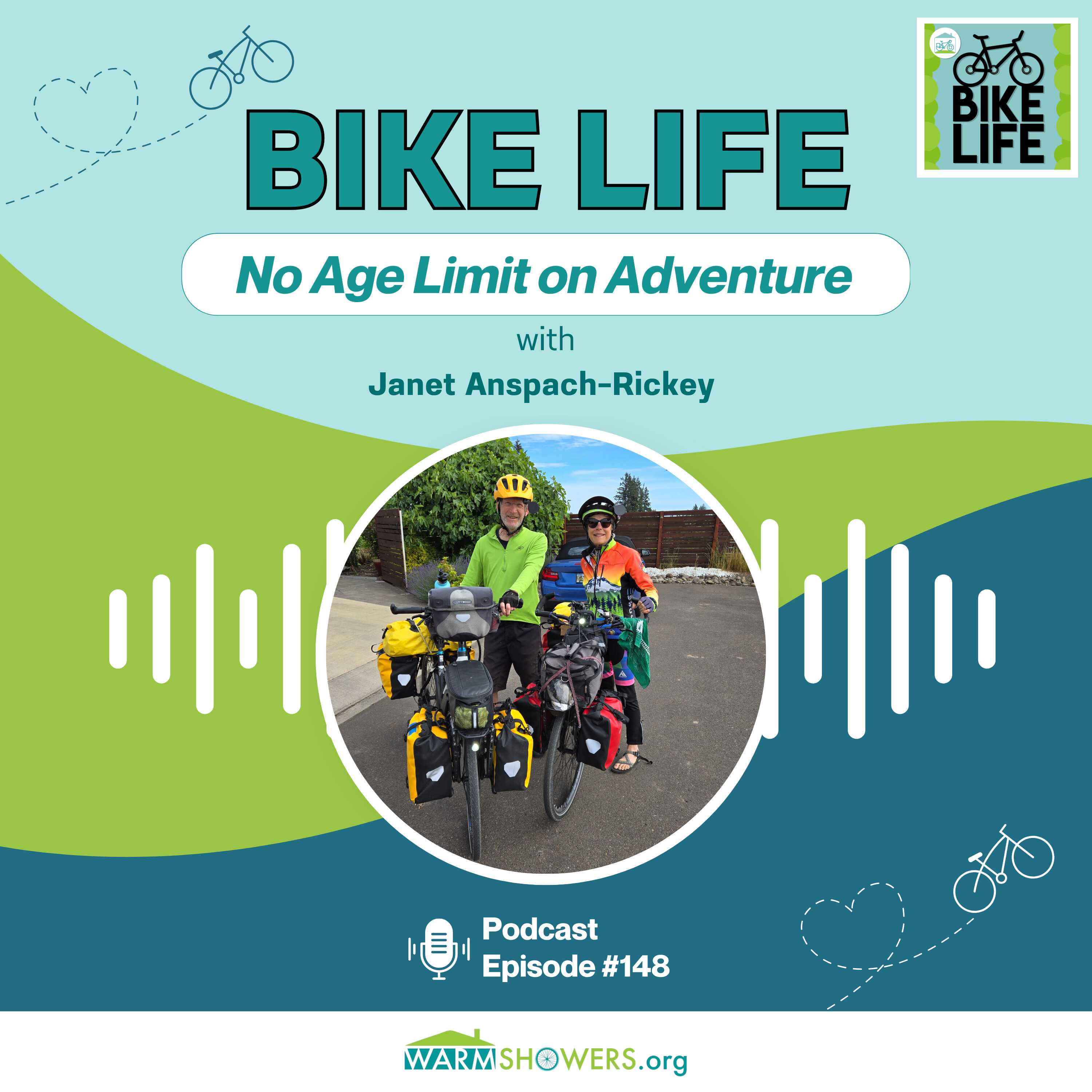
Janet Anspach-Rickey shares how she used an e-bike, a plant-based lifestyle, and pure resilience to log over 40,000 miles and pedal across the U.S. and its perimeter twice, proving that adventure has no age limit.

 Apple Podcasts
 Spotify
 Overcast
 PocketCasts
 RSS Feed
 What keeps someone spinning the pedals after 40,000 miles? Janet Anspach-Rickey shares her story of how life's second act turned into the ultimate cross-country adventure. We chat about how a pedal-assist e-bike, a plant-based lifestyle, and a whole lot of resilience made it possible to ride across the United States and tackle the country's perimeter twice.
It hasn't all been smooth pavement, though! Janet shares plenty of laughs, road mishaps, and deep insights on personal growth.
In this episode:
- How new tech (hooray for e-bikes!) and a healthy lifestyle can unlock lifelong movement.
- Navigating relationships while living out of panniers and recovering from injuries far from home.
- Embracing change, partnership, and always saying "yes" to whatever is around the next bend.
Whether you're an endurance junkie, curious about healthy living, or just looking for a little inspiration to kickstart your next chapter, Janet’s story is your reminder to keep pedaling and keep exploring.
Catch up with Janet on Instagram at @luv2cyclerickey and on YouTube at @plantpoweredpedaler.
Join our community at Warmshowers.org, follow us on Instagram @Warmshowers_org, and visit us on Facebook.
Watch this and all episodes of the Bike Life Podcast on YouTube.
Special thanks to our sponsor, Bikeflights – the best in bicycle shipping service and boxes, guaranteed.
Theme Music by Les Konley | Produced by Les Konley
Happy riding and hosting!
Jerry Kopack [00:00:02]:
Welcome to Bike Life, a podcast from the Warmshowers Foundation. Here we celebrate our global community of touring cyclists and hosts who make life on the road unforgettable. Through stories, insights, and shared experiences, we explore the connections that fuel every journey. Whether you're pedaling across countries or welcoming travelers into your home, you're part of a movement rooted in generosity and adventure. Discover more and join the community at warmshowers.org now let's hit the road together. Hey everyone, this is Jerry Kopeck, the host of Bike Life, coming to you from the Rocky Mountains of Breckenridge, Colorado. Today, I'm joined by Janet and Spa Ricky, a lifelong cyclist whose touring story goes all the way back to 1990, when the she first rode her bike across the United States. Since then, Janet has crossed the US Multiple times, ridden the perimeter of the country twice, and now logged more than 40,000 miles on her pedal assist E bike.
Jerry Kopack [00:01:05]:
We'll talk about what keeps her coming back to long distance touring, how cycling has evolved over the decades, and why she's passionate about encouraging more people, especially retirees, to get out and ride. Janet, welcome to Bike Life.
Janet Anspach-Rickey [00:01:19]:
Thanks, Jerry. It's good to be here.
Jerry Kopack [00:01:21]:
Now those are some big numbers you vlog. So I want to touch back into your origin story. Take me back to that first ride across the US
Janet Anspach-Rickey [00:01:31]:
1990. My husband and I went across the country and there, there is a little story there. When I met Steven, he didn't, he had stopped riding. He was 40 years old and he, he felt he was too old to ride. And I was training for the Seattle to Portland ride that year, so I was always taking off to go on a ride to get ready for the, the 200 mile Seattle to Portland ride. It's a 100 miles over two days, you know, two days of 100 miles each. And lots of people do it. That year, 10,000 people did it.
Janet Anspach-Rickey [00:02:05]:
And I asked him if he could come pick me up in Portland and he said sure. And so he, he, he arrives in Portland and hundreds of people are riding into port, into the finish line and all ages, all different types, all different bicycles. And when I, by the time I got there, he said, what am I saying? I mean, 70 year olds do this ride. And he thought he was too old at 40. So he went right out and bought a bicycle and did the Seattle to Portland the next year with me. And as soon as we got done, I said, well, you know what I really want to do? I want to ride across the country. And he said, well, we're not. I'm not getting any younger.
Janet Anspach-Rickey [00:02:48]:
Let's do it. Yeah. We spent the whole year getting ready. And about the week before, we were so busy working to get everything paid off three months in advance. And the week before, we looked at each other, and we hadn't even gone camping yet. So we said we better do a ride and camp for the weekend and make sure we like it. And so we did. We live in the Pacific Northwest, and we ran a little Kitsap peninsula.
Janet Anspach-Rickey [00:03:19]:
And we rode up to this little town called Port Townsend. And it was May, and the campgrounds weren't even open yet, but there was a primitive area, what they call a primitive area, so it means it's just a pit toilet and there's no electricity. And anywhere that's where the ranger put us. And we loved it. We had such a great weekend. So we came home and we knew we'd be okay, and we left. On June 2, we crossed the North Cascades highway and we went across the northern tier. It was amazing.
Jerry Kopack [00:03:57]:
I think it's so funny because you said that your husband felt at age 40, he was too old. I'm sure looking back on this, it must seem very comical, all the adventures you guys have done since he's been
Janet Anspach-Rickey [00:04:11]:
40 and now he's 79 and he's still riding.
Jerry Kopack [00:04:15]:
Yeah, right. Do you. Do you still give him. Kind of poke him about that or give him grief, like, hey, remember that time when you were too old at 40?
Janet Anspach-Rickey [00:04:23]:
Yes, of course.
Jerry Kopack [00:04:25]:
Good. Good for you. So how'd you feel those first few days when you were setting out on the road, when you're figuring things out?
Janet Anspach-Rickey [00:04:33]:
Oh, gosh, the whole ride, really, the whole ride was that I learned so much. We learned so much about each other. We. We met in 1988. 1987. We were married in 1988, and we left. Left on the trip in 1990. So we really didn't know each other, and we really got to know each other for sure.
Jerry Kopack [00:04:57]:
Yeah. How long was your trip?
Janet Anspach-Rickey [00:05:00]:
It was. That one was 4,000. You know, there were no computers or computer journals. And I did have a little diary that I lost because a few times, Stephen and I have just given away everything and gone touring. And in some of those cleanouts, I lost my journal.
Jerry Kopack [00:05:23]:
I meant, like, more timeline. Like how many days, weeks, months. Were you together?
Janet Anspach-Rickey [00:05:28]:
Yeah. So let's see. We left June 2nd. We got to my mom's in New York at the end of July. We continued on to Kennebunkport, Maine. Think another couple of weeks in August So June, July, roughly two and a half, three months across the country. We were, you know, we had to get back to work. So we averaged about 70 miles a day.
Janet Anspach-Rickey [00:05:57]:
That's way too much when you're crossing the country way too fast.
Jerry Kopack [00:06:02]:
I bring that up because you said you were essentially newlywed, you didn't know each other that well. But boy, spending two and a half, three months together every day for that long period, you definitely get to know everyone's idiosyncrasies, their quirks. Were you similar? Were you both morning people? Did one person like to sleep in?
Janet Anspach-Rickey [00:06:26]:
Steven is a night person, I'm a morning person. So I would get us up in the morning and he would put us to bed at night. So once we realized we were complementary, it worked really well. But in the beginning, I'm kind of a high energy person and Steven's more of a laid back person. And so I was up and ready to go and wanting to go and he really needed to rest. And I came to realize that if I honored that he really came alive, you know, by, by noon he would start talking. And so I learned don't expect him to start to wake up until around noon. And once he's awake, he's so, he's just full of it and fun and funny and, you know, it was just getting to know each other's.
Janet Anspach-Rickey [00:07:17]:
Yeah.
Jerry Kopack [00:07:18]:
And did that flip when it starts getting to 8 o' clock at night, did you start winding down? You got a little quiet and he's like, hey, what's going on? Why are we talking anymore?
Janet Anspach-Rickey [00:07:28]:
Yeah, I mean, one night we were, we. When we. The North Cascade highway is all mountain ranges and so we, we. And it was really wet still at the beginning of June, and the place we were supposed to camp was all flooded. So we said, oh, let's keep going, so we'll just camp somewhere. Going up the mountain, Sherman Pass. So we were climbing the second mountain pass that day and there was no place to stop. There was no flat area.
Janet Anspach-Rickey [00:07:57]:
Duh. Climbing a mountain. And so we were getting near the top. It was around 10 o' clock at night and it was really getting dark. And there's the summit sign and the campground is about a mile down past the summit sign. He wanted to stop because we were always stopping, taking a picture of the summit. And I said, no, no, we're, we're losing light by the second. We gotta get so we can find the campground, otherwise we're not gonna be able to see the turnoff.
Janet Anspach-Rickey [00:08:27]:
And so the faster I wanted to Go. The slower he went. And finally I just said, I'll meet you at the campground. And I went, but it was too light. It was too dark. And I rode right past the campground.
Jerry Kopack [00:08:39]:
Oh, no.
Janet Anspach-Rickey [00:08:39]:
I had to turn around a third time and climb back up to the campground. And I found. Found it going slower. And he was in there and it was really dark. I couldn't tell. You know how sometimes you turn one way to go to the picnic area and the other way to go to the campground? So I just guessed, and I guessed right. And I was doing the loop, I guess, and I was going, stephen, Stephen. And he wasn't talking to me at first.
Janet Anspach-Rickey [00:09:07]:
And then he finally said, I'm here. And then like, oh. And so I found him and. And then in the morning we got up and there was these big signs about Lyme disease. Beware. There's Lyme disease. There's ticks here. But we were fine and, and we got over it.
Janet Anspach-Rickey [00:09:24]:
But yeah, we had a lot of fights that first year just because
Jerry Kopack [00:09:31]:
another
Janet Anspach-Rickey [00:09:31]:
thing was he was real skinny. And so when he said, I'm getting hungry, that meant eat now. We couldn't eat now. He would turn into this, this hungry bear because he just didn't have any fat. And I always had fat. And when I said, I'm getting hungry, I could still ride 20 miles. And it took me a long time to realize when he just, you know, he's just such a laid back guy. When he said he's hungry, though, it means now.
Jerry Kopack [00:10:01]:
Yeah, but look, I mean, you, you learned these little quirks and I'm sure there's. He probably, If I, if he was on this show right now, he probably would say, oh, yeah, but Janet has her quirks too, so what do you think he would say about some of your quirks? What would, what stories would he share?
Janet Anspach-Rickey [00:10:21]:
I did. I'm not prepared, scared for that.
Jerry Kopack [00:10:23]:
Sorry.
Janet Anspach-Rickey [00:10:25]:
Well, that I, you know, that I get up too full of energy in the morning. I need to, you know, calm down.
Jerry Kopack [00:10:31]:
Yeah.
Janet Anspach-Rickey [00:10:31]:
And I'm, I'm very, I love meeting people. So I would go, and then I disappear because I get talking to people and then he'd wonder where I was.
Jerry Kopack [00:10:42]:
So are you more extroverted and he's more introverted?
Janet Anspach-Rickey [00:10:45]:
Yes. In fact, you know, over the years we've come. Come more toward the middle and I've become more aware of my introverted self and I, I've grown really fond, loving to just ride by myself and be by myself and, and, you know, recharging my batteries by not being out there all the time, and. And he's come to enjoy riding with other people. And, yeah, he's definitely more an introvert, and he loves being on his own, but he loves being with me, too. So we now, we just love riding together because we just. We just know what each other's going to do. We've done so many miles that boy.
Janet Anspach-Rickey [00:11:29]:
Like last year, we did this ride around the Olympic Peninsula and down to Eugene, Oregon, and everybody else got on the train, and we canceled our train reservations and rode home together because we just enjoy it so much.
Jerry Kopack [00:11:43]:
Yeah.
Janet Anspach-Rickey [00:11:43]:
So I want to get on a train when you could ride your bike. Yeah.
Jerry Kopack [00:11:46]:
I want to keep talking about your trips because it sounds like you made it through that experience, and it sort of lit a fire underneath both of you to continue traveling, to continue seeing the world this way. Right. And since then, you've crossed the country more times. You've ridden the Perimeter route twice, which I think that's somewhere around, what, 12,000 miles each time. And I think you've also ridden iconic routes like the Pacific coast and the Northern tier. So what is it about the. These big rides? What's the allure? What's the draw for you guys?
Janet Anspach-Rickey [00:12:20]:
I love just packing up the bike and going. And I'm the navigator. I stay about five days ahead. I navigate the routes, find places for us to stay. Love meeting the people, seeing the small towns, what's around the next bend. And if I can get Stephen out, he has just as much fun. The hardest part is getting him to leave. But the last Perimeter trip, I said, let's just go for a week, and if we're not having any fun, we'll just come home.
Janet Anspach-Rickey [00:12:52]:
And as soon as he gets out there, he's, let's go. So we just kept going and we rode all around the country.
Jerry Kopack [00:13:00]:
Yeah. Talking about the Perimeter trip, what are some of the highlights of that? Because you've gone through the Middle east to west or west to east. I'm sorry. And then you decided you wanted to go around the outside.
Janet Anspach-Rickey [00:13:12]:
I love leaving the house and coming back to the house. And if you're going to go cross country, why ruin it then by getting in a. On a train or a bus? You know, just keep riding. So that's what happens is the first time. 2014, 2015, we started down to Eugene, and then we turned east, did the Trans American to Kentucky, and then went north to Lake Erie and got on the Northern tier and then went east to. I guess we went east to Lake Erie and then south to Pittsburgh and then got on the Greater Allegheny Passage, which is dirt, and then went down to the C and O towpath, and that takes you into Washington, D.C. so they're connected. Got to Washington D.C.
Janet Anspach-Rickey [00:14:11]:
found our way back to the Transamerican, took that back east to where we left it in Kentucky, and then got on the underground railroad route. That's what it was in Kentucky. We went. Did the underground railroad route north, and then when we came back to Kentucky, we took the underground railroad routes south to Mobile, Alabama, and then got on the southern tier and headed west to San Diego and then back up the Pacific coast to home.
Jerry Kopack [00:14:38]:
Wow. How long does that take?
Janet Anspach-Rickey [00:14:41]:
That took A year. That took. We left. We left in May of 2014 and got back in June of 2015. Yeah.
Jerry Kopack [00:14:55]:
Did you. Did you time the weather right?
Janet Anspach-Rickey [00:14:58]:
Yeah, it was beautiful. Yeah. And actually in Bracketville, Texas, I herniated a disc in my neck, and we had to hold up for a while before I could get back on the bike. So we ended up renting a little. A condo through this really sweet real estate fellow. And it was on the golf course. It was in the place that adventure cycling has you stay. It's a senior retirement area.
Janet Anspach-Rickey [00:15:33]:
It used to be a fort for the military, used to be a calvary, one of the. You know, they had horses there and soldiers rode the horses, and they have a big RV park and then they have apartments, and it's all retired people. And. And so it was really fun. We met a lot of people there and. Well, actually, I laid on the floor of the. The condo and. And I.
Janet Anspach-Rickey [00:15:59]:
There was a television, and I actually watched all 10 seasons of Friends to make myself stay, heal, and then gradually got to where I could walk. And then. Boy, it took a while before I could get in that position on the bike again. Yeah, I bet forward. And then. Yeah, just really closed down on the herniation and my arm would go numb in my. My hand and I just. I couldn't.
Janet Anspach-Rickey [00:16:22]:
Couldn't tolerate it, I guess.
Jerry Kopack [00:16:26]:
Yeah. I was gonna say it's fortunate that you were able to find a place to. To rest for a while, that you were in the middle of the Mojave Desert or something.
Janet Anspach-Rickey [00:16:35]:
We were staying in the hotel there, and it was Christmas time and they. They needed it for the holiday. And so that's what helped us, you know, give us a little push. And we went ahead and got that idea and. And called this fellow, and he turned out to be just a blessing and. Yeah, and he let us rent it by the month. So we rented it January, February, and then March 17th. I was able to, to ride enough to take off again.
Janet Anspach-Rickey [00:17:04]:
And the first few rides were 30 mile rides and I thought, boy, if I can get 30 mile rides in, you know, that'll start building me back up. And, and I, I was saying I'm a retired physical therapist, so. And I rehabbed herniated discs all the time. So I, it was fascinating for me to be the one going through the healing and experiencing what was going on. So
Jerry Kopack [00:17:28]:
at least you knew what was going on and you understood how to get yourself back there based on your background. So that was helpful.
Janet Anspach-Rickey [00:17:34]:
Yeah, I knew what the red flags were if, you know, if I needed to, to get more assistance and there weren't any, and, and I was fine, I, it just gradually healed and resorbed into the, to the body. I mean, the body is amazing at healing itself. It's, it's always vectoring towards health. So we just get in the way all the time.
Jerry Kopack [00:17:56]:
We do get in the way. I'm curious, so you've ridden the perimeter, you've ridden cross country. Have you checked off all the 48 states or is that something that, that you're targeting?
Janet Anspach-Rickey [00:18:09]:
I would think, yeah. I mean, you know, Alaska we flew to and Hawaii we've flown to, so you know, we haven't. Yeah, we bicycled in Alaska. We rented bikes and bicycled and when we went there, but trying to think if we ever run. I don't think we ran bikes in Hawaii. Went to Hawaii for our honeymoon and then I taught there 20 years later. So we, we went back again, which was cool.
Jerry Kopack [00:18:35]:
Okay.
Janet Anspach-Rickey [00:18:35]:
Yeah, I, I would say we've hit all the states. I've done the, the reg Braai right across Iowa.
Jerry Kopack [00:18:42]:
Sure.
Janet Anspach-Rickey [00:18:42]:
You know, one way or the other. I've been in all the, all the states. With the second Perimeter Tour, we started down the coast, went across the southern tier, went down to Key west, came up the east coast or the central part of Florida, and then out to the east coast because it was spring break time. And so we thought you better not do all the east coast during spring break.
Jerry Kopack [00:19:04]:
Stay away from Daytona, Florida.
Janet Anspach-Rickey [00:19:07]:
Yeah, Miami and all the crazy places, but central Florida was. The orange blossoms were out. Oh my gosh, the smell was just wonderful. Just. It was. Yeah.
Jerry Kopack [00:19:24]:
I wanna, I wanna back up to something and I kind of wanna go back to your, your injury with your herniated disc and just kind of, just kind of touch on something more because it's, it's really easy for people to romanticize Bike traveling, you know, for good reason. It's an incredible way, as you know, to see the world, to see the country. But as you've experienced, there's some tough days. Outside of that, is there an experience or a time that you thought like, wow, how am I gonna get out of this one?
Janet Anspach-Rickey [00:19:54]:
Yes. We were in Texas for the, for the second perimeter trip and I was right. We were riding into this sanctuary where we were going to spend the night and this female pit bull came running out. And we really didn't ever have much problems with dogs, I guess, because we were. I don't know why, but you know, they would bark, but a lot of times they'd stop at their, at their yards and. But this one came right towards me and I was like, hi, sweetie. And she, I could tell she had just had puppies and she grabbed my front bag and stopped the bike. You know, the wheel turned and I kept going and I landed on my hands and knees.
Janet Anspach-Rickey [00:20:36]:
And by that night I couldn't, I couldn't walk. And the gal at the sanctuary was so sweet and I thought, oh, no, you know, how long is this going to take? And her mom had been had, used a walker, so she had a walker for me. I asked for a five gallon bucket to pee in because I just, I just couldn't weight bear on the one leg. And you know, again, thank God I'm a physical therapist. I do all the assistive things that I would need for that night. And by the next day I could weight bear on. On it. The one leg was pretty good.
Janet Anspach-Rickey [00:21:10]:
The left leg was. I just couldn't weight bear. But within five days I got back on the bike and then we rode to the, to the local town and to the store and back and I was okay. So then the next day we went ahead and off I went. And one thing I've noticed about being on the road is I. Both of us tend to recover fairly quickly and it's nice to be out there when you don't have a timeline. We didn't have the pressure. We were retired and we could take the time we needed.
Janet Anspach-Rickey [00:21:43]:
And usually, like I say, I was only. I would only be about five days ahead of myself. And so we could call that many places and change things and rearrange things, so they always worked out.
Jerry Kopack [00:21:59]:
Today's episode is brought to you by bikeflights.com Bikeflights delivers everything you need to ship your bike, whether you're riding a bucket list tour, selling your bike online, moving across the country, bike flights, easy to pack, bike Boxes, carbon neutral shipping and pickup to delivery monitoring. Make it simple and save you up to 40%. Visit bikeflights.com warmshowerstoday to book a shipment. Now back to the show. Yeah. So you are, you are a model of resiliency and toughness. Was there, was there a time in either of these episodes with, with that bike crash or with the, the herniation in your neck? Did you think, like, I think we might need to, to fly out of here, or were you just always at the mindset that, yeah, it's gonna pass, we'll get through this?
Janet Anspach-Rickey [00:22:49]:
Yeah. I mean, what, what better place to be? Like when we were in Texas in December. I don't want to go home in December. Let's just find a place here, you know? Plus, I, I just couldn't sit up. So, I mean, it was, it was pretty serious when it first started. So. Yeah, it's so funny because, yeah, people are like, oh, you want help getting homes? Like, no, not in December. I'm staying right here.
Janet Anspach-Rickey [00:23:13]:
It was nice and, you know, the sun would come out and it was, it was much preferable to be in the South.
Jerry Kopack [00:23:20]:
Yeah, I bet. And I want to stay along this same topic here because you've been bike touring now, you said 1990. Looking at my math, that's 36 years. I'm sure a lot of things have changed. Obviously in 1990, we didn't have cell phones, we didn't have offline GPS navigation. You probably were using paper maps. But there's also other things have changed, probably with you. What's been your secret for longevity?
Janet Anspach-Rickey [00:23:48]:
I love getting out on the bike. And we switched, like I was telling you, from regular bikes to pedal assist electric bikes.
Jerry Kopack [00:23:55]:
Yeah.
Janet Anspach-Rickey [00:23:56]:
Stephen, he said, you know, if I'm going to tour, I need some help. It's, it's, it's getting too hard. And, and really, to be honest, I wasn't going to get a bike, but I also, I could the climbing. And in Kitsap county here, it's very hilly and I could feel my heart really having to work hard. And like, in the mornings it would beat outside my chest almost. And I thought, I really, you know, I'll go with you. So we both went and hopped on an electric bike, Seattle electric bikes. And oh, my gosh, I said, if you're getting one of these, I'm getting one too.
Janet Anspach-Rickey [00:24:34]:
I mean, they, it really made a difference with the hill. It, it brought all the joy back to cycling. And even more so, I mean, as you get older and the hills get tougher you tend to do rides, wanting to avoid the hills. And now everything was back on, on the board again. You know, we, we could go down because we knew we could get back up. We'd go up because we knew we could get up. And we, you know, all exploration opened up with these E bikes and with touring you can carry as much as you want. I mean, it just really changed the game.
Janet Anspach-Rickey [00:25:07]:
We, we, we like, when we do long distance traveling, we like doing between 40 and 60 miles a day and even 30 because it gives you more time to experience the locals and the local town and go to the grocery store. And we shifted from eating crap to eating whole food and that really helped. Our weight went down and our blood pressure normalized, our cholesterol normalized, we got healthier because, you know, you think when you're riding, oh, I'm riding, I can have ice cream and I can eat whatever I want. But it's not true. Inside you're still getting heart disease and it sneaks up on athletes because you might not be as fat as you might be if you weren't cycling, but it's still everything inside is going on that until you start getting blood work or some signals that something's going on in there, you're not, you're unaware. And I think that's why athletes can drop dead because they don't realize what they're doing to their bodies. Yeah.
Jerry Kopack [00:26:15]:
Did you, did you have some results that came back that made you change to a healthier diet? I think you may have mentioned that. I think you also follow a plant based diet as well.
Janet Anspach-Rickey [00:26:25]:
Yes, yes. And now I'm raw. So I've been raw for about a year and a half.
Jerry Kopack [00:26:29]:
Okay.
Janet Anspach-Rickey [00:26:29]:
Even vegan. And yeah, I dropped it 50 pounds and everything normalized, all my blood work normalized and I have endless energy and yeah. But between that and the, the pedal assist electric bike, I think I can ride another 10 years.
Jerry Kopack [00:26:48]:
I love that. Now, are you carrying a backup battery or are you just charging your same battery every night?
Janet Anspach-Rickey [00:26:56]:
No, no, no. We were on two batteries. This, the, the 201819 round, round country trip. We went down the coast over to Key west, up to, to Maine and into Vermont. And finally in Vermont, we thought, gee, you know, we better get an extra battery because we need to get home before winter. And so we had still the country to cross and I gosh, what, I would have to look at the journal to see what time of year that was. But we were thinking we, we better get a little bit more backup. And so we Went ahead and got a second battery and now we won't go without it.
Janet Anspach-Rickey [00:27:33]:
I mean even on 20 mile ride, we'll take an extra battery just in case because the batteries are getting so old now.
Jerry Kopack [00:27:40]:
Yeah.
Janet Anspach-Rickey [00:27:40]:
With, you know, over 40,000 miles on the bike. So we just make sure that there's a backup in case one of them bricks on us, which means it goes out, it stops. So yeah, we, now we always have two batteries.
Jerry Kopack [00:27:56]:
I am, I am stuck on just the sheer numbers that you keep sharing with me. 40,000 miles. That is incredible.
Janet Anspach-Rickey [00:28:06]:
I had more miles on the bike than the car until last year.
Jerry Kopack [00:28:13]:
That's incredible. So what's, what's on your hit list? That place you still want to go now that you have this new lease on life. You have e bikes. Your, your weight feels good, your health feels amazing. What, what do you still want to do?
Janet Anspach-Rickey [00:28:28]:
Well, we, we have, we have a bike club here and we do tours every summer. And so we, we, we like riding right around here. I mean, I like riding in the States. We've done, you know, Germany and France and we've done the Camino. There's a bike route for the Camino. Santiago. Oh, we've been in Switzerland. We've, we've done along the Rhine, the Mosul.
Janet Anspach-Rickey [00:28:58]:
I'd like to do Czechoslovakia. I'm reading right now. This fella's gone from the south of South America up to Alaska. He's right in the middle. He's just gotten to the United States. But wow, South America sounded kind of rough. I don't know if I thought to do that.
Jerry Kopack [00:29:18]:
Yeah.
Janet Anspach-Rickey [00:29:19]:
But riding to Alaska might be fun. We did a couple years ago, I did a 30 day tour up into the Canadian ice fields. That was gorgeous. Last year I took a small group across the North Cascades again because it had been since 1990 that I'd done it and it was just magical. We left on July 4th. The traffic was great. I don't know what was up there wasn't that much traffic up there. People had said, oh, it's so busy.
Janet Anspach-Rickey [00:29:47]:
But it really wasn't. And it was a gorgeous ride. And then we did the forgotten corner. Northeast Washington had a great time.
Jerry Kopack [00:29:57]:
What was it like going back to a ride you had done 35 years earlier?
Janet Anspach-Rickey [00:30:01]:
It was, it wasn't that much different. You know, the towns were still all about the same size. The road has been improved. It was, it was just great cycling. The weather was perfect. I mean we had tried to book the ride the two years prior and the fires would keep breaking out and close the road. And we couldn't do it. We'd have to cancel.
Janet Anspach-Rickey [00:30:24]:
And this time I said, okay, we're going to start in July because August is, you know, anymore fires are up there in August. And actually there was a fire even in July, but it wasn't near the highway, so they didn't close the road. And it turned out but just gorgeous. And maybe that's why there wasn't a lot of people up there. But we thought being the Fourth of July weekend that it just be packed and it wasn't. So. Yeah, I like. I mean, we've done around the peninsula a couple times and it's just different every time.
Janet Anspach-Rickey [00:30:58]:
The weather's different, the people are different, where we stay is different. It just doesn't feel the same. We've done the Pacific coast three times, twice going down and once coming up. And they're completely different rides. Yeah. Depending on the direction you go because of the north winds, which just meant we got up earlier and got done earlier because the north wind really gets going from noon or one o' clock on. And so we would just do our riding earlier and it was still a great ride. But, you know, that's after you've done it.
Janet Anspach-Rickey [00:31:29]:
If you're doing it the first time, definitely go north to south.
Jerry Kopack [00:31:32]:
Okay. Yeah. I share this on other episodes that there's elements. So it's heat, it's cold, it's rain, it's snow, whatever. The thing that breaks me the most mentally is wind. I think I can handle everything else but wind. It just feels like I'm riding as hard as I can and I'm going to make it five miles today because the wind is just turning me backwards. So good tip about that still.
Janet Anspach-Rickey [00:32:01]:
But I mean, E bike, you're still pedaling, but it's not as much.
Jerry Kopack [00:32:04]:
Yeah, yeah, yeah, now I know. Go ahead.
Janet Anspach-Rickey [00:32:08]:
No, you go ahead.
Jerry Kopack [00:32:10]:
Well, I know that you're, you're a big proponent of trying to encouraging more people to get out and ride, especially retirees. Give me some tips, like, what would you say to people who think maybe it's too late? Like your husband said, At 40, it was too late.
Janet Anspach-Rickey [00:32:25]:
You know, I just kept writing, I said, okay, and I mean, sooner or later, it either hits him or it doesn't. I mean, I, I actually, I go on Instagram every day trying to encourage people to eat better and get out there and move and I'll, you know, I'll come on when I'm walking or bicycling, whatever. I can be doing that day and say, come on out here and just trying to model, you know, how I feel and where I'm at at the age I'm at, which is 71, that I just think it keeps a person, that my mind more active and my body responds better. I've started powerlifting now because I've got some osteopenia that's getting a little bit too close towards osteoporosis. So I'm going to see if I can reverse it. You know, the medical profession, oh, it's normal for somebody your age, blah, blah, blah. I said, well, it's not normal for me. I'm not, I'm not going to just go with it.
Janet Anspach-Rickey [00:33:25]:
I'm going to, I'm going to try to turn it around as much as I can. But I guess it is true that bicycling isn't enough weight bearing for strong bones. So. Okay, I'm going to introduce another thing.
Jerry Kopack [00:33:40]:
Yeah.
Janet Anspach-Rickey [00:33:41]:
And I just, I. All my life I motivated people to, to do more and to move more because of being a physical therapist. And I just, I, I think it's just my calling. Just come on, we can do it.
Jerry Kopack [00:33:56]:
So are you, are you, are you coaching your husband and you guys going to the gym together?
Janet Anspach-Rickey [00:34:01]:
No, I tried and he went for a little while but he, he's just different. He. Yeah, he likes to put in a paver wall or you know, that's hard. Yeah. He finds other ways of keeping in shape.
Jerry Kopack [00:34:19]:
I think it's all about just moving. So. I've heard the expression motion is the lotion. You probably have heard that too. So you keep your body going. It's, it's, it's beneficial and to your point, weight bearing as we age, I mean, I'm 52 and, and I noticed that if I am a length long cyclist as well, but if I don't do some kind of weight burn exercises that my knees don't feel as good, my back doesn't feel as good. But weight burn exercises. I'm sorry, not weight bearing.
Jerry Kopack [00:34:47]:
More, more intensive weight training helps a lot.
Janet Anspach-Rickey [00:34:51]:
Powerlifting.
Jerry Kopack [00:34:51]:
Yeah. So I think that's a great tip for people as they age and it
Janet Anspach-Rickey [00:34:55]:
does help with the cycling. Yeah, it does help with declining now. It's great compliment.
Jerry Kopack [00:35:04]:
Now we've got some time left and I'm really enjoying this conversation and I want to, I want to play a little rapid fire game here. I knew you probably know this is coming, so I've got some different questions for you. I'm not going to ask you if you bike Has a name? Because I think you've already expressed to me that it doesn't, and I'm going to look the other way with that. But the question. The first question I'm going to ask you is a little cliche, and you've probably been asked it way too many times, but I'll ask anyways. Did you. Do you have a favorite state or favorite region or favorite ride that you've done over the years?
Janet Anspach-Rickey [00:35:38]:
Yes, yes. The one I'm. The one I'm in. And the ride I'm doing at the moment.
Jerry Kopack [00:35:43]:
Oh, I love that.
Janet Anspach-Rickey [00:35:46]:
You know, everywhere we are, it's like, this is. This is so cool.
Jerry Kopack [00:35:50]:
What a great answer. I was expecting you to say, oh, the. The national parks or the mountains or the coast or whatever, something like that. But I love your. Just your being present. What a great answer.
Janet Anspach-Rickey [00:36:03]:
Amazing to be out here. Yeah.
Jerry Kopack [00:36:06]:
Okay, so, Katina, on that same line, we dig a little bit deeper. Do you have a favorite landscape? Desert, mountain, coastal forest?
Janet Anspach-Rickey [00:36:17]:
I. I'm definitely a water girl.
Jerry Kopack [00:36:19]:
Okay. Yeah.
Janet Anspach-Rickey [00:36:21]:
All right. We follow the water all around the perimeter. Okay.
Jerry Kopack [00:36:26]:
Your gear, I'm sure, has changed over the last 35 years. Is there a piece of gear that you never leave home without?
Janet Anspach-Rickey [00:36:36]:
Well,
Jerry Kopack [00:36:39]:
your panniers, your bags.
Janet Anspach-Rickey [00:36:41]:
Yeah, Yeah. I mean, I have five of them. Two on the front, three on the back. And then I have a little lunch bucket on my front rack. Yeah, we were fully loaded. Yeah.
Jerry Kopack [00:36:52]:
But with the pedal assist, you can do those things without. Without as much of a. Yeah.
Janet Anspach-Rickey [00:36:58]:
In fact, I was thinking now I have to ease up on all I take just because I'm getting older and it's just heavy for me. Like, if you can't ride over a certain area, you have to push the bike. I know along the Columbia, there's actually a staircase, steps, that we had to lift our bikes up the steps. And it was really stupid, but we were trying to do it without taking all the bags off, and, you know, we did it, but, oh, my gosh, we thought we're getting older because that's. That's a lot of weight.
Jerry Kopack [00:37:34]:
That's over 100 pounds, right?
Janet Anspach-Rickey [00:37:36]:
Oh, yeah, for sure.
Jerry Kopack [00:37:37]:
Because the bike itself is probably 50 or 60.
Janet Anspach-Rickey [00:37:41]:
Yeah, well, 48.
Jerry Kopack [00:37:42]:
48. Okay.
Janet Anspach-Rickey [00:37:43]:
Our. Our bikes are 48. But yeah, I mean, you definitely have some weight without all that we were carrying. And, I mean, we both grabbed it, one in the front, one in the back. But. But, you know, if you want to be lazy like that and not take your bags off, careful about where you're taking These bikes. But we always love, you know, adventures.
Jerry Kopack [00:38:06]:
Yeah.
Janet Anspach-Rickey [00:38:07]:
So you have to be ready for anything. Any kind of surface. Yeah.
Jerry Kopack [00:38:11]:
What. What kind of surface do you like? Do you like more paved tarmac roads? You like dirt roads?
Janet Anspach-Rickey [00:38:18]:
I like the paved roads and the hard packed. Hard packed is okay, but paved roads are better for the E bikes, definitely.
Jerry Kopack [00:38:26]:
Okay. You mentioned you have a little snack bucket on the front. What do you normally keep? What's your favorite snack for down the road?
Janet Anspach-Rickey [00:38:35]:
Well, actually, it's my little refrigerator, and it's the thing that you can fit the six pack of pop or beer in. It's about that size. And I have a little freezer pack. And so whatever we've got left over from. Because we stop at a grocery store every evening and get our dinner. Breakfast and lunch, and then we take it to the hotel, and they've got a little refrigerator that hopefully won't freeze everything. And so anything I have left over, I'll pack in that little. That little bag.
Janet Anspach-Rickey [00:39:09]:
And so bananas. Bananas don't have to go in the freezer pack, but that's a very common. It's a great food to have on the road for a raw vegan like me.
Jerry Kopack [00:39:20]:
Yeah. Do you do peanut butter?
Janet Anspach-Rickey [00:39:25]:
I don't because it's so high in fat.
Jerry Kopack [00:39:28]:
It's a good fat, though, right?
Janet Anspach-Rickey [00:39:30]:
Well, no, no.
Jerry Kopack [00:39:33]:
Okay.
Janet Anspach-Rickey [00:39:34]:
I mean, not for me.
Jerry Kopack [00:39:35]:
Okay.
Janet Anspach-Rickey [00:39:35]:
Just. Yeah. Stephen will do peanut butter, so.
Jerry Kopack [00:39:38]:
Okay.
Janet Anspach-Rickey [00:39:39]:
He definitely needs more calories than I do. With me, it's mostly fruit. And actually, I just love raw cauliflower and broccoli. Just munching on them. He does. He does hummus and peanut butter and that. That's definitely a lunch staple, you know, and then he'll put it on something. He'll get the little thin breads and.
Janet Anspach-Rickey [00:40:02]:
And make himself sandwiches, whereas I'll just grab the raw veggies or apples, bananas, oranges, mangoes, you know, whatever. In season with the fruits.
Jerry Kopack [00:40:15]:
Yeah, I love that. Does he have a little cooler on the front of his bike, too?
Janet Anspach-Rickey [00:40:19]:
He does. Smart. He tends not to use it like I use mine, but he's just. He's so cool. It's just so fun to see our different strategies. A lot of times he'll think up something, and then he'll get it for us and I'll use it, and he doesn't. So it's funny.
Jerry Kopack [00:40:42]:
Well, so last one, and this is kind of a broad question. After all the trips you've done, after all the adventures you guys have done together, what keeps motivating you? What Brings you back to this lifestyle.
Janet Anspach-Rickey [00:41:00]:
I just love meeting the people and seeing even, like I say, if I've. I've already done the route. It's just. It's a new adventure every time I do it. Like, he, he and I love this ride up to Bellingham. And we spend three days getting up there, spend a few days there, and then cycle three days home. And we've done it a number of times. I never get tired of it.
Janet Anspach-Rickey [00:41:23]:
Just to me, it seems different all the time. We do the San Juan Islands. We'll be doing that in June again. And I'm thinking, you know, everybody meets up there, and I'm just going to ride up there. So I ride up to Fort Townsend and I ride up Whidbey Island. I get to Anacortes. I take the ferry over to, you know, one of the islands and I'll meet up with them that way. I just.
Janet Anspach-Rickey [00:41:44]:
It's kind of fun being in familiar areas, knowing. Knowing about the routes and just riding the ride. I. I don't ever tire of it.
Jerry Kopack [00:41:54]:
Ah, that is beautiful. That gives me goosebumps. And that is a perfect sentiment to wrap up our conversation on today. I love it. Thank you so much for taking time out of your day to hang out with me. For people who are listening, how can they follow along with your adventures or keep up with what you're doing?
Janet Anspach-Rickey [00:42:17]:
Oh, I'm on. On YouTube, I'm plant powered peddler peddler. You know, like peddling a bike peddler. And on Instagram, I'm Luv, the number two cycle Ricky. And I just, I love to hear from people. I love to hear other older people that are out there riding. And I just share the trips I go on. And if I'm not on a trip, I'll share what I'm making at home and.
Janet Anspach-Rickey [00:42:46]:
And what I'm doing. You know, if I'm going on a walk, let's just keep moving.
Jerry Kopack [00:42:50]:
Yes, America, I love it. Thank you so much for sharing that. We will have those links posted on our show notes so people can click and follow along. This has been so much fun. Janet, thank you for your time.
Janet Anspach-Rickey [00:43:06]:
Thank you, Jerry, and good luck on your trip. Coming up. Can we follow you?
Jerry Kopack [00:43:10]:
Yeah, you can follow me. I'll send you a message offline.
Janet Anspach-Rickey [00:43:16]:
Okay.
Jerry Kopack [00:43:16]:
But it's just my name on Instagram and I've got a website too, but you could find me. Yeah. I want to thank everyone. I want to thank everyone for tuning in to my conversation today. Stories like these hopefully will inspire you to set off on your own bicycle adventure and maybe make the world feel a little bit smaller, one pedal stroke at a time. Until then, keep the wheels rolling and the stories coming. Thanks for joining us on Bike Life. I'm Jerry Kopeck, and I hope you enjoyed today's episode as much as we enjoyed sharing it with you.
Jerry Kopack [00:43:50]:
Please leave us a rating and review or just tell your friends. This helps us reach more cyclists and hosts around the world. To learn more or become part of this amazing community. Visit us at Warmshowers.org or follow us on Instagram at warmshowers_org. If you'd like to be a guest on the show or have a question you'd like us to explore, email us at podcast@warmshowers.org.