555. Smarter Podcast Marketing with AI and Social Media

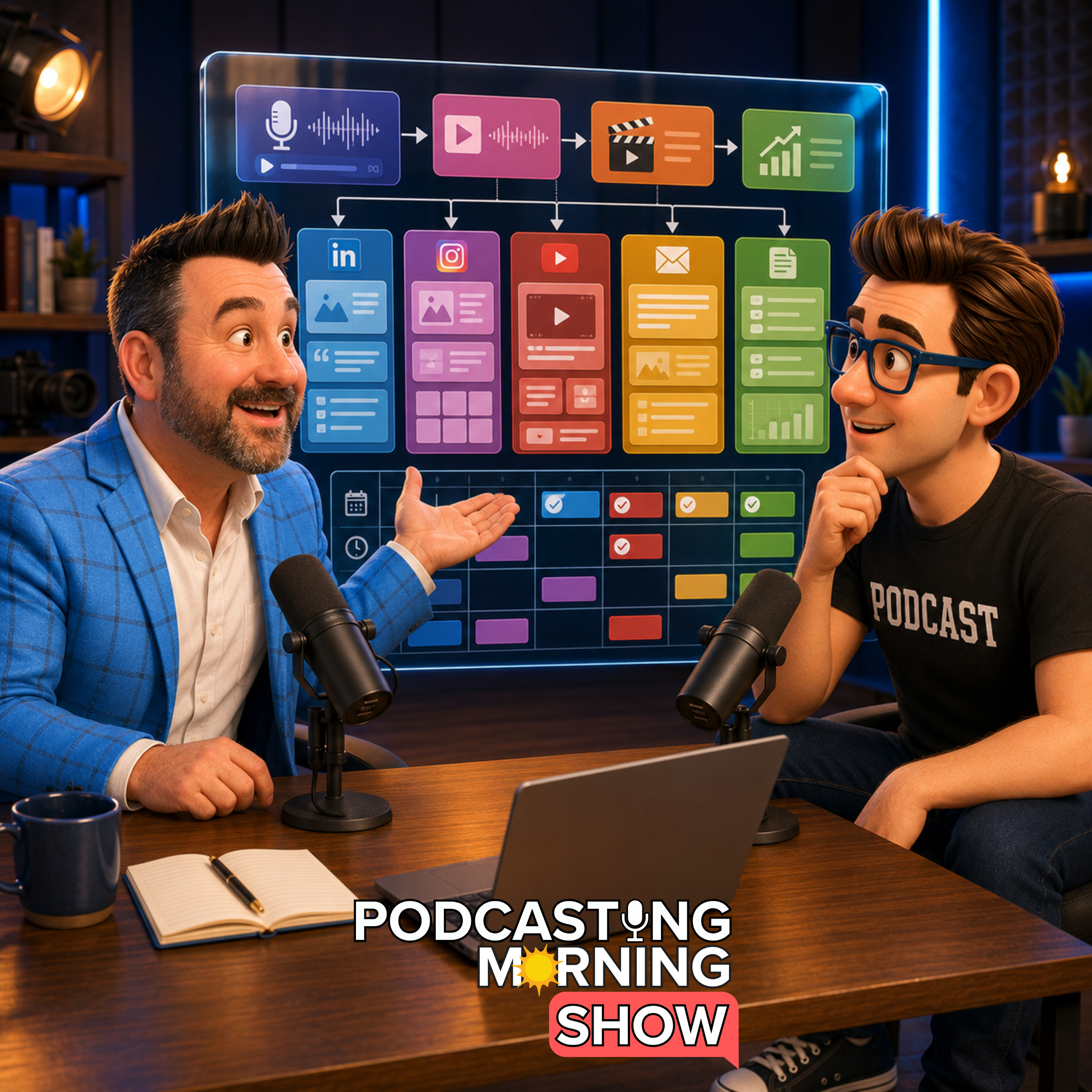


Great podcast marketing goes beyond publishing new episodes. The morning show cast and crew explore smarter podcast marketing, sharing practical strategies for using AI, creating content between episodes, and improving podcast discovery without sounding robotic. From social media workflows to sustainable growth tactics, the conversation is packed with actionable ideas to help you market your podcast more effectively. Learn how better prompts, smarter workflows, and authentic content can help you grow your audience while saving time.
Episode Highlights:
[02:37] Meet Eddie Garrison
[05:54] AI Prompting and Content Repurposing
[08:33] The Keyhole Content Strategy
[11:29] AI Tags and How Algorithms Work
[13:41] The Social Media Slop Problem
[19:54] Pick the Right Platforms and Build Owned Media
[24:34] Maintaining Your Brand Voice with AI
[30:02] Focus on Hooks, Not Virality
[33:23] Prompting AI from Podcast Transcripts
[40:02] Using AI as a Coworker, Not a Replacement
Links & Resources:
Connect with Eddie Garrison:
https://www.eddiegarrison.com/
Feature Your Podcast on the Podcasting Morning Show:
https://PodcastingMorningShow.com/spotlight
The Podcasting Morning Show:
www.podcastingmorningshow.com
Ways to Watch or Listen: https://www.podcastingmorningshow.com/joinus/
Meet the PMS Cast and Crew:
https://podcastingmorningshow.com/people
Join The Empowered Podcasting Facebook Group:
www.facebook.com/groups/empoweredpodcasting
Book A Free Call With Marc:
https://calendly.com/ironickmedia/freestrategycall
Application To Submit Your Show For Evaluation:
https://podcastingmorningshow.com/eval
Powered by iRonickMedia.com and ContentCreatorsAccountant.com
Send in your mailbag questions: https://www.podcastingmorningshow.com/contact/ or marc@ironickmedia.com
Want to be a guest on The Podcasting Morning Show? Send me a message on PodMatch, here:
https://podmatch.com/hostdetailpreview/1729879899384520035bad21b
0:06 Marc Ronick: Good morning, Today is Thursday, july 23 2026 and today Smarter Podcast Marketing with Eddie Garrison, who shows you exactly what to post between episodes, how to use AI without sounding robotic, and how to turn your content into business growth. So, if you're listening live on Clubhouse, hit the share button top right hand side of the screen and share it however Clubhouse lets you. And if you're catching us via podcast, YouTube, etc. please share this episode with a fellow podcaster. seconds, and we'll get things Thanks for being here. The podcasting morning show is powered by Ironick Media, helping podcasters launch, polish, and grow great shows, and by Content creators' accountant helping creators build real business behind their morning show. Thank you so much for being here. I am your host, Mark Ronick, and DR Fay, Phil Better, Sid Meadows, and also from the audience Dan Schultz has joined us once again.
1:37 Great having you up here as well, Dan, and we also have our guest here today, Eddie Garrison, who we will get to officially here in just a Did I get everybody? I think I did. Okay, good. And if you want to learn more about all those people, go to and you can click on each member bit more about them and how to to just remind you: Tuesday we Eastern, and Tuesday we will be evaluating another community members podcast, and it's actually Nikki who has just joined us on stage here, KA Tide Tutoring. So we will break down her podcast, talk about what we can learn from it. We'll help her if there's opportunity to improve it. We will share some thoughts around that. We would love to have you join us. So join us over at podcastingmarningshow.com/slash join us.
2:34 Okay, so let's do this. strategist, a speaker, a of the Modern Marketer. He helps businesses turn scattered marketing into predictable growth through stronger messaging, smarter systems, and measurable strategy. He's also one of the speakers at Empowered Podcasting Three this August, and Eddie's connection to the morning show began when he generously helped Dr. I think it was over the weekend answer some questions about social media and social media managers. Today we're building on that practical ways to improve their social media and use AI more effectively. So Eddie, first, good morning to you, sir. Eddie Garrison: Yeah, good morning. Thank you for so much for having me today, guys. Marc Ronick: Yeah, love that you're here. Love supporting fellow community members, especially the empowered podcasting community.
3:32 So cool that you're going to be a part of that for the first time this year. And Eddie Garrison: yeah, I'm looking forward to heading into Charlotte next month. It's going to be good. Marc Ronick: Yeah, yeah, and I know you and Rich are planning lots of partying. I've seen on social media while you're there. Eddie Garrison: Business gets That's right, right. Marc Ronick: That's right, absolutely. So, Eddie, when we talked about you joining, and and you, we talked about this very last minute. So, thank you for joining last minute. You told me that you've been using AI since people were calling it machine learning, Eddie Garrison: correct. Marc Ronick: What were you doing would eventually affect nearly every part of marketing, and for Eddie Garrison: Yeah, you know.
4:15 So my interest really piqued on AI, you know, while it was really called machine learning, and understand how technology could use data to identify patterns, you know, predict behavior, and make marketing just more intelligent and maybe a little bit easier for us just dumb marketers to understand of how to persuade strangers to spend money at businesses that we don't own. But what's been fascinating, really, is just watching how AI has moved from something largely happening behind the scenes to something that almost anyone can interact with. You know, for a lot of years, marketers were already using forms of AI. You know, was called machine learning and advertising, customer segmentation, dynamic pricing, predictive analytics, and automation in a little bit. But generative AI really changed the accessibility. Of it all, you know that that background shapes how I approach AI today because I don't look at it as simply as a content generation tool.
5:07 I look at it as a total system. You know, so the question really for me. The better question is something along the lines of where can AI improve the way that I research, think, create, distribute, analyze, and make decisions. So you know that distinction is very important because AI is incredibly powerful, but it amplifies what you give it. If your strategy is unclear, AI is going to help. Is AI can help you create unclear marketing much faster. So the foundation really still matters at its core. Fascinating. Okay, so you know a lot of people in all sorts of businesses and or industries, including marketing, are concerned about AI. You know, taking over and taking over our jobs or what have you.
5:55 What marketing skill do you think will become more valuable as AI makes content faster and easier to produce. It really comes down to an old programming adage called Geigo: garbage in, garbage out. But the opposite can be true. So good in, good out. So understanding really how to structure a prompt correctly efficiently and produce better really streamline anything from you know an overall marketing strategy to creating social podcast. So you know being able to use like a podcast as what we refer to as keyhole content.
6:36 You know you can take the transcript of a podcast, put it into an AI like ChatGPT or Perplexity or Claude or you know whatever your favorite LLM is right now, and have it extrapolate from a transcript some quotes that that can be tied to Canva, and it can to be able to post on social It can also create YouTube short scripts from your transcript. Then you can tell it to create insert number here of social media post with this graphic and tie that to Canva, and it's automatically going to create those for you. And then it can take it a step further and it can schedule those posts for you as well. So just being able to understand the prompt structure engineering quality is the base of how AI is going to help you streamline everything across every system. Marc Ronick: Okay, I have to ask First, I'm just curious, and I know we're going to get into AI a little bit more here, but you mentioned whatever your favorite now? Eddie Garrison: I have stuck with Chat GPT. Now I do use like notebook LLM for a few things.
7:43 coding. Chat GPT for me is just one of the. I understand it a little bit more, and we have so much built into the backend through you know APIs and MCPs into our internal servers at work that it's very hard to migrate away from that. Yeah, but anything that I say when I refer to Chat GPT can really be used on any LLM right now. Marc Ronick: Yeah, I'm with you. I kind of feel like I've invested so much time and energy, and it has learned so much about me and my business, and the podcast and the conference, et cetera. That it's really hard for me. I know there are all sorts of hacks and suggestions how to kind of move from one platform to another, but I just feel too comfortable where I am and kind of a creature of habit. So I'm with DR: I don't want to break up with it. I feel like we have a you there.
8:30 relationship, right? Marc Ronick: Right. I'm with you there, DR. Absolutely. The other thing you said in your last answer there was keyhole content, and I would love to Eddie Garrison: Keyhole content as a strategy, I guess, for lack of a better term, is you create one piece of content and then extrapolate many pieces of content from that. So that would be the keyhole. Like for many of your listeners out there, that's going to be a podcast. And for most of your viewers out there who are joining us and are actually doing this. They do video podcasts as well. I'm sure. So you know you can take the one piece of content create once, and then pull almost unlimited pieces of content out of it. So it's basically working smarter, not harder. Marc Ronick: All right.
9:14 Okay. So I'm going to hand the baton to DR. for a second because again, if it wasn't for DR. asking this question on Facebook, we might not have had this interview today. So, DR. Go ahead and ask any questions. DR: So, Eddie, you and I connected when I posted on Facebook asking about social media managers and stuff like that, and I was upfront with you have some questions, and you were so generous. So one of the questions that I had was, I have a couple of clients that are actually doing podcasts like every other week, twice a month. So what I do, like the in between times, to keep them still top of mind. Ralph Estep Jr.: Yeah, I think one of the biggest mistakes podcasters make is thinking the episode itself is the content, and that's the only content that source material, or what we were just alluding to as keyhole content.
10:15 really become short form videos, carousels, quotes, articles, and you can even responses to industry. But I wouldn't repurpose everything just for the sake of being active. You know, every piece of content should have a job. You know, is it designed to create awareness? Is it designed to start a Is it to demonstrate your industry expertise? Drive someone to another episode, build your email list, or is it to generate an inquiry? So I also wouldn't tell every podcaster they need to be everywhere. Choose the platform where your audience actually spends time and where you can realistically maintain a presence. So you know if your target demographic isn't 13 to 16 year old girls that want to learn a new dance step.
11:01 TikTok is probably not where you need to be. You know, the the goal here isn't maximum content; it's maximum value from the content that you've already created. DR: Okay, can you walk us week content for like the shows that are like you know twice a month? Marc Ronick: You know, actually, exercise where we can really dig into that dr. So I think that's okay. Yeah, but I know you had another question. DR: Yeah. So when you're talking about having AI post for you on the platforms, don't some they know that you're using AI, and won't you get penalized?
11:44 Ralph Estep Jr.: They do a it has like a little CR up there it says this image or something was most likely created with AI. From what I've seen over the past say three years of doing this, very very consistently with AI generated imagery and everything like that, I've never And I can also disprove a myth that if you schedule posts, you know, to post on social media that's not on the platform itself. There's always been this rumor that it doesn't have the same amount of reach that has been conclusively disproven so many times. So it doesn't matter where you're posting from or how are you posting. It still boils down to how valuable the content is to you talk about, I'll use like Their algorithm works a little bit differently than everybody else's, but you can kind of other platforms. So they have what's called passive engagement and active engagement, and they assign a numeric value to every piece of content that is posted, called a rank signal. Now, Meta doesn't disclose what those numeric values are for obvious reasons, because everyone could just build around that.
12:51 However, it's easy to extrapolate when you look back at all the content that you posted, say for the last 60 days or 90 days. And what I've determined is the ranking signals that are weighed the heaviest are shares, content that gets 150 likes, and people. You can have a piece of content that has 10 shares and it reaches 10,000 people. So you want to make sure that when you're writing your content and creating your content from your podcast to post on social media-that it's very eye-catching and engaging for somebody to want to either share, comment, or save because those are really the top three engagement pieces that most platforms algorithms are looking for.
13:34 DR: Thanks. Okay. Yeah. Marc Ronick: All right. And Ralph, you had a question. Ralph Estep Jr.: I do, Eddie. Good morning. I have a question for you. Oh, great. I have a question for you because I honestly think that social media marketing has become oversaturated. What do you think about that? Because I honestly think it's become like modern day junk mail, and I feel like no, I seriously, I feel like there's so much of it that's coming at us from all directions that people are zoning it out. I'd love to hear your take on that. Eddie Garrison: You know what? I would wholeheartedly concur on that. I see people in the marketing industry. I see businesses that are really just, and I hate this term, but they're just posting slop. There's no value behind the There's no engagement that you know that really is behind any of the content. So you know I agree with you to where as a marketer I have to post quite a bit because I need to be you know in the public eye, if you will, to you know have my industry authority be rising all the time.
14:32 But you know when we work with brands, we rarely post more than twice a week unless it's some type of like news outlet or you know somebody that needs to post every single day because they're actually putting out relevant news for a community or you know like a homeowners association or something like that. But I really like to only post twice a day, and those days are Tuesdays and Thursdays. And people are like, "Oh, you don't really have to do that anymore. I'm like, "Okay, well, you know, we've backed this up with data from our end, and we know that Tuesdays and Thursdays are." So I really like the fact that if you put in thought and if you put in your strategy and you put in you understand your target audience and the content that you post is going to be relevant to them, it's going to be engaging, it's going to be eye catching, it's going to be important to them that that you will get through all of the junk thing is, I think that this is where AI sort of does content creators a disservice because it wants to promote so many social clips. I mean, everything we do is I'll give you five social clips, I'll give you this, and I'll give you that. But most of that stuff, Eddie, and I'm glad to hear that you're agreeing with me.
15:36 Is that is just garbage, and people are just overrun with garbage. And so I think what I hear you saying, and I'm embracing this in my own content world: less is more. Rez: Oh well, 100, 100, and I'm always of the the old adage: if if you can say it in 10 words, don't use 15, because I don't like there. There used to be this thing where it's like everybody's attention span is that of a goldfish. I don't think that is true. I think our attention span has shrunk because of this slop and this garbage that's been posted. When you have quality content that resonates with your audience, that will hold their attention. Marc Ronick: Yeah, that's why their doom scrolling exists, right? Because there's just so much junk, and you're just flipping through until you find the one that provides the right dopamine hit for you, right?
16:23 entertaining that you stop on. Eddie Garrison: And to Ralph's No, go ahead, go ahead. It's to Ralph's point about you know doing a disservice to creators. It really has because I think that AI affords us some some time limit. It takes the time that used to have to create all this it, right? If you don't have genuine input in there, it's going to spit out the trash that we're all used to seeing in these doom scrolls. And you know, you can spot this stuff a mile away in the fast-paced world. If it says that at the beginning, I know AI totally did understand. They're copy and pasting this stuff, the responses from these LLMs, they're not putting any kind of personal touch, and they're not looking at the formatting. I can't tell you how many posts I see from major companies and big content creators that don't reformat the AI crap that they're generating from these LLMs.Yeah, you're telling me I get so frustrated.
17:18 I mean, even emails these days that I get from people, I feel spot the AI generated ones, and I'm not talking about from the spammers. people that I normally And I saw one recently. I'm not going to call anybody's name out because I'm not that kind of. Marc Ronick: think it was Rich I think it must have been. Eddie Garrison: It was not Rich. But when they copied it from ChatGPT or wherever, they forgot to look what all they copied, and it said, "If you would like for me to make this something else, and they posted that on LinkedIn, and I'm like, "Oh my God, what are you doing? Yeah, yeah, it's really sloppy. It really is. I mean, it's Ralph Estep Jr.: become the easy button for so many people, and I think that the automation of that has even made it worse.
18:00 Marc Ronick: Yeah, an easy Right, that is true. Yeah. So, if podcasters, I'm curious since we're talking about social however we want to define that, but their show doesn't grow, where would you look for the disconnect? Rez: What I'm a data-driven So if their social media content is hitting with their audience and they're pulling that content from their podcast, I would go back into their podcast and kind of look where the audience starts to drop off. So let let's say that they have a 30 minute podcast and they're they look at say like maybe like the last dozen of their episodes, and they're dropping off at the 15 or 20 minute mark.
18:44 Maybe consider reducing your time of a podcast from 30 minutes down to 15 or 20 You know, a lot of podcasters think that their show has to be an hour long for it to be like a real podcast, and I'm here to tell you that it doesn't. Right, and I am not here to self promote my podcast of any stretch, but mine very rarely goes over 15 minutes. You know, I want my podcast to be when somebody's in the gym riding a bike and they only have they're just riding a few miles, or they're getting a workout in, or they're in the car driving to lunch back from the office. So it's more kind of like bite-sized one piece of content that we're talking about that day, so I would definitely take a look at the data on the back end because there's no reason to even waste your time if you're doing 30 to 45 minutes and people are dropping off at 20.
19:30 So maybe your content could be reduced down to be more impactful in 20 minutes than trying to have to say I have to have an hour long podcast because that's what everybody else is doing. Marc Ronick: Yeah. All right. I know BC and on Clubhouse here wants to ask a question. BC, stand by. I want to finish kind of talking a little bit about this social media stuff, and maybe that's your question too. So let me know in the chat what you want to talk about. I want to ask you, Eddie. What are some of those some of the earliest signs that a podcast. Caster has chosen maybe the wrong platform, right? Though, and I'm talking social media. Rez: Yeah, yeah. So really understanding what we try to do for a client, and and you can use this to your own advantage as as a single podcaster, or you know, even here on the morning show, is we put together something that is a derivative of Donald Miller's story brand framework to where we bring up a buyer persona. You know, we try to understand. You know, the the internal struggle, the external struggle of the people that Once we understand what their issues are, we make them the hero of all the content. Because I'm here to tell you, nobody cares about your podcast. Nobody cares about your business. They only care how you can help their life get to a better or their desired state of success.
20:48 So understanding the people that you're talking to and understanding what social media platforms they're active on. Because again, if you're trying to talk to like business executives or C-suite, they're not on TikTok. They're not on Instagram. They're not on Facebook. They're on LinkedIn, and they're in their emails. So an email newsletter for me my podcast because what I would do is I would add it in kind of like in the the lower third of and and all of mine content is What we talked to you about so my newsletter for the week is what I'm talking about in more depth in my podcast. I'm like, if you more click on this, so growing your email list, I always love that because that's owned media.
21:34 Your website is owned media. Don't build a house on somebody else's real estate because Facebook goes down all the time. Microsoft doesn't want to do they'll pull the plug on So all of your 500,000 connections on there don't matter anymore because you can't contact them again. So you know, build your house on your own land. So website and email are help grow your podcast and just your business overall, DR: Eddie. Do you have images on your newsletter? Rez: Yeah, very, very few. I don't want the load time of the newsletter to bog down, especially if they're looking at it on a mobile device. Yeah, and if you're not good at creating images for an email, those it can actually skew the way the email is delivered, and it will begin to know. Especially Google Gmail, it'll do something called clipping, and the actual the graphic will not show up in its entirety. And then you run the risk of you might actually be insulting people, or you know they may read it a certain way, and because the entire graphic isn't on there. So I use images very minimally. DR: Thanks.
22:39 Okay. Yeah. Marc Ronick: Okay. So I want to ask. You mentioned something that we preach a lot here on the show, as far as you know, don't rely solely on social media for getting your content out there, and we encourage people put it on your own website. So we're tracking with you, and I'm curious: are you including things like shorts, what the short form content that you're putting on social media. Do you put that or recommend that we put that content on our website as well? Rez: I think that it's a good idea. I wouldn't just, you know, I wouldn't have like every your YouTube channel on your First of all, it's going to slow the website down.
23:19 Yeah, it's not going to help you for SEO purposes or anything. I would do maybe like your your last your top three or your top five from the week or the month or however many you know that you're doing, and make sure that you can link it to your YouTube channel. I love YouTube. You know, LinkedIn and YouTube are the the two social media platforms that I really use the most. But again, that's where my audience lives. I understand where who I'm talking to and how I'm talking to them on those platforms. But you know, social media feeds on your website-you know-it was cool probably 1012, years ago. I don't see a lot of people using them anymore. But I'm again in full agreement with you. Where I wouldn't build an audience or even a business on Yes, it's good for awareness, exposure, you know, reach, everything like that. But you know, if all those went away, you have no audience anymore, and that's just not a good way to start and run a business or to grow a podcast at Thank you, Eddie. And let's go to BC.
24:14 BC, you have a question, and BC, say I see all of you here on ask questions as well, we will questions here today before the hour is up. With that, BC, go for it. BC Babbles: Yes, good morning, everyone. So, a couple couple quick questions. First one, Eddie, if you could clarify, you mentioned earlier your preferred hosting frequency when working with another brand was it twice a day or twice a week? Rez: Twice a week, BC Babbles: and that was Tuesdays and Thursdays. Rez: Yes, sir. And BC Babbles: my other question, and I like that you mentioned earlier about how people are just posting the quote-unquote slop or not putting their personality into it.
24:56 And I've come across some articles that talk about how it does some. Sometimes causes to feel less personable, and I'm wondering what your particular solutions are when you come across a client that has that habit already, and what you do to kind of work them out of it. Rez: Right. Yeah, that's a great question. Thank you so much. When we bring on a new client, we have an onboarding meeting, and we ask them 10 very specific of background on the company as well as the owner, and we come up with a language and tone strategy, and we leverage ChatGPT or you know notebook LLM, you know whatever LLM you'd profile, and in that client profile, it lays out exactly how using that tone and language strategy to communicate to their So when we do leverage AI to generate copy, be it for social media posts, their website, their newsletters, it's pulling that information from that client profile, and that's coming directly from the horse's onboarding meeting with our clients.
26:05 So we make darn sure that when we are using AI to generate copy, it's pulling it from a good source, and it's not just pulling it from everybody else that's using ChatGPT or whatever LLM you're using. Because what people don't understand about AI is even when you think that you're creating actually not. It's going out on the internet and it's pulling information from anybody that's posted anywhere that has anything to do with that prompt that you're putting in. So the more context that you can put behind your prompt structures, the better the overall result is going to be. BC Babbles: Love that! Thank you so much. Thank you. Marc Ronick: And I want to just remind everyone we are going to get into more deeply into AI, so I just want to finish out this social media discussion.
26:51 So if anyone has questions around social media, by all means, let me know, and you can ask Eddie. But Eddie, I'm curious. We've talked a little bit about this here and there over the past couple months. What's working right now on social media? Eddie Garrison: Yeah, and I'm and all that. I'm talking about as far as a podcast goes, and if we're trying to promote our what our brand, our content, etc. What's really working? Because it used to be a few years ago. It used to be kind of that hard hitting-I don't want to call it overproduced, but I'll just say very produced content. And I used to loved making it. Like I used to be part of that trend, and I loved making it really pop.
27:33 But now I'm feeling like that doesn't work anymore. And what I'm seeing more of is just kind of the more casual content, where it's just the person on screen, kind of leaning in and talking to you about whatever that topic is that they're talking about. But I'm curious, from you, a guy who is living and breathing all this kind of stuff in the marketing world, what's working on social media right now? In a word, real, because people are so over to to what Ralph was talking about a little bit earlier. Is this junk mail AI slop, whatever you want to call it? You know, it can make anything look as polished and professional as any television studio could do. But people are just inundated with this garbage that's just being put out there.
28:16 So the more real, the more authentic that you can be conversational, even episodic type of content, but as long as it's bringing the conversation to an ultimate goal of what you want your audience to see, but real is definitely in. Marc Ronick: And I'm going to just a second. I so what's working? Actually, let me go to Rez because full disclosure, totally lost my question, so I'm going to go to Rez, and then hopefully it'll come back. Rez, good morning. Go for it. Rez: Good morning, Mark, and everybody. So when I'm hosting my podcast, there's always a part of my brain that's asking, "What's the question I could ask right now that would create a viral social media clip? Like I'm constantly looking for that moment that's compelling, surprising, suspenseful, and is that a good good idea?
29:05 Kind of a good. I know it sounds a little bit cheesy, but what's your take Eddie Garrison: So everybody media. That is a saying. Obviously, it helps everything. But what I try to preach to our client and any kind of one-off consulting people that I might work with is going viral isn't a strategy. Viral is a little bit of just being really good at your craft and a little bit of luck. Now I don't actually believe in luck at all, but going viral is really about something that one person finds so interesting that they want to share with so many people that thought process on, and it just becomes this snowball effect, you know. And going viral for people is on different levels, right? If you only have maybe a couple of 1000, you know, followers on Facebook, and your post reaches 50,000 that's viral to you.
29:54 You know, it doesn't mean that you have to reach 50 million people to be viral. But again, I would stress. That going viral isn't a strategy; it is a great byproduct of putting out authentic, genuine, just content that resonates with your audience. Marc Ronick: So let me rephrase that question for Rez, then, because yeah, I think sometimes we use the term "going viral" as really just a reference to the content itself really took off for us, right? Like maybe it didn't go viral in the sense of millions of views, but for our content, I think what Rez is getting at is how do I create a piece of social media content by asking the right questions, or is that a good strategy to do? Eddie Garrison: Yes, it is, and I think that what what you would want to do is look at your podcast is, and whatever the the meaning of that show is, the ultimate goal of that episode, come up and have AI help you with this. Come up with a very very short script to do, like a YouTube short, or you know, a a Twitter thread or a Facebook post, and it needs to be very, very. It's got to be.
31:02 I hate to use this term. It's got to be very clickbaity. And everybody stays away from that word. They think clickbaity is bad. It's actually not because it used to be called the hook. Right? Clickbait is just basically a hook that gets people to look at your content. So if you can phrase it in a way that it's saying, "Do you have a sure that you get to this goal in this you know this amount of time. So make it very very engaging, make it very hooky, and I you know again I hate to use the nomenclature clickbaity, but it really needs to be clickbaity to draw people in. And don't be afraid of that word clickbaity. It's clickbaity is not a bad thing. DR: I'm more afraid of the word nomenclature. Nomenclature.
31:46 Marc Ronick: All right. Well, I think if anyone, if we're done with the social media questions, I want. Can I jump in there? Yeah. Go ahead. Thank you, Ralph Estep Jr.: Eddie. I got a question for you because I think one of the things you're saying without saying it is the biggest problem with that virality thought is that you're not getting back to a clear and succinct marketing plan, and what is the point? And that's what I think a lot of people miss. Is like, okay, you can get seen by a lot of people, but if it's not driving back to the very purpose of why you're doing this in the first place, I don't But I think that's what you're really talking about. Is do you want to elaborate on that a little bit, Rez: yeah. It so being seen by more people doesn't mean that you're being seen by the right So if somebody is sharing your podcast that has nothing to do with what you're talking about, is that really a viral moment for you? Because it's not, you know.
32:35 Everybody should have a marketing strategy, even if it's just a one-page plan that says, "Okay, here are my goals. Here are my objectives. Here are the action items that I need to do. Here are the deliverables. Here's who account who's accountable for that. You know that that in in a nutshell, that's the kind of like five step one page plan that everybody needs to have, regardless if you're doing podcasting as a hobby, regardless if you're running it as a business. Everybody needs an actual marketing strategy. Starting out with a one-page started, and then you can dive buyer personas and an entire you need to do in Q1, Q2, But yes, to your point, Ralph, going viral isn't really about having more people see it. It's about having more of the right people see your content. Marc Ronick: I love that.
33:23 Okay, let's go back to AI because we were dancing around it. And Dr. I appreciated the question you have about yeah you wanted to kind of get some a strategy for somebody who's a every other week podcaster, right? Let's build something that our audience can actually use. Imagine Eddie. Eddie that I host a twice monthly podcast like Dr. was describing. I've got a finished transcript. I want to maybe put out content on LinkedIn and let's say Instagram, or actually, let's use your favorite platforms as an example. I want to post them on LinkedIn and YouTube, and as a busy business owner, I have this. How would you structure that prompt? Rez: Okay, so I wouldn't immediately ask AI to write the posts.
34:12 First, I would establish So something like you're a social media content strategist helping market a twice monthly podcast for small business owners. Your your goal is to turn each episode into educational social content that builds authority, generates conversation, and increases podcast discovery. Then I provide the episode transcript and detailed notes, and then I define what I wanted to be extracted. So you would also structure the prompt after that in saying like, identify the five strongest insights, maybe three practical tips, two contrarian or thought-provoking ideas, and then maybe three moments that could create a conversation. Then I'd build the to say, for LinkedIn, I might with a strong opening hook. And discussion-driven conclusions. You know, for YouTube, I might say create a 60-second single-host YouTube script including only what the host will say from this transcript.
35:11 So basically, you're going to take one giant create content request and create a repeatable process. And I wrote this down because I wanted to get it right. So it's context, source platform adaptation, and and That's a much more powerful way to leverage prompt structuring than just typing in some random thing that you can't repeat over and over again. Marc Ronick: So I imagine, and correct me if I'm wrong, but I imagine that even doing all of that, the AI still might spit out something that feels maybe a AI posts out there or content. Yeah.
35:53 So how do we recognize that it's Because look, we said it before. So many people are are using it and just thinking it's good to go, and I want to try to educate people how can we recognize this so that they can change it before they put it out, just like making it look like everyone else's. So I use another prompt structure that is it's called RMC. It's recursive metacognition, and it's basically for strategic telling the prompt, the core directive is do not settle for the first acceptable answer. So, and I actually have mine pulled up because I'm going to read it exactly as it is. Right. So, RMC. The purpose of this is to produce the highest quality strategic output through multi-perspective reasoning, and optimizing for business impact.
36:43 So don't settle for the first acceptable answer. Instead, analyze, plank, create, critique, improve, challenge, refine, validate, repeat until meaningful improvements no longer exist. Every iteration should produce a measurable, stronger result. That is the opening hook. That is the opening prompt of the core directive of recursive metacognition for strategic marketing. So RMC is something that I learned when I was studying sociology when I was in telling it not to listen to the first response. It's to go back and analyze it, critique it, improve it, challenge it, refine it until the best possible solution is the output. Awesome.
37:26 Okay, Ralph, I know you have a question, and before before I do, go to you, Ralph, Eddie. I know you gave some of these prompts that you're sharing with us, or at least some of your go-to prompts with Dr. When Dr. was reaching out over the weekend, is this something that you would be open to sharing with our community Is this something like is there a link or something I can include in the show notes and you could share maybe out loud here? Yeah, there is. I have it on my website actually, and it and it's just basically you know getting better AI prompt structuring. If you go to eddiegarrison.com and scroll down to about the middle of the page, you'll see it, and it's 100% free. You click on it, you know, just name and email, and you will get all the prompts that I share.
38:08 Not maybe not all the prompts that I share with Dr. but the majority of my base prompts that we use on a daily basis, you you'll have access to. And RMC is part of that package. Very cool. All right, so we will put a link to Eddie's website and follow his instructions and looking for some extra help. Ralph Estep Jr.: Yeah, Eddie, I just want to bring to everybody's attention, and I'm where I'm going. This I pivoted away from Chat GPT about two months ago and went to Claude because Claude has this skill set that you can build. And the thing that was really amazing to me, and I didn't know this before I learned this. Is that most people think that these models are actually learning you? They're not. It's really the definition of what's in that window of context, and I think that's what you're getting at. And that's one of the reasons I like Claude is because you can build those skills.
38:54 Is that what you're really getting at here? Is you've got to build that lot of people just think, "Well, because it's going to know everything about me because it's already done these things for me. But that's not true, is it, Eddie? Marc Ronick: No, it's not. Yeah, you're 100 right. And ChatGPT has a very similar feature. They just don't call it a skill. And we just-it's not actually in So we use an API or an MCP to go look in our Google Drive and pull that context where Claude is kind of all in one, you know. But to Dr. point, it's like I don't want to break up with ChatGPT. We've been in this relationship for years now, and I would feel bad if I left. But in you know any principle that I talk about in prompt structuring or being able to put of that is extrapolated into any LLM that you're using.
39:39 But you know, again, it's the responses that AI generates are only going to be as good as the context and the data that you put in. You know, because like we mentioned before, if you don't give it context, it's just going to pull stuff from the internet that anybody can post at any time, and it's not going to be yours. It's not going to sound like you, and it's just going to create more garbage at a. Faster rate. That's all that it's doing. Okay, so let's get into that, Ralph. It's a great question because it was a great segue into where I wanted to go next here. Because tools like Claude right? Which I just started playing with ChatGPT Work. Which my impression is from the limited experience with Claude Cowork, they're very similar, and they can these things can now work across our personal files, our apps, our connected accounts to complete multi-step projects. And I'm curious how can podcasters actually use these tools to maybe save time, improve their marketing, previously couldn't manage took them a ton of time. And I'm asking you this question because I'm full disclosure again.
40:51 I'm kind of intimidated by it. I don't know why because my community knows me well enough to know I love using AI. I've been talking about it for longer than a lot of other people in this community have yet, for some reason, this co-work and work stuff makes me feel a little intimidated. So, how can I use this to help save time, improve my workflow, etc. On the saving time bit, it can it can possibly help you create scripts at a faster rate. I don't know if you use a script on your podcast or not. I I personally do every no a little bit a little bit a little bit yeah on the time saving. I really don't because I'm not really I don't work with ChatGPT work a lot like you.
41:36 I I've just kind of stepped my my toe into it. I have worked with Clod work and you know, in Claude Code, in in that instance, I tried once to I do my podcast very segmented, and I let it when I hit the record button. I wait five seconds, and then when I'm done talking, I wait five seconds. GPT and Chat GPT Work to see if it can edit my podcast for me to where I can just tell it to say five seconds before I start talking five seconds after I start talking, clip those and then string them all together because I don't really like the editing portion of podcasting. I don't I don't know a lot of people that actually do, but you Oh, Dr likes editing. I'll just send you my podcast and you can edit. Yeah, you know I feel like so what I constantly am told by other people who are using it, and actually, I see Billy Thorpe is here in the audience, and he and I were texting last night a little bit about it because he's what's interesting about that conversation was Billy and I previously had been talking about him looking for a virtual assistant, and now he feels like he can use cowork.
42:43 Assistant: Next week we're going to be doing this evaluation where this is like an ongoing series that we do where we evaluate a feedback and share what you know could be improved. And that particular series on this show is one of the biggest time sucks for me because it takes a lot of preparation. Even though I have the team that's also helping out, listening and giving their feedback. And so what I did was I went into cowork again with very limited knowledge of how to use it, and I said to it, "Do you remember the evaluation series that I prepare for every so often?
43:29 And it said yes, and it gave me a little bit of a summary. And I said, "I want you to improve this workflow process because it takes me way too long. And then it started going back and forth with me a lot, like a virtual assistant might. trying to understand what are my accomplish, and before I knew my work for me. I mean, like it really it prepared everything from really researching and analyzing the episode, even though I personally I feel this obligation, I'm going to go and listen and analyze it myself. But it still goes in and it and it starts suggesting, giving feedback, etc. But it's also prepared my entire outline, my rundown, etc. Like it just did everything for me on its own, accessing different things of mine, and and also accessing other things on the internet.
44:24 So I guess all this to be said is that how you're using it at all these days? Are you using it for stuff like that? Yeah. Oh yes, 100. Because I mean, I do I do have an assistant at work, and she's great. Me too. But she also leverages her AI as her own virtual assistant, and we work in unison together because you know we're working from the same LLM. You know we're working in the same AI agent, or we're working in the same customer project folder. You know in in our LLM, so it's constantly learning from what we input into these folders and into these projects and in these agents. But it's also you know using things that we run every single. Day to say, hey, go back and look in Q2's social media content.
45:04 What was the highest 2026? What have you seen tail off in July of 2026? You know, how can we bring that type of content back to be more engaging and ultimately get the you know the customer to wherever that post is trying to get them to guide them to, so you know it's constantly thinking, and it also will just you you can run it on daily schedules. You can have time schedules. You know you can tell it to every Monday morning at eight a.m. Go into your project management tool and say, hey, what are my highest priorities today? What can you do to help me automate this process? How can I finish these tasks faster? So you know, using it in that light is a perfect way to start to begin to use an LLM as a virtual assistant.
45:49 Yeah, I love that advice, Eddie, because I remember that used to be the advice I gave often when ChatGPT was newer to a lot of people. I used to tell it when they would come to me and say, using Chat GPT. My first answer would be go ask Chat GPT how to chat. Yeah, right. And that's the same thing. So I think the lesson that I'm hearing and I'm learning from you here is just if you're intimidated by it, just go in and start asking it questions on how it can help you. It might not be perfect with all of its answers, but it might then what it's done for me is it's helped my brain get understand. Oh, okay, I could do this, I could do that. All right, now let me play a little bit more. So I appreciate.
46:31 Hey, Mark, can I throw something in there real quick though? Because you have to be careful what you just said though, because so many people don't go back and read what it's giving them. So make sure when you do that, go read it before you let it post anything for you. Before it sends an email for you, go read it because I have gotten garbage from AI that caught me. It got me in trouble with somebody also because I put something there. I didn't realize what it said. So make sure you're reading it because I've got a real life story about that. Yeah, yeah. Careful. And all I'm really suggesting is, if you're intimidated to use some of these newer features like co-work on Claude or work on ChatGPT, instead of being intimidated, just go to it and tell it you're intimidated.
47:11 Say, "I'm intimidated to use you, and I want to learn how. Tell me how we can work together, and it will it will work with you on that. That, but yes, we also have to remember AI is as dumb as it's going to be as of today. It's going to be smarter But you know, even these powerful tools that we use, and and I use it quite a bit in my daily work. You know, as a as a marketing professional, it will still I will still see overlap. So I will be doing something for one client, and it it pulls it from some other complete client. So you know, to Ralph's point, you need to read this stuff. Don't don't just take it as the gospel, if you will, that it Because I literally saw it pull from another client's folder where I told it, you know, to only pull from a specific place. So you know, even AI, machine learning, whatever you want to call it, it you still need some quality assurance, and you have to look into this and go, "Hey, is this ready to post? Is this ready to send out?
48:06 Because you don't want to come off and looking like you know an ass, and you know you post something that's completely different. Hey, I'm going to go to Sid Meadows, who's been waiting patiently to ask or comment, and what he's doing, I I asked him to come up to share a little bit. But first, let's go to Sid. Go ahead, Sid. Good morning. Yeah, good morning, everybody. Eddie, I'm certainly energized to hear your talk at the conference in a month. So thanks for being here today. Sid Meadows: So I just wanted to I started like you, Mark, using Chat GPT work this week. Marc Ronick: Yeah, Sid Meadows: and I gave it three website addresses that have attendees to industry-specific trade shows, and I ask it to compare those lists, and then I ask it to create the name of the company, the website address, the top three, and identify the top three executives that I was looking for to provide their LinkedIn profile, their email address and which show that they attended, and it took it about an hour and a half, and it produced a really good spreadsheet. Now, there's a lot of information missing, which is point because I'm going to use network. We're going to use this for some email marketing to reach some executives that we don't know, so I thought it was really, really powerful.
49:24 So just keep playing with it. But do that as I use.Oh, you do the same thing. Yeah, I didn't know that it would actually go read the website. Marc Ronick: Yes, yeah, it was The only thing that I'm doing with Harvard too. When you're looking for email addresses, there's another tool called Hunter AI. So if you can use an MCP or an API, and and have that connected to your Chat GPT work, Hunter AI help. You can type in a website address, and it will give you either the exact email or it will tell you the email structure of how maybe it's like first initial dot last name at. So that might actually help you get. Results for the actual email for the people that you're targeting. Sid Meadows: Oh, that's great! Thank you. I'll go check that out.
50:05 So I also wanted to comment Claude CoWork. So I built a script with the cowork agent, and basically, it's I need to go and reiterate it again this week. But basically, I upload the transcript and I have it output seven different things for me: a blog, a LinkedIn newsletter, a copy for a LinkedIn post to accompany the newsletter, email to my community, FAQs that we add to our landing page. I also have it do a page description for Kajabi when we post the blog, so that it has the page description. It writes the blog too, so that's the seven seven things. And oh, Instagram posts, so actually eight things. Does Instagram post too?
50:49 So, and I copy that over into put it in our shared folder, and then I review it. I read every word of it. I change it as I feel it needs to be changed. Remove all the m dashes and all that kind of nonsense, and then I let my editor know that it's ready, and she grabs the stuff that's important to her, and then I take it from there. So that tool allowed me to redeploy my marketing assistant to do other things that were more productive in my business because these tasks she was doing, and it was taking too long. We were always Chunny's fire drill on Sunday nights, trying to make sure everything was done, and it really typically wasn't done. And so I pulled that work from her, and I gave her other work to do, and decided to build this agent.
51:31 And now I'm four weeks ahead with all of this content. So it just really revolutionized my workflow. Marc Ronick: That's great to Yeah, that's very cool. And I'm curious on that point regarding Sid's seven pieces of content. There, Eddie, is it better to tell the AI to create all seven pieces of content in one swoop, or should we have it be building Is there an advantage one way or the other? I tell it to. I do break it down by platform specifically, just because I know LinkedIn posts can can be a little bit longer than say a Facebook post can, and obviously if you're posting something like Twitter, you need then tell it, oh, does it need to be a Twitter thread?
52:13 And I will never call it X. I'm sorry, it's still Twitter, but I like it just to think all at once and say, okay, this is how I want my LinkedIn post. This is how I want my Instagram post. This is how I want you know the the Twitter thread to be. Now, when I do like a newsletter or a blog post, I bring those. I break those out specifically because it's going to be a little bit more context, and I'm going to put a lot more constraints in there to where you know I'm telling it not to use m dashes, not to use line breaks. You know, make sure that you're only using contractions and don't do cannot, do can't. So you can tell it to do exactly what you want, and that's what it's going to spit out. Okay. All right. Very cool. Now I think I'm doing it right. Then all right.
52:54 That's cool. I hate that AI has just like ruined the M dash because it really is part of being grammatically correct. But anytime that anyone sees an M dash, they automatically think it's AI generated. Yeah, yeah. I mean, it's yeah. There's no question about it. I always think that even if you're using it and not AI, I'm thinking AI did it. Yeah. All right. So before we wrap up, I do want to ask you one more question, Eddie. I want to pause real quick because I said I was going to do this. Billi is-he's just started using Claude CoWork, and Billi, I'm going to ask you not to do this in six minutes, like the voice message you gave me last night. Instead, if you could condense that to maybe two minutes, I would love for you to share how you automatically started making a little bit of cash by using cowork. Billi: Well, first of all, I blame ADHD, Marc. It's not.
53:44 It's not me Marc Ronick: for the six minute message. Billi: If you don't want No, I'm just kidding. Well, yeah. So my friend told me about Cloud CoWork, and I was like, okay, I'll check this out. And so I got in there, and I built a digital product. A three, actually, several digital products within one, so like a bundle, a couple of freebies. So those are like just PDF downloads. And then I was like, oh, I could use this to do product research for my Amazon influencer business, find highly qualified products, examine other high-level influencers in the program, see what they're doing. So I built a Chrome extension. Didn't even. I don't even. I say I built. I didn't really do anything. I said, "Hey, Claude, this is what I think I need to be doing.
54:26 And so, anyway, so I got all that. I'm scraping data about also having Claude automatically like a program within inside Connections, and so that's cross out a high quality product list to me, and I have already 1000s, probably 3000 highly qualified products to make, you know, to build relationships with brands or to buy or whatever. So that was pretty cool. But yeah, the digital product I built it in like I built the majority of it in like. Three days, sold a beta like 10 seats for like this. I don't even. I should call it like a test group or a feedback group or something. I call it a beta group for whatever reason.
55:13 purchased it for discounted I took that feedback, and they and some people even like handwrote notes on. They printed it off the PDF, wrote handwrote notes, sent me pictures. I dropped those pictures back in the ones that I agreed with, and Claude read the pictures, made the changes, and then I just kept reiterating the And then yeah, man, I just put it for sale like yes last night and already generating sales this morning, so it's crazy. And and all I did, Mark, was took content that I've already produced and my whole business strategy I've talked about on podcasts for years. Took all those transcriptions from all those different places, folder and said, "Okay, Claude, let's create digital products with this content. Yep, Marc Ronick: that's so cool. So yeah, you don't even necessarily have to like upload all the different transcripts.
56:09 You can just put them all in a local folder on your computer and have it access it. I think that's the way I'm understanding it. Very cool. Exactly. I Billi: crawled out from underneath the rock, dude. It was fun. Marc Ronick: Eddie, you did you want to comment at all? Eddie Garrison: I think it's a We are doing that for clients, not to not not actually build products, but to understand and try to get a little bit more competitive advantage over their direct competitors. To where you know we're scraping their websites to find out you know what their back end, not their backend, but like what where they're seeing the most traffic. You know, we're trying to be able to pull you know what they're using for SEO and AEO keywords to see where we can maybe leverage that you know low hanging fruit, if you will, to make sure that they're getting cited in AI overuse, or they're getting you know in a knowledge panel, or they're trying to rank in the top five, you know, on on Google's first page because what one thing for us is SEO still is is a huge thing for our clients people are looking for things is you know just people typing Google you want to be cited AI if you were ranking in the page one of Google. Now, what happens with AI overview and then the AI citations?
57:25 They really chop down, you know, on how you can rank number one on Google's front page. And if you're not in the top five of the search, you're not going to be listed unless you're in the AI overview or in those AI citations. So it's very important for us to be able to leverage AI in a very similar manner that he was speaking, to be able to scrape certain websites to see what they're doing and how again we can leverage that competitively to make sure that our clients are outranking their direct competitors. Marc Ronick: Awesome, yeah. And by the way, side note: I did take Billy's six-minute voice note and ran the transcript through ChatGPT to give me the cliff notes. Nice.I did. Billi: You should have just read what I just Marc Ronick: read, Eddie.
58:08 I appreciate that you've given our community a system that they can begin using as this conversation comes to a close. We're also we're excited to have you joining us at as a speaker at Empowered Podcasting Three, as we wrap up, just tell us a little bit about your presentation. Eddie Garrison: Yeah, so at really want people to walk away understanding how to use AI as a part of their marketing system, not simply as another tool that just generates content. So a lot of people have experience with AI. They've opened Chat GPT asked it to write something, gotten the mediocre response, and thought, okay, that's just AI.
58:58 We're we're gonna you know that in this talk, so we're context, structure your prompts, voice, and build repeatable already creating. So you know the goal here for our talk at Marc Ronick: Awesome! I can't wait to see you there! Can't wait to sit through that talk as well. So many talks, and I'm not Empowered Podcast Three is sure how I'm going to get to all that's what the video's for. But actually they can actually use when they get home. So I don't Eddie, thank you so much for joining us today. I'm so glad we want someone leaving thinking, "Hey, AI is really interesting. were able to work this out on such short notice. Go to Eddie Garrison.
59:39 Yeah, you're welcome. want them leaving to know and learn all the different ways you I'm going to do different on course get that free prompting Eddie, thank you again. Appreciate you. panel discussion. Eddie Garrison: Thank you so much, guys. I really enjoyed it. Marc Ronick: Yeah, and we are so If you are sad that we will not be on tomorrow, we actually will be back. Tomorrow, not doing a live show, but we're going to play an encore presentation of this past partner Jessica Schiller. So that will come out around the same time that the podcast always does each and every day. So check that out tomorrow afternoon@podcastingmorningshow.com Take care.


