553. The Hardest Podcasting Decisions Explained

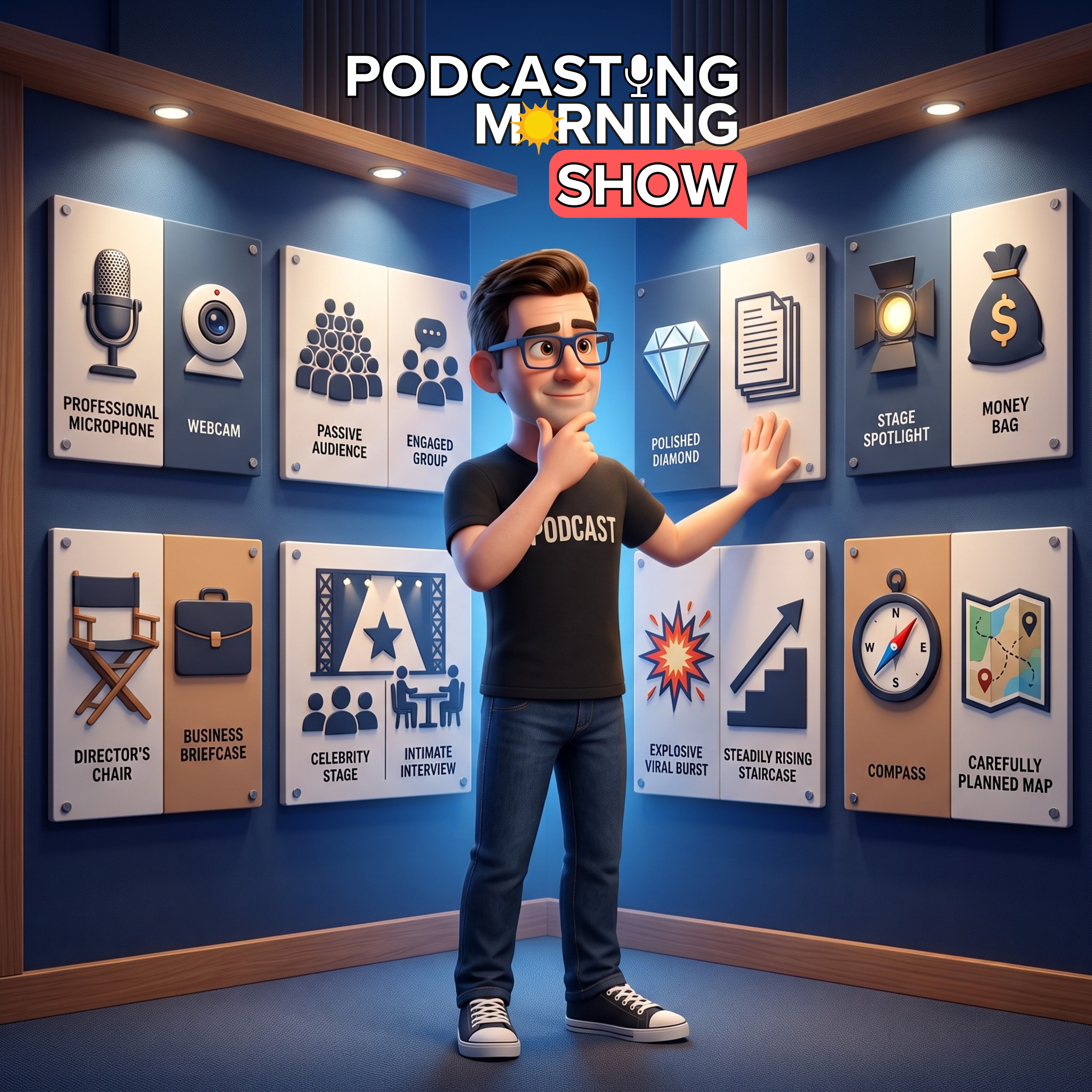


The hardest podcasting decisions rarely have a perfect answer, and that's exactly what makes them so valuable. The morning show cast and crew tackle common creator dilemmas, from audience growth and guest selection to monetization, consistency, and creative freedom, without hiding behind "it depends." Every choice comes with a trade-off, and this conversation helps you think through what matters most for your show. By the end, you'll have a clearer way to approach the podcasting decisions that shape your success over time.
Episode Highlights:
[03:21] Social Media Manager Search
[07:26] In-Person vs. Remote Recording
[14:23] Big Audience vs. High Engagement
[22:54] Discovery vs. Retention
[28:56] Discovery vs. Promotion
[29:44] The Warm Leads Strategy
[31:17] The Dream Guest Debate
[34:10] Celebrity Guest Pitfalls
[42:17] Money vs. Creative Control
[47:05] Viral Hit vs. Slow, Sustainable Growth
Links & Resources:Classic Conversations with Jeff Dwoskin:
Feature Your Podcast on the Podcasting Morning Show:
https://PodcastingMorningShow.com/spotlight
The Podcasting Morning Show:
www.podcastingmorningshow.com
Ways to Watch or Listen: https://www.podcastingmorningshow.com/joinus/
Meet the PMS Cast and Crew:
https://podcastingmorningshow.com/people
Join The Empowered Podcasting Facebook Group:
www.facebook.com/groups/empoweredpodcasting
Book A Free Call With Marc:
https://calendly.com/ironickmedia/freestrategycall
Application To Submit Your Show For Evaluation:
https://podcastingmorningshow.com/eval
Powered by iRonickMedia.com and ContentCreatorsAccountant.com
Send in your mailbag questions: https://www.podcastingmorningshow.com/contact/ or marc@ironickmedia.com
Want to be a guest on The Podcasting Morning Show? Send me a message on PodMatch, here:
https://podmatch.com/hostdetailpreview/1729879899384520035bad21b
0:05 Marc Ronick: Good morning, Today is Tuesday, july 21 2026 and today we're making the toughest podcasting decisions without using the words "it depends. Every dilemma forces us to choose, defend our answer and discover what matters most as creators. So, if you're listening live on Clubhouse, hit the share button, top right hand side of the screen, and share it however Clubhouse lets you. And if you're catching us via podcast, YouTube, etc. please share this episode with a fellow podcaster. And now, give me about 30 seconds, and we'll get things rolling. Thanks for being here.
0:49 The podcasting morning show is powered by Ironick Media, helping podcasters launch, polish, and grow great shows, and by Content creators, accountant, helping creators build real business behind their content. Good morning again, podcasting morning show. Thank you so much for being here. I am your host, Mark Ronick, and currently on stage with me, my co-hosts. We have Ralph Eastep, D.R.
1:31 Fay, Sid Meadows, and B.C. Also on stage with us here on Clubhouse, we have Dan Schultz, Tide Tudoring, aka Nikki, and also Rez, aka DJ Rez, We've been having a little trouble seeing the chat lately on Riverside. I haven't taken enough time to really figure out why I can't anymore. So, if you're chatting us over there and we're a little slow to respond, that's why. But Ralph, I know you usually keep an eye on YouTube, right? Ralph Estep Jr.: Yes, sir. I keep an eye on it, and I am live on YouTube, so feel free to join in the chat. Marc Ronick: Awesome, thank you. Ralph Estep Jr.: And you can see the old mic back. Marc Ronick: Yes, you are.
2:12 You got rid of the other one, the fancy looking one. Ralph Estep Jr.: The fancy one this one. Marc Ronick: Well, okay, so you're back to the Shure SM7B, and we also have, by the way, special guest Jason Circon, my business partner for Empowered Podcasting. Welcome, Jason. What's up, everybody? Great to have you here. I was hoping to also get another special guest. I was hoping Nick Nallback be able to return today. Oh, he has a change in schedule that's going to make it a little more flexible for him to join us. By the way, did I say Sid Meadows is on stage with us? Not sure if I actually said that or not. So please forgive me, Sid. And by the way, you can learn about Sid and Nick and all the other people I just mentioned over at Okay, so we are going to dive I wanted to. There were a couple things I wanted to actually get to first.
3:06 Usually, lately we've been doing on Tuesdays interviews. We didn't have an interview scheduled for today. That's why we're going to be playing this game. It's very much like Would You Rather, and I'll explain more in a moment. because Dr. You were, I guess, challenges over the weekend, and Podcasting Facebook group manager. Curious, what were the struggles that you were dealing with? Because we found somebody to join us, maybe as soon as this Thursday. It depends on some programming stuff. DR: Yeah, so because of AI, I have had to expand what Mouthy Broad Media, my company, does, and I have added press releases to the whole you know repertoire management. I've added this.
4:01 I've added that. Now I'm not doing social media. I'm getting. I'm outsourcing that. Marc Ronick: Sure. DR: But it has proven I have two And one of them had questions that I couldn't really answer very quickly, so that's why I had to kind of go out and reach out to some maybe empowered podcasting people, and I think I put the note on some other platforms, and I just had questions, and I wanted to be perfectly transparent that I was not hiring. I just Marc Ronick: that's a hard thing on social media to ask a question without getting then bombarded with the people that often.
4:48 DR: And I apologize. I'm not hiring. I just really need some questions answered. And holy cow, Eddie, Eddie, dude, so generous with his. Eddie Garrison, yes, Marc Ronick: he's going to be a speaker at Empowered Podcasting as well in August this summer, and yeah. So when I saw he jumped in and said, "Hey, I can help you, I reached out to him. Why not? Let's bring somebody who's part of our community here and talk about some of the social media challenges that you have, but also in general, how we can use social media more effectively for us in our podcast. DR: And it's a way to also to interview him. It's also going to promote him.
5:32 It's a way of thanking him for all the beautiful resources that he just handed over to me. Awesome. So yeah, yeah. Marc Ronick: So we'll do that. Maybe we'll ask him about those resources, learn more about those things. I think it'll be an interesting. We haven't really done a social media episode in a while, so I think it's overdue. So we will do that either this Thursday or next Tuesday. I will keep you posted. We also have an evaluation that the team has started already listening to has already people have and Nikki, it's your I know you're on stage with us, so thank you for submitting. I know it's been a minute. You submitted last month, I believe, and we're getting to it now.
6:15 At least half the team has already listened, so I will also let you know if it happens this Thursday or next. So more to come on that today. I picked today's game because podcasters have choices that they have to make all the time, and most of those choices come with a trade-off. For example, more listeners or a episodes or more frequent Are you searching for recognition or revenue, creative We usually want to say it to be made for both sides. So this morning, I want to force ourselves to pick one, similarly to how we played that other game. Keep it, dump it, change it.
7:03 Last week, so for each dilemma, you'll get two choices, A or B, and then everyone will choose their answer first. Don't give me long explanations. I just want your answers first, and then a couple of you will get a chance to explain and It depends. Can be a part of your explanation, but it can't be your answer. It can't be your choice. Okay, so I think what I want to do is start with a warm up that affects how a lot of us actually make our shows. question. This is going to kind of maybe feel like a softball question to some of you, but that's the idea here. If you had to choose one way to record every episode, would you rather record in person or would you rather record remotely?
7:53 All right. Wow. DR just came right off mic. I want to answer. I want to answer. Okay. So DR will go to you, and then we'll go down the row A or B. So again, A is you would rather record in person. B remotely. Go ahead, DR. DR: B remote. Marc Ronick: Okay, Ralph. How about you? Ralph Estep Jr.: I would rather do A. Marc Ronick: Okay, Ralph would Okay, let's keep going down the the row here, Sid. How about you? Sid Meadows: Yeah. Good morning, everybody. I do them virtually, and they work. But I would much more prefer to do them in person. I think the chemistry and the body language and all that stuff. DR: Hey, you're going against Going against rules. No explanation.
8:36 Marc Ronick: Sorry, I was just Sid Meadows: Sorry, I wasn't Sorry, I wasn't paying attention. Marc Ronick: That's okay. Sid Meadows: Going back on you. Marc Ronick: B C. What say you? A or B? A being you would record in person. B remotely. BC Babbles: A in person all the way. Marc Ronick: In person. So most people are saying in person, except for you, Dr. Right? You said remote. Okay, let's go to Dan. Dan: Remote. Marc Ronick: Dan prefers remote. Do you want to play along? Knikki: Sure, I pick remote. Marc Ronick: Okay, and there you It's just when I say it, it starts evening out. Res, you get the last vote Rez: in person. Marc Ronick: All right, so I out. Let's go to Sid first.
9:19 DR: Did Jason give? Marc Ronick: Oh, Jason, my bad, Jason. Please forgive me. Jason: I'm on camera, and you Marc Ronick: I know. Please forgive me. Jason: I'd say in person. Marc Ronick: All right. DR: Oh, damn. The only reason why I brought up your news because I thought you were going to say whatever. No, sorry. Marc Ronick: All right, we'll go I forgot, Jason, we'll go to Jason next. Go ahead, Sid. Sid Meadows: What are you coming Sid Meadows: Oh, so now I'm Yes. Okay. So I just mean I record virtually now. I have four recordings this week, and they're great, and I really enjoy them. It's super easy to do from anywhere, and where my over my guests are, you know, wherever.
10:00 It makes the ability to access them super easy, right? But I just think that the chemistry of recording in person is so much stronger, and your ability to build a stronger connection when you're sitting across to the table from somebody or on a chair next to better dynamic and you know more Marc Ronick: Fair enough. Fair enough. I'll share my thoughts in a second, but first, let's go to Jason. Jason, so you also chose in person. Jason: Yeah, what Sid said. That's really my answer. I think if I could add one thing to it, I look at podcasting on the level of networking and building relationships, and the recording is just the first part of that.
10:44 element, then you can probably you would connect on a call that domination, quote unquote. So doing that in person, you have that ability right on the spot. That's why I prefer that method. Marc Ronick: Okay. Yeah, I like that add-on. Thank you for that, Jason and DR. Since you said remote, let's go to you. Why did you choose remote over in person? DR: It just feels cleaner. The audio can be cleaner. I like the two separate tracks. I don't know. I just yeah. Marc Ronick: I mean, you can do the two separate tracks, and you can have pretty clean sound in person too. DR: But with the, you're always worried about the the bleed, and yeah, you know.
11:29 Marc Ronick: So the bleed-that's The the bleed is when your audio Wheel of jargon when the sound is coming out of your headphones and your microphone is picking it up, DR: or if you were in a live situation with a someone in the room, what they are saying is coming through on your microphone, correct, and vice versa. Marc Ronick: Yes, Jason, were you going to add something? Jason: Yeah, I was going to SDR. studio where all of the microphones were connected properly, and you're able to Marc Ronick: spaced accordingly, about if you're setting it up yourself versus you know doing it like we're doing today. DR: I don't know.
12:16 You know, I had the most horrendous experience recently trying to edit some recorded video with two guests and a host, and it was it was comical. It was like the Three Stooges. It was the most horrible thing, and so maybe I'm stinging a little bit from that. You're a little Jason: jaded. Oh, it was bad. I'm going to be honest. Marc Ronick: Like I think my opinion is the podcast most of the time is going to be a better There is something like Sid said and Jason echoed as far as that chemistry. There, it feels like the chemistry develops a lot natural. At the same time, I know that I've gotten so used to doing it remotely.
13:06 I think it would take me a while to get comfortable always doing a show in person. DR: Well, Knikki also said remotely, and so did Dan. I think. Marc Ronick: Yeah. Did anyone else want to defend that? Go ahead, Dan. Dan: I like that I use to be neat and in order for my And I love knowing that I can go back four months ago and grab the one file from my co-host, and I can do whatever I want with it. I think that's all important. Jason's right, though. I mean, if you have it set up properly, you can still do the consistent. I mean, but I really hate all of the bleed. I hate. I want editing to be as simple as it can be because I spend enough time on it on purpose.
13:50 Like I really want to spend time making really good edits as opposed to cutting out mic bleed. So I want it to be one spot. Everything's the same. I know she recorded at this level. I recorded at this level. Everything with me is like frameworks and getting stuff from Riverside into Descript, into whatever I'm editing, and then it's nice and easy. Marc Ronick: All right, there you go. Thank you, Dan. All right, let's keep moving because that was a warm up, and I don't want to get too caught in the weeds on that one, so let's keep it going. Would you rather 10,000 listeners who rarely interact with you, or 500 listeners who regularly respond, share, and participate?
14:34 So again, 10,000 listeners who rarely interact, but they do clearly show up because you know that they they exist according to your analytics, or 500 listeners who regularly respond, to guess, but I want you guys to be really honest about this, okay? correct answer, quote unquote. So let's. Let's go down the line, Ralph. I'm starting with you. Ralph Estep Jr.: I'll take the 500 Marc Ronick: I feel like we're playing Jeopardy. I'll take 500 Alex. Ralph Estep Jr.: I'll take the 500 Marc Ronick: Alex. Go ahead, DR. DR: 500 Marc Ronick: Okay, Jason. Yeah, this is too easy. 500 All right, we'll go through this one quickly.
15:16 Sid, how about you? I have a feeling I know your answer too. Sid Meadows: 500 Marc Ronick: I promise you guys, these get a little more intense as we go. BC, go ahead. BC Babbles: 500 All Marc Ronick: right, I'm going to stop. Does anybody have a different answer? Does anyone say 10,000 I want to share this. I did pause. Now, obviously, yes. I want people to interact, respond, help share. That's what makes this show go round. Do we have 500 regular listeners every episode? No, we have less than that. Being transparent with you, and I'd still take that over 10,000 But I will say there is something attractive about having 10,000 listeners, and I are advertisers, sponsors out the big numbers, regardless of There are sponsors out there that that number means they may want to work with you. So I can't knock somebody for saying they want 10,000 listeners because I know that there are other advantages that come with that.
16:25 So I think yeah, this is where. Ralph Estep Jr.: But Marc, isn't Though to be blunt, Marc Ronick: yes. Ralph Estep Jr.: And I, you month, July, has been an show. I'm probably going to have close to 40,000 downloads this month because I've been doing a lot of push on that. Nice, and you know that's a huge growth for me. And part of that is an ego thing because I'm thinking, yeah, but this isn't making me any more money. But so, so strategically, I'm thinking, oh, that's great. But I just worry that we get stuck on the ego for that. I'm not disagreeing with you. There are sponsorship opportunities if the audience is think we really need to focus on the smaller, engaged audiences. this one. Marc Ronick: Yeah.
17:06 Anybody else want to chime in on that or respond to what I said, Jason? Do I go to Jason? Okay. Go ahead., DR DR: Oh, sorry. The 10,000 It's like you're speaking into the void. There's no no gage to tell you that you're doing good. They they agree with you, that they disagree with you. It's just speaking into a void, and at least if you had some engaged listeners, that could only make your show better. Marc Ronick: Okay, and Jason, your thoughts? Jason: Yeah, there's a lot to it. I think it comes down to what you want to accomplish. If you are working a pure CPM model, then yeah, 10,000 make more money. But the artist nailed it perfectly, and I echo a lot of that with what I'm seeing on LinkedIn with all these bots that are constantly commenting or reaching out and saying they want to blow up your numbers.
17:54 Is any of it real? I mean, some of it you have to believe just based off of law of averages that your numbers are legit, but of that 10,000 how much of it is just bot nonsense that's inflating your metrics for nothing? That's a hard sell to make to a potential sponsor, but at the same time, if they're only looking at a big number, then it could be in your favor. to what you want to accomplish Marc Ronick: Okay, and then I'm going to go to BC, and then Alex, and then we're going to go BC, I saw you put something in the chat. So, did you want to share here out loud? BC Babbles: Sure, real quick. So I said you can't pitch 10,000 followers when you only have 1500 that actually engage. That's that's the number that matters. But also, we don't know whether or not you had a surge of followers come in because you had a weird one-off piece of I had a surge a couple years ago on TikTok for a piece of content I don't do anymore, and my actual content that I do every every day now, I don't get 2400 views or 2400 pieces of engagement because it's now irrelevant to that one off that caused the surge. So the number's there, but the activity's not. Marc Ronick: Yeah, that makes sense. All right, I'm going to go to Alex. Go ahead, Alex.
19:08 Alex: Hey guys. Yeah, it just depends on what you're going to do with them, and I think that's the main thing. Like what BC was saying, you might get those one-offs, but even if you do have that, if it's 10,000 and you only have really 1500 you know, they're still engaging. to realize is, and this drives stuff. You'll post all the time, and then all of a sudden, you'll post something that's kind of obscure, and then people will start commenting on it. And you know, I really do believe that you know, with that 10,000 whether it's real or not, it's where you can kind of push them to go. And if you do have that core, maybe you can increase that core over time.
19:50 Marc Ronick: Okay, thank you, I'm going to give you and Sid the final word, and then we're going to move on to the next one. Go ahead, Dan. Dan: I wasn't going to comment, but. If you really do have 500 that are engaged, that is what I'd always rather have because you can easily turn. If they're really engaged, you can easily have them grow the 500 to 10,000 It's just all about how you use them to do it. Marc Ronick: Yeah, that's a great point. Yeah, if you've got the group of engaged listeners or an engaged community, there's a lot you can build from there, so that yeah, excellent point, Dan. Sid, how about you? Sid Meadows: So I want to be clear. I would love to open up Buzzsprout and see that an getting an average of 10,000 I would love that, and my sponsors would love it as well. It but the engagement of the listeners that I have now is really high, so yeah, I want 10,000 but I want 10,000 engaged, and that relies on me providing valuable content and insights that that they want to listen to and they want to So, is it possible? Yes, possible.
20:57 It's going to take a heck of a lot of work in order to get 10,000 listeners, and I would absolutely love it, but I don't want it as a one-off viral I want it consistently, and I want 10,000 engaged listeners that are going to take action and move the needle forward for not just my show, but for their business. Marc Ronick: Fair enough. Fair enough. Okay, so yes, not one of the choices, but yes, I asked for explanations, and I appreciate your answer. Ralph Estep Jr.: Can I throw Because Res put something in the YouTube chat. I think we should address. Okay. And Rez said in there that make more money, and I want to not necessarily true. And I think there's a lot of content creators that think if you have numbers, you're going to make more money with your show.
21:38 That's not necessarily true. If you've got 500 engaged people offer. I can show you truthfully that that can make ton more money than 10,000 I just I just wanted to correct the record there a little bit because I I think it's a popular misconception of people in in podcasting. Marc Ronick: Yeah, I agree with you, Ralph. And I think think about that even if the argument is well, yeah, you can make money with 10,000 listeners with a sponsor, right, or multiple sponsors. But here's the truth, and I've seen this happen firsthand. When you have a show with a lot of listeners that don't really interact, that also advertisements. They're not doing what the advertiser is hoping they do go buy that product, go sign up for that service, whatever it is, and then they leave.
22:27 So yeah, you might get make a little money at the front of it, but it doesn't last. Whereas when you have an engaged audience of a smaller engaged audience, you can sell products and services. They're going to eat that up, whether they're yours or someone else's, and that's going to encourage you or the advertiser to keep going, keep selling those products and services to that audience. So it is something to think about. I'm glad that you called that out there, Ralph. Thank you. All right, would you rather double the number of new double the percentage of episode. Okay, so double the number A is double the number of new listeners that find you.
23:10 B is double the percentage of listeners who return for another Go ahead, DR. DR: I'm going to say A, I think. Marc Ronick: Okay, A. So she's gonna say she wants to double new listeners that find her show. Jason, how about you? Jason: B. Marc Ronick: All right, Dave. Ralph Estep Jr.: I'm gonna go Marc Ronick: Okay, Sid. Sid Meadows: I'm gonna go with C, which is both. Marc Ronick: Got to pick one as big as Sid Meadows: I'm gonna actually pick the Marc Ronick: returning episodes. episodes. Okay, fair B C.
23:52 BC Babbles: I'm gonna go with Marc Ronick: Okay, Dan, Dan: I'm gonna go returning B. Marc Ronick: All right, we kind of have a split going. I think right now, go ahead, Nikki. I'll come back to you, Nikki Rez. There she is. Knikki: My fault. I was sending an email. Could you remind me of the question? Marc Ronick: Double the number of new listeners finding your show, or double the percentage of listeners who return for another episode. Knikki: I would say return. Marc Ronick: Okay, return. Go ahead, Rez. Rez: Return for sure. Marc Ronick: Alex, you want to Alex: Yeah, I say B. Marc Ronick: Okay, Alex: and I'm surprised people were saying A as much. Marc Ronick: Yeah, well, since Why are you surprised? Alex: Well, you know, I'm gonna I'm gonna pick on DR. and Ralph.
24:34 You know, in one breath, you retention of your listeners, and listeners that are loyal, it's that that's kind of the way I I mean you know just because people see your feed doesn't mean they actually engage with it versus people that are engaging. I just think it's you want to build that, as we like to say, that community of people that that really wanna that are passionate about your topic, and if they're engaging, I'm all for it. Marc Ronick: Yeah, DR: and just because they're returning for a second episode doesn't mean that they're engaging, Marc Ronick: right? So that's the thing.
25:20 Is I think there is a correlation. There is a correlation there. Alex, can you mute because it makes? Alex: Oh, I was going to say they're all those guys are all the the 10,000 people. They're all a bunch of Android users, so it doesn't really astruct noise. Marc Ronick: There is there is a difference and there's a correlation because I think that probably going to be interested in coming back again to the next also is a sign that they're But they're not necessarily Does anyone anyone want to defend their answer?
26:03 Ralph Estep Jr.: I do. I want to defend the new ones, and I'll tell you why. Because I have confidence in the content I put out, and if I have somebody that gets to hear it or see it for the first time, I have a high level of confidence they're going to want to come back. So one of the biggest struggles I think, especially in podcasting, is discovery, and if I can double the amount of people that have discovered what I'm doing, then I feel like that's going to move the needle. Because honestly, the people who already are already you know in there, they're coming back anyway, so they're getting value. Marc Ronick: Fair point, Jason. Jason: Not anymore, because My my thinking on saying that I would want people to be coming back and doubling up the people that are hearing.
26:45 I forget how the. How did you say this again? How did how was this Marc Ronick: double the number of new listeners finding your show, or double the percentage of listeners who return for another episode? Jason: I tend to lean towards than once or see something more than once to really get engaged with it. So to get to that point to where you have an engaged listener, those 500 is our magic I feel like they need to hear One episode might do really well, but maybe that first episode just whets their appetite a little bit and said, "Okay, that wasn't bad. What else is here? And now they start going through the catalog a little bit more. So I would rather get to that point. I'm with Ralph, though.
27:27 Like I feel that my podcast content is good enough that a first time listener is going to say, "Okay, what else is here? Let me check out the rest of this catalog, and then I can start to move them down that engagement path. So, man, this goes all over the map. Marc Ronick: Uh huh. Dan, I see you wanted to chime in, and then we'll go to Sid. Dan: Yeah, I agree with both of you guys. Ultimately, growing, getting new listeners is a tools thing or a process thing, right? It's just you do some SEO, you do this, you do that. That's just something we can all back, that means you actually worked on the show, and you should always. That is ultimately always going to be my answer: that your show can't suck.
28:11 It's so hard to get people to get there. So all of the work you're doing, you should just spend so much time making the show good. So when they do show up, they are going to come back. I mean, one is simple, one is hard. The hard one. Marc Ronick: Yeah, and Dan is. I know what he was just referring to. I have had a conversation with him about this off the show, where we talk, where he's talked about. You know, really, we there are all these tips and tricks out there around how to get discovered, how to improve How to grow your show? And Dan in that camp-that I can't argue. If you're putting on a really good show, all that other stuff really comes falls into place. You can.
28:51 Dan: I think Steve Martin said, "Be so good, they force you not to ignore you. I don't know. Yeah, something like that. Marc Ronick: Yeah, but Ralph Estep Jr.: but Marc, isn't If you build it, they will come. I just don't know if I believe that. I think you can have stellar content that's fantastic and engaging, but if people don't know about it, they're never going to find it. Marc Ronick: Yes, there are help people find your show. You can't just put out a really good show without promoting it, without spreading the word, etc. But I believe that the effort isn't nearly as challenging if you're putting on a really good production. That's really what I think it comes down. Alex: So the answer is that Marc Ronick: right. And actually, Alex: it's a Sophie's choice. I mean, they're both good.
29:34 It's not you know. It's not like Marc Ronick: well, that's the idea of the game. Alex: I understand. I'm just saying. It's just it's you know. Marc Ronick: Yeah. No, I hear you, Alex. Sid, did you want to get the final word on this one? Sid Meadows: So Ralph is not and we talk about this a lot, Yeah. And Jason, I can't see Jason on my screen. I forget that he's there because he's not on Clubhouse. But Jason had some really great follow-ups to it because we talk about it a lot. Discovery. Hard and I focus on it quite a bit, but when you think about it, like from a sales perspective, when you're it's like cold calling, and get people to buy. In our case, get people to listen, but when they've come once already, that's a warm lead, where you're trying to get them to convert.
30:23 You know them. You have a relationship. They've heard your content. They've heard how you talk. They heard how you moderate a conversation, whatever it might be. And so I think it's easier to convert the ones that are that can come back right and capture that. So I think of it like a warm lead. listen one day for me, that's an people into true followers. And so I'd rather focus on them. I mean, I do focus a lot on discovery. Don't get me wrong about that, right? Because I want more people listening to my show. But the ones that are already there, you got to keep them coming back. And so it's. I think it's a really important conversation. To Alex's point, I think C is really the AC. Marc Ronick: You know that's why Right?
31:17 The category is dream guest or Let me explain. Choice A: Your dream guest on an quality. It was fine. It was a good episode, or an unknown guest on one of your best episodes ever that you've deemed it like this one was out of the park, knocked it out of the park. It's a guest that nobody really knows. Okay, so A, your dream guest on an average episode. B, an unknown guest on one of your best ever. Ralph, going to you first. Ralph Estep Jr.: I'm going to the unknown number B. Marc Ronick: Okay, and that's a letter. Just if we're playing along, not a number. Sorry, it's early in the morning here, my friend. Just kidding.
32:00 All right, go ahead. Ralph Estep Jr.: I'm good with numbers, dude. Marc Ronick: I know. See, that's it. You're just always thinking numbers. Yes, go ahead, Dr. DR: I say B, unknown guest. Marc Ronick: All right, and Jason, Jason: same B. Marc Ronick: Okay, lot. All three said B on that one. Let's see what the rest of the panel says. Sid, Sid Meadows: B, Marc Ronick: another B. All right, B C. BC Babbles: Tougher one, but I B. Marc Ronick: Okay, Alex, Alex: I had this happen. It's B. Marc Ronick: Okay, we'll have to Dan, how about you? Dan: The real answer is B, but we had mr. T on our show once, and he talked to my dog, so that was a really crappy episode. It was really neat because now I So if A gives you a story, go A. Marc Ronick: I like that.
32:46 Okay, Knikki, Dream Guest. Knikki: I'm gonna go with you. Marc Ronick: Which one? I'm sorry. Knikki: The guest. The guest. Marc Ronick: You're going with Knikki: Yep, the guest. Okay. Marc Ronick: Well, because All right, and we'll go to Rez Rez: for sure. The dream guest one. Marc Ronick: I had a feeling you Let's go to you, Rez. Why your dream guest on an average episode over an unknown guest on one of your best ever? Rez: I don't know. I think that having my dream guest would just naturally make that episode better and also more social proof, and I'm assuming by dream guest, you're talking about a guest that is like maybe famous or right.
33:29 Marc Ronick: I guess you can I'm not, yeah, mr. Rez: T, clearly. But yeah, that's that's basically it. Marc Ronick: Okay, yeah. I mean, look, there is something we talk about this with podcasting, right? Like some of this is that it's a an amazing networking opportunity, and if you can get an opportunity to sit down with your dream guest, I can understand why you, someone like be selfish if you're doing some things for you, right? Because you got to be able, you you have to enjoy what you're doing, so I certainly don't fault Rez for picking A. Anyone else want to chime in and defend their answer? Sid Meadows: Who's up, Ben? Marc Ronick: Yeah, go ahead, Sid. Sid Meadows: You know, I think that I mean I don't have a dream guest list, but there are some really big names in the industry that I would like to interview for a variety of different reasons, but the reason that I don't reach out to them is there's too many loopholes to jump through, too many constraints.
34:30 I mean, there's a somebody that I've known for many many years. He's the CEO of a $3 billion or the chairman of the board of a $3 billion family owned company. He's the third generation, and I've known him for probably 20 years, and I actually asked him when I saw him in person in June, and the look on his face was, "Oh, I don't know, Sid. Like I don't know. And the reason I say that is because he's going to want to have all the questions before we Then his marketing team is. Going to want to review the podcast. They want to do their own edits to it. So I think sometimes the celebrity or the big guest comes with a lot of loops that are a lot of loopholes you have to jump through in order to get the episode actually published. And that's not my show.
35:16 My show is a real conversation with real people, and I'd rather my keep the keep the integrity of my show than to bring on a dream guest that I'm going to have to change the show so much and edit it so many times to get it to a place that they like it. Marc Ronick: Yeah, I wasn't even Thank you, Sid. Let's go to Knikki. Knikki, what did you want to add to this? Knikki: I was just gonna say think that my episode is gonna done, the greatest job ever, it never turns out that way as far as like the numbers are So I feel like just lost all hope on that end, and I would just go with the dream kiss. Ralph Estep Jr.: Ralph, I want to I want to jump in there for a second, and Nikki, you do great work. By the way, I previewed your episode; it's fantastic.
36:07 Yeah, spoiler valuation does But I think the problem with this is so many people think that Dream Guest is going to rocket ship them to the top of the charts, and if you look at the statistics, I look at the people who have had the dream to Dream Guest. It doesn't work. Does it open up new doors? Sure, but is it going to be that propel you into stardom? found is people, the dream They come on there to you know I think that's the problem, Mark. Is a lot of people go into this with that thought process of, well, if I get the dream guest, they're going to send me my show instant sensation overnight. It just doesn't usually happen like that. Marc Ronick: I see, Jason, you're nodding emphatically. Jason: I couldn't agree with that more. That's why I I can remember the last time even thought about dream guests, quote unquote.
36:54 I just figured. I mean, I've had a couple cool experience my show with a couple I mean, these are past podcasts I don't do anymore. Probably the biggest one was Claudio Sanchez from Coheed and Cambria. These are neat experiences that, for me, I get to think, wow, I get to sit down and actually talk with this guy and have him on my podcast. That was cool. But in regards to growth, maybe one episode took off a little bit more, but after that one episode, it went right back to where it was. So people were coming for that guy and then going away. So for me, it's more about building quality content with like-minded peers that I can bring on the show, and then let that speak for itself. Marc Ronick: Yeah, thank you, Jason. We've got Jeff Dwoskin on stage, and more people coming up on stage.
37:36 I didn't realize this question would get people chatting, but here we are. So, Jeff, go for it. Good morning. Jeff Dwoskin: Hey, good morning. Marc Ronick: Good. Jeff Dwoskin: I think one thing we're all assuming is that these are good dreams and nightmares are dreams too. And so, you know, I think a dream gas looks good on the timeline. Looks good when you're asking for credibility. I think they, the difference. I always really enjoy the people, and I think you get more information out of the people who aren't necessarily that famous, but have the right stories and will actually tell them. With the dream guest, there's a good chance that person's already been on 1000 other podcasts, also.
38:17 So you're one of 1000 of that piece of content, and then the other people, and sometimes specific in how they'll say And the people who are less famous, I guess you could say, will share stories because they they don't have anything to lose at that point. You know what I mean? Or that's how I always kind of gage it: is how much, where are they in their career, and what do they have to lose? Because the people that have the most to lose are going to always be the most reserved They're not going to give you like the tea. Marc Ronick: Yeah, and so Jeff, I know Jeff does a show, and he gets to interview a lot of, I D listers. Is that fair to say, Jeff?
38:58 Not B necessarily. Jeff Dwoskin: I like to say I interview people who were really famous when they were famous. Marc Ronick: Got it. Okay, so have you? I mean, you've interviewed a lot of famous people, and you love pop culture. Have you ever had your one of your dream guests? Jeff Dwoskin: I've had some good by the Fonz four times, so that would be like, you know, like that would be that's that's to. But I know, like, if I was to interview Steven Spielberg, I'd just be like, you know, Marc Ronick: yeah. And yes, whenever whenever you land Henry Winkler, let me know. I will be the first in line to listen to that episode, Jeff. Jeff Dwoskin: Yeah, I mean, I've So Jeff, DR: who was the last person that you were like, "Hey, this is this was a good get.
39:46 I'm impressed. Jeff Dwoskin: Well, you know, I think the last person I talked to, Clay Aiken, he was on American Idol season two was a really big one and had a huge fan base. Matthew Lillard was a big one recently. I find that it depends on how old you are to answer the question who's the most famous person you've talked to, because it depends on your point of view. Like I might go, "Hey, I talked to Ed Begley, big names, you know, and then they'll just stare at me, and I'll go, "Carol Baskin from Tiger King. You talked to Carol Baskin? Oh my God! And I'm like, "Okay, I need to go. I need to retire. Marc Ronick: And Jeff, share the to listen. Jeff Dwoskin: Classic conversations with Jeff DeWaskin.
40:32 I say with Jeff DeWaskin. It's not officially part of the name, but if you type in classic conversations, everything goes classical. And like, no, that's a different word. Okay, Marc Ronick: yeah, yeah. We will put a link in the show notes as well. Thank you for sharing. All right, let's see here, Yvonne. Welcome to the stage. It's been a minute since we've talked to you. Great to have you back up And what did you want to add to all Yvonne: this? Thanks. I think it's similar to what Jeff was saying. It's I don't have celebrities on my podcast, but I occasionally will get somebody who feels like a dream guest to me because they have a good following on Instagram. They're known by older women in who are who are talking about pro age topics, and so I've had some of those ladies on, and it's been fantastic.
41:22 Actually, each one of them has been a great episode on top of being a dream guest because they're so aligned with what I'm talking about. And then the next time I go to approach somebody who I feel is a dream guest, I've got somebody to reference who's already been on the show that gives me that credibility where they might say yes. So Marc Ronick: yeah, yeah, I love it. Okay, yeah, absolutely, and yeah, I think that this is all about if this is your dream guest. It doesn't necessarily have to be a celebrity either. So yeah, I think that applies Thank you, Yvonne. Okay, I know that we have people at you. This one I have in my extra questions category, but this one caught my eye, so I want to share it with you. Would you rather make exactly the show that you want with no income for a year, or earn $5,000 a month producing a show shaped heavily by a company. So you've basically been hired to make that show. It's and I'm going to throw in and it's on stuff that you couldn't care less about.
42:40 Okay, so let's do it, Ralph. We're starting with you. Ralph Estep Jr.: Oh, this is a with A because of where I am in my career. Marc Ronick: Ooh, okay. I'll have to hear more about that. How about you, DR. DR: I'm going to go with B. I won't say because okay, B. Okay, Marc Ronick: Jason. Jason: I think I would go with B. Marc Ronick: Okay, interesting. go with this. How about you, Sid? Sid Meadows: A. Marc Ronick: Okay, and then B, C. BC Babbles: Um, I'm gonna. God, this one's hard. I wouldn't say A. Marc Ronick: Okay, I'll BC Babbles: say A. Marc Ronick: And we're getting a Alex, how about you? Alex: I might go with B. Ace for good, but I might go with A for now. Marc Ronick: All right, I'm Dan, would you rather make exactly the show you want with no income for a year, or earn $5,000 per month producing a show shaped heavily by a company that you couldn't care less about? Dan: No income for a year, delayed gratification, baby. Marc Ronick: Okay, all right.
43:36 And Nikki, how about you? Knikki: I'm gonna go with B for now. Marc Ronick: Okay, B for now. Okay, and Rez, I saw you flash the money bag. Rez: B for sure. Marc Ronick: Oh, okay, B. Right. bag. That's that makes sense. How about you, Jeff? Jeff Dwoskin: Well, I'm already doing the no money thing, so I would try the 5000 Marc Ronick: I was waiting for an answer like that. Glad we have a comedian on stage. Okay, Yvonne, how about you? Yvonne: Jeff and I have a lot in you know, but I have a doing, so it lets me do that. Marc Ronick: Fair enough. Okay. So, Ralph, you caught my attention when you said at this stage in my career. So I'm curious.
44:18 Yeah, because Ralph Estep Jr.: I think it depends. Are you starving right now? And that it sounds mean, but like if you're really hurting for money and you're trying to figure out how to put meals on the table, sure, then this discussion here is a tough one because you're going to do what you got to do. Yeah, but if you've gotten to the point in your career where you can have some poetic license, for lack of a better term, and you can put some stuff out there into the ethos to see where it lands. That's why I picked that one personally, and that's just blunt. But I understand the other side of that because a lot of people are struggling right now. The economy is not great, Marc Ronick: right? Ralph Estep Jr.: And if you've got an opportunity to go make money, then the argument could be made: Well, I'll go make the money, and I'll have time to do this other passion project. But I do.
45:00 It comes down to putting food on the table sometimes, and that's why I think that the B is especially for content creators. Marc Ronick: Fair, fair point. Yes, it certainly depends on your current situation. Jason, did you want to add something? Jason: Yeah, this is my I'm already doing this in regards to working with clients and building podcasts that are for them, now $5,000 a month from one, no, but over that collectively, sure. My thinking is if I could take a year to really focus on making That's $60,000 that I have at the end of that one year. Now I can move back to my that I can put behind it. So maybe now I can invest in ads. Maybe I can invest in anything that I feel might take my podcast to the next level.
45:51 I've got some cash in my pocket to play with. That's how I looked at it. Now, if I'm looking at it wrong, then tell me. But that seems like a pretty good trade-off at the end of the day. Marc Ronick: Yeah, that's fair. That's fair. Yeah, there's there's no hidden agenda here. however we want to interpret it. Nikki, you had something you wanted to add. Go for it. Knikki: I was going to say that for me as a new podcaster, I would want to gain the skills of Now, if I already had the tech skills and all the know-how, I probably would go the route of making my own podcast the way I wanted it to be. But if I didn't have the skills and I could learn that by think it would be really good my own business world is because worked, and those jobs have given me tremendous knowledge and skills that now I use for my business.
46:47 Marc Ronick: Yeah, I think Yeah, if you're a newer podcaster, sure, it would be exciting to get an offer to work on a show for 5000 a month, but you may not be ready for it. Yeah, I agree with you. Anyone else want to chime in? Okay. Yeah, let's do one more. Okay. Would you rather have one episode go viral or gain 25 loyal listeners every month for two years? One episode go viral, 25 loyal listeners a month for the next two years. shared this already, kind of. So we'll make this one a quick round. I'm going to go to you first, Ralph. Ralph Estep Jr.: B, Marc Ronick: Jason. Jason: B.
47:32 Marc Ronick: Does anyone Does anyone feel they would viral? No. Okay. Then I'm going to go to a bonus question. This is inspired by something Sid said earlier. Would you rather give your upcoming guest every question for an interview, or enter with one question, giving them just one question, and follow the conversation from there? Jason: Ralph, Ralph Estep Jr.: B. Follow the conversation. Marc Ronick: Okay, Jason, I I Yeah, Sid, how about you? Sid Meadows: This mute button today, my goodness, B. Marc Ronick: Okay, B.
48:13 So he wants just one question and follow the conversation from BC Babbles: I'm gonna say A this Marc Ronick: Okay, you so you're stop here for a second. You're cool with giving every question before an interview to that guest. Can you expand on that? How come? BC Babbles: For me, my one want to make sure they're okay that if we follow a blank I don't want to accidentally go anywhere that is not comfortable for them. Marc Ronick: Okay. Yeah. So you're just you're looking to try to create some trust between you and the guest, and giving them those questions to feel comfortable and really prepare for the interview. Yeah.
48:59 Okay. BC Babbles: And honestly, what I I say is what I want to talk about, but this is not in any way a strict verbatim list. Yeah, get to all these points. Marc Ronick: Sure, yeah, I think sense, if my guest asks, I'm okay giving them questions, but I don't think I would give them every question, partially because I'd be afraid that yeah they're gonna create answers to every question and then have gonna feel natural yeah so I'm at least give them a few want to cover with them so again over prepare, because I think an for, generally speaking, kind of Just being honest with you. All right, anyone else want to chime in? Chime in.
49:53 Sid Meadows: Go ahead. Marc Ronick: All right, we'll go link setup. Gives them a list of sample questions, just so they have an idea of what I might ask them. But I also say these are just examples of the types of questions I ask, and we follow a Okay. I'm with you there. And Alex, go. Let's go to you. Alex: Sometimes I don't even I mean, yes, you have the the outline of questions that you're going to ask, but you got to follow the conversation because there's just sometimes it just doesn't work with that constraint. Yeah, Marc Ronick: I can appreciate that. I don't think you're the only one. I I know a lot of podcasters who, Jason, I think you do this right when you when you prepare for a show, you don't necessarily have every question prepared. Jason: I have zero questions prepared. I talk with the person I'm going to bring on the show, and we figure out the angle that we want to take, and then I do my research on them and learn about them. I listen to some shows they've been on. I find out what they're passionate about. Sometimes, if they say that within the first five minutes of a show, I'll move to another show so I can have enough to understand who they are and what they do. But when they come on the show, we just talk and we just focus on the conversation, and I let them know that's how it's going to roll.
51:15 And I've had no problems with it up to this point. But I will say this: there's to add a caveat to that. That comes with experience. It's very hard for a new podcaster to just start like I'm doing this for over a decade now, so I feel comfortable and confident that I can do that. But if you're brand new, try it. Yeah, you you might want to have a couple bullet points or a couple questions in front of you just in case, because sometimes you're just not ready for that yet, and that's okay. There's nothing wrong with that. It's just something that comes more naturally with more experience. Marc Ronick: Yeah, I personally, having questions in front of me. Do I get to all of them?
51:56 Almost never. There you go. And do I end up asking questions that I didn't have prepared, absolutely. Jason: Right. Marc Ronick: But I personally, I into an interview without questions. Even if I've learned a lot about them going into the interview, I forget half the things I want to ask. So it just it's a confidence booster for me. Jason: Yeah, I think it's Whatever makes you comfortable. I do. I'll go back to what you were saying before. If it's over scripted, and you give somebody the opportunity, they have all of the questions in advance, and then they write out answers. It's ugly, and it takes away from the true core root of what a good podcast is all about, and that's usually rooted in good conversation and something that engages both the host and the guest, and builds something in a synergistic environment that the audience can then grab a hold of. So, if you're scripting it, it sounds like almost like you're reading an audio book.
52:56 It can take some air out of the show. Marc Ronick: Agreed. Yes, Rez, I'm going to give you the final word, and then I want to share some thoughts before we wrap up. Rez: Appreciate it, Mark. So my last, very last episode, I had this guy on, right? I had prepared for it, crazy, like I had a lot of questions, and he hijacked the entire episode. Like I couldn't even ask him one He literally wouldn't stop talking for the whole episode. So I just want to share that that even even if you have questions, sometimes you just can't ask them because it just yeah. Marc Ronick: What did you end up Rez: I went with it. I went with it and gave me an excellent review on Podmatch, so I'm okay with it. Okay. Marc Ronick: Okay.
53:36 Rez: Oh DR: damn! I think I missed a good question. Was it about scripting? Marc Ronick: No, it was about to a guest. DR: You know what? Or not. I do it. I give my questions to the guest. Okay. Am I in the minority? Marc Ronick: Yes, you are. But I'm with you, so you got me at least, and a couple other people as well. All right. Listen, this was a lot of fun, and you know those choices that we made also revealed, I think, something kind of important that every podcasting decision comes with some trade-off, right? Like more reach may mean less connection, more frequency may affect the quality of the show, right?
54:19 And I know we didn't get to that specifically, but you you get my drift. And and more recognition may produce less revenue. So the best choice depends on what you're trying to build and what matters to you right now. There's rarely one answer, as for every podcaster. A decision that helps one show grow could pull another show away from its purpose. Your priorities, like Ralph was sharing earlier, as far as whether or not you could afford to do a show for free for a year, those priorities may also change as your podcast, your business, and your. Life changes, so when you feel stuck between options, just ask yourself which one moves me more closer to the kind of podcast or the kind of business or relationship with my audience that I actually want.
55:14 Then consider what you're willing to give up in exchange for it. For me, once I understand both the goal and the trade-off. That's when the choice becomes a lot easier. So I hope that this was helpful for you today. And a reminder that we are back tomorrow, eight a.m. Eastern, covering all things podcast news. So if you want to be in the know about the latest and greatest stuff going on in this very industry, come join us podcastingmorningshow.com/slash join. join us, and if you can't join us live, no worries. You can still use that link and find the episode when it publishes a few hours later. So until tomorrow, make it a great day, everybody.
55:54 Take care.


