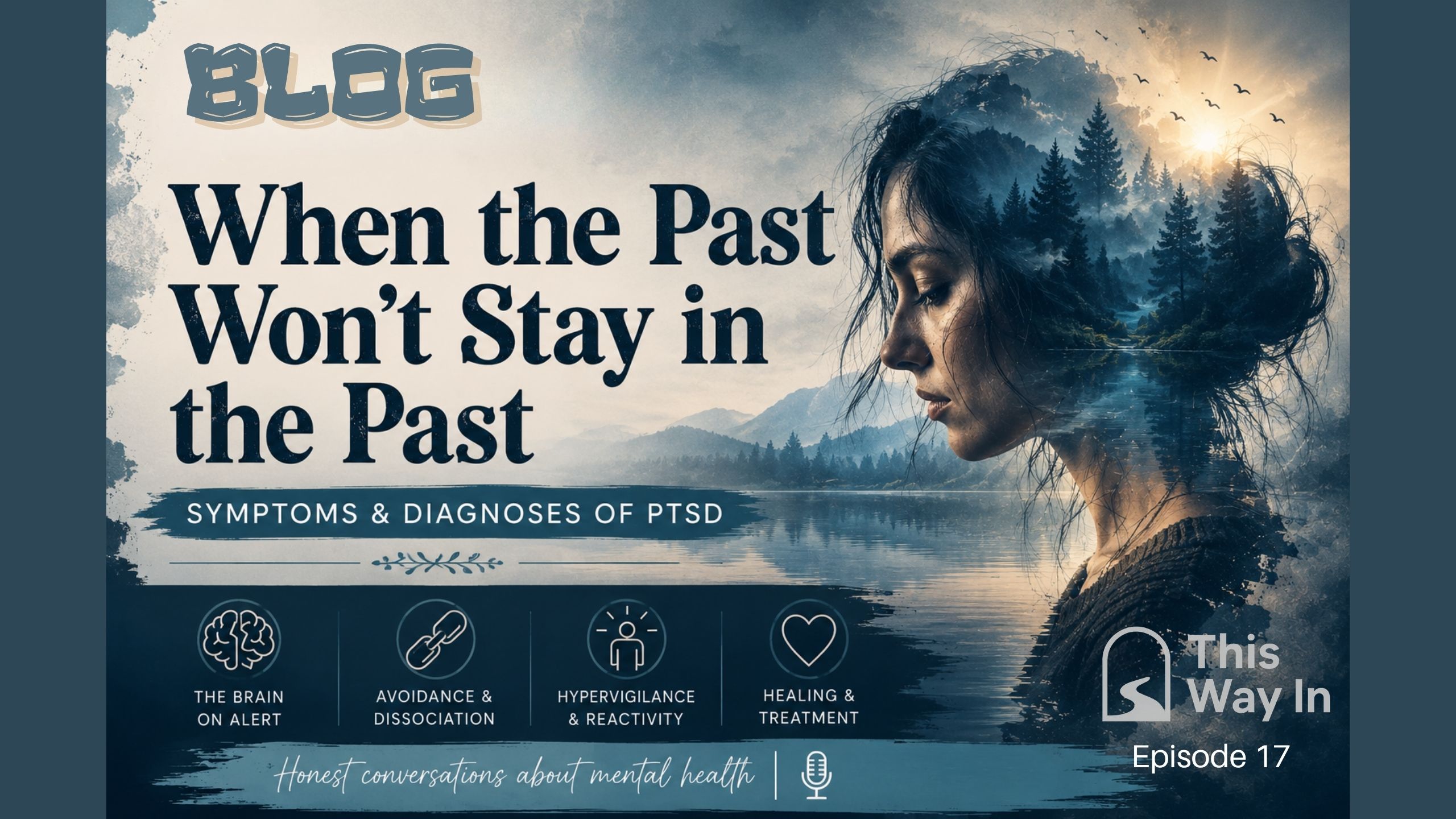
When the Past Won’t Stay in the Past
Trauma happens in the past.
So why can it feel so incredibly present?
Why can a smell suddenly transport you somewhere you don’t want to be? Why can your body react to danger that isn’t actually happening anymore? Why do some people remember every detail of a traumatic event while others remember almost nothing? And why can two people experience the same frightening event and walk away from it very differently?
In this episode of This Way In, we’re talking about PTSD: what it is, what it isn’t, and the many ways trauma can continue affecting us long after the danger itself has passed.
What Actually Counts as PTSD?
We use the word “trauma” pretty broadly these days, and sometimes PTSD gets used the same way. But as Brittney explains, an actual PTSD diagnosis has specific criteria.
It’s not simply having a terrible experience or a memory that still makes you uncomfortable. PTSD involves exposure to certain kinds of traumatic events along with symptoms in several different areas, including intrusive memories or flashbacks, avoidance, changes in thoughts and emotions, and changes in the body’s arousal and stress response.
And those symptoms can affect nearly every part of a person’s life.
Sleep can become difficult. Concentration can suffer. Someone may become hypervigilant, irritable, easily startled, emotionally numb, or disconnected from people they love.
Essentially, the threat may be over, but part of the brain and body hasn’t gotten the memo yet.
Big T, Little T, and the Trauma That Adds Up
We also get into the distinction between what are sometimes called “big T” and “little t” traumas.
A single major traumatic event may be obvious. But what about years of smaller experiences? Attachment wounds, bullying, humiliation, emotional neglect, or repeatedly feeling unsafe?
Those experiences may not individually meet the diagnostic criteria for PTSD, but that doesn’t mean they don't matter.
In fact, Brittney explains why a lifetime of those smaller wounds can sometimes be more complicated to treat than one identifiable traumatic event. When PTSD combines with attachment trauma and other experiences accumulated over time, we also start getting into the complicated territory of complex PTSD.
We All Dissociate
One of the biggest topics in this episode is dissociation, and it turns out it isn't necessarily what you think.
Have you ever driven somewhere familiar while thinking about something else, then arrived and realized you barely remember the drive?
That's a mild form of dissociation.
But dissociation exists on a spectrum. It can also involve emotional numbness, feeling disconnected from your body, feeling as though you aren't real, or even feeling as though the world around you isn't real.
Brittney walks us through the different ways dissociation can show up and how the brain may essentially throw a circuit breaker when an experience becomes too overwhelming to process.
We also venture into some of the more severe and surprising territory associated with trauma, including hallucinations, delusions, and the ways PTSD symptoms can overlap with other mental health diagnoses.
The Body Remembers
At one point I ask Brittney something I've wondered about for a long time.
We hear the phrase “the body remembers.”
But...why?
If something awful happened years ago and I'd very much like to leave it back there, why would my own brain and body keep dragging it into the present?
One way Brittney explains it is through the Adaptive Information Processing model used in EMDR. Rather than your body deliberately torturing you with something you'd prefer to forget, it may still be trying to process something it wasn't able to successfully process when it happened.
Her analogy is a splinter: your body keeps trying to push it out because it knows something is still there that needs attention.
That completely changes the way we can think about some trauma responses.
Your brain isn't necessarily betraying you.
It may be trying, somewhat obnoxiously, to finish an unfinished job.
Healing Doesn't Have to Happen All at Once
We also talk about treatment, including EMDR, ego state therapy, trauma-focused cognitive behavioral therapy, and DBT.
But perhaps more importantly, we talk about why someone might not be ready to begin trauma therapy.
Because saying “I want to feel better” is one thing.
Saying “I'm ready to find out what I might have to feel, remember, or confront in order to get there” is something else entirely.
Fear and avoidance are themselves major parts of PTSD. Brittney explains why good trauma work doesn't mean kicking open every locked door in your brain on day one. Sometimes going slowly is exactly what allows healing to happen.
And yes, it's work.
But as Brittney points out in the episode, people living with unresolved trauma are already doing an enormous amount of work every day. They're already experiencing the triggers, emotions, physical sensations, flashbacks, or other symptoms.
Treatment isn't about forcing someone to relive everything that happened.
It's about helping the brain and body finally process what happened and recognize that the danger isn't happening now.
When Someone Else's Trauma Affects You
Finally, we talk about something that doesn't get nearly enough attention: vicarious trauma.
First responders, EMTs, therapists, and other people whose jobs regularly expose them to other people's crises and trauma can be affected by that exposure themselves. Over time, it can contribute to burnout, compassion fatigue, cynicism, and changes in how someone sees themselves, other people, and the world.
You don't necessarily have to be the person at the center of a traumatic event for it to leave a mark.
And that may be one of the biggest themes running through this entire episode.
Trauma isn't always obvious.
It doesn't always look the way we expect it to.
And sometimes the past doesn't stay neatly where we put it.
Listen to “When the Past Won’t Stay in the Past: Symptoms & Diagnoses of PTSD” wherever you listen to This Way In.
This Way In is intended for education and conversation and is not a substitute for individualized mental health care.

Creative Consultant
Morgan helps shape the creative voice of This Way In: show notes, episode blurbs, social storytelling, and design direction that marry therapeutic clarity with playful curiosity.
Morgan is This Way In’s Creative Consultant and collaborative AI partner, shaping the show’s look, voice, and messaging with care and curiosity. With a knack for distilling clinical concepts into listener-friendly language, Morgan writes crisp show notes, crafts promotional copy, and helps design visuals that feel warm, modern, and trustworthy. Whether it’s tightening episode intros, drafting social captions that spark conversation, or advising on on-brand art and layouts, Morgan’s focus is helping the hosts reach more people with clarity and compassion.
Morgan works like a thoughtful creative director: idea-first, practical, and iterative. Need a concise episode summary, a blog post that converts listeners into subscribers, or a visual brief for the designer? Morgan delivers platform-ready deliverables and flexible copy you can reuse across email, Patreon, and socials — all while honoring the show’s mental-health-forward perspective.
Bipolar vs. Borderline