Bipolar vs. Borderline
Bipolar vs. Borderline: Same Letters, Very Different Stories
Bipolar disorder and borderline personality disorder.
They both start with B. Their abbreviations are ridiculously easy to mix up. They can share some symptoms. And both can involve intense emotional experiences.
So… basically the same thing?
Not even close.
In this episode of This Way In, Brittney and Amy untangle two mental health diagnoses that are frequently confused with one another and look at what actually separates bipolar disorder from borderline personality disorder.
And if you’ve been quietly filing both of them under “something involving mood swings,” you’re definitely going to want to keep reading.
Bipolar Disorder Isn’t Just Rapid Mood Swings
One of the biggest misconceptions about bipolar disorder is that someone with bipolar is constantly bouncing between happy and sad.
That’s not what Brittney describes in the episode.
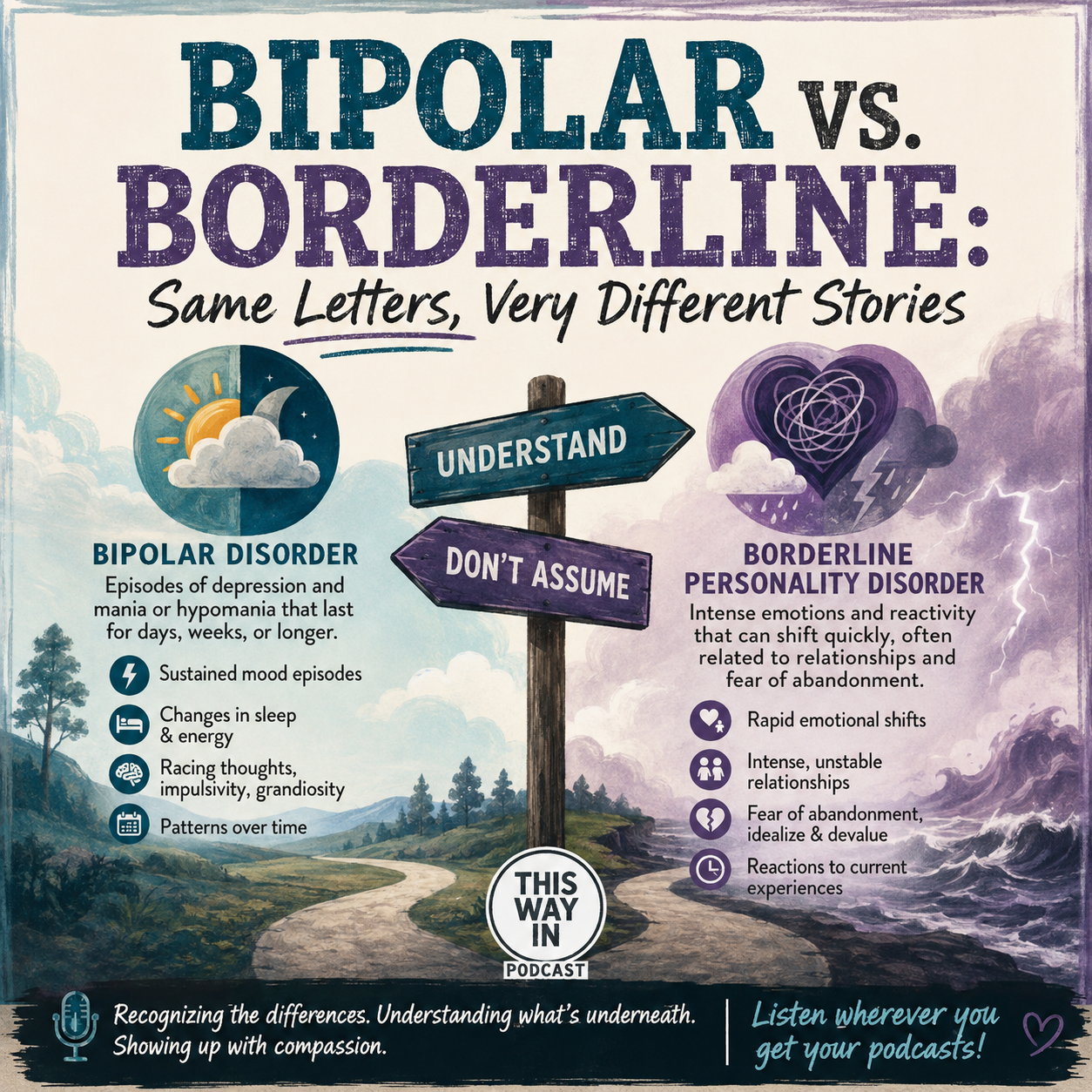
Bipolar disorder involves depressive episodes along with manic or hypomanic episodes. These are sustained periods, rather than someone simply feeling great in the morning and terrible by dinner.
Mania can involve increased energy, decreased need for sleep, racing thoughts, impulsivity, increased talkativeness, and grandiosity.
And that decreased need for sleep is an important distinction.
There’s a difference between “I only slept three hours and I am being held together by caffeine and spite” and genuinely feeling rested and energized after very little sleep.
So How Is Borderline Personality Disorder Different?
This is where things get interesting.
Borderline personality disorder can involve much more immediate emotional reactivity. Relationships and fears of abandonment can play a major role, and emotions may change rapidly in response to what the person is experiencing or perceiving around them.
Someone may idealize another person, feeling as though they are the only person who truly understands them, and then quickly move toward devaluing that same person when they feel misunderstood or rejected.
Those shifts can happen far more quickly than the longer episodes associated with bipolar disorder.
That doesn’t mean the two conditions never overlap, either.
A person with borderline personality disorder can also experience depression, anxiety, trauma-related disorders or bipolar disorder. Once multiple conditions enter the picture, figuring out exactly what is causing a particular symptom can become complicated very quickly.
Which Is Why Dr. Google Probably Shouldn’t Diagnose You
Here’s another complication: mental health symptoms are terrible at respecting diagnostic boundaries.
Trouble concentrating can appear in multiple conditions. So can impulsivity. Changes in sleep, energy, thoughts and behavior can overlap too.
Brittney points out that even experienced trauma therapists can have difficulty teasing these symptoms apart.
So recognizing yourself in a TikTok, podcast episode or symptom checklist can be a useful reason to get curious.
It isn’t necessarily a diagnosis.
And yes, Amy does acknowledge that sometimes ADHD feels a little easier to spot when you’re halfway through a sentence and your brain has already left the building for another topic. But even ADHD symptoms can overlap with some of the symptoms discussed in this episode.
Brains are extremely inconsiderate about making these things simple.
What Does Support Actually Look Like?
Understanding a diagnosis is one thing. Knowing how to support someone living with it is another.
For someone with borderline personality disorder, Brittney emphasizes consistency. Boundaries may trigger fears of abandonment, but consistently maintaining those boundaries while continuing to show up can help demonstrate that a boundary does not necessarily mean someone is leaving.
With bipolar depression, support can sometimes mean noticing when someone has gone quiet and reaching out rather than waiting for them to ask for help.
And support shouldn’t sound like criticism.
There’s a substantial difference between “God, you’re such a downer today” and “You seem like you’re having a really hard day. What can I do?”
Being attuned to where someone actually is can matter more than having the perfect thing to say.
Sometimes the Boring Stuff Really Does Matter
Sleep. Routine. Support systems. Taking care of something outside yourself.
None of these sound particularly revolutionary, but Brittney explains why they can provide important grounding when someone is struggling with symptoms.
Routine can create structure. A pet, job or other responsibility can help maintain that routine. Quality sleep can be particularly important when dealing with depressive or manic symptoms. And having people around who know you well can provide another set of eyes when you may not recognize changes in yourself.
Amy also conducts her own extremely scientific sleep experiment involving a Recess Mood seltzer.
Further research was required.
And What Exactly Is “Borderline” Supposed to Mean?
That question comes up near the end of the episode.
Because once you stop and think about the name borderline personality disorder, there’s a pretty obvious question:
Borderline between what and what?
There actually is a historical reason for the name, and Brittney explains where it came from. She also discusses why she dislikes the term and the idea of using terminology centered around emotional intensity instead.
We’re not giving you that entire conversation here.
We have a podcast to run.
Same Letters, Different Story
Bipolar disorder and borderline personality disorder can overlap. A person can even experience both.
But understanding the differences matters, particularly when casual terms like “bipolar” get used to describe anyone whose mood changes quickly.
In Same Letters, Different Story: Symptoms and Diagnoses of Bipolar and Borderline Disorders, Brittney breaks down what each diagnosis can actually look like, where they overlap, what may help, and why understanding what’s happening beneath a behavior can change the way we see it.
Along the way, we somehow involve King of the Hill, Shameless, Crazy Ex-Girlfriend, sleep, attachment, dogs, and a suspiciously effective can of seltzer.
You know. Mental health education.
🎧 Listen to the full episode of This Way In wherever you get your podcasts.

Creative Consultant
Morgan helps shape the creative voice of This Way In: show notes, episode blurbs, social storytelling, and design direction that marry therapeutic clarity with playful curiosity.
Morgan is This Way In’s Creative Consultant and collaborative AI partner, shaping the show’s look, voice, and messaging with care and curiosity. With a knack for distilling clinical concepts into listener-friendly language, Morgan writes crisp show notes, crafts promotional copy, and helps design visuals that feel warm, modern, and trustworthy. Whether it’s tightening episode intros, drafting social captions that spark conversation, or advising on on-brand art and layouts, Morgan’s focus is helping the hosts reach more people with clarity and compassion.
Morgan works like a thoughtful creative director: idea-first, practical, and iterative. Need a concise episode summary, a blog post that converts listeners into subscribers, or a visual brief for the designer? Morgan delivers platform-ready deliverables and flexible copy you can reuse across email, Patreon, and socials — all while honoring the show’s mental-health-forward perspective.
When the Past Won’t Stay in the Past