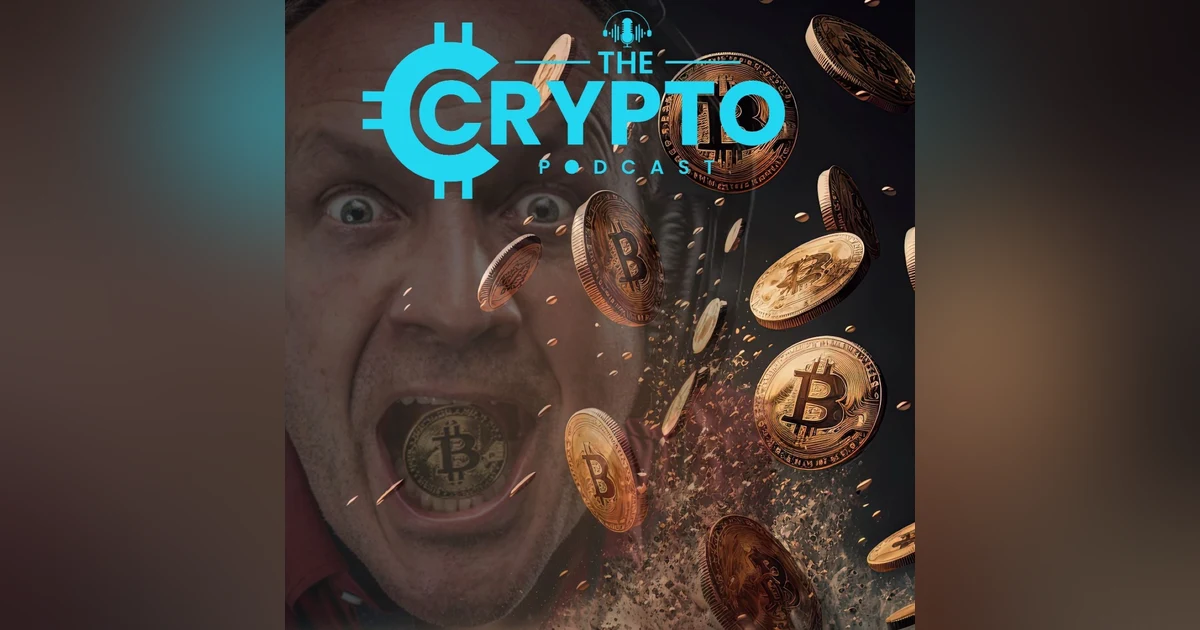
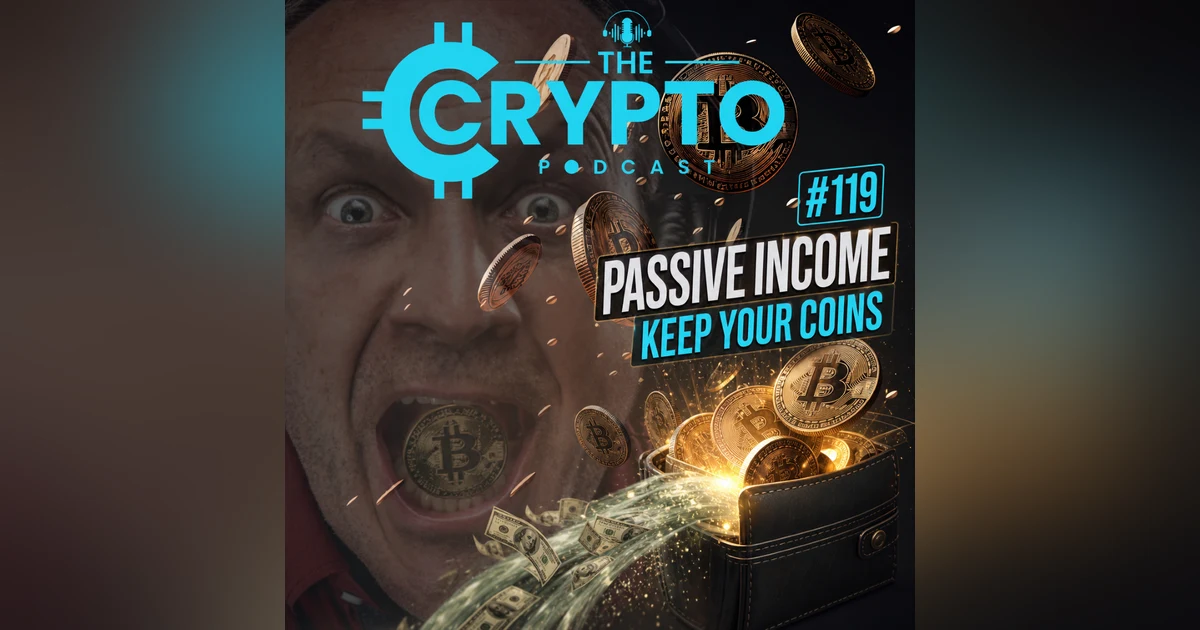
#119 Productive Crypto - Generate Cash Flow Without Selling Your Coins With Brandon Diggs


 Apple Podcasts
 Castro
 RSS Feed
 Spotify
 PocketCasts
 RadioPublic
 Castbox
 Overcast
 You bought Bitcoin early. You held through the crashes, the media panic, and you never sold. So why is your daily life exactly the same? Today's guest says there's a third option most crypto holders don't even know exists — and it doesn't involve selling a single coin. Brandon Diggs from Overseas DeFi joins the show to reveal what productive crypto actually looks like, and how you can turn your idle holdings into a monthly cash flow machine using Decentralised Finance.
Timestamp Topic 00:00 Introduction — the third option most crypto holders don't know exists 01:15 Brandon's background and the mission of Overseas DeFi 03:30 The HODL mindset: Bitcoin from $0.01 to $69,000 and the 6.9 million X return 06:00 Getting paid to wait — treating crypto like a rental property 08:00 Navigating negative market sentiment and the "hot ball of money" 11:00 The two core narratives: currency debasement and blockchain migration 14:30 Why Bitcoin is harder money than gold (inflation rate comparison) 17:30 The $100 trillion store of value market and Bitcoin's position in it 20:00 Why the entire global financial system is migrating to blockchain rails 23:00 Ethereum vs. Bitcoin: smart contracts, tokenisation, and Layer 1 blockchains 26:30 Asset tokenisation is up 400% — and most of it is going to Ethereum 29:00 The level playing field: DeFi is equally accessible with $500 or $500,000 31:00 Step 1 — Taking self-custody of your assets 33:30 Brandon's Mt. Gox story: bought Bitcoin at $77 in 2013, lost 84% in the hack 37:00 Why leaving coins on Coinbase or Binance is still a risk 39:30 Step 2 — Buying and allocating assets (Bitcoin and ETH) 41:30 Step 3 — Collateralised lending: unlocking cheap borrowed capital 44:00 The DeFi carry trade: borrowing at 1–5% and earning 40–300% APR 47:00 Delta-neutral hedging: how to earn fees with zero price risk 50:00 A $5,000 portfolio example: borrowing $2,500 and earning 7% per month 52:30 Why DeFi beats day trading: consistency, lower stress, and less time 55:00 Narrow vs. wide liquidity ranges: yield vs. time commitment trade-off 57:30 How Brandon manages family accounts earning 40–60% APR in 30 mins/day 59:30 The Overseas DeFi app: AI agent, portfolio tracker, and TradingView integration 62:00 Security and scam prevention — "with great power comes great responsibility" 63:30 Capital gains strategy: borrow against your coins instead of selling them 65:00 How to off-ramp USDC as monthly cash flow while stacking ETH fees 66:15 Where to start: the free "Copy This Portfolio" YouTube series 67:00 Outro Contact & Resources Listen to this episode on Podbean: thecryptopodcast.podbean.com Explore more podcasts: Find all podcasts at the PodFather Network Website: RoyCoughlan.com Need help running your business? If you are looking for a Virtual Assistant and get reliable support for your daily operations. Virtual Assistants: VA.world Communities: BrainGym.fitness Learn about a Private Networking Group in 50 US States & 39 Countries with 640+ Members: connectedleaders.academy Connect with Brandon Diggs: •Website: OverseasDeFi.com •YouTube: @OverseasDeFi #CryptoPodcast #DeFi #Bitcoin #Ethereum #PassiveIncome #CryptoInvesting #DecentralisedFinance #ConcentratedLiquidity #OverseasDeFi #BrandonDiggs #YieldFarming #CryptoEducation #RoyCoughlan #PodFatherNetwork #VAWorld #BrainGymFitness
Welcome to the Crypto Podcast. You can find all our episodes on the Crypto Podcast.org. You bought Bitcoin early. You held true to crashes, the media panic, and you never sold.
So why is your daily life exactly the same? My guests today say there's a third option. Most crypto holders don't even know exists. And it doesn't involve selling a single coin, picking up trading or becoming a DeFi nerd.
Brandon Diggs from Overseas DeFi is here to show you what productive crypto actually looks like. So welcome to the show, Brandon. Thank you very much, Roy.
I don't know about the DeFi nerd part. I might have to push back on that one. But certainly, you know, these days, the narrative and the sentiment is very negative for crypto.
So we don't have we're sort of a shrinking breed of people that actually invest in Bitcoin and these other crypto assets to begin with. But where we take it to a couple of orders of magnitude beyond just buying and holding crypto, that's where we get into the DeFi. And that's the interesting part of our business, our portfolio structure, and really what we teach at Overseas DeFi.
Our goal is to so we're heading into a brand new, completely different global financial system. All of finance is gradually migrating to blockchain rails. And so there's a whole new area of financial literacy that that's starting to play out.
And so we specialize in helping to teach people and make them financially literate in this new system that we're all migrating to. And we think we think these assets are spectacular. We can get into the details of why I'm so bullish on Bitcoin, why I'm very bullish on certain layer one blockchain coins.
A lot of people don't even invest in Bitcoin. They don't even know what Ethereum is. So there's just a learning curve here.
And that's that's what we hope to do at Overseas DeFi and hopefully dispel some of that mystery today. So I suppose let's kind of learn your own crypto journey first. Yeah, these assets, I have a T-shirt that says just hodl it.
So that's sort of the mantra in crypto, Bitcoin, ETH, whatever asset you're interested in, the mantra is hold on for dear life. And we've seen, let me give you an example of this. I used to have a video called hodl, the hodl mindset.
And I alluded to the fact that in 2011, it was actually possible to buy one Bitcoin for one cent. There was a flash crash. I doubt anybody got filled at that time.
But the point is, you could have bought a coin for less than a dollar. And then later on, that that coin, that same coin hit a price of about $69,000. So it was a chance to have a 6.9 million X return.
But that's not available to anybody except for someone who bought the coin and then just held on for a long period of time. So that's the mantra. And what we do at Overseas DeFi is we teach people not only just investing in these assets to begin with, but then we enable someone to have patience and generate a cash flow, turn these assets into productive assets.
So you really have you're literally getting paid to wait. There's a good analogy. If you if you purchase a piece of real estate as an investment, you purchased a single single family home, for instance.
After you purchase that property, what's the next thing on your agenda? You're going to try to rent that out and bring in some cash flow. You purchase that property as a as an investment. You hope that it goes up in value or at least maintains your purchasing power.
But while you're holding on for the ride, you want to generate income. So we do the exact same thing with our crypto assets. And that's where decentralized finance comes in.
And we can get into that as well. So, I mean, you mentioned kind of like the bad press, because a lot of people are seeing what's happening and then the kind of the obscene list. And there's mention of him being involved with Bitcoin.
And then everyone is in social media is just going to left and right. Whatever people decide when you're trying to get people in and they just they're listening to all the noise. How do you navigate that? Yeah, it's like I said, the sentiment is just absolutely in the toilet right now.
And I think a lot of that has to do with what we call the hot ball of money. So there's constant capital rotation. It used to be that crypto was the gambling asset.
Crypto was your opportunity to get a hundred X return on your money. And that hasn't happened anymore. That's not happening anymore.
And instead, that hot ball of money is chasing assets, particularly the assets, the stocks that are benefiting from the whole data center build out and all the capex and all that. Those are your opportunities these days in recent times to make a 10 X or 100 X. And that's where the retail gambling mentality, investors and traders, that's where they're gravitating towards. And the capital has left the crypto market and entered those markets.
So what we try to do, look, we follow two core narratives in our business. And this is this kind of dictates how we structure our portfolio. So first and foremost, we want to invest in certain crypto assets that we believe in, that we believe are going to appreciate over the long term.
Again, that hodl mindset we have to hold on. And that's the way we can make amazing returns with these assets is being able to just hold on to the assets and wait for that narrative to play out. So the two narratives are, number one, currency debasement.
Pretty much that's a lot of what you hear on YouTube and different podcasts these days. Fiat currency is continuously being debased. It's like death and taxes.
You can always count on the government is going to spend more than it brings in. And I don't care if you're talking about the U.S. government. It's all governments around the world are printing more and more units of the fiat currency, whether it's dollars, the Australian dollar, the Canadian dollar, the euro, the yen, the Great British pound.
I don't care which fiat you're talking about. They are all being debased. And so what you want, that narrative steers you towards an asset that is scarce.
So gold. Gold has been doing well. It's a scarce asset.
A lot of people don't understand this, but Bitcoin is actually more scarce. It's a harder form of money. The supply of Bitcoin does still inflate.
A lot of people mistakenly believe that it's a fixed supply, 21 million points. That is the end point. New Bitcoin is is being minted every 10 minutes.
That's the block reward is what the miners get paid to secure the network. But the inflation rate for Bitcoin is something on the order of less than one percent a year. And if my recollection is correct, the supply of gold inflates maybe one point five to two percent per year, depending on the technology.
And of course, there's always improvements in technology. They're able to dig gold out of the ground with more efficiency. And so that supply increase, the inflation rate of gold could actually increase, probably will.
You never know. We're going to find gold on the moon or gold on an asteroid or something like that. And so Bitcoin is our asset of choice to really store our wealth.
And that's that's the narrative there. If you want to put a put a pin on it, it's store of value. This is an asset where it's competing with approximately 100 trillion dollars in assets.
That's the global slice of store of value use case. Let's call it where people want to store their wealth for the long run. They're going to buy some real estate.
They're going to buy rare, rare art. They're going to buy wine. They're going to buy Rolex watches or they're going to buy gold or they're going to buy Bitcoin.
So that store of value, very clear narrative. I don't I don't think I need to preach that, too. It's fairly obvious, especially these days.
You have folks like who's the CEO of BlackRock talking about the debasement. Larry Fink. Larry Fink.
Thank you very much. You know, they're actually giving words to these things that we've been talking about in Bitcoin circles, you know, for more than a decade. And to hear these mainstream figures talking about the debasement trade, it's a clear narrative.
Now, the other to me, much more exciting narrative is what I alluded to earlier, where the entire financial system in the future, the entire system global will be on blockchain rails. It just makes sense that there's no need for counterparty risk. There's no need for two or three day settlement and settlement.
Financial settlement can happen on the blockchain practically instantly. Right. And the costs are orders of magnitude lower.
So the system will migrate to blockchain rails. And then the question is, which layer one blockchains will benefit from that migration? So in our case, we're huge believers in the Ethereum ecosystem. It is the biggest smart contract enabled protocol or blockchain smart contracts.
If the financial system migrates to blockchain rails, which we believe it is, that migration and that chunk of capital that's going to the blockchain, it won't really benefit the Bitcoin blockchain. The Bitcoin blockchain is very simple. What you can do with the blockchain, you can send coins.
That's it. It's a one trick pony, but it does it very well. It's the original blockchain.
It's the original store of value asset. It's kind of like Facebook. If a new company says, you know what, I'm going to try to make a replacement for Facebook.
You're not going to replace that entire industry. You're not going to disrupt that business. Maybe you'll get a little sliver, a percentage of a percentage point of that market.
But Facebook was the first mover. It's got it. It's not going away.
It's the same thing with Bitcoin. You might have other coins. And this is kind of something that people will say to criticize Bitcoin.
Mike McGlone comes to mind. He'll say, well, Bitcoin has thousands and thousands of competitors. No, it doesn't.
Bitcoin is the one that has ETFs. Bitcoin has the mind share. It has the market dominance.
It won't be replaced. When you're looking at tokenization, though, when you're looking at the financial system moving to the blockchain, you need a smart contract protocol. One of the ways that smart contracts are used, and Bitcoin doesn't do it.
The Ethereum blockchain does it. The SWE blockchain does it. There are lots of other layer one blockchains that do it.
But Ethereum is the biggest. One of the main uses for a smart contract is to tokenize an asset. And I'm sure you've heard a little bit about this.
And I believe that all assets will be tokenized on the blockchain. And I'm not just talking about financial assets, although that's the clear initial low hanging fruit use case. We're going to tokenize, and we already are tokenizing real world assets and financial assets.
And the majority of that asset tokenization so far, it's a growing industry. It's up by more than 400% from last year. Most of that is going to the Ethereum layer one blockchain.
Another fantastic use case for smart contracts is decentralized exchanges. And we can get into in particular what we do here at Overseas DeFi in order to generate that cash flow. But I'm kind of going in a little bit too much into the weeds.
Like what you said about the tokenization, because even you gave the example of the real estate. What that's allowing is that's allowing the small buyer that has a couple of grand to buy tokens that can get into it and eventually start increasing. Whereas before, you needed to have a lot of money to actually even put your toe in the water in real estate.
It opens up a lot of different financial opportunities to the retail investor, to the guy that doesn't have a million dollars to deploy, who has a couple thousand dollars. And it's a level playing field. That's one of the things I really love.
There are many things I love about decentralized finance. One of the things I really love is that this system and these strategies that we teach, these are available to anybody. I don't care if you have $500 to invest or if you have $500,000 to invest.
The percentages work out the same. It's equally accessible. These systems are accessible to anybody with an Internet connection.
And the strategies that we teach, it's kind of a recipe. You could call it a five-ingredient recipe. So the first part of the recipe is taking custody of your assets.
Ironically, even though Bitcoin was literally designed for self-custody, the majority of people who invest in Bitcoin, they never take custody of those coins. They leave their coins on a centralized exchange such as Coinbase, Kraken, et cetera, Binance. I feel unfortunate on Mt.
Gox. Yes, and I raise my hand. I was one of the Mt.
Gox creditors. I bought my first Bitcoin in 2013. I paid $77 per coin.
Unfortunately for me, in February of 2014, I had all of my coins on Mt. Gox, and that exchange closed its doors. I had to wait more than 10 years to finally get my coins back.
And by the way, I took an 84% haircut because coins were stolen from the exchange. So I learned the lesson. It's kind of a weird thing because, yeah, I lost 86% or 84% of my coins.
But on the other hand, I was forced to hodl, right? Talk about hold on for dear life. Talk about a long-term mindset. I was forced to hold those coins for 10 plus years.
Of course, the price went up quite a bit from where I bought my first coins at $77. So it was a mixed bag of, man, I wish I could get all my coins back, but I'll take what I can get. But yeah, to your point, that's exactly the reason.
That's exactly what most people do. To the extent they even invest in Bitcoin, let alone these other great assets, they buy the coins and they sit on the exchange. So the first recipe or the first step for our strategy and our portfolio design, take custody of your coins.
You control them. You get to choose where they are and when to spend them and when to hold them. And you don't have to worry about any counterparty risk.
I don't think Coinbase is going to have any problems. They've been running for a decade, more than a decade now. There's so much things happening that even people doing job interviews, they're doing it on Zoom.
And they're putting in software, scamming software, and they're taking people's wallets. I don't think anywhere is safe. Yeah, yeah, I agree.
And that's the thing with crypto, and that's a big reason why the Bitcoin white paper and the way the system was designed. That's why is because for the first time, you can hold an asset, and you own it, and no one can take it from you. There's zero counterparty risk.
So that's very important, and that's the first step, and we teach that in our different programs. And then the next step is to actually buy some assets, right? So we talk about allocations. We talk about the market.
We have weekly calls where we're looking at macro factors. We're looking at all the latest news. I've become an expert in 10-year rates and things that I never imagined I would really get into, but that's what it takes these days to have a handle on the market and where it's going.
But the basic idea is we're going to buy Bitcoin, and we're going to buy ETH. Right now, I'm much more heavily weighted towards Ethereum. It's what I think of as a faster horse, but those are the two main assets.
So step two, buy some assets, and now that you actually have these assets in your custody, with self-custody, that's what unlocks the power of decentralized finance. You can't do anything that we do in DeFi if your coins are sitting on Coinbase. You have to take possession, and you have those coins in your wallet.
Now here's where it starts to get exciting. We're keen on the idea of velocity, so you have a certain amount of dollars or euros to invest. This is your nut.
You're able to have this extra capital. You're going to invest it, right? So you want to put it in an asset that you believe is going to go up. So that's the start of it.
But what we can do in decentralized finance, and I can show you some examples of this, we can collateralize those assets. A lot of investors wouldn't even be familiar with the idea of collateralized lending. So that's part of the learning curve that we teach.
And by the way, we do have the YouTube channel Overseas DeFi, and we're giving away a lot of this content for free. So you don't have to sign up for our membership. I mean, it's pretty cheap, $97 a month.
Cancel anytime, and we're going to be able to teach you everything from A to Z on how to set up this portfolio. But if you want to spend some time on YouTube, all the information is there as well. Anyway, with collateralized lending, this unlocks an extra chunk of capital.
So let me give you an example. Let's say I have $100,000 to work with, and I believe in Bitcoin. I believe in Ethereum.
I believe in tokenization. I believe in blockchain, Rails, all of that. So I buy some Bitcoin and Ethereum, and now I have $100,000 invested, and that money is working for me, right? Ideally, over the long run, the prices are going to go up.
I'm going to have a return on that investment. Now, if I have $100,000 of Bitcoin and ETH, I can collateralize that on a lending protocol. Now, there is risk associated with that, and there's a learning curve with that.
But if I collateralize that, I can responsibly borrow anywhere from 30 to maybe as high as 60% loan to value. So what does that mean? So that means I put my $100,000 into this protocol, and this is a decentralized finance protocol. It's only available in DeFi.
It's only available to having your coins in self-custody. That's what this unlocks. I have that $100,000 as collateral, and let's say I borrow $50,000.
Now I have this $50,000 to play with. I can use that however I choose. Maybe I buy more assets.
So I have more capital working for me. What we like to do for the most part is we take that borrowed capital, and we deploy it into a concentrated liquidity position. So that's a mouthful, and it's – most people, they only know Bitcoin.
And probably they don't even own any Bitcoin, but they've heard of it. Then you go further out. Maybe a fraction of those people have actually heard of Ethereum.
Even a smaller fraction of that actually owns the coin. Then we go further out. Almost no one that's invested in crypto has self-custody of their coins.
It's something on the order of 5% of crypto investors actually take custody. The rest of them leave their coins on the exchange, right? So then once you actually have custody, it keeps going smaller and smaller out. We're just really a narrow – a very small breed of people, of humans on this planet are taking advantage of this opportunity.
That's one of the reasons why the opportunity is so fantastic because not a lot of people are taking advantage of it. It's not a crowded trade at all to the extent you want to even call it a trade. So now I have my borrowed capital, and I put that into a concentrated liquidity position.
That's a mouthful. There's a learning curve there. But the yield that I'm able to earn on that position – and again, this is borrowed capital that I've deployed.
And what's the rate of the borrowed capital? Yes, good question. So we have what we call the DeFi carry trade. And if you've heard of a carry trade, this is where it's kind of unwound.
People will borrow big investors, multibillion-dollar hedge funds, etc. They'll borrow a bunch of Japanese yen at a very low interest rate, and then they'll take that capital, and they'll earn a slightly higher interest rate in whatever, U.S. bonds or whatever. And they pocket the difference.
They're paying maybe 1% over there and earning 3.5% over there. Ooh, exciting, 2.5% a year. We don't get out of bed for those kinds of returns.
What we're talking about in DeFi with a concentrated liquidity position – so you asked what's the rate. I can borrow capital right now. I'll pull up the live rate.
It is a variable rate. I can borrow Ethereum on Aave, which is the decentralized lending protocol. Right now, the interest rate on that is 1.23%. 1.23%. And why does that fluctuate? It does fluctuate.
Does it go by much? No. No. And right now, the interest rate for USDC – so that's a U.S. dollar-based stablecoin.
Each token is worth exactly a dollar. That interest rate is 4.3%. These days, your mortgage is 7%. Your car loan is 11%.
Your credit card is probably about 30% interest. Here, we have an opportunity to borrow capital somewhere between 1% and 5%. And it does fluctuate.
It's a decentralized protocol, so it's based on supply and demand. If people are trying to borrow more USDC, that rate will adjust. But I've been doing this for, gosh, close to five years now.
And the rate I typically see is – I've never seen a double-digit rate on USDC. It's always been a single digit. And in my recent experience, usually 5%, plus or minus maybe 1%.
Now, so I've borrowed this capital. I'm paying a low rate of interest on that – a low carrying cost, right? And this is our mantra. Borrow low, earn high.
Well, what's high? Depending on your risk tolerance, depending on how much time you want to spend managing the position, you can earn anywhere from, I would say, 40% APR on the very low end up to – so I have a position right now. Yesterday, it was paying me about 300-something percent. Right now, it's come off a little bit.
My APR on this in the moment is 237%. So somewhere on the order of 40%, 60%, 80%, 100%, 120%, and you keep the difference. So you're borrowing it, let's say, 5%, and you're earning it, let's say, 80% or 100%.
And the difference there is pure profit. Now, is there risk? Absolutely. We're in the market.
When we put our capital into a decentralized exchange, we are at the mercy of the market. Now, lately, the crypto market has been bearish. So there are other strategies, such as shorting and hedging, where we can actually hedge off that price risk of the asset.
And you can actually set up a liquidity position where, like I said, you're earning, let's say, 80%, and you can pair that position with a short position where you're completely delta neutral. Remember, what we do here is we teach people financial literacy. A lot of it has to do with the decentralized finance system, the blockchain system, the wallets, the private keys, all of that.
But a lot of it is just basic financial literacy, like a carry trade, like collateralized lending, like hedging and shorting. Most people have never even shorted anything in their lives. We do that when the market environment calls for it.
So anyway, getting back to that paired position, you can have a liquidity position over here, funded with borrowed capital, and you can have a short position over there, and it's completely delta neutral. So if the market dumps, for example, Ethereum, it just crashed from $2,000 down to about $1,600. So if the market crashes $400, your liquidity position is going to lose value.
So let's say you have the equivalent of one ETH in your liquidity position. That would be a pretty small position, but let's do easy math. So your liquidity position drops, and it goes down by $400 in value because the price dropped $400.
Your short position, that actually profits as the price goes down, which in and of itself is kind of a foreign concept for most retail investors. They've never even considered shorting an asset. What that does is as the price drops $400, your short position, if you've sized it correctly, which is not difficult, you're making $400 of profit.
So you're losing $400 over here, but you're making $400 over there. It's completely offset. You have no price risk.
So then any of the fees that you're generating from that liquidity position, that's completely pure profit. I hesitate to use the phrase free money, but this is as close as you can get to free money. I wouldn't want to short the market if we're in a raging bull uptrend.
No, I don't have any shorts, but that's not where we are. That's not where we've been since the big crash on November 21st. We can look at the charts and things like that, and I can explain how we adopted a bearish bias way back in late November.
Since that time, we've had plenty of hedges on. We've actually been making money as the price has crashed. You mentioned 97 a month, which is reasonable, because I know there's a lot of different people training, and they're only looking for high end.
They're looking for $6,000 or $10,000 or even higher. So at what level does a person need to be investing for this to make sense for them? That's a great question. We have what we call the 90-day accelerator, and this is for someone who wants a little bit more hand-holding.
Not exactly the one-on-one guidance, but we have very small class-size workshops. So someone who wants to get on a Zoom call three or four times a week. We have open office hour sessions.
We have a little hangout that we do on Fridays called DeFi and Coffee, which is a lot of fun. We just chat. We have our weekly training workshop.
We just go through a different concept each week, and then we have our Thursday strategy session. This whole product, that's the high-ticket product. We do have that, the 90-day accelerator, something on the order of several thousand dollars to get you completely up and running 90 days, full-fledged DeFi operator by the end of it.
But we wanted to create an opportunity and really lower the barrier to entry for most people. Most people don't have $6,000 or $7,000 to spend on a program. So that's why we introduced the Overseas DeFi Community.
It's really a fantastic product. It's not expensive. And in terms of what kind of a portfolio someone would need to deploy, right? Now this DeFi is, like I said, it's open to everybody.
Even if you have $100, you can do this. And the percentages, the yields that you're earning are the same for everybody. It's really a level playing field.
But if you're looking to pay your bills or pay some of your bills with your DeFi portfolio, that's the whole point. We're getting paid to wait for these narratives to play out. And once we do get a massive rally in Bitcoin and ETH, happy days, right? Our portfolios are going to double and triple and quadruple in value that will be fantastic.
But in the meantime, while we're waiting for that to play out, we need cash flow. We're human. We have bills to pay.
And so let me give you some rough numbers with the caveat that you need to do hedging if it's a bearish market environment and those sorts of things. And you need to be conservative when you're doing this collateralized lending. That's the part I didn't mention, which I should.
If you collateralize some assets on a protocol and then you borrow against it, you have what's called a loan to value ratio. And usually we're going to be somewhere in the neighborhood of 30 to 60 percent LTV, depending on where the market is and how much lower we think it can drop. But if you collateralize those assets and then you borrow a whole bunch of money against it, if your collateral drops in value, eventually it'll hit a threshold.
That's called the liquidation threshold. And that loan to value ratio, usually somewhere on the order of 80 percent. So if it hits that 80 percent LTV, you're going to get liquidated, meaning the protocol is going to automatically sell your assets to pay back that loan.
So it's not free money. You have to be responsible. You have to manage your risk.
And we have a whole slew of strategies to teach you on managing and mitigating risk. But let's just use some basic numbers and to what you could deploy. So let's say you have, let's say a $5,000 portfolio.
Okay, you have $5,000 to invest in this kind of a portfolio. So you take that and you buy $5,000 of Bitcoin and ETH. And then you collateralize that $5,000.
And let's say my LTVs are in the neighborhood of 60 percent right now because the market has dropped so much. And I also have short positions built into it, which is a whole other topic. But let's say you're more conservative.
You borrow 50 percent. So you've got your $5,000 of Bitcoin and ETH. And then you borrow $2,500.
Now you take that $2,500. You're only paying 4 percent interest on it, thereabouts. You take that $2,500 and you deploy it into a liquidity position.
Now, I've been doing this for a long time. And I'm a data guy. I'm a spreadsheet guy.
I don't think you can read it anymore. But I have a sticker on my water bottle that says, Ooh, this calls for a spreadsheet. So I'm a spreadsheet guy.
I've been tracking all of my liquidity providing activities for years now. And I can confidently tell you my monthly average yield, monthly, is somewhere between 9 and 10 percent. Now, that's me.
I'm a junkie. Like you said at the very beginning, I'm definitely a DeFi nerd, okay? But let's be more conservative. Let's say you're going to earn 7 percent a month.
Now, I should have used an easier number. But let me just bust out my calculator on my computer. I would go with 5 to make it easy.
Just half of the things. So 2,500 into the position. And if you're earning 7 percent a month, that's $175, okay? So that more than covers your $97 a month.
By the way, this isn't a 12-month thing. And I'll tell you another thing. Before I really got into DeFi, which was back in 2021, I was into day trading.
Spent years, years and years of my life learning how to day trade. And I signed up for multiple different programs. You know, this $1,000 course, this $50 book, this live chat community for $99 a month.
I spent lots of money trying to learn how to trade. And it took more than 10 years for me to finally be consistently profitable. The rest of that was just burn.
And I roasted accounts. I lost money not only in actual trading, but also paying these outfits to teach me how to trade. Our business, you know, I hesitate to say guarantee.
But, well, one thing I can guarantee you. If you start up a liquidity position, you will start earning cash from that position immediately. Guaranteed.
I can guarantee that. Now, the price might drastically move, might jump higher, and might crash lower. And if it exits your price range, then you'll stop earning cash.
But as long as that price remains inside your range, you are earning cash every single day. So I can guarantee you within a couple of weeks of learning how to do this, you will start earning money from your portfolio. You will start earning free cash flow.
And that's the beauty of what we do. We think these assets are going to go up in the long run. We're happy to invest in Bitcoin at $60,000.
And we're happy to invest in ETH at $1,600. This is the bargain of the century in our minds. And we do believe these assets will go much, much higher in the future.
Currency debasement will continue and all the rest. But isn't it lovely that while we're waiting for this narrative to play out, we can generate real useful free cash flow. That's what everybody wants.
Especially in these days, people are freaking out about the AI. Am I going to lose my white-collar job? My knowledge worker job is in jeopardy of being replaced by AI. So now is the time to strike in terms of learning a new skill, full self-custody, full control, full ownership of the whole thing.
You don't have to depend on anybody. And to be able to learn how to start generating cash flow from your assets. Now you have to have money to make money.
So people can't get into this business for absolutely zero cost. You have to have some investment capital. But yeah, hopefully that answers your question about kind of what seed money would you need to start out with.
I would say around five grand would probably be the minimum. Now you can spend a couple of months in the community, learn everything you need to learn, and then cancel. That's fine as well if you have a smaller portfolio.
You don't want to keep paying the $97. But it's an opportunity where you can pay this money and learn how to do something that's going to change your life. It's absolutely going to change your life.
You learn this skill, you will be able to earn cash flow off of your capital. I hesitate to say forever. We don't even know what the financial system is going to look like five years from now in the 2030s.
It could be a completely different environment. But it's an important skill. People talk about streams of income.
This is another skill that you can pick up and you can generate a little income for yourself. You mentioned I think 275 or something like that. Even if they're making 5%, 7%, they can reinvest it, which in turn it's increasing all the time.
And then it justifies being in there. My question is because I've seen lots of day traders glued to their computers, they go on holidays, they're on the deck chair, but they're really on their computers. How much time is needed for this? I love that question.
And that's one of the key reasons why I quit day trading. Gosh, it's been almost two years now. First of all, DeFi is just so much easier and so much more consistent.
I don't have to be perfect. With day trading, you have to be perfectly behaved. And if you slip up one time and stop following your plan and stop operating with discipline and you make one mistake, you can collapse your entire account in a day, in a week.
You can have six months of profits and lose it all the next week. You know what I mean? But on top of that, it's the tremendous suck of your time and energy. So I'm not proud of this, but I used to spend between five and seven hours every weekday glued to the screen, like you said.
I was day trading the S&P 500 e-mini futures and the NASDAQ 100 futures. So ES and NQ, I was trading those and I was watching not even a one-minute chart, a very fast-paced chart, a tick chart, we call it in futures trading, just glued to the screen. So imagine all of the time and life energy that I wasted in that pursuit.
DeFi is order of magnitude less involvement that's necessary. Maybe later we can get into the charts, but really, once you set up a liquidity position, and that's why I said earlier, depending on how much time you want to spend on this, you can have a more narrow range. Maybe I should explain quickly on that.
We provide what's called concentrated liquidity. So when we set up a liquidity position, we're providing our tokens and other people trade those tokens. It's a pair of tokens.
So for example, ETH and USDC, we provide our tokens within a certain range of price. If traders trade those two tokens with each other in that price range, we get part of the trade fees for doing that. But then if the price escapes the range, we've set up a price range and the price goes higher or the price goes lower, as soon as the price escapes our range, we stop earning the fees.
And that's a decision point. We talk about that as well. We have an entire week and a workshop dedicated to how do you manage your liquidity position and whether or not you want to move the range and that kind of thing.
But if you set a very narrow range, two things happen. Number one, your fees go way up. If you concentrate your capital in a very narrow range of price, you're getting a bigger portion of the trade fees, as long as the trades are happening in that price range.
But the other thing that happens is it becomes very easy for the price to escape. It doesn't take a big volatile move for the price to go up or below that range. So there's a customization.
There's a bit of a fine tuning factor to this, where if you set a narrow range, you're going to get great yield, but you have to manage it more frequently because the price is going to escape more easily. Or if you set a wide range, you're giving up on a little bit of yield. It's still going to be great.
I have a wide range right now on my ETH USDC position. My yield is somewhere on the order of 90%. So it's still great yield.
But, you know, if you set that wider range, now it's much more hands off. I manage an account for my daughter and I manage an account for my other daughter's boyfriend. And I just have them really super wide and they're earning 40, 50, 60% APR.
And I barely have to do anything. I mean, I literally go in every couple of weeks, look at their position, look at their wallet, you know, maybe make a tweak here and there. It's very low time commitment.
The way I'm doing it, I mean, I'm running a business. I'm the main educator here at Overseas DeFi. So there's a lot of time that I spent doing all of that.
But I also very actively manage my portfolio. I would say something on the order of 30 to 60 minutes a day. That does include weekends because sometimes, you know, crypto trades 24-7.
So sometimes you need to make a decision or do some management on the weekend as well. But, yeah, I would say definitely somewhere in that neighborhood of 30 to 60 minutes a day. Does that answer your question? Absolutely.
And, you know, you mentioned previously about the AI and the jobs taken. I mean, I covered that in my other podcast. And, like, I don't think people realize how many jobs are going to be taken.
But just curious, are you incorporating AI in this to make your job easier and does it give better results? Oh, my goodness. Yeah. So it's just my business partner and me.
So it's Roman and I running this business. So we've maximally utilized AI in every aspect of running the business. And in addition, recently, we've developed an entire application.
So we have a web app. It's actually available on mobile as well. The Overseas DeFi app.
Do you mind? Could I share my screen, perhaps? Yes, of course. Yeah. And just talk through it because there's some people will be actually listening.
So I'll just share. Right. So let me just share here.
So the main point of the Overseas DeFi app is to be a well-informed portfolio tracker so I can see all of my positions across multiple different blockchains, Ethereum, BASE, Arbitrum, BNB chain and SWE. And we're going to be adding more blockchains to this. But I can see my liquidity positions.
I can see my lending and borrowing positions. I even have a position on the perpetual futures exchange. So that's another way that we can hedge our positions.
Spot assets. I can keep track of all of the fees that I've been generating in my equity positions. This is an important one, especially these days.
I can look at my exposure. So my delta exposure. This is where our portfolio, for the most part, our portfolio is positioned long, meaning we own assets.
We want the prices to go up. But when you're in a bearish market environment, you want to have some short positions on. Let me refresh this.
I don't know why it's lagging. You want to have some short positions on where you can benefit as the price drops. The price has been doing a lot of dropping in the last seven months.
So we have this exposure where we can look at our long positions and our short positions on one screen and get our net delta of how we're going to either benefit or lose as the price goes up. In this case, I do have some short positions. But for the most part, I'm positioned long.
I do think the bottom is in or very, very close to being in. But to answer your question about AI, we have this built-in overseas DeFi AI agent. Now, this is not just a wrapped up Claude instance.
The back end, the brain of it is Claude. However, what we've done with this AI agent, it's almost like a specialized model, like a specialized LLM, because we've fully trained this agent on all of our IP, all of our content. So every single Thursday strategy session that we've had built into this brain, every workshop that we've ever done is built in.
We have a weekly open office hours. So our accelerator members can come in, share their screen. I can look at their positions.
I can answer their questions in real time. And these open office hour sessions typically go for, I have a hard time making them go for less than two hours. So we have hundreds and hundreds of hours of content, all of our strategies, all of our frameworks, everything.
It's basically my brain and our brains plugged into an AI. And so this is going to give you some really smart, focused answers on any of your crypto and DeFi related questions. So we're really proud of this.
It's very helpful. We pride ourselves on being available to our members and our community. I will say 24-7, but I'm in this every day.
I'm in this chair, in this office, looking at my screens pretty much seven days a week. And so we're highly available to help our members in real time. But if you're working through something at 3 o'clock in the morning, Roy and Brandon isn't available and Roman's not available, well, this AI is a really good route for you to get your questions answered.
And this thing will guide you through the process step by step, because it's fully trained on all of our strategies and frameworks and all of our content. And it goes one step beyond if you ask a question, it is going to hunt through all of our video content. Let me show you this.
So the Academy over here, hundreds of hours of community calls. That's that Thursday strategy call. I told you about our weekly office hours.
We have, I believe, 17 different video courses, all of the group workshops that we've ever done. Everything is in here. All the video is captured, the study guides, the transcripts, everything else.
So that AI will surface anywhere from one to three of these videos, where not only is it going to answer your question, but it's actually going to point you to the exact moment in a particular video where Roman or myself explained exactly what you're asking about. So it's funny that you asked that. I'm glad that you asked that.
We definitely, yeah. Is it reaching out to the web as well if people are asking about the market and things like that, or is it only for the internal stuff that you're… Well, that's a great question. So we do have TradingView built into the app as well.
And it's not really designed to replace – it's not really designed to go out on the broad internet and do research. It's more focused, and that's kind of the value of it. Like if you want to research on the internet, I would just go with Claude or go with ChatGPT and do it with that route.
But if you have a specific targeted DeFi type of question where you're literally trying to work through something, then that's what our AI is there to serve. And by the way, with the AI and with the Portfolio Tracker, this AI is completely aware of your specific positions. So it knows, oh, these are the assets that you have as collateral on Aave.
It knows, okay, this is your short position on GMX. It knows your liquidity. It knows everything about your portfolio and your wallets that you have connected, and so it's context aware.
And it can provide guidance. I mean, you know, caveat, grain of salt. You don't necessarily want to exactly trust an AI bot, but it's very smart in terms of knowing how to do that.
Just on that, actually, because I use a lot of different ones, but I've put in, don't ever lie to me. Don't ever lie, yeah. Don't hallucinate, yeah.
You know, and then sometimes you're asked to something, and it's honest, and that's what you want. Whereas a lot of times people are taking it, not just with this but anything with AI, they're taking it as gospel assuming it's true, and you have to be very careful with it. Yeah, absolutely.
It's so funny because, like I said, Roman and I make max use of Claude and ChatGPT for every aspect of our business, and so this web app was designed and built by Roman and Claude and myself as well, and it's so funny because Roman will talk to his Claude, and he'll say, spin up 50 agents and do this and this and this and this, and I don't want any bugs. It's just sometimes I feel like we ask too much, and to your point, you could learn. People could spend time on YouTube, hours and hours on YouTube.
They could have conversations with ChatGPT and probably learn how to do this, but at least not yet. There's no real replacement yet for real intelligence of a human being, especially someone who, I mean, I'm not trying to toot my own horn, but someone like me who has years of experience in DeFi, I know way too much about all of this stuff, and I'm going to be able to think about your question and figure out how to explain to you in real time as a human. There's no replacement for that, but the AI bot that we have and the different tools that we have are pretty dang good, but that's why we have a business, Roy.
We're lowering the barrier to entry, and what we're doing is there's a learning curve to this. This is not simple. It's not rocket science, but it's not incredibly simple either.
It's somewhere in between. You're not just going to be able to install an app, and boom, you're earning 80% yield on your liquidity position. No, there's a learning curve to it, and what we specialize in is compressing that learning curve.
That's literally why we call our 90-day program the Accelerator. It's a 90-day Accelerator. We're going to, in three months, we're going to fully train you from A to Z on how to do this, and you could spend a year watching YouTube videos and using other tools to learn how to do it on your own, but it's much better to have a real live human literally looking over your shoulder in the open office hours.
You can share your screen, and I can literally tell you what to click on. If that's the kind of guidance that you require, it's available to you. So we compress that learning curve, and this is not trivial.
We help you to stay safe, all right? It is, unfortunately, this space. There are scammers out there. There are people who will try, and there are fake websites and the whole gamut, and so that's a big part of our training and our educational materials is to help you avoid the different scams that come up and the different ways that phishing and the other ways that the scammers will get you in this space in crypto.
It's a double-edged sword. We have full custody, full control of our assets in DeFi, in crypto, full control, but with, what do they say? With great power comes great responsibility, I think is how it goes. So it's great power, but you're responsible.
You're in charge, and if you slip up, if you make a mistake and send money to the wrong address, it's gone. If you make a mistake and give your seed phrase, your master key to a scammer, your money is gone. So there's a responsibility there, and we really focus on that day one.
Day one is about self-custody and security. And it's evolving so much, because, I mean, I talk about that a lot on different shows, like people coming in, and every time there's something new. And I think when you're part of a community like that, you're staying on top of it, plus even your members will spot stuff that are sharing it with you, and people, like, yeah, they might go in and start watching the YouTube videos, but then they stop doing that, and they just get complacent, and they get caught, and you could be building a massive mountain for your retirement, and I have a friend, half a million was taken from him just like that, and never got it back.
So it does happen, and you have to be very careful. Tremendous power in community, yeah. And for our Accelerator clients, we have a private telegram group.
I'm in there all the time posting market updates and different moves that I'm making. And then, yeah, sometimes, somebody just the other day, hey, I got this random email. It looks like it came from Coinbase.
Did anybody else get this? And I'm immediately in there, scam, scam, scam, beware. Coinbase is not going to email you, and Ledger's not going to call you asking for your seed phrase, none of that. So yeah, there's a lot of power in just having that community human element to it.
So we like that. And I know that internationally, but I have a very high listenership in the States. Regarding kind of capital gains then on this, how does that work? Well, that's actually one of the huge benefits in the way that we structure our portfolios.
So if you've invested in coins a long time ago, you probably paid a much lower price. If you bought Bitcoin in 2020 and things like that, the prices are much higher now. And so if you sell those assets, if you dispose of those assets, first of all, yeah, you're signing up for a big tax hit on the capital gains.
But secondly, you lose the potential future upside. It's kind of like you're out of the game. If you sell your coins, you're done.
And now what are you going to do? And especially typically you sell, and the next day it's up 10% and keeps going higher. And you're like, ah, why did I sell? So what we do, that's the beautiful part of it, is instead of selling, we're actually going to make those assets productive. So we're just transferring the coins.
I transfer my Bitcoin to my Coinbase account and then transfer it from there to the base blockchain, for instance. And now it does become a tokenized version of Bitcoin, but it's still Bitcoin. I haven't sold it.
Now I can actually collateralize that, unlock that cheap money, cheap borrowed capital, 3%, 4%, 5% that I'm paying on that capital. Now I can take that capital and deploy it into a liquidity position, for example, to earn that extra cash flow. So I have my capital still working for me.
It's still in the market. Even though I collateralized it, it still belongs to me. I still own it.
I would have to pay the loan back to get it back out of the protocol, but it's still mine, which the important part there is, if the price appreciates, I'm making money on that. My investment is going up. Those coins still belong to me.
They're still capturing every single dollar of price appreciation. So I still have my coins. I haven't sold them.
I haven't paid any capital gains taxes. Now, caveat, I'm not a tax advisor. So consult your tax professional when you do your taxes, right? But as far as I understand it, if you don't sell the assets, you don't experience a capital gain and you don't have to pay any tax.
If you borrow money, if you take out a loan, which is what we're doing, we're borrowing against our collateral. That's also not a taxable event. And that's how the big guys do it.
Elon Musk doesn't sell his Tesla shares. He borrows capital against his Tesla shares and it's tax-free money. It's like the real estate.
If you release equity in your property, you're not paying tax on the money that you get from that. Right. And this is where the parallel comes in with the real estate as well.
If I take that borrowed capital and I start generating fees, now, again, I'm not a tax expert, but I consider that to be income. I will have to pay taxes on the cash flow that I'm generating. That's fine.
I'm willing to pay a little tax on the extra income that I'm now using. And this is my bread and butter. I use my DeFi portfolio to literally pay my bills on a month-to-month basis.
If you're in a position where you have a steady job, maybe you're a little bit worried that it might be in jeopardy with AI and all of that. But at the moment, you've got that steady paycheck. Then, like you alluded to earlier, now you have the opportunity to compound your cash flow.
You have your Bitcoin and ETH. You've borrowed some cheap capital. You put it into an LP.
You're generating that daily cash flow and just stacking it. One of the nice things about the positions that we do, generally, I provide liquidity for ETH-USDC. That's the token pair.
I'm also doing a position in SWE-USDC. SWE is just another Layer 1 blockchain, very nice, very awesome technology. When I provide liquidity in those pairs, my fees are in the same format.
If I provide ETH-USDC, my fees are ETH and USDC. One of the things I really like to do is the USDC part, I will off-ramp that. That means I take it out.
I send it to my Coinbase account. I convert it to dollars and withdraw it to my checking account. That's my monthly cash flow.
I'm going to use that to pay bills. The ETH part, I just stack that up. I love earning free ETH right now when the price is $1,600 because imagine when the price goes back to $4,000, maybe $5,000, maybe new all-time high, all of those fees that I've been stacking in my wallet, I'll be able to give myself a really nice bonus.
Maybe at the end of the year, we'll have higher prices and I'll be able to give myself a nice Christmas bonus, maybe. No? This has been very interesting. Is there anything we haven't covered before we finish? No.
I would just say simply that anybody can get started with this. If you have an internet connection, you can do all of what I'm talking about. Very recently, I just released a third video.
We have a short YouTube video series on our channel. It's just at Overseas DeFi on YouTube. It's a playlist.
It's called Copy This Portfolio. I really tried to lay it out step by step of how anybody can get started. I would encourage people to get started today and just start really small.
Again, a beautiful thing about DeFi is it doesn't matter how small of a fish you are, you can get started and you can prove the concept. You don't have to take my word for these yields and everything I'm talking about. You could literally start out and I do my demonstration.
I use my demo wallet. I have $120 and I show you from A to Z step by step. Okay, here I'm buying some Bitcoin.
Here I'm putting it in the Aave as collateral. Here I'm borrowing against it. In the most recent video just released yesterday, here I'm putting that borrowed capital into a liquidity position.
Literally step by step. Anybody can do it. I would encourage people just to try it out.
Put $100 into this and see how it goes. I think you're going to be pleased with the results and how it seems a little bit daunting at first, but once you get into it and you get those first few transactions under your belt, it starts to become easier and easier every day you're doing it. I would encourage people to get started.
There's free. It's free. Sign up to the YouTube channel.
Subscribe and watch those videos and check it out. Excellent. You might let the listeners know where they can find you.
Yes, the website is OverseasDeFi.com and the YouTube channel is at OverseasDeFi. Simple. Excellent.
I'll make sure I put the links about the audio and the video in the description. Those that were listening, I'd encourage you to go into BitTube, YouTube Rumble and Spotify where the video will be available so you can actually just see what he was actually demonstrating. Thank you very much, Brandon.
Yes, absolutely. My pleasure, Roy. Thank you.
Thank you. That's all for the Crypto Podcast. You'll find all the references on the CryptoPodcast.org. You'll find everything about me.
Scan the QR code or go to RoyCoughlan.com where you'll see all my podcasts. I know I have a podcast network as well. We're getting over 1.2 million downloads a month, so we have sponsorship opportunities.
And if you're looking for virtual assistance, go to va.org. Be sure to give us a thumbs up, five star rating, maybe share with three friends. Until next week, take care.