
 Apple Podcasts
 Spotify
 PocketCasts
 Amazon Music
 YouTube
 Driving Brand Growth: A Modern CX Playbook
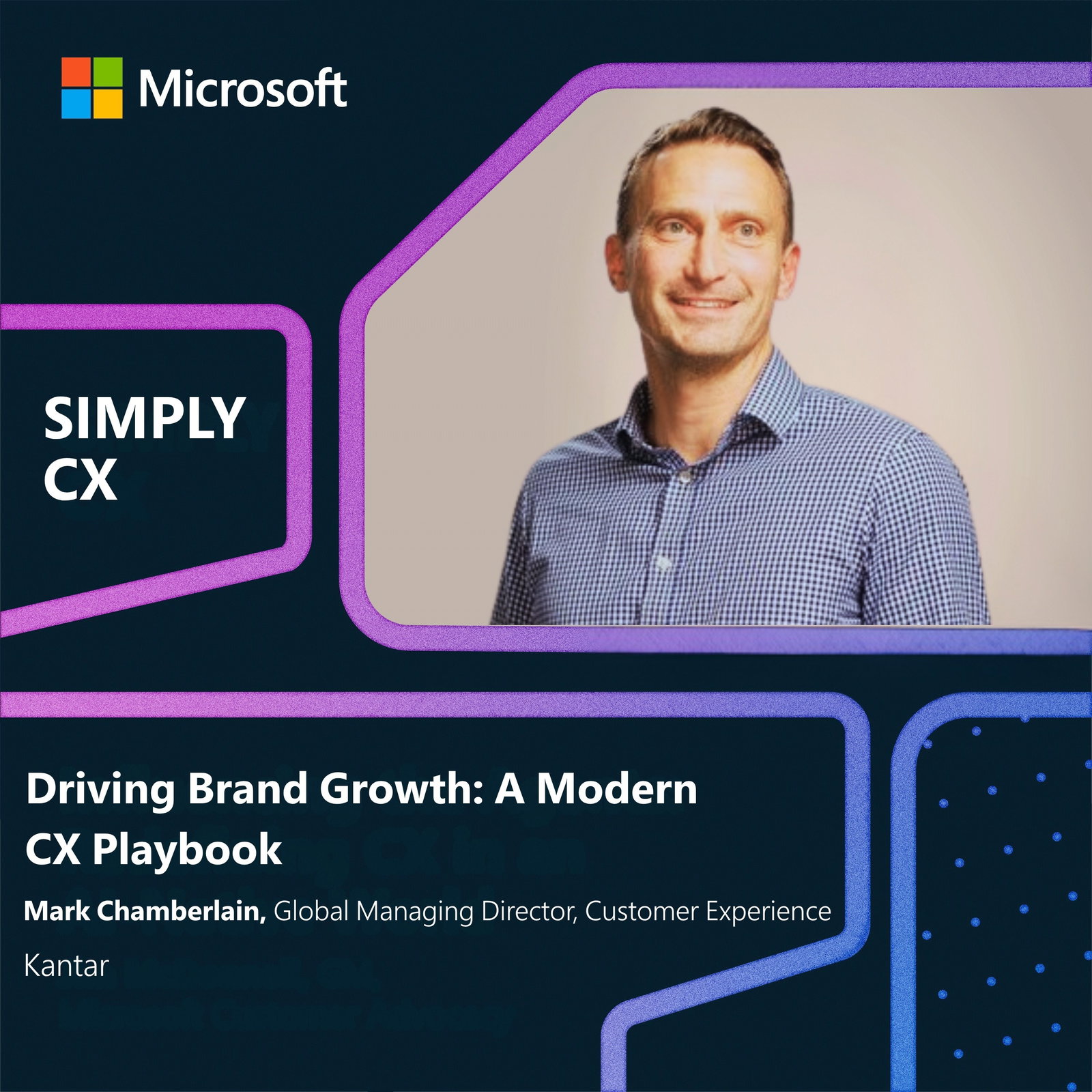
In this episode, Nicole sits down with Mark Chamberlain, Global Managing Director of Customer Experience at Kantar, to challenge conventional thinking about CX metrics. Together, they explore why long‑term memory—not momentary satisfaction—is the real driver of customer choice, brand growth, and competitive advantage.
You'll walk away with:
• A new way to think about CX as the business of shaping long-term memory
• Why frictionless experiences matter—but rarely differentiate
• How the MDX (Meaningfully Different Experience) framework connects CX to real business growth
Whether you're a CX pro, team leader, or brand builder, this episode will inspire you to see customer experience through a more human—and more powerful—lens.
Mentioned in this Episode
• Net Promoter Score (NPS)
• Meaningfully Different Experience (MDX) framework
• Octopus Energy as a CX‑led growth example https://link.cohostpodcasting.com/01806067-d268-480c-8efa-7cea4ea73848?d=enJor4dtb&v=8526
• Virgin Atlantic’s signature experience moments
• Apple’s unboxing experience
🎧 Produced by Larj Media
📩 For more CX insights, follow Nicole on LinkedIn
If you have questions or comments about CX email us: SimplyCX@microsoft.com
Additional Resources
Mark Chamberlain is the Global Managing Director of Customer Experience at Kantar, where he helps organizations connect customer experience, brand strength, and commercial growth through evidence based measurement frameworks.
| we analyzed 10,000 brands in our Brand Z datasets. And actually, we found from that that brands that improve their experience performance over a two-year period and amplify it were two and a half times more likely to grow their market share. So the evidence exists more broadly that good customer experience does help you grow and outperform your peers in your category. |
| [music] Welcome to Simply CX. I'm Nicole McKinley. If you're here for the first time on Simply CX, we aim to bring you CX insights from experts in every episode. And we hope you'll come away with new ideas that you can bring into your work. And if you've heard the show before, welcome back. And thank you so much for joining us. Today, we're joined by Mark Chamberlain, the Global Managing Director of Customer Experience at Cantar. Qantaworks with organizations around the world to turn data about human behavior into clearer decisions about customer experience and growth. They are one of the most influential voices in how organizations measure customer loyalty and brand strength. Mark has been closely involved in the evolution of how metrics like Net Promoter Score are being rethought and what CX leaders should be paying attention to next. And I couldn't be more honored to have you here with us today, Mark. So thank you and welcome. |
| Thank you, Nicole. It's a pleasure. |
| You and Qanta have done some really groundbreaking work when it comes to customer experience measurement. This whole topic of what metrics matter is a hotly debated one. I know at Microsoft, depending on the business functional leader, the metrics that one cares about differ quite significantly. NPS is always at the center of that conversation. |
| NPS necromotor score is a recognized metric within the industry. It has a lot of strengths. Many of Qantas' clients, by the way, still use it, and it's super simple to understand and super simple to deploy. However, it's often criticized for not really providing the so what, the now what, and being able to link CX to brand growth. |
| I know you've introduced a new framework called MDX, meaningfully different experience. What is MDX? |
| MDX is based off Qantas' meaningful, different, and salient framework, which is accredited by the Marketing Accountability Standards Board. That's a mouthful, but it's a really important mouthful because in order to get that accreditation, we have to prove that those metrics link to real-world commercial outcomes. So that link between CX and growth is really important. I find it helpful to think about this in the context of different kinds of value pools. So NPS as a metric can be quite good at helping you think about providing frictionless experiences for your customers. Oftentimes, it's associated with solving problems, removing problems. And you can unlock some value by providing frictionless experiences. But the problem is that a lot of companies stop there. And if you're only fixing problems, even if you do that in the moment rather than after the fact, and technology allows you to do that in the moment these days, maybe even preempt problems as well. But if you're only fixing problems, you're only realizing some of the potential value from experiences. You can unlock a lot more value by going a step further and thinking about intentionally designing maybe two to three signature, meaningfully different experiences. And these would ideally be repeatable experiences. They're scalable. They solve a real tension. They allow you to delight your customers. Importantly, they could only be offered by your brand. So they're either aligned with your brand personality, or they're unique to your brand, and you're amplifying them. And if you're able to do that, if you're able to intentionally design these sorts of meaningfully different experiences with those sorts of characteristics, then you start to really get into the business of shifting long-term memory structures, and you're driving value not for the customer today, but for all future customers and all future purchase decisions as well. So I'm not saying that frictionless experiences are bad. You can't afford for every touchpoint on the customer journey to be a meaningfully different experience. And your customers don't want that either. Right? Your ATM interaction or transaction, for example, doesn't need to be meaningfully different. |
| Just needs to work. |
| Just needs to work. But frictionless experiences are less memorable. So if all you're doing is providing frictionless experiences, then you're missing out on the opportunity to create brand associations, drive advocacy, drive acquisition as you amplify those really special experiences. |
| So is MDX both a philosophy and a framework? |
| I think it's helpful to think about meaningfully different experiences in their totality. But we also use it as a framework to help clients think about the sorts of touchpoints and the sorts of experiences in terms of driving growth. And so there are six core dimensions of meaningfully different experiences. There are three signals that relate to meaningfulness. And those are whether or not the experiences are effective, whether they're easy, whether they build affinity. And then there's three signals that relate to whether or not those experiences will build difference. And those signals are authenticity, uniqueness, and whether or not they're inspiring interactions. So that's the way in which we think about meaningfully different experiences. |
| Well, I love thinking about it in both ways. The philosophy and having the mindset around the importance of humans' memory and the power that that brings with it, as well as just the practicality of introducing a new way to think about experience measurement. And so for leaders like myself and others across the industry that have perhaps a number of different experience measures that they're already focused on, whether it's, again, MPS or customer satisfaction or what have you, how should we think about MDX as a philosophy and a framework in conjunction with, or is it in replacement of, other metrics that perhaps our businesses are attached to? |
| I think it can be in conjunction with. So oftentimes, we think about it as an MDX and. Or it could be an NPS and MDX, for example. So it can definitely be in conjunction. And that can be helpful, particularly if a business is wedded to a certain metric already. Sometimes businesses and leaders are bonused on some of those metrics. So you can think about this as a journey and think about other metrics and MDX in conjunction. But many of our clients have made that switch already and will use MDX as its kind of main framework and the main way in which they think about CX. |
| How do you think about brand perceptions and meaningful experiences? |
| Brands in their simplest form, nothing more than a series of perceptions that exist in our heads, right, memory structures. And if I was to throw, Nicole, some brand names at you, you would probably be able to throw back some words or perceptions that you associate with those brands. So if I was to ask you for some words or associations that come to mind when you think of Virgin Atlantic, what are some of the top two or three words that you might throw out there? |
| Cool and fun. |
| That's good. Yeah, I mean, I think different, which is a form of cool, right? A bit daring and fun. Definitely the sorts of perceptions that we typically see elicited when people talk about Virgin Atlantic. And you get a real sense of that from their lounges. If you've ever been into any of their business lounges, they look and feel very different. But I think their most interesting signature meaningfully different experience is the in-flight ice cream that they serve. Often during a movie, even in economy on all of their transatlantic flights, they will bring out this ice cream or ice lolly. And it's a very small way of having a bit of fun. It's a little bit decadent. And I guess it sort of fits, therefore, the bill of this signature mean [inaudible] different experience. It's scalable. It aligns with their brand personality. It delights. It sought attention. You're bored on a flight. And really interestingly, actually, post-COVID, in an attempt to recover some of their losses, like many of the airlines, they stopped serving ice cream for a while. |
| Oh, I didn't know that. |
| Yeah, they did. And customers immediately noticed it. And that came through loud and clear in the transactional study that Contour were running. We were able to flag, "Hey, you're losing a hard-earned differentiator here that is helping to grow your brand." But it's not just service brands. If you think about food and drink brands, perhaps Corona has got a really interesting kind of signature experience. It's often associated with summer, with refreshment, a bit of zing. And if you think about that lime moment, that is reinforcing all of those memories, all of those associations with the brand. I know I love pushing the lime into a bottle of Corona, licking my fingers, and getting that kind of zingy sensation. And that definitely drives what I choose to drink in the summer when Corona is available. They're then not only doing that, but their advertising really features that lime in many different creative ways, so they're amplifying the experience. And if you're Budweiser or Heineken, what's your equivalent that's going to reinforce those memory structures that you want to be associated with? So there are lots of different kinds of ways in which you can create these experiences. You can measure the impact of the different touchpoints, and they can look and feel quite different. |
| So what has your work at Contour revealed about the real impact of a lasting memory associated with the brand at scale? |
| The work that we've done at Contour over the last five decades shows that strong brands have a much clearer, more defined set of associations that would more consistently be repeated by larger numbers of people, and those associations or memories that consumers have about a brand are really commercially important because they influence the decisions that consumers then make. And so primarily, they make you a bit more likely to choose one brand over another, or they impact your willingness to pay more for some brands than others. And if you think about your own behavior in terms of how you choose and buy brands, you'll recognize those sort of two ways in which our decisions are not always equal. And at Contour, we talk about those outcomes as predisposition. So what we do is identify the signals that show that a brand has the sort of associations and memory structures that are commercially valuable. And if you understand that, you can then start to get into the focus of the kind of measures and the kind of metrics that matter in CX. |
| In light of that, what do you recommend CX leaders think about and do differently? |
| Do you think of yourself as being in the business of building long-term memory structures? If you did, then what you do and how you spend your time might look a little bit differently. Secondly, are you thinking beyond customers? You can delight 10, 100, even 1.000 customers a day and impact their long-term memory structures of your brand. But if you amplify the best experiences to all of your customer base, or even better still, all consumers, and actually you're beginning to influence the long-term memory structures of millions of people, not just thousands, and that creates predisposition or commercial impact at scale. So that framing maybe just helps us think a little bit around how we think about measurement. It's helpful to think about measurement beyond just your customer base, and it's helpful to think about how you then amplify some of what you're measuring to your wider set of consumers. |
| So super powerful, Mark, in terms of the opportunity to influence and really change the mindset, in this case, the memory of humans. The concept is relatively simple, but in reality, we're talking about something that's super complex, especially at scale. |
| One of my favorite examples is an energy supplier called Octopus Energy. |
| Oh, yes. We're familiar with Octopus Energy. We learned about them in our episode featuring Ken Hughes. We'll put a link to that in our show notes. |
| Octopus was probably launched maybe eight or nine years ago in the UK. It's now starting to expand across Europe. They launched as a very small player. They were perhaps number seven or eight in the market. But they were built on this idea of really great service and doing things that were best for the customer. And this is in an industry that has a pretty bad track record of customer service, that puts acquiring customers ahead of looking after your existing customers. And they were really single-minded about that focus. And not just in terms of how they showed up in their interactions with customers, but also, they were very single-minded about communicating and amplifying that experience advantage. So their most recent radio campaign, while it probably won't win many creative awards, it's really effective. It features simple recordings of real customers thanking Octopus call center employees for just how great Octopus has been. And that's a way of really starting to amplify that experience and lodge it in memory structures by talking about it through your advertising. And interestingly, Octopus are now very clearly the number one energy supplier in the UK, and they're starting to expand into other markets. So it's that way of taking something that you stand for as a brand, showing up day to day, but then also talking about it through your advertising. And that shifts the needle on those memory structures. |
| When we think about creating a well-rounded CX strategy with an eye on MDX, what are the components to make sure to include? |
| You want to look at it in a number of different levels, right? So you definitely want to think about meaningful different experiences from a design perspective and intentionally design some signature, meaningfully different experiences that you can amplify. And that's part of it to the things that we typically do for our clients in this space is, first of all, to think about it from a touchpoint level. So once you've designed those signature experiences, actually measuring them and asking whether they're meaningful through those signals of being effective, easy, building affinity, and asking if they are different, through those signals of authenticity, being unique, and being inspiring. So simply measuring all of those key signature touchpoints to check that they are meaningfully different, that they do meet the bar, that they are being consistently delivered, and they're not waning over time. They're continuing to reach that bar over time. That's really important. That's at a touchpoint level. And then the other level is more at a general overarching level. So at a total experience level, we produce a metric called experience power. And that allows clients to benchmark how good their total experiences are at shifting the needle for long-term brand growth. And so experience power allows you to then benchmark yourself against others in your category or best-in-class competitors in other categories at that sort of total experience level. |
| Yes, I couldn't agree more. Competitive benchmarking is a critical indicator in CX. What's an example of a client you've worked with recently that has made that switch? And how did that transpire? I'd love to understand just kind of what that journey looked like. Because as humans, letting go of something that's been near and dear to one's heart or institutionalized in a business is really hard. I think change is hard in general. What's an experience that you've had with a client where that change was successfully navigated? And what did you learn from it? |
| There's a great example of a European telco company that Canta works with. Telco is a really heavily commoditized, probably price-sensitive category. The days of being able to win through technology in that category are long gone. I think they realized several years back that the route to growth was through experience-driven brand trust. They've been running a brand program for over 15 years with Canta that used MDS, the meaningfully different salient framework. And they then set up a CX tracker using MDX. And they did some other work in the background as well. They restructured their teams so that CX and brand were much more closely linked through setting up that program that gave them common language, common objectives with their brand program. Through bringing their brand team and their CX team more closely together, they were able to go to market in a different way in order to drive this experience-driven brand trust. And over a couple of years, they saw churn reduce in 80% of their markets, which is great. But more excitingly, they were also able to see increases in average revenue per offer and in new customer acquisition as well. So it's this idea of you're unlocking value beyond just short-term retention and fixing problems. You're amplifying that and using it to acquire and grow your customer base as well. And in the end, that client, together with Kantar, won an International CX Award [inaudible] a couple of years ago. |
| Congratulations, by the way. That's super impressive. So you touched on the connection between experience and marketing. And depending on the company, sometimes those functions are combined. Sometimes those functions are distinctly different. I know there's lots of companies out there where even the concept of customer experience and measuring it is quite distributed across many different business functions so it's not centralized at all. What's your perspective on how closely marketing or the work on brand loyalty should be connected to customer experience? And is there a model out there that you feel is optimal? |
| I've seen all sorts of different structures and all sorts of different models. And I'm not sure there's a sort of one-size-fits-all solution to it, but I do think it's important that somehow there's a connection. The connection can be through storytelling, the connection can be through data integration, or it can be through the teams being structurally more connected. The important point is you need to be able to provide your organization with a common set of signals and a common language that links marketing and CX. In a lot of client organizations, there is actually that silo. And the reason that's important is that marketing and CX are really two sides of the same coin. I talk about this idea of feeding and framing. So your marketing frames customer expectations, it gives your customers an expectation of what they might get. And then your experience feeds into that, either reinforcing positive expectations or detracting from the expectations that the marketing sets. So being able to kind of work closely together is really important. And being able to have a framework that does some of those things and brings it together actually really helps provide common objectives, common language, common understanding. And that can be a real accelerator for identifying opportunities for creating more value. |
| That makes me think about the reality inside big organizations. Oftentimes, the larger the company, the more challenging it is to enable alignment and connection across business divisions or functions. You mentioned working in silos. I see that all the time in support of customers that I interact with, as well as even sometimes within the business I'm in. What should CX leaders focus on to ensure that there is that true connection between business divisions and alignment on what to even measure? The concept of introducing a new framework like MDX-- again, simple in concept. But the work to actually drive the buy-in and the alignment and then bring that to life across large companies, globally distributed companies can be really challenging. |
| It's definitely not easy from a Kanta perspective. I mean, we actually work with 98 of the world's largest 100 advertisers. And in many ways, MDS, Meaningful Different Salient framework, is the marketing industry currency already for brand so I guess when we're working with clients that are used to working with Canta, that's the start point is they're probably already measuring meaningfully different salients in their brand programs. And having a CX program or a CX framework that aligns with that is an easier selling to the business. And so that's the opportunity because then you provide your business with a common language, with common objectives, a common understanding through having those interrelated signals. And that helps to break down the silo. |
| If you don't already use MDS, then it probably is a little bit harder. And then my advice is to start with business impacts. So start with the commercial impacts that your team is making that you can make for the business, and really think about finding someone or a framework that can help you maximize the commercial impact. Because at the end of the day, that's what will get the attention of leaders in your business, right? If you're promising them the opportunity to drive more impact, more ROI through a different way of thinking, that gets attention. |
| How does MDX enable that connection to actual business operational or performance metrics? And does it enable kind of variance depending on the business function that is accountable for a piece of the experience? |
| A couple of years ago, we analyzed 10,000 brands in our Brand Z datasets. And actually, we found from that that brands that improve their experience performance over a two-year period and amplify it were two and a half times more likely to grow their market share. So the evidence exists more broadly that good customer experience does help you grow and outperform your peers in your category that evidence exists. I think then more at a kind of operational level, there are lots of different ways you can do that. You can do that through analytics, linking some of your operational metrics together with commercial metrics. But you can also do that through a framework that's respected, that's understood. And that's where, when I talked earlier about the MASB, that mouthful, that's really important because we've had to demonstrate that these metrics do relate to real-world outcomes. And so there are lots of ways in which you can look at that. |
| So I think that gives great hope and optimism for those CX leaders that are maybe struggling with how to go about it. For those same leaders that perhaps, again, are measuring other aspects of the experience in different ways, again, whether it's NPS or another metric, what advice do you have for those leaders in terms of what they should maybe let go of or start to do differently that will help them drive incremental value as a CX leader? If they're interested in embarking on tapping into the meaningful different experience framework, where do they start? What should they do next? |
| Maybe the start point is, across all of your touchpoints, do you know the touchpoints that really matter and count? And once you've identified maybe those two or three touch points that really make a difference from an experience standpoint and therefore a commercial standpoint, are you intentionally designing them to be meaningfully different? Are you intentionally thinking about how they align with your brand promise, whether they're authentic, whether they're building brand affinity? That's the sort of start point, just looking at all of those different customer touchpoints along the customer journey and trying to understand, "Actually, do I know what matters? And am I really thinking about designing those to be meaningfully different?" |
| Once you've identified the contribution that each of your key touchpoints are making, you'll have a bit of a sense of whether you've got anything already that fits the bill as a signature, meaningful different experience. Then you might want to think a little bit about either developing one or two new ones if you don't feel you have enough, or reinventing some existing ones and developing them a little bit more. So there's a sort of stage where you probably then design for a bit more of that meaningful difference, and you try and optimize those experiences, those headline experiences. And then the third point is, how do you connect that into marketing? So how do you engage the marketing team to make sure that they understand the power of those experiences? And in some form, there's an amplification of those experiences in the marketing and comms that the organization is putting out there. And then step four was probably that point around measuring it over time and just keeping an eye on those signature experiences in particular and making sure that they're still delighting customers in the way that you intend them to. |
| So let's talk about a hotly debated topic, competitive benchmarking. More and more across the AI landscape in particular, commoditization of technology, in addition to commoditization of what once was perhaps a meaningfully different experience that then becomes the new expectation across a customer base, is real. This is a real challenge. How do you think about really understanding the competitive landscape? Is that something that the meaningfully different experience framework looks at inherently in terms of how it's built? And what guidance do you have for CX leaders to stay ahead of or on top of where the competition is going? |
| So what we do for clients is to look at Experience Power Score in the context of competitors within that category. Experience Power Metric sort of summarizes and looks at the overarching perceptions of the experience that you offer as a brand or as a service. That is benchmarkable. That's important. And it's probably not something you do on a regular basis, but every now and then, once every two years, perhaps just making sure you're benchmarking yourself and where you stand. That is important. |
| Well, I wanted to conclude with kind of AI and the future of CX measurement. There's a lot of questions out there as we think about AI and how will that change MDX or choose another CX measure and how we as CX leaders should be thinking about customer experience measurement in the context of AI. |
| Yeah. There are two ways to think about it, right? There's AI in the context of measurement and surfacing information and data for organizations. And look, there's a lot of interesting stuff going on there, and AI will be more infused in the different platforms that we all use and will become much more [inaudible] at using AI to kind of surface insights through natural language querying and all of that good stuff. The thing that interests me more, though, is thinking about how AI influences consumer decision-making. |
| The real opportunity, as I've sort of briefly mentioned earlier, is for experience to play a much bigger role and amplified experiences to play a much bigger role in helping AI assistants to recommend your brand or your service. So as more and more consumers start to use AI assistance to do research on different, maybe high involvement, decisions they're making, or to really outsource some of those decisions and allow AI to make autonomous choices on their behalf, those AI assistants are going to pull primarily from amplified experiences in different places. And so really understanding where each of these AI assistants is going to get their information on brands and what it's showing to consumers, that's a really interesting area for CX professionals to be thinking about. A lot's being said in the other sort of measurement space, but actually thinking about how you're amplifying those experiences and showing up in the right places, that could unlock quite a bit of value. You want AI to be able to identify that your brand or service is able to offer meaningfully different experiences. |
| I couldn't agree more. [music] Fascinating. It's an exciting space to be in, especially right now, probably more than ever. Thank you. |
| I really enjoyed it. Thank you. |
| This episode is part of a two-part series featuring the work Kantar is doing with brands and customer experience. I'm equally looking forward to our upcoming episode featuring Tom Winter, who leads Strategy and Transformation at Kantar, exploring together how customer insight becomes a practical driver of experience, growth, and organizational change. Thank you for listening to Simply CX. I'm Nicole McKinley. Our show is produced by Larj Media. That's L-A-R-J Media. Special thanks to Elizabeth Machado. To find out more about today's guests, check out the links in the show notes. If you have your own challenges or questions, email us at simplycx@microsoft.com. And please share today's episode with someone you think could learn from it. And follow me on LinkedIn to keep the conversation going. |