
 Apple Podcasts
 Spotify
 PocketCasts
 Amazon Music
 YouTube
 Bringing Joy to Wine Lovers: Inside a Family Winery’s CX Transformation
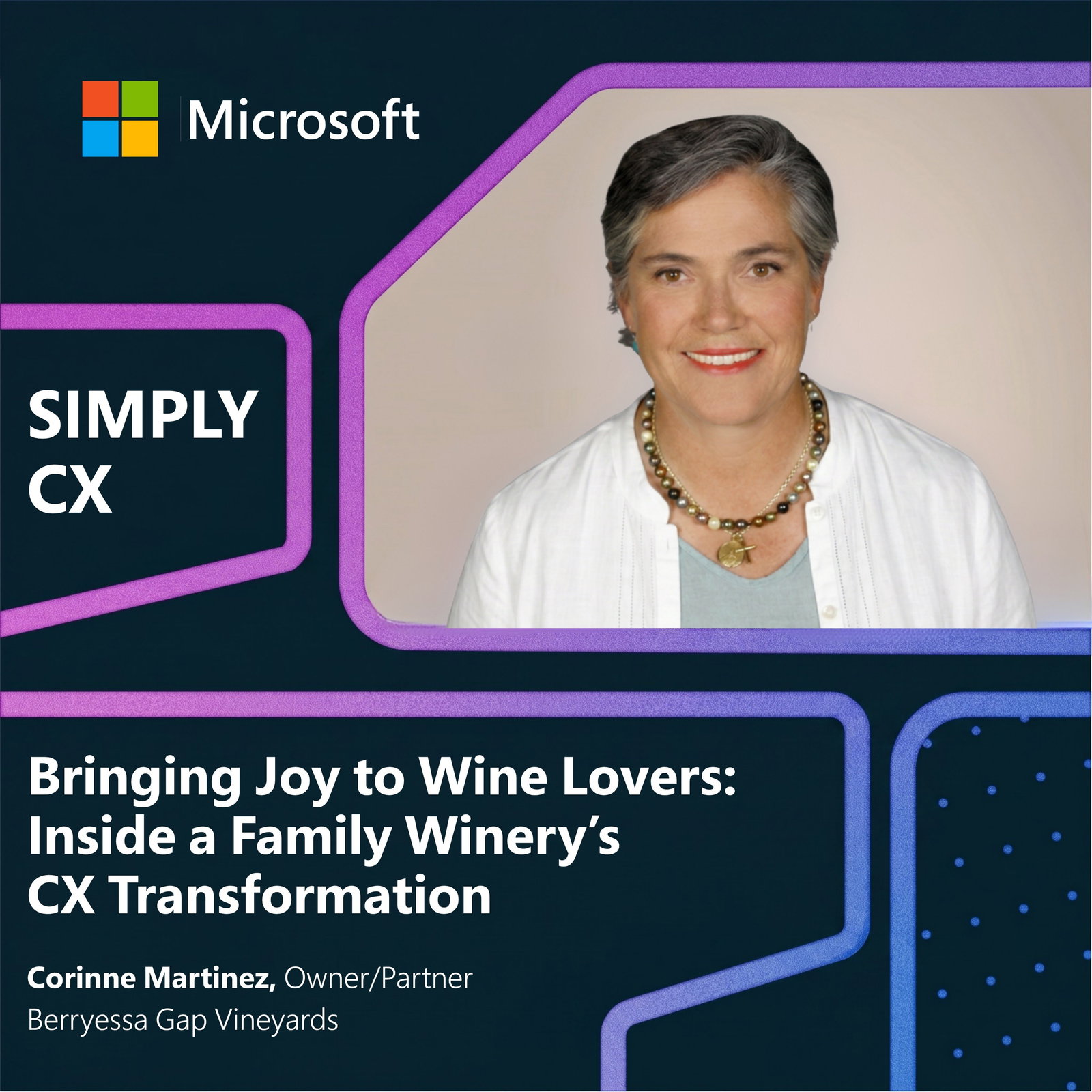
In this episode of Simply CX, Nicole McKinley sits down with Corinne Martinez, owner and partner of Berryessa Gap Vineyards, to explore how a family-owned winery transformed both customer and employee experience through intentional CX leadership an...
In this episode of Simply CX, Nicole McKinley sits down with Corinne Martinez, owner and partner of Berryessa Gap Vineyards, to explore how a family-owned winery transformed both customer and employee experience through intentional CX leadership and smart use of technology. From vineyards to tasting rooms to Teams Voice and chatbots, Corinne shares practical lessons on communication, change management, and delivering joy at every touchpoint.
You'll walk away with:
• How small, practical technology changes can dramatically improve customer and employee experience
• Why communication breakdowns are often the root cause of CX failures—and how to fix them
• Real-world lessons on applying change management in a small, people-driven business
Whether you're a CX pro, team leader, or brand builder, this episode will inspire you to see customer experience through a more human—and more powerful—lens.
Mentioned in this Episode
- Microsoft Teams Voice and Auto Attendant
- Chatbots for customer self-service
- Change management best practices
- Wine club and tasting room experiences
- Vertically integrated winemaking (from rootstock to bottle)
🎧 Produced by Larj Media
📩 For more CX insights, follow Nicole on Linkedin
If you have questions or comments about CX email us: SimplyCX@microsoft.com
Additional Resources
Guest: Corinne Martinez
Role: Partner & Chief Operating Officer
Company: Berryessa Gap Vineyards
Focus Areas: Customer experience, winery operations, technology-enabled CX
| we thought we knew the most frequent questions and the types of questions that we would get, but we're finding that we are getting questions that we didn't think of. And so that kind of opened our eyes like, "Wow, we didn't know people would ask that type of a question of a chatbot." | |
| Hi, I'm Nicole McKinley. I lead global customer experience at Microsoft. This is Simply CX, where we bring you stories about what it really takes to deliver great customer experiences. CX isn't simple. So in each episode, I sit down with leaders who are in it every day, unpacking what they're learning, what's working, and what they're still figuring out. Today, we have the awesome opportunity to learn about how technology has made significant experience impact for Berryessa Gap Vineyards. In the wine industry, customer experience really is everything. From tastings and events to wine club relationships, the way people connect with a winery often determines whether they come back or simply move on. And for a family-owned operation like Berryessa Gap Vineyards, that experience depends not just on what's in the bottle, but on how well the team stays connected behind the scenes. Joining me today is Corinne Martinez, co-owner, president, and chief operating officer of Berryessa Gap Vineyards. Corinne, welcome. So how did you first get involved in the winery business? | |
| Well, I'm a farmer's daughter, so we come at it from the farming side, as we like to say. So I grew up on a farm. And we grew a lot of different crops, not necessarily grapes at that point, although my dad did start a grapevine nursery business in 1969, selling rootstock to vineyards growers in Napa and Sonoma. And then fast forward several years when my brother came back and started farming with my dad, he decided to plant a vineyard. And initially, the thought was, "Well, let's sell some grapes to the people that we sell vines to," because people in Napa are always looking for additional grapes that they can use in their wines. But the best way to show people what kind of good grapes you have is to actually make wine. And then we made some wine and showed it to people, and they said, "Well, that's pretty good." So then we sort of accidentally became a winery because people wanted to buy the wine that we were making instead of just using it to buy grapes. So I joined my brother and our other partner in the winery and became an integral part of it, focusing on the customer experience. And I helped start the customer experience side, the tasting room, the wine club, and all that we do to help the customers enjoy the wine and enjoy the experiences. | |
| And I know you haven't always been involved in the day-to-day operations. What did life look like for you before you got so deep into customer experience at the winery? And how did you kind of make that leap into customer experience? | |
| Correct. I was an absentee owner and partner for many years as I was working in the technology industry, also focused on helping customers, in that case, get value out of their investment. And I guess I've always been customer-centric in that way, that if the customer is getting value, if the customer enjoys their experience, if the customer has a great experience with the product or with the person they're dealing with, they'll be back. And for me, bringing that back into the wine industry was pretty easy because it's a great product. It's a product that's built around connection, and it's an integral part of how I grew up and how we think about bringing together just people. Our tagline is bringing joy to wine lovers. It's really about wine and food and community and coming together. That was my passion, and that's what brought me there. And I want people to experience that joy. And that's what you get if you slow down, take the time to just share a meal and share a conversation and have a glass of wine to go with it. That's a great way to stay connected to people and what you want to experience in life. | |
| So as chief experience officer, what does that really entail? And what are your big areas of focus, day in and day out? | |
| So the first thing I would say is I want to empower the people who are daily in our tasting rooms, talking to customers and face-to-face with them. We have multiple tasting rooms. We have a lot of people who that is all they do for us is interface with the customers. I wear a lot of hats, and I like doing that part, but I've got a lot of other things I do behind the scenes. So number one, for me, it's empowering them, enabling them to deliver that incredible experience every time someone walks in the door. What is it that's going to help them be able to do that? So I try to bring tools to the team and experiences to the team and allow them to deliver that to the customer on the company's behalf. | |
| And so before we kind of dive deeper into the tools and some of the very cool, I think, technology elements that you've brought to bear. If you take a step back and you think about Berryessa Gap Vineyards and what's unique about the experience that you deliver, what are the things that stand out for you in terms of either differentiators that are like, "Wow, that's super unique," or challenges, opportunities perhaps that you saw as you came into your chief experience officer role? | |
| Yeah. So it's a crowded industry. So I'll start with the challenges. There's a lot of choice for consumer, which is a great thing. There's a lot of wine out there. People have different palettes. So those are things we always have to think about in terms of how can we stand out? What does differentiate us? What does make us unique? And one of the unique experiences that we can provide to our customers is that I mentioned the grapevine rootstock business. We're one of the only completely vertically integrated companies, if you will, or families, in the industry, where we actually have a nursery where we grow grapevine rootstock that then gets put in the ground, that grows the grapes, that then we have our own estate vineyard. We harvest our own grapes. We bring them to our own wine facility. We make the wine and we sell it directly to the consumer. That might sound like an obvious thing, but frankly, that's not how a lot of wineries work. A lot of wineries don't own grapes. They buy them. Very few vineyard people have nurseries. And so we can bring people into our town, into our winery, and we can offer them a tour that says, "We're going to start with the roots right here. And this is the stick that goes in the ground that grows this grape, and then here's the grapes that comes off, and here it comes to our winery, and here's where we crush it, and here's the tank it goes into, and here's the barrel it's in, and here's the bottle it's in, and here's your glass." And for people who are really into wine, that's kind of a geek-out experience, because-- | |
| That's very cool. Yeah. | |
| --very few people even think about the rootstock when they think about wine. They think about the grape and what's the variety. So these are kind of really geeky wine things, but it does make for a really compelling story. We have a couple of winemakers we're working with right now, both women who one is listed on Forbes 40 under 40, the other one's got multiple 100-point wines from Robert Parker. So we're making great wine as well. | |
| I'd like to dive deeper into the experience that customers and your employees have day in and day out, and just better understand what that experience entails. And then I know you've introduced some pretty great innovation, as well, using technology to enhance that. But before we go to the innovation side of things, what does a typical day in the life look like for your team that you're leading at the vineyard, the winery, as well as what does that look and feel like for customers? | |
| So we have two locations where we have tasting rooms that are open to the public, for people to make a reservation or walk in for a tasting experience. And and also, we offer choice when the customer comes in, if they're familiar with us and they're a wine club member, or maybe they're bringing their friends, or maybe they're just coming back themselves, we can offer wine by the glass, or we can offer flights of wine. Some people buy bottles of wine and go sit outside and sell charcuterie boards. And so we have a number of experiences that we can offer to people as they walk in the door. And then, as I mentioned, you can make a reservation to come in. And for our customers, they are choosing either our downtown location, which is in historic downtown Winters, in our original winery location, which is a newly remodeled tasting room. It's kind of an elevated experience. Or if we go out to our winery, it's a lot more casual. We have a big giant outdoor patio, and there's an adjacent brewery. So there's beer and wine in one location. There's food trucks. There's live music. It's a very casual, sort of picnic, family-friendly environment. So we offer a lot of choice to the consumer on kind of what it is they want to experience. And what that turns into for our team is needing to be prepared to deliver on any of those experiences depending on where the customer is and what it is that they're looking for. So that's the tasting room experience. I mentioned that we also have a wine club. And for the club, they interact with our wine club manager. We have wine-club-only events that we invite them to. They, of course, are welcome anytime in a tasting room. They have an online account that they can manage their club, and they can choose what they want in their club at any given time. And they can ask to speak to the wine club manager if they have any questions. So that's the consumer side of it. On the production side, our team in the winery, who's actually there making the wine, taking the direction from the winemaker, they're also on tap to do winery tours. So customers can book a tour of the winemaking facility, and our production team needs to be equipped to do that. We're so small that everybody has to be able to do everything kind of. So even our guys in the production room, they sometimes have to put on a nice shirt and stand in the tasting room and pour wine for people too. | |
| Everyone's wearing multiple hats and has to flex clearly and meet customers where they're at based on the different needs and desires that they might have. | |
| Exactly. | |
| So many moving parts. | |
| Very much so. | |
| As you take a step back and you think about how you are juggling the consumer experience with the production experience, what elements are most critical, from your perspective, to ensure that the end-to-end experience is optimal and ideally able to really be successful and bring that joy in the glass to your end consumer. | |
| Yeah, it's basic in the sense that it's about being connected and being on the same page, which sounds easy, but our production team is in the back. We're not physically co-located, and not everybody's there at the same time of the day, every day. The production team starts early in the morning. Sometimes, the production team at the winery where we have a tasting room is actually leaving by the time the tasting room staff shows up because we are open a little bit later on Thursdays and Fridays out there. And then the other location is in downtown a couple of miles away, so they're not in physical proximity. And then we have an event venue across the street. So just staying connected and staying on the same page for the whole team. And we're a small team, but that is, at the end of the day, probably the biggest thing that we always are working on. It's always about communication and are we all on the same page? And try as we might. If something happens that doesn't go well, we'll look at each other and go, "What happened?" There'll be like, "Breakdown in communication." | |
| So connection, collaboration, communication. And to give perspective, what type of impact had you seen or had you experienced when there was miscommunication? Because I'm sure that's happened from time to time previously. | |
| One of the pain points that I wanted to overcome is, as I mentioned, people weren't always there at the same time. And this would directly impact the customer. The customer would call. They were calling for the Wine Club manager. Well, the Wine Club Manager wasn't there at that time. The production person had to take a note, write it down a piece of paper. That sits on the desk and the Wine Club manager didn't show up at that facility for three days. And meanwhile, the customer doesn't get a response. So those kind of things were really painful and directly impacted the customer experience and was really a driving force for me to try and make some changes and leverage some technology to get that corrected. | |
| Was there a key moment in time where you're like, "Okay, I have to solve for this. It's a non-negotiable." Was there a turning point? | |
| Probably during COVID when it got even worse because we were forced to be even more separated. And in some instances, on the customer side, we had to-- well, we did have to shut down for a while. And then we got to reopen, but we had to interact with customers in a very different way. And with my background, I knew the technology was there, but we weren't leveraging it, and I needed to make that happen. | |
| And so what did that look like for you and for the winery, which clearly was not fully tech-enabled? I mean, I imagine even the concept of saying, "Oh, something's got to change, and I want to introduce a technology solution to improve our employee experience and our customer experience." That, in and of itself, is significant. What did you do? How did you start? | |
| I said, "We're not going to pay the phone company anymore. We're going to unplug these phones. And it's going to all ring on the PC that's sitting there on your handheld device. And it's only going to ring after the customer has been routed to the right person. And we're not going to have pieces of paper sitting around because there's not going to be a phone call that gets answered by one person that needs to go to another person." So I knew the capability was there, and I knew I could go to the soft phone solution. I also know that just because you want to make a change with technology doesn't mean everyone's going to be happy nor that they're going to come along. And there's this discipline called change management that needs to be applied to actually get people to work differently. But given that I had some background in that, I was confident that I could get through a change management program with the team by convincing them of the value and how it was going to help them. So really, then it just became a matter of how do I get this up and running? And fortunately, got a great amount of support from Microsoft to make that happen. And it's helped the team not be frustrated by finding a message that was intended for them three days later. | |
| And so what was the actual solution that you implemented? And what did you see in terms of the impact to the customer experience as well as the employee experience? | |
| We implemented Teams Voice and automated call attendant and also routing. And I created an entity so that the team that's working in the tasting room, that if a person says that they want to make a reservation, that's why they're calling, it's going to route right to the person who's working. If they're busy with another customer and they can't take the call, it actually goes into a voicemail or into a queue that anybody who's working has access to so anybody can pick it up and make the reservation and return the call to the customer right away. That helped with the customer getting better callback. It helped with the team being able to be more responsive and not disrupt their current work. It's hard to remember, but if you're working in the tasting room and you've got three tables and you're working and the phone's ringing and you're like, "I got to go answer that phone," it can be very disruptive to the experience. So now with the soft phone, we don't actually hear it initially until the customer chooses to come to that location, right? We also went down from three telephone numbers to one telephone number. So that was a lot of reduction there. | |
| And that's helpful because now customers are calling one place and they're getting routed to the right place before-- the [test room?] team might pick up the phone, but it was a call for production team. And the production team is in the back, and that's why they didn't answer the phone. In hindsight, it was painful. And I don't think people realized how painful it was till it wasn't a pain anymore. And then they were like, "Wow, I don't miss messages anymore," which is amazing. | |
| Yeah, this is a game-changer. Yeah. | |
| Yeah, yeah. | |
| Well, and the impact, right? I mean, you've touched on a number of different areas. What would you say was the biggest kind of impact that you saw? And did you measure anything that kind of jumped out for you that made it even that much more compelling of like, "Wow, this is that game changer." | |
| The tangible measuring I did, honestly, was on just cost savings of I no longer pay the phone company for three different phone lines. So I was able to get rid of that expense and just pay the fees that I'm paying for the software that I'm using. And then I measure the value of the customer experience based on that I know that messages aren't getting left on a desk for three days. | |
| Well, I mean, I think you're spot on. I think that's the key, is ensuring that you're measuring both tangible business outcomes like cost savings and the reduction that you saw, in addition to what might be more qualitative in nature in terms of customer sentiment or feedback, or, again, back to joy where you started. So, Corinne, in addition to empowering your team through phone and the team's solution, what, if anything, have you done to enhance the consumer's online experience? | |
| So we have implemented in a very small way now, but intend to enhance it, the chatbot on our website. So a way for us to answer simple questions for the customer when they come to our website to put the little helpful chat guy out there. As I said, we've got a small implementation of it now. We need to expand that. We wanted to test and see what we thought people would use it for. So I think there's a lot of potential there. I mean, I see it on other people's websites. And I think what we have today, and we're just scratching the surface. So I look forward to bringing that forward a little bit more. | |
| So with the chatbot, I understand it's a small kind of pilot implementation. Are you seeing anything surprising or interesting in terms of how customers are engaging with the chatbot? And are you seeing new use cases, new specific ways that you can really add experience value through it? | |
| I think that one of the things that we're learning from the pilot is that we thought we knew what the most frequent questions and the types of questions that we would get, but we're finding that we are getting questions that we didn't think of. And so that kind of opened our eyes like, "Wow, we didn't know people would ask that type of a question of a chatbot." We didn't anticipate that, so we don't have an answer. And so we started out with some simple items that we thought would be really helpful. And then we pointed to a set of answers. And we found out that wasn't sufficient. So we got work to do there. | |
| Well, and I imagine soon you can tap into the chatbot, not only reactively answering questions, but proactively making recommendations, suggestions. "Oh, hey, Corinne, I see your favorite wine to drink in summer is the Sauv Blanc. We have a sale going on. Buy one case, get a second case free," whatever it may be. | |
| Exactly. Exactly. When we do promotions like that, we are limited today in the way that we can get that information out. And that's exactly a scenario that we would use that for as we-- we put it in our newsletter. We probably put it on social media. But the people that are coming to us, we ought to be able to push that to them when they get there. And with some intelligence, like you said, about what they normally buy. | |
| Well, I think the tech will then connect and can connect the online experience with the in-person experience, with the phone call experience, you name it. And I think that's where the real power starts to come into play in terms of creating incremental value and differentiation. | |
| Lots of opportunity. | |
| Well, I'm a firm believer that no change, especially a process or a technology one, is successful without real usage, real adoption, and buy-in that comes with that. What did the change management approach look like that you took? And even though you're a super-seasoned change leader, was there anything that surprised you as you approached this kind of change in a small business venue? | |
| There's always a surprise somewhere, but just falling back on the actual using the proven methodology and discipline that exists of starting with why and answering those questions for people so that they get their initial buy-in. And then knowing that their next question is, "What's in it for me? How is this going to impact me?" And being able to translate that to them in a positive way, making sure that then we're able to provide them with the training that's needed and any resource so that they actually feel comfortable doing it. | |
| And doing this with enough lead time, that's one of the things, too, that we started talking about, "This is the change that we're going to make," and started getting people to try to do the online training that's available through Microsoft for Teams, so that they knew that this was coming. And then being able to get the feedback from them on, "Is it working, and what's not working?" You think you can take shortcuts, and you can't. I guess that's what I learned, like, "Well, this is my team. It'll be different." | |
| "And this is my family business. Oh, I've got this," but you still relied on those change management practices and applied them in your own way. I think that's great advice and perspective. The other thing I take away from your experience here is no matter the size or complexity of the change, whether it's impacting a small team or a global enterprise, no matter if you're introducing a complex AI-driven ecosystem solution or a more simple technology solve like Teams Phone or M365, a change is a change. And being thoughtful about how you introduce that change and really approaching it with a people-first mindset and ensuring you're bringing people along and equipping them and empowering them to take advantage of the benefits of the change is key. | |
| And so when you think about getting to the other side, what's next as you look ahead? Do you feel like you've implemented the level of innovation and change in experience that you've aspired to? Or do you have anything new on the horizon up your sleeve in terms of how you're thinking about innovating the experience? And again, the experience for customers as well as for your employees. | |
| Oh, I have so many things that I'm wanting to implement going forward. The agent idea and what agents can do to help us be better at giving the customer what they want. We know. We have data now. We can look up what does a customer buy? "Oh, you like this wine. We're going to tailor it to it." But a lot of times, there's a lot of heavy lifting to do that, where AI is just going to tell us that, and then AI is going to tell us what to ask them for, right, and what to offer them. | |
| There's so much that I think about that I just can't implement because I don't have the-- I am the IT person, unfortunately, at my small business, right? And so I don't have enough resources to do everything that I want to do. But there's endless opportunities. I'm very excited about some of what I'm hearing is available with agents and with mainline attendants and things that are going to be able to-- even the auto attendant can be improved with mainline attendant just because people call and they say, "When do you open? Is there music today? What's this?" It's all posted someplace. We have that in the data file. Just tell them that if that's what they want to know and help them get their information faster so they don't have to wait and say, "Will the person in the taste room answer my phone?" There's little things, and then there's bigger things. And the people that are out in the vineyard that are on a mobile device and how that data comes back, sometimes we need to wait for them to actually come back from the vineyard, whereas if they have the right technology with them, they could be sending data from the vineyard in the moment, would make decision-making improved for the viticulture team, for the winemaking team. So I see a lot of opportunity with AI, and I just want to be able to get there faster. | |
| The great news is that with AI, you can manage an IT team of AI agents. And I think AI has the power to really help all those different hats that your team is wearing, yourself included, and really enable that scale. And then it really frees up you and your team to focus on the things that are uniquely human and uniquely personalized that really your customers value most, so exciting times ahead. | |
| Very much so. | |
| I really enjoyed connecting with you and hearing about how you're bringing innovation, even simple elements of technology innovation to change the experience for your winery business, not only for customers, but for your employees as well, so really appreciate the time. | |
| Thank you very much. It's a pleasure. | |
| Thank you for listening to Simply CX. I'm Nicole McKinley. Our show is produced by Larj Media. That's L-A-R-J Media. Special thanks to Elizabeth Machado. To find out more about today's guests, check out the links in the show notes. If you have your own challenges or questions, email us at SimplyCX@microsoft.com. And please share today's episode with someone you think could learn from it. And follow me on LinkedIn to keep the conversation going. |