
 Apple Podcasts
 Spotify
 PocketCasts
 Amazon Music
 YouTube
 Agentic AI in Action: Rethinking Sales, Scale and Customer Experience
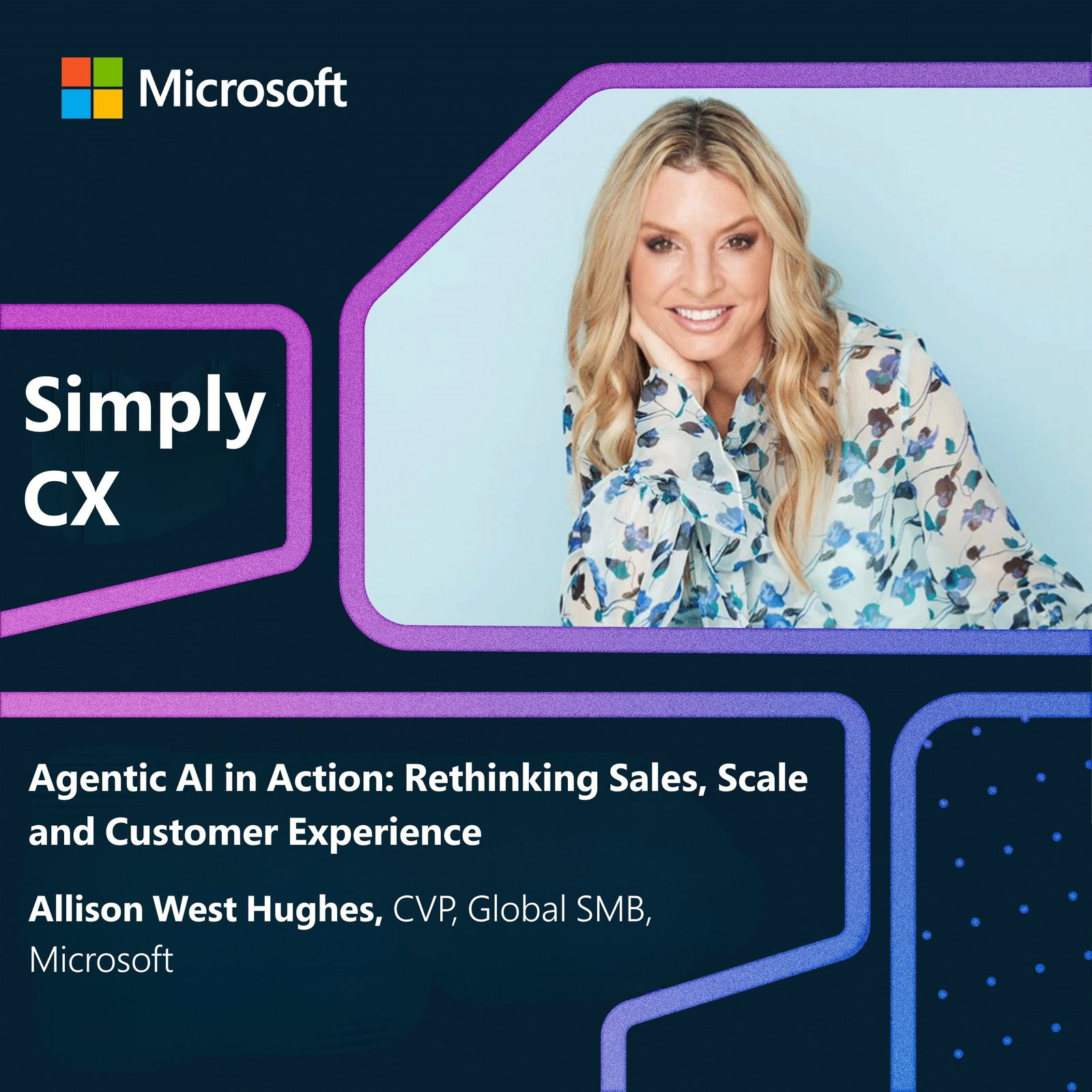
In this episode of Simply CX, Nicole McKinley sits down with Allison West Hughes, Corporate Vice President of Global Small and Medium Business at Microsoft, to unpack how Microsoft became its own “customer zero” by deploying an autonomous AI sales ...
In this episode of Simply CX, Nicole McKinley sits down with Allison West Hughes, Corporate Vice President of Global Small and Medium Business at Microsoft, to unpack how Microsoft became its own “customer zero” by deploying an autonomous AI sales agent—Agent Riley. Together, they explore what it takes to balance scale, trust, privacy, and human-centered design while transforming the Small and Medium Business customer experience with agentic AI.
You'll walk away with:
• How Microsoft used AI to solve a real CX and scale challenge in its SMB business
• Practical lessons on testing, iterating, and governing agentic AI responsibly
• Why SMB customers are embracing AI-led experiences faster than larger enterprises
Whether you're a CX pro, team leader, or brand builder, this episode will inspire you to see customer experience through a more human—and more powerful—lens.
Mentioned in this Episode
• The concept of “Customer Zero” at Microsoft
• Agent Riley (Autonomous Sales Agent)
- Agentic AI and the Frontier Firm mindset
- • Data integrity, privacy, and legal considerations in AI deployment
- • SMB adoption trends of AI and Copilot agents
🎧 Produced by Larj Media
📩 For more CX insights, follow Nicole on Linkedin
If you have questions or comments about CX email us: SimplyCX@microsoft.com
Additional Resources
Guest: Allison West Hughes
Corporate Vice President, Global SMB, Microsoft
Leader of one of Microsoft’s fastest-growing and most complex global organizations serving millions of small and medium businesses
| I laugh and I look back and I think, "Boy, our ambition was high there, but we didn't have any grounding on what the phases of AI productivity were going to-- how they were going to change or any framework for what we should expect." So maybe there's something there about not knowing what to be limited by to go ahead and start designing and dreaming something big. |
| Hi, I'm Nicole McKinley. I lead Global Customer Experience at Microsoft. This is Simply CX, where we bring you stories about what it really takes to deliver great customer experiences. CX isn't simple. So in each episode, I sit down with leaders who are in it every day, unpacking what they're learning, what's working, and what they're still figuring out. Today's guest is Allison West Hughes, corporate vice president of Global SMB at Microsoft. She leads one of Microsoft's most complex and high-growth organizations, serving millions of small and medium businesses around the world. At Microsoft, we talk internally about Customer Zero. And Customer Zero really means trying our own technology and solutions on for size, experimenting, growing new capabilities so that we can confidently share with customers the real value that the tech brings. So Allison, you led a project where Microsoft became its own Customer Zero for agentic AI as a response to a very real CX and scale problem. From your perspective, what were the biggest challenges that you saw in the experience that the SMB customers were having? Let's start with how they engage with Microsoft traditionally. |
| Customers primarily engage with us through our partner network. About 80% of our SMB revenue is transacted through our incredible partner network globally. And then about 20% of them engage directly with Microsoft. They come to our website. They're interested in signing up for a service. They bring their credit card with them, and they become a paying customer of ours directly through our e-commerce platform. And so therein begins the beginning of some of the complexity in that we're designing kind of for two models all of the time. One is a partner lab model, and one is the engagement with customers directly. |
| And with that, given the complexity of those two different models, what was the one or two kind of big challenges in either the direct or the through partner model that you saw, "Gosh, this is ripe for AI"? |
| Even with thousands of sellers that are devoted to these customers and in our partner motion, as well as our direct business, even at the most stretch we could possibly imagine, we've made all these modifications and improvements to our model year over year over year, whether it's like propensity models or really just trying to get sellers engage with customers at the right time in their buying journey. And we've iterated and improved on that over time. We still have this incredible potential to continue to expand and grow in SMB. And so the answer to my scale question was certainly not to continue to hire more sellers, but instead to think about ways to improve the productivity of the sellers that we have and ways to engage with our customers at even greater scale than what our traditional model had allowed us. |
| And so as you say your traditional model and you're talking about sellers, was this to clarify sellers from a direct engagement perspective, or did it also include the sell-through partner model as well? |
| It's a little bit of both. The idea and the inspiration maybe came from our direct business to begin with. And then as we started to think about the operating model, we contemplated it as impactful to both our partner-led business and our direct business. |
| Got it. And so you started on this kind of AI journey. How long ago was that? |
| Oh gosh, it was almost two full years ago Being in a scale business, you're always thinking about how do we improve? What do we do next year that's going to drive outsize impact with the investments that we have? And so we started kind of ideating on that a few years ago. And I remember we had an off-site in Atlanta, and I brought my leadership team in, and we just gave ourselves space to be creative about it and came up with five or six different scenarios where we thought AI could help. And then we kind of put that together, and then went back through the end of our planning process and began the new fiscal year in the July timeframe. And that was that lightning rod moment where we had something that created a greater sense of urgency for us than maybe what we had in hand when we started to do our workshop in May. |
| What was your approach, and how was it received at that early stage? Were people fearful of the AI? |
| At that point, I don't think there was a lot of fear yet. Fear came in later. It was more just curiosity. How can we leverage this to improve the outcomes that we're driving, the experience for customers, the life of our sellers, the clarity which we deliver our results to our management? We saw this thing developing and we're really excited about where and how we could apply it in our environment. And we had a really good kind of cadence of just continuous improvement and looking at our businesses and continuing to make small modifications that we thought would drive outsize impact. And we did that generally through our partnership with our marketing organization and improving signal type and signal quality. So we allowed our sellers to engage at the right time. So maybe that framework of continuous improvement and of always contemplating when is the right time for the person to be involved versus a digital nurture set us up well to be able to embrace this new platform that we created with Agentic AI. |
| And so you mentioned you came out of this workshop with your team with five, six, a number of different ideas. What were the big ones that were highest impact that came out of that? And where did you go from there? |
| One of the ones that ranked highest was an AI coach for each seller. And so we had a large sales force, still do, and our product portfolio is really broad. And we have different offers and different execution opportunities. And so we thought, what if an AI agent could be an always-on coach for each seller so that they had this safe place to get immediate answers and get right back to their days? And so that was the one that emerged top out of that workshop. Now, what's funny is that wasn't the one that we pivoted and put into place right away, but that now exists at Microsoft. |
| And MCAS, which is our customer and partner organization, created that and launched it. So it was a good idea. It just wasn't the one that we needed first. |
| Well, and who wouldn't want an always-on coach? Sign me up, right? |
| Yeah. |
| So given that the always-on coach wasn't the one, what was the one? And how did you get started? |
| The one that we decided was a always-on customer outreach. And looking at the surface area of S&B in that kind of infinite universe of customers and opportunity, we had a lot of customers that we did not have the human capacity to cover. So when we rolled into our new fiscal year, which was that July following that MEA workshop, we had a moment in time where we realized that, and we also realized we've got just as high of ambition for what we're going to get out of those accounts that we can't cover as we do from the accounts we can cover with people. And so connecting that with some of the conversations we've had in the spring, we thought, what if we had an agent that could reach out to these customers and help them on their buying journey, and then eventually potentially either close that opportunity or hand it to somebody that could deal with the complexity for it. And so, we imagined a place where on the smaller end of our customer portfolio relative to their spend with Microsoft, how can we automate that and allow the same level of service, whether they had a Microsoft seller or they had an AI agentic seller? That was really the inspiration for the creation of what became our autonomous sales agent. We chose the name Riley and that became like the [codeme?] for our project. |
| So Project Riley or now known as Agent Riley? |
| Yes, that's right. |
| And so, you talked a little bit about this, but as you translated the initial idea into a vision, into an implementation plan, what was it that you really set out as a team to specifically achieve with Agent Riley. |
| So what we set about to do was to drive the same growth, whether there was a human involved or a sales agent involved on customer cohorts. What we learned in that aspiration was to do tests on cohorts of customers and then change the variables and see how the response improved over time. And so, I'll give you an example of one of these variables. Maybe the initial outreach was simply to Allison. And then the next week, we would create a cohort of customers, and we would add context based on the recent engagement with marketing. And then we would look side by side, "Hey, did just the kind of more vanilla outreach get a better response, or did the one that reference that Allison has been engaging with marketing assets that look like this? And might I have curiosity about the technologies that I've engaged with?" Somewhat predictably, the context really mattered and improved our engagement rates and our reply rates and opportunity creation rates. So what we did was we ran these batches, for lack of a better word, through the course of that first year to see how we could continually improve the experience for our customers. And so, we'd change a variable. We'd look at it. We'd stare at the data, and we kind of created this chart of like, "Okay, this number of customers had these outcomes, and we changed this variable that looked like this, and these are the outcomes we drove." And with the mindset that we completely understood that we would not start with the perfect idea, the perfect execution, and it gave us a more digestible structure, so it's more of like a sprint structure of what variables do we want to change and how do we want to see that evaluated. |
| Clearly, you and your team, you had the big idea. You had a right platform to test and iterate. And obviously, you were rapidly learning. At what point did you kind of realize, "Wow, this is really impactful and working, and we need to move from kind of experimentation or pilot mode to full-scale"? |
| Yeah. I think we're still working our way through what full-scale looks like. So the initial technology came out in English that limited the number of markets that we could pursue. And then, privacy became maybe one of the other big challenges that we had to face. So if you lay a kind of Venn diagram of markets that we had language support and then markets where we had the greatest flexibility with privacy and permissions, that was really where we started to find out what the true cohort of customers were that we could engage with Riley. And we went through a lot of decision-making within our privacy group and our legal group to create a separate category of outreach that was not human or seller and it was not marketing. It was agentic outreach. And so I would encourage anybody thinking about this to get close to your legal team sooner rather than later. Make sure that you've got their buy-in on your approach, and their answer might be different than the answer that we got from Microsoft's legal. So I think this is a developing space where people are looking for peers to provide guidance and also looking to be able to establish their own privacy rules. And so I'd encourage you to really look at your legal team and bring them into the fold really early, because we got our way through that, but it definitely took us a little time to land on what our decision was there. And there were also a lot of lessons learned about data integrity, making sure that the customers that were emailing were the customers that were truly SMB customers. And so sometimes there's some overlap there with customers might be listed. |
| For example, an enterprise customer could show up in our online business because they wanted to create an instance of Azure for something that they just wanted access to right away. So then when we started emailing these customers, we found out that we were catching some of the enterprise customers in our outreach. And that was a weird experience for them because they've got 50 people from Microsoft on site. And so they're a little bit confused as to why they're getting an email from an AI agent. So we had some moments of learning along the way and just making sure that we had the right balance of risk, accountability, and progress as we worked our way through those. |
| So I haven't experienced Riley myself, but if I were to interact with Riley, would I know that Riley is an AI agent, or does Riley show up for me or any customer truly like a human? No different than one of your sellers on your team. |
| Our initial construct was over email, and you would just see that the email was created leveraging AI. It would be in the footer as a disclosure to those customers. But what we found is that the customers were completely content to get their questions answered, to engage with the AI agent, and to our surprise at times, improved conversion over dealing with humans. And so that was maybe an unexpected outcome that they replied or responded more favorably at times to human and traditional marketing outreach, traditional call outreach. And so we had higher engagement, higher qualification rates than seller-led prospecting. And the customers interacted with the AI agent candidly, directly. They felt like they could speak in plain terms without filter. So what we learned was somewhat surprising, was that they felt like the engagement was less transactional and was more helpful to them. So the AI agent was more oriented on the tone of the conversation, the back and forth instead of thinking about, "How am I going to get to this outcome that I'm trying to drive as a seller?" So that was maybe some of the pleasant surprises of the early days. |
| Super interesting. And how many customers is Agent Riley interacting with today? |
| So like we talked about, we've been running these cohorts. So now all in, we have over 75,000 customers that have engaged with Riley, and we continue to grow and scale that every week. |
| Impressive. Wow. Were you able to take any of the learning from that early on work with Riley and actually use that to then think about coaching and training and/or other ways to improve human interaction as well? |
| We've not yet taken that step, but I think that's a great suggestion. One of the things that we did was, as Riley was uncovering more complex conversations or complex needs for the customers, we passed along that customer to a human to continue to qualify, and that gave us the chance to expand the conversation a little bit more The other thing that is unique looking back is this is before Microsoft had grounded on the frontier firm and the way that AI would begin by assisting humans. And so in our maybe naivete, we imagined an AI impact that was like the third wave of the frontier firm, which is a fully autonomous worker working on our behalf, doing work and helping us scale. And then in our original inspiration, we're just starting to get to that today. We also wanted them to be able to close opportunities, to actually transact. So if it's a customer that just needs some add-on, let's just say they need another seat of office because they expanded their employee population. We wanted to make that frictionless for them. Just tell Riley what you want, and we'll close it out for you. We don't even have to involve humans. |
| What we learned as the market matured was that that was very, very frontier. So I laugh and I look back and I think, "Boy, our ambition was high there," but we didn't have any grounding on what the phases of AI productivity were going to-- how they were going to change or any framework for what we should expect. So maybe there's something there about not knowing what to be limited by to go ahead and start designing and dreaming something big. Where I got really lucky - and this is one of the great things about working at Microsoft - is I raised my hand and I said, "I've got this idea, and it's how are we going to cover this cohort of customers?" And Judson Althoff, who's now our chief executive officer of our commercial business, said, "Yeah, go for it." And when he did, then we were able to work with engineering and get support and cycles from engineering, who was also looking for great ways to develop AI capabilities. And so that sponsorship really helped us get out of the gates and start to get to work. |
| I bet the power of executive sponsorship and just enabling acceleration of any idea to come to fruition is super critical in any work. And seeing that again and again across the industry in terms of the power of AI and applying it, but having that tops-down sponsorship to remove roadblocks and just really pave the way for that unconstrained thinking is just a huge accelerant for sure. So what was your own kind of personal biggest learning as you navigated through introducing AI into a business that really didn't have it before? |
| We have a formal review process at Microsoft, and so I share this willingly because it was my reflection as part of that review process last year, where I could have been better. What I learned throughout the year was there is a tension between what impact you can drive, the size of the cohort of customers you are going to reach, the potential risk of doing something wrong and reaching out to too many customers at one time and doing something wrong, and maintaining that prioritization within the company on engineering cycles and other things. And so throughout the year, we would shift, right? We would get, "Hey--" the push is for more in your impact. And so we'd say, "Great, we'll pivot that way," and then the push would be maybe in a different way in the future, like, "Hey, let's pause. We got a few enterprise customers captured in that last cohort. Let's make sure that we've got the right data integrity to ensure that that happens minimally, if not never." And so I think I probably followed a path that a lot of amazing product people follow with absolutely no experience as to how I was going to go through it, which is-- |
| No playbook, right? |
| --what are you developing? What is the outcome going to be, and what is the impact this year? What's the future direction? So I learned a lot through that and and grew a lot as a leader as I kind of balanced the different agendas at hand. We particularly targeted some of our smaller customers because we felt like there was less risk there. But if you can imagine smaller customers also have smaller spend, which adds up to less dollars at the end of the year. And so just kind of working our way through that, I feel like I still am doing that, honestly. And now we're adding five new languages and we're able to scale more effectively so the products matured a lot. That was probably like my biggest learning that year. |
| Well, I really appreciate you being so transparent and reflective in sharing your learning. What you described is the leadership challenge, quite frankly, that I'm experiencing. I think that no matter who you are in the industry, you're probably experiencing in some way, which is how do you balance speed with quality in this never-before-seen rapidly changing landscape, where there's probably more that we don't know than we do, so much learning to be had daily and figuring out what are the right bets to place, and then how do you course correct if you've learned something that didn't materialize the way you wanted it to. So thank you. |
| That makes me feel better. |
| You're not alone. You're not alone. In the spirit of learning, you mentioned the example where there were enterprise customers that had outreach through efforts that your team was driving by accident. The CX domain, we often talk about never waste a great crisis. Never waste the opportunity to rebuild trust. How did your team and how did you as a leader go about recovering from that experience or any other bumps along the way that you ran into? |
| Well, I think practically, we had moments where we paused and we tried to improve our control mechanisms to prevent it from happening again. That was like job one was to figure out what we were going to do structurally so that that didn't continue to happen. The other thing is I reflected on it, I felt like maybe this is a great opportunity to educate. And so I left myself open for those sales leaders to say if your customer's been contacted and they're kind of curious about AI and they want to know what the heck that was, I'm happy to tell them all about our journey, our experience, and in doing so, maybe create some ideas for them around places that they can innovate in their organization in partnership with Microsoft. And so I tried to turn it into an opportunity to open up a conversation about AI and agentic AI. And I have to say the leaders, my peers, met this situation with a lot of grace. And so it kind of went from a real tense moment into something that was palatable and we could handle. So I appreciated their partnership a lot then. |
| Well, I think you said something that was brilliant in terms of taking the opportunity and turning it into something that's meaningful and value-add, not only for you and your team, but for, most importantly, the customer. And in a sense-- I know at Microsoft, we like to talk about being customer zero. In a sense, you were really at the forefront of sharing with customers your own experience as Customer Zero or applying our own AI, our own technology to the way we work. And I'm sure that drew people in, wanting to learn more. |
| Yeah, I think so. And then the cohort of people that got really excited was our partner community because all of the opportunities we have are similar in our partner community. And so they saw the technology and said, "Oh, wouldn't this be great to manage a different part of my business?" Or, "I'd love to have access to it to work on this that is a problem that I'm faced with." And so that was exciting. This fall, we did a series of conferences, including Ignite, where we met with customers at scale, different customer types, different partner types. And once we started sharing what we were doing, they started provoking us with great ideas about how they could use it in their environments. |
| Love it. Speaking of your team, obviously, you, as a leader, learned a lot through this experience. Your team's learning a lot. How did you bring them along in this journey? Again, I think oftentimes, as you introduce AI, there's skepticism, there's fear. You touched on that a little bit, that fear was kind of later on in the journey that you experienced. What did that look like for your broad organization? And how did you coach and guide and enable your team, and perhaps the partner community as well, as an extension of your team, to really take advantage of what Riley and AI was bringing to the SMB business? |
| So I think because SMB is such a scaled business, the idea that we would scale further leveraging technology was not met with the opposition that you might have in other spaces and other parts of the organization. We had always been trying to cover a vast number of customers efficiently. And so it was somewhat natural for us to contemplate a new way to do that. And like I said, we're in that cycle of continuous improvement. We meet once a month on the different sales personas with marketing in the room and say, "What did we do right? What did we do wrong? How can we improve this?" And so with that foundation, there was less concern about how and where we're going to apply the technology. Now, as a company, we've come a long ways, and we're celebrating the success of agent creation, agent utilization, Copilot utilization. And so Riley was the first, but now there are literally thousands of agents that help power SMB, doing everything for sellers, doing things for customers. And so once we kind of got there, then it seems like the floodgates opened and everybody had an idea as to how they could leverage agentic AI to improve their productivity and to change the way that they were connecting with customers and partners. |
| So a super exciting space to be, for sure, but I bet also a bit overwhelming. How are you thinking about not only measuring kind of the operational impact of these capabilities, the revenue, right, the business impact that you care about as a leader, with the actual experience impact that your customers are having? I know you're a champion of customer experience and it's super important to you, but what are you looking at to really gauge, "Is the experience being improved while the business growth is also occurring?" |
| Yeah. Because it's kind of our nature in sales, we can measure the progress through first engagement, through to conversion to opportunity, to closing. And so we have these different milestones that are totally native to any sales environment, and we can compare and contrast our improvement against those measures over time, and then the dollars that fall out of the bottom at the end of it, and start to look at the business impact as well as this idea of continuously improving and enhancing the experience. So while you don't necessarily have a customer interview that we do afterwards to say, "How did you like dealing with Riley?" we can see that if the responsiveness to the initial outreach is improved over getting an email from marketing, we know that they like that experience better than getting an email from marketing. It piqued their curiosity more. They felt like there was more value. And the same thing is true of opportunity creation or conversion to opportunity, is that we know that the customer is enjoying that experience and that the sales cycle is accelerating. So you can look at these gates throughout the sales cycle and compare them to our human sellers and see where that improvement is. And it's then improved noticeably over those kind of traditional ways of reaching out to customers. So to me, that's the customer voting with their time, with their wallet, with their mindshare, which is really, really exciting and important to us. |
| Absolutely. And given that, why do you think SMBs are leaning in so heavily in this moment? All data points point to AI agent-powered experience is one that SMB customers want and are enjoying. Any thoughts on why that is? |
| Well, I think it's just the need for productivity, and they're willing to flex. They don't have a staff of 10 people to do every function in their organization. And so I think there's a lot of curiosity, a lot of acceptance. I shouldn't say, I think we actually, we know we have the data. SMBs are more quickly embracing agentic AI in their own environment. So they're creating agents to engage with their customers. And so we see that. We track that. We're excited about it. We think it's a key performance indicator. And so what we're seeing is that SMBs, when they're engaging with Microsoft Copilot, are creating agents at a greater scale than even their large company peers. And so SMB is just this ideal spot where people are anxious for their productivity gain. They're anxious to get the time back. They want to get their invoices paid on time. They have all of these real-world challenges, and the answer for them has never been to continue to stack because they can't staff for their peak moment. They've got to staff for somewhere in the middle. And so they have these peaks and valleys of activity. And so leveraging agents in those moments really makes sense for them. So I'm proud of the segment because I'm really excited as we're looking kind of on the back end. Everything is private, is secure with Microsoft, but we can see this SMB population is creating more agents and leveraging more creativity in their use of AI than even some of the large company counterparts. So I'm excited about it. It makes me so happy, and it really connects me with our mission in SMB. |
| Really phenomenal and for sure exciting. So Allison, as you look back at your journey so far, it's been quite the journey. You've been on the forefront of introducing AI as a real game changer to SMB customers. What is one lesson or one word of advice that you would have for any customer experience leader who maybe is just starting to embark on experimenting with AI? Perhaps they're excited, your team are curious. Perhaps they're more skeptical and afraid. What advice do you have for CX leaders out there? |
| I think the commitment to be customer zero, that's an internal phrase, but really the commitment to innovate and change is something that's always part of our culture. And so this was a natural outcome of that. But that commitment stays, and I'm asking myself every day, what am I going to do next? What's the next idea I have? And I've enjoyed the process. I would maybe suggest that thinking about data integrity and privacy take shape as part of your strategy. There have certainly been some moments that we've had to take a step back before we went forward. So making sure that you're really thinking about how and where you're going to recover and creating that space for your team to know that you have our support, regardless of whether it's a moment where we're all high-fiving each other, or there's a moment where we're stepping back and regrouping. Also, just understanding how different that, that customer behavior was and how surprised you were from early insights that customers just really wanted to get their questions answered. They weren't as worried about where and how, and they enjoyed the experience of dealing with the AI agent. Just kind of this idea that your future leaders will be working with AI, working with people, working with combinations of the two in different levels of intensity. That's probably grounding as well. So really thinking about orchestration for CX leaders versus people, which has so traditionally been a really important measure for us and our commitment to CX and things. Just thinking about that hybrid team, what work would you retain for people and what work could you relieve them from so they could focus on the highest-value engagements with your customers? |
| And then how to best deliver the easiest, lowest effort experience for customers and partners along the way. Thank you. Great advice. Again, I'm so appreciative to have spent time with you today, and I'm more confident than ever that the experience our S&B customers will continue to have will only be next level and truly differentiated under your leadership. So thank you. |
| Thanks for having me on. It was fun to catch up. |
| Yes, always. Thank you for listening to Simply CX. I'm Nicole McKinley. Our show is produced by Larj Media. That's L-A-R-J Media. Special thanks to Elizabeth Machado and our video partner, Specular Studios. To find out more about today's guest, check out the links in the show notes. If you have your own challenges or questions, email us at simplycx@microsoft.com. And please share today's episode with someone you think could learn from it. And follow me on LinkedIn to keep the conversation going |