
 Apple Podcasts
 Spotify
 PocketCasts
 Amazon Music
 YouTube
 Influencing the Agents: Redefining CX in an AI-Native World
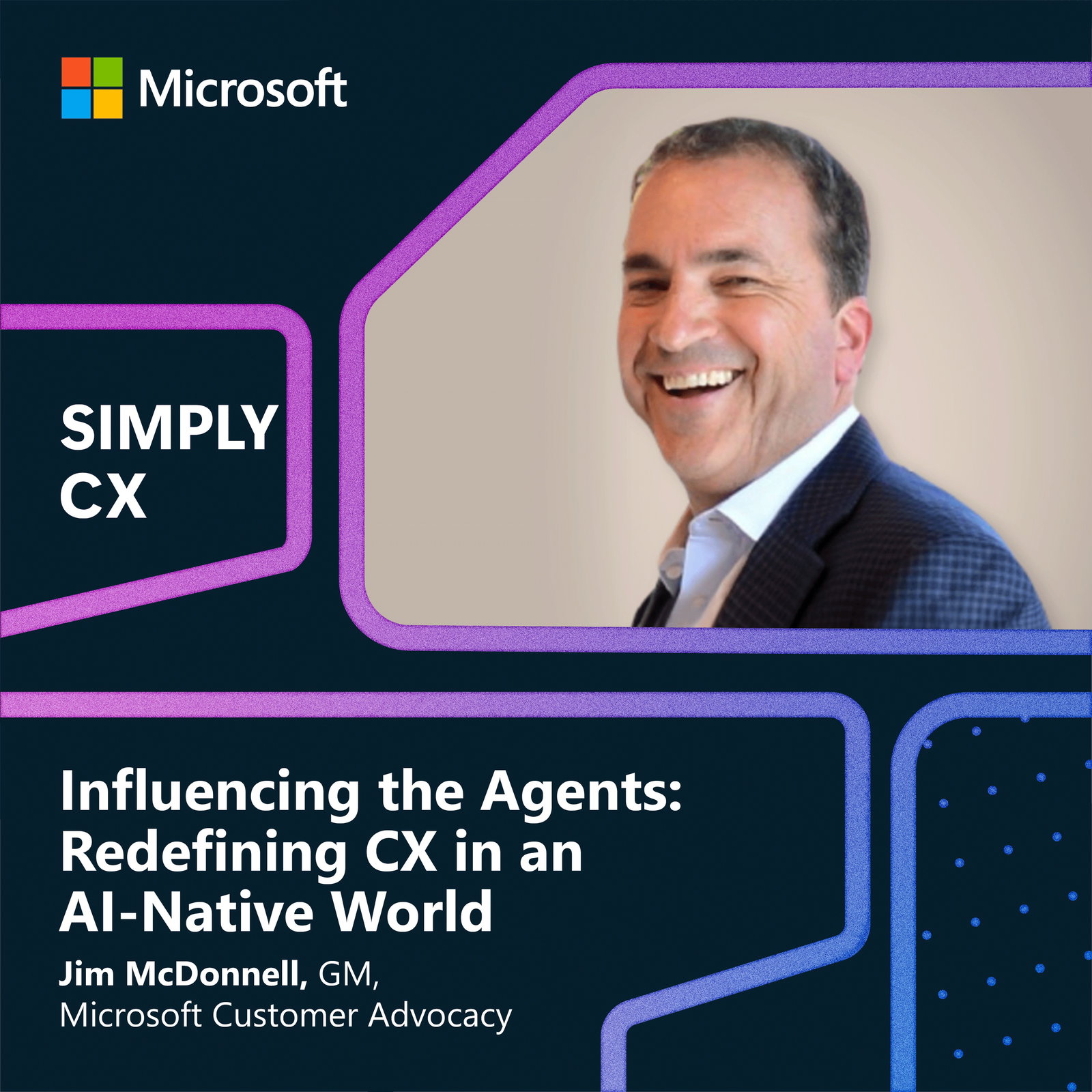
In this episode, Nicole talks with Jim McDonnell, Microsoft’s Global Lead for Customer Advocacy, about how AI-native developers, students, and small businesses are reshaping customer expectations. Jim shares why AI agents are now part of the customer ecosystem, how to eliminate friction for developers, and what he’s learned about experience design from running multiple restaurants.
You'll walk away with:
- Why AI agents are becoming key influencers in customer decision-making
- How to build loyalty in an AI world
- Practical ways leaders can identify high-impact, low-risk AI starting points
Whether you're a CX pro, team leader, or brand builder, this episode will inspire you to see customer experience through a more human—and more powerful—lens.
Mentioned in this Episode
• Copilot Researcher
• AI agent ecosystems and developer forums
• Early-stage developer platform decision-making
• Microsoft Hackathon multi-agent orchestration
• Restaurant guest experience “know me” principles
Produced by Larj Media
For more CX insights, follow Nicole on Linkedin
If you have questions or comments about CX email us: SimplyCX@microsoft.com
Additional Resources
Guest: Jim McDonnell — Global Customer Advocacy Lead, Microsoft
Focus Areas: Digital natives, education, SMB, corporate segments; developer experiences; AI adoption strategies
| The definition of loyalty is changing dramatically. I think as it relates to developers, it really goes back to, "Can you help me solve problems quickly?" Because that's what developers face all of the time. And what's happening now is many of the mundane tasks that development is being identified, and we have agents doing a lot of the code development and so forth, the developers are spending more and more of their time on very complex challenges, problems that they have to wrestle with. And so are we able to give them that help when they need it? That, to me, is what is likely to build the greatest amount of loyalty. |
| Hi, I'm Nicole McKinley, and I lead Global Customer Experience at Microsoft. Simply CX is about making sense of CX in the real world. Each episode brings you inside conversations with leaders who are navigating complexity, trade-offs, and change, sharing what they've learned along the way. And if you're one of those leaders and want to keep the conversation going, feel free to connect with me on LinkedIn. My guest today is Jim McDonnell. Jim leads Global Customer Advocacy at Microsoft and is a colleague of mine and is responsible for incubating and scaling innovative new business models and customer experience across various segments. Those segments range from digital natives, education, and small and medium enterprises and corporate customers. And I am more than thrilled to have you, Jim, join us today. Welcome. |
| Thank you, Nicole. It's so great to be here. Thank you. Appreciate it. |
| You bring a really unique perspective that I'm excited for everyone to learn from. When it comes to customer experience, you're not only a very experienced, tenured business leader in the technology sector, but you're also a very experienced restaurateur. I'd love to just hear you share a bit about what you see. The key differences are as you think about the different segments of customers that you're serving. You engage across such a wide variety of customer segments. What are those unique experience needs that you see in your leadership role? |
| Yeah. So there is a lot of variation. If you look at digital natives, for example, their level of tech intensity is very, very high. And so their expectation of the customer journey and the customer experience starts with really deep technical intensity. And they expect that, frankly, from the outset, right? And they need it because they're making a lot of their decisions based on that technical lens. As you look at some of our small and medium business customers, it's almost the direct opposite. They don't have the luxury of being tech intense. They're running a restaurant or they're running a store or they're running a small manufacturing company or what have you. And they've got to be just laser-focused on that business. And they rely then on usually a partner to assist them with their technical needs. So it's a very broad spectrum. And understanding where that customer is on their journey and what their unique characteristics and needs are is super important to be able to meet them where they're at. |
| So how do you figure that out? How do you and your organization really dig in and understand what those unique needs are and what tech intensity looks like for one customer segment versus another? |
| It starts with the segmentation. So we understand at a broad level, what segment do they belong to? That helps. But increasingly, there's some crossover. And by the way, where they are might shift over time. You can't necessarily just take a snapshot of something and say, "Okay, this is how it is and will be indefinitely." So we're very dependent, for example, on telemetry and signals to really understand what are the kind of workloads are they running? And where are they in terms of their adoption of other technologies where they might need help, and then how we best connect with them and engage with them? |
| And I know, especially in our digital natives business, but also equally in our small, medium enterprise business, the competitive landscape's pretty significant right now, especially. And I love this quote I just heard, which stated that price can be matched, product can be copied, experience is what remains. And that was from Clay Walton-House of REI. |
| I love it. |
| And it just kind of sat with me, and it got me thinking, gosh, the competitive landscape in an age of AI is super intense. It's changing literally daily. And then I think about the customers that you're serving and their unique needs. What does differentiation look like? And how do you hone in on what experience differentiation could be given the diverse customers that you guys are working with? |
| First of all, I love that quote. It is particularly amplified in this era of AI. I think experience is just ever more important. And one of the dimensions of experience that is increasingly important is, first of all, personalization. As I was mentioning, the circumstances of a given business may shift quickly over time. And so, how are you really adapting to that? So personalization is really key. And then a sense of immediacy. We don't necessarily have the luxury of taking weeks and months and years to kind of figure this all out. I was at a roundtable of CEOs of AI startups here in the Bay Area where I live, and they were asked the question, how frequently do you change models? And it's at least every six months, right? So there's that immediacy of, look, I can save a lot of money if I switch over here, or I can get a much better output and so forth. And the last thing I would just say is, it's increasingly important to be mindful of where ideas are being formed. So education is a good example of a segment that I have responsibility for. And if you think about student developers who are just starting on their journey and beginning to kind of learn the platform and get comfortable and familiar with whatever it is they're choosing to develop on, that sort of sets their thinking for potentially many, many years to come. And so increasingly, again, particularly in this era of AI, we have to be really cognizant of the fact that some of these decisions are being made very early, and there's a high degree of decision-making authority at the individual level. |
| What are you seeing unique to the education sector and the student experience? Is there anything that's starting to pop there as an opportunity to really enable them more effectively and capture their mind share? |
| This is maybe the first generation that is truly AI native. And so it's the starting point. It's not like, "Oh, well, I'm having some trouble. Maybe I'll try AI." It's no, no, no. That's where many of their experiences are going to start. One of the things that we've recently surfaced is that many of these early-stage developers, in particular, are actually using AI agents to make their platform choices and help configure those environments and so forth. |
| Fascinating. |
| So in some sense, the agent is now our customer because they're the ones we have to influence. It's not the traditional influencers that are online writing blogs. It's agents that are making recommendations, right? |
| And with that, given so many different partners, solution providers, competitors of Microsoft, are trying to influence students. And I'm sure now influencing the AI agents, to your point, who are influencing students. What are you seeing, if anything, are those kind of ripe differentiation opportunities, where, again, the experience will be what dictates whether or not the student chooses one platform versus another? |
| It's super important to be very cognizant of how the agents form their opinions and what sources are they relying on, and ensuring that the richness of the information that's available via those sources, and frankly, the precision and accuracy. So not only is it guiding them to the right sort of platform or environment or tech stack or what have you, but then things like, "Okay, I want to configure this. I'm writing an application that does these eight things, and I want it to perform in this way. It'll be deployed in this kind of manner. How should I configure this environment?" That there's enough information in those repositories that the agents go to that it can effectively and accurately answer that question as up to date as possible. Because as we both know, the landscape of technology is changing incredibly rapidly. So it's not useful to get an answer that was accurate two weeks ago if there's been major changes to some of the underlying platform capabilities. |
| So this concept of influencing agents is almost mind-blowing to a certain degree, but it's obviously in the here and now. And now we're talking about not just 5 agents or 200 agents. We're talking about a global ecosystem of AI agents and needing to influence that ecosystem in order to ultimately influence purchasing decisions and big investments of people's time and energy and money going forward. How do you think about that? How do you think about influencing an agent ecosystem? You mentioned data. Obviously, knowing the sources of the data that they're drawing from. But how does a company, how does a business leader like you go about trying to actually influence those data sources, knowing that the complexity and the scale of what we're talking about here is so significant? |
| First of all, it's important to understand what agents do early stage developers trust most. And then the second, as I said, is what are the repositories they go to. And then we have a significant opportunity, if they're not repositories we own, to contribute to them. So let's get our content contributing. Let's get our technical experts participating and ensuring that the right answers-- for example, if it's a Q&A forum for developers, that the answers that are available in that Q&A forum are getting the right answers. They're accurate answers, so as the agent goes there and says, "Oh, hey, this is the answer to the question that you just asked me," that we have confidence that it's right. And by the way, that itself will be identified. But it'll be agents overseeing agents. |
| Well, you went exactly where I was going to go, which is this complex ecosystem of agents where you have QA agents, you have influencer agents that have deep subject matter expertise in X, Y, Z product or solution influencing other AI agents. Recent Microsoft hackathon brought to life some really amazing levels of tiered capability across-- in this case, it was hundreds of agents and how they can work together and influence one another. So I can imagine a future where as humans-- this is now, not tomorrow, where we as humans are orchestrating and managing and also applying judgment and coaching and guidance to these agents. And I think it's really changing the nature of all of our jobs. |
| It is definitely changing the way how we do our job day-to-day, for sure. |
| Let's talk a little bit more about developers. You work day in and day out with developers and have a huge focus on that segment. What matters most to developers beyond the immediacy factor if you were to compare them to our largest enterprises? |
| So a couple of things. First, I think it's important to get closer to the individual developer because, as we were discussing, they have a lot more decision-making authority now. Developer choices is prevalent even in many of the larger enterprises. The other thing that we see, particularly if you look at startups, they're facing tremendous pressure is to get a product out on time and hit that market. And they maybe have six months of funding left in the bank. So the pressures from a timing perspective are intense. And as developers face obstacles, it takes more than a day or two days to overcome that and continue on their journey, they're just going to throw up their hands and say, "Look, I'm taking another path," right? So we have to be very cognizant that we are very attuned to the friction points and the obstacles that these developers might face and making sure that we're relentless about driving those out of the system, whether those are things like process or documentation or platform issues or what have you. It's so important to understand where are those moments where they run into obstacles. |
| In the customer experience management domain, we often refer to friction points as the moments that really matter. For developers, what matters most? And what, if anything, is your organization doing to eliminate the friction? |
| I think what matters most is, particularly as they're just getting familiar with a new platform, for example, is quickly being able to not just get answers to their questions, but really clear guidance. I'm trying to solve a specific task. I have this problem I'm solving, and I need help, and how do I configure the database environment, or what layers of the stack should I be implementing, and what's going to give me not only the optimal outcome in terms of the product I'm trying to develop, but also is, frankly, cost optimized, because these startups are running on very tight budgets. That's really where we see the opportunity to really help them is, again, in those moments where they're trying to make decisions and they need help and guidance so they can quickly make the decision and start getting hands on keyboard and actually start knocking stuff out. How do you help them with that process? And then as I said, when they run into that obstacle, it's like, okay, the virtual machine I set up isn't giving me the output I've wanted. What do I need to do? How do I reconfigure it? Again, being able to step in and help as they're going through their own journey of trying to get a product to market as an example. |
| For you as a leader, has there been one or two capabilities that you've found to be most impactful that you're using on a recurring basis that helps you be more effective in your job? |
| Yeah, Copilot Researcher is really the one that I get the most value on because it takes something that might take months and compresses it into something that I can execute in hours and gives me rich insight and perspective. Because as we're talking about, things are changing so rapidly, you sort of have to reassess strategy almost in real time. And how do you do that without deep access to research? You don't want to make ill-informed decisions, but if it's going to take you months to get all the research you need to make a decision, well, then you've sort of missed the opportunity. So that's the one probably that is most impactful for me. |
| Couldn't agree more. Researcher agent is a fantastic one, Analyst agent two. Yeah. On the topic of AI and the developer audience in particular, there's this ability to switch models, switch platforms, switch the capabilities that you're tapping into. If we take a step back, it's starting to challenge this whole notion around what equates to a loyal customer. We talked a little bit about its experience that matters more so than price or product. Yet we still struggle in the era of AI to understand, well, what are those specific experience differentiators that really matter most? How do you think about building loyalty, maintaining loyalty amongst the developer audience in particular? |
| The definition of loyalty is changing dramatically. I think as it relates to developers, it really, really goes back to, "Can you help me solve problems quickly?" Because that's what developers face all of the time, right? And what's happening now is many of the mundane tasks that development is being identified, and we have agents doing a lot of the code development and so forth. The developers are spending more and more of their time on very, very complex challenges and very, very complex problems that they have to wrestle with, and they need help. And so are we able to give them that help when they need it? That, to me, is what is likely to build the greatest amount of loyalty. Because again, developers are spending more and more of their time on things that are just super, super hard. And so if we're not there to help them, they're going to go somewhere where they can get that help. |
| I love what you said in terms of the definition of loyalty is changing. That's something that, whether you're a CX professional or any leader across industries, like wrapping your brain around this concept of what equals loyalty now is a super important nut to crack. I think we've historically looked at loyalty as equating to continued engagement, repeat purchasing, repeat usage, promotion. Are there things that you're seeing across the segments that you work with every day that are new indicators for loyalty from your vantage point? |
| From a Microsoft lens, they're rapidly taking advantage of the full capability set that they have, right? And frankly, on this journey to really using AI in impactful ways. And one of the measures that we're certainly very interested in, and I can't claim we've fully cracked the code on this, but is, okay, they're using AI, but what is it doing in terms of driving real business impact? Is it helping a real estate agent close deals 13% faster? What are the things that really are impacting the bottom line or top line of the business and how AI is enabling to do that, and how quickly they're able to gain access and leverage that capability because their competitors are doing the same thing. In many cases, when I talk to customers, they're like, "I got to get AI driving these outputs for impact for me because I know all my competitors are. And if I don't do it, they're going to outpace me and they're going to win more market share because they're using AI to capture customers." And so we're talking about sort of the competitive dynamic from a Microsoft lens, but many of our customers also face that same competitive dynamic, which is, if they can't leverage AI to drive the kind of impact that they need to have, the competitors will outpace them. |
| We often talk in the CX world about never wasting a great crisis or a great time when the experience goes awry, and using that as a way to rebuild trust and, again, win hearts, minds, and build that loyalty. Is there an example in the recent past where you've seen something kind of go off the rails, but used that as an opportunity to really lean in and create a differentiated experience that has won the customer over and brought them back? |
| Yeah, the one I've seen, and I've actually seen this a number of times, is when there isn't sort of the, I would say, organizational fortitude or organizational structure to make sustained progress, you really, really need to think about how are you going to organize around execution for AI, particularly in large firms. And it isn't necessarily the same way you organize for other projects and programs that you've undertaken in the past. And if you don't do that, there's a very good possibility that you're going to run into a roadblock, hit a brick wall, have to pull back, and you don't have the structure to navigate that effectively. |
| And then what is the differentiation opportunity to course-correct that scenario? Is that largely being driven through the power of human engagement or AI or both? |
| My experiences has been it's largely human. There is certainly a role for AI, for example, to identify blockers and play a role in helping to course correct and things of those nature. But I think it sort of goes back to the policy and structure, maybe, that's in place, and that that's not perfectly suited to the era of AI, and that you need to sort of rethink that. That's very much still a human domain where we as leaders need to identify and understand it. And then frankly, again, sort of have the organizational fortitude to make sometimes maybe hard choices and hard decisions. It is still, in that instance, more of a human domain. |
| Obviously, at Microsoft, we talk a lot about just the power of human judgment, human expertise, and AI. And by using both, most effectively, that's where the real magic comes from. When you look across all of these different segments that you and your organization are supporting and enabling, are you seeing that human plus AI really take shape? Is there still a place for human judgment, human leadership, human imagination? And if so, what does that look like, if at all, differently between these different segments? |
| For sure. There is a big, big place. I was talking to a professor at a local university a few months ago, and she was really leaning in to understand how AI could really help her do her job more effectively, most importantly, to make sure that her students were getting greater outcomes and accomplishing their education objectives more effectively and more rapidly. And was really very thoughtful about the responsible application of AI in that kind of environment and looking at sort of administrative things that she was able to kind of use AI to help automate, which took a lot of workload off of her plate so she could then focus on her students more, and then how she wanted to make sure that students were able to leverage AI again to accomplish those. |
| But that's somebody who had 20 years of experience in the classroom, and understood the dynamics of the student environment, and the university environment, the organization that she was a part of. And if you don't have that understanding and perspective, it's very, very difficult to build a roadmap and say, "Hey, this is how I can really land something and this can be really, really impactful." So that was really exciting because one of the things that she was most excited about is, she could point to several things that were just very significant administrative burdens that she used to have to do manually that AI was now doing. |
| And again, what that allowed her to do is just spend more time with students out of the classroom, those that needed additional help and coaching, focusing more of her energy in terms of preparing for the classroom time, and all those things that make great teachers and great professors great, right. |
| Absolutely. So we talked about the importance of eliminating friction, the immediacy factor, given the pace of change and just the need for speed across segments, across industries. I want to touch on personalization. And when you think about personalization, especially given the diverse customer segments that you're working with, developers in particular, what are you seeing that look like? And how is that changing? How's your perspective on what personalization looks like or how it could look in this combined world of human plus AI? |
| Yeah. I think the number one premium is what we call in the industry know me. There's a very high expectation for good reason that you really know my environment, you know my industry, you know what my market pressures are. Obviously, the environment I'm operating in and from a platform perspective. And there's tremendous benefit to really bring that deep sense of insight that AI can offer to all of the conversations we have with customers, and just informing them from a rich perspective on the details around that customer that are meaningful to the conversation you're having with them at that moment. |
| I think that's key. Using AI to really deepen that know me insight. And that could even include know what I'm building, know what I've done in the last 24 hours and what I haven't done. Propose what I could be doing differently. |
| Exactly. |
| Personalization is maybe a good segue into your other job as a restaurateur. What's your top challenge as a business owner of multiple restaurants? I know you've played many different roles in getting your restaurant business up and running. What are the biggest challenges that you've seen from an experience perspective? And has anything surfaced that has really been a unique differentiator in your restaurant business? |
| I mean restaurants are all about experience, right. I mean, everything in the restaurant is about the experience. And so the thing that I always find interesting in splitting my time between restaurants and tech is that the customer journey is comparable in many ways. If you're in a new city and you're looking for a place to eat, you increasingly go to AI to get tips on restaurants that you might enjoy. You'll usually land at a website. Hopefully it's one of my restaurant's websites. And you look at the pictures and start forming a view about, is this the kind of experience I'm looking for? What is the menu? |
| Then you may book either online or you call, and how easy is that? Can I offer my preferences? Do I have dietary restrictions? Those kinds of things. And then from the moment you walk in, what is your experience? Who greets you? What is the environment like? What is the ambiance? What's the noise level? Those kinds of things. And then just when you seated down the dine, does the restaurant staff identify those moments of matter? Do they see somebody whose water glass is getting empty and quickly come over to refill it or see signals and say, "Hey, this is a moment that I need to touch that table because there may be something I need to be responsive to." And the other thing about Nomi is context is really important. If a couple is out on their first date, for example, you may want to touch the table a little less frequently, right? If it's a very important business dinner and their business colleagues having very, very serious conversation versus a family with young kids where things can kind of unravel if things don't get addressed quickly. So I think there's a lot of similarities. What's different in the restaurant business is that those things play out over a course of a few hours. In tech, we sort of typically had the luxury of having quite some time to sort of build and nurture and deploy and-- in the restaurant, you typically have that one and first visit to either win or lose. |
| Right. That's your moment. |
| If somebody doesn't have a good experience-- that's the moment. That is the moment that matters. And so the other thing I would say that we find critically important in my restaurants is like all restauranteurs would say this is just being super, super close to customer feedback. And so for our general managers who are the manager on duty, we want to be sure that they're walking the floor, they're visibly watching what's going on. Are there signals that maybe the staff is missing, talking to customers about the experience? It's amazing how much rich insight you can gain. And there are customers that leave reviews, and restaurants are always two minds to read reviews. But yeah, those provide useful feedback for sure, but often it's just that in-person interaction. Because if you can address something in that moment, and you can tell the customer, "Hey, you know you're right. This part of your experience wasn't the way we would like it, then we're going to give you a gift card. We're going to do something to make it right for you, but also we're going to take action to fix this going forward," all those things matter. |
| Yeah, great analogy. And the signals in that key moment that matters happening rapidly, you have to have some level of empathy, intuition, interpersonal awareness. How do you train for that? Are you immersing your employees throughout your restaurant business in situational awareness development training? Or what does that look like? And are you using AI at all to help you, or do you have thoughts on that? |
| So we do things like situational training. More I would say we do role-playing, because it's super important if you can just actually see how this experience unfolds. The other thing that's super important is coaching in the moment. And again, this is why we always want our manager on duty on the floor. It's like when you see somebody doing something where there's an opportunity to improve, catch it at that moment. Because, oh, yeah, okay, I can see if it's at the end of the shift or something, it doesn't have the same because it's like they're thinking back, I don't really remember that. So those are two that are super important. We absolutely are using AI. I want to be a little more ambitious about our use of AI-- but for example, one of my restaurants is a sports bar. And so we used AI to help us build our strategy and plan for how we would really engage guests around March Madness, and it helped us to develop a bracket competition. So it was actually really cool. It had some great stuff. And again, because it's context aware, it knows that I own several restaurants and said, "Hey, you should do cross-promotion, and you should offer a gift card at this restaurant." Anyway, so yeah, I mean, AI is super impactful, particularly as we start to explore different concepts that we really want to try out and build on. |
| Any words of advice for CX leaders across industries, whether the leader is deeply experienced in this domain or not, any parting words that you have for our audience on what they either should focus on or perhaps unlearn in this era of AI? |
| If you're not sort of regularly challenging your understanding of what is the definition of customer experience for your industry or for your role or for your market or whatever, then you're missing an opportunity. Because as we've talked about, the customer experience expectations and what drives customer loyalty is changing. It just is. The second is just really be thoughtful about where AI plays a role in your customer's journey. If my customers are going to agents to get decisions about what restaurant they want to go to, I need to be aware of that. I need to make sure I'm feeding that agent with the information it needs to help guide the right outcome. So how is AI affecting the journey of my customer and am I doing everything possible to lean in to make that experience the best possible experience for them? |
| Lastly, just building off of that, I know a lot of leaders right now are skeptical, nervous, unsure of where to start in using AI. And I know in particular, your team at Microsoft helps customers get started and to figure out even where to focus in getting started. Any last words of advice for someone that's not yet using AI, listens to all of your great experience and guidance, wants to get going, but just is unsure of where to start. What should they do? What next step should they take? |
| Yeah, you breathe door that's really important. Focus. Focus is key, is identify something, and we sort of have a set of characteristics we think, here's things that make a good AI POC, for example, is that it's meaningful enough that if you use AI and it has an impact, you can measure it, you can understand it. But it's not like mission critical. So if you get it wrong, the whole enterprise is going to collapse. So those two are important. The third characteristic is that the underlying data that AI will use is of good quality. Because if it isn't, AI is just going to produce the wrong outcome. And the fourth is that you can execute something relatively quickly. And by industry, that quickly could be days, could be weeks, could be a couple of months, perhaps, but took something that you can actually execute on that would allow you to see the output relatively quickly. So those are kind of the four characteristics that we recommend to customers to consider as they look at, "Hey, here's 100 things that AI might be able to go do in my enterprise. What are the two or three I want to go address now?" And if you think about those four characteristics, they might help you to kind of narrow the field of what you want to focus on. But focus, again, is key. |
| I love it. And I think in this AI world, the risk of doing nothing far outweighs the risk of doing something and just getting started. So thank you. Wonderful advice. It's always a pleasure chatting with you. I really appreciate you joining us today, and learned a lot as well through our conversation. So thank you so much. |
| Awesome. Thanks, Nicole. I really appreciate the opportunity. |
| Thank you for listening to SimplyCX. I'm Nicole McKinley. Our show is produced by Larj Media. That's L-A-R-J Media. Special thanks to Elizabeth Machado and our video partner, Specular Studios. To find out more about today's guest, check out the links in the show notes. If you have your own challenges or questions, email us at simplycx@microsoft.com. And please share today's episode with someone you think could learn from it. And follow me on LinkedIn to keep the conversation going |