
 Apple Podcasts
 Spotify
 PocketCasts
 Amazon Music
 YouTube
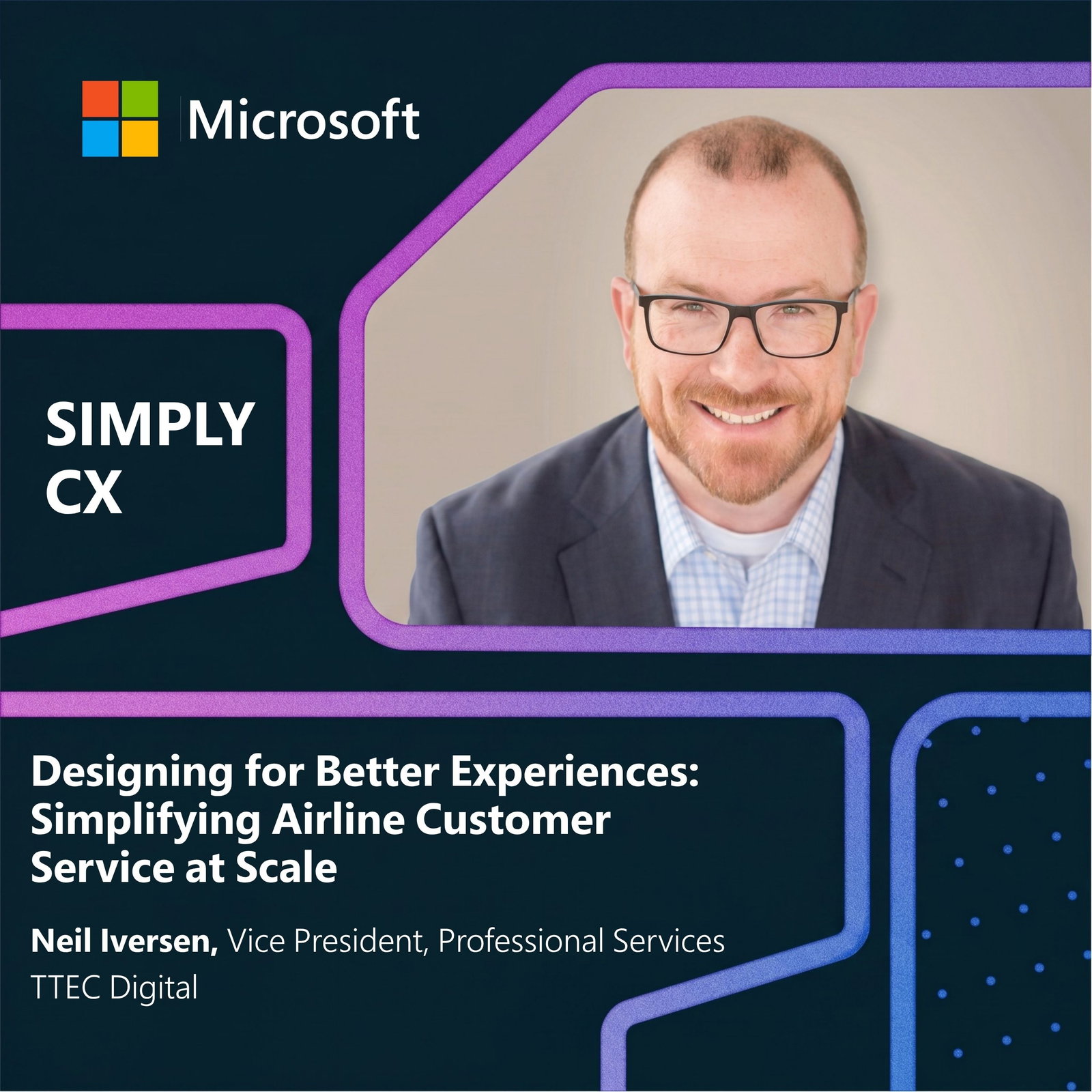
 Designing for Better Experiences: Simplifying Airline Customer Service at Scale
In this episode of Simply CX, host Nicole McKinley sits down with Neil Iversen, Vice President of Professional Services at TTEC Digital, to unpack a real-world airline contact center transformation that reduced average handle time by 30% while dram...
In this episode of Simply CX, host Nicole McKinley sits down with Neil Iversen, Vice President of Professional Services at TTEC Digital, to unpack a real-world airline contact center transformation that reduced average handle time by 30% while dramatically improving agent and traveler experiences. Together, they explore how AI, journey design, and early agent involvement came together to turn one of travel’s most stressful moments into a more human, efficient experience.
You'll walk away with:
• How AI-powered context and summarization can radically reduce agent effort and customer frustration
• Why customer agent experience design is the fastest path to better customer experience outcomes
• Practical lessons on change management, adoption, and building CX and AI together—not separately
Whether you're a CX pro, team leader, or brand builder, this episode will inspire you to see customer experience through a more human—and more powerful—lens.
Mentioned in this Episode
• Neil Iversen, Vice President of Professional Services, TTEC Digital
• Microsoft Dynamics Customer Service
• Power Platform, Dataverse, and Copilot capabilities
• Journey mapping and experience design for contact centers
• AI-driven routing, summarization, and agent guidance
🎧 Produced by Larj Media
📩 For more CX insights, follow Nicole on LinkedIn
If you have questions or comments about CX email us: SimplyCX@microsoft.com
Additional Resources
Guest: Neil Iversen
Role: VP of Professional Services, TTEC Digital
Expertise: AI-enabled CX transformation, contact centers, enterprise service design
| AI and CX are intertwined. You can have an AI project out there and you can get some results from it, but it kind of rings hollow. And CX is all about what is possible now and how can we create that better experience. I see those two as being very linked, where right now AI is powering new types of CX experiences that hadn't been possible or feasible. But having those two linked together is how you can create a really solid and useful solution that has the largest amount of benefit. | |
| Hi, I'm Nicole McKinley. I lead Global Customer Experience at Microsoft. This is Simply CX, where we bring you stories about what it really takes to deliver great customer experiences. CX isn't simple. So in each episode, I sit down with leaders who are in it every day, unpacking what they're learning, what's working, and what they're still figuring out. My guest today is Neil Iverson, Vice President of Professional Services at T-Tech Digital, a company that helps organizations improve customer experience through strategy, technology, AI, and contact center transformation. Neil, thank you so much for joining us today. | |
| Thanks for having me. It's great to be here. | |
| You set out to solve a problem most of us are super familiar with in the travel space. I've certainly been there myself, where your flight's delayed, your connection's at risk, information keeps changing, you need answers, you need them fast. You call the airline or approach the gate agent, and the person who's trying to help is typing away, working to understand the problem, trying to find a solution, all while a line of frustrated travelers builds behind you. T-Tech Digital set out to change all of that. What's happening behind the scenes in that scenario? | |
| There are a multitude of systems at play. Airlines, and basically, the travel agency is a very complicated set of applications and tools and interfaces and regulations all that come into play, and they get focused at a single point at the agent at the time that you are having an extremely stressful day or something isn't going right. So you have a lot of tensions that all come together right at a single point with time being a critical element. That's where we got dropped in and we're allowed to work from. | |
| So to give perspective, when we say time was a challenge, like how much time are we talking about? On average, how long would kind of an interaction with a customer and a customer service representative take? And describe what that experience looked like both for the traveler agent as well as for the traveler themselves. | |
| So if you're calling in and walking through, identifying yourself, and then you're finally talking to a person-- so there's already some time that has elapsed there. From that point, the agent is still having to find out a lot more about you. So asking additional questions, maybe looking up your statuses, looking up the statuses of the flights that you have been on, going to another system to see the flights that are upcoming, their status, what's happened, and really also trying to understand from you what the problem is. Is it a misconnection? Is it, well, now you aren't going to be able to get your rental car, or you're traveling with your family, and it's the first day of vacation, and now you're missing an entire day. So really understanding the context of what's driving that call as well as the business side of, well, what actually can they do and what caused that call? When you're talking to someone in a high-stress situation and trying to navigate many different systems simultaneously, that becomes very difficult to still have that empathy and bring that while trying to solve the problems simultaneously. so what we were really looking at is, "How do we make this an easier experience for the agent to really drive a better traveler experience for everyone involved?" | |
| So you set out to both improve the experience for the agent, in this case, the customer service representative, and for the traveler as well. | |
| Yeah. Absolutely. Doing multiple things is hard, seeing agents having to navigate while also talk and extract information-- I mean, I'm sure you haven't, but I know I've been guilty of multitasking on a meeting before. And-- | |
| Oh. Me too. | |
| --then you're strained trying just to handle that amount of load. So there's a lot of complexity that goes into play and really understanding, "Yes. We can make this easier. Yes. We can pull these things together and really simplify that journey." | |
| And for perspective, how many tools are we talking about that the actual agents were having to previously work through or bounce between? | |
| Yeah. They were navigating anywhere between three to kind of like seven or eight different systems on a given interaction. It would usually-- | |
| Oh. Wow. | |
| --take that amount to get through everything. | |
| And as you guys started to kind of better understand the current state, what did that entail? Did you spend time, you and your team, actually shadowing the traveler agent and their interactions and their lived experience? Or how did you kind of unpack all of the pain points that they were experiencing? | |
| Yeah. There was a lot of work that was done around understanding the journey from the traveler experience, but also from the agent side. So what they needed to do, what the official process was, and what that entailed, and kind of the touchpoints along the way that were rougher or that caused people to go into different systems or out of the main flow. And then you go into, "Well, what are the exceptions?" So the happy path, the green cases, are looking like this, but there's always a few things that will pull you out of that. And what can you do to bring some of those things in, provide easier guidance, and generally drive that experience forward? | |
| Well, I'm a big fan of journey management, journey maps, and just the value of experience design. And I think taking a look at what is that desired to be experienced both from the customer lens, but as well as the agent, in this case, lens, can really create clarity as to what it is you need to design for when it then comes to process change and technology change. But before we jump into the actual solution that you guys built, which is pretty cool, I know that not all customers are equal, per se, or look the same or have the same needs. And in particular, for this commercial airline, I assume there was a need to create some level of differentiated experience as well. When you think about those customers that have maybe spent a lot of money, or frequent flyers with this airline, how did you approach really identifying and working through, from both a strategy as well as an experienced differentiation perspective, the unique differences that a customer should or could experience based on their status or their tiering with the airline? | |
| Yeah. The travel industry is a very competitive industry, and there are a lot of loyalty, status, programs. They spend a lot of time to use those both to help position themselves in the marketplace as well as focus on providing that experience or what that differentiation is. So recognition of loyalty is really important throughout the process. And sometimes that's more complex things like, "Oh. You have an upgrade or free snacks," but also, throughout the brand, having just recognition, "Thank you for your status. Thank you for your loyalty," is a part of what goes on every day. So being able to bring that into the agent's experience seamlessly to provide this is the status and also the context. So if you are traveling with your family and you have status because you travel a lot for work, on that ticketed flight, so do they. And having that context of who is with you, even if it's not you yourself, is a really important part. And that's one of the things that was a struggle before because it would just identify who the person calling was and treat them in isolation. But really bringing that holistic view to the trip, to the ticket, to the traveling party, to better help the agents understand what sort of world they're living in, what sort of experience is the person at the other end of the phone having. | |
| Yeah, no, that's so critical. At Microsoft, we often refer to that as [know me?] from a customer experience principle point of view and just the criticality of deeply knowing who the customer is that you're interacting with and everything possible that can be used to enable you to better deliver value in that conversation and the ongoing interaction. It sounds like that's exactly what you tackled here. | |
| Yeah, it's fundamentally the core of really any customer experience journey or any customer service project. | |
| So you spent all this time understanding the current state, delving into the 2B experience design, again, from a customer service representative lens. What did you do next? | |
| So really, from there it was actually making this a reality. A lot of times that pushes you to make a lot of things in documents and diagrams and everybody looks at this and says, "I guess that's right. I guess that's what I'm going to want to have." But what we really focused on is getting quickly out of that and into the system. So where we were prototyping, we were having some of those design meetings in the system so that everybody was on board with, "This is what it will look like. This is real." So getting in there, even while we're still in the design phase, we felt was really critical to building out a successful system, kind of building up that trust with everybody in the organization, and so that people can quickly see my concerns are being met, or I'm being heard, and this is the action to get there. | |
| And when you say the system, what did this entail from a technology perspective? Did you guys know out of the gate, "This is the technical solution that we want to implement that's going to best meet the objectives of this effort," or through the prototyping phase, were you actually experimenting with different technologies that could best serve the needs? | |
| So in this case, we knew that it was going to be on the Microsoft platform, but the different components had to be determined. So we kind of knew what that foundation was going to be going in. There was a lot of buy-in on the customer side for this is the right foundation to build on top of. But then what does that actually look like? What are the pieces and what different technologies are actually going to be at play here was what we were working through during that design phase and prototyping and building out to say, yes, this is the right path forward. | |
| And so when you say the Microsoft platform, was this Dynamics Customer Service or? | |
| Yeah, so the foundation of this is Microsoft Dynamics Customer Service, and then we were pulling in additional parts of the Power Platform, the Dataverse, Copilot, and then into some of the other Azure features as well. | |
| Awesome. So a full-stack solution, it sounds like. | |
| That's right. | |
| And where and when did you really identify the AI opportunity in particular and how you could apply Copilot and other capabilities to either dramatically transform process or eliminate entire steps in the process and just, again, make life easier for the customer service representatives and the travelers. | |
| Well, it seems to be pretty hard right now to have a conversation that doesn't involve AI. | |
| Fair enough. | |
| Comes in right at the beginning. A lot of it is what makes sense in the specific use case. We don't really go in and say, "AI is the answer." We're looking at it from, "This is the experience that we need to provide. This is the experience that people are expecting, and what is it that makes that possible?" Now, AI provides a lot of power to do that right now, and so it's generally an answer, but it is not the only answer. And making sure that you understand that distinction is really important to having a successful deployment. | |
| Couldn't agree more. And you talked a bit about how you were actually prototyping during the design phase. I'm curious, were you actually using AI in any way to accelerate the prototyping aspect of the build? And then I'm curious as well, you involved people at the airline, the customer service representatives themselves in the design process. What did that look like? What did it entail? | |
| So for the prototyping, one of the advantages of the Dynamics platform is that it's very easy to go in and work off of. So we didn't actually need to have AI do the prototype. We were able to do that right live in the room, which is a really fun way to get immediate feedback. And demonstrate some of the AI features in the platform, which is a really great way to get people on board with the capabilities of what's possible and to start thinking about how they could drive it further. In terms of getting people involved, it's really important to have as many people involved as possible. Getting that agent perspective is really important when you're designing a system for the agents. And so we had a steady cadence where we were actually putting things out, giving demos at a particular interval so people could see them. And then we also were engaging people in between those with follow-up questions, with kind of many demos or many questions. We think it's really important that you don't just wait until the end and say, "All right, here's your system. How's it look?" And having that constant feedback on a structured basis is really important from a milestone. And then just day-to-day, making sure that you have people that you can talk to, people that are actually going to be using the system. And then for customer service cases like this, we always like to sit with the agents. I personally find that a really great experience that I like to do wherever possible. And not only teaches you a lot about different industries, hearing what's on the other side of those calls and giving you the empathy for the challenges that it takes to be on that other end of the phone call is just always an eye-opening experience and really helps benefit the creation of an agent and customer-focused project. | |
| It keeps it real, for sure. It also builds the buy-in and the commitment of the end users to not only help shape the solution, but to then truly be all in on using it once it's ready for full deployment. So as you're getting all this feedback and you're sitting with the customer service representatives, how were you capturing the feedback? How did you prioritize or triage the feedback? What did that look like in terms of shaping the final solution? | |
| I mean, the nice thing here is that we had a really strong North Star focused on making it access to information, simple, and driving the handle time to make that lower by making them not have to go everywhere. So by having a really well-defined North Star, that makes a lot of decisions and and prioritization conversations much easier. Because the project was unified around that, that kept everybody focused on the goal. The other thing was we had a very aggressive timeline, which helped in prioritization because it wasn't, "Oh, well, that's so far in the future," it was, "All right, we have a very short window," and that made everybody think, on a daily basis, what is important to get out there, what is critical, and how can we prioritize that at the top? | |
| So you mentioned the goals of reducing time, reducing effort. How were you validating that those objectives were actually being achieved or could be achieved as you moved through that kind of final solution build process? | |
| One of the great things about doing contact center work is that there are so many metrics. There is data all over the place. And so any impact that you can have is very straightforward. So AHD average handle time is a very common metric, and it is logged everywhere. You've got reams of data on how it's been doing historically, by person, by team, by month, allowing you to have a good foundation for comparison. So we took some of the metrics like that that we were able to work off of. But then we also like to do surveys against the actual agents while you're in a pilot, or even during build in a project, to get their input on how things are going, is it better or worse than the old system on this specific feature, and then overall. And that really gives you a good feel for how your adoption is going to be, or areas that you need to work on before you get there. And then you couple that after you go live with the actual CSAT on the traveler side to make sure that you're maintaining or increasing based on what you're doing. | |
| What was the feedback? What was the sentiment telling you along the way? And was it all rosy, or were there any early warning signs or challenges that you were able to get ahead of before implementation because of the feedback that was coming in? | |
| Yeah, I think that all projects have challenges, but in this case, we all had a unified vision of where we were going. And then we were working together as one team. It wasn't just TTEC and a customer, and we were kind of separate. We were all going for the same goal, we were all in this together. And that was not just project level, but really, throughout both organizations. So at every level, we were communicating, we were talking, and we were building and testing and presenting together. And I think that is a really important part of having that common vision and that common goal that really drives a project like this forward. | |
| And it sounds like, as a result, you guys were able to achieve your super aggressive timeline and then also deploy a pretty phenomenal solution that achieved its goals. But we'll get there. Before we do, I want to spend a little bit of time on the role of TTEC Digital. And obviously, as a solution provider, you were there to build and to test and to deploy. Where did you feel like you and TTEC Digital's expertise was most critical throughout the duration of this effort? And what learning, if any, did you have along the way that kind of enabled you to reach these successful outcomes? | |
| One of the biggest things for us is that we certainly bring a technological background to everything it is that we do. But that is not the most unique thing about TTEC. There are a lot of organizations that have extremely talented development teams and technical teams. But what we do is we have a dedicated team that is integrated with everything that we do on the delivery side. | |
| I love that, by the way. | |
| And that is a really fun part of being able to tie two different areas together. And then finally, for something like this, we have an extensive background in service and inside of Contact Center, where we have a part of our company that actually does contact centers, that runs them. So having a really deep understanding, just kind of in our bones, of what it means to have a contact center to run it, the service level that needs to be provided, the technological underpinnings that make that possible. And then finally, you can wrap that together with CX for how it should be delivered. | |
| Because I'm so intrigued and also an avid champion of customer experience, what does the customer experience piece of your business really entail? | |
| Really what we're focused on there is understanding how we can apply change to an organization to better the customer experience. So it's not about a specific technology, it's about a change frequently enabled by technology that you can use to empower and create a better customer experience. | |
| Well, and on that, that's, I think, a perfect segue to talking a bit about change management and adoption. If you mentioned it a few times-- we all know as leaders in the technology space, you can have the best technical solution, but at the end of the day, if your end users aren't actually using it or adopting it to the maximum potential, really, the value of it is quite minimized. What was the change management strategy that you and the T-Tech digital team took on here? And any insights that you can share with our listeners in terms of what really went well, and perhaps anything that you learned from that didn't. | |
| Yeah, I think one of the biggest things is that we don't start change management when you're three-quarters of the way through the project. Change management starts day one, getting the buy-in, getting the adoption throughout the project. It's not just about how you train people and get a new group on there. If the solution doesn't actually line up with what they need, that's not really going to work. So change management for us starts right away at the beginning and is a common thread throughout the entire life of the project. And then we really formalize the training and the adoption, creation of champions. Depending on the type of organization, there are different strategies that you use to roll things out and to get that consensus and buy-in. | |
| Well, I'm a huge fan of always-on change management. What would you say was the one element of your change management strategy in this implementation that really made the difference? Was it that early involvement of the customer service representatives in the prototyping and design phase, or was it something else? | |
| Yeah, I would say that the early involvement of actual agents was the most critical. You get to think about things in a different way than perhaps you had. It breaks down some of the assumptions that you have going in with how things should work versus how they'll actually end up working or what it's like. And that's absolutely critical in making sure that the rest of your project follows the right path. | |
| And then just to kind of circle back to the solution, what was the differentiator that AI brought into the fold? | |
| AI was really useful in really helping, especially for routing, getting to the right person, getting to the right agent, and providing a nice summarized context to the agent right off the bat. So where we really saw value is taking what somebody had said or written, using that and the rest of the profile unified together to start to make some more advanced routing decisions. And then when it dropped onto the agent, whatever we could fill from behind, can we look up some additional information? Can we summarize some other key pieces? What else has happened recently? And summarizing that for the agent so that that's right at their fingertips as soon as they pick it up. | |
| So with that, what were the results? You said that reducing time or average handle time, reducing effort were the two big objectives of this effort. But you were also looking at sentiment both from customers as well as the customer service reps. What was the outcome? | |
| Yeah, so we had really good outcome. We had a 30% reduction in handle time. | |
| Wow, very impressive. | |
| Which is a fantastic foundation to build on top of. One of the other big things is that we were able to have really great sentiment from the agents as they use the system. And then one of the goals that the client also had was a virtually no training offset when onboarding a new agent from the old system. Which is a very interesting bar to manage. It really makes you have things as intuitive as possible. So minimizing the training time was another bar that we were able to cross. | |
| And how is that one achieved? Was that about making the features and functions just super easy and intuitive, like you said, or was there any AI-enabled set of capabilities built into the solution that would guide the customer service rep? | |
| It definitely starts from, I mean, just simple things like how should the screens be laid out? So there's a lot of user experience that goes into making it intuitive where you can't just have all of the buttons and boxes on there. Maybe they're there somewhere, but are they there in a logical order? Are they there in a way that can flow through? And then yeah, being able to use AI to start saying, all right, what's the next action or what's the next step to sort of guide from point to point in a process is extremely helpful. | |
| Well, impressive results, for sure. I'm sure that this is an amazing example that other airlines or other businesses that have large call centers or customer service organizations are eager to implement themselves in some way, shape, or form. As an AI solutions leader, what was your biggest learning in this effort? | |
| It really reinforces that AI and CX are intertwined. You can have an AI project out there and you can get some results from it, but it kind of rings hollow. And CX is all about what is possible now and how can we create that better experience. I see those two as being very linked. Where right now AI is powering new types of CX experiences that hadn't been possible or feasible. But having those two linked together is how you can create a really solid and useful solution that has the largest amount of benefit. | |
| So well said. I think that was a great insight. I like to say myself, just being a leader in experience, but also a leader in the technology industry, that if you can dream it, you can build it when it comes to AI now. And so if you can dream up an experience, a completely new differentiated experience, you now have the tools at your fingertips that you can tap into using AI. And of course, there's huge benefits in an end-to-end stack that's integrated as well, but you can really bring to life whatever it is that you can imagine, which is a pretty empowering and inspiring place to be, I think. | |
| Yeah, it's a great message. It's a great time right now. | |
| So building from that, as you look ahead, and obviously, the AI landscape is changing daily, new models, new capabilities. Again, if you can dream it, you can build it. What do you see as a leader in technology and as a leader in experience in the future, whether that's six months from now, a year from now, what is top of mind for you in terms of where you see CX and AI and this kind of intertwined set of ways of working, what does that future look like for AI and CX? | |
| That's a great question. I wish I knew the final answer, but I'm in this industry because there is change and there is a lot of change right now. I'm a big fan of a William Gibson quote that is, "The future is here already. It's just not evenly distributed." So we're seeing pockets of things that are possible and how we combine those in the future. It's there right now, and that's what we'll be seeing in wider adoption a year from now, 18 months from now. And so I think it's really exciting because we are defining what customer experience is going forward. There are new modalities, new channels that we can use to communicate, and there's a new expectation for what's possible and how I as a customer should be able to interact with an organization. It's fun to be a part of building that and seeing what that's going to look like going forward. | |
| Well, it is an incredible time indeed. I couldn't agree more. So thank you. I really appreciate your time and your learning and you sharing all of your insights with all of us. | |
| Thank you. It's been a pleasure. | |
| Thank you for listening to Simply CX. I'm Nicole McKinley. Our show is produced by Larj Media. That's L-A-R-J Media. Special thanks to Elizabeth Machado. To find out more about today's guests, check out the links in the show notes. If you have your own challenges or questions, email us at simplycx@microsoft.com. And please share today's episode with someone you think could learn from it. And follow me on LinkedIn to keep the conversation going |