Dec. 4, 2023
Solar Activity // NASA’s Fermi Mission // Day That Changed Astronomy | S26E145
The Space News Podcast.
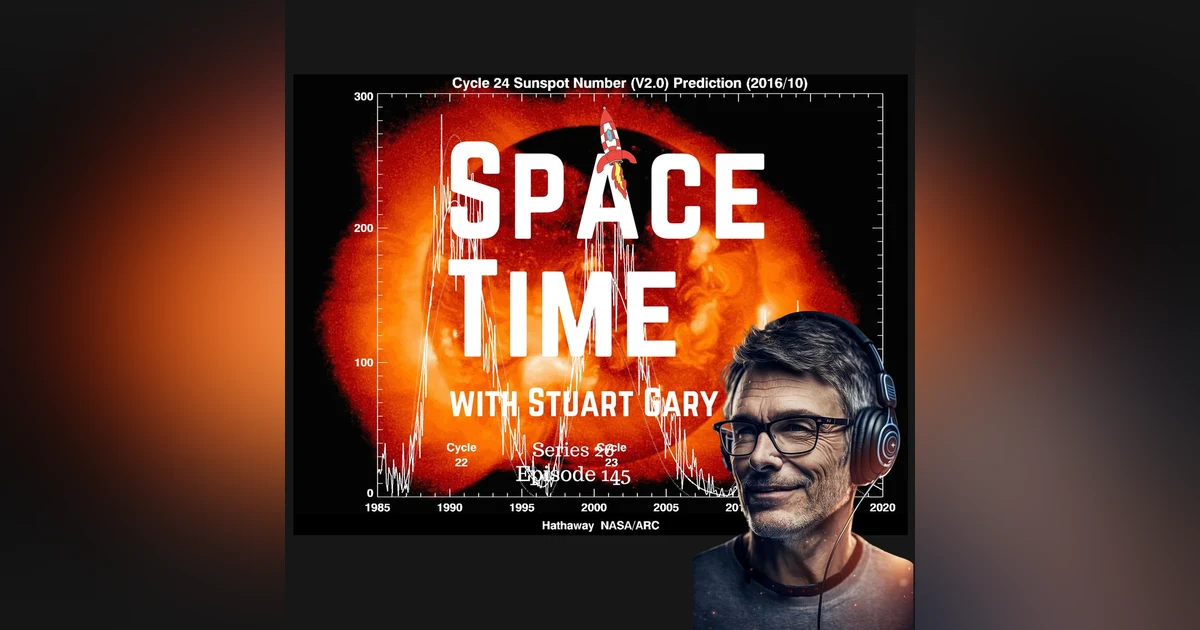
SpaceTime Series 26 Episode 145
*Solar activity likely to peak next year.
A new study claims the Sun will reach the peak of its eleven year solar Cycle next year. The current Solar cycle -- 25 began in December 2019 with a...


 Spotify Spotify
  Apple Podcasts Apple Podcasts
  Youtube Music Youtube Music
  iHeartRadio iHeartRadio
  Spreaker Spreaker
  PocketCasts PocketCasts
  Amazon Music Amazon Music
  YouTube YouTube
  Castbox Castbox
  Deezer Deezer
  TuneIn TuneIn
  Rumble Rumble
  Overcast Overcast
  Podcast Addict Podcast Addict
  Podchaser Podchaser
  JioSaavn JioSaavn
  Castro Castro
  RSS Feed RSS Feed
 The Space News Podcast.
SpaceTime Series 26 Episode 145
*Solar activity likely to peak next year.
A new study claims the Sun will reach the peak of its eleven year solar Cycle next year. The current Solar cycle -- 25 began in December 2019 with a minimum smoothed sunspot number of 1.8.
NASA’s Fermi Mission nets 300 gamma-ray pulsars … and counting
A new catalogue shows that NASA’s Fermi Gamma-ray Space Telescope has discovered 294 gamma-ray-emitting pulsars, while another 34 suspects await confirmation.
*A day that changed astronomy for ever
Back on the 17th of August 2017 astronomers were for the first time ever able to measure the violent death spiral of a pair of neutron stars using both conventional electromagnetic telescopes and the relatively new field of gravitational wave laser interferometry.
*The Science Report
Ozone levels above Antarctica may not be recovering after all. Inhaling air pollution while sitting in traffic associated with an increase in blood pressure.
Study claims city dwelling bees tend to have bigger brains than their country cousins.
Skeptic's guide to the 2023 Bent Spoon Awards
This week’s guests include:
Professor Matthew Bailes from OzGrav the ARC Centre of Excellence for Gravitational Wave Discovery
Mars Odyssey deputy project scientist Laura Kerber from JPL
And our regular guests:
Alex Zaharov-Reutt from techadvice.life
Tim Mendham from Australian Skeptics
Jonathan Nally from Sky and Telescope Magazine
isten to SpaceTime on your favorite podcast app with our universal listen link: https://spacetimewithstuartgary.com/listen and access show links via https://linktr.ee/biteszHQ
Additionally, listeners can support the podcast and gain access to bonus content by becoming a SpaceTime crew member through www.bitesz.supercast.com or through premium versions on Spotify and Apple Podcasts. Details on our website at https://spacetimewithstuartgary.com
For more SpaceTime and show links: https://linktr.ee/biteszHQ
For more podcasts visit our HQ at https://bitesz.com
This show is part of the Spreaker Prime Network, if you are interested in advertising on this podcast, contact us at https://www.spreaker.com/show/2458531/advertisement
SpaceTime Series 26 Episode 145
*Solar activity likely to peak next year.
A new study claims the Sun will reach the peak of its eleven year solar Cycle next year. The current Solar cycle -- 25 began in December 2019 with a minimum smoothed sunspot number of 1.8.
NASA’s Fermi Mission nets 300 gamma-ray pulsars … and counting
A new catalogue shows that NASA’s Fermi Gamma-ray Space Telescope has discovered 294 gamma-ray-emitting pulsars, while another 34 suspects await confirmation.
*A day that changed astronomy for ever
Back on the 17th of August 2017 astronomers were for the first time ever able to measure the violent death spiral of a pair of neutron stars using both conventional electromagnetic telescopes and the relatively new field of gravitational wave laser interferometry.
*The Science Report
Ozone levels above Antarctica may not be recovering after all. Inhaling air pollution while sitting in traffic associated with an increase in blood pressure.
Study claims city dwelling bees tend to have bigger brains than their country cousins.
Skeptic's guide to the 2023 Bent Spoon Awards
This week’s guests include:
Professor Matthew Bailes from OzGrav the ARC Centre of Excellence for Gravitational Wave Discovery
Mars Odyssey deputy project scientist Laura Kerber from JPL
And our regular guests:
Alex Zaharov-Reutt from techadvice.life
Tim Mendham from Australian Skeptics
Jonathan Nally from Sky and Telescope Magazine
isten to SpaceTime on your favorite podcast app with our universal listen link: https://spacetimewithstuartgary.com/listen and access show links via https://linktr.ee/biteszHQ
Additionally, listeners can support the podcast and gain access to bonus content by becoming a SpaceTime crew member through www.bitesz.supercast.com or through premium versions on Spotify and Apple Podcasts. Details on our website at https://spacetimewithstuartgary.com
For more SpaceTime and show links: https://linktr.ee/biteszHQ
For more podcasts visit our HQ at https://bitesz.com
This show is part of the Spreaker Prime Network, if you are interested in advertising on this podcast, contact us at https://www.spreaker.com/show/2458531/advertisement
The Astronomy, Space, Technology & Science News Podcast.
WEBVTT
1
00:00:00.680 --> 00:00:04.440
This is Spacetime Series twenty six,
Episode one hundred and forty five, for
2
00:00:04.559 --> 00:00:09.199
broadcast on the fourth of December twenty
twenty three. Coming up on Space Time,
3
00:00:09.839 --> 00:00:13.560
a new study claims the Sun's eleven
year solar cycle will peak early,
4
00:00:13.720 --> 00:00:18.480
possibly as early as next year.
NASA's Fermi mission nets three hundred gamma ray
5
00:00:18.559 --> 00:00:24.280
pulsarsn't counting, And we look back
in history at the day which changed astronomy
6
00:00:24.320 --> 00:00:31.640
forever. All that and more Coming
up on Spacetime Welcome to Space Time with
7
00:00:31.920 --> 00:00:51.960
Stuart Gary. A new study claims
the Sun will reach the peak of its
8
00:00:52.000 --> 00:00:57.520
eleven year solar cycle early, possibly
next year. Solar Cycle twenty five began
9
00:00:57.600 --> 00:01:02.920
in December twenty nineteen with a solar
minimums smooth sunspot number of one point eight.
10
00:01:03.520 --> 00:01:07.439
It's expected to continue until twenty thirty. It marks the twenty fifth solar
11
00:01:07.519 --> 00:01:12.799
cycles since seventeen fifty five, when
extensive recording of solar sunspot activity first began.
12
00:01:14.560 --> 00:01:18.840
The Solar Cycle twenty five Prediction Panel
thinks the current cycle will be similar
13
00:01:18.920 --> 00:01:23.599
to the previous solar cycle twenty four, which was especially weak. The Sun's
14
00:01:23.680 --> 00:01:27.200
solar cycles trigger space weather events,
which can have dramatic effects on Earth.
15
00:01:27.840 --> 00:01:33.319
Space. Weather is a sudden flood
of energy and ionized particles such as protons,
16
00:01:33.319 --> 00:01:38.079
electrons, and atomic nuclei, triggered
by powerful eruptions of solar flares and
17
00:01:38.159 --> 00:01:42.200
chronal mass ejections on the surface of
the Sun. Solar flares are explosions of
18
00:01:42.359 --> 00:01:47.840
energy caused by the sudden snapping of
tangled and twisted magnetic field lines known as
19
00:01:47.879 --> 00:01:53.920
flux robes, emanating from sunspots on
the solar surface. Sunspots are cooler regions
20
00:01:53.920 --> 00:01:57.959
on the Sun's surface that appear darker
than surrounding areas. That's because the magnetic
21
00:01:59.040 --> 00:02:01.920
field lines reach out into space from
deep inside the Sun, prevents some of
22
00:02:01.959 --> 00:02:07.560
the heat from within the Sun reaching
the surface. Because the Sun's not solid,
23
00:02:07.599 --> 00:02:10.280
that a big ball of plasma.
Different latitudes of the Sun rotate at
24
00:02:10.319 --> 00:02:15.599
different rates, causing these magnetic field
lines to become tangled and twisted. Eventually
25
00:02:15.639 --> 00:02:21.560
they snap, realigning through magnetic reconnection
in the process, producing an eruption of
26
00:02:21.560 --> 00:02:24.400
the electromagnetic energy called a solar flare, which, when facing the Earth,
27
00:02:24.439 --> 00:02:29.479
can reach the planet in just eight
point three minutes. If the solar flares
28
00:02:29.479 --> 00:02:34.120
are powerful enough, they'll also eject
billions of tons of chronal plasma and embedded
29
00:02:34.159 --> 00:02:38.199
magnetic field frozen in flux. Exploding
out of the Sun. It speeds them
30
00:02:38.240 --> 00:02:40.960
up to three thousand kilometres per second, which, if facing the Earth,
31
00:02:42.199 --> 00:02:46.400
can reach the planet in just fifteen
to eighteen hours. When these geomagnetic storms
32
00:02:46.479 --> 00:02:51.840
reach the Earth, the flux of
ionized particles slam into the planet's magnetic field,
33
00:02:51.919 --> 00:02:55.599
called the magnetosphere. They're then guided
by the Earth's magnetic field lines through
34
00:02:55.599 --> 00:03:00.840
the ionosphere region already filled with church
particles, down to towards the North and
35
00:03:00.919 --> 00:03:05.800
South magnetic poles. As these charred
streams of plasma travel through the Earth's upper
36
00:03:05.800 --> 00:03:09.319
atmosphere, they collide with oxygen and
nitrogen atoms and molecules, causing them to
37
00:03:09.439 --> 00:03:15.639
excite and emit photons, giving off
a glow and producing colorful curtain like displays
38
00:03:15.759 --> 00:03:20.719
known as the Northern and Southern lights, the Aurora borealis and Aurora straalus.
39
00:03:21.360 --> 00:03:25.599
The colours being emitted depend on the
particles being ionized. Reddish brown glows are
40
00:03:25.639 --> 00:03:30.960
caused by the collision of particles with
single oxygen atoms in the Earth's upper atmosphere,
41
00:03:30.039 --> 00:03:36.240
usually above three hundred kilometers lower down
a green hue created by single oxygen
42
00:03:36.280 --> 00:03:40.000
atoms. Down to altitudes of around
one hundred kilometers, the kaleidoscope turns a
43
00:03:40.000 --> 00:03:45.560
whitish, shallow beige when nitrogen is
mixed in with the oxygen. Aurora can
44
00:03:45.599 --> 00:03:49.680
also exhibit a blue, red,
or even purple glow in the lower atmosphere,
45
00:03:49.680 --> 00:03:53.759
caused by the excitation of molecular nitrogen
below one hundred kilometers. However,
46
00:03:53.919 --> 00:03:59.159
as well as these spectacular aurora light
shows, these highly charged particles can also
47
00:03:59.240 --> 00:04:03.759
damage or even destroy spacecraft by shotting
up their electronics and destroying circuits. They
48
00:04:03.800 --> 00:04:10.280
also cause the atmosphere to expand and
contract, increasing atmosphere dragon orbiting spacecraft,
49
00:04:10.439 --> 00:04:15.039
resulting in premature orbital decay and the
need to use up more fuel in order
50
00:04:15.080 --> 00:04:18.879
to maintain an operational orbit. Worse
still, space whether can increase the level
51
00:04:18.879 --> 00:04:25.199
of radiation exposure astronauts experience, affecting
their health. On the ground, the
52
00:04:25.319 --> 00:04:30.959
solar storms can overload power lines,
causing widespread blackouts. Back in nineteen eighty
53
00:04:30.040 --> 00:04:35.120
nine, one such geomagnetic storm blue
out transformers, causing blackouts across most of
54
00:04:35.240 --> 00:04:42.199
eastern North America. Space weather also
affects communications and navigation systems, and it
55
00:04:42.279 --> 00:04:46.000
forces polar airline flights to be rerouted
to lower latitudes, using up more fuel.
56
00:04:46.600 --> 00:04:51.279
All space weather activity increases and decreases
in line with a solar cycle.
57
00:04:51.920 --> 00:04:56.600
However, predicting when the peak of
the solar cycle is going to occur,
58
00:04:56.920 --> 00:05:00.959
time known as solar maximum or solar
max for short, remains challenging. The
59
00:05:00.959 --> 00:05:06.040
solar cycles produced by a dynamo mechanism
driven by energy from plasma flows deep inside
60
00:05:06.040 --> 00:05:12.639
the Sun. This dynamo mechanisms understood
to involve two primary components of the Sun's
61
00:05:12.639 --> 00:05:15.959
magnetic field, one of which manifests
in the cycle of sunspots, and the
62
00:05:16.040 --> 00:05:20.279
other which manifests in the cycling of
large scale dipole fields in the Sun.
63
00:05:20.800 --> 00:05:25.439
The latter is much like the Earth's
magnetic field, stretching from one pole of
64
00:05:25.480 --> 00:05:29.000
the Sun to the other. As
with the cycle of sunspots, the Sun's
65
00:05:29.040 --> 00:05:32.920
dipole field is also observed to wax
and wane in strength, and this also
66
00:05:33.000 --> 00:05:39.079
happens over an eleven year cycle.
Back in nineteen thirty five, Swiss astronomer
67
00:05:39.120 --> 00:05:43.439
Max Voltmeyer discovered that the faster the
rate of rise of a sunspot cycle,
68
00:05:43.519 --> 00:05:46.920
the stronger its strength, so stronger
cycles take less time to rise to their
69
00:05:46.959 --> 00:05:53.399
peak intensity. This relationships often been
utilized to forecast the strength of a sunspot's
70
00:05:53.439 --> 00:05:58.759
cycle based on observations of its early
rising phase. The new study, reported
71
00:05:58.759 --> 00:06:02.000
in the Monthly Notices of the Royal
Astronomical Society claim scientists to find a new
72
00:06:02.079 --> 00:06:06.439
relationship which shows that a decrease in
the rate of the Sun's dipole magnetic field
73
00:06:06.560 --> 00:06:12.360
is also related to the rate of
rise in the ongoing sunspots cycle. This
74
00:06:12.439 --> 00:06:17.040
new discovery, utilizing decades old data
from archives of mudible ground based solar observatories
75
00:06:17.079 --> 00:06:23.199
around the world, complements to Voltmeyer
effect, connecting the two primary magnetic field
76
00:06:23.240 --> 00:06:28.319
components of the Sun and supporting the
theory that the evolution of sunspots are integral
77
00:06:28.360 --> 00:06:31.319
to the functioning of the solar dynamic
process, rather than nearly being a symptom
78
00:06:31.360 --> 00:06:35.959
of it. The authors believe they've
now demonstrated how observations the rate of the
79
00:06:36.040 --> 00:06:42.519
decrease in the Sun's dipole magnetic field
can be usefully combined with sunspot observations to
80
00:06:42.560 --> 00:06:47.000
predict when the ongoing cycle is likely
to peak, and their analysis suggests that
81
00:06:47.120 --> 00:06:51.879
solar max for cycle twenty five is
most likely to occur early next year,
82
00:06:53.240 --> 00:06:57.639
with an uncertainty in the estimate ranging
as late as September twenty twenty four.
83
00:06:58.480 --> 00:07:03.959
Needless to say, we'll keep you
informed. This space time still to come.
84
00:07:04.160 --> 00:07:10.000
NASA's Fermi Space Telescope net's three hundred
gamma ray pulses in counting, and
85
00:07:10.160 --> 00:07:15.279
we look back in history at a
day which changed astronomy forever. All that
86
00:07:15.319 --> 00:07:35.360
are more still to come on space
time. A new catalog shows that NASA's
87
00:07:35.360 --> 00:07:41.120
Fermi Gammaray Space Telescope has now discovered
two hundred and ninety four gamma ray meeting
88
00:07:41.199 --> 00:07:46.040
pulsars, with another thirty four suspects
still awaiting confirmation. The findings, reported
89
00:07:46.040 --> 00:07:50.959
in the Astrophysical Journal, represents a
twenty sevenfold increase compared to the number nine
90
00:07:51.000 --> 00:07:56.240
before the missions launched back in two
thousand and eight. PULSA has touched on
91
00:07:56.319 --> 00:08:01.920
a wide range of astrophysical research projects, from cosmic rays and stellar revolution to
92
00:08:01.959 --> 00:08:07.319
the search for gravitational waves and dark
matter. The studies, coordinated David Smith
93
00:08:07.360 --> 00:08:11.480
from the Bordeau Astrophysics Laboratory in France, says the new catalog compiles full information
94
00:08:11.560 --> 00:08:16.959
on all known gamma ray pulsars in
an effort to promote new avenues of exploration.
95
00:08:16.639 --> 00:08:22.519
Pulsars are rapidly spinning Neutron stars the
Sun size leftovers of massive stars between
96
00:08:22.519 --> 00:08:26.040
eight and twenty times the mass of
our Sun, which have run out of
97
00:08:26.199 --> 00:08:31.120
nuclear fuel and exploded a supernovae.
Neutron stars contain more mass than our Sun,
98
00:08:31.279 --> 00:08:35.960
but compact it into a ball less
than twenty kilometres cross put. Simply,
99
00:08:37.159 --> 00:08:41.519
they represent the densest known matter in
the universe other than black holes.
100
00:08:41.120 --> 00:08:46.039
They possess strong magnetic fields, produce
streams of energetic particles, and can spin
101
00:08:46.200 --> 00:08:50.120
rapidly, the fastest at more than
seven hundred and sixteen times per second.
102
00:08:50.639 --> 00:08:56.919
Pulsars emit narrow beams of energy that
sweep across the universe as they rotate like
103
00:08:56.960 --> 00:09:01.000
a lighthouse speaking, and when one
of these beams happened to sweep past the
104
00:09:01.039 --> 00:09:05.840
Earth, astronomers can detect a pulse
of emission. The new catalog represents the
105
00:09:05.879 --> 00:09:09.840
work of one hundred and seventy scientists
across the planet. A dozen radio telescopes
106
00:09:09.879 --> 00:09:16.440
carried out regular monitoring of thousands of
pulsars and radio astronomers search for new pulsars
107
00:09:16.440 --> 00:09:22.000
within gamma ray sources discovered by FERMI. Other astronomers manage to tease out gamma
108
00:09:22.080 --> 00:09:26.840
ray pulsars that have no radio counterpart
through millions of laborious hours of computer calculations,
109
00:09:26.919 --> 00:09:31.440
a process called blind search. Of
the three thousand, four hundred pulsars
110
00:09:31.480 --> 00:09:35.480
now known, most of them are
observed through their radio waves and located within
111
00:09:35.519 --> 00:09:41.440
our Milky Way galaxy, but about
ten percent also pulsing gamma rays, the
112
00:09:41.480 --> 00:09:46.679
highest energy form of light. Visible
lights energies ranging from two to three electron
113
00:09:46.799 --> 00:09:52.399
vaults fermi's Large Area Telescope and detect
gamma rays with billions of times that amount
114
00:09:52.440 --> 00:09:56.919
of energy, and other facilities have
observed emissions thousands of times greater still from
115
00:09:56.919 --> 00:10:01.080
the nearby Villa pulsar, the brightest
persistent source of gamma rays in the sky.
116
00:10:01.960 --> 00:10:05.399
The Villa pulsa and its famous sibling, the Crab Nebula a young solitary
117
00:10:05.480 --> 00:10:09.879
objects formed at eleven thousand, nine
hundred and seventy years ago, respectively.
118
00:10:11.399 --> 00:10:16.279
Their emissions arise as their magnetic fields
spin through space, but this also gradually
119
00:10:16.360 --> 00:10:22.720
slows down their rotation. The younger
crab pulses currently spinning it around thirty times
120
00:10:22.759 --> 00:10:26.320
per second, or the villa pulsa
clocks in about a third is fast.
121
00:10:26.960 --> 00:10:31.360
Paradoxically, though, some pulses that
are a thousand times older still spin much
122
00:10:31.440 --> 00:10:35.679
faster. One example of these so
called millisecond pulsars is Jay eighteen twenty four
123
00:10:35.879 --> 00:10:41.159
minus twenty four to fifty two a. It swalls around at some three hundred
124
00:10:41.200 --> 00:10:43.960
and twenty eight times per second,
and with an age of about thirty million
125
00:10:45.039 --> 00:10:48.600
years, it ranks among the youngest
of the known millisecond pulsars. Thanks to
126
00:10:48.679 --> 00:10:54.519
a great combination of gamma ray brightness
and smooth spin down, the millisecond pulsa
127
00:10:54.759 --> 00:10:58.879
J twelve thirty one minus fourteen eleven
has become known as an ideal timer used
128
00:10:58.919 --> 00:11:05.159
for gravitational wave searches. By monitoring
a collection of stable millisecond pulsars, astronomers
129
00:11:05.200 --> 00:11:11.200
hope to link timing changes to passing
low frequency gravitational waves ripples in space time
130
00:11:11.320 --> 00:11:16.799
a capy detected by current gravitational wave
observatories. It was discovered in one of
131
00:11:16.799 --> 00:11:22.120
the first radio searchers targeting fermi gamma
ray sources not associated with any no counterpart
132
00:11:22.159 --> 00:11:28.720
at other wavelengths a technique that's turned
out to be exceptionally successful. Before Fermi
133
00:11:28.840 --> 00:11:33.399
scientists didn't know if mereisecond pulsars could
be visible at high energies, but it
134
00:11:33.480 --> 00:11:37.519
turns out most of them can,
most of them do radiating gamma rays,
135
00:11:37.679 --> 00:11:41.399
and they now make up half of
the catalog. The presence of millisecond pulsars
136
00:11:41.440 --> 00:11:48.399
in binary systems offers astronomers the clue
to understanding the aid spin paradox. Now
137
00:11:48.480 --> 00:11:52.720
left to itself, a puls us
emissions will slow down as it ages,
138
00:11:52.000 --> 00:11:58.320
and as the spin slows, their
emissions also dim But if closely paired with
139
00:11:58.399 --> 00:12:01.279
a normal star, the pulsar can
literally pull a stream of matter off its
140
00:12:01.360 --> 00:12:05.960
companion that over time and causes it
to spin up again. In other words,
141
00:12:05.000 --> 00:12:09.960
it'll start spinning faster. So called
spider systems offer a glimpse of what
142
00:12:11.039 --> 00:12:16.279
happens next. They're classified as red
backs and black widows, aimed after spiders,
143
00:12:16.320 --> 00:12:20.879
which are known for consuming their mates. Black widows have lightweight companions,
144
00:12:20.039 --> 00:12:24.840
usually less than about five percent the
mass of the sun, while redbacks tend
145
00:12:24.879 --> 00:12:28.279
to have heavier partners. As the
pulsar spins up, its emissions and particle
146
00:12:28.320 --> 00:12:33.799
outflows becomes so invigorated that process still
fully understood, it heats up and slowly
147
00:12:33.879 --> 00:12:39.799
evaporates its companion. The most energetic
spiders may fully evaporate their partners, leaving
148
00:12:39.840 --> 00:12:46.799
only an isolated millisecond pulsar behind.
An analysis of twelve years of Fermi data
149
00:12:46.919 --> 00:12:52.120
reveals long term spin variations much larger
than those seen in other millisecond pulsars.
150
00:12:52.639 --> 00:12:56.000
Another pulsa, J fifteen to fifty
five minus twenty nine eight is a black
151
00:12:56.039 --> 00:13:01.559
widow pulsa with a surprise. It's
gravitytional web may have snared a passing planet.
152
00:13:03.080 --> 00:13:07.080
Astronomers think a model of developed which
incorporates the planet as a third body
153
00:13:07.080 --> 00:13:09.960
in a wide orbit around the pulsar
and its companion star, probably describes the
154
00:13:11.039 --> 00:13:15.639
changes they're seeing a little bit better
than any other possible explanation, but they
155
00:13:15.679 --> 00:13:18.320
admit they still need a few more
years of firm the observations in order to
156
00:13:18.360 --> 00:13:24.919
confirm it. Other curious binaries include
so called transitional pulsars such as J ten
157
00:13:24.000 --> 00:13:30.039
twenty three plus double zero thirty eight. An erratic stream of gas flowing from
158
00:13:30.080 --> 00:13:33.120
the companion to the neutron star can
surge, suddenly, forming a disc around
159
00:13:33.159 --> 00:13:37.480
the pulsa, which can persist for
years. The disc shines brightly in optical
160
00:13:37.600 --> 00:13:43.399
light, X rays and gamma rays, but its pulses become undetectable. Then,
161
00:13:43.559 --> 00:13:46.559
when the disc vanishes, so is
the high energy light, but the
162
00:13:46.639 --> 00:13:52.360
pulses return and again. Some pulsars
don't require a partner to speed things up.
163
00:13:52.600 --> 00:13:56.120
Good example of this is J twenty
twenty one plus forty twenty six.
164
00:13:56.399 --> 00:14:00.600
It's a young, isolated pulsa located
four thousand, nine hundred light years away.
165
00:14:01.159 --> 00:14:05.159
It underwent a puzzling mode change in
twenty eleven, dimming its gamma rays
166
00:14:05.200 --> 00:14:09.600
over a period of just a week, and then years later slowly returning to
167
00:14:09.639 --> 00:14:15.240
its original brightness. No one's quite
sure why. Similar behavior had already been
168
00:14:15.279 --> 00:14:18.679
seen in other radio pulsars, but
this is the first time it was seen
169
00:14:18.679 --> 00:14:22.559
in gamma ray pulsar. Astronomers suspect
the event may have been triggered by crustal
170
00:14:22.639 --> 00:14:28.480
cracks that temporarily changed to pulsar's magnetic
field further afield. Back in twenty fifteen,
171
00:14:28.639 --> 00:14:33.000
Fermi discovered the first gamma ray pulsa
in another galaxy, the neighboring large
172
00:14:33.039 --> 00:14:37.879
Magellanic Cloud, and in twenty twenty
one, astronomers announced the discovery of a
173
00:14:37.960 --> 00:14:41.879
giant gamma ray flare from a different
type of neutron star called a magnetar,
174
00:14:43.080 --> 00:14:46.720
located in the Sculptor Galaxy, about
eleven point four million light years away,
175
00:14:48.480 --> 00:14:54.159
so more than fifteen years after its
launch. NASA's Fermi space Tulskirt remains an
176
00:14:54.159 --> 00:15:01.799
incredible discovery machine. This space time
still come. We look at a day
177
00:15:01.840 --> 00:15:05.200
which changed astronomical history, and later
in the Science report, a new study
178
00:15:05.279 --> 00:15:11.759
warns that ozone levels above Antarctica may
not be recovering after all. All that
179
00:15:11.799 --> 00:15:31.120
and more still to come on space
time. Back on the seventeenth of August
180
00:15:31.120 --> 00:15:35.639
twenty seventeen, astronomers were for the
first time ever able to measure the violent
181
00:15:35.720 --> 00:15:41.360
death spiral of a pair of neutron
stars using both conventional electromagnetic telescopes and the
182
00:15:41.399 --> 00:15:48.159
relatively new field of gravitational wave laser
into ferometry. The historic event, together
183
00:15:48.200 --> 00:15:52.200
with a subsequent gamma ray bursted produced, is considered a major landmark of astrophysical
184
00:15:52.240 --> 00:15:58.600
discovery, confirming once and for all
that neutron stars can create stellar mass black
185
00:15:58.639 --> 00:16:03.799
holes when they collapse. The collision
involved two non spinning neutron stars, five
186
00:16:03.840 --> 00:16:08.639
hundred and twenty eight and two hundred
and twenty two solar masses in NNGC forty
187
00:16:08.720 --> 00:16:12.919
nine ninety three, an elliptical galaxy
one hundred and forty million light years away
188
00:16:12.960 --> 00:16:18.240
in the constellation Hydra. The merger
and the resultant fireball were witnessed across the
189
00:16:18.279 --> 00:16:25.000
electromagnetic spectrum, but the real star
of the observational program was its initial detection
190
00:16:25.159 --> 00:16:30.320
in gravitational waves by the Lego Virgo
collaboration. One of the studies authors,
191
00:16:30.320 --> 00:16:34.799
Professor Matthew Bales from OSGRAV, the
AIIC Center of Excellence for gravitational wave discovery,
192
00:16:34.879 --> 00:16:38.159
says it was the first time that
any cosmic event was observed both through
193
00:16:38.159 --> 00:16:42.440
the light it emitted and the gravitational
ripples that caused in the fabric of space
194
00:16:42.519 --> 00:16:47.960
time. Just one point seven seconds
after the gravitational waves were detected, a
195
00:16:48.000 --> 00:16:52.399
sudden burst of gamma rays hit the
Earth, generated by a short duration gamma
196
00:16:52.440 --> 00:16:56.039
ray burst or killinova, produced by
the merger, and then a visible light
197
00:16:56.120 --> 00:17:02.360
flash of the event reached Earth eleven
hours later. The subsequent avalanche of scientific
198
00:17:02.440 --> 00:17:08.480
data was virtually unparalleled in modern astrophysics. Scientists had already hypothesized that colliding neutron
199
00:17:08.519 --> 00:17:12.519
stars were the forgers that created most
of the gold and other heavy elements in
200
00:17:12.559 --> 00:17:18.920
the universe, but actually witnessing the
event provided a scientific gold rush. The
201
00:17:18.000 --> 00:17:23.359
collision, cataloged in gravitational waves as
GW seventeen zero eight seventeen and in gamma
202
00:17:23.440 --> 00:17:29.680
rays as GiB seventeen eight seventeen a, has gone down in history as the
203
00:17:29.799 --> 00:17:34.680
dawn of a new era of gravitational
wave multi messenger astronomy. The event reported
204
00:17:34.720 --> 00:17:40.000
in the journal Science, at hundreds
of astronomers around the world scrambling for their
205
00:17:40.039 --> 00:17:44.720
telescopes. In Australia, the osgrav
team were literally woken up by the news
206
00:17:44.799 --> 00:17:48.880
and soon had their sky mapp At
telescope pointing eastwards as the Earth rotated into
207
00:17:49.000 --> 00:17:53.599
view. Astronomers at the University of
Western Australia used the Zago telescope to gain
208
00:17:53.680 --> 00:17:59.960
crucial information about the brightness and wavelengths
of the gamma ray burst and its afterglow.
209
00:18:00.039 --> 00:18:04.640
Ul Scientists with CASTRO the University of
Sydney used the CSIRO's Australia Telescope Compact
210
00:18:04.720 --> 00:18:08.440
Array at Narrabri and Rural New South
Wales to be the first in the world
211
00:18:08.480 --> 00:18:12.880
to confirm the radio emissions coming from
the event. One of the other important
212
00:18:12.880 --> 00:18:17.240
things to come out of this merger
was that it demonstrated that the speed of
213
00:18:17.279 --> 00:18:21.680
gravitational waves was the same as light
that just a few parts in ten thousand
214
00:18:21.799 --> 00:18:26.559
trillion in the process, verifying a
central prediction of Albert Einstein dating back more
215
00:18:26.599 --> 00:18:30.319
than a century to nineteen fifteen.
And it doesn't end there. In October
216
00:18:30.319 --> 00:18:34.519
twenty eighteen, scientists studying the event
presented a new way to use the information
217
00:18:34.599 --> 00:18:40.480
they gained from gravitational wave events,
especially those involving the merger of neutron stars,
218
00:18:40.599 --> 00:18:44.839
to determine the Hubble constant, which
is essential for establishing the expansion rate
219
00:18:44.880 --> 00:18:48.359
of the universe. The two earlier
methods of finding the Hubble constant, one
220
00:18:48.400 --> 00:18:52.119
based on redshifts and the other based
on the cosmic distance ladder, have yielded
221
00:18:52.200 --> 00:18:57.079
different values, which may one day
be reconciled by a new type of standard
222
00:18:57.119 --> 00:19:02.799
candle. Baiales says well, the
twenty seventeen event was an historic first.
223
00:19:03.000 --> 00:19:10.079
Future similar events will tell scientists even
more about these tumultuous collisions. Amazing.
224
00:19:10.160 --> 00:19:14.119
This is what would be way for
credibles. Is why Ligo was built.
225
00:19:14.200 --> 00:19:18.640
And there it was. On the
seventeenth of August twenty seventeen. Two neutron
226
00:19:18.720 --> 00:19:23.279
stars, each half a million times
the mass of the Earth only ten kilometers
227
00:19:23.279 --> 00:19:27.839
in radius, tore each other apart, and they sent out this burst of
228
00:19:27.920 --> 00:19:36.000
gravitational waves that whacked into the Ligo
detector. Then nothing, but only for
229
00:19:36.079 --> 00:19:41.279
one point seven seconds. It was
a company by a burst of Gava rays
230
00:19:41.480 --> 00:19:47.200
that flushed past the Earth. The
Gama rays proved that where neutron stars moved,
231
00:19:47.319 --> 00:19:51.079
we get a Gavaray burst. Nobody
was really sure exactly what a gamray
232
00:19:51.160 --> 00:19:53.920
burst was. We now know that
cam neutrons fifty year old. His street
233
00:19:55.160 --> 00:19:59.200
solved in two seconds. The other
thing had told us was that the speed
234
00:19:59.240 --> 00:20:03.599
of gravitation white waves or gravity for
mine, was the same as the speed
235
00:20:03.599 --> 00:20:07.440
of light. There's just four parts
in ten thousand, and that's an amazing
236
00:20:07.559 --> 00:20:12.200
stat The two neutron stars sent ours
to a fireball, and that enabled us
237
00:20:12.240 --> 00:20:17.839
to determine which galaxy it came from. And virtually every telescope on the planet
238
00:20:17.920 --> 00:20:21.799
was looking at this thing. And
I think we'd love to know what happens
239
00:20:21.839 --> 00:20:26.640
when a very heavy neutron starts.
A lightmark or a black hole means a
240
00:20:26.640 --> 00:20:30.160
neutron star. So I think there's
a lot of secrets out there still waiting
241
00:20:30.200 --> 00:20:36.400
to happen. And to the memory
of Sunny Time, let's professor Matthew Bales
242
00:20:36.400 --> 00:20:42.079
from osgrav the AC Center of Excellence
for Gravitational Wave Discovery, and this space
243
00:20:42.200 --> 00:21:02.599
Time Time that to take a brief
look at some of the other stories making
244
00:21:02.640 --> 00:21:07.400
news in science this week with a
science report. A new study warns that
245
00:21:07.480 --> 00:21:11.480
ozone levels above Antarctica may not be
recovering after all, and changes in the
246
00:21:11.519 --> 00:21:18.119
Southern Hemisphere's atmosphere may be contributing to
the persistence of the ozone hole. The
247
00:21:18.160 --> 00:21:22.079
ozone hole over Antarctica usually emerges around
August and stays open until the end of
248
00:21:22.160 --> 00:21:27.200
November, but it's always been thought
that total ozone levels were slowly recovering following
249
00:21:27.200 --> 00:21:33.279
ozone depletion substances being banned. However, a new study reported in the journal
250
00:21:33.359 --> 00:21:37.960
Nature Communications has now found that over
the last twenty years there's actually been a
251
00:21:37.000 --> 00:21:41.319
twenty six percent reduction in the core
of the ozone hole over Antarctica. During
252
00:21:41.359 --> 00:21:45.799
the middle of this period, usually
around October. The research also found that
253
00:21:45.880 --> 00:21:51.079
when they added the most recent satellite
data into the observations, the trend towards
254
00:21:51.119 --> 00:21:56.039
recovery of total ozone disappeared. The
research has found that these changes may be
255
00:21:56.160 --> 00:22:03.160
driven by alterations in the atmospheric layer
directly above the ozone layer and you study
256
00:22:03.240 --> 00:22:07.079
warns that inhaling unfiltered air pollution while
sitting in traffic is associated with a four
257
00:22:07.119 --> 00:22:11.920
point five millimeter increase in your blood
pressure. The findings reported in the Annals
258
00:22:11.920 --> 00:22:17.440
of Internal Medicine are based on a
study which saw sixteen people aged twenty two
259
00:22:17.480 --> 00:22:21.519
to forty five driven through traffic in
a busy US city for three days,
260
00:22:21.720 --> 00:22:23.839
either using a real filter to clean
the air in the car or a fake
261
00:22:23.920 --> 00:22:29.400
one that allowed unfiltered air through.
By monitoring their blood pressure before, during,
262
00:22:29.519 --> 00:22:33.880
after each drive, researchers found that
drives in unfiltered vehicles associated with increases
263
00:22:33.920 --> 00:22:38.039
in blood pressure compared to drives with
the filter, and that suggests that are
264
00:22:38.160 --> 00:22:42.839
health risks associated with sitting in traffic, but they can be mitigated with effective
265
00:22:42.839 --> 00:22:49.680
air filtration. The biological words abuzz
with news flying about that city, dwelling
266
00:22:49.799 --> 00:22:56.039
bees tend to have bigger brains than
their country cousins. The findings, reported
267
00:22:56.039 --> 00:22:59.559
in the journal Biology Letters, is
based on a study which measured the brain
268
00:22:59.640 --> 00:23:03.680
and body size of three hundred and
thirty five bees from eighty nine species,
269
00:23:03.759 --> 00:23:07.400
finding that bees who hang around urban
environments tend to have bigger brains relative to
270
00:23:07.440 --> 00:23:12.359
their body size compared to their country
bumpkin counterparts. The authors say it's the
271
00:23:12.400 --> 00:23:17.880
first evidence of the so called cognitive
buffer theory in insects, which suggests that
272
00:23:18.000 --> 00:23:23.960
larger brains allow animals to adapt their
behavior better to a changing environment. Television
273
00:23:25.000 --> 00:23:29.440
reporter Ross Coulthard has won the Australian
Skeptics twenty twenty three Bentz Spoon Award.
274
00:23:30.039 --> 00:23:34.920
Coulthard was given the award for his
ongoing investigations into unidentified flying objects and alien
275
00:23:36.000 --> 00:23:40.440
life forms from other planets. A
highly covered at trophy is the highlight of
276
00:23:40.480 --> 00:23:44.759
the annual Skepticon conference, which this
year was held in Melbourne. The award
277
00:23:44.799 --> 00:23:49.279
is presented annually to the individual or
organization Australian Skeptics believed to be the perpetrator
278
00:23:49.319 --> 00:23:56.000
of the most preposterous piece of paranormal
pseudo scientific pefol Past winners have included the
279
00:23:56.000 --> 00:24:00.359
Australian Broadcasting Corporation for its lack of
journalistic integrity, so an Across University for
280
00:24:00.400 --> 00:24:06.599
offering a degree course in naturopathy,
the csro's chief Larry Marshall for his support
281
00:24:06.640 --> 00:24:10.759
of water divining, and the University
of Wollongong for proving that you don't need
282
00:24:10.799 --> 00:24:15.839
to be especially bright or scientifically accurate
to be awarded a doctorate. Of course,
283
00:24:15.920 --> 00:24:19.400
Courtard is a former Maudiple Walkley's winner, the Walkleys themselves having lost a
284
00:24:19.400 --> 00:24:23.799
lot of credibility, with one of
the hosts described as a hardened Palestinian activist
285
00:24:25.000 --> 00:24:27.759
and at least one past winner being
given the award for her reporting is fact
286
00:24:27.759 --> 00:24:33.400
they now discredited still doss yet Russian
collusion story. If she was a real
287
00:24:33.480 --> 00:24:37.880
investigative reporter, she would have worked
it out for herself to mend them from
288
00:24:37.920 --> 00:24:41.240
strands skeptics, as many journalistic colleagues
were surprised when they found out as this
289
00:24:41.400 --> 00:24:45.799
is Ben Spoon when it was We've
been giving out the bens Through award now
290
00:24:45.839 --> 00:24:48.640
for forty years and it's always it
was the highlight of what people look forward
291
00:24:48.680 --> 00:24:52.839
to. Covers a wide variety of
candidates and nominations, but this time was
292
00:24:52.880 --> 00:24:59.680
particularly interesting. We had some nominations
from a government senators notorious for being shall
293
00:24:59.680 --> 00:25:03.400
we say, the pompous about climate
change and his prognostications, trying to trip
294
00:25:03.440 --> 00:25:06.559
people up. We've got a natural
Path of Australian natural path who's been banded
295
00:25:06.599 --> 00:25:10.519
in Australia but is active overseas.
And we've had the Special Broadcasting Service which
296
00:25:10.559 --> 00:25:14.799
has had an interesting program about allowing
you Regala to talk about how wonderful Yury
297
00:25:14.839 --> 00:25:17.400
Galer is. But none of those
one souse. The person who actually won
298
00:25:17.440 --> 00:25:22.400
the award was a Walkley Award journalism
winner who's now added another prize to his
299
00:25:22.519 --> 00:25:25.519
list of Ben Spoon Award, and
that was Ross Coultart is a well known
300
00:25:25.559 --> 00:25:30.759
Australian journalist. He won because of
he's changed in a way from his investigative
301
00:25:30.799 --> 00:25:34.759
journalism. He's still using that description, but he's then investigating UFOs and unfortunately
302
00:25:36.079 --> 00:25:40.880
as an investigative journalism, he's now
purely relying on third party claims which he
303
00:25:40.960 --> 00:25:45.319
believes totally no evidence. He keeps
talking about, obviously the recent claims about
304
00:25:45.400 --> 00:25:48.839
UFOs and things technology that's available,
machines that are crashed and being taken apart
305
00:25:48.880 --> 00:25:52.079
by various government bodies of aliens,
all that sort of stuff. He believes
306
00:25:52.079 --> 00:25:56.359
they exist, he's never seen them. The people he's spoken to largely haven't
307
00:25:56.480 --> 00:25:59.079
well, haven't seen them, and
admit as much. But he will.
308
00:25:59.160 --> 00:26:03.400
He's outputting for without this supposed evidence
that's out there in favor of aliens,
309
00:26:03.440 --> 00:26:07.319
and unfortunately it just doesn't stack up. So as an investigative journalist, seems
310
00:26:07.319 --> 00:26:10.200
to me he swept aside down.
What does it say about the standard of
311
00:26:10.319 --> 00:26:12.920
journalism in Australia, especially as there's
a lot of criticism about the walkleays of
312
00:26:14.000 --> 00:26:17.279
late That's right, Yeah, the
Walkers haven't been without their own controversy and
313
00:26:17.480 --> 00:26:21.599
it's happened in the past too large. Sort of follows the same pattern,
314
00:26:21.640 --> 00:26:23.599
doesn't it. It does to a
certder standard. It depends on the individual.
315
00:26:23.720 --> 00:26:27.599
Sometimes they're their standards slips somewhat.
Sometimes the standards slip a lot.
316
00:26:27.960 --> 00:26:33.720
Has been any reaction from mister Kiltard, not so far. Let me just
317
00:26:33.759 --> 00:26:37.400
make one point actually about Coiltard and
his investigative journalism sort of journalists mostly based
318
00:26:37.440 --> 00:26:41.759
on evidence, right, and he
complains that people keep asking where's the evidence,
319
00:26:41.759 --> 00:26:45.000
where's the evidence? And his response
is I don't give a what they
320
00:26:45.119 --> 00:26:48.359
say, And that is pretty telling. One of the problems with kild Out
321
00:26:48.359 --> 00:26:52.599
being investigated journalists is that several times
he's rejected the need for evidence to support
322
00:26:52.640 --> 00:26:56.160
his claim. He complains about people
saying the bleeding debunkers. He says,
323
00:26:56.200 --> 00:26:59.160
to keep asking where's the evidence,
where's the evidence? And they don't think
324
00:26:59.200 --> 00:27:02.960
be interested in evidence at all.
He just rejects any criticism and just goes
325
00:27:02.960 --> 00:27:04.599
straight forward. Never let the facts
get in the way of a good story.
326
00:27:06.519 --> 00:27:07.880
Yeah, and it's going to be
interesting. Think he really believes his
327
00:27:07.960 --> 00:27:11.240
stuff. Oh, I'm sure he
does. I'm give him the feeling that
328
00:27:11.279 --> 00:27:14.079
he really does believe that. Getting
no evidence, he says he doesn't need
329
00:27:14.079 --> 00:27:15.880
to. I trust the people who
tell me. Thinks trust his sources.
330
00:27:15.960 --> 00:27:37.039
Yeah. That's timendum from Australian Skeptics
And that's the show for now. Space
331
00:27:37.039 --> 00:27:41.640
Time is available every Monday, Wednesday
and Friday through Apple Podcasts, iTunes,
332
00:27:41.920 --> 00:27:48.960
Stitcher, Google podcast pocker Casts,
Spotify a cast, Amazon Music, Bytes,
333
00:27:48.000 --> 00:27:52.960
dot Com, SoundCloud, YouTube,
your favorite podcast download provider, and
334
00:27:53.079 --> 00:27:57.920
from space Time with Stuart Gary dot
Com. Space Time's also broadcast through the
335
00:27:59.000 --> 00:28:03.720
National Science fan on Science Own Radio
and on both iHeartRadio and tune In Radio.
336
00:28:04.279 --> 00:28:07.880
And you can help to support our
show by visiting the Spacetime Store for
337
00:28:07.960 --> 00:28:14.119
a range of promotional merchandising goodies,
or by becoming a Spacetime Patron, which
338
00:28:14.119 --> 00:28:18.039
gives you access to triple episode commercial
free versions of the show, as well
339
00:28:18.079 --> 00:28:21.799
as lots of bonnus audio content which
doesn't go to weir, access to our
340
00:28:21.799 --> 00:28:26.599
exclusive Facebook group, and other rewards. Just go to space Time with Stewart
341
00:28:26.640 --> 00:28:30.680
Gary dot com for full details,
and if you want more space Time,
342
00:28:30.720 --> 00:28:33.839
please check out our blog where you'll
find all the stuff we couldn't fit in
343
00:28:33.880 --> 00:28:37.559
the show, as well as heaps
of images, news stories, loads of
344
00:28:37.640 --> 00:28:41.880
videos and things on the whereby find
interesting or amusing. Just go to space
345
00:28:41.960 --> 00:28:45.640
Time with Steward Gary dot Tumbler dot
com. That's all one word, and
346
00:28:45.680 --> 00:28:49.920
that's Tumbler without the E. You
can also follow us through at Stuart Gary
347
00:28:49.960 --> 00:28:55.079
on Twitter, at space Time with
Stewart Gary, on Instagram, through our
348
00:28:55.119 --> 00:28:59.920
Spacetime YouTube channel, and on Facebook. Just go to Facebook dot com forwards
349
00:29:00.039 --> 00:29:03.920
slash space Time with Stuart Gary.
You've been listening to Space time with Stuart
350
00:29:03.920 --> 00:29:11.720
Gary. This has been another quality
podcast production from bytes dot com
1
00:00:00.680 --> 00:00:04.440
This is Spacetime Series twenty six,
Episode one hundred and forty five, for
2
00:00:04.559 --> 00:00:09.199
broadcast on the fourth of December twenty
twenty three. Coming up on Space Time,
3
00:00:09.839 --> 00:00:13.560
a new study claims the Sun's eleven
year solar cycle will peak early,
4
00:00:13.720 --> 00:00:18.480
possibly as early as next year.
NASA's Fermi mission nets three hundred gamma ray
5
00:00:18.559 --> 00:00:24.280
pulsarsn't counting, And we look back
in history at the day which changed astronomy
6
00:00:24.320 --> 00:00:31.640
forever. All that and more Coming
up on Spacetime Welcome to Space Time with
7
00:00:31.920 --> 00:00:51.960
Stuart Gary. A new study claims
the Sun will reach the peak of its
8
00:00:52.000 --> 00:00:57.520
eleven year solar cycle early, possibly
next year. Solar Cycle twenty five began
9
00:00:57.600 --> 00:01:02.920
in December twenty nineteen with a solar
minimums smooth sunspot number of one point eight.
10
00:01:03.520 --> 00:01:07.439
It's expected to continue until twenty thirty. It marks the twenty fifth solar
11
00:01:07.519 --> 00:01:12.799
cycles since seventeen fifty five, when
extensive recording of solar sunspot activity first began.
12
00:01:14.560 --> 00:01:18.840
The Solar Cycle twenty five Prediction Panel
thinks the current cycle will be similar
13
00:01:18.920 --> 00:01:23.599
to the previous solar cycle twenty four, which was especially weak. The Sun's
14
00:01:23.680 --> 00:01:27.200
solar cycles trigger space weather events,
which can have dramatic effects on Earth.
15
00:01:27.840 --> 00:01:33.319
Space. Weather is a sudden flood
of energy and ionized particles such as protons,
16
00:01:33.319 --> 00:01:38.079
electrons, and atomic nuclei, triggered
by powerful eruptions of solar flares and
17
00:01:38.159 --> 00:01:42.200
chronal mass ejections on the surface of
the Sun. Solar flares are explosions of
18
00:01:42.359 --> 00:01:47.840
energy caused by the sudden snapping of
tangled and twisted magnetic field lines known as
19
00:01:47.879 --> 00:01:53.920
flux robes, emanating from sunspots on
the solar surface. Sunspots are cooler regions
20
00:01:53.920 --> 00:01:57.959
on the Sun's surface that appear darker
than surrounding areas. That's because the magnetic
21
00:01:59.040 --> 00:02:01.920
field lines reach out into space from
deep inside the Sun, prevents some of
22
00:02:01.959 --> 00:02:07.560
the heat from within the Sun reaching
the surface. Because the Sun's not solid,
23
00:02:07.599 --> 00:02:10.280
that a big ball of plasma.
Different latitudes of the Sun rotate at
24
00:02:10.319 --> 00:02:15.599
different rates, causing these magnetic field
lines to become tangled and twisted. Eventually
25
00:02:15.639 --> 00:02:21.560
they snap, realigning through magnetic reconnection
in the process, producing an eruption of
26
00:02:21.560 --> 00:02:24.400
the electromagnetic energy called a solar flare, which, when facing the Earth,
27
00:02:24.439 --> 00:02:29.479
can reach the planet in just eight
point three minutes. If the solar flares
28
00:02:29.479 --> 00:02:34.120
are powerful enough, they'll also eject
billions of tons of chronal plasma and embedded
29
00:02:34.159 --> 00:02:38.199
magnetic field frozen in flux. Exploding
out of the Sun. It speeds them
30
00:02:38.240 --> 00:02:40.960
up to three thousand kilometres per second, which, if facing the Earth,
31
00:02:42.199 --> 00:02:46.400
can reach the planet in just fifteen
to eighteen hours. When these geomagnetic storms
32
00:02:46.479 --> 00:02:51.840
reach the Earth, the flux of
ionized particles slam into the planet's magnetic field,
33
00:02:51.919 --> 00:02:55.599
called the magnetosphere. They're then guided
by the Earth's magnetic field lines through
34
00:02:55.599 --> 00:03:00.840
the ionosphere region already filled with church
particles, down to towards the North and
35
00:03:00.919 --> 00:03:05.800
South magnetic poles. As these charred
streams of plasma travel through the Earth's upper
36
00:03:05.800 --> 00:03:09.319
atmosphere, they collide with oxygen and
nitrogen atoms and molecules, causing them to
37
00:03:09.439 --> 00:03:15.639
excite and emit photons, giving off
a glow and producing colorful curtain like displays
38
00:03:15.759 --> 00:03:20.719
known as the Northern and Southern lights, the Aurora borealis and Aurora straalus.
39
00:03:21.360 --> 00:03:25.599
The colours being emitted depend on the
particles being ionized. Reddish brown glows are
40
00:03:25.639 --> 00:03:30.960
caused by the collision of particles with
single oxygen atoms in the Earth's upper atmosphere,
41
00:03:30.039 --> 00:03:36.240
usually above three hundred kilometers lower down
a green hue created by single oxygen
42
00:03:36.280 --> 00:03:40.000
atoms. Down to altitudes of around
one hundred kilometers, the kaleidoscope turns a
43
00:03:40.000 --> 00:03:45.560
whitish, shallow beige when nitrogen is
mixed in with the oxygen. Aurora can
44
00:03:45.599 --> 00:03:49.680
also exhibit a blue, red,
or even purple glow in the lower atmosphere,
45
00:03:49.680 --> 00:03:53.759
caused by the excitation of molecular nitrogen
below one hundred kilometers. However,
46
00:03:53.919 --> 00:03:59.159
as well as these spectacular aurora light
shows, these highly charged particles can also
47
00:03:59.240 --> 00:04:03.759
damage or even destroy spacecraft by shotting
up their electronics and destroying circuits. They
48
00:04:03.800 --> 00:04:10.280
also cause the atmosphere to expand and
contract, increasing atmosphere dragon orbiting spacecraft,
49
00:04:10.439 --> 00:04:15.039
resulting in premature orbital decay and the
need to use up more fuel in order
50
00:04:15.080 --> 00:04:18.879
to maintain an operational orbit. Worse
still, space whether can increase the level
51
00:04:18.879 --> 00:04:25.199
of radiation exposure astronauts experience, affecting
their health. On the ground, the
52
00:04:25.319 --> 00:04:30.959
solar storms can overload power lines,
causing widespread blackouts. Back in nineteen eighty
53
00:04:30.040 --> 00:04:35.120
nine, one such geomagnetic storm blue
out transformers, causing blackouts across most of
54
00:04:35.240 --> 00:04:42.199
eastern North America. Space weather also
affects communications and navigation systems, and it
55
00:04:42.279 --> 00:04:46.000
forces polar airline flights to be rerouted
to lower latitudes, using up more fuel.
56
00:04:46.600 --> 00:04:51.279
All space weather activity increases and decreases
in line with a solar cycle.
57
00:04:51.920 --> 00:04:56.600
However, predicting when the peak of
the solar cycle is going to occur,
58
00:04:56.920 --> 00:05:00.959
time known as solar maximum or solar
max for short, remains challenging. The
59
00:05:00.959 --> 00:05:06.040
solar cycles produced by a dynamo mechanism
driven by energy from plasma flows deep inside
60
00:05:06.040 --> 00:05:12.639
the Sun. This dynamo mechanisms understood
to involve two primary components of the Sun's
61
00:05:12.639 --> 00:05:15.959
magnetic field, one of which manifests
in the cycle of sunspots, and the
62
00:05:16.040 --> 00:05:20.279
other which manifests in the cycling of
large scale dipole fields in the Sun.
63
00:05:20.800 --> 00:05:25.439
The latter is much like the Earth's
magnetic field, stretching from one pole of
64
00:05:25.480 --> 00:05:29.000
the Sun to the other. As
with the cycle of sunspots, the Sun's
65
00:05:29.040 --> 00:05:32.920
dipole field is also observed to wax
and wane in strength, and this also
66
00:05:33.000 --> 00:05:39.079
happens over an eleven year cycle.
Back in nineteen thirty five, Swiss astronomer
67
00:05:39.120 --> 00:05:43.439
Max Voltmeyer discovered that the faster the
rate of rise of a sunspot cycle,
68
00:05:43.519 --> 00:05:46.920
the stronger its strength, so stronger
cycles take less time to rise to their
69
00:05:46.959 --> 00:05:53.399
peak intensity. This relationships often been
utilized to forecast the strength of a sunspot's
70
00:05:53.439 --> 00:05:58.759
cycle based on observations of its early
rising phase. The new study, reported
71
00:05:58.759 --> 00:06:02.000
in the Monthly Notices of the Royal
Astronomical Society claim scientists to find a new
72
00:06:02.079 --> 00:06:06.439
relationship which shows that a decrease in
the rate of the Sun's dipole magnetic field
73
00:06:06.560 --> 00:06:12.360
is also related to the rate of
rise in the ongoing sunspots cycle. This
74
00:06:12.439 --> 00:06:17.040
new discovery, utilizing decades old data
from archives of mudible ground based solar observatories
75
00:06:17.079 --> 00:06:23.199
around the world, complements to Voltmeyer
effect, connecting the two primary magnetic field
76
00:06:23.240 --> 00:06:28.319
components of the Sun and supporting the
theory that the evolution of sunspots are integral
77
00:06:28.360 --> 00:06:31.319
to the functioning of the solar dynamic
process, rather than nearly being a symptom
78
00:06:31.360 --> 00:06:35.959
of it. The authors believe they've
now demonstrated how observations the rate of the
79
00:06:36.040 --> 00:06:42.519
decrease in the Sun's dipole magnetic field
can be usefully combined with sunspot observations to
80
00:06:42.560 --> 00:06:47.000
predict when the ongoing cycle is likely
to peak, and their analysis suggests that
81
00:06:47.120 --> 00:06:51.879
solar max for cycle twenty five is
most likely to occur early next year,
82
00:06:53.240 --> 00:06:57.639
with an uncertainty in the estimate ranging
as late as September twenty twenty four.
83
00:06:58.480 --> 00:07:03.959
Needless to say, we'll keep you
informed. This space time still to come.
84
00:07:04.160 --> 00:07:10.000
NASA's Fermi Space Telescope net's three hundred
gamma ray pulses in counting, and
85
00:07:10.160 --> 00:07:15.279
we look back in history at a
day which changed astronomy forever. All that
86
00:07:15.319 --> 00:07:35.360
are more still to come on space
time. A new catalog shows that NASA's
87
00:07:35.360 --> 00:07:41.120
Fermi Gammaray Space Telescope has now discovered
two hundred and ninety four gamma ray meeting
88
00:07:41.199 --> 00:07:46.040
pulsars, with another thirty four suspects
still awaiting confirmation. The findings, reported
89
00:07:46.040 --> 00:07:50.959
in the Astrophysical Journal, represents a
twenty sevenfold increase compared to the number nine
90
00:07:51.000 --> 00:07:56.240
before the missions launched back in two
thousand and eight. PULSA has touched on
91
00:07:56.319 --> 00:08:01.920
a wide range of astrophysical research projects, from cosmic rays and stellar revolution to
92
00:08:01.959 --> 00:08:07.319
the search for gravitational waves and dark
matter. The studies, coordinated David Smith
93
00:08:07.360 --> 00:08:11.480
from the Bordeau Astrophysics Laboratory in France, says the new catalog compiles full information
94
00:08:11.560 --> 00:08:16.959
on all known gamma ray pulsars in
an effort to promote new avenues of exploration.
95
00:08:16.639 --> 00:08:22.519
Pulsars are rapidly spinning Neutron stars the
Sun size leftovers of massive stars between
96
00:08:22.519 --> 00:08:26.040
eight and twenty times the mass of
our Sun, which have run out of
97
00:08:26.199 --> 00:08:31.120
nuclear fuel and exploded a supernovae.
Neutron stars contain more mass than our Sun,
98
00:08:31.279 --> 00:08:35.960
but compact it into a ball less
than twenty kilometres cross put. Simply,
99
00:08:37.159 --> 00:08:41.519
they represent the densest known matter in
the universe other than black holes.
100
00:08:41.120 --> 00:08:46.039
They possess strong magnetic fields, produce
streams of energetic particles, and can spin
101
00:08:46.200 --> 00:08:50.120
rapidly, the fastest at more than
seven hundred and sixteen times per second.
102
00:08:50.639 --> 00:08:56.919
Pulsars emit narrow beams of energy that
sweep across the universe as they rotate like
103
00:08:56.960 --> 00:09:01.000
a lighthouse speaking, and when one
of these beams happened to sweep past the
104
00:09:01.039 --> 00:09:05.840
Earth, astronomers can detect a pulse
of emission. The new catalog represents the
105
00:09:05.879 --> 00:09:09.840
work of one hundred and seventy scientists
across the planet. A dozen radio telescopes
106
00:09:09.879 --> 00:09:16.440
carried out regular monitoring of thousands of
pulsars and radio astronomers search for new pulsars
107
00:09:16.440 --> 00:09:22.000
within gamma ray sources discovered by FERMI. Other astronomers manage to tease out gamma
108
00:09:22.080 --> 00:09:26.840
ray pulsars that have no radio counterpart
through millions of laborious hours of computer calculations,
109
00:09:26.919 --> 00:09:31.440
a process called blind search. Of
the three thousand, four hundred pulsars
110
00:09:31.480 --> 00:09:35.480
now known, most of them are
observed through their radio waves and located within
111
00:09:35.519 --> 00:09:41.440
our Milky Way galaxy, but about
ten percent also pulsing gamma rays, the
112
00:09:41.480 --> 00:09:46.679
highest energy form of light. Visible
lights energies ranging from two to three electron
113
00:09:46.799 --> 00:09:52.399
vaults fermi's Large Area Telescope and detect
gamma rays with billions of times that amount
114
00:09:52.440 --> 00:09:56.919
of energy, and other facilities have
observed emissions thousands of times greater still from
115
00:09:56.919 --> 00:10:01.080
the nearby Villa pulsar, the brightest
persistent source of gamma rays in the sky.
116
00:10:01.960 --> 00:10:05.399
The Villa pulsa and its famous sibling, the Crab Nebula a young solitary
117
00:10:05.480 --> 00:10:09.879
objects formed at eleven thousand, nine
hundred and seventy years ago, respectively.
118
00:10:11.399 --> 00:10:16.279
Their emissions arise as their magnetic fields
spin through space, but this also gradually
119
00:10:16.360 --> 00:10:22.720
slows down their rotation. The younger
crab pulses currently spinning it around thirty times
120
00:10:22.759 --> 00:10:26.320
per second, or the villa pulsa
clocks in about a third is fast.
121
00:10:26.960 --> 00:10:31.360
Paradoxically, though, some pulses that
are a thousand times older still spin much
122
00:10:31.440 --> 00:10:35.679
faster. One example of these so
called millisecond pulsars is Jay eighteen twenty four
123
00:10:35.879 --> 00:10:41.159
minus twenty four to fifty two a. It swalls around at some three hundred
124
00:10:41.200 --> 00:10:43.960
and twenty eight times per second,
and with an age of about thirty million
125
00:10:45.039 --> 00:10:48.600
years, it ranks among the youngest
of the known millisecond pulsars. Thanks to
126
00:10:48.679 --> 00:10:54.519
a great combination of gamma ray brightness
and smooth spin down, the millisecond pulsa
127
00:10:54.759 --> 00:10:58.879
J twelve thirty one minus fourteen eleven
has become known as an ideal timer used
128
00:10:58.919 --> 00:11:05.159
for gravitational wave searches. By monitoring
a collection of stable millisecond pulsars, astronomers
129
00:11:05.200 --> 00:11:11.200
hope to link timing changes to passing
low frequency gravitational waves ripples in space time
130
00:11:11.320 --> 00:11:16.799
a capy detected by current gravitational wave
observatories. It was discovered in one of
131
00:11:16.799 --> 00:11:22.120
the first radio searchers targeting fermi gamma
ray sources not associated with any no counterpart
132
00:11:22.159 --> 00:11:28.720
at other wavelengths a technique that's turned
out to be exceptionally successful. Before Fermi
133
00:11:28.840 --> 00:11:33.399
scientists didn't know if mereisecond pulsars could
be visible at high energies, but it
134
00:11:33.480 --> 00:11:37.519
turns out most of them can,
most of them do radiating gamma rays,
135
00:11:37.679 --> 00:11:41.399
and they now make up half of
the catalog. The presence of millisecond pulsars
136
00:11:41.440 --> 00:11:48.399
in binary systems offers astronomers the clue
to understanding the aid spin paradox. Now
137
00:11:48.480 --> 00:11:52.720
left to itself, a puls us
emissions will slow down as it ages,
138
00:11:52.000 --> 00:11:58.320
and as the spin slows, their
emissions also dim But if closely paired with
139
00:11:58.399 --> 00:12:01.279
a normal star, the pulsar can
literally pull a stream of matter off its
140
00:12:01.360 --> 00:12:05.960
companion that over time and causes it
to spin up again. In other words,
141
00:12:05.000 --> 00:12:09.960
it'll start spinning faster. So called
spider systems offer a glimpse of what
142
00:12:11.039 --> 00:12:16.279
happens next. They're classified as red
backs and black widows, aimed after spiders,
143
00:12:16.320 --> 00:12:20.879
which are known for consuming their mates. Black widows have lightweight companions,
144
00:12:20.039 --> 00:12:24.840
usually less than about five percent the
mass of the sun, while redbacks tend
145
00:12:24.879 --> 00:12:28.279
to have heavier partners. As the
pulsar spins up, its emissions and particle
146
00:12:28.320 --> 00:12:33.799
outflows becomes so invigorated that process still
fully understood, it heats up and slowly
147
00:12:33.879 --> 00:12:39.799
evaporates its companion. The most energetic
spiders may fully evaporate their partners, leaving
148
00:12:39.840 --> 00:12:46.799
only an isolated millisecond pulsar behind.
An analysis of twelve years of Fermi data
149
00:12:46.919 --> 00:12:52.120
reveals long term spin variations much larger
than those seen in other millisecond pulsars.
150
00:12:52.639 --> 00:12:56.000
Another pulsa, J fifteen to fifty
five minus twenty nine eight is a black
151
00:12:56.039 --> 00:13:01.559
widow pulsa with a surprise. It's
gravitytional web may have snared a passing planet.
152
00:13:03.080 --> 00:13:07.080
Astronomers think a model of developed which
incorporates the planet as a third body
153
00:13:07.080 --> 00:13:09.960
in a wide orbit around the pulsar
and its companion star, probably describes the
154
00:13:11.039 --> 00:13:15.639
changes they're seeing a little bit better
than any other possible explanation, but they
155
00:13:15.679 --> 00:13:18.320
admit they still need a few more
years of firm the observations in order to
156
00:13:18.360 --> 00:13:24.919
confirm it. Other curious binaries include
so called transitional pulsars such as J ten
157
00:13:24.000 --> 00:13:30.039
twenty three plus double zero thirty eight. An erratic stream of gas flowing from
158
00:13:30.080 --> 00:13:33.120
the companion to the neutron star can
surge, suddenly, forming a disc around
159
00:13:33.159 --> 00:13:37.480
the pulsa, which can persist for
years. The disc shines brightly in optical
160
00:13:37.600 --> 00:13:43.399
light, X rays and gamma rays, but its pulses become undetectable. Then,
161
00:13:43.559 --> 00:13:46.559
when the disc vanishes, so is
the high energy light, but the
162
00:13:46.639 --> 00:13:52.360
pulses return and again. Some pulsars
don't require a partner to speed things up.
163
00:13:52.600 --> 00:13:56.120
Good example of this is J twenty
twenty one plus forty twenty six.
164
00:13:56.399 --> 00:14:00.600
It's a young, isolated pulsa located
four thousand, nine hundred light years away.
165
00:14:01.159 --> 00:14:05.159
It underwent a puzzling mode change in
twenty eleven, dimming its gamma rays
166
00:14:05.200 --> 00:14:09.600
over a period of just a week, and then years later slowly returning to
167
00:14:09.639 --> 00:14:15.240
its original brightness. No one's quite
sure why. Similar behavior had already been
168
00:14:15.279 --> 00:14:18.679
seen in other radio pulsars, but
this is the first time it was seen
169
00:14:18.679 --> 00:14:22.559
in gamma ray pulsar. Astronomers suspect
the event may have been triggered by crustal
170
00:14:22.639 --> 00:14:28.480
cracks that temporarily changed to pulsar's magnetic
field further afield. Back in twenty fifteen,
171
00:14:28.639 --> 00:14:33.000
Fermi discovered the first gamma ray pulsa
in another galaxy, the neighboring large
172
00:14:33.039 --> 00:14:37.879
Magellanic Cloud, and in twenty twenty
one, astronomers announced the discovery of a
173
00:14:37.960 --> 00:14:41.879
giant gamma ray flare from a different
type of neutron star called a magnetar,
174
00:14:43.080 --> 00:14:46.720
located in the Sculptor Galaxy, about
eleven point four million light years away,
175
00:14:48.480 --> 00:14:54.159
so more than fifteen years after its
launch. NASA's Fermi space Tulskirt remains an
176
00:14:54.159 --> 00:15:01.799
incredible discovery machine. This space time
still come. We look at a day
177
00:15:01.840 --> 00:15:05.200
which changed astronomical history, and later
in the Science report, a new study
178
00:15:05.279 --> 00:15:11.759
warns that ozone levels above Antarctica may
not be recovering after all. All that
179
00:15:11.799 --> 00:15:31.120
and more still to come on space
time. Back on the seventeenth of August
180
00:15:31.120 --> 00:15:35.639
twenty seventeen, astronomers were for the
first time ever able to measure the violent
181
00:15:35.720 --> 00:15:41.360
death spiral of a pair of neutron
stars using both conventional electromagnetic telescopes and the
182
00:15:41.399 --> 00:15:48.159
relatively new field of gravitational wave laser
into ferometry. The historic event, together
183
00:15:48.200 --> 00:15:52.200
with a subsequent gamma ray bursted produced, is considered a major landmark of astrophysical
184
00:15:52.240 --> 00:15:58.600
discovery, confirming once and for all
that neutron stars can create stellar mass black
185
00:15:58.639 --> 00:16:03.799
holes when they collapse. The collision
involved two non spinning neutron stars, five
186
00:16:03.840 --> 00:16:08.639
hundred and twenty eight and two hundred
and twenty two solar masses in NNGC forty
187
00:16:08.720 --> 00:16:12.919
nine ninety three, an elliptical galaxy
one hundred and forty million light years away
188
00:16:12.960 --> 00:16:18.240
in the constellation Hydra. The merger
and the resultant fireball were witnessed across the
189
00:16:18.279 --> 00:16:25.000
electromagnetic spectrum, but the real star
of the observational program was its initial detection
190
00:16:25.159 --> 00:16:30.320
in gravitational waves by the Lego Virgo
collaboration. One of the studies authors,
191
00:16:30.320 --> 00:16:34.799
Professor Matthew Bales from OSGRAV, the
AIIC Center of Excellence for gravitational wave discovery,
192
00:16:34.879 --> 00:16:38.159
says it was the first time that
any cosmic event was observed both through
193
00:16:38.159 --> 00:16:42.440
the light it emitted and the gravitational
ripples that caused in the fabric of space
194
00:16:42.519 --> 00:16:47.960
time. Just one point seven seconds
after the gravitational waves were detected, a
195
00:16:48.000 --> 00:16:52.399
sudden burst of gamma rays hit the
Earth, generated by a short duration gamma
196
00:16:52.440 --> 00:16:56.039
ray burst or killinova, produced by
the merger, and then a visible light
197
00:16:56.120 --> 00:17:02.360
flash of the event reached Earth eleven
hours later. The subsequent avalanche of scientific
198
00:17:02.440 --> 00:17:08.480
data was virtually unparalleled in modern astrophysics. Scientists had already hypothesized that colliding neutron
199
00:17:08.519 --> 00:17:12.519
stars were the forgers that created most
of the gold and other heavy elements in
200
00:17:12.559 --> 00:17:18.920
the universe, but actually witnessing the
event provided a scientific gold rush. The
201
00:17:18.000 --> 00:17:23.359
collision, cataloged in gravitational waves as
GW seventeen zero eight seventeen and in gamma
202
00:17:23.440 --> 00:17:29.680
rays as GiB seventeen eight seventeen a, has gone down in history as the
203
00:17:29.799 --> 00:17:34.680
dawn of a new era of gravitational
wave multi messenger astronomy. The event reported
204
00:17:34.720 --> 00:17:40.000
in the journal Science, at hundreds
of astronomers around the world scrambling for their
205
00:17:40.039 --> 00:17:44.720
telescopes. In Australia, the osgrav
team were literally woken up by the news
206
00:17:44.799 --> 00:17:48.880
and soon had their sky mapp At
telescope pointing eastwards as the Earth rotated into
207
00:17:49.000 --> 00:17:53.599
view. Astronomers at the University of
Western Australia used the Zago telescope to gain
208
00:17:53.680 --> 00:17:59.960
crucial information about the brightness and wavelengths
of the gamma ray burst and its afterglow.
209
00:18:00.039 --> 00:18:04.640
Ul Scientists with CASTRO the University of
Sydney used the CSIRO's Australia Telescope Compact
210
00:18:04.720 --> 00:18:08.440
Array at Narrabri and Rural New South
Wales to be the first in the world
211
00:18:08.480 --> 00:18:12.880
to confirm the radio emissions coming from
the event. One of the other important
212
00:18:12.880 --> 00:18:17.240
things to come out of this merger
was that it demonstrated that the speed of
213
00:18:17.279 --> 00:18:21.680
gravitational waves was the same as light
that just a few parts in ten thousand
214
00:18:21.799 --> 00:18:26.559
trillion in the process, verifying a
central prediction of Albert Einstein dating back more
215
00:18:26.599 --> 00:18:30.319
than a century to nineteen fifteen.
And it doesn't end there. In October
216
00:18:30.319 --> 00:18:34.519
twenty eighteen, scientists studying the event
presented a new way to use the information
217
00:18:34.599 --> 00:18:40.480
they gained from gravitational wave events,
especially those involving the merger of neutron stars,
218
00:18:40.599 --> 00:18:44.839
to determine the Hubble constant, which
is essential for establishing the expansion rate
219
00:18:44.880 --> 00:18:48.359
of the universe. The two earlier
methods of finding the Hubble constant, one
220
00:18:48.400 --> 00:18:52.119
based on redshifts and the other based
on the cosmic distance ladder, have yielded
221
00:18:52.200 --> 00:18:57.079
different values, which may one day
be reconciled by a new type of standard
222
00:18:57.119 --> 00:19:02.799
candle. Baiales says well, the
twenty seventeen event was an historic first.
223
00:19:03.000 --> 00:19:10.079
Future similar events will tell scientists even
more about these tumultuous collisions. Amazing.
224
00:19:10.160 --> 00:19:14.119
This is what would be way for
credibles. Is why Ligo was built.
225
00:19:14.200 --> 00:19:18.640
And there it was. On the
seventeenth of August twenty seventeen. Two neutron
226
00:19:18.720 --> 00:19:23.279
stars, each half a million times
the mass of the Earth only ten kilometers
227
00:19:23.279 --> 00:19:27.839
in radius, tore each other apart, and they sent out this burst of
228
00:19:27.920 --> 00:19:36.000
gravitational waves that whacked into the Ligo
detector. Then nothing, but only for
229
00:19:36.079 --> 00:19:41.279
one point seven seconds. It was
a company by a burst of Gava rays
230
00:19:41.480 --> 00:19:47.200
that flushed past the Earth. The
Gama rays proved that where neutron stars moved,
231
00:19:47.319 --> 00:19:51.079
we get a Gavaray burst. Nobody
was really sure exactly what a gamray
232
00:19:51.160 --> 00:19:53.920
burst was. We now know that
cam neutrons fifty year old. His street
233
00:19:55.160 --> 00:19:59.200
solved in two seconds. The other
thing had told us was that the speed
234
00:19:59.240 --> 00:20:03.599
of gravitation white waves or gravity for
mine, was the same as the speed
235
00:20:03.599 --> 00:20:07.440
of light. There's just four parts
in ten thousand, and that's an amazing
236
00:20:07.559 --> 00:20:12.200
stat The two neutron stars sent ours
to a fireball, and that enabled us
237
00:20:12.240 --> 00:20:17.839
to determine which galaxy it came from. And virtually every telescope on the planet
238
00:20:17.920 --> 00:20:21.799
was looking at this thing. And
I think we'd love to know what happens
239
00:20:21.839 --> 00:20:26.640
when a very heavy neutron starts.
A lightmark or a black hole means a
240
00:20:26.640 --> 00:20:30.160
neutron star. So I think there's
a lot of secrets out there still waiting
241
00:20:30.200 --> 00:20:36.400
to happen. And to the memory
of Sunny Time, let's professor Matthew Bales
242
00:20:36.400 --> 00:20:42.079
from osgrav the AC Center of Excellence
for Gravitational Wave Discovery, and this space
243
00:20:42.200 --> 00:21:02.599
Time Time that to take a brief
look at some of the other stories making
244
00:21:02.640 --> 00:21:07.400
news in science this week with a
science report. A new study warns that
245
00:21:07.480 --> 00:21:11.480
ozone levels above Antarctica may not be
recovering after all, and changes in the
246
00:21:11.519 --> 00:21:18.119
Southern Hemisphere's atmosphere may be contributing to
the persistence of the ozone hole. The
247
00:21:18.160 --> 00:21:22.079
ozone hole over Antarctica usually emerges around
August and stays open until the end of
248
00:21:22.160 --> 00:21:27.200
November, but it's always been thought
that total ozone levels were slowly recovering following
249
00:21:27.200 --> 00:21:33.279
ozone depletion substances being banned. However, a new study reported in the journal
250
00:21:33.359 --> 00:21:37.960
Nature Communications has now found that over
the last twenty years there's actually been a
251
00:21:37.000 --> 00:21:41.319
twenty six percent reduction in the core
of the ozone hole over Antarctica. During
252
00:21:41.359 --> 00:21:45.799
the middle of this period, usually
around October. The research also found that
253
00:21:45.880 --> 00:21:51.079
when they added the most recent satellite
data into the observations, the trend towards
254
00:21:51.119 --> 00:21:56.039
recovery of total ozone disappeared. The
research has found that these changes may be
255
00:21:56.160 --> 00:22:03.160
driven by alterations in the atmospheric layer
directly above the ozone layer and you study
256
00:22:03.240 --> 00:22:07.079
warns that inhaling unfiltered air pollution while
sitting in traffic is associated with a four
257
00:22:07.119 --> 00:22:11.920
point five millimeter increase in your blood
pressure. The findings reported in the Annals
258
00:22:11.920 --> 00:22:17.440
of Internal Medicine are based on a
study which saw sixteen people aged twenty two
259
00:22:17.480 --> 00:22:21.519
to forty five driven through traffic in
a busy US city for three days,
260
00:22:21.720 --> 00:22:23.839
either using a real filter to clean
the air in the car or a fake
261
00:22:23.920 --> 00:22:29.400
one that allowed unfiltered air through.
By monitoring their blood pressure before, during,
262
00:22:29.519 --> 00:22:33.880
after each drive, researchers found that
drives in unfiltered vehicles associated with increases
263
00:22:33.920 --> 00:22:38.039
in blood pressure compared to drives with
the filter, and that suggests that are
264
00:22:38.160 --> 00:22:42.839
health risks associated with sitting in traffic, but they can be mitigated with effective
265
00:22:42.839 --> 00:22:49.680
air filtration. The biological words abuzz
with news flying about that city, dwelling
266
00:22:49.799 --> 00:22:56.039
bees tend to have bigger brains than
their country cousins. The findings, reported
267
00:22:56.039 --> 00:22:59.559
in the journal Biology Letters, is
based on a study which measured the brain
268
00:22:59.640 --> 00:23:03.680
and body size of three hundred and
thirty five bees from eighty nine species,
269
00:23:03.759 --> 00:23:07.400
finding that bees who hang around urban
environments tend to have bigger brains relative to
270
00:23:07.440 --> 00:23:12.359
their body size compared to their country
bumpkin counterparts. The authors say it's the
271
00:23:12.400 --> 00:23:17.880
first evidence of the so called cognitive
buffer theory in insects, which suggests that
272
00:23:18.000 --> 00:23:23.960
larger brains allow animals to adapt their
behavior better to a changing environment. Television
273
00:23:25.000 --> 00:23:29.440
reporter Ross Coulthard has won the Australian
Skeptics twenty twenty three Bentz Spoon Award.
274
00:23:30.039 --> 00:23:34.920
Coulthard was given the award for his
ongoing investigations into unidentified flying objects and alien
275
00:23:36.000 --> 00:23:40.440
life forms from other planets. A
highly covered at trophy is the highlight of
276
00:23:40.480 --> 00:23:44.759
the annual Skepticon conference, which this
year was held in Melbourne. The award
277
00:23:44.799 --> 00:23:49.279
is presented annually to the individual or
organization Australian Skeptics believed to be the perpetrator
278
00:23:49.319 --> 00:23:56.000
of the most preposterous piece of paranormal
pseudo scientific pefol Past winners have included the
279
00:23:56.000 --> 00:24:00.359
Australian Broadcasting Corporation for its lack of
journalistic integrity, so an Across University for
280
00:24:00.400 --> 00:24:06.599
offering a degree course in naturopathy,
the csro's chief Larry Marshall for his support
281
00:24:06.640 --> 00:24:10.759
of water divining, and the University
of Wollongong for proving that you don't need
282
00:24:10.799 --> 00:24:15.839
to be especially bright or scientifically accurate
to be awarded a doctorate. Of course,
283
00:24:15.920 --> 00:24:19.400
Courtard is a former Maudiple Walkley's winner, the Walkleys themselves having lost a
284
00:24:19.400 --> 00:24:23.799
lot of credibility, with one of
the hosts described as a hardened Palestinian activist
285
00:24:25.000 --> 00:24:27.759
and at least one past winner being
given the award for her reporting is fact
286
00:24:27.759 --> 00:24:33.400
they now discredited still doss yet Russian
collusion story. If she was a real
287
00:24:33.480 --> 00:24:37.880
investigative reporter, she would have worked
it out for herself to mend them from
288
00:24:37.920 --> 00:24:41.240
strands skeptics, as many journalistic colleagues
were surprised when they found out as this
289
00:24:41.400 --> 00:24:45.799
is Ben Spoon when it was We've
been giving out the bens Through award now
290
00:24:45.839 --> 00:24:48.640
for forty years and it's always it
was the highlight of what people look forward
291
00:24:48.680 --> 00:24:52.839
to. Covers a wide variety of
candidates and nominations, but this time was
292
00:24:52.880 --> 00:24:59.680
particularly interesting. We had some nominations
from a government senators notorious for being shall
293
00:24:59.680 --> 00:25:03.400
we say, the pompous about climate
change and his prognostications, trying to trip
294
00:25:03.440 --> 00:25:06.559
people up. We've got a natural
Path of Australian natural path who's been banded
295
00:25:06.599 --> 00:25:10.519
in Australia but is active overseas.
And we've had the Special Broadcasting Service which
296
00:25:10.559 --> 00:25:14.799
has had an interesting program about allowing
you Regala to talk about how wonderful Yury
297
00:25:14.839 --> 00:25:17.400
Galer is. But none of those
one souse. The person who actually won
298
00:25:17.440 --> 00:25:22.400
the award was a Walkley Award journalism
winner who's now added another prize to his
299
00:25:22.519 --> 00:25:25.519
list of Ben Spoon Award, and
that was Ross Coultart is a well known
300
00:25:25.559 --> 00:25:30.759
Australian journalist. He won because of
he's changed in a way from his investigative
301
00:25:30.799 --> 00:25:34.759
journalism. He's still using that description, but he's then investigating UFOs and unfortunately
302
00:25:36.079 --> 00:25:40.880
as an investigative journalism, he's now
purely relying on third party claims which he
303
00:25:40.960 --> 00:25:45.319
believes totally no evidence. He keeps
talking about, obviously the recent claims about
304
00:25:45.400 --> 00:25:48.839
UFOs and things technology that's available,
machines that are crashed and being taken apart
305
00:25:48.880 --> 00:25:52.079
by various government bodies of aliens,
all that sort of stuff. He believes
306
00:25:52.079 --> 00:25:56.359
they exist, he's never seen them. The people he's spoken to largely haven't
307
00:25:56.480 --> 00:25:59.079
well, haven't seen them, and
admit as much. But he will.
308
00:25:59.160 --> 00:26:03.400
He's outputting for without this supposed evidence
that's out there in favor of aliens,
309
00:26:03.440 --> 00:26:07.319
and unfortunately it just doesn't stack up. So as an investigative journalist, seems
310
00:26:07.319 --> 00:26:10.200
to me he swept aside down.
What does it say about the standard of
311
00:26:10.319 --> 00:26:12.920
journalism in Australia, especially as there's
a lot of criticism about the walkleays of
312
00:26:14.000 --> 00:26:17.279
late That's right, Yeah, the
Walkers haven't been without their own controversy and
313
00:26:17.480 --> 00:26:21.599
it's happened in the past too large. Sort of follows the same pattern,
314
00:26:21.640 --> 00:26:23.599
doesn't it. It does to a
certder standard. It depends on the individual.
315
00:26:23.720 --> 00:26:27.599
Sometimes they're their standards slips somewhat.
Sometimes the standards slip a lot.
316
00:26:27.960 --> 00:26:33.720
Has been any reaction from mister Kiltard, not so far. Let me just
317
00:26:33.759 --> 00:26:37.400
make one point actually about Coiltard and
his investigative journalism sort of journalists mostly based
318
00:26:37.440 --> 00:26:41.759
on evidence, right, and he
complains that people keep asking where's the evidence,
319
00:26:41.759 --> 00:26:45.000
where's the evidence? And his response
is I don't give a what they
320
00:26:45.119 --> 00:26:48.359
say, And that is pretty telling. One of the problems with kild Out
321
00:26:48.359 --> 00:26:52.599
being investigated journalists is that several times
he's rejected the need for evidence to support
322
00:26:52.640 --> 00:26:56.160
his claim. He complains about people
saying the bleeding debunkers. He says,
323
00:26:56.200 --> 00:26:59.160
to keep asking where's the evidence,
where's the evidence? And they don't think
324
00:26:59.200 --> 00:27:02.960
be interested in evidence at all.
He just rejects any criticism and just goes
325
00:27:02.960 --> 00:27:04.599
straight forward. Never let the facts
get in the way of a good story.
326
00:27:06.519 --> 00:27:07.880
Yeah, and it's going to be
interesting. Think he really believes his
327
00:27:07.960 --> 00:27:11.240
stuff. Oh, I'm sure he
does. I'm give him the feeling that
328
00:27:11.279 --> 00:27:14.079
he really does believe that. Getting
no evidence, he says he doesn't need
329
00:27:14.079 --> 00:27:15.880
to. I trust the people who
tell me. Thinks trust his sources.
330
00:27:15.960 --> 00:27:37.039
Yeah. That's timendum from Australian Skeptics
And that's the show for now. Space
331
00:27:37.039 --> 00:27:41.640
Time is available every Monday, Wednesday
and Friday through Apple Podcasts, iTunes,
332
00:27:41.920 --> 00:27:48.960
Stitcher, Google podcast pocker Casts,
Spotify a cast, Amazon Music, Bytes,
333
00:27:48.000 --> 00:27:52.960
dot Com, SoundCloud, YouTube,
your favorite podcast download provider, and
334
00:27:53.079 --> 00:27:57.920
from space Time with Stuart Gary dot
Com. Space Time's also broadcast through the
335
00:27:59.000 --> 00:28:03.720
National Science fan on Science Own Radio
and on both iHeartRadio and tune In Radio.
336
00:28:04.279 --> 00:28:07.880
And you can help to support our
show by visiting the Spacetime Store for
337
00:28:07.960 --> 00:28:14.119
a range of promotional merchandising goodies,
or by becoming a Spacetime Patron, which
338
00:28:14.119 --> 00:28:18.039
gives you access to triple episode commercial
free versions of the show, as well
339
00:28:18.079 --> 00:28:21.799
as lots of bonnus audio content which
doesn't go to weir, access to our
340
00:28:21.799 --> 00:28:26.599
exclusive Facebook group, and other rewards. Just go to space Time with Stewart
341
00:28:26.640 --> 00:28:30.680
Gary dot com for full details,
and if you want more space Time,
342
00:28:30.720 --> 00:28:33.839
please check out our blog where you'll
find all the stuff we couldn't fit in
343
00:28:33.880 --> 00:28:37.559
the show, as well as heaps
of images, news stories, loads of
344
00:28:37.640 --> 00:28:41.880
videos and things on the whereby find
interesting or amusing. Just go to space
345
00:28:41.960 --> 00:28:45.640
Time with Steward Gary dot Tumbler dot
com. That's all one word, and
346
00:28:45.680 --> 00:28:49.920
that's Tumbler without the E. You
can also follow us through at Stuart Gary
347
00:28:49.960 --> 00:28:55.079
on Twitter, at space Time with
Stewart Gary, on Instagram, through our
348
00:28:55.119 --> 00:28:59.920
Spacetime YouTube channel, and on Facebook. Just go to Facebook dot com forwards
349
00:29:00.039 --> 00:29:03.920
slash space Time with Stuart Gary.
You've been listening to Space time with Stuart
350
00:29:03.920 --> 00:29:11.720
Gary. This has been another quality
podcast production from bytes dot com


