
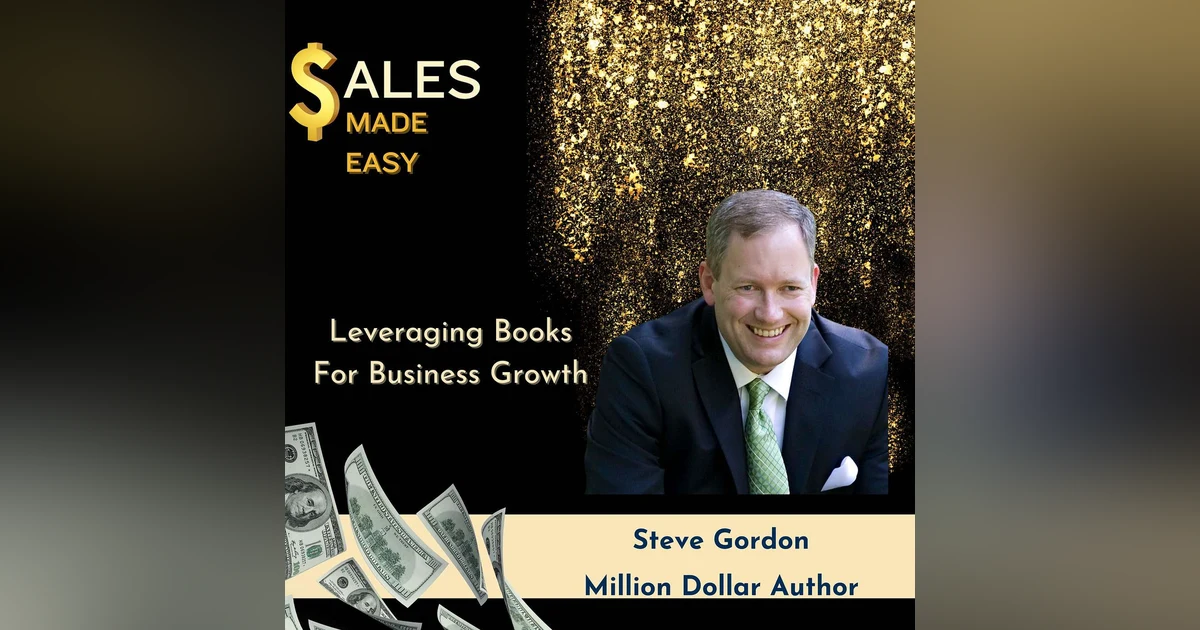
Leveraging Books For Business Growth With Steve Gordon


 Apple Podcasts

 Castro

 RSS Feed
Steve Gordon didn't just flip the script on referrals; he rewrote the whole playbook. From engineer to leading marketing maven, Steve's books transformed his life and business – now he helps others do the same. His systematic approach to writing could turn your business insights into an asset that speaks volumes.
Tune in for an episode that plants the seeds for sales success. Recognize the magnetic pull of a well-crafted book. Say goodbye to pressure sales. Say hello to a world where prospects come pre-qualified, prepped by your prose.
Steve Gordon has been where you are – and he's left a page-turning trail on how to reach new heights. Learn his narrative tactics. And if you're itching to connect with a maestro of marketable manuscripts, find him on LinkedIn https://www.linkedin.com/in/gordonsteve/ or at www.milliondollarauthor.io.
0:00 this is designed for a decision maker to read it, understand what it is that you do, how you could take a big, hairy problem that they're facing and transform it and give them a really bright. Future Welcome to Sales Made Easy, a podcast for business and personal growth. Join Harry Spaight, as he hosts sales experts and business owners who share their journeys of personal growth and business success now, here's your host, Harry. Hey, what is the good word? Have you thought about writing a book?
0:41 Can a book actually help you grow a business? Well, we're in for this conversation today with my friend Steve Gordon. He is a two time entrepreneur and best selling author of five books, including unstoppable referrals, and his latest book. The million dollar book is available and he has got downloads and things that he could help you in writing your book. So Steve, I can't wait to get into this conversation. Welcome to the sales made easy podcast. What's the good word. I am just so excited to be here.
1:21 Harry. Thanks for the opportunity. I always love talking about this topic and talking about sales in general, because, you know, nothing happens until the sale is made. So it's it's pretty important. Yeah, absolutely. It's funny. When people think of business, there's probably 2 things they're not thinking about. 1 is the actual selling that needs to take place. And the other is, should I be writing a book? I mean, it's like, why not? So how did this all come into place for you? Because you have an interesting background, I believe as an architect, so that transition had to be something. So why don't you give us a little bit of your background?
2:02 Yeah, I actually came out of a career in engineering and, and owned a consulting firm in that industry. For about 12 years and we grew that firm and had some success and I was the guy that was going out getting all the new clients. And so I just found that I really loved that part of the business a lot more than I did the technical part. So I left, started our current business and this is about 14 years ago now. I started working with other professional service firms, helping them Figure out how to get clients because that was a skill I developed and and about 2 years into that business.
2:43 I wrote my 1st book unstoppable referrals. You mentioned it a minute ago when I wrote that book. I had no idea what to expect. In fact, I, I couldn't even get the book written on the 1st, 2 tries. So I had 2 that had gone in the garbage. And 3rd tries, you know, 3rd one was a charm. And we can talk about what made that 3rd one work. But but we launched that 3rd book in July of 2014, 10 years ago now, and, and I got to tell you, it's just astonishing what happened. I had 15 of my colleagues, people I'd connected with, they were in my network. They had some of them had small networks and a few of them had pretty good sized.
3:28 Email lists, and I had these 15 people that agreed to share the book when it launched so launch week comes and I'd written some emails for them to send out and they send them out. And in about a week, we had 5268 prospects. Get a copy of that book and changed the business. Overnight, we went from a tiny little. 1. 5 person consulting firm in Tallahassee, Florida. And if you don't know, if you're listening to this, you don't know where Tallahassee is. We're the 11th largest market in Florida, which makes us really, really small. So I went from that only working with local clients to now getting inquiries.
4:10 Like, really, within a week, I was getting inquiries from all over the US, UK. Canada, I think I would even have 1 from Australia just overnight and totally changed everything. And so some of the businesses that I was working with at the time saw this and they're like, wow, that was pretty cool. I've always thought about writing a book. Could you help me write a book? So. You know, we're in that stage of, of, you know, early stage business where you'll, you'll take any opportunity that somebody throws at you. And so we took it and we've, we wrote some, some short books for people and they had really great results. I have one guy, very first one we worked with. He was a financial advisor, and his target market were physicians who were coming out of residency, because that's the point for a physician where they go from not making a lot of money to really making a lot of money.
5:03 So critical time for him to acquire them as a client. So he wrote a book and was having a meeting with. His very best doctor client about a week after we finished the book, and he said, how can I use this to get, you know, I want to get into to share it with people. So we walked him through a really simple framework for having that conversation and this doctor had not in the. The 5 years they work together, not referred 1 person in 30 minutes. He referred 11 people just by offering the book as a way to make the introduction. So we started noticing that. Anytime one of our clients had a book, they did way better than everybody else with their marketing.
5:48 And so over time, we refine the system for helping people create them. And now, I mean, we went from sort of requiring it of our clients to just saying, no, this is all we do. We're just going to help you write a book and then we're going to use that to multiply your business. Incredible. Okay. So where do I begin with the questions? The first one is. What was going on in your mind when you went through book one or the first edition and then what happened with the second edition where it made you say I need to get a third edition going here? What was that process like for you? So I think I was probably like a lot of people. I get the idea. Hey, I want to write a book.
6:30 Like a lot of entrepreneurs, I if you're familiar with the Colby index, I'm, I'm a high quick start, which means the minute the idea happens, I don't need any research. I'm going nice and it's a strength and it can also be a weakness. But you know, I jumped into the projects pretty decent writer at that point. I had been doing marketing copy for a couple of years. So it wasn't like I was going into uncharted territory, but writing a book's a different animal and. I'd be great, you know, I'd get hopped up on caffeine at the start of both of those 1st, 2 additions and all this motivation and went into him and I wasn't super organized and I get to the 3rd or 4th chapter and fall into a rabbit hole and then I'd pop my head up and go.
7:18 Where am I going with this? This doesn't make any sense. I need to start over. My idea wasn't that good. And really, the thing that made the difference by the 3rd edition was I figured out. Okay. I've got to have a system to do. This is where the engineering brain kicked in. I got to have a system to do this. I had heard someone describe their process for writing a book. I thought, oh, that's pretty good. I, I would, I'd change some things, but that's pretty good. And you know, That resulted in me going away on a Saturday into the home office, telling my wife, you're not going to see me until I've outlined this book in extreme detail.
7:59 And so I was in there from probably 7 a. m. to 4 or 5 o'clock in the evening. And I outlined the entire the 3rd, what ended up being the book that got published and it was the 3rd try. And the key there was really getting it down to a very specific level of detail. So that when I would wake up in the morning to write, all the thinking was already done. I had a road map and this is what we teach our clients to do now. It's really cool because after 2 or 3 days, so our, our whole process is, if you can devote 30 minutes or an hour to writing your book. We'll show you how to get it done in 30 days in 30 minutes to an hour a day.
8:40 Wow. And if you don't want to do that, we'll write it for you, but that's a whole other process. But you know, 30 minutes to an hour a day I found was sort of the sweet spot because that works with the way your brain wants to work anyway, short burst, really well organized and our clients. Now tell me they find what I found in that first book. I would wake up, you know, after writing for a day and I'd look ahead. Okay. These are the next few key points that I'm going to do. I would wake up the next morning and my brain had already written it. And now I had to race to the keyboard because it was coming out. So good. Yeah, this is really, really interesting. So when I wrote my book, it was 30 days times eight maybe nine.
9:26 So I could see it being done, but I mean, I'm not really sure I can, but you, if you're telling me that you could write a book in 30 days, now my curiosity is really peaked here. What, first of all, what size book are we talking about? Just so I can put this in perspective. So I like to call these. Plane ride books, you know, this is designed for a decision maker to read it, understand what it is that you do, how you could take a big, hairy problem that they're facing and transform it and give them a really bright. Future and so that's what we're trying to communicate in the book. We're not trying to teach them how to do what you do, because clients don't want to learn how to do what you do.
10:09 They want to know you have a process. To help them. And those are different things. I call it the difference between a textbook, which is a terrible business book to write and a transformation book. People that write checks want transformation books, not textbooks. So we're talking about a book. That's between 100 and 150 pages and final printed form. That's a great consumable size. It's. Long enough to feel authoritative, but not so long that when it's sitting on their desk or on the coffee table that it looks like a project. Beautiful. So the book was the 3rd edition.
10:50 Was it the same concept about the referrals to the unstoppable referrals? Or are they completely different? No, it kind of evolved. Some things happened in the interim. That I right before I wrote the referral book, the summer before that I had taught a whole series of workshops on referral marketing here locally and had about 300 business owners come through. We did different sessions over many weeks and, And it was great. People loved it. We were teaching all the kind of, you know, old standbys for how to get more referrals, which basically boils down to ask your clients more often and follow up with the people they refer forever.
11:31 So we did that and about 6 months later, I was, you know, running into some of the folks who were. In the, in those workshops, and I was asking him, okay, what's happened and I ended up talking to about 20 people who have been through the process. I gotta tell you, I mean, these Harry, these were the most depressing conversations I've ever had, because I'd spent all this time. I had all this great feedback from people about the workshops. And then I find 6 months later, they've done nothing. Oh, yeah. Yeah, okay. And, you know, and they're all telling me, no, it was great stuff. And I need to do this. I know I need to work on referrals, but they weren't doing it.
12:13 So I started asking questions, trying to figure out what what didn't work for them in that. And really, what it came down to, and this is sort of the, the impetus for the new book was that that, you know, most business owners understand that they need to ask for referrals, but they also know that the people that are going to ask. Are kind of like the goose that played the golden egg in their business, and they don't want to go back and take too many of those golden eggs too quickly. You don't want to kill that goose. And they know that asking for referrals is taking value out of that relationship the way that it's traditionally done. Right? It's all about me. And how can you give me more business?
12:55 Right? And unstoppable referrals flips it on its head, and it's how to use an asset like a book. To put all your best ideas into it, and then go to your client and say, you know, we've been able to help you with this problem or that problem. And you really, you told me you really appreciated this approach. We have that approach. Well, I've written about all of that out in this book, and I know that here, you probably know people who would really benefit from getting these same ideas that you've gotten so much success from. Why don't we sit down and brainstorm together? If you're open to it, who we might be able to give this book to as a gift from you. And what we found is that approach, it's a giving approach that unlocks a lot more referrals.
13:37 Our clients average about 7 introductions every time they have that conversation. Wow. Yeah. So the, what I love about this is that it takes so much of that awkwardness out of the just asking for a referral, right? So now it's a gift, right? Who doesn't want to give a gift to somebody? Number one. And when you mentioned earlier about the relationship can be Strained a little bit by asking for the traditional referral. I don't think you use the word strain, but are you following along here? How that can absolutely. Okay. Can you talk a little bit about that as to why that is?
14:17 Or what do you mean by that? Well, there are a few reasons behind it. Number 1 is risk. And if we don't acknowledge the risk, it's really hard to it. Understand why referrals don't work. So when you're asking for a referral, 100 percent of the risk falls on the client or the referral partner. Because they're going to put their reputation on the line for you, and it doesn't take much for the, the interaction you have with the person that they refer to go sideways. I mean, it might not even be your fault. It could just be that that person's having a bad day. It just didn't receive it. Well, and so there's all of this risk. There's really no upside to making the referral and, and even if you're paying a referral fee or something like that, which generally those don't work, And there are situations where they do, but by and large, in most situations, they don't work.
15:13 That it just all that risk ends up suppressing the number of referrals that you're going to get. The other piece of it that I think people overlook is that you're asking your clients or your referral partners to really become your unpaid and untrained sales force. And you're asking them to do the thing that is the most difficult thing in any business, which is prospect. And if you're not doing it successfully, how in the world are they going to do it successfully? Yeah, there's so much on that. It just, the simple thing of returning a phone call being respond.
15:54 We, we assume so much that people are like us and we talk to someone and say, wow, this guy, Steve's a really nice guy. I might have a reputation where I return emails in an hour, right? And now I'm referring Steve and Steve says, well, I'm really busy. I'm traveling. I'll get my emails in the next couple of days, inside of 48 hours. I'm not saying you're like that, but someone may be that way. Now, the referral that you gave is so used to you, the way you do business. Now they see, Hey, this guy is different than you. And now. There's more questioning that takes place. So when people ask for referrals and they say, well, we just met.
16:38 So I'm going to tell you all about me. So we, you could be referral partner for me. It's like, are you crazy? We just met. I don't know how you respond to emails. I don't know what you do on the phone. I don't know if you stick through problems. I don't know if you'd lose your temper. I don't know. I don't know what your billing is like. I don't know any of this. So for me to risk my, my relationships and someone who's a stranger, it's a real risk. And so I don't think people get this and the whole network community. And so your approach on this is it's so much softer. And you're working together with your client on this which is really a nice way of doing it.
17:20 What's your, what's your thought? I'm not that random. Well, you're, you're, you're absolutely right. And, and the, the thing that we've found with this is that because you're just giving a book away, I mean, have you ever been really angry with someone who gave you a book? No, I don't get really angry with people who give me gifts. Yeah, I mean, I can remember, like, 1 time somebody in a webinar. I said that and and somebody put in the comments. Well, what if they gave you a book on weight loss? And I was like, well, okay, maybe then if I was really sensitive about my weight, but even then I probably wouldn't be super upset about it. You know, I've had people give me books that I just. Totally wasn't interested and it just went on the shelf and I actually still have them because it's taboo to throw books away.
18:06 So here's where we get into some of the power of this. And I'm gonna connect this back to why we write books now. Okay. But the, the reason this is so powerful is you can go to that referral partner that you network with, and you maybe you've only met them 1 or 2, once or twice, and you can give them a copy of your book. And if they respond to that and go, wow, this is really great. You can go, you know, I, I like to give these things away. And if you've got clients that would be impacted by this, you know, why don't we sit down and brainstorm who we can send some books to? I, you know, I have plenty of them. They don't cost me much. And I think it'd be a real value. And what you're doing for that referral partner or that client is you're giving them a very easy way to do something that they've been meaning to do, but they don't do, which is give value into their network.
18:53 So now you're empowering them to look like a superhero. You know, and you're elevating their status because now they're going to get, get to be associated with an author. Now, the benefit to you is you get introduced not as a salesperson, because we all know that in that old model of referrals, it always ends in the dreaded sales meeting, right? You know, it's a sales meeting. The referral partner knows it's a sales meeting and the prospect I guarantee you knows it's a sales meeting and they're scared because they might be sold something. And I don't know about you, Harry, but I sell for a living and I don't like to go to sales meetings unless I'm the one doing the selling. Right. Right. Yep. So, so you're able to, to give this gift and now you're introduced as the 1 who wrote the book.
19:39 That's far better positioning now, you're in a category of 1, and if you do it, right, you put all of your best ideas, all of your best thinking and those ideas go and sell you. Right. Most people do it the other way around. Most people have all of their best ideas and they keep them hidden inside the closed doors of their office and they go out and try and sell people on how great the ideas are. If you come back with me to the office, totally backwards, but the good stuff out there and people get afraid. Oh, people, you know, prospects won't need me. Then that's nonsense. Real prospects who want to write checks don't want to do what you do.
20:21 Really good. So the idea of using these books as a, I'm not, I don't want to say a business card, but it's a gift. And some people say, you know, your books more than a business card, but it's clearly a gift here and you're not looking to sell books. Why is that? It's just far more profitable to give them away. Talk to me. I mean, I love it. So let's just talk about the business model of the book business. Right? So let's say you publish your book and, and you publish it to Amazon because I'm going to make more money doing that direct than trying to go through a traditional publisher and take years to get it out if they pick you.
21:14 Right? So, in a matter of 90 days, you know, we'll take a business owner from 0 to the book is published and launched and they're starting to attract clients with it. Well, they're going to make every time they sell a book, they might make somewhere between 2 and 5 dollars a copy. Let's say, you know, occasionally a little more than that, but that's pretty rare. You got to sell a lot of books to make, like, if you're in a a service business where you're selling a high value service, which is really where this shines. You've got to sell an awful lot of books to make up probably for just 1 hour of your time.
21:54 In your service business, you know, but if I give away. A thousand books, the likelihood of me making a hundred thousand dollars or a million dollars in new revenue to the business off of that pretty high. If I give them to the right people. Hello. Yeah. So, you know, when you look at it that way, it's, you know, sometimes it might be ego gets in the way. And people want to hold on to the book instead of giving it but I just I love the approach right as you look at it as really an investment in your marketing, and you can say here if I put this out to the right people right if you know your ideal client.
22:35 And you put it out to the right people at really a small dollar amount whatever it costs to publish the book. It's not a lot, especially for a book 150 pages or so and it's paperback. I think I have some numbers but I won't share them but it's low. And so, if you think about what it costs to get a meeting. I mean, you know, just to get the meeting, you know look at what it costs for outbound marketing company to do outbound for you. It's going to be a lot more than the cost of the book. Yeah. Well, let me give you an example. So one of our clients his name's Charlie and he's a.
23:18 Sales consultant works with bigger businesses mostly in the, the professional service world and super successful guy. Like, this is not somebody who wasn't successful before. He was plenty successful came to us and said, I've always wanted to write a book, which I hear all the time. And you know, I want to go ahead and get this done. So he does. He wrote this great book called how to turn order takers into rainmakers and and so about a week or 2 after the book launched, he's at a charity event on a Friday night and. He's there. He runs into the CEO of a 400 million organization that he has been trying to get a meeting with for two years and they knew each other, right?
24:03 But the CEO never took the meeting. They'd run into each other in the community. So they bump into each other. I don't know, probably standing in line at the bar or something. And and the CEO says, well, Hey, Charlie, what have you been up to lately? Charlie said, well, I just wrote a book. And the CEO reacts the way everyone reacts. When you say, I just wrote a book. They go, oh, yeah. Oh, wow. What's it about? Where can I get a copy? And Charlie said, well, it's called how to turn order takers into rainmakers. And I happy happen to have a copy in the car. Let me go get one for you. So Charlie goes to the car, comes back, signs the book, hands it to the CEO. And he says, the funniest thing CEO is just like staring at it and he's rubbing the cover and staring at it and kind of processing for a minute.
24:43 And he looks up at Charlie and he says, This is what you do. I had no idea. Now. Wow. Have you ever had that experience where someone that you kind of knew who was probably a pretty good prospect for you, but they had no understanding of what you really did. And then you get angry because they're now they're working with the competitor on the street. You're like, I never had a shot. Don't you know, I do that. This is what we said. Don't you know, I do that. Exactly. So, so the CEO is looking at this. He looks at Charlie said. I'm going to read this in the morning. And so that's a Friday night. Charlie gets a text at nine o'clock on Saturday morning.
25:25 It's a picture of the book next to the CEO's cup of coffee on his back porch. He's reading the book. He said, I'm reading the book, loving it so far. About an hour and a half later, he's finished the book. He sends an email to his assistant, copies Charlie and says, Please get with Charlie. I want everyone on the leadership team to read this book and Charlie, I'm thinking about how we can use you. So he goes from two years of not being able to get in the door to overnight being invited in. Beautiful. That that's the power of a book. It is. That's really amazing. A great story. And how's Charlie doing today?
26:07 He's doing awesome. He's he's gotten to the point now where I think he's he's, he's gotten enough business that he's kind of. Stepping aside is starting to ease into retirement because he did so well. Yeah, very nice. So, does Charlie give you referrals? I would say that he does. He would be your number one referral guy. Stuff like that. Well, so my other. So we, we've got this little kind of record board leader board thing going internally, we launch books and, and with our launch strategy, it's really geared to helping the business owner get their first client from the book within the first days or weeks and our current record holder.
26:54 Got his 1st client from his book 5 hours after we launched it. Okay. Yeah. So, and this is what happens. So he, we tell everybody build, build what we call your dream. 100 list and 100 is a nominal number. You might have more or less on there, but he did that. He emailed out to. All the people on the list said, Hey, my, my new books available on Amazon. Here's the link. Go get it. And usually in the early days of the launch, we want to do that. We want to get an Amazon bestseller stuff because that adds another layer of credibility. And so he got that. And and somebody who got the book knew someone, this guy was a kind of a web consultant, like internet presence consult.
27:37 So you build your website and then do a whole bunch of other. For things to drive leads to it and he's like, you know, I've got somebody that is starting a new business. They're pretty well funded. He needs exactly what you're talking about in this book. So he connected the 2 of them. They met for lunch. Our client walked out with a 38, 000 dollar contract to do this guy's entire web presence. 5 hours after he launches his book. Wonderful. That's the other lesson that we've kind of discovered in this is that there's gold hiding in your network that you need to give people an excuse to get excited about you and to see you differently.
28:19 You know, if you're, if you're networking your brains out, and I got to tell you, I was in every networking group. Like I was in the, the one with the three letters that's all over the world. That's awesome. You know, and and I did what they said to do. You're, you know, you need to be doing right. Networking about 10 or so, 10, 12 hours a week. I was doing that maybe a little bit more, was networking my brains out. And when I wrote my book, six months later, I went completely cold Turkey on networking and In that way, because I didn't need it anymore. Right. But you can, you can take that book and use it to get people excited about what you're up to and give them a really easy way to share you.
29:03 It gives them something newsworthy to talk about. And it's not like you're not, you don't have a network anymore. No, I just, I don't have to go to a breakfast meeting or a lunch meeting or anything else. The other. And what I found is that elevated the networks that I was in. Yeah, it becomes less obligatory, I think. And you now have, I think this is where a lot of people get lost is that they do it because they're being told that they need to do it, but they're not necessarily calculating the hours spent into the return for their business. And if you can do this and you know, I love the approach in the sense that, I mean, do you consider yourself, maybe you do now, but did you consider yourself like a salesperson that had the sales answers?
29:50 No, no. So I mean, I still really don't. I don't consider myself good at sales. I mean, I've gotten good enough and you've gotten this approach that. So this often happens, I think, in business that someone from outside of an industry comes in and says. I think we should try it this way. It was like, what giveaway books? Who does that? And then you're like, well, simple math is you're going to spend whatever, five, 10 on a book that costs 200 or more per meeting. I think I can get a meeting for about 15 bucks, right? Using some very limited numbers, but I mean, I would do that one all day long versus, you know trying to break the ice.
30:34 I've got ice breakers. I'm meeting people. They're not connecting with me, spending time with people who are not my ideal client. You know, it's like, I recognize that. I was like, when I want to make good use of my time, I want to be in front of my ideal client. Absolutely. Right. Absolutely. Yeah. And you want that ideal client to be prepared. So I will tell you 1 of the best experiences that I ever have in sales. And I have it pretty frequently now because we use books so much in our marketing. But the best experience that I have in sales is when I have a prospect who tells me right out of the gate that.
31:14 He's read my books, or she's read my books, and they start quoting chapter and verse from them. And our clients tell us that this happens all the time. They will get a really good client has become a very good friend over the years. We've done 3 books for him. And he has had people come in who he's been marketing to and trying to get in with sometimes for years and they'll come in and they're finally ready. But they've been holding on to that book and it's highlighted and dog eared and it's got sticky notes in it. And they know exactly what they want to buy at that point. There's nothing for him to sell.
31:54 Yeah. At that point. He's just saying. All right, what's your situation? He's diagnosing. He's prescribing some, but they pretty much already know that they want him and they want his process and the results that it's going to produce. Exactly. So there's, there's not a lot of selling that needs to go on in that, right? It's, yeah, it's beautiful. That's the reverse. That's how to become a salesperson into an order taker, how to become right. Because you're, you're taking the order when someone wants it that badly, which is. Also, also very good. Yeah. So good stuff. What about your Sally? When someone is now curious, do you view yourself as a closer or do you kind of feel like people you've got so much out there of value that you say, I can just let people buy when they want or I'm not really worried about closing.
32:46 What goes through your mind in that process? Well, I don't like that the word closing. I, I believe that selling is a very noble thing. It's all about identifying problems people have and matching them to solutions. And and so I love to just be able to be there and sort of be curious and ask questions and understand where's, where's the real problem and pain here, because that's where all the opportunity is if there is any, but I want to know the truth of that, is there opportunity or not? And. You know, and then there is obviously you need to be able to sell to some degree because people have fear as they're coming into things and they don't have the certainty that you have about your solution because they haven't seen it work hundreds of times, you know, like I've seen our process work with our clients.
33:44 And so they don't have the benefit of all of that. And so you've got to give them a level of confidence and comfort that, you know, that, you know, That their situation is going to be transformed by what you have. And so, you know, you have to be able to be there and be present and really be able to lean into what those fears are and get them to be honest about it so you can address them. And if that turns into a sale, fantastic. I'll tell you the thing that really freed me in selling was when I was able to create leverage. In the lead generation side of it, and part of that was moving beyond just networking, and using the book to make sure that there was a pretty healthy, steady flow all the time.
34:31 Because if you know, you've got a full calendar, you don't need to sell any. Single prospect. And so there's no pressure, no pressure on me to sell, no pressure on them to buy. Let's just see if this works. If we can, if you've got a problem that we can solve, man, let's go solve it. And that'll be fun. We'll do it together. And you're going to have a great outcome, but I don't have to worry about it because I'm, I got 10 people in line behind you. So good. Yeah. I love everything that you said, especially about the close. This is a sales term and the fact that you're not even thinking about it, thinking about serving the people, how we work together, how we can solve problems. Just that's money in itself because it takes the pressure off and the buyer is not thinking about everything that he says is somehow going to be manipulated into.
35:18 Aha. Gotcha. Just sign right here. Just sign right here. You said just sign right here. So I tell you why that, that has never worked for me. I mean, I've done that to people and I've, I feel very bad about the ones that I've done that to, but I've done that. I've been through all the sales training that, you know, I shouldn't have probably been to, but it always results in bad clients. Because they, well, they, anytime somebody is sold into something and they're a little bit still hesitant and you haven't dealt with, All of the, the fear and the objections, they're going to come in with doubts into the relationship and they're not going to be accepting of your advice.
36:03 And that's really what they're they're paying for your expertise. Yeah. And there's like you mentioned coming in with doubts. They're probably second guessing why they signed. And so already the attitude is on the wrong side which is never good. Right. So great. I'm loving this conversation. The sales concepts that you have the, the full pipeline. It takes the pressure off of selling completely. You know, there's a comment I was listening to a coach one time and he said, you got to remove all anxiety, all neediness when you're in front of a prospect.
36:51 And he said, his thing was, I may need a client. I don't need this one. I don't need you as a client. So he moved the person that was in front of him as the one that he needed because he looked at, like you mentioned, the full calendar. I think that is so good in sales, taking the pressure off so that we're not so worked up about what do I have to say that's magical for this person and just serve the person and be there for them. And things will come up where you can say, well, How do you feel about working together on this project? Right? Where it becomes very natural versus, you know, am I going to use the alternative clothes?
37:34 Am I going to use this power clothes and all this stuff? That's comedy in my mind anyway. So final thoughts, Steve, this has been a blast. Well, so for anyone who's listening who. Maybe doesn't describe themselves as a salesperson. Maybe they're an expert at what they do. And they sell something that's complex that maybe is hard for prospects to, to really wrap their head around. Sometimes I, I just know from experience, the very best thing that you can do is write a book. And we didn't start off giving that advice to our clients. We kind of discovered our way into it by seeing what.
38:15 The results were and so maybe that's a little self serving now, because that's what we do for folks, but we know that works better than anything else. And and so if you're in that situation, and you want to make selling a whole lot easier, and you want to have more opportunity than you need, which is a powerful place to be when you get to that point, you can do an awful lot. You know, you can. Relax a little bit, you don't have to worry about getting that next 1. like you say, you can raise your fees. So you can make more money and work less. I mean, there's all kinds of power that comes from that. Really, the very best thing you can do is write a book. And the only caution I have for people who want to do that. And I know now, I've been doing this long enough to know that the vast majority of business owners have thought about or wanted to write a book for a long time.
39:02 Stop thinking about it. Transcribed Stop turning if you're in the process of writing 1, and it hasn't been done, and it's been more than 90 days, then you need to stop thinking about it as a write the book project. And you got to start thinking about it as how do I get to have a book? Because there's no profit in writing a book. Lots of profit and having a book beautiful. Where can people find more of you, Steve, and your brilliance? I'm on LinkedIn. Feel free to reach out and connect to me there. And you can also find us at milliondollarauthor. io. So remember the io on the end. And we've got a great Free training there people can, can take part in.
39:45 It's about 20 minutes kind of goes through everything you need to know about how to use a book to get clients. If they'd like to get a copy of my book, my latest book, the million dollar book, which again describes the whole process that's available there. You can, you can get that for free and request a copy there on the website as well, right at the top. So that's the best place to go. I'm going there. This has been a blast, Steve. Thank you so much for joining me on the podcast. We'll put the links in the show notes. And you guys, if you're even thinking about writing a book, is it safe for them to reach out to you or to go? Oh, a hundred percent. Yeah, absolutely. All right, cool. So stop thinking and start doing get in touch with Steve Gordon, ladies and gentlemen.
40:29 Great stuff, Steve. Thank you. Thank you for listening to Sales Made Easy. If you found value in our conversations, please subscribe and leave a review. Our goal is to provide practical strategies for growing your business while staying true to your values. Remember, six. Success in sales is about serving your clients. Serve first and the selling will follow.