Rising After Divorce with Counselor & Author Sonia Krishna Chand, LPC
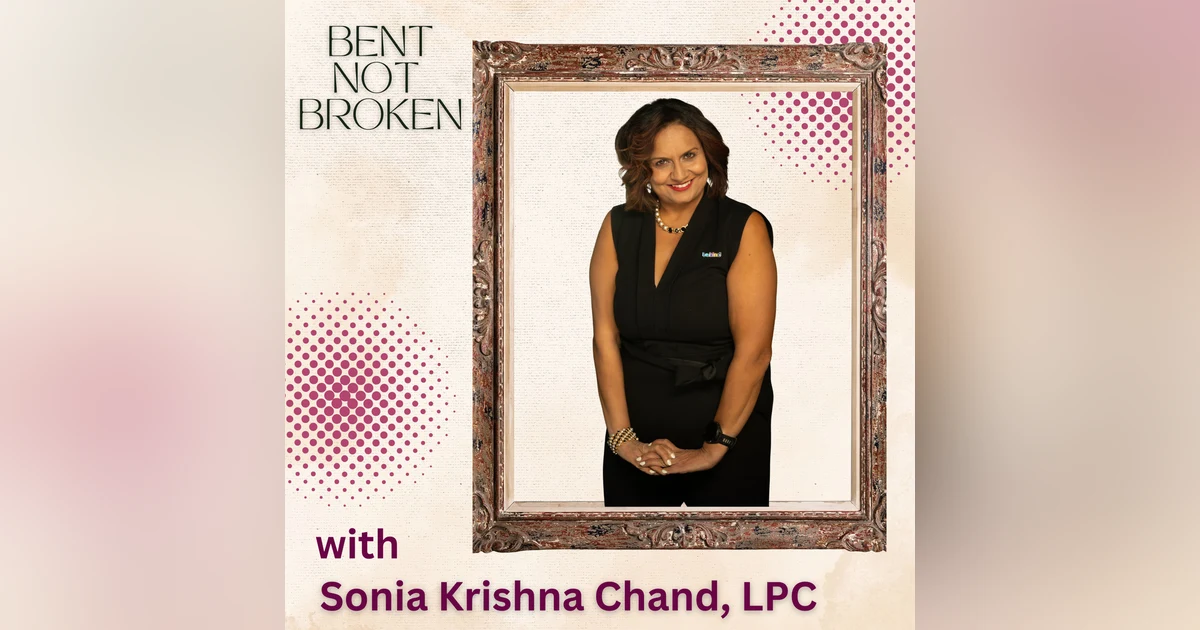


In this powerful episode of Bent Not Broken, host Deborah Griffiths sits down with licensed professional counselor, podcast host, and author Sonia Krishna Chand. Together, they dive into the emotional challenges of divorce, the journey of rebuilding self-esteem, and the practical steps you can take to reclaim your sense of identity and self-worth.
Sonia shares insights from her counseling work and her own journey—reminding us that while divorce can feel like the end, it’s also an opportunity to rise, heal, and redefine your future.
What You’ll Learn in This Episode
- The most common emotional struggles people face during and after divorce—grief, heartbreak, and loss of identity.
- How to recognize triggers and stop them from taking over your life.
- The truth about self-esteem—what it is, why it matters, and how to strengthen it.
- The power of positive self-talk and affirmations in rewiring your mindset.
- Why therapy, coaching, and group support are vital tools for healing.
- How to set and protect healthy boundaries in future relationships.
- Sonia’s key message of hope: “You may feel broken, but you are not broken—you are on the rise.”
About Sonia Krishna Chand, LPC
Sonia Krishna Chand is a licensed professional counselor, podcast host of On the Spectrum with Sonia, and author of the memoir Dropped in a Maze. Through her work, she helps individuals process trauma, build self-esteem, and navigate life transitions with courage and clarity.
- 🎧 Listen to On the Spectrum with Sonia on all major podcast platforms
- 📖 Get her memoir Dropped in a Maze on Amazon, Barnes & Noble, Target, and Walmart
- 🌐 Learn more at soniakrishnachand.net
Key Takeaway
Your worth is not defined by your relationship status. Divorce may change your title, but it doesn’t erase your value, your gifts, or your purpose.
Resources & Links
- Sonia’s memoir: Dropped in a Maze
- Podcast: On the Spectrum with Sonia
- Website: soniakrishnachand.net
Episode Quote
“Every emotion in grief is a teacher. When we ask, ‘What is this trying to teach me?’—that’s when true healing begins.” — Sonia Krishna Chand
💬 Enjoyed this episode of Bent Not Broken: Life After Divorce with Deborah Griffiths?
Don’t forget to rate, review, and subscribe on Apple Podcasts
and Spotify so more people searching for life after divorce, divorce recovery, co-parenting, dating after divorce, and healing from gaslighting can discover this empowering podcast. Every review helps others find hope, inspiration, and practical tools for thriving after divorce.
🌐 Explore more resources: Visit BrokenToBoldness.com
for coaching, workshops, and guidance on divorce recovery and life transitions.
📲 Follow Deborah Griffiths for daily empowerment and support:
- Instagram: @BrokenToBoldness
- Facebook: Broken to Boldness
- Eventbrite Events - Register for a monthly Divorce Recovery Workshop
✨ Remember: divorce may bend you, but it does not break you. You are stronger than you think, and your bold new chapter starts now. ✨
Welcome to another episode of Bent Not Broken. Heartbreak and trauma may feel like the end of your story, but here it's the beginning of a bold new chapter. I'm your host, Coach Deborah Griffiths, and this is the space where women rise, rebuild, and rediscover their purpose. Remember this truth. You are bent, not broken. I'm very excited today for our next guest. Not only is she a friend, but she's a licensed professional counselor. She's the podcast host of On the Spectrum with Sonia, which you can find on all major audio platforms. And she's the author of her memoir, Dropped in Amaze. So welcome, Sonia Krishacan. Thank you so much for being here. I'm so excited.
SPEAKER_01Thank you so much for having me, Deborah. I'm really excited for you and congratulations on your new podcast.
SPEAKER_00Thank you. Thank you. So we'll get started. We're obviously going to be talking about the topic of divorce and the emotions that tie along with it and self-esteem and really how you can take steps to rebuild your life after divorce. So, from your perspective as a counselor, what are some of the most common emotional challenges you find that people face during and after a divorce?
SPEAKER_01During the divorce, uh very understandable emotions of heartbreak, grief, and which starts, you know, during, but then even after the divorce settles. A lot of that same heartbreak, the grief. A lot of times too, I've seen clients come in where they felt completely destroyed internally. Lots of feelings of worthlessness, feeling lost, um, some struggles with self-esteem, because a lot of times people, after they've gotten out of a a really toxic relationship, for example, that ended up in a divorce, they lost a sense of who they were because they've been beaten down so badly emotionally. And they completely forgot that they had any self-worth, that they, you know, everything that was they had everything that was already in them to begin with. A lot of that sense of self and purpose gets lost.
SPEAKER_00I can relate to that. I went through a very messy divorce myself, and you know, to the point where I was driven to the point of a suicide attempt. So coming out of that, you really don't know who you are. And it takes some time to to rebuild your life. Now you mentioned grief. And you know, there's probably also that sense of failure as part of that grief. What are some ways that people can or steps that people can take to positively move from that point into uh into healing and having a productive life again?
SPEAKER_01Well, one of the things to remember is that grief doesn't really have a deadline in that it's constantly moving, but you just learn how to cope with it and manage it. But I think the first step for anybody here is to learn to sit with it. Because before you can go on to healing, you have to first go through the emotions, right? And I like to analogise it like this. So let's say you're training for a marathon, right? And you have to do, let's say you have a 15-mile training run, right? Do you stop the run the moment your body starts to feel it? Or do you stop when you're finished with what you're supposed to do? It's the same thing with emotions. The way you get stronger is you have to learn to sit with it. And some of the best ways to sit with it is ask yourself, what is it teaching you right now? Every emotion in grief, the anger, the doubt, the denial, the sadness, right? That everything that goes on with it is teaching us something. Every emotion is there for a reason. And if we can look at this as what is it trying to teach me? What's being hit right now, what's not being addressed, then we can start effectively learning to grow. And this is where that healing can start to begin. When we start learning to use these emotions as our teachers instead of something to make us feel bad.
SPEAKER_00I love that. You know, being able to recognize of all, you got to recognize it when that emotion is hap happening. But when it does, rather than go off in a negative tangent, take that step back and and ask yourself, like you said, what is this, what am I supposed to learn right now? What am I, what is it teaching me? And learn from that. And I I love that. I love that perspective. Because so much of it all entails that mind shift change, you know, that we that we need to make to uh you know, to be more positive and not let that self-talk, negative self-talk weigh us down. Now, I have a question, and it was gonna leave it for later, but now it's kind of a good time. Is when you're dealing with some of those emotions, um, you know, sometimes they those emotions arise from triggers. You know, as you're going through the divorce, or maybe it's after the divorce, and you're having to deal with your ex with custody issues or visitation or any of that stuff, and so, or maybe your ex says something and it doesn't set well with you, how do you process those triggers and move and not let it ruin your day or just ruin your life or ruin everything to move past, recognize it what it for what it is, and be able to move on. Do you have any advice for that?
SPEAKER_01If you're getting triggered by something and you're facing that, um, the first thing is understanding what is it that you're getting triggered by. So go into an example, your ex says something to you that was harsh. One of the things I say to clients all the time is, you know, when you hear something you don't like, something that's critical, sometimes you have to look at the source, right, of where it's coming from. Because not everybody who says something is worth giving your salt to, right? If we're just being honest here, that not everybody, and here's the thing: one thing to remember is people who say things to you to make you feel a certain way are doing so out of a place of their own hurt and pain. And most oftentimes when you are in a contentious divorce situation, one thing to remember is it's two parties getting hurt at the same time, a lot of times. Even if that partner was toxic, that partner who is even toxic is hurt because the ego got blown. Yes, right, and they don't know how to handle the fact that their ego is shattered because somebody got up and said no more and I'm out. Right. That's the last thing a toxic person wants is to lose that kind of control and to lose their ego.
SPEAKER_00Right.
SPEAKER_01And then the other person on the other side, you know what? If you're getting triggered by something, also one thing is just to remember this as well, is just if it's affecting you, right? Also, where is this where does this really truly deeply stem from as well? Right. Because a lot of times, you know, one thing you'll find is when you look at people in their relationship patterns, it's emulated by what they saw in their own family structure growing up, family of origin. And a lot of times what you'll find is a person who has any unfinished business, what we call unfinished business, with a parent that they didn't get. Perhaps it was a parent who they whom they never could get along with, and perhaps something happened and they never got that closure. Right. Or if it's um someone who had a very hypercritical parent, right? It's not uncommon for people to, for example, I hear this from people all the time. Oh, Sonia, I um, you know, I, you know, I dated this guy who used me and always made me feel like I was never good enough. And when you actually go and you peel back the layers, it's not surprising at here. They grew up in families where they had parents who made them feel like they were never good enough. They always felt like they had to live up to something. And so it, you know, and so it just all plays out. And if you can realize where this comes from, right, and do that work, and this is where therapy is so important in helping deal with these emotions. Um, because truth of the matter is, even if you do get triggered by something, the feeling, you know, that whole feeling of I need to feel good right away, right? It's not gonna come as quickly unless you've done some work and you had learned some tools that you can use to be like, okay, this is where it's coming from. I'm gonna learn not to now I know what you know the source of it, I can compart, then it's easier to compartmentalize.
SPEAKER_00Right, that makes sense, and it kind of all ties into my next segue is about talking about self-esteem and I identity. And I know this is a topic that is near and dear to you, to your heart.
SPEAKER_01Sure.
SPEAKER_00What is actually the maybe there's a clinical definition of self-esteem? What would that be? Or what is it?
SPEAKER_01So self-esteem is basically the definition of that is how do you feel about yourself throughout, right? And people with healthy self-esteem, it's not that they think they're better than everybody else, or they feel, you know, like, you know, they're infallible, right? It's not that at all. What healthy self-esteem is, is you accept what your strengths are, you accept your weaknesses, you continue to be teachable, you continue to work on yourself. People with healthy self-esteem will take care of themselves more, right? So they'll go to the gym, they'll, you know, do, you know, go for exercising, they will eat well, they appear well. People with healthy self-esteem understand that, you know, even when things get rough, that they're not gonna become their own worst enemy and automatically start hating themselves, right? Self-esteem is how you feel about yourself throughout. And there are going to be times when self-esteem can be challenging, right? And it's so easy to forget who you are as a person, forget that your self-worth has always been with you because it's innate. It starts from the day you're born. That in a lot of people, it's so easy to get lost in that and forget who you are, forget those things. It's you know, and it's doubly difficult when perhaps maybe, you know, when you've been in a relationship and you thought that this is the closest thing you've ever felt to being loved before, or this is the closest thing that you know that you understood what it was for you to feel love, lovable, and feel loved. And a lot of that could be even feel worthy, yes, yes, and even feel worthy. And so when that gets taken from you, right? It's really easy to have that all dropped.
SPEAKER_00And I think so many, and and I'm gonna speak from a woman's perspective, because I know I found this true for me, is you know, when we're married, we identify ourselves as a wife, as a mother, as maybe we're we're in the workforce, maybe we're involved with PTA. We somehow lose our sense of who we are. So when you get go through a divorce, it how what are some of the steps you can take to rebuild and figure out your own identity identity and and and rebuild your own identity?
SPEAKER_01So one of the things that I encourage people to do, and I work with clients on this, is I do self-esteem exercises with clients where we go through and we work on what are things about you, right, that you're good at, what are things about you that you enjoy? What are things about you that make you who you are? Because the truth of the matter is if you've always been, let's say, been a good cook, right? Just because you get divorced doesn't mean you stop being a good cook.
SPEAKER_00Right.
SPEAKER_01If you're a mom, that doesn't mean you're you stop being a mom the moment you get divorced. If you're funny, that doesn't mean you stop being funny the moment you get divorced. You're still going to be, you know, that, right? Like it's still there. Everything you need is still there. The only thing that changed really was a title from going from now misses to miss. That's the only thing that would change, is just the initials before your name.
SPEAKER_00I like that. And hopefully, women out there can identify that and remember that. That's a key takeaway, I think. I wish I had thought about that back in the day when I went through my divorce. I love that. So, what role does self-talk and negative self-talk play in part of the healing process from from you know, moving from a divorce and now you're now you're working on becoming a single person? And how does that self-talk, what kind of self-talk do we need to encourage ourselves to be whole again?
SPEAKER_01The way we talk to ourselves is huge. And it's crucial in how we how it makes us feel about ourselves, how it affects our moods. And if we're being our own critic constantly, right, it's no surprise then that we start feeling depressed, we feel anxious, we start hating ourselves, right? Because we're feeding ourselves that the message from the bully, right? And one of the things is if this is a rule that I've rule of thumb that I've always said to clients, is I said, let's say you were to say the same thing to a friend of yours, right? If you said what you said to yourself to a friend, do you would that person still be your friend anymore? Or do you think that person will be like, screw you, goodbye?
unknownRight.
SPEAKER_00The ladder, the ladder, yes.
SPEAKER_01And if it's not okay for you to say this to somebody else, it should not be okay for you to tell yourself those same messages, too.
SPEAKER_00That's a great point. Love that. Yep, yeah, I agree.
SPEAKER_01And one of the ways we can start is affirmations is so powerful, right? And even if you don't feel like it, and at first it might feel weird, especially if you've always been a person who struggled with self-esteem. Now, the reason self-esteem is such a big topic for me is I've had a love-hate relationship with myself my whole life. Okay. And I feel like I've had to learn a lot on how to love myself and be my own friend and accept me for who I am, even in the midst of not having that kind of support, right? From others. I had to learn how to do this kind of on my own. And I describe this so well in my book as well, just that journey, what it took, you know, and do I still struggle at times? I'm not gonna lie, I'm on the autism spectrum. I have bouts of depression that sometimes get heavy. Sometimes the voices get loud, right? Like when we say, you know, that critic voice, if you will. I get anxiety too. But, you know, at the same time, it's one of those things, you know, that, you know, I had to learn when I first started doing affirmations. I had to get up. I started practicing this in front of a mirror where it started with, you know, and I'm a sexy diva. I used to say this, you know, I started telling myself this back when I was in law school. And um, it felt very weird at first. Of course, that critic side, you know, those critics side of me were like, oh no, Sonia, what are you talking about? Everybody else called you ugly your whole freaking life. No, you're not. Shut up already. But I had to actually drown it out, but I kept doing it. And if something doesn't feel comfortable the first time, it just means you need to practice it. So it just feels like, okay, so I had to just keep doing it. And one of the things I like to do now is, you know, before I start my day, sometimes I'll say, you know, I I pretend that um I don't know this is gonna sound really embarrassing, but at the same time, I pretend that there's a cute guy telling me this. Okay. So I'll say, oh, you know what, Sonia? You know, you're doing amazing. I love you. I'm here for you. I'm cheering for you. Let's go start our day, right? Like I tell myself that. Pretending there's a cute guy that would tell me that.
SPEAKER_00Okay, but no, I mean, you know, whatever it takes, I guess. And you know, and I think we're born with we're created with imaginations and stuff. So, you know, whatever it takes to inspire us. And I like that, and that's probably something I need to do work more on myself is is doing those affirmations. And you're right, I've tried to do it before. I've tried to stick the posting notes on the mirror that says, you know, I am enough, and and saying it, but it does, it does feel weird. And it, you know, how many times do you have to say it before it starts resonating? I guess it it depends on the person.
SPEAKER_01It depends, and you know what? Who said there had to be a time limit to it, right? Very true. If you wanted to say that to yourself every day for the less rest of your natural living life, do so. I mean, there's nothing wrong with that. But I feel like, you know, the more you feed your brain the messages, the more that you keep practicing with affirmations and that positive self-talk, and you know, being that person for you, eventually your brain is going to adapt, right? Because that's kind of goes into the neuroplasticity that our brains are always changing, and that like when we talk about like cognitive behavioral therapy, right? You change first behaviors to change your thoughts to get the radical mood change, right? These are this is kind of what we're doing is creating a new pathway in our brain.
SPEAKER_00Yes. Is there any science as to how long it takes to create that new pathway in our brain? Um, I mean, is uh is where it just depends on the person and well, I know that every time we learn something new, our brains automatically regenerate a new pathway.
SPEAKER_01And that starts from when we're, you know, in our infancy, right, and growing up. You know, an example I, you know, I can think of is like learning to read, right? When we start learning to read, right, our brains create a new pathway, and it gets stronger each time that you reinforce it. That's when that pathway gets more solidified. So when you know, first you start reading, you start sounding out letters, sounding out the words, then you read a sentence out loud, and then later stages would be that you read to comprehend and understand points of view, things like that. So, I mean, you know.
SPEAKER_00So your brain's a muscle, you gotta keep working.
SPEAKER_01Yes. And every time that you learn something, you know, that's when your brain uh creates that new pathway.
SPEAKER_00Okay, interesting. I love that. I love that. How important do you feel is professional support, such as therapy, coaching, group support for you know, in the healing process? And and when should someone seek it out?
SPEAKER_01I think that therapy, group support, all of that is so important as you are in the healing process, I would highly recommend it because let's just face it, healing in and of itself can be a very lonely journey. And you want to be around people who can understand you. And the more that you're around like-minded people, people that you can bounce ideas from, or just have that person who can listen to you objectively and help you process through your feelings and help you work through areas where you may be caught, you know, in what seems like quicksand, right? I think that the better it it is for you, because it doesn't have to be a lonely experience that way, right? I think the more you find connection, right? I mean, everything is better when there's connection involved, I feel. You know, like they say, like when you look at things like, for example, addiction, when they say there's a reason they say the opposite of addiction is not sobriety, but connection, right? Because you want to be around those kinds of people who've been on that similar journey and who could be there for you the moment you do feel, oh, maybe I do want to use again. I do want to do this, I feel so horrible. Maybe I do want to have that drink. You want to be around those people that will get it and who get you, and then you guys can help support each other through that, right?
SPEAKER_00No, and that makes a lot of sense because so often you you said about the journey being lonely. A lot of times we create that island, you know, because we think we're the only ones experiencing it, experiencing that divorce or that addiction or whatever it is. I like that about the connection, especially with like-minded people, because then they're then you're not alone. You're not somebody else does understand and can help you realize you're not alone in this.
SPEAKER_01Absolutely. And and you will under, you know, and one thing about it too is when you listen to other people's stories, you know, in a way, and I I don't mean this to sound like sadistic or anything, but like you kind of feel grateful knowing that you're not alone, right? Even though, of course, do you feel bad another person is also suffering in their own way? Sure, but but this is kind of what helps us too, is when we can connect on that level of pain and we can all rise up together.
SPEAKER_00I agree, I agree. What advice do you give clients who are hesitant to trust again or who fear repeating some of the old relationship patterns?
SPEAKER_01Well, one thing is I would recommend that clients first and foremost take some time off from dating after a divorce and do the work on themselves, right? And really process the feelings that come along with the ending of the relationship, the grief, go through the emotions and sadness, rediscover who they are, and then also take time to kind of process the relationship in and of itself as well, and that like what was it when you look back? Were there potential red flags that you may have missed? Um, were you know what did you learn from the relationship? What did you tolerate now going into your next relationship that you may not tolerate? Things like that, making sure that you are once you have a better idea of those things you you know about yourself in terms of moving past the feelings, working on yourself, working through the relationship, learning and getting through that. Then, you know, what if you when you are ready to put yourself back out there doing it, right? And just because you had a bad experience and you went through something doesn't necessarily mean that you're automatically going to repeat the pattern, especially if you've done the work on yourself to learn from the experience, and you've done the work to uh build yourself back up again.
SPEAKER_00No, I would agree. I think I would add one more thing, too, is making sure you you know your boundaries. Yeah, what's acceptable to you and what's not acceptable. Because you know, I know in my experience I I wasn't clear on my boundaries and they got squashed. And I know better now. So that's a lesson that I had to learn the hard way. But um and that's okay. But I I think boundaries, having boundaries, whether it's a dating relationship or a parent-child relationship or a friendship, we all need those boundaries.
SPEAKER_01We really do. And one thing to remember while you we are on that subject of boundaries, is anybody who doesn't respect the fact you have boundaries doesn't respect you.
SPEAKER_00Good point.
SPEAKER_01And that's now if you called someone out and you said, hey, you know, please don't do this again, and they continue to repeatedly violate your boundaries, that's a clear indication that they don't care about you.
SPEAKER_00Right. I would I would agree. I would agree. Thank you for that. If you could give one key message of hope to someone listening right now who feels broken after divorce, what would it be?
SPEAKER_01You may feel broken, but that does not mean that you are broken. It may feel that way, but please remember that you are not a broken person. You are a person who's on the rise. You are a person who's gonna rise above. You will overcome this. This is just choppy waters right now, but you will get to your destination, a flat land soon, right? Like that's how I like to look at it. You'll get to that flat land, but you just gotta keep pushing through. And remember, one thing is just because you feel a certain way doesn't make you your identity of that.
SPEAKER_00Agree. Love that, love that. So if someone wants to know more about you or purchase your book, your or listen to your podcast, you know, how what's the best way to for them to do that? And I'll put everything in the show notes as well. And please mention your self-worth workbook.
SPEAKER_01Yes. My book, Dropped in a Maze, can be purchased on Amazon or any major book retailer like Barnes and Noble's. Um, all online. Uh my my podcast on the spectrum with Sonia that is available on Apple, Spotify, Amazon, all the major audio platforms. I have a website, Sonia Krishnachand.net, where you can go on and learn more about me. And on my website, it has also all the it has links to where you can go and get my book and also links to the podcast. And it has blogs. So every podcast episode I've done, there's a blog written that corresponds with the podcast episode. And then I don't, I mean, I like to use self-esteem workbooks with clients. The latest one I I just have to I will have to send it actually to you. That's fine.
SPEAKER_00That's fine.
SPEAKER_01But um, it's but I have done with my clients this and they have all benefited out of it. But it's one where there are exercises involved, there is also challenging your thoughts. Um, it's just very comprehensive in things and ways to help you improve your self-esteem, help you feel better about who you are as a person. And, you know, that's and one thing, if I could just really drive this one home, is your relationship status does not make you any more or less of a person. A person is a person regardless. And at the end of the day, you know, I feel like our society, we put so much emphasis on marriage, we put so much emphasis on, you know, a woman being worthy if she has kids, right? Like this is kind of what I've experienced, especially like especially in the culture I grew up in, being of Indian descent, you know, that's all about being married, all about having the family. If you're my age, now I'm not married, don't have any kids, none of that. And I'm a 43-year-old woman. Believe me, they look people look at me like I'm a murderer. Let's just be honest here. They really do. I'm like, because all because of that, right? Because it's so ingrained that your worth is only with your marriage, your worth is if you check boxes, your worth is only if you do X, Y, Z, right? But truth of the matter is your worth is not dependent on any of those things. Your worth is already in you. And so next time you start to feel bad, you start to feel worthless, you start to feel broken, you start to feel like, oh my God, what's wrong with me? You know, just remember this. You're bright, you're beautiful, you're worthy. All of these things, all the goodness, you already have it in you, regardless.
SPEAKER_00I love that. Thank you, Sonia, so much for coming on the show and sharing your your expertise and what and your knowledge. It's been real a fantastic discussion. Thank you, I really appreciate it. Thank you. Thank you for listening to today's episode of Bent Not Broken. I hope that this episode reminded you that even through life's toughest moments, you are bent, not broken. If this message inspired you, please share, rate, review, and subscribe, as it helps us reach more women who are ready to rise and rebuild. And until next time, keep living bold and walking in your purpose.