Reclaiming Your Voice After Divorce: David Alan Brown on Healing, Identity, and Inner Alignment
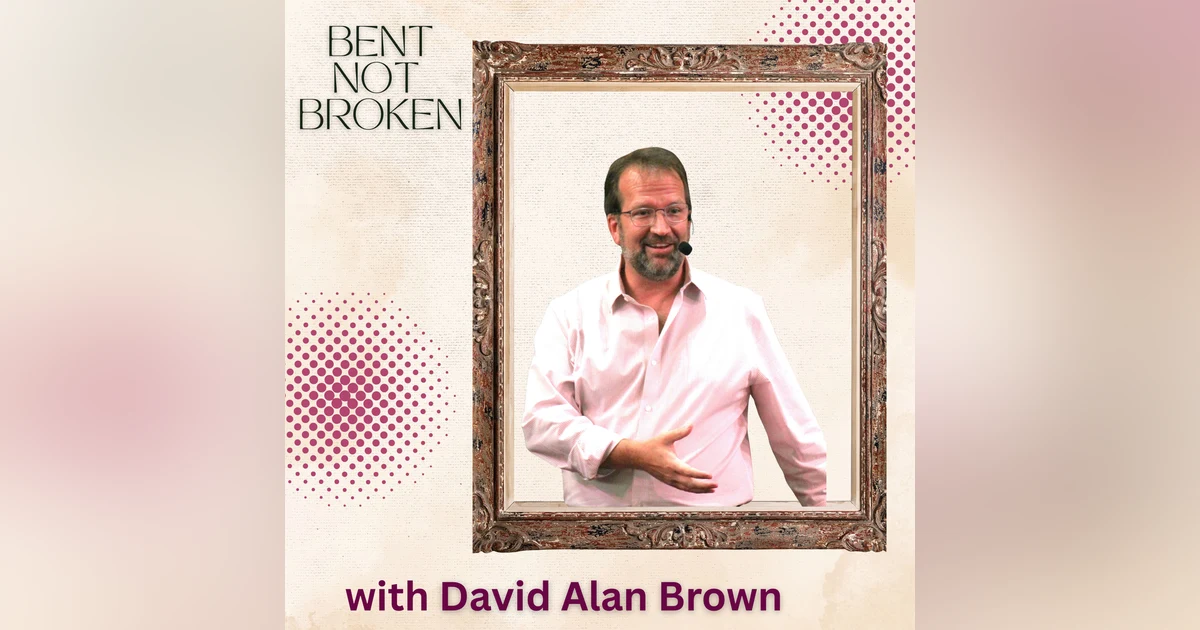


In this episode of Bent Not Broken, Deborah talks with David Alan Brown, writer, empowerment teacher, and creator of The Convergent Conversation—a method that helps people reconnect with their emotional, behavioral, and spiritual voices to rebuild clarity, confidence, and purpose.
David shares his powerful journey from years of depression, numbness, and suicidal ideation to rediscovering his identity, leaving a 24-year marriage, and rebuilding his life with intention. His story offers practical insight for anyone navigating divorce recovery, emotional healing, or major life transitions.
What You’ll Learn
• How David lost his sense of self—and what sparked his turning point
• Why emotional numbness can be more dangerous than sadness
• How self-rediscovery led to the end of his marriage
• What the Convergent Conversation is and how it helps you regulate your inner voices
• Signs you’re stuck in one part of yourself (emotion, action, or spirituality)
• A healthier way to understand anger without fear
• How Convergent Energy reframes manifestation as practical, grounded action
About David Alan Brown
David is the creator of The Convergent Conversation, a transformational program that helps people rebuild inner balance, reclaim their voice, and navigate life changes with clarity.
Learn more: DavidAlanBrown.com
💬 Enjoyed this episode of Bent Not Broken: Life After Divorce with Deborah Griffiths?
Don’t forget to rate, review, and subscribe on Apple Podcasts and Spotify so more people searching for life after divorce, divorce recovery, co-parenting, dating after divorce, and healing from gaslighting can discover this empowering podcast.
Every review helps others find hope, inspiration, and practical tools for thriving after divorce.
🌐 Explore more resources: Visit BrokenToBoldness.com
for coaching, workshops, and guidance on divorce recovery and life transitions.
📲 Follow Deborah Griffiths for daily empowerment and support:
- Instagram: @BrokenToBoldness
- Facebook: Broken to Boldness
- LinkedIn: Broken to Boldness
- Divorce Recovery Workshop: Click here to register.
✨ Remember: divorce may bend you, but it does not break you. You are stronger than you think, and your bold new chapter starts now. ✨
Welcome to another episode of Bent Not Broken. Heartbreak and trauma may feel like the end of your story, but here it's the beginning of a bold new chapter. I'm your host, Coach Deborah Griffiths, and this is the space where women rise, rebuild, and rediscover their purpose. Remember this truth. You are bent, not broken. Today's guest, David Allen Brown, is a writer and empowerment teacher whose life journey led him from early confidence and inner strength to a profound sense of loss and ultimately to a powerful personal awakening. After facing deep mental health struggles, David reconnected with the core parts of himself and created the convergent conversation. It's a method that helps people honor their emotional, behavioral, and spiritual voices to rebuild clarity, confidence, and purpose. In this episode, he's going to share his story and practical tools that you can use to reclaim your voice and step back into your power. Welcome, David. Thank you so much for joining me today.
SPEAKER_01Oh, it's my pleasure. Thank you so much for having me.
SPEAKER_00So there was a point in your life when things were very dark for you. Can you talk to us a little about that and then tell us about the moment when you began to sense that shift?
SPEAKER_01Sure. One of the things that many people will recognize, but it's also a little bit hard to explain, is that there wasn't a defining moment in which all of the sudden things either fell apart or it got super difficult. I sort of fell into a pattern of depression and suicidal ideation by the end. Mine is a story of a lot of very positive choices, quite a bit of privilege sustaining and not being desperate, but also succumbing a bit to just the social pressures of a little less authenticity, a little too much giving myself or my own needs and wants away, stuck in a routine, choosing only safe things or quiet things, or just following the old adage about better to blend in. This came along with some of my own built-in fallacies like perfectionism and fear of confrontation. In my late 40s, depression for me wasn't sadness, it was a numbness. It was just a lack of feeling. Enjoying or emoting in almost any way, feeling as if the days were going by without any true experiences. One of the times I remember most clearly, I was a runner at the time, which was helpful. There's a song called Be Okay. And the lyrics are pretty much, I just want to be okay today. I just want to feel something today. And I remember actually weeping a little during my run. Yes, that's all I want. I just want to feel again. I want to engage again. I want to know that I have a purpose, a direction, and a reason, and not merely just be responding to all of the things that were occurring. Not that all of them were bad. We had tough situations, of course, but mostly it was very much internal. It was very much based in emotion for me. And then, of course, COVID came along and decided to really rattle my cage, as it did for so many of us. We're now in a world that was providing even less stimulation. If what was sustaining me was comfort and predictability, now all of that was out the window. If what was sustaining me was caring for my family or uh knowing how to operate it as a stay-at-home dad, those parameters were all changed. Everyone in my circles and immediate family was feeling the distress of the time. There was really nowhere to go. As someone who was more of a self-sacrificer, I didn't feel like it was okay to burden someone else when I saw so many people already burdened. This is leading to the second part of your question. I remember needing to escape, just needing to get out of the house and being frustrated. I think there was something that happened with my son at the time, an altercation of some sort. So I just got in my car and I was driving through very empty streets in Indianapolis, Indiana at the time, through suburban Indianapolis late at night, and recognizing that the thoughts in my head about what would happen if I crashed the car. How could I ensure that could work as a means for going beyond suicidal ideation and into actual thinking about the doing of it? And I remember thinking that I had read somewhere or saw on TV that they do forensic studies of crashes and that they would be able to tell that it wasn't an accident and that I didn't want to leave that legacy. The shift of that thinking, because it wasn't merely conjecture at that point. Part of me was truly afraid that that was going to happen right then, that I was talking myself into something. It felt very different. It felt very analytical and it felt very real. And that was the shift for me. That was the moment of I need to do one or the other. And the other was find help. And that's what I did. I had been in therapy before with varying results, but I found a good therapist. And the other very important agreement that I made with myself was that there would be no more lack of authenticity. There wouldn't be me going into therapy hoping they would tell me what I wanted to hear. I would lay it all on the table and I would return to being myself and see how that would work. So that's the short version. That's the short version.
SPEAKER_00Okay. I believe you also went through a divorce as well. Was this all during this time?
SPEAKER_01Well, the divorce contributing to a little bit as a result of that, the self-work, the self-rediscovery on so many factors. Who do I remember myself being, as you said in the introduction, the purposefulness of my youth, the person I was, and sort of reclaiming that and having that to build from. And then, well, why wasn't I? What was keeping me from both that and a newly discovered version of myself? You start looking at what are the circumstances in my life, and then some primary relationships in my life. Are they supporting me or are they hindering me? Are they the reason or the block? And then we did that work too. My wife and I did some counseling. I was married for 24 years. We have two great kids. And we agreed that there was a lot to do, that we were in different places, that I was embarking on something that she hadn't started to do for herself yet. And that we could really an hour a week try and live through the tension the other six days. And maybe somewhere down the road it would seem better, but there was a long way. There were even probably some deal breakers that hadn't come onto the table yet. And, you know, maybe we could decide how to be happy a different way. That was really how we said it to each other when it was finally, you know, we talked about needing our own space to process, but we were very honest about if we separate, we'll divorce. We were aware enough to know that was the case. So, yes, in this time, almost as a result of the rediscovery and self-discovery, is where the where the divorce fits into that picture.
SPEAKER_00Okay. Do you think we all come to a point in our life where we start questioning who we are, what we've done, maybe where we need to be?
SPEAKER_01I think we all have many opportunities where that happens. And some are built into the way we've created our society and the choices we're expected to make, even at young age, about school and focus and ideas and marriage, family. Let alone young adult when, oh, well, this is the time when apparently the next thing to do is to get married and to have kids and the rest. Some of that goes to biology and our desire to propagate the species. Some of that goes to culture and how we seem to do it around here, all of those things. So yes, I think that of course we have those times. Maybe what you and I are talking about a little bit more, and the listeners of this podcast want to know about is you know, what about that point where for me everything seems great? Like you all the questions from the outside have been answered. We have our two kids in a beautiful home that we're functioning well, have an income, a dog and two cats, and we go on vacation twice a year and we gather at family gathering. You know, I mean, the the picture was there. I think people outside our marriage were stunned that we were getting divorced. That was one of the many points in our lives when I looked around and said, if this is supposed to be the picture, if this is supposed to be leading me somewhere, why isn't it? Why am I not there? To me, that's the moment. It's when those questions become internal instead of external. And there are times when we all have that. Some of us were coached when we were young, find a career that you love that is emotional based. Others of us were coached when we were young. Make sure you find a way to support yourself and do whatever it takes in order to, you know. So there are there's so often in our lives the moments where we wonder whether the answers are coming from outside of us or inside. I do think that the longer we continue to look outside, the louder the voice will come from inside.
SPEAKER_00Excellent. You have created a 27 lesson online program, and I believe it's called the Convergent Conversation. Talk to us about that. What is Right?
SPEAKER_01It sounds like a university course when you describe it. There is a big course, it's online. We've also just released a quick start program, which is less than an hour. It has five lessons and five worksheets. But either way, whether you just want to dip your toe in or you want to go the full master's degree. Essentially, what I've developed is a course that helps people recognize and regulate their inner voices, to understand that as both a human being who functions in this world and has things that we need to accomplish, but has a dynamic and extraordinary inner life of emotion and feeling, can access a higher power, something greater than ourselves, completely defined by anyone who takes the course. I'm not starting a church. I'm just recognizing that it's part of the process to recognize the divinity that surrounds us all, whatever phrase you want to use. I recognize these as three fundamental parts of the human experience. And what I remembered from my youth was my ability, for me, I'm a very verbal person, but have literal out loud conversations. Why are we doing that? How do we feel that way? How can we find an answer to that? What's a solution to this? What should we try next? You know, this whole little committee going on in my head. For a while, I succumbed to the idea only crazy people talk to themselves. And then I got over that. And someone said, Well, it's okay if you talk to yourself as long as you don't answer. And then I got really, you know, oh shoot, because I'm, are you kidding? I'm having an entire, you know, I'm having uh full-on seminars up there. But then I came to understand that as my education grew and I learned about, you know, Freud's ego, id, superego, Jungian philosophy, you know, there's so many understandings about the different facets of our personalities and of our human makeup that I began to understand, oh no, I think this is very, very real. It's very, very real for me. How can I recognize these voices in such a way where I can empower or become empowered by their agreement? That's what convergence is. When our emotional side responds in such a way that says the right thing to do, when we use our emotions to help guide us to take action, the action side says, Well, maybe we should try this, or we can provide this. Let's take this next step and see what's happening in the world. And then the universe conspires to say, Oh, thank you so much for answering the call of your purpose in life. When those three voices ring true, this rather amazing energy comes forth. Then it's been my joy to watch other people experience, oh, this is what true manifestation energy is. This is what true empowerment was, how I know I'm going to get through the hardest parts. My divorce was one of the most difficult things that I've done. And from it came this understanding because it's how I got back in touch with all of the elements that could help me survive such a dramatic and sometimes traumatic life change. So I eventually wrote it into a 27 module course that can help people get from here to there. And now in varying forms, including the quick start program, I'm helping other people come to it, understand it, and utilize it for themselves.
SPEAKER_00What happens when we're only engaging in one of these parts of ourselves? How do I know if I'm stuck in an emotion, for example?
SPEAKER_01Sure. I think first of all, let's be super clear. It's very common for us to be stuck in one or the other of these things. And emotion's a good place to start because they're such good practical examples. I mean, grief is such a profound example of when the emotional self is just so needy. And sometimes it's so expansive, it just seems to overwhelm other things. And we recognize it as very natural. There's plenty of research books and understanding, and even just friends you can lean on to understand what grief does to us and why that as an emotional foundation is so hard to balance while it's going on. And there's there are other aspects of it too. You know, it's, I mean, the theme of the being angry is such a gift that I avoided for years. Anger was never okay in my household. I never recognized anger as a gift. Now, when it comes and I see the motivation that it provides, the insight and the justice that it seeks, I follow that. If I'm just stuck there, if I'm not accepting the gift that it is and saying to a higher power, what am I to do with this feeling? or to turn to the action side of me and say, how can we enact justice in a way that makes a difference here? Then I'm just angry. I'm just angry. I'm just angry. And that's the simple question to answer to your question. How do we know when we're just the one thing? And it can happen in any of those realms. I can be just busy, I can be just trying as hard as I can every day to get everything done that I possibly can. And I have to get here and I have to get there. My listening to get done, I can be just striving to survive. Sometimes it takes so much of our energy just to survive. How can we regulate that and bring it into balance? And I think it's important to point out too, we can be just pious. We can be just believing that it will all work out on behalf of some greater power than us. And I have no responsibility at this place because someone else will take care of this when the time is right. And someone else will take care of me when the time is right, and therefore whatever injustice I'm seeing or uh a need that I'm not having met, I can wishfully believe that that will be in spiritual counseling and in ministry, which I do some consulting in. We call it spiritual bypassing, which is, oh, we'll just give it all to God. And ignore that we have real human emotions and feelings about this, or that we have real human responsibility and action to take in response to this. That's some of the how we know we're stuck. When we're just weak, then we're stuck.
SPEAKER_00You brought up something that I hadn't thought of or being stuck in is busyness. I have a tendency of, you know, I'm one of those taskmasters. I have a list of things that I have to do. Boo, boo, boo, boo. And I sometimes am not good about taking that pause, taking that step back, breathing, maybe step outside, enjoy the blue sky and the mountains and everything around me to really feel whole. I think that's what you're talking about, is when we've got spiritual and we've got emotions and action, it's all finding that balance. Right.
unknownYeah.
SPEAKER_00But so often I think we find ourselves out of balance.
SPEAKER_01I think it's very common. And that's one of the reasons that I enjoy this program, because when folks can just take the time, awareness is the first step, and understanding that there is a balance there. And and people can always, in my experience in workshops and when I present in person, people can always find a moment, a memory, a thought, an idea, even if it's just an inspiration. Sometimes it's just a daydream, but they can always find something in which they know that balance is there. They felt that convergent energy. Things were just humming or thriving. With my program, I try to describe that feeling. You just know when we work with people individually, they too have trouble describing what it is, but somehow they know when they've experienced it. So many of us recognize that. And it's a delightful seed to plant as part of the convergence program.
SPEAKER_00And I'm thinking in terms of relationships and stuff too. I mean, we have ourselves as individuals, right? But when we're in a relationship, each person has to not only find their own balance, but they have to find their balance within themselves as a couple and then eventually as a family as as well, extend, broaden that convergence.
SPEAKER_01I agree. I think that context is there. And it certainly was part of what led to my dysfunction as a person, as an individual, and then eventually the reclamation of myself outside of my marriage, because in that particular structure, I was way out of balance, completely out of balance. I was, I was, I was doing all the time, and I did it very well. I believed that I had that ability, and I was a Superman and I was super dad and I was super homemaker, and that place ran darn well. Pretty much it was a right ship. Even to this day, looking at my children and realizing how we didn't leave a lot of space for emotions and just feeling and working through what we were doing. Even when I did allow my children that, not allowing myself that in any way, just uh totally acquiescing to the time and energy it took to help them find their feelings, but ignoring my own. My early books are very spiritually based, have a great connection to a higher power. And that just went away slowly over time as I lost faith that I was doing it right. I managed to beat myself up enough to think that, well, if I was praying better, then the things that I wanted would be coming, or if I believed more, then I'd be happier. And that became a dysfunctional thought I had to overcome too. So there are lots of ways to be stuck. And it's not always that one circle is super big. Sometimes it's that other circles get really tiny or get neglected. I experienced a lot of that over the years.
SPEAKER_00How do we discover the strengths of these facets on our own human being?
SPEAKER_01Well, some of that is the point of the course. How do we discover that they're there at all? How do we recognize some of the different voices? Oftentimes people say, How do I know that isn't just ego or something I'm making up? The answer is yes. It's all of those things. What can you, uh, what is it that you can do to understand and regulate how and why those voices are there? And I think that sometimes we have to admit that neglected voices, especially emotional ones, can be very spicy. And sometimes they are angry and sometimes they are hurt, and sometimes there is a frustration that seems to come from outside of ourselves. And all of those things, the short answer to your question is that the very first thing that we can do is release all judgment from the things that happen to us and the things we perceive as errors. We avoid that phrase a lot. We just remove a sense that all of that has to be categorized and ranked on a scale and put into some sort of comparison with what everyone else is doing or with what I thought I would be doing at this point. Certainly release judgment of feeling, that notion of, oh, well, we were never allowed to be angry. This is a good divorce story because the attorneys were involved, as it was in so many of our past. Unfortunately, the first one I hired was not competent and simply failed on the job. It's a long story. But when it came to light, I was as angry as I've maybe ever been in my entire life. I told my children later, like, you've never seen me that way. I remember being in my apartment and furious and wanting to rattle cages, having to call my brother and another trusted friend. What do you do with this? What do you do? And being reassured, the greatest gift I got was first of all, anger is the right response in this situation. Thank you for not wanting to shame or deny. Let it be. And then understanding that once we give it permission, then we feel it. It's real, it's in response to real things. And when the time is right, then we will begin to bring in other voices that soothe us, that help us to provide context and the rest. So releasing judgment of feeling in a major way. We can use the same starting phrase for our higher power releasing judgment. But I think the what we're really saying about there is just leaning into faith, leaning into confidence that side of us. And I take it as an internal part of us, our ability internally to access the external energy that is around us, that that side of us wants nothing but our perfect happiness, that loves us unconditionally, and that all words, the way to know whether the words coming from that voice are true is whether or not they are the loving and supporting voices of unconditional love. When we cultivate that, when we recognize that, when we invite that in, then we find this wonderful harmony that starts to happen because now we're developing day-to-day actions, responses, ideas, creativities, coping skills that are based on this extraordinary combination of truth that's within us, these powers that are within us. Your question was how do we know? How do we recognize? And the truth is the mechanism for understanding is within. It just is. And what's remarkable is that as we develop our ability to recognize, to be aware of what's happening, the events, the ideas, the prosperity, the joy, the people, the opportunities become so wondrous that we start to we like, oh, oh, like it becomes it, it's a compounding revelation that occurs there. It's not instantaneous, it is a process and a practice and attunement to what's happening, seeing those small blessings and recognizing that they're in response to the convergent action and conversation. This is all something we cultivate over time and in relationship.
SPEAKER_00Do you think anger is one of the toughest emotions people deal with? And I guess I'm asking, you know, sometimes like you said, you bottled up your anger, but on the other hand, there's a lot of people, and I'm gonna raise my hand, we're afraid of that conflict. We're afraid of seeing other people angry, especially angry at us. So we do whatever we can to backtrack and keep the peace.
SPEAKER_01Yeah.
SPEAKER_00That happens in toxic relationships too.
SPEAKER_01And I don't think that anger is the hardest thing to deal with. I think that the what you're describing, this this compendium of of of fear that we wrap around anger. We see faces in the news or we see violence, and we've somehow associated that with someone being angry. Sometimes that is the case. There is reasonable expectation that when we see an event that's happened, we presume that person was so angry at the other person or so angry at their situation or workplace. If we take a deeper look, we can begin to understand that anger, number one, doesn't always lead to violence. And in fact, probably far less regularly than we think it does. Does anger make me violent? And I can come to understand that at a very real and personal level, that's not what it means for me. I can begin to redefine it for myself as something that's separate from what I'm afraid of it being. And that's an awareness we're really just trying to look for in all of our feelings. Laughter or happiness doesn't mean everything's okay or that it's all gonna work out, that laughter and happiness are a moment and an instant. This beautiful phrase, happiness is the weather, I heard once. It passes and the next thing will come along. And so, what's the foundation? Well, how does that work into the rest of our lives? How does anger propel us in a certain way, not to violence, but to understanding or action or the rest? I didn't go to my attorney's office and I did say a few things, but that experience, it was action, it was clarity. It was making a better choice the next time and finding someone who was truly on my side, able to listen, and who accomplished my goals in a matter of months after a year of trying with this other person. That was the result of my anger. And I think that's what we can begin to understand. We're in control of the outcome whilst protecting ourselves from when there are other people who don't have that same capacity. Not denying that at all. Our understanding of what it is doesn't mean that we can just ignore how other people might be behaving, it just means that we can create our own perspective around our feelings, the whole spectrum of feelings.
SPEAKER_00Beyond facing what comes toward us, many people are also eager to create the life they are inspired to live. Manifestation is a common term, but sometimes it's been commercialized or even minimalized. Your program includes an entire unit on manifestation with what you call convergent energy. How is your understanding different and effective?
SPEAKER_01Yeah, I love the optimism. Even as you were reading that question, I got enthusiastic and excited about the opportunities and possibilities in the midst of divorce or change and other change. You know, there really is and and and convergence provides for me this coping mechanism day to day, moment to moment. I came to understand that when we reach a level of proficiency and ability, you know, then then there tends to be, especially from our higher self, you know, a call, okay, and so, and so now that we're to a place where where, at least to the best of our ability, we're functioning, what might the universe be looking to us for? What might we be looking to receive to engage with the universe? This is what manifestation is for me. And I hear the question, there was a time, there have been times when this sense of manifestation as, you know, magical thinking, as, you know, if you can just envision it here, that you go this straight line, if you do these steps, then by the time you get there, you'll have exactly what it is that you pictured back there. Somehow magically picture a Porsche and you'll have a Porsche someday. It didn't work. And people got frustrated. A lot of people left the understanding of universal dynamics and energy dynamics behind because they thought, well, this isn't how it really functions. As I was cultivating for myself the convergent conversation, I began to see quite clearly how this could work into another project I was working on at the time, which was this reunderstanding of what manifestation could be. First and foremost, the thing you'll recognize if people go to my website is the circle that surrounds the logo of my organization. We see manifestation as a cycle, something that happens in a circle with steps along the way, but never really ends at some place where there's all of a sudden that magical outcome. It's a way of functioning in many areas of our lives in which we're integrating different aspects of our human experience and the conversation along that path. It starts with inspiration. We tend to be more open to creativity and to a higher power, to true inspiration. And then there comes a testing, a little bit of trial, which is our doing part. Hey, maybe if I put this out to the world or try this little test or see what that is. And then there's an attunement, understanding what is actually happening, what is being brought to me in response to this, which leads us to our sort of emotional side, which is okay, so how do I feel about that? Is this energizing? Is this empowering, or is this defeating or deflating? Is it helping me move along the way? What maybe next steps should I see? You kind of see all parts coming in. You get that soothing sense from higher power if you're feeling defeated or disappointed. And then frankly, going around that circle comes the step of doing the work, which is that sense that isn't magical. How are you organizing your lists, your intentions, and your language, what you're saying out loud each day, what materials you're buying at the store, how you're getting business cards printed, or what continuing education you're doing, recognizing that the doing part is real. We live on the human plane, and this plane and culture requires us to enact certain things in order for other things to happen. Beautiful outcomes will be brought to us, decisions will be made easier, energy will attract people who will want to support. All of that will happen as part of an actual plan. Then we celebrate, which is delight and a recognition of where we've come, even if it's just partway down the circle, even if it's not that grandest, greatest, best-selling author vision at the end, but it is, hey, I've finished 90,000 words and I have them down on paper or whatever that step is, and then dive in and start going around. It's not just a circle, it's really a spiral because we keep going up and up, going through these conversations and through these steps. That's how manifestation has become very powerful when I've had the opportunity to teach it, inspire people, and sometimes coach people. Where are you in the process? Which primary voice are you listening to? But how are the other voices converging on that action or that feeling or that inspiration? That's what I think separates it. It's a very actionable program. The worksheets and the things that we provide are, you know, the videos are theoretical. Here's what we're working on, and here's the bullet points and things to remember. You can get this manifestation module just by itself now. Used to be part of the full program and still is, but it's also available as a standalone. And so there's worksheets along the way. We guide you through. Here's a list you could make, here's how to sort through that list, here's how to check things off that list, here's processes and meditations and worksheets that help you get to that sort of honing and inspiration, creating a vision for yourself. It's so vital to me that this is practical. Whether it's the day-to-day support because I've gone through a major life change and divorce is weird, and my whole life has gone out the window, and I don't even know what's next. I have all the stories about how these voices came to me and said, it's gonna be okay. And then later, with my feet under me and feeling good and having these tools and saying, okay, well, I'm very good at this. I'm a remarkable communicator. I also have this convergence program. I know I've seen success in the corporate world and doing this, that, and the other. What if we did this? And then all of a sudden, getting a phone call and saying, Well, why don't you try that? In always, I've seen this work. And that's part of why I just get so passionate about it. Well, I'm so glad to share it.
SPEAKER_00Great. How can people contact you and find out more about your course? You mentioned a website.
SPEAKER_01It's davidallenbrown.com. There's a lot of David Browns in the world. So I started throwing my middle name in there, also as an homage to my father. That's his name. The only trick some people get is the spelling Alan is A-L-A-N, but davidallenbrown.com, and you'll find all things that I do there, including all of the convergence programs. If you're just not sure yet, or you have some questions, or you'd just like to talk to me, you can also just send me an email through that website. I love to connect to people and hear what they're experiencing, what they've found, maybe what you're reading right now. All of this is about building a community. Everyone who becomes part of the program, which is self-guided, by the way, everyone does it at their own pace, is also invited to online events where we just have Zoom conversations, like share a little extra teaching sometimes, but we talk about where people are on their path and what they might need next and all sorts of group coaching type of stuff. That's all just part of it. Building community, having a way to bounce these things off, creating a little accountability maybe here and there. And that's part of the process too. This isn't a book on a shelf. This is my life's work and it energizes me to do the work with people.
SPEAKER_00Thank you so much for your time today. This has been a fascinating conversation and certainly an avenue people can use if they're feeling stuck, how to get on stuck and live the life that you're meant to live.
SPEAKER_01That's what we want the most. Thank you so much for having me.
SPEAKER_00Thank you for listening to today's episode of Bent Not Broken. I hope that this episode reminded you that even through life's toughest moments, you are bent, not broken. If this message inspired you, please share, rate, review, and subscribe, as it helps us reach more women who are ready to rise and rebuild. And until next time, keep living bold and walking in your purpose.