You Can See Everything: The Future In Plain Sight
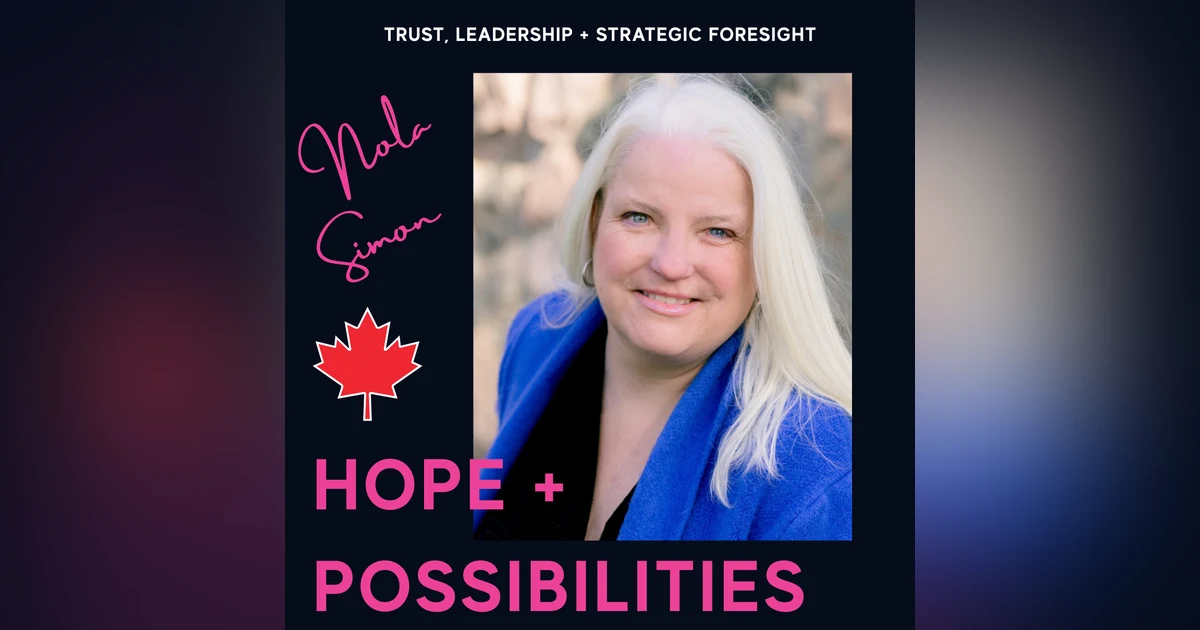


Show Notes: Finding the Through Line in Your Career, Leadership, and Future
In this episode of Hope and Possibilities, I explore something I've been noticing among respected authors, thought leaders, and experts: they're pivoting. Not by abandoning their past, but by reinterpreting it.
The inspiration for this conversation came from a LinkedIn post I wrote about how people connect their past expertise to future opportunities. Within minutes of publishing it, two experts I follow closely announced new directions in their own work. The timing felt like a signal worth paying attention to.
It also reinforced a question that many professionals, leaders, and organizations are asking right now:
How do you move toward the future without starting over?
Why Expert Pivots Matter
One of the people I've been watching is author and executive coach Dorie Clark.
What's interesting to me isn't simply what she's doing. It's how she's positioning herself.
Dorie has built an impressive career. She's a bestselling author, speaker, educator, coach, and recognized thought leader. Yet recently, she's been showing up on Instagram with a very specific focus. She's creating short videos that analyze communication moments from celebrities and public figures, breaking down what worked, why it worked, and what viewers can learn from it.
A Taylor Swift interview becomes a lesson in communication.
A celebrity interaction becomes a lesson in influence.
A public mistake becomes a lesson in leadership.
What stands out is how carefully she connects every example back to her expertise.
She introduces herself as a communications expert, a former presidential campaign spokesperson, and someone who taught at Duke University. Every credential directly reinforces the message she's delivering.
At the same time, she's emphasizing some aspects of her background while placing less attention on others.
That's not accidental.
That's positioning.
Following the Signals
When people begin reframing how they talk about themselves, I pay attention.
Because often what they're highlighting reveals where they believe future opportunities exist.
Communication is a universal skill. Everyone communicates. Whether you're a CEO, community volunteer, entrepreneur, healthcare worker, government employee, or student, communication matters.
That makes it a topic with broad relevance and broad appeal.
Looking at her content strategy, I find myself wondering if she's preparing for a larger audience than the executive and leadership audiences she's traditionally served.
I could be wrong.
But that's what signal spotting is all about.
It's about looking at patterns and asking what they might mean.
It's about observing what's changing before the official announcement arrives.
The Through Line
Years ago, I named my LinkedIn newsletter The Through Line because I've always been fascinated by the connections between our past and our future.
Most people think of career transitions as dramatic reinventions.
I don't.
I think they're acts of interpretation.
The real challenge isn't becoming someone new.
The challenge is understanding what has always been true about you.
What strengths have consistently followed you throughout your work?
What skills show up regardless of your title?
What expertise do people seek you out for over and over again?
Those are the threads that matter.
Those are the strands that make up your through line.
The strongest pivots aren't built on abandoning your history.
They're built on understanding it more clearly.
What This Has to Do With Leadership
This is true for individuals, but it's also true for leaders and organizations.
Strong leadership isn't about reacting to every change around you.
It's about understanding which capabilities are enduring and which assumptions need updating.
Many organizations struggle with transformation because they become attached to how they've always done things.
Many leaders become stuck because they define themselves by their current role instead of their deeper capabilities.
The future doesn't usually require us to throw everything away.
It requires us to reinterpret what we already know.
That's a very different mindset.
It's also a much more practical one.
How I Approach Foresight
This episode is also a window into how I think as a futurist.
People sometimes ask me how I identify emerging opportunities or spot trends before they're obvious.
The answer usually starts with observation.
I pay attention to language.
I pay attention to stories.
I look at what people say.
I look at what they don't say.
I watch how experts position themselves.
I watch how organizations describe change.
I pay attention to assumptions, narratives, and signals.
Then I start asking questions.
What future are they preparing for?
What opportunity do they see?
What problem are they trying to solve?
What assumptions are driving their decisions?
Those questions often reveal far more than direct statements ever could.
Reading Between the Lines
The analysis I share throughout this episode isn't based on secret information.
It's based on observation.
When someone publishes a series of videos, launches a newsletter, changes their messaging, explores a new audience, or starts emphasizing a different expertise, those actions communicate something.
Not everything is being said directly.
But often the clues are visible.
This is true in organizations as well.
A strategic plan tells a story.
A hiring decision tells a story.
A rebrand tells a story.
The challenge is learning how to read those stories.
Why Experimentation Matters
One of the biggest misconceptions people have about reinvention is that it's risky.
What I've observed is that the strongest reinventions usually happen through experimentation.
People test ideas.
They try different approaches.
They explore adjacent opportunities.
They gather feedback.
Then they adjust.
Using Dorie as an example, if her communication-focused content doesn't deliver the outcomes she's hoping for, she's still a respected communication expert.
Her credibility remains intact.
Nothing has been lost.
Instead, she's gained information.
That's the value of experimentation.
Not every experiment succeeds.
But every experiment teaches.
And learning is essential if you want to remain relevant in a changing world.
Other Experts Making Moves
The timing of this episode became even more interesting because, almost immediately after publishing my LinkedIn post, I noticed other experts beginning to signal changes as well.
One was Jennifer Singh, a communications and PR professional whose career began in journalism before evolving into public relations. She has started hinting at a new direction, though she hasn't yet shared the full details.
Another was Rachel Botsman, whose work on trust and technology has influenced leaders around the world. She recently announced that she is working on something new as well.
Neither pivot has been fully revealed.
But that's precisely what makes them interesting.
We're seeing the signals before we're seeing the destination.
What Got You Here Won't Get You There
There's a famous leadership idea that what got you to your current level of success won't necessarily take you to the next one.
That doesn't mean your past no longer matters.
In many ways, your past matters more than ever.
The key is learning how to reinterpret it.
The skills that brought you success may still be valuable.
The way you apply them may need to change.
The story you tell about them may need to change.
The audience you serve may need to change.
But the capability itself often remains incredibly valuable.
That's why understanding your through line is so important.
Questions Worth Asking
As you listen to this episode, consider a few questions:
- What is the through line in your career?
- What strengths have remained consistent across different roles?
- What expertise are you known for?
- What assumptions might be limiting your next move?
- What future are you quietly preparing for?
- If someone analyzed your work today, what would they conclude you're building toward?
The answers may reveal more than you think.
Final Thoughts
One of the biggest challenges in both career development and leadership is figuring out how to evolve without abandoning who you are.
The people I admire most aren't starting over. They're finding the thread that has always run through their work and reinterpreting it for a changing world. They're taking the credibility, expertise, and experience they've already built and connecting it to a future opportunity.
That's what I see when I watch experts like Dorie Clark, Jennifer Singh, and Rachel Botsman. They're not discarding their past. They're reframing it. They're clarifying what they want to be known for next and creating visibility around that future direction long before they officially arrive there.
For me, that's what strategic foresight is really about. It's paying attention to the signals, stories, assumptions, and patterns that indicate where opportunities may be emerging. Whether you're leading an organization, building a personal brand, or navigating a career pivot, the question isn't, "How do I become someone entirely different?"
The question is:
What is the through line that connects who I've been to who I want to become?
Because the future isn't built by rejecting your past.
It's built by understanding which parts of your experience matter most and carrying them forward with intention.
And sometimes the clearest signals about where you're going next are already hiding in plain sight.
0:23 Hi, I'm Nola Simon and I'm the host of the Hope and Possibilities podcast. I just wrote a piece for LinkedIn and within 10 minutes, two of the people that I've been watching for that same topic announced their pivot. So I wanted to podcast about it because I think it's very topical. So the post that I wrote about was actually about announcing how your expertise from the past ties into your future, and it's a rebrand, it's a reinvention, but it's not that big a shift, right?
1:05 It's about capitalizing and being more intentional, about being more specific about what your top strength is and how your Biggest credibility, like your expertise, have the most visible credibility have, you have ties into that opportunity. And so the post that I wrote was actually about Dorie Clark, who's a coach. It's actually interesting the way that she's been framing herself. It's interesting to me what she's actually leaving out. So she's a coach. She's actually a LinkedIn top voice. She's a Thinkers 50 expert.
1:47 She's got all of the awards out there. She's an author of, I think, maybe four books now, something like that, three, four. But the way that she's positioning herself, she's doing these Instagram reels basically, and she's positioning herself as an expert in communication who taught at Duke University for 10 years. And before that she was a campaign, presidential campaign spokesperson. And the way that she's doing these reels is she's pulling on headline moments public moments from celebrities, from famous people, and analyzing what they did wrong from a commu- or what they did right from a communication standpoint.
2:31 So she's pulling on an example of an interview with Taylor Swift to say, how genius this was that she handled this way, and this is why it works, and this is what you can take from it, and you too can try it out the next time you're in that sena- situation. And then she, has a call to action basically to follow her and subscribe. Now the reason that she's doing this, I know because I follow her frequently, she is writing another book, and so this is in advance of another book launch. To me, that makes it sound like it might be a communications book. But I do think it is actually designed for a bigger audience than just the executive coaching clients that she's had so far.
3:15 That's why she's targeting Instagram. I don't know for sure. I'm interested to see if I'm right and the observations are good. But I do think that what she's doing is targeting a more general audience who are interested in communication because everybody communicates. This is a communication. So if her book is about communication and it's more targeted more specifically to help everyone communicate and no matter the circumstance, whether you work at corporate, whether you work in a restaurant, that could be why that she's trying to grow her Instagram thing. She runs a master class called Recognized Expert, and this is again where it's interesting she's leaving this out, right?
4:02 She charges $25,000 US to run this mastermind, and she doesn't mention that at all. But one of the really big pivots that she's doing is the way that she's advised people to really place it. She herself had found her expertise by actually placing articles in all kinds of journals, so like Forbes and MIT Sloan and various different business pieces. And that's how she built out her expertise and her credibility and got really recognized, then used podcasts and she's really leveraged that visibility aspect and essentially that worked for her.
4:43 She wrote a book called Reinventing You, and then she started running this master class. She was keynote speaking as well, but she found that she didn't like the lifestyle. She got sick a lot if she was on the road a lot. And so she pivoted to this mastermind where people actually came to her rather than her traveling which I think is genius because it's about building a life that fuels you, that- helps you reach your dreams, and part of that is how do you actually wanna live, right? So I know this because I follow her, but, To me, it seems that she needs to rejig that because MIT Sloan, for example, is being shut down.
5:24 There's a real push to eliminate a lot of journalism, and it might be a lot harder to actually get articles placed because there's just fewer and fewer opportunities because the magazines that run these articles are being shut down as well. And there's just, there's so many layoffs happening in journalism. And It just doesn't seem to be where the opportunities are right at this particular moment, and so the pivot to social media I think is interesting as well as, particularly since she's targeted Instagram. That tells me a little bit more about the type of people that she's hoping to engage in.
6:09 And so anyways, the way that she runs these reels is basically she starts out with a clip of the celebrity, whoever it happens to be, then she points out what they did well, and then she introduces herself again, bringing it back to, Duke University communications and the p- presidential campaign spokesperson essentially tying in w- the problem that she's solving, which is teaching people to be better communicators, to her credibility stack. And this is why you should listen to her. So she's like, "I can say that this is great, and it's because of this, and this is how you can use it the next time you're presented with this particular scenario." And it's relatable.
6:55 It's familiar because chances are those clips have already been out there on Instagram and TikTok and you've seen this before. You're familiar with, it's a genius way of making it approachable, and it's not too academic, right? If you're an academic, you have to really watch your language to make sure that you're really not leaving people out, especially if you're looking to change your audience from executives and academics to the general public, right? And Dori is really good at that. She's really good at not using jargon. She's really good at using plain language that It really demonstrates her ability to show off her communication expertise, right?
7:45 And this is where I find it fascinating. As soon as I published that, basically saying look for other experts who are pivoting and how they're doing it, how they're framing their expertise, how they're tying it together, and this shows where the opportunities they think are. If I was gonna take a bet, the book is gonna be about communication, but Dory's long-term goal, and long-term I'm meaning like two to three years, is that presidential campaign spokesperson, because what's happening in the US, the midterms are this week. Two years from now, that's the election to elect a new president, and I think she's putting herself out there She threw her hat in the ring, but she's building up that presence and that portfolio, that demonstration of exactly why she has a voice, exactly how she's recognized by the general public, and how she can communicate in a way that's approachable and engaging.
8:51 To me, it makes complete and utter sense. So if I was going to bet, I would bet that's something that she is looking to do. So all of your expertise, if you can narrow it down into what the thread is. My- when I started my my newsletter on LinkedIn, I called it The Through Line, because it's how do you tie everything that you've done into the work that you want to do in the future, right? How do you illustrate that the past is the future? And that's hard. So for me I'm tying in the ability to perceive and assess what's going on in the present tying in threads from the past into the future, and that's why this particular conversation is 100% ex- an example of how I assess things.
9:52 Dorie hasn't said any of all of this clearly. It's interpretation and analysis on how she's written and how she's published and what I know of her from her books. It's essentially her personal brand and her reputation, right? This is my jam. This is how I see what's happening in the present then becomes the future. And I can do this with individuals, but also with organizations, and this is my pitch of how I tie my ability to Understand what people are saying, what people are writing, look at the language look at the narrative, see what they're really not saying but exists underneath what's actually being verbally said, but that's not the full story, and how that relays into the future.
10:45 What are the signals? What are the trends? What are the scenarios? What are the assumptions that people are holding now which may become problematic to get to the future state that they want to be? It's es- it's essentially how do you analyze your current state, and then what do you have to have in place to get to the future? What has to be true, and how do you get there? And how do you use stepping stones, and how do you adjust and you pivot? What's a, an understandable risk that you want to test out and how do you adjust to that? And all of that can be done. This is an example. If those reels don't go anywhere, she's still a communications expert.
11:29 She's still someone who has that past of being a presidential campaign spokesperson. That doesn't do her any damage at all, even if that doesn't work out, because she can then… Communication is everywhere. She can then pivot into something else. It's just she's feeling out those opportunities. She actually is a long-term goal of hers is actually developing plays for Broadway. I don't know where that st- currently stands. I haven't seen an update on that for a very long time. Broadway has got financial pressures as well. It may be that she's put that on hold. But it doesn't mean that will be the same forever, right?
12:12 Who knows? We'll see. But this is where it's an interesting practice. How can you do something similar with your expertise and your brand or even as your organization and your reputation? How do you pull out the key strengths that have carried you along so far up until now, and then reinterpret those, tie those strengths and skills and expertise into one or two that are then anchored to a future state that you wanna get to? And try that out. And you can look at how organizations are doing this, how other experts are doing that.
12:53 The two experts that I noticed Jennifer Sing is like a PR expert in Ontario, and she used to be a reporter, and now sh- and then she became a PR expert, and now she's announcing that she's going to be doing something completely different. I don't know what that is yet. She hasn't announced the full details, but she's announced the breadcrumbs. I had already noticed that she was starting to drop that. The other expert that I follow is the tr-- my favorite trust expert, which is who is Rachel Botsman. She announced that she's starting something new, and I knew she was working on a book, which seems to be about memory and the way that technology use can really impact how we use our brain and the neuroscience of it all and all that.
13:40 That's what I think the book is about. I don't know for sure. She has a way of surprising. But sh- she actually literally published that teaser two minutes after I hit publish on that post. And so this is a really topical thing because I think a lot of people are feeling stuck, and they don't know how to get from where they were to where they wanna be. And don't forget, what got you there won't get you there, right? So Marshall Smith, who's a coach that Thinkers50, and, he's been very involved in Dorie Clark's career as well too. That's a book of his, is whatever got you to where you are right now, it's not going to be the thing that gets you further, right?
14:25 So how do you reframe, how do you reassess, and then pull out the strands from your… the career you've woven to this point, and then make it into something else that's gonna stand you up for the future. That's really what this is about. Anyways, I will link the post and you can read it. And I'm interested to see which experts you're noticing are pivoting, and if you wanna do a review or comment or send me an email, it's nola@nolasimon.com. I'd love to know. Anyways, thanks.

