Scars On The Mountain: The Story Behind The Story with Christopher Pike & Michael Foley
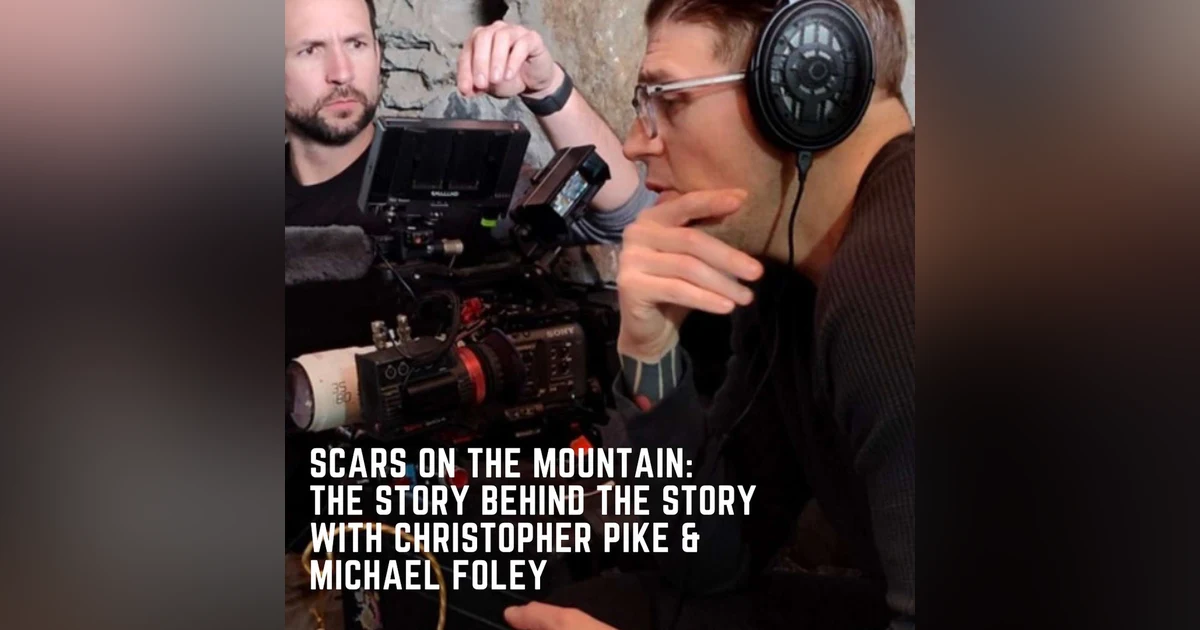
Send us Fan Mail In this episode I sit down with Executive Producer Michael Foley and Director Christopher Pike to talk about Scars on the Mountain, their feature documentary now streaming on Angel Studios. Foley shares what it was like to mobilize with volunteer helicopters, deliver medicine, and witness a grassroots rescue effort that became Operation Helo. Chris walks through the hardest part of the work: earning trust in small mountain towns, holding space for grief, and refusing to make ...

 Apple Podcasts
 Spotify
 Castro
 RSS Feed
 In this episode I sit down with Executive Producer Michael Foley and Director Christopher Pike to talk about Scars on the Mountain, their feature documentary now streaming on Angel Studios. Foley shares what it was like to mobilize with volunteer helicopters, deliver medicine, and witness a grassroots rescue effort that became Operation Helo. Chris walks through the hardest part of the work: earning trust in small mountain towns, holding space for grief, and refusing to make what he calls “glorified disaster porn.” Christopher and Foley share interviews that still sit with them, the role of faith and resilience in recovery, and why the storm is only the backdrop for a story about humanity.
We also pull back the curtain on distribution and rejection: film festivals said no, then Angel Studios’ guild voting said yes. If you want a grounded look at disaster recovery in Appalachia, community resilience, ethical documentary filmmaking, and how everyday people become the lifeline, this conversation is for you. Subscribe, leave a review, and share the episode with someone who believes good stories can move people to action.
Mike Andress
Host, Exploration Local
828-551-9065
mike@explorationlocal.com
Podcast Website
Facebook
Instagram: explorationlocal
00:00 - Not A Storm Story
03:18 - Helicopter Rescues And First Aid
07:15 - Pivot From TV To Service
11:03 - Operation Hilo And Early Aftermath
16:05 - Earning Trust Without Exploiting Trauma
22:58 - Stories That Stay With Them
27:05 - What The Film Wants Us To Remember
32:37 - Rejection To Angel Studios Breakthrough
36:43 - How The Project Changed Them
43:15 - Where To Watch And Help
Not A Storm Story
SPEAKER_00It's not a documentary about a storm. It's a documentary really about humanity and about how faith, resilience, neighbors, Americans, all working together to do something in a time of incredible need, how they all pulled together and how they all got through it.
SPEAKER_02He didn't approach it as, hi, I'm Chris. I want to tell the story about the worst day of your life. It was, hello, I'm Chris. I am a director, but I'm here to be your friend. I'm here to be an outlet for you to express what you went through. And I'm here to make sure that you know the worst day of your life doesn't just become another page in a book. It needs to be on the cover of a book, and I'm here to build the library.
SPEAKER_01You're listening to Exploration Local, a podcast about exploring stories that shape the places we call home and the places we pass through. My name is Mike Andris, the host of Exploration Local. Join me on this journey as we discover the stories that inspire exploration, adventure, and a deeper connection to the world around us. I encourage you to wander far but explore local. Let's go. A hurricane in the mountains sounds impossible until you see what it did to Western North Carolina. And before we get into this conversation, I want to acknowledge something very important. Hurricane Helene devastated communities all across Western North Carolina. Marshall, Suantanoa, the River Arch District, Chimney Rock and Lake Lure, and countless other communities and hollers that were forever changed. This documentary focuses on Yancey County. That's not to suggest that the devastation in those other places was any less significant. Helene touched an enormous part of Western North Carolina, and every community has its own story. But as fate would have it, Yancey County is where Foley became deeply embedded in the aftermath of the storm, and where his connection to the people of this region of Appalachia began. Through repeated trips, rescue efforts, and relationships with the people he was serving, both Foley and Chris became deeply connected to the community. And they came to feel that, because they were so close to what happened, this was a story they had a responsibility to tell. As many of you remember, on September 27, 2024, record-breaking rainfall poured into the valley surrounding Mount Mitchell. In Yancey County, roads collapsed, bridges were destroyed, communication failed, and entire communities were cut off. With no way in or out, the community became its own lifeline. Neighbors became rescuers, volunteer pilots became a lifeline from the air, people with medical supplies, chainsaws, helicopters, and whatever they could offer simply showed up. And that's where the story of Scars on the Mountain begins. I'm sitting down with Michael Foley and Director Chris Pike to talk about those first chaotic hours, the grassroots rescue effort that followed, and the difficult work of telling the stories of people who are still living through the aftermath. As Chris puts it, this isn't ultimately a story about a storm. It's a story about people, about service, trust, resilience, faith, and what happens when ordinary people refuse to leave their neighbors
Helicopter Rescues And First Aid
SPEAKER_01behind. So let's get into it.
SPEAKER_02Got a call from a friend that there was a bunch of volunteer helicopters meeting up at Hickory Airport, dusted off the old med bag, drove through the night, got there about 6 a.m. and uh boarded a helicopter. And I remember the skids touched down over in the Bent Creek neighborhood. I'm right there at the at the bend in the river here in Yancey County where the bridge was out. And as we landed, I saw some uh some locals in kayaks and they had ropes strung across the river, and that's how they were accessing their hauler that was on the other side of the bridge. And I remember stepping off those skids and dropping off medicine and kind of triaging some elderly folks who were running out of oxygen. They were they were really trapped. And I remember getting back to the airport that night and you know, I had a kind of a personal thought that wow, this is this is gonna be a life-defining week out here in Appalachia. And fast forward six days and many different operations later, I had a a weekly call with Chris and our other partner, Parker. And again, we were on the topic of documentaries, and I just kind of stopped everybody and I said, Look, if if you want to hear a story and it's you know, a story that matters and one that not a lot of people know about, I've got it. So let's assemble our production crew, let's figure out a date, and let's get up here and let's find a way to uh really masterfully tell the story of not just what they went through, but what they overcame and all of the lessons that I personally learned and all of us in the the year eight circle learned in getting to know these people and telling their story.
SPEAKER_00Now that was really well said. It's you know, my background comes from TV and TV development, and I spent a long time, about a decade, you know, developing, directing, producing TV shows, and you know, selling them to various distributors. And as fun as that is, and and what I learned, there's not a lot of soul. There's some soul in reality TV, but not a lot. It's a lot more fun and entertainment than something that's meaningful. And I'm I'm fortunate enough that I was at a phase in my career when Hurricane Helene happened that I was I was remembering, you know, why I wanted to tell stories in the first place and and what stories were actually important to me and important to tell and important for humanity. I decided to pivot year eight from doing traditional TV development to let's let's tell one for us. You know, I didn't know what it was. And Foley called me and he said, You gotta get up here and you gotta see this. This is exactly what you've been talking about and the pivot that you want for year eight. You know, the moment he told me about it, started sending pictures. I I I couldn't believe what was happening. I couldn't believe that most of the United States didn't even know what was happening. If I talked to friends of mine in New York, they were like, What are you talking about? There's a hurricane in the mountains I haven't even heard about. I'm like, look at these pictures. You know, from there we just mobilized. I started, you know, doing what I do and using my skill set to figure out what the story was here because it was it was resonating with me. And it was resonating with me because I felt like I could be of service and I felt like I could help and I could do something meaningful for people that were in need. Wow, it's powerful.
SPEAKER_02So talk a little bit about the first days and weeks. Like the first 14 hours, I want to say that the uh the Operation Hilo crew, which is it was really, you know, like I said, a grassroots effort born out of Helene. That actually the Operation Hilo Task Force that
Pivot From TV To Service
SPEAKER_02ended up being the largest civilian orchestrated helicopter rescue in U.S. history. Our other producer, Greg, you know, he came up there with me during the early days. And like I said, we weren't up there to, you know, do anything other than help. I didn't know if I was just going to be loading a helicopter for the army to fly supplies out, but you know, we beat the National Guard up there by quite some time. But, you know, the first 14 hours, I believe the number was 144 souls rescued out of the mountains all over Appalachia. So very uh, very meaningful, impactful uh couple days up here right off the bat.
SPEAKER_01Chris, what about you once you finally got up here and started to see things?
SPEAKER_00Foley was here right right when the storm hit, and then we started having weekly conversations about it. I started mapping it out. I was hesitant to come up too soon. I thought it was too raw, people were still grieving, people were still missing, and I I needed time to process how I wanted to tackle it, and I also didn't want to bombard the community with questions and cameras that that is in a crisis. Yeah. So we started talking about the project, we started putting the plan together, and and my thought was right after Christmas in the new year, we should go up and see how it looks, see what's going on. I got up here on January 2nd of 2025, and this place still looked how it looked three days after the storm. Yeah. And I was like, what is going on here? There's no roads.
SPEAKER_02There is a little bit of a uh funny story in between September when I was here. I think I I think I left October 13th to come home. But, you know, I got home and Chris and I are having this conversation. I'm sitting at my at my desk. You know, I'm a CEO of a company. I have a very busy schedule, and all I could think about was, you know, get my ass back up here and find another way to help. Long story short, between October when I came home and January when Chris and the crew came up, I took 25 trips every other weekend to uh come back up here and help. You know, I brought a bunch of my friends with me, chainsaw crews, winches, off-road trucks, all the things. And that's how we met some of the people that you will meet in this documentary. I also organized a Christmas drive with Kira Albert over off 19 West, and uh her and I raised over $25,000 that we bought pretty much everything and then some for every child along the Cane River. And I think that that that ultimately kind of spearheaded some rapport. You know, it wasn't, oh, let's do all these nice things so we can do a documentary. I I did it because I wanted to do it. It really made things a lot easier. And, you know, I kind of put it into some people's ears that, like, look, I've got a a director friend who can really put this story on the map and make sure that the world never forgets what you all went through. And, you know, through some time and some pressure and some true acts of kindness from my heart, we kind of together, Chris and I kind of built this bridge into getting up here in January. And I'll let him continue with with what he's got after that. But I think it was important to say that Chris helped me with a lot of a lot of acts of kindness before the cameras were rolling.
SPEAKER_01I love that. That's actually one of the things I've been thinking about, Chris, since we first connected about this is when you come up, you're coming into an area that almost feels war-torn, and it's something that we've none of us have ever experienced in our lives, and hopefully we never experience it again. But being able to be invited into those
Operation Hilo And Early Aftermath
SPEAKER_01people's lives to kind of tell the story, it wasn't synthetic. It was very, very real because you're coming up helping them to survive and to live and to care for them. Yeah.
SPEAKER_00That that to me, what what you just said is is and was paramount at the forefront of my mind, you know, when I came up here on January 2nd. I I I didn't want to make a documentary that is glorified disaster porn. You know, I want I wanted to make something that that could actually help the community. And it's a very sensitive conversation to talk to someone about being on camera and to talk about one of the worst days of their life. That was always something that I tried to be very conscious about and be very aware of and and and not feel like doing something that isn't helping or bringing up past trauma just to bring up past trauma to tell a story. I I I wanted to be invited and to be trusted, but I knew that takes time, you know, and and when people are at that most vul vulnerable point, you know, you have a lot of responsibility to make sure you do right by them and that they can trust that you're going to do right by them. And that that was probably the hardest part of the whole process for me is just making sure I did this community and the story justice for the people here.
SPEAKER_01What did that look like? Unpack that a little bit because I think that's really, really profound. Foley, you're flying in, you're doing the things. Chris, you're bringing a skill set that it's amazing to be able to help document this whole experience and to tell the world a bigger story. What was that like trying to gain that trust on your side?
SPEAKER_00Small mountain towns, it's a fun everything's word of mouth, and everyone knows everybody. And I I don't I don't know how I did it, you know.
SPEAKER_02It I know how you did it. How'd I do it? Chris didn't meet these people, whether it was people that I knew, people that a spectacle in the Burnsville community that we'll talk about here in a minute knew. He didn't approach it as, hi, I'm Chris. I want to tell the story about the worst day of your life. It was, hello, I'm Chris. I am a director, but I'm here to be your friend. I'm here to be an outlet for you to express what you went through. And I'm here to make sure that, you know, the worst day of your life doesn't just become another page in a book. It needs to be on the cover of a book, and I'm here to build the library. And he did it in an artistic way that I I wouldn't know how to explain again, you know, but he did it. Um, you know, he opened his heart and he came up here and he made sure that these people knew that he wasn't just here, he's not here to make a profit, he is here to take care of you and to ensure that your story is told the way that you want it to be heard. Wow.
SPEAKER_00I've I interview people for a living. I'm good at making anybody feel comfortable instantaneously, but the mental gymnastics when you're dealing with a natural disaster like this, it it's the hardest project I've ever done. And sitting down and talking to someone and having them unpack what happened that day to them, you just have to hold a lot of space and a lot of energy and and and you have to really just listen. I'm not you know, and you have to know when to just get out of the way and to let someone talk. Like a a very interesting thing. I don't know if the subjects of the documentary will agree with me or or if this is accurate. This is just my thought. I don't think a lot of them spoke about it the way they spoke about it with me. I don't think they talked about it out loud. It was almost like some of these interview sessions were like therapy sessions. I was gonna say that. And to me that was profound because you know, coming from TV and it's all fun and etc. It it was heavy. Every single day was heavy, and every single day was important, and every person's story was important. We interviewed about probably 40 to 45 people. Wow, and every single one of those stories is important. Not every single one of those stories is in the movie. I I wish they could be. And that process and and built I think the trust is trust is built if I've had time to think about it now a little bit. Trust is built through being genuine
Earning Trust Without Exploiting Trauma
SPEAKER_00and being authentic and showing up as a human being, looking at you, saying, I see you where you are, I'm here to help you, and and just giving off that energy of of just honesty and transparency and authenticity, and allowing someone to get comfortable with you.
SPEAKER_02And Chris, you know, you made sure that these people knew that they mattered and that their story mattered.
SPEAKER_01Yeah. I know there's over 40 stories, and there are a few of those, a sample of those that are in the documentary that I've had a chance to watch this a little bit of. Talk about some of those stories that have really left a lasting impact on you, and I know that the easy answer might be all of them, but when you're away from here, when you're away from the creative process, when you're away from all the mechanics and the and everything to put this together, what what is sticking with you, Chris, as you went through all of this?
SPEAKER_00The overwhelming theme and feeling I get is is just how strong and impressive the human spirit can be. And you know, so a story that keeps me up at night is is Ryan Weeby's story. I'm not trying to say that his is more important than anyone else's, but that interview day I still I still sometimes lay in bed and think about that day, and think about that interview and where we interviewed him. You know, the something I tried to do with the project was we shot everything on location where the event they were speaking about transpired. So we sat with Ryan Weeby where his family's house was on that piece of property where his family members got washed down the river and never to be seen or heard from again. And we sat in that spot and he talked about that. And that was one of the the hardest but most powerful interviews I've ever done. And and Ryan is amazing. You know what he's done and how he's come through through excuse me, I'm getting upset. Um what Ryan has done, you know, through that adversity is tremendous because not many people can come out of that the way he did. And the there's just you know, I'm I'm not trying to get spiritual or whatever, but we were sitting there and like there was a feeling, there was a feeling of sadness and heaviness when we're sitting where the house was, and he's talking about it, and and that feeling I can still feel it today. And whatever that energy was, you know. Yeah, that that's the story that sticks out to me.
SPEAKER_02So for me, it's uh there's definitely one story that sticks out, and it's not because of really anything to do with the documentary. Unfortunately, our second week filming in 2025, my mom had a tragic accident, and we had to say goodbye to her in this life. So I uh thank you, thank you. And I uh I left left Burnsville, went home, handled business, and my dad told me, you know, she would want you to go back up there. And you know, my mom, she helped deliver all the Christmas presents on December 20th, 2024, and she had been here, she knew the story, you know. Before I initially came up here, she filled the back of my truck with you name it, from feminine products to wipes to baby food to diapers. So this this was an important story to her, and she was very proud of it. But, you know, there's a there's a gentleman that you will all meet when you watch this documentary named Ron. And on my second trip up here, I went up Pensacola, the Cattail Creek community, and just started pretty much talking to every single person I could find. Who needs what, who needs tree work, who needs a hot meal, who needs what? And there was a man, I don't even know his name, and he said, if you take this right across this creek and you go all the way up this trail, not many vehicles are able to make it up there, but you and your buddies' trucks, y'all will make it up there. There's a man named Ron, and I don't know what he needs, but I know he's by himself, his wife's out of town, and that's who you need to go spend some time with. So we drove up there and I pulled up and outwalked this old man named Ron from this uh 70-year-old cabin that his wife's family had built. I don't want to call Ron a broken man because he is a one of the strongest guys I've I know, and his spirit was broken, is the best way to describe it. And you'll learn all about everything that Ron and his wife Patty went through. But long story short, me and my good friend Steele, we uh set up a pulley system and brought a bunch of firewood across to keep him warm for the next couple months. And every time I came up here, like I said, sitting in Burnsville now, this is my 36th trip up here. And every time I came up, Ron was one of the places that I I started with Ron the week, you know, we'd come up Friday after work and go home Sunday evening. And Ron was the first place I went and the last place I stopped by on my way home. And and through that, we developed a friendship. And then when my uh when my mom unfortunately passed, I uh like I said, I came back up here and then went back down to Georgia and I walked into the funeral parlor and Lo and behold, the first two faces that I uh excuse me, that I saw was uh Ron and Patty. And you know, all that they went through, and I guess me kind of stepping up to the plate and making sure that Ron was good in my uh time of dark clouds in life, they returned that favor. And for the next you know month after that, we came back up here and continued filming, they would have me over for dinner and they'd bring me to their church on Sunday mornings, and you know, they really wrapped their arms around me. So again, it's not to say that their story is better than anyone else's or anything like that, but the love that they showed me, it uh it really pulled me through to the other side, and I'll I'll never forget the way that Ron and Patty made me feel when I needed them just like they needed me.
SPEAKER_01Oh it's the true Appalachian spirit that just seems to be driving through all of this.
SPEAKER_02And it's alive and well. I can tell you that.
SPEAKER_01Yeah, it is. Yeah, it's it's very powerful.
Stories That Stay With Them
SPEAKER_01Wow, Chris, from your perspective, trying to bring something like this to the world, what do you hope that people will? You know, you talk about the people in New York that may not know about this area, or I'm sure they do now at some level, but but what re do you really hope that people are gonna take away from this and and really maybe not even take away, but what action would you hope that people would take?
SPEAKER_00It's interesting when you when you this this is the first documentary I've made. It's the first time I've directed a feature documentary, and there haven't been constraints from network producers, um, network executives, or production companies, and I got to make something the way I wanted to make it. And you know, the the lessons there and themes that really shine through and what I want people to take away. There's a lot of hate in this world, there's a lot of arguing amongst Americans, and what coming up here did for me was remind me that we are all a lot more alike than we are different. Why are we all fighting with each other? Yeah. Well y I I'm not trying to get political here, but but why why? Why do we have to be so hateful at times towards each other? Because then when something like Hurricane Helene happens, all of that goes away. And why does it take something that horrific to happen for all of that to go away? You know, this is we're all human beings, we're all here to help each other, you know, and what I really want people to understand is that it's not it's not a documentary about a storm. It's a documentary really about humanity and about how faith, resilience, neighbors, Americans all working together to do something in a time of incredible need, how they all pulled together and how they all got through it. Because sure, what what happened on September the twenty-seventh was horrendous. But what happened after that was absolutely beautiful. I agree with that. And it's just should be the film should be a reminder to everyone of what America can be, is really what I want people to understand.
SPEAKER_02I believe that inside every man and woman there's a hidden hero, and they're usually quiet their entire life until that greater power for me it's God, for others it could be whatever it is, but until that greater spirit or existence calls you to serve your fellow man, it just sits quiet and it sits dormant and it's waiting. And you know, there's there's one story that didn't make it into the documentary. These folks wanted nothing to do with being on camera, so I'll leave their names out. But one of these gentlemen was, you know, he's become my my best friend in Burnsville, other than Ron, of course. And uh, you know, the flood came through, and luckily they were up enough in their holler that the flood didn't affect where they lived. But they walked down to the end of their street, and the neighbor to the right, his his house was coming up off its foundation, and these two young fathers stepped up, and because of their self-sacrifice and literally putting their life on the line, there's a there's a young boy here in Burnsville that has a father for the next generation because these two silent heroes they had that spirit speak to them and they stepped up. So, I mean, if I were to talk about a big message that this documentary portrays, it's you know, everyone is a hero.
SPEAKER_00Yeah. It should give you faith in humanity. It should.
What The Film Wants Us To Remember
SPEAKER_00And to that point, I would be remiss if I didn't really thank Angel for giving us the platform to do this. And I I think Angel is a phenomenal partner. Yeah. And the content that they put out aligns tremendously with this with the message of this project, and they have been phenomenal, you know, and there couldn't have been a better home for it.
SPEAKER_01That is really evident and it's really clear. And I I wondered how you go about the process of you know, pitching, I don't know if that's the right word or how to say it, but like when you're pitching to networks or you're pitching to people, was it more than the Angel Network, or do you just say, hey, I believe in them and I want this on the Angel Network?
SPEAKER_00You're opening up a can of worms. Oh, here we go. Yeah, you're you're opening up something that so ironically enough, other than the Richmond Film Festival, so thank them, and thank you, Richmond Film Festival, Scars on the Mountain was rejected from every single film festival in this country. Holy smokes. And and you know, listen, I I have a tough skin. I've been in the business for a long time. There you get a lot more no's than yeses. Yeah, but you pouted a little bit. Of course. A little bit.
SPEAKER_02Of course I did. For an hour.
SPEAKER_00You know, when when the when the rejection started coming in, I was like, okay, I need a pivot to going straight to distribution and going through my network of network executives and start getting in front of people. Ironically, maybe it's God, maybe it's not, maybe who knows what it is. I was hearing really great things about Angel. And Angel has an awesome process where it's called guild voting. So you submit your movie, and then the subscribers of the platform get to vote if this movie gets a streaming deal or not.
SPEAKER_01Okay, that's what being because you can go on and be a guild member. Yes. Yeah, so we've experienced that a little bit. Okay.
SPEAKER_00So you can become a guild member and then vote on what actually is going to be on the platform.
SPEAKER_01Okay.
SPEAKER_00And what I think is so genius about it is it you're you're focus grouping and testing stuff to see if it works before you even need to invest in it, and you're letting your audience take some ownership. That's brilliant. And and you know, and a lot of the other bigger networks do not do that, and and I, you know, m maybe if they did, this is just my opinion, this is not what I'm saying for anyone else. Maybe if they did do that, they wouldn't have as many flops, or they'd maybe know what direction they want to go in, or what their audience wants to see. So I submitted the angel first just to see. And it's a very arduous, hard process to get through the Angel Guild. And it's three levels of voting, and we passed all three levels on the first try. Amazing. Which is something that rarely happens. And after after that happened, and they send us the email, congratulations, and they give you uh a licensing agreement. I I didn't even go, I I could have pitched other places, but I was like, you know what? I've found my audience. And and and even though there were a ton of rejections from all these big fancy film festivals, I always had faith. I'm like, this film has an audience. I just need to find who my audience is. And the light bulb kind of went off when it passed the Angel Guild. That's beautiful. Wow.
SPEAKER_01Foley, when it came to the Angel Network supporting this right off the rip, is that something that you were kind of aware of? Some of the, you know, the challenges of getting out to the music festivals or excuse me, to film festivals and to other networks as well. Is that something that made the same impact on you?
SPEAKER_02So I obviously was upset that we didn't get into the more, you know, any big name festivals, because I think it's the best documentary ever made, hands down, of course. But, you know, that being said, when we got that news, me and Chris were again on another Zoom call. You know, Chris, it's kind of crazy. It's like we have these Zoom calls and it's where the magic happens. So no offense, but I'd rather you just zoom me than us get together in person. But anyway, you know, we were on a Zoom call. I was out on a at a works work location, and he was like, you know, you have a very, you know, connected LinkedIn. Why don't you send a LinkedIn message to this guy at Angel Studios? So I did that, and we didn't hear back from him. But lo and behold, what two weeks after that LinkedIn message was sent, Angel reached out to us. So I don't know if it was that gentleman's fault or whatever, but you know, Angel Studios, it was uh, you know, it wasn't uh wasn't something that we planned on, but now that we've landed there, I mean, I think I can speak for everybody on the year eight team, myself and Chris included, that we're we're very happy and we're very pleased, and they've been just a joy to work with.
SPEAKER_00100%. 100%. They are, you know, through the whole process after I got through uh the guild submission, their marketing team, their social media team, their streaming director, uh they've been a pleasure to work with, and they're very responsive and and very helpful. And I don't think there is a better home for Scars on the Mountain than Angel.
Rejection To Angel Studios Breakthrough
SPEAKER_01So, Chris, I know that you've been in this industry for a very long time, and you're a master storyteller. Um, it comes through in the end product. Did this teach you anything though? Anything new about storytelling, or did it unlock anything in you about storytelling?
SPEAKER_00That's an interesting question. What has Scar what did Scars on the Mountain teach me? It made me a better interviewer. I always thought I was a pretty good interviewer, that's what I've done for a living. But sitting there sitting across from someone with some of the backdrops that we had of houses cut in half or where a road used to be or a bridge used to be, and sitting in that environment and holding the space for that person to tell their story, it it made me a more disciplined and just aware interviewer because sometimes you want you're right, you're the director, you want to you want to drive the conversation, you want to hammer the sound bite, you want to make sure you get what you're getting. Completely different with this. And you're gonna go where you're gonna go because you should not push any of these people to say or do anything that that they do not feel comfortable saying. And and it taught me restraint. It taught me that you can build something quietly and calmly. It doesn't need to all it's it taught me a lot. The movie made me a better person. So that that that's that's what I really learned and took away, because I have this skill set, but wow, did did going through the process and meeting the people of Yancy County, did it change me as a human being, you know, be a little kinder, be a little more patient, have some humility, you know. It made me aspire to be better and do better because of what I saw here. Wow, that's profound. That's really what I learned more than anything else.
SPEAKER_01That's a big lesson.
SPEAKER_02Yeah.
SPEAKER_01Foley, same question for you.
SPEAKER_02So don't ask me much about uh what I learned as an executive producer. Um, because honestly, I leaned on Chris more than anything else. I mean, obviously, my experience up here with my skill set after the flood may have been what initially got us up here, but he basically took the flag and ran it through to the finish line. But, you know, in general, Scars on the Mountain has showed me that Appalachia is exactly where I want to be. You know, I didn't uh I didn't grow up in Appalachia per se, down in Gwinnett County, Georgia. But, you know, now my wife and I, we live in White County, Georgia in Cleveland, um, near a town called Helen that a lot of your listeners probably know of. That's about 15 minutes from our house, but I can promise you that from here on out, my uh children, whenever that day comes, they will for sure grow up in Appalachia. But, you know, even um even beyond the um the Scars on the Mountain film. You know, I got out of the Navy in 2023 and kind of gave up the medical side and when I started my own business. And, you know, when the flood happened and I came up here, I realized that I had a passion, a burning passion for helping others that I had stepped away from. And since then I've become a uh swap medic for a local agency where I live, and I've joined the search and rescue program for our um Mountain SAR in our county, and you know, the the service hasn't stopped, but you know, uh I always have this saying that uh life of service is a good life indeed. And I think Scars on the Mountain and the whole Hurricane Helene situation really uh really brought that out.
How The Project Changed Them
SPEAKER_01Where do you see year eight going now that you've had all of your your past, all the skills that you bring to the table, connecting with Angel Network, knowing that you want to tell these stories that are a lot more meaningful and impactful, where do you see year eight going? It's a great question.
SPEAKER_00I love TV. I loved reality TV. It it served a place in my life that that you know I I learned a skill set, I learned a level of professionalism, I learned how to interface with network executives, with owners of very large production companies, and and what I learned over that decade of doing that wasn't valuable. You know, but I I needed to scratch the itch of directing and making my own documentary because that's what I've wanted to do since I was a kid. And now since I since I've opened up that can of worms, that's what I want to keep doing. And I'm someone who maybe I'm oversharing, but whatever. You know, I've been sober for uh almost 13 years. I'm a recovering heroin addict. I had to go to rehab, I had to do the whole thing. And something that's really uh important to me and fully touched on it is you want to always be of service. And you and and to me, I always want those themes to shine through in the work I'm doing. And where I see Yuri going is we're starting our second documentary. And you know, I always will keep doing some TV stuff if it comes up, but you know, it's gonna align with the same themes of faith, resilience, overcoming all odds, themes that I'm very familiar and love talking about. Um, our next documentary is without saying too much, it's going to be about sobriety and UFC. There's a particular UFC fighter who has a very similar story than me, recovering heroin addict. And he's been sober now for quite some time and telling his journey of getting over that addiction and now being in recovery and then becoming one of the top UFC fighters in the world, and now at a point in his career where he, you know, he doesn't know how many fights he has left. He might have a bunch, he might have another title run in them, he might not. You know, it depends on you know, by the grace of God. So it's a very fascinating intersection in his life to pick up a story to see where he's going with this part of his career, his late career in UFC, and then also what's going on next in his life and what's the next chapter, and how has sobriety and recovery really changed him and made him who he is, and hopefully what we can do with this film, because I've I've always been someone who uh I've always wanted to talk about sobriety and about being sober and and AA and all these things in my work, but I never wanted it to be corny, and I never wanted it to feel like a PSA for some rehab that they throw up on a website, and you're just like, oh my god. Um so having a very organic way in to telling a story about recovery around one of the world's top UFC fighters is a dream come true, and that's where year eight is uh going next.
SPEAKER_01Very nice. And then I imagine once you do that, you'll be looking always out. Not maybe not necessarily for the next thing. What is the next story, but I feel like the next story is going to find you.
SPEAKER_00You just said it. It's like you know, it's it the biggest difference between being, you know, a filmmaker, documentarian versus being a TV producer, TV developer is yeah, I I'm not here churning out ideas to sell them, you know, and having them all in my backpack and and going in and selling my hotcakes. When you when you're making documentaries, it the story's gonna find you when it finds you, and that's a story you're gonna tell because it takes everything in you to do the story justice. It I I I nearly killed myself making this movie because of the amount of pressure I put on myself to get it right for the people of Yancey County. And you know, you don't how many of those do you have in you? You know, so so what when you're looking for a story, you're not really gonna find it, it's gonna find you when you're ready. Because how many times can you pour your heart into something and you're actually truly pouring your heart into it because you feel it in your soul? Yeah.
SPEAKER_02I'm here to support Chris, so I'm just gonna say uh yeah, what Chris said. What Chris said.
SPEAKER_01Oh man. Well, listen, guys, I I can't thank you enough for allowing me to have the space to hear a little bit about your story, your background story, the work that you've done and will continue to do is absolutely amazing. And for somebody who is a resident of Western North Carolina and I feel like I was watching a lot of this stuff, people don't realize, a lot of people don't realize that Western North Carolina got hit hard, but this particular county is one of the hardest hit counties. And I don't want to dismiss or minimize anything that happened anywhere south of here, west of here, or anything, but the scars on the mountain, that word scar, and I think that may be one of the things that I resonated with me right off the bat because when I would drive through here, and even Teresa and I recently did a drive is called the Mayland Meander, and it kind of goes through Yancey County. A lot of the roads that you guys are talking about, the scars are evident, and they will be the evident for a very, very long time. So yeah, thank you for the work that you've done and you are doing and and uh and and just the presence not only of you being here and doing the work that you did, but I think the impact that you've had on the people of Yancy County will live on for eternity.
SPEAKER_02Yeah, yeah, thank you. I uh I think that this will be something that's shown in you know the the history classes around here, but you know, we had another name before this that I won't even mention, but when Chris came up with this name, him and I discussed it, and you know, a important theme to remember is that a scar is a sign of overcoming an adversary, and I think that that perfectly describes Yancey County and all that they went through.
SPEAKER_00Absolutely. Yeah, it's uh you know, Yancey County is always gonna have a special place in my heart. Being here and making this project changed me for
Where To Watch And Help
SPEAKER_00the better. Shameless plug. You can watch uh you can watch Scars on the Mountain now, streaming on Angel. If you go to Scars on the Mountain on Instagram, there is a free link in my bio for anyone to watch this. Even if you don't have an Angel account, just click on it, put in your email, set up a password, you can watch the movie for free. And a portion of all the proceeds goes back to this community. So just by watching the movie, you are actively participating in donating to the community communities, donating to the communities that were affected by this hurricane. That's amazing.
SPEAKER_01I want to thank Michael Foley, Chris Pike, and everyone at Ear 8 Productions for the work they put into telling this story and for doing it with so much care and heart. Scars on the Mountain is a beautiful documentary, but more importantly, it's a record of the people, the relationships, and the resilience that emerged from an incredibly painful time. If you'd like to watch it, Scars on the Mountain is now streaming for free on Angel Studios. Go to at Scars on the Mountain on Instagram, and there's a free link in their bio. You can also go to the free link in my bio as well. You don't need an Angel account, just enter your email, create your password, and you can watch the film. And a portion of the proceeds will continue to go back to the communities around Nancy County, affected by Hurricane Maline. So watch the film, share it with someone, and help these stories continue to be seen and remembered. Fully, Chris, thank you for telling this story, and thank you for trusting us to share it here on Exploration Local. Well, if you enjoyed this episode, please subscribe, leave a review, and share Exploration Local with someone who loves the outdoors and adventure as much as you do. You can also follow Exploration Local on Instagram and Facebook, and if you have an idea for a future episode or you know a story that deserves to be told, I'd love to hear from you. Feel free to email me at mike at explorationlocal.com. Until next time, I encourage you to wander far, but Explore Local.