Rooted in Place: Cullowheegee Farms, Handmade Soap, and Building a Life Around the Land with Sarah & Eric Rehmann
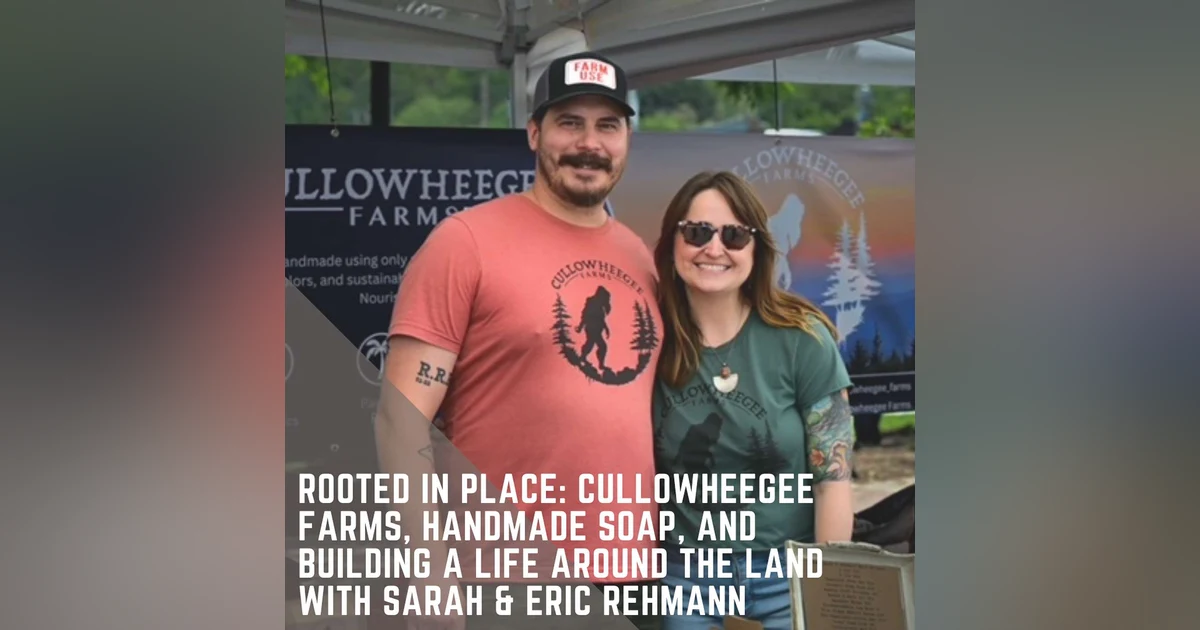
Send us Fan Mail For Sarah and Eric Rehmann, a dream of a different kind of life eventually led them to the mountains of Western North Carolina — and to an eleven-acre property that became the foundation for Cullowheegee Farms. What began as a small batch of handmade soap grew into a collection of natural goods inspired by the land, the seasons, and the values they live by. But this isn’t just a story about soap. It’s a story about listening to a place, building community, and allowing the la...

 Apple Podcasts
 Spotify
 Castro
 RSS Feed
 For Sarah and Eric Rehmann, a dream of a different kind of life eventually led them to the mountains of Western North Carolina — and to an eleven-acre property that became the foundation for Cullowheegee Farms.
What began as a small batch of handmade soap grew into a collection of natural goods inspired by the land, the seasons, and the values they live by.
But this isn’t just a story about soap. It’s a story about listening to a place, building community, and allowing the landscape around you to shape the life you’re creating.
In this episode of Exploration Local, we explore the connection between people and place with Sarah and Eric Rehmann of Cullowheegee Farms.
Mike Andress
Host, Exploration Local
828-551-9065
mike@explorationlocal.com
Podcast Website
Facebook
Instagram: explorationlocal
00:00 - Intro And Intentional Living
03:12 - The Leap From Michigan South
08:23 - Eleven Acres And Listening To Land
15:57 - Soap Begins With A $200 Batch
25:12 - Trade Shows Scale The Business
36:16 - Plastic-Free Swaps And Sustainability
40:55 - New Store On Main Street Silva
50:02 - Retailers Community And Final Thanks
Intro And Intentional Living
SPEAKER_01You're listening to Exploration Local, a podcast about exploring stories that shape the places we call home and the places we pass through. My name is Mike Andris, the host of Exploration Local. Join me on this journey as we discover the stories that inspire exploration, adventure, and a deeper connection to the world around us. I encourage you to wander far but explore local. Let's go. There's something powerful about the moment when a dream that once felt distant suddenly becomes real. And for Sarah and Eric, that dream started years ago. A someday dream of leaving behind the familiar, finding a piece of land, and building a different kind of life. A life connected to nature, community, and the rhythms of the place that they called home. That journey took them from Michigan to Raleigh, and eventually to the mountains of Western North Carolina, where they found an 11-acre property that would become much more than just a home. From that land came curiosity, creativity, and eventually a small batch of handmade soap that would become the foundation of Koli Ouija Farms. But this story isn't just about soap. It's about listening, listening to the land, listening to customers, and listening to the quiet pull toward a life that feels more intentional. Over the years, Koluigi Farms has grown from those first handmade products into a collection of natural goods inspired by the mountains, the seasons, and the values Sarah and Eric live by. Along the way, they built a community around their products, expanded into retailers across the country, and are now opening a new chapter. But I'm going to save that to the end so they can share it with you personally. But at the heart of it is still the same question. What happens when you allow a place to shape you? At its heart, this is a story about the connection between people and place. And what can happen when you allow a place to shape the life you're building? Let's join the conversation. Sarah and Eric, welcome. It's really good to finally sit down together. I appreciate y'all making the drive over to Hendersonville and welcome to the studio.
SPEAKER_04Yeah, thanks for having us. Thank you.
SPEAKER_01Absolutely. We actually met, I don't know if y'all remember this, but we actually met a few years ago at the White Squirrel Festival in Brevard. Yes. It was my first exposure to Kola Ouija Farms. You had your beautiful booth, the tent, all the goods. And I have been a loyal customer actually since then. And so y'all are directly responsible for my new habit.
SPEAKER_03I do remember that, by the way.
SPEAKER_01Oh so over the years, I have watched you all grow from being there at uh the White Squirrel Festival and then just watching you all on social media. You're very, very active, you're very busy, farmers markets and other other places. And then I've seen you grow into a lot of different retailers too. In fact, I was at the Danahela Outdoor Center just last weekend, and I was very pleased to see my wife turn around and go, Mike, look, it's your stuff.
SPEAKER_04Yeah.
SPEAKER_01Yeah. So that was really cool to see too. But long before Kola Ouija Farms, long before the move to Raleigh, there was a former life. And I love to kind of start there even before anybody knew the name Kola Ouija Farms, maybe before y'all knew the name Koli Ouija Farms. But what did life look like for you two?
The Leap From Michigan South
SPEAKER_03I mean, I guess before Raleigh, uh, we lived in Michigan and we worked together at a restaurant. Cool. That's how we met. And I would say then when we decided to kind of more be committed, we were like, someday we're gonna move down south and buy some land and live off the land. I don't know, just you know, we were really young. We were, you know, in our mid-20s or whatever, and romanticizing about the South. And it always just seemed like a someday, someday. And then all of a sudden we just were like our leases were up, and we're like, let's move to Raleigh. Let's just do it. You know, we had like no money. I think we borrowed money from family.
SPEAKER_00Moved there with no place to live. No place to live. We just put everything in a U-Haul and drove there.
SPEAKER_01You just pick a place on the map and put it there, or what what why North Carolina? Why Raleigh?
SPEAKER_03My mom had moved to South Carolina, like Fort Mill area, and I went to visit her once, and it was in the middle of December, and we were hiking. I was in a flannel. It was not that cold, you know, and then I loved it so much, then flew back to Michigan, and my car was literally buried under the snow. He had to help me start from the top to just, you know, carve it out. And it was like that moment that I was like, I don't have to live here. What's you know, life's too short for me to be, you know, digging my car out of the snow. Um, so pretty much then I decided we're I'm moving down south. I'm not doing this anymore.
SPEAKER_01All right. So Raleigh is.
SPEAKER_03We picked Raleigh. It was close enough to where my mom lived, but not too close. Yeah.
SPEAKER_01All right. And what were you all doing there? What were your occupations, your jobs? What were you what were you pursuing?
SPEAKER_00Uh I transferred within uh Landry's Corporation, which is the largest uh privately owned restaurant group in the world. Uh in Grand Rapids I was working at Charlie's Crab, and then uh in Raleigh I worked for McCormick and Schmick's. Uh they just kind of took me on as a transfer, and uh uh over a year or two I took the place over and was I was chef.
SPEAKER_01So nice.
SPEAKER_00Yeah. I know Landry's yeah, they're they're big.
SPEAKER_01It's everywhere.
SPEAKER_03Yeah.
SPEAKER_01Yeah. Very cool.
SPEAKER_03So we met at Charlie's Crab, which was a Landry's restaurant in the So I worked at a um at like a pool hall kind of sports party bar and also an Irish pub. Uh ended up being the general manager of an Irish pub. Uh really great one. It was actually just voted North Carolina's number one Irish pub. Very good. Yeah, Tralee uh in Briar Creek. Okay. North of Raleigh. Um and I loved it. We loved it so much. Um, but we lived there for four years and we just, you know, kept talking about the someday, someday. We'll move to the mountains because we would visit, you know, we were closer now. We would visit the mountains on weekends sometimes and just felt this pull, this like, this is where we need to be. What are we what are we doing? So um, yeah, we got married in 2017. We actually um got married under dry falls.
SPEAKER_01No way.
SPEAKER_03In Highlands, yeah.
SPEAKER_01Very cool.
SPEAKER_03Yeah, I I Googled um epic waterfalls in North Carolina because I had wanted to get married under a waterfall. Found that, got married, and uh he ended up having a job interview out at Western North uh Western University.
SPEAKER_00Western Carolina.
SPEAKER_03Yeah. And uh the rest is history.
SPEAKER_01The rest is history.
SPEAKER_00A buddy of mine, uh a chef buddy, had uh moved out there the previous year, and he was like, Well, dude, we're hiring tons of chefs and restaurant people. What are you doing? Like, do you want to move out here? And it was like we were getting married, um, had an interview that week. They offered me a job the day before we got married.
SPEAKER_01Oh my.
SPEAKER_00And then it was like, just let me call you back. Let me one thing at a time here. And uh, you know, after that we just kind of decided freshly married, let's just do it. If, you know, if we don't like it, we can always recover. Um, because we've always wanted to be out in in the mountains and uh so it was great. It was a a a risk, but um it paid off.
SPEAKER_01Paid off, yeah. Oh, that's so cool. So from Raleigh coming over to western North Carolina, what were some of the areas that you would visit and what was the draw for you?
SPEAKER_03When we lived in Raleigh, we would visit Bravard and Bravard and Asheville.
SPEAKER_00I don't think we ever went west of Asheville. No, okay.
SPEAKER_03We actually never visit where we ended up buying a house. No kidding. Yeah, it just kind of happened and it just all feels so perfect now that we're here. And then all that someday, someday, when we were in living in Raleigh and we were talking about someday we'll buy land and live in the mountains and all this, it just always felt so far away. It felt like a retirement kind of move for us. But you know, the week of our wedding and then this job interview, and it just was like, oh, it all came together. Yeah, so quick. Okay, so here we are.
SPEAKER_01So you bought the property then.
Eleven Acres And Listening To Land
SPEAKER_01Was this how many acres and and was this something you had the vision of turning into something that it is today, or was this just a place to live at the time?
SPEAKER_00Uh little bit of both. I don't think we knew what we wanted to do, but we knew we wanted land. You know, we looked at what 14 houses in two days. Wow. Jeez. And had to decide. The place we chose wasn't necessarily uh the the best looking house. Um it needed some work, uh, which we did. Yeah, uh it's uh eleven acres. I think we just wanted to get in the space and let it tell us you know, type of deal.
SPEAKER_03Like we knew we wanted a garden, even though we didn't know anything about gardening.
SPEAKER_00Yeah, yeah.
SPEAKER_03That was just something that we thought was really cool that if we're gonna move out to the mountains, we wanna grow food.
SPEAKER_00Growing up, both of our you know, my parents had a garden, her parents had a garden. We both grew up in the country. Yeah. Um, you know, and so getting back to the country uh was important to us, but you know our careers, you know, it's not really a whole lot of high-paying chef positions in the country.
SPEAKER_01So well, that in time, too, right? I mean, restaurant industry is very difficult for people to have life outside of that restaurant.
SPEAKER_03Yes. Yeah, and when we moved here, uh we had just got married, you know, and we had this land and all these things, new things, and we're like the restaurant hours and lifestyle didn't really fit where we were now. Okay. So we're like, okay, well, how are we gonna, you know, uh he was working at Western as, you know, as a chef, but it was a different kind of layout than working at a fine dining restaurant in the city. Yeah. Um, and I started working at Innovation Brewing. Um, I had done some brewery work um at Lone Rider in Raleigh. And so as soon as I visit Innovation Brewing, I was like, I want to work here.
SPEAKER_01Oh wow.
SPEAKER_03They didn't have room for me, and I was like, I will mop the floors in. I I I want to work here.
SPEAKER_01Was this the Dillsboro location or the one in Silva?
SPEAKER_03Um, so it was actually the one in Silva, but I opened the one in Dillsboro. So they moved me over there, and then I opened Dillsboro, and then I ended up going back into Silva. But I worked there for the first four years we lived here, and we still visit there regularly.
SPEAKER_01That is so cool. I was just by there Friday. You used to have a beer there. I know this is way off topic, but it was the greatest beer that I've had to date. Okay. It was called Double Circumnavigation.
SPEAKER_04Yeah.
SPEAKER_01And then they stopped it.
SPEAKER_03I know. They still make some really good doubles, but I uh when I worked there, the double circumnavigation was in a glass, big glass bottle.
SPEAKER_01Oh man, it was so good. Like I usually don't take pictures of beers, but I was like, look at this beer, you know? And it uh yeah, amazing. And then I went back in and they're like, Yeah, we don't brew it anymore. I'm like, ugh, you're killing me. You said something, Eric, just a minute ago that really got my attention. You said on the land, you waited for the land to kind of speak to you and show you. And I think that's pretty profound because oftentimes we can move into an area. I shouldn't say oftentimes, but sometimes people move into areas and they they haven't like a romanticized idea of what this could be like, but they don't really allow the the place to kind of shape them. Like they don't become a part of the community, they're just kind of in it, not of it. And something that you just said that really got my attention, uh, and I'd love for you to kind of uh unpack that a little bit more, some of those aha's. What was revealing to you about this land, about the property, about the acreage?
SPEAKER_00About half of it's usable land. You know, we looked at a lot of houses where eight acres, but it was the side of a mountain and couldn't really do anything with it. So to kind of I think when we there uh the previous owner had a garden and had some flowers and had some stuff going on in there. We I don't think we did anything specifically to the land or the garden for the first year and a half. Uh you just kind of see what works and where it works, and we tried to be smart about it. You know, I guess where we built our shop, um, that kind of all came together. There was a bunch of different other places where we built the warehouse on the property. You know, we kind of just let it happen rather than force and we're gonna move this side of a mountain and do you know what I mean? Just kind of let it work itself out and what what felt right.
SPEAKER_01So any lessons the land was teaching you back then when you first moved on? And I know you said one was you were waiting, so I don't know if patience has a virtue here, but what were some of the early things that we're taught? Mother Nature will win.
SPEAKER_00Always.
SPEAKER_03Oh, also mulching is very important. You gotta mulch. You got to.
SPEAKER_00You got to. Yeah, so from looking at the house, you know, nine years ago when we bought it to today, so many things have changed. They're all very gradual. Um and I think just knowing, you know, it's all about the soil for for plants and stuff like that, and where they want to be, and you know, look up where are the trees gonna be in five, ten years, and what kind of canopy is that gonna look like, and how's that gonna affect other plants around it?
SPEAKER_03Aaron Ross Powell We have learned a lot about plants. We didn't really know hardly anything about plants and trees and vegetables and flowers, and this place that we bought already had a lot of that going on, and so when everything would come up, it was like, ooh, what's this? Let's learn about this, you know. Are we gonna keep this or we're you know? And you know, this place had tons of irises, and we didn't really know anything about iris, so all of a sudden now we're like iris freaks, and we have always trying to find the new coolest iris we can, you know, and it's funny how that this land has shaped who we are now because of of that, you know, and the different trees, the different wild plants, and especially for me, the mushrooms. I love foraging for mushrooms. Kind of did before I moved there. I just didn't really get a whole lot of opportunity to do that. And now, you know, I'm going mushroom hunting and finding this wide variety of of mushrooms to eat and cool or to use in our soap, or um, it's just so cool how how much we've learned from just that, just this piece of land that we have now and um yeah, how it's changed over the years. And we work with what was there for a while and now we're kind of carving it into our own, but it still has that same personality. And actually, the gentleman who sold us the house, he wanted to interview us to make sure that we were gonna be stewards of the land.
SPEAKER_01I love that.
SPEAKER_03Because he loved it, you know, and he he still comes into visits and feels like he's family, you know, and he's like, I just didn't want someone to not appreciate this. And we're like, man, we this is our dream, literally. And it's great when he comes to visit, he's just so proud of what we've done with it. And um, it's a really cool feeling.
SPEAKER_01Oh, that's a that's a really cool feeling, and it's a great message too, that we're just kind of stewards for a little time. You know, and then someone was before us and somebody will be after us. So finding a kindred heart and a kindred spirit that, you know, was able to carry that on is huge. I'm sure that was made him feel a lot better about the sale as well.
SPEAKER_03Yeah, yeah. Our uh realtor was like, This is really not normal. And I understand if you guys don't want to do it, we're like, no, we'll we'll meet him, you know. And we actually sat at the dining room table in the house, which we still have, the dining room table. Cool. He left a lot of stuff. Um, so I don't know. A lot of him is still there. Yeah.
SPEAKER_01Oh, I love that. Yeah.
Soap Begins With A $200 Batch
SPEAKER_01So let's let's dive in and talk about the soap. How did this come about? You did you ever have any soap making lessons, or is this just one of those things that you said, hey, I want to try this too?
SPEAKER_03We had just moved here and I was just not really making the money I used to make in the city. And I love Christmas, so I was like, Man, I I can't really afford to get my family Christmas presents. We spent all our money on this house and the move and everything.
SPEAKER_00And the wedding.
SPEAKER_03The wedding, yeah.
SPEAKER_00Let's not forget that.
SPEAKER_03All these things. And so a friend that I worked with at the brewery said, Well, why don't you make like soap or candles for Christmas presents or something? And I had personally just switched to like a natural soap, and I remember it was a lavender oatmeal soap, and I was like, Man, my skin is so much better. So I was already on that train, and I said, when she said soap or candles, I was like, you know, soap. That would be cool to learn how to make it. So I literally just found how to do it on the internet. My great grandma didn't teach me how to make soap or anything. So at the time I just, you know, found a recipe online and bought, you know, I think I invested like $200 and I bought all the stuff I would need and made a batch of lavender oatmeal soap, and I posted a picture of it on Facebook and I said, Hey, look, I did this thing, you know. And then I just started getting comments like, you know, are you selling it? Are you selling it? I would totally buy some. And that just a little light bulb went off, like, well, that's a good way to make some money, I guess, on the side, and I'm crafty and I like to cook, so I kind of felt like those were all, you know, in the same vein. So it just kind of organically happened, and then a friend from Raleigh messaged me and said, Hey, I see you're selling soap on Facebook. So I would sell it, you know, friends and family. She said, I'll build you a website, and I'd take soap as a trade so you can sell your soap on a website. I said, Oh, okay. So I think I sent her like $100 worth of soap. This was, you know, back in 2018. And then we needed a logo, so I had a another friend of mine who worked at the brewery, and I said, you know, can you make a logo for us? We want it to look kind of like this. And so she made us a logo, traded her, you know, uh, Eric and I made a river table with wood, a hoxy river table.
SPEAKER_01Like with Live Edge. Yeah, okay, cool, cool.
SPEAKER_03So we traded that for a logo, you know, and then I had a a guy, a friend of mine, create that, turn that logo into like a graphic image, traded him soap for it, you know, and it all just kind of started happening. And then somebody said, You need to have a booth at the farmer's market. So I had a tiny little like four-foot table and I did it. I was so so excited, and and then COVID hit, and then you know, then all of a sudden my website was like really busy. People were staying home, people were shopping online, they were supporting small business, and the brewery had shut down temporarily. So I wasn't making money there. So I'm like, well, I guess my side hustle is now it's your hustle. Must my hustle. So that's kind of how it all started. It just really happened organically. It wasn't like I sat down, I'm like, I'm gonna start a business. Yeah. So I think that's what makes it cool, and that's what makes it I don't know, more fun that it wasn't so serious to start.
SPEAKER_01Yeah, yeah. Yeah, you weren't it you didn't have the pressure behind you to produce and to sell. And so what was that first batch like?
SPEAKER_03I think it turned out pretty good. Yeah? Yeah.
SPEAKER_01Is it like the finished product we see today, or was did you ever have No, not at all.
SPEAKER_03I would have done it a lot differently now, but you know, I actually still make that soap. Really? Yep. Maybe not exactly that, but it's a lavender oatmeal sage. It's our number one, two seller. Um, but that's just kind of the soap that started it. So and it's a you can't go wrong with lavender and oatmeal. Yeah. So um, but yeah, the soap has changed before I was just finding recipes online, and then I realized, you know, I do have some standards. Like I I don't want to use artificial fragrance, I don't want to use artificial color. The more I made soap, the more I learned about the oils and the way they work together, um, then I was able to formulate my own recipes. And that's when it kind of took off because I could really play with all of that.
SPEAKER_01Creates a more consistent product, you know. Yeah, yeah. So what was it like putting something out into the world, you know, for the first time? You know, it's it's something that you liked, something that you saw a need for, and you're feeling the difference, and then obviously you're uh you have this barter system that's going on. But once you started to get it out there in the world, what does that feel like to create a product and say, hey world, you either gonna love this, hate this? Yeah, who knows?
SPEAKER_03I mean, it was scary at first, but I mean I guess I had tons of good feedback. We always really have had really good feedback, and that's always what kept me going, even when you have the imposter syndrome, you know, and like, oh, maybe maybe this is terrible. I don't know. Or we would make a bad batch, and that happened. We've thrown away soap uh in the beginning, you know, where I'm like, oh, I just wasted all that money and all those you know ingredients, and what am I doing? You know. But I just kept going and I'm like, you know, other people do it, I can do it. I get so much good feedback, I just gotta keep I gotta keep doing it.
SPEAKER_01I love it. Yeah. So those early days of the market, talk kind of through that. I know, Eric, you're usually in every single picture I see, for the most part, you're you're you know, you're lockstep in this whole thing, so you're as equally invested in this, it seems. But what would what did some of those early farmers markets teach you guys?
SPEAKER_03Well, he quit his job in 2022 to to go to do this with me. I started a market like 2019. Okay. So um it was all me. I would love a car all by myself, had a small table, small amount of products, but you know, once we started growing and him realizing that, you know, or us realizing that the more we put into this, the more we're gonna get out of it.
SPEAKER_00Treat it like a business.
SPEAKER_03Yeah, we started treating it more like a business. Once he quit, then we were able to fully focus and it made markets and trade shows and everything. Things so much better, you know, because we had both of our energies. And now this is it. You know, we don't have a a nice salary with um benefits to back us anymore. Like because if it wasn't for him having that, I wouldn't have been able to start this, really, you know, and take that leap where I left my other job to just do this. And um, so the market, how the market has evolved, I mean, a ton. Now we have three big tables that are full busting at the seams. And we have, I mean, every time we're at a market or a festival, we constantly hear people come up to us and say, Oh, my whole family uses this soap, or I've used this soap for five years, or my skin has never been better. It's the only thing I use. Yeah. Yeah. We never get sick of hearing that.
SPEAKER_01Oh, I bet you don't. So like what's the why behind that? Because there's a lot of different soap makers that are kind of out there. But and I could probably answer this question myself, but but for you and what you hear from your customers, because there truly isn't anything. I mean, there's a lot of soap, but there isn't anything like this soap. And I maybe it is all the natural ingredients. I don't know. Like, I can't put my finger on it. All I know is in the wintertime, when I usually have dry skin, I don't have dry skin. And this stuff just makes me feel good.
SPEAKER_03Yeah. I you know, I wish I had the answer. The secret sauce. No, I I think that I really nailed down the recipe and the um proportions of the oils to help it be super moisturizing without drying. And but then, you know, as far as the all the natural ingredients, I feel like I see a lot of soap companies that um, you know, they might have started with a good idea, but they they still use this artificial fragrance and artificial colors. And some people don't care, and some people it doesn't bother the their skin or whatever. But for me personally, and for us, we like to eat clean and live cleaner lifestyles, and so it just made sense. Like if we're if we're gonna do this, we're gonna do it, you know, this way, plant-based, you know.
SPEAKER_00Folks see how much we care about our products, you know, um, just from an ingredients stance, I guess. Anybody could start a company and make stuff and do the easy way or the cheap way, you know, and uh we've been using the same ingredients basically the whole time. And even though ingredients get more expensive or that they're always everything's kinda up and down. We've never really raised the price of our soap. And it I think it's just a consistent product with the consistent ingredients with a a couple of folks who really enjoy um providing that to the public, and I think people see that and they say, you know, that's what we want. We want to support these people.
SPEAKER_03We can make a lot more money making a cheaper product, you know, but it's not about I mean, of course, we need to make money and we need to survive, but it it really is about us feeling good about what products we're putting out there. We use everything that we make ourselves the shampoo bars, a conditioner bars, all the lotions, the bug sticks, I mean, uh the dish soap, we use it all.
SPEAKER_01Yeah, that's a great transition, actually, or segue because it was soap.
Trade Shows Scale The Business
SPEAKER_01At some point, did you just have this idea always that we're gonna branch out and start to make other products, or did one thing just sort of lead to another and you're just kind of listening to the business?
SPEAKER_03Yeah, I think I was listening to the business. Also, I was learning from other soap makers. So I was, you know, uh following, you know, other soap makers that were maybe on the same wavelength as me, like using essential oils and natural colorants, and you know, and I noticed that a lot of them would have other like lip balm or uh salves, you know, and I I didn't really want to do everything the same as what everybody else was doing, and I kind of had the idea for like the bug repellent lotion bar, and I don't really know where that came from, but I was like, oh, like a lotion, but it's bug repellent because essential oils keep bugs away. And when I put it in a I originally had it in a little tiny disc form uh in a little glass jar, and it would get all over your hands and be kind of a mess, and then eventually put it in a tube, and that has been one of our most popular products besides the soap. Um, and that has evolved over the years. But everything just kind of, I don't know. First it was inspiration from others, and then once I got into it, now I just kind of let nature inspire me, or just just different ideas that way. Um in this place, you know, living in Western North Carolina has has definitely given us the inspiration to keep going in an you know, in this natural way. And what other natural ingredients can we use? And or a summer collection, like what are we gonna call this one? You know, um, so I feel like this area really inspires all of those things for us.
SPEAKER_01So is it this area just because of the mountains and the natural environment, or are you talking about like the ingredients? Because I'd love to kind of know a little bit more about are you sourcing the ingredients, are you growing the ingredients, is there a hybrid of both?
SPEAKER_03A little a little both. I would say it's mostly just nature itself, but then as far as you know, this area, we use the jewel weeds. We harvest that naturally. You make a jewelweed soap that helps with poison ivy and poison oak. Um we have used locally foraged Rishi mushrooms in one of our soaps that's really great for like psoriasis and eczema and what else we have done, like different infusions of uh like our witch hazel face cubes are super popular, and we would harvest yarrow from our field and plantain and plantain. Cool. Um so little things like that. We don't we do grow a huge organic garden, but we are foodies, and so we're a little selfish and we'll just grow those for ourselves.
SPEAKER_01There you go. There you go. One of the things that keeps coming back to my mind as we're thinking and talking here is you both came from the restaurant business. But one of the things I know about chefs is that they love to serve, they love to present, you know, their food. And and is there any of that kind of that's in your you know, your mindset when you're when you're thinking about soaps and you're thinking about shows? I mean, it's not creating food, but it's creating something that you know somebody else is gonna consume.
SPEAKER_00People remember you by their last meal. They don't remember any of the meals before that. So I think that translates into the to the soap, again, consistency. It's gotta be the same product over and over and over. And we create new products and stuff, but those those home runs that that people love, it's gotta be consistent and you gotta be proud of it. That that is a big part of it. And people see how you know we go to a trade show or something like that, and we're set up and you know, we're over there talking with people, and oh, so like where are the owners? We're the owners. Oh, you guys are the owners. Oh, yeah. It's like, you know, that direct connection of talking to our customers and um just being the face of the product and how proud we are of it. And that's very much it relates to the shit to being a chef, you know. I I as a chef, I was always in the dining room trying to talk to tables and yada yada, and fix put to put out fires and you know, running around. And uh the hours are a little better for the soap, though, I will say that.
SPEAKER_03I've always been impressed with how he can sell soap. Um pretty much the first market we ever did where he helped me, or I had to go to the bathroom or something, and I come back, and he's got like three women around him just like listening to him talk about the soap, and they're like, Wow, yeah, that's really cool. And that they bought all this soap, and he's like, See, I got it.
SPEAKER_01Yeah. Um Sarah proceeds to walk around the rest of the first time.
SPEAKER_03I'm like, You got this, I'm done.
SPEAKER_00Well, the the first trade show we ever did, Sarah heard her back two weeks before that. It's bad. And we didn't really know how extensive the injury was. And, you know, we paid a lot of money to be in this trade show. We paid a lot of money to stay for our room and everything over there in uh Gatlinburg, Tennessee. Uh the day of it was decided that I'm gonna go alone.
SPEAKER_02And he didn't even work for the company like full-time at all.
SPEAKER_00Yeah, I still was doing my full-time job. So I had we had the one week uh in Gatlinburg, and then the very next week following was uh we had another trade show in uh Greenville, South Carolina. I would show up to the trade show at 7 a.m., work my real job for two hours, and then sell soap to people, which I didn't even know that much about. Like I was just like reading ingredients and you know, I was winging it really. Make it till you make it. Yeah, I was hey, this is the best stuff here. Like, I don't know what you guys, you know, giving them the whole deal. Between the two trade shows, not knowing what I'm doing, I think we sold $35,000, $40,000 worth of soap. And no way. Yeah, she it was wild. I came back and she was like, I hope I'm better.
SPEAKER_03So I hope we can make this happen.
SPEAKER_00Wow.
SPEAKER_03And we did.
SPEAKER_01Wait, so were those orders you had to create? Fulfill, yeah, for the next spring. Wow, wholesale kind of order? Yep. Yeah, oh my.
SPEAKER_03They were like pre-orders essentially. So we we do the trade show in the fall, and then the orders start rolling in in the spring. So we had some time to plan. You know, we had never done that before. And we're like, oh, we have no idea. Here we go. How are we gonna do it? And we did it, and we delivered on time, everybody, and um a lot of it I had to do, you know. I I needed help. I couldn't lift, I ended up getting back surgery ultimately. But yeah, we we made it work, and then we just kept going to trade shows every year because we're like, okay, this there's something to this, and uh that's how we're now in 37 states. We have over 250 wholesale accounts. Amazing. And every week we get orders for wholesale, and that's you know, that along with the online and the market, and that keeps us pretty busy.
SPEAKER_01I bet it does. So this trade show that you go to and you sell thirty-five, forty thousand dollars worth of orders, and you're still working at this point. Yeah, was leaving the job more of you had built it, you had scaled it to a level where you had no other choice.
SPEAKER_00It was gonna bury Sarah, or did you like so like towards the end, I would uh you know when I when I left uh WCU, uh I technically I worked for Eramark. Yeah, I was the director of operations for the uh entire dining program.
SPEAKER_01Holy smokes. You weren't just a chef, man.
SPEAKER_00You were so yeah, I had 19 locations, 37 managers, and like 600 employees all reporting to me. And it was uh it's stressful. And at the beginning of every school year, you know, we're short staffed, and I'm there. I think I worked every year. It was like 31 days in a row, 32 days in a row. And uh I'm I'm just a leader. Uh uh I'm not gonna go home and watch my team get smoked. I'm gonna be right there with them. Yeah. I'd take my because at the end I was wearing a suit and tie and that whole bit, and I'd throw on my apron, go do dishes, do whatever I gotta do. And that last year, you know, go to work at 7 a.m. and she'd pick me up at like 9 or 9.30 on her way to an event, and I'd work the event with her. And I think one the the one in particular uh that I'm remembering, we went to the event from 10 to 4 or something, and then she dropped me back off at work on her way home, and I was at work till midnight. And I'm thinking to myself, I'm like, we just made three grand in like five, six hours, and I'm over here as a as a salaried, nice salaried employee, you know, upper management. I'm back here scrubbing dishes and stuff. I'm like, what are we doing? And she always was encouraging me to quit before, but it was kind of like, I don't think you understand how nice it is having the salary. And you know, I get it. I'm stressed out. I got two phones, people call me all the time, you know.
SPEAKER_03Health problems because of it.
SPEAKER_00Stress. Oh, yeah, yeah. Yeah, yeah. It all kind of came about. I uh had lost my father in uh July of 22. This is actually a pretty good story. I was walking in, I had to park at a different parking lot than where my office was on campus. Um, and it was in the morning, it was right around late August, early September. I was walk- I'm walking into work, I'm you know, talking to Dad, and I'm saying, you know, Sarah's really pushing me to quit this job, Dad. You know, can you can you show me a sign that if I quit, everything's gonna be okay? And I walked by the parking lot, I'm walking through the parking lot, and there's two cars parked right next to each other, and they both have Kaluigi farm stickers in the back window. And I said, That's all I needed to see. Wow. Came home and told Sarah, I said, I'm ready to quit. The next week I put in my notice. I think I worked like a 45-day notice. Uh good for you. Just to send them off in the right direction, but took two weeks of vacation in between. And you know, when uh something like that happens and you lose your uh a close family member, you kind of think about how you want to spend your time while we're here.
SPEAKER_01Right.
SPEAKER_00Two phones seven days a week, bust and hump wasn't it.
SPEAKER_03When we moved here, we were making a small fraction of what at this time he was making, and we were fine, we were happy. So we're like, we can do this again. You know, we can risk it all and we'd still probably be okay. Wow, you know, and and here that was four years later. I wouldn't say we're rolling in the dough, but I tell you, our lives, the quality of life has improved. We spend a lot of time together, which for us is great. I don't know, we're just grateful to be here, be able to do this and make a cool product that we're proud of and spend time together. And um, it's awesome.
SPEAKER_01Well, as one customer, I am very grateful for the time that you all spend together, the great subs that you all make. I need to expand mine out now because we just started doing these little shampoo bars as well from another place. And um, I didn't realize you did that, so I will definitely redirect my business. Well,
Plastic-Free Swaps And Sustainability
SPEAKER_01I love that. One thing we haven't talked about is this the sustainability piece. And I know that you all, the land that you live on, sustainability is obviously is important. How you package your products are important. But talk to talk to me a little bit about the the sustainability ethos that you have with Koluigi Farms.
SPEAKER_03From the beginning, I we always had wanted to start a business or live off the land, we said. Um but we always wanted it to be something that felt good and felt like we weren't, you know, we were doing something sustainable. So Creating waste. Yeah, we didn't want to do any single use plastics. And that was pretty much from the very beginning. The most plastic we'll have is maybe a lid on something. Um but we even try to avoid that if we can. And I mean, I there's just so much waste and I just didn't want to be part of that, you know. I mean, it's hard to avoid plastics, you know in the world we live in. It's nearly impossible. And so when you can cut those things out and feel uh me feel better about that, you know, and I I didn't want to contribute to that in our business.
SPEAKER_00So I I think we used to have a bunch of uh like, you know, pinpoint marks that we'd talk about at trade shows, and I think one of them was like uh thirty percent of anything you send to a recycling center actually gets recycled or something like that. Again, we both grew up in the country, we both enjoy nature. Being able to, you know, try and not leave your mark as long as you can so somebody else can enjoy it is good, you know. We we we'll go to a waterfall and go on a hike, and you see a big pile of garbage sitting there, and you're like, these people come all the way out here to enjoy this, and then they just leave that. Um and with our product, if you drop a bug repellent while you're hiking on the trail, it's just gonna disintegrate and be gone, or there's not gonna be anything left of it.
SPEAKER_01So I didn't even think of that. Yeah, you're right, because you do find some of those products out on the trail, not that somebody's doing it intentionally, but open a zipper, it falls out of their pack or whatever. I didn't even think about that aspect of it.
SPEAKER_00Aaron Ross Powell So all the paper tubes for the lotion, you know, the the minimal use of the plastic. Um we're we're proud of that.
SPEAKER_03And uh And that's why we started doing the shampoo bars and conditioner bars. Dish soaps. You know, yeah, we make a solid dish soap. Uh we do have someone in, I think she actually lives in Hendersonville, she makes our beeswax wrap that's like a substitute for a Sran wrap that you can reuse over and over and over again. So we really want to kind of evolve, or we have been slowly evolving into just also offering those plastic-free swaps, those simple things that you can just swap thing in sometimes they're not the most convenient, you know, sure. Like using a big block of soap to wash your dishes isn't as convenient maybe as grabbing the bottle and squirting it. But you know, it it changes the way you you do the dishes, you know, and or I mean we use that to wash our counters and you know get spots out of clothes, you know. So there's a lot of different things that you can swap that are pretty simple that just make your waste way less.
SPEAKER_01I love that. I I know that we have talked a lot about some of the different products that you sell, but not putting you on the spot for a you know, a speed test of all the different products. But we talk about soaps, shampoo bars, conditioner bars, conditioner bars, dish soap now.
SPEAKER_03Yep, yep. We make a beard oil and we make a facial serum, a really great popular uh peppermint, appalachian honey lip balm. We do soap trays as well. So we have uh like a cedar soap dish, and then we also work with a potter out of Waynesville, Hemp Hill Pottery, and he makes our ceramic dishes. Um we make face soaps, different face soaps.
SPEAKER_00Yeah, two different kinds of natural deodorants, uh mineral sunstick, uh a lotion, the uh Mountain Glow lotion bar.
SPEAKER_03We do body butters in the fall.
SPEAKER_00Yeah.
SPEAKER_03And we don't use any synthetic ingredients, we don't use the preservatives, that which is why we don't make lotion. So lotion is typically basically a plastic bottle with water, some chemicals, and maybe some good stuff. Body butters don't need water, and when you have water in a product, that's when you need to have preservatives. Um not that they're all bad. Um, that's just not something that we want to dabble in. So people ask us, well, do you make liquid soaps? And like, no, because it's unless we sold it in glass jars, which we might eventually consider, but our our big thing is the plastic and the ingredients. So I don't want to use anything synthetic for the sake of making it cheaper.
SPEAKER_01I love it.
SPEAKER_00Making it last longer on a shelf.
SPEAKER_01Yeah. I love that.
New Store On Main Street Silva
SPEAKER_01Speaking of shelves, not only do you have big shelves in the warehouse, but we have some big shelves that are coming to a store near you. Yeah. I guess more specifically in Silva.
SPEAKER_04Yes.
SPEAKER_01So this is this is big news. This is new news for you.
SPEAKER_00This is uh from first uh from the mouth of Kaluigi. You know, we've told some close friends and stuff like that, but as a business, we haven't announced it.
SPEAKER_01So you heard it here first.
SPEAKER_03Yeah, so we are opening a store on Main Street, Silva, and we are getting the keys here in a few days and hoping to open by early September. September 1st is our goal. And we we think we're we're pretty confident we'll be able to get in there and and get it open. But yeah, it this is just it happened. It wasn't like something, another one of those organic growths, you know, it wasn't something we were planning. And we always kind of said we didn't want a store, we didn't want the overhead, we didn't, you know, and that was years ago, and we were given this opportunity from a close friend of ours who owns the building. She was getting the space was available, and she came to us and was like, I think you guys should have a store. I've always thought you guys should have a store, and we really look up to her as a friend and as a business entrepreneur.
SPEAKER_02Nice.
SPEAKER_03And so we kind of just started thinking about it like, should we have a store? And we just kind of kept pointing to yes, because we've already really nailed down the other avenues of our business. You know, I feel like if we would have gone in with a store first, that's scary. You know, no one knows who we are, and we're trying to figure this business out, have this store. But we did everything on our own, you know, with the wholesale and the online and then the markets, and then this just seems like the next best thing, you know. We can be open all the time. Yes. And we have a lot of support from people in Silva. Yeah. A lot of customers that have been with us for years, that come to our market, you know, what which is only three hours a week. So we're like, well, man, if we can have this availability all the time, this is kind of perfect. And the space is really small, which is perfect for us. It's not scary, it's not this big thing we gotta fill, or we gotta borrow a bunch of money to to stock the shelves. We have everything ready to go. Perfect. We're always pretty loaded with good products.
SPEAKER_00Uh been producing in anticipation uh for the store. So we're uh we're on we're on track.
SPEAKER_01I love it. Yeah. So September 1st, right across from Lazy Hiker.
SPEAKER_03Yep, it's from Lazy Hiker. It's gonna be called Koluigi Farms the Alley. Ooh. Um, because it is like eight foot across this building. Oh, that's cool.
SPEAKER_00It is really there's a little cottage kitchen in the back. So we'll see what we can figure out with that. I'm sure it will not go unused.
SPEAKER_03Oh see your wheels spinning right now or cooking classes or so it's really gonna be called Colabiji Farms, the alley and seasonal kitchen. And that's gonna happen at a later time. Okay.
SPEAKER_00Maybe not like ready to eat foods. Well, maybe some ready to eat foods, but you're not gonna eat it there. Okay. You're gonna go there. Get some, you know, maybe. We're making hot sauces, mustards, seasoning blends, dips, and too cool pick pickled stuff, whatever we can crank out of it.
SPEAKER_03We really can't help the food thing. It finds us it, it is more of like our original passion, you know, with working in restaurants and everything. And as much as we try to not do it, we do it.
SPEAKER_01Yeah. You can't get it out. Yeah, I mean it's in you.
SPEAKER_03It's in us. And yeah, it it's inspiring for us. We love to grow food, so we love to cook food. Love we love cooking at home and we've done pop-ups, like he was saying. We've done some food events. We've done some catering things, just the two of us. I don't know. We know better not to have a restaurant. So how can we how can we dabble in the food industry without having a restaurant?
SPEAKER_01Scratch that itch a little bit. Yeah, exactly. So is that heavily influenced by the Blue Ridge Mountains or by, you know, Southern Appalachia, the Great Smokies? Of course you all are in the Great Smokies of North Carolina, but is is is the food and and that sort of thing influenced by that, or is this just something that's just in you and it you need an outlet for it?
SPEAKER_03I think the since we've been here, we've we've definitely learned more about food and what kind of food speaks to us more from living here. Um but he's worked in a lot of different restaurants and so have I. So we've we've got a lot, we pull a lot of influence, I think, from just our experiences. Yeah.
SPEAKER_00And uh Yeah. Food is um one of the cultural things uh around the world that everybody can some mostly agree on, you know. Yeah, yeah, yeah.
SPEAKER_01It's the one universal thing.
SPEAKER_00Yes, let's let's let's have a meal and uh break bread. Break bread. Oh, I love that. Yeah. And uh let's come together.
SPEAKER_03And we've been doing the farmer's market for eight years now, and so we're always exposed to local food, plus we grow our own. So that's always really inspiring to us too. Like, if there's an abundance of tomatoes, you know, or we grow right now, we have 130 pepper plants. Oh my goodness. And they're all really happy. Yeah, so we didn't even know why we were growing so many peppers a couple years ago. We're like, what are we doing with all of this? So we started making a hot sauce line, and then we last year I think we made like $1,500 selling all our hot our hot sauce. So we're like, dang. Okay, let's keep doing this because this is fun. So that's you know, just the more we've been here and learned about food and been exposed to to that local food scene, I think, has helped too.
SPEAKER_01Oh, I love it. How has this place really kind of been the right place for you all at this time in your lives?
SPEAKER_03So many ways. I can walk down a trail and be like, uh that's a this and that's a yarrow, that's a jack in the pulpit, that's a you know, um woods nettle, and look at this mushroom, this is a Russella variety. And I'm like, who am I? Like, where where did this come from? It's here, you know? And when we first moved here, somebody said to us that this place is magnetic and they that a lot of like-minded people are just attracted to this place. But yeah, I just feel like we were meant to be here and we're never we we say all the time, uh, we're never leaving.
SPEAKER_01How has this place shaped you, or how is it shaping it even today?
SPEAKER_03I mean, I s feel like we're we just keep learning about this place and we're inspired by it to keep growing. And this community has been really supportive from day one for us. And if it wasn't for that, I wouldn't have kept making soap, you know. Even our local community in Silva was just like huge cheerleaders. In I had just moved her, they didn't even really know me yet. And they were like, Man, have you tried our soap? It's so great. And so being in the, you know, at the brewery too, that with that community of people, um, I think helped. And I I don't know, I just feel like there's so much more to come here. And the blessings just keep rolling in.
SPEAKER_00I love it. I'll kind of add that, you know, when it kind of like if you're in a heavily populated area, it's very easy to get caught up in the race and uh, you know, keeping up with the Joneses and the this is and the that's and you know, tw we we are 20 minutes away from the closest grocery store from us. So that puts us out there. We've started our own business. We're we're we're learning how to manage the business, we're learning how to manage our gardens, we're learning how to manage all this stuff that I don't think ever would have happened if we didn't move out here. If we would have stayed in Raleigh or stayed in Michigan, I would probably still be a chef somewhere in a restaurant. Uh I don't know what you would say you would be, but I I don't think to so to say how it shaped us, you know, it made us gardeners, business owners. We've learned so much about everything.
SPEAKER_03He knows about birds now. He has a bird app.
unknownYeah.
SPEAKER_03So did you hear that?
SPEAKER_01Oh, that's so great. And the older we get, I think that happens with age too. But yeah. We got the little bird app. My daughter will sit out there. I heard 16 varieties of birds, Dad. Really? Who heard that? Merlin.
unknownYeah.
SPEAKER_01Is that the app you got? Merlin. I don't know if she has it, but yeah, she downloaded it one day and she we just walked up the sidewalk and she just holds her phone up.
SPEAKER_04Yeah. Yeah.
SPEAKER_01I love that. It sounds like this place has taught you a lot and continues to teach you a lot. And I think, and I really appreciate you sharing that. One of the things for me that I love about this podcast is being able to talk to people like yourselves. And there's so much more than just buying a bar of soap or a product on a you know, on a sure on a soap. There's so much more to it. And I just love the fact that you guys are open enough to sort of let the land speak to you and let the space speak to you and the culture speak to you, and you all have uh just kind of melted right into it, it sounds like.
SPEAKER_03Yeah, it feels like this is the place we're supposed to be.
SPEAKER_00And you know, the listening. You you you gotta listen to your customer, you gotta listen to the land.
Retailers Community And Final Thanks
SPEAKER_01So, how can we find out more about Koloigi Farms? I know you're on social strong website.
SPEAKER_03Yeah, you can check out our website, it's just coluigifarms.com. Yeah, we're on Instagram and Facebook. I don't we don't really do a whole lot other than that. Try to do some you YouTube once in a while. And I'm the marketer, the seller, the we do have some employees. So we have two uh right now who help us with production, and then we have two more that we just hired that are gonna be helping us with a store. So marketing is hard.
SPEAKER_01And then not only that, but on Saturdays you have to pack it up and I'll go to a farmer's market. That it probably sounds laborious and I'm sure it is, but you all love it. So it feeds you.
SPEAKER_03Yep. Um I feel like for a little while it felt more like work when it w when the business was more stressful when I was by myself or when it's a lot of unknowns. But now I have like I feel like we have a clear direction and the market is constantly good to us, and if we have a nice community and family there. And now you're looking at the president.
SPEAKER_00Whoa, president of what? The Jackson County Farmers Market. No way. We uh we love it that much. You do, that's a commitment. We do a lot for the market, you know. I'm the official seat on on the the board of uh directors, but Sarah's always uh creating flyers and documents and signs and things like that for the markets. And I help with the fundraising and yeah, we've raised uh a lot of money for the for the market and in our efforts. You know, it needed uh it needed somebody. You stuffed up. We're yeah, I I joined the board two years ago just to nobody else was gonna do it. And I'm like, well, one of us has to.
SPEAKER_02We're looking at each other like you're gonna do it, or you're gonna do it, you're gonna do it.
SPEAKER_00So I I hopped in there and then our president left this uh this year, nominated me, I accepted. So I'm at least in I'm at least in there for two more years.
SPEAKER_03We're invested.
SPEAKER_01Yeah, you're very invested. I mean, literally, figuratively. You know, the thing that's really kind of cool about that too is that you're opening up this retail store, which some people think, okay, that's the you know, that's the crescendo of this whole thing. I'm just gonna, you know, hire a staff and sell my soaps, but no, you're telling me that you'll still be at the Saturday farmers markets. That's still part of who you you you are, and it's hard to separate that.
SPEAKER_03Totally. Yeah, we don't plan on leaving. I mean, he'll be the president for the next two couple years anyway, but I feel like uh there's not as much pressure, maybe now with this store. Actually, we made a comment, it was like pouring rain, like downpour the other day, and Eric, and we were like, Do we stay? Do we go? Do we stay? I don't know. We ended up staying in. And he's like, you know, when we have a store, this will be a lot easier decision. A lot easier decision. Meet us down at the store. Yeah, exactly. We're gonna go get some breakfast.
SPEAKER_01Yeah, that's right.
SPEAKER_03I mean, eventually we'd like to retire from the market, but we would definitely still have a presence there.
SPEAKER_01That's cool. I know this may put you on the spot, but we have listeners obviously, not just all over Western North Carolina, but other places too. But if you're in western North Carolina and you have one of your retail, well, you're in 37 states.
SPEAKER_04Yeah.
SPEAKER_0137 states, you said. But just around here locally, where are some places that people can find your soaps?
SPEAKER_03Aaron Powell Well, we have a lot of presence in Silva. Um, and so we're gonna keep all those accounts if they'll let us. Black Balsam Outdoors, um, Wild Kitchen and Re-philosophy, and then Snake Song. Snake Song is is our good friend. They do great there too. And then in Asheville, if you're ever flying out, you'll find our soaps and some other products at the Asheville airport.
SPEAKER_01You are exactly right. And when I flew in from Denver, I saw that and made a comment. Oh, that is so cool.
SPEAKER_03Yeah. Winchester Creek Farms. They have a really cool uh they have like alpacas and all kinds of cool animals and a really awesome gift shop, and our stuffs are in there.
SPEAKER_0010-acre farm, which is past Waynesville a little bit. We just sold an account here in Hendersonville. Did you you finally got Augusta Trail?
SPEAKER_03You're the one that told me about it. Yes, yes.
SPEAKER_01I bet every time I go in that place, I'm like, y'all need to call them.
SPEAKER_03And they did, and they ordered a couple things here and there, but then they just got uh one of our wholesale packages.
SPEAKER_01Oh, I love it. Oh my goodness. I go to Food Matters over in uh Brevard.
SPEAKER_00Food matters and bravard and Morganton.
SPEAKER_03Yeah. Oh, Bullwinkles.
SPEAKER_00Didi Bullwinks.
SPEAKER_01Didi Bullwinkles, yeah. That's so cool. And then I I said the NOC, so I saw you guys over at the NOC, which was really, really cool. Like as soon as you walk in, the very first thing you see on that table to the left is Kaluigi Farms.
SPEAKER_03And the casino and Cherokee. No way.
SPEAKER_00Harris Cherokee Casino.
SPEAKER_03Yeah, they have an outfitter store, I think it's called Cherokee Outfitters within inside the casino, and uh our display is right there right when you walk in.
SPEAKER_01Oh, I love that. Yeah. Well, I could sit here and talk to you guys all day long. I'm sure there's so many more stories that we can share, but Sarah, Eric, this has been amazing. Thanks so much.
SPEAKER_04Thanks for having us.
SPEAKER_01Sarah and Eric's story is a reminder that sometimes the places we choose end up choosing us right back. What started as a dream of living closer to the land became a business, a community, and a way of life built around intention and connection. The story of Koloiji Farms isn't just about the products they create, it's about the relationship they've built with the land, the people around them, and the values that guide every decision they make. A huge thank you to Sarah and Eric for taking the time to share their story and for reminding us that meaningful things often grow slowly. One idea, one connection, and one small step at a time. If you enjoyed this episode, please subscribe, leave a review, and share Exploration Local with someone who loves the outdoors as much as you do. You can also follow Exploration Local on Instagram and Facebook, and if you have an idea for a future episode or know a story that deserves to be told, I'd love to hear from you. Feel free to email me at mike at explorationlocal.com. Until next time, I encourage you to wander far, but explore local.