Your Audience Will Forgive Bad Video. They Will Never Forgive Bad Audio.

When people start creating content, whether it’s podcasting, livestreaming, or building out video for their brand, the first thing they obsess over is how it looks. Better camera. Better lighting. Better background. And look, none of that is wrong. But here is the truth that seasoned creators and broadcast professionals have known for decades: audio is more important than video.
Full stop.
Think about your own behavior as a viewer. You have probably watched plenty of content where the video was a little rough. Maybe the lighting was off, the framing was awkward, or someone was clearly recording on a webcam from 2017. And you stuck around. You kept watching because what they were saying resonated with you, the information was valuable, and most importantly, you could hear everything clearly.
Now think about the opposite. You click on a video or tune into a livestream and the audio is thin, noisy, full of hiss, or the host sounds like they are talking through a tin can. What do you do? You swipe away. You close the tab. You are gone in seconds. It does not matter how beautiful the set looks or how expensive the camera is. Garbage audio is an instant dealbreaker because it creates friction between your message and your audience’s ability to receive it.
This is why understanding your signal chain matters so much, especially if you are using dynamic microphones like the Shure SM7B, MV7+, Electro-Voice RE20, or Heil PR40. These are incredible microphones trusted by broadcasters worldwide. But they have a well-known challenge: they need more gain than most audio interfaces can cleanly provide on their own. So what happens? You plug in your nice new mic, it sounds quiet, you crank the gain on your interface, and suddenly you are introducing noise, hiss, and distortion into your signal. Your mic sounds nothing like you expected. And your audience pays the price.
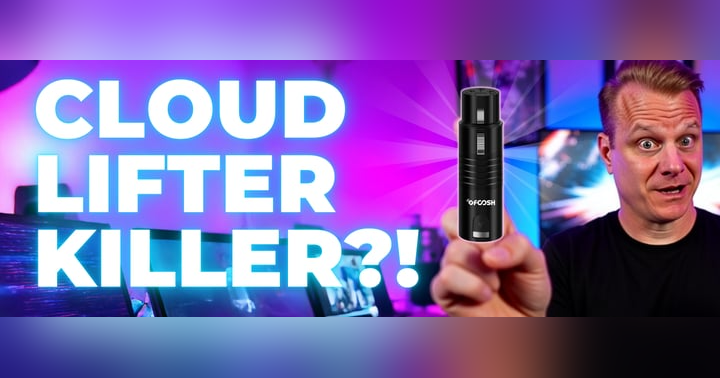
This is the exact problem the Cloudlifter Mini CL-25 was designed to solve.
We recently put this device through a hands-on review on the Dealcasters channel, testing it across three different broadcast microphones with zero processing applied. No EQ. No compression. No noise gates. Just raw audio, same room, same interface. The results were striking.
The CL-25 is a tiny inline gain booster, literally smaller than a lighter, that plugs directly between your dynamic mic and your XLR cable. No extra cables required, unlike its bigger sibling the CL-1. It delivers up to 25dB of ultra-clean gain using patented Class A JFET circuitry that was originally engineered for military and scientific applications. What that means in plain terms is that it boosts your microphone’s signal transparently. No coloration, no artifacts, just more of your mic’s true character. The warmth, the detail, the nuance. All of it comes through because your preamp is no longer straining to do a job it was never meant to handle alone.
..and don’t start talking to us about how your Rodecaster Pro “has enough gain” and “doesn’t need it.” There’s a noticeable difference, folks. It’s why we put Cloudlifters on all our mics, even with a Rodecaster Pro 2 interface.
During our testing, the Shure SM58 went from requiring 50dB of added gain from the interface down to just 20dB with the CL-25 in the chain. That is a 30dB reduction in preamp strain. The Heil PR40 dropped to 22dB. On the SM7B, we had to dramatically pull the gain back just to keep it from being overwhelmingly loud. In every case, the audio was noticeably cleaner, warmer, and more detailed.
And here is what makes this especially relevant for creators who are building an audience and showing up consistently, whether on a podcast, a livestream, or video content across platforms: your audience is making split-second judgments about your credibility based on how you sound. Not how you look. How you sound. Creating an environment where people want to keep showing up for you, where they thrive as part of your community, starts with respecting their experience. And that experience begins the moment they hear your voice.
The CL-25 also safely blocks phantom power from passing through to your microphone, which means it is completely safe for dynamic mics, ribbon mics, and tube mics. It is built with gold-plated Neutrik connectors, hard-soldered internals, and a rugged steel chassis. It is made in the USA on the Navajo reservation in Tucson, Arizona, and it comes with a lifetime warranty when registered.
We’ve had the pleasure meeting Rodger Cloud and the people at Cloud Microphones. They’re not just incredibly intelligent audio geniuses - they’re great people.
For creators at every level, from someone just starting their first podcast to a seasoned professional producing daily content, this is one of the simplest and most impactful upgrades you can make to your setup. You do not need to spend thousands of dollars overhauling your gear. You need to fix the weakest link in your signal chain. And for most dynamic mic users, that weak link is gain.
Don’t fear the gear. Plug it in. Turn down your preamp before you do, because you will have more gain than you are used to. And then hear your microphone the way it was actually designed to sound.
Check out the full Dealcasters product review and sound comparison to hear the difference for yourself.

Chief Content Entrepreneur, Cast Ahead
With a 25+ year history in the music industry with Sony, driven and passionate entrepreneur Chris Stone founded the Podcast and Live Streaming Consultancy Cast Ahead after the success of his own co-hosted podcasts changed his life. At Cast Ahead, Chris thrives on enabling driven entrepreneurs, influencers, thought leaders and enterprises to express their story and elevate their reach.
In the same way Chris was able to work with multi-platinum artists, record label executives and creatives of all levels – he’s found great joy seeing other Live Streamers, Keynote Speakers and Podcasters achieve their own creative, financial, physical and spiritual success. He’s produced videos for keynote speakers like Victor Antonio and Sam Silverstein, produced virtual, physical and hybrid live conferences for corporations, consulted, developed and produced podcasts like Sales Influence, The Big Ticket Life, The Sales Energizer, The Pete Primeau Show, Lancaster Connects and many more.
Chris also co-hosts an Amazon Live show “Dealcasters” with Jim Fuhs of Fuhsion Marketing. Dealcasters are Livestreaming Amazon Influencers who interview experts and entrepreneurs while training Amazon customers how to overcome the fear of technology, start and flourish in their content creator journeys. In just over a year, Dealcasters have established themselves as a trusted authority not only in the live video and podcasting space, but also in the education of the Amazon Influencer program and the development of Influencers already on the platform. They’ve spoken on stages and virtually at PodFest …Read More
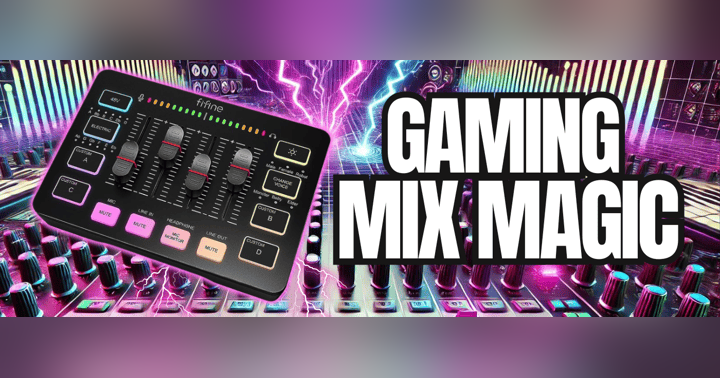
The Fifine SC3: A Solid Entry-Level Mixer That Actually Delivers