WEBVTT
00:00:02.879 --> 00:00:14.400
Welcome to Creative Spirits Unleashed, where we talk about the dilemmas of balancing work and life. And now here's your host, Lynn Carnes,
00:00:19.019 --> 00:00:37.244
Welcome to the Creative Spirits Unleashed Podcast. I'm Lynn Carnes, your host. My guest for this episode of the podcast is Tik Maynard. If you follow Road to the Horse known as the World Championship of Colt starting, you know him as the winner of the last two years.
00:00:33.465 --> 00:01:04.890
Besides that distinction, he's a three day event writer, clinician and horse trainer. Yet tick shared a very simple bio about himself, author of two books, father of two kids, also three day event writer, husband, juggler, dad joke teller, Road to the horse, competitor. There is a lot more to tick than this bio indicates, and I'll leave it to you to look him up on the internet to find out all the things he's accomplished.
00:01:01.289 --> 00:01:54.719
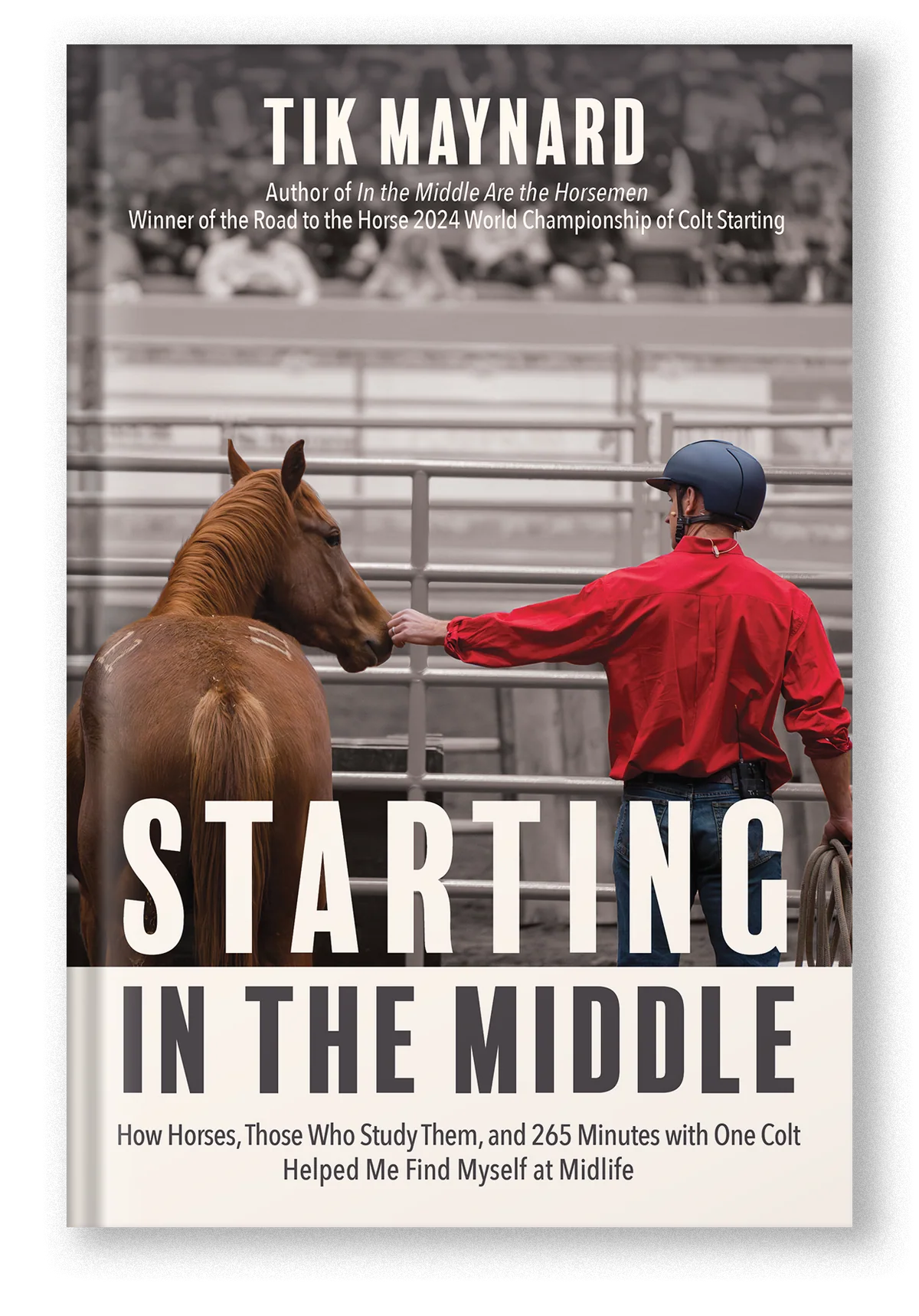
However, talking about this simple bio was a great kick off to a very deep and intentional conversation. The conversation ranged from the very practical, how did you prepare for the road to the horse to the philosophical? How do we balance our training with horses in ways that are acceptable? Confidence was a theme that ran throughout this conversation as well. We talked a lot about his latest book, starting in the middle, how horses, those who study them, and 265 minutes with one Colt helped me find myself at midlife. This is a horse book that's really more about learning, navigating doubt and cultivating a spark. It's by far my most highlighted book in the last few years. I really do think you're going to enjoy this deep and wide ranging conversation with tick Maynard.
00:01:50.159 --> 00:01:56.459
Tick Maynard, welcome to the creative spirits unleashed podcast.
00:01:57.760 --> 00:01:59.319
Thank you very much. Thanks for having me.
00:01:59.739 --> 00:02:42.699
I'm I'm excited to have you here for lots of reasons, but I I'd like to start because I'm coming off. People will have just heard me read your bio, and I'm probably going to elaborate on your bio, because it is the most the bio you sent me is the most focused, real bio I've ever gotten. It's like the essence of you without all the I'm going to pardon my French, but the wall and the bullshit of your accomplishments, and yet they're in there. So tell me how you've come to be able to make that be your bio, as opposed to, what if you listed your all of your accomplishments would be several pages of information.
00:02:44.500 --> 00:03:29.180
Yeah, I guess I just start to feel like it's, it's it's unneeded, it's overkill. I'm in a position now where we hire staff to work at our place, at our barn, and working students. And you know, it's just like you said, it's refreshing when you can see somebody that can be succinct, that can be honest, that can be authentic, rather than having stuff go on for on and on. You know, sometimes almost when you see somebody put all this detail and you have a five page resume, it doesn't mean as much as somebody that can just put it in a few sentences. It reminds me of the quote. I don't remember exactly what it is, but somebody that said a real expert is somebody that could explain the concept to a 10 year old child.
00:03:29.180 --> 00:03:34.819
You know, you don't have all the jargon and sum it up. And I kind of like to apply that to my writing as well.
00:03:36.319 --> 00:04:02.639
It comes through in your writing, having just read for the second time your book, starting in the middle. You do have that essence, and I like to call that and there was a client that mentioned this to me once, and I've adopted it. But it's something, it's a quote that says something like, I would not give anything for simplicity on this side of complexity, but I would get give everything I have for simplicity. On the other side of complexity,
00:04:02.879 --> 00:04:06.240
Oh, that's good, yeah, I see what you mean. I like that, yeah,
00:04:06.419 --> 00:04:23.300
yeah. And so there's like a texture there that it's earned, like it's like your essence is earned because you have been there, done that, and just the first two lines, author of two books, father of two kids. And it's kind of all some summed up in there.
00:04:24.920 --> 00:04:51.399
Yeah, there's a lot just in those sentences. You know, everything that goes into your life, to become a to become a dad, to get married and to raise children and to feel good about it, and proud of the kids, and proud of the job you're doing. And then same thing to get to the point in life where you feel like you have something to say and you feel comfortable and confident sharing it with the world and writing a book. I mean, it does sum up a lot. I think you're right.
00:04:53.379 --> 00:06:28.819
A lot of people might go to when they see that sort of work life balance. Yeah. And I have, I'm coming up on the 100th episode of this podcast, and I've, I've begun to realize, as I'm looking back on the themes I started this podcast talking about work life balance. Because a lot of people come to me asking me, they're busy corporate executives or whatever, how do I get more balance in my life? And I've started challenging the notion that there is such a thing. And when I listen to my themes and I think about what I've what I learned reading your book, what I'm starting to recognize is what may be more valuable is balance under pressure. And for example, when I read starting in the middle, which we'll just go right there and talk about it in this podcast, to me as I listen, as I listen to you, because you were in my head as I listened to you describe your journey to road to the horse in 2024 it was, how can I perform at a high level in a way that honors the horse? Is it even okay to do this, in other words, and still manage to be a good husband and a father to my children along the way, knowing what it was going to take, and in the end, it was about, I think Stacy Westfall had, might have been the one that had a nice quote that said something like, Who are you under pressure, something along those lines. So did you feel that as you were going through that process?
00:06:28.819 --> 00:06:29.120
Like,
00:06:30.319 --> 00:07:45.160
absolutely, I felt, I felt a lot of pressure, both about the competition itself, how I was going to do pressure, about how I would come across, you know, in this day and age with a large audience and social media, and whether I felt comfortable doing that in front of an audience. You know, a lot of people can start a horse at home, but do you feel really, truly comfortable with your process, that you can do it in front of television cameras and a live audience? And then I was also worried of exactly what you said, was I going to be able to also be a good father and husband and take care of the other horses that we had at home during that time? And when I look back on it, I don't think I was perfect. I don't think I was a perfect dad or a perfect husband or a perfect cold starter, you know, in large parts of that process, but what I will say is that it was constantly at the front of my mind, and I was constantly trying to find the balance, and I was constantly trying to ask the questions that I should be asking, and and I try to give myself permission to sort of just be human and say it's okay To not be perfect and not get it right, as long as you're trying, because that's what I expect.
00:07:45.160 --> 00:08:16.680
You know, that's the first thing I try to teach horses, is you don't have to do it, but I want you to try and appreciate in a horse, and that's what I try to train into a horse as well. Is that try is, is whether it's with pressure and release, or whether it's with food, or whether it's with play, or however I'm trying to motivate them, the first thing I'm trying to motivate them to do is to keep trying for me and and feel overwhelmed that they have a way to tell me that they're feeling overwhelmed that is productive.
00:08:13.500 --> 00:08:16.680
It's not bucking or spinning.
00:08:17.040 --> 00:08:21.980
And so I tried to essentially train myself the way that I was training horses.
00:08:23.120 --> 00:09:06.779
Gosh, there's so much in there so many threads I want to follow, but I'm going to start with a perfect piece, because there was a quote in your book that I actually also quoted in my book, dancing the tightrope, and it probably in a little bit, maybe different way, but it says the saying, There's a saying that the master is not the one who is never knocked off balance. He is the one who regains with more grace. Yeah, and if we come to realize that, then I feel like that awareness or that principle is the antidote to perfectionism, because balance, a lot of people think is a state of being that's constant, and I've learned it, especially through water skiing.
00:09:06.840 --> 00:09:43.240
It's actually more like dynamic alignment, and it's just like walking. We're out of balance when we're walking, we're falling and then catching ourselves with our feet, but with grace. And then, of course, the analogy I use is, if you want to watch somebody forget how to walk, put them on a 12 inch beam 100 feet in the air, and they can walk, walk a 12 inch beam on the ground or 12 inch path. But sometimes, even if it's a beam on the ground, they can't do it, you know, because the consequences are different. The pressure is different, and so it's just a matter of regaining balance, as opposed to constantly being perfect,
00:09:43.899 --> 00:09:54.159
yeah, and I think in water skiing, you know, I'm definitely not a competitive water skier, but I've water skied a few times in my life.
00:09:49.720 --> 00:11:50.019
And I, you know, when I train horses, I think about having three stages for each thing that I'm. Teaching them. And one is a stage where they're learning something new. They're learning something for the first and a separate stage is where you're practicing something that they've learned. And the third stage is now where you're getting ready to do a performance or a demonstration or compete. And sometimes people you know trying to get their horse ready to compete before they even learn the thing. So it's like they're skipping two full steps. And when I think of myself, and I think back to when I was a young teenager learning to water ski, there's that first part where you're actually you can't even stay up on the water skis for 10 seconds, water, and then they get the rope gets pulled out of your hand, and then you get halfway over the water, and then the road. And depending on, you know, your background and other sports and stuff like that, it can take you, you might not even get it on the first day. It might take you a few days before you can get pulled out of the water. And so we have the grace in that, you know, to try again and to not give up, and to to, you know, how you handle that for yourself and the people around you that are in the boat, you know? Do you say, Oh, I don't want to waste your time like I've fallen once, let somebody else have a turn. Or can you do it in a in a smooth way that feels good to everybody, that you want to keep trying, and that you are going to kind of find, find, find the balance there and then once you've kind of learned that, now you're in a practicing stage, and you're trying to find the grace and refining your balance, and then also, when you become an expert, those little moments where you're going to be off balance on such big moments, you may not even fall you may just you may even be the only one yourself that realizes you're a little bit out of balance, and you'll bring yourself back into balance. I think that never, it never goes away. No matter how good you get. It just gets kind of more and more more and more subtle, but you still have to yourself to talk yourself to have that self talk where you can refine, find balance, again, with grace
00:11:50.919 --> 00:12:57.820
that. And that's I think the self talk is important. And one of the things that's become somewhat aware to me, especially when we're working with horses, as as I've mentioned to you, I'm on the board of rain rescue, where we bring in more wild horses, either feral or Mustangs. And I have I'm a relatively new horse person, but joy Baker, who is the founder, is a deep, deeply experienced horse person who has frequently commented to me how different these horses are than the domestic horses that she had raised. And what we have noticed is that even our self talk, even if we're beating ourselves up quietly, in other words, it's just the vibration. It's really not out loud. The horses that we are now working with are sensitive to that, and one day, it just hit me. I was like, Oh my gosh, I owe it to these horses not to beat myself up because they don't know if I'm beating them up or the or the or me, like they don't know the difference. So it feels to me, to them, like I'm telling them they did it wrong when I'm the one who's frustrated with me.
00:13:00.100 --> 00:13:53.500
Yeah. Yeah. I think, I think something that is that could be that small, that sort of self talk that you're having, I think it affects your body language, you know, your intention that you put out, the energy that you put out. I think it affects you being clear in your mind about the plan that you have, what you're wanting to unit communicate, and I think, more than anything, unless you're really present with that horse and you're not having that negative self talk. I think it affects your timing. With a horse, horses are so aware of your timing, especially in that initial stages where you're building a rapport with them and they're learning something new for the first time, because if your timing is off, they just learn the wrong thing instead of the right thing. I mean, those horses are especially those, those wild horses, or those feral horses. They are so quick to learn, and in those initial stages, it just depends what they're learning. Are they learning to stay away from you, or are they learning to trust you?
00:13:54.100 --> 00:14:25.100
Gosh, I just what? I just realized we were having this conversation, actually on the ski dock yesterday, about the difference between the skiers at the really high levels, we just had the World Water Ski championships, and it was the highest scores, or the best scores that have ever been posted in this competition, with a couple of one, one who's more of a veteran, and one who's actually a Canadian, a young Canadian man almost won like he'd met. He missed it by one buoy, and he's an up and comer.
00:14:20.299 --> 00:14:59.320
He's 20 years old. But what is good, what's strong about both of them is neither one of them, when they make a mistake on the water ski, register it so they don't lose that split second, that timing, yeah, they keep going. And it's almost like in every every time there's a bauble. And even at their level, and as good as good as they are, there's a bobble, but for them, it's more like, how do I recalibrate, versus, Oh darn, look what I just did, I gotta recalibrate. And just that momentary thought of, Oh darn, look what I just did messes up the timing. And it just connected to me with the horse.
00:14:56.559 --> 00:15:00.600
It's also affecting the timing of the horse. If. You do that,
00:15:01.500 --> 00:15:17.580
you have to. I think, I think there's a moment to, if you make a mistake, to learn from it. But it's, it's not in a moment of action. It's a moment of thoughtfulness that happens on a break or a pause, or at the end of the day, or in a conversation with your coach.
00:15:14.220 --> 00:15:53.860
You know, to learn from those mistakes, but during the actual when there's action going on. I mean, I try to put exactly put those things behind me as quick as I can, and think about where we're at now, not what happened five seconds ago. And there's, there's no, I don't think there's any animal that humans work with as much on a regular basis that are so in the present. You know, people are constantly thinking forward and thinking back, and you know, even dogs have the ability to do that a little bit more than horses. I think horses are are living much more truly in the present than almost any other animal that we we work with on a regular basis.
00:15:54.879 --> 00:16:11.820
And that's the tricky part for people like me and a lot of the a lot of us who just kind of, we tend to be one or two seconds ahead, sometimes even, and staying in the moment while knowing what your next thing to do is as, I think, another real important Balancing Act. We all have
00:16:13.080 --> 00:16:22.639
exactly, exactly, you know, you kind of have a plan, and then you put in the back your mind so you can be right there in the present. And then on the break or the pause, or at the end of the session.
00:16:20.659 --> 00:16:31.340
Then you bring what's at the back of your mind to your forefront, and you think about your plan again. And then you have the back your mind when you're actually there with the horse. So it's a kind of constant back and back and forth.
00:16:32.299 --> 00:17:17.160
That's it's interesting, because I back to the conversation we were having before, and we talked a little bit, obviously, in the introduction about the road to the horse, I watched your road to the horse both 2024 and 2025 24 was the most interesting to me, just because you had written about it in your book. Yeah. And here's what really struck me when I watched it after reading the book, and I kind of did it simultaneously that you were talking to yourself through the audience as you went through all the motions. And that's very different than talking to us, which puts you outside of the round pen.
00:17:17.759 --> 00:17:25.818
Yes, yeah, that's a real I, you know, I've never thought about it that way, but that's really, I think that's really insightful, that you said that. Yeah,
00:17:26.598 --> 00:17:45.098
so how did you get yourself in the mind space to do that? Because we already just talked about two layers, which are really incredibly difficult, which is, I have a plan. I've got 265, minutes to start this horse over three days. Oh, my God. I mean, it's like, what?
00:17:40.479 --> 00:18:21.798
And then, then you so you have to have a plan. I did notice also that there were a lot of moments. You might have had 265 minutes, but I bet you had an equal, if not more, momenta, I'm going to call them catches, moments where you stopped, almost like you declared victory, checked in with the horse, and now we're doing the next thing. And so it now that you've described it, so we're like, I'm going to go back into my back of my mind and bring forward what's next. Now that's one layer, and then this other layer of speaking it into a microphone in front of an audience while not making it about the audience. How the hell did you do all that?
00:18:23.538 --> 00:18:54.939
Yeah, so the speaking thing is something that I deliberately began practicing in my mid 20s. Before that I'd never, you know, all through elementary school, high school and five years of university, I somehow managed to avoid any public speaking to any class, you know, I would, I would not show up at school that day. I would take a whole different class, even if I really wanted to do it, just to avoid any kind of public speaking whatsoever.
00:18:51.578 --> 00:19:04.138
And I somehow managed to get through, you know, that whole time until I was probably 25 not ever doing any public speaking.
00:18:59.439 --> 00:20:38.419
And when I kind of started going down the road of wanting to learn about horsemanship and wanting to become a horse professional, I started to think ahead that where do I want this to take me? And I realized, you know, when I looked around the people that are competing and the people that are clinicians and the people that are able to share successfully what they're doing with their students and with the world is they have to talk about it. And you know, you know, there's, there's probably a lot of people that are good horse trainers or dog trainers or good at anything in the world. But if you can't communicate what you're doing to other people, you're going to be pretty limited, I think. And so I consciously kind of realized that I got up my nerve and I signed up for a public speaking course, and it was one instructor and five of us in it, and it was probably one of the hardest things I've done in my life. Actually, I felt so awkward. And embarrassed. We met once a week for like, three months, and it was really difficult. And then from that point on, I started to try to put myself in situations where I could, you know, what I felt most comfortable talking about was stuff that I knew well, which was horses. And I tried to put myself in situations where I would speak about, you know, either handling a horse, what I was doing, or it would be just in front of a group, speaking about something that I had done, or a concept that I, you know, was getting clear in my mind, and, you know, it just grew to the point where I got it was happening more and more often, and it was something that I got more and more comfortable doing.
00:20:34.459 --> 00:20:57.219
And so even though I didn't hear about road to the horse until 2012 and I didn't compete in it till 2024 you know, probably in about 2006 was when I started practicing being able to talk to a crowd. And it was a very gradual, long process that involved a lot of practice and repetition before I could actually do that.
00:20:58.598 --> 00:21:30.558
Well, I It's interesting, as I'm listening to you talk, because, you know, I mentioned my, my example of the balance and the walking on the 12 inch beam. But the same thing that we can all do generally by the time we're three or four is being pretty proficient talkers, until you get in front of a crowd under pressure, and then all of a sudden we can't talk, you know. So my, my theory, is that skill practice isn't necessarily the way out of that. It's building your pressure threshold. That's the way out of that, building your internal mental tools to prepare you.
00:21:27.318 --> 00:22:12.898
Yes, you need to practice under pressure, but it's reaching for something that I think was more God given at birth, you know, sort of courage in that case, and and bravery and that kind of thing to get through, which you clearly had had done ahead of time, so much so that you didn't even mention, I don't think you mentioned in your book that you were going to have to talk to everybody while you were going through it, which really strikes me as just a sign of where you were. Yeah, like you were worried about how to put a Western saddle on and and were you gonna be the only one wearing a helmet? Which, yeah, kudos for you, by the way, for that. But yeah, one of my favorite moments was when you threw the western saddle over in such a very good way, and you said, how would you say I've been practicing this for a long time? Or,
00:22:14.160 --> 00:23:21.299
yeah, you know, I just started using a Western saddle, maybe, maybe six months before that competition, and it's a lot heavier than an English saddle, and it's a lot more awkward, and there's a lot more pieces kind of hanging down and hanging everywhere. And doing the cinch up is a little bit different than doing the girth up and then you brought the back cinch. And so you know, to just get a Western saddle on a horse, it doesn't take much practice. You can learn how to kind of plop it on and do it up in a rough way, in five minutes, but to do it with a horse that's never been saddled before, where the stakes are that high, it was something that I knew I wanted to do really well, which means both smoothly and quickly. So it's something that I practiced hundreds of times, you know, to the point where sometimes it was just for the horse that was comfortable with it, and I just put the saddle on and I take it off, put the saddle on and I take it off. And a few times, I would have somebody there watching me do it, you know, I had Martin black there one time watching me do it. I'd have Jake bierenbaum watching me do it, and just for 10 minutes, just put it on. 30 or 40 times, you know, so my arms got tired. And, you know, they'd say things like, it's got to be smoother.
00:23:21.299 --> 00:23:26.660
It's got to be quicker. You got to get the front end higher, you got to get the back end higher.
00:23:23.660 --> 00:23:38.480
You know, very you know, something that's really tough is you've got this outside stirrup that actually has a little weight to it, and so when you get over, if you swing too much or too high, that outside stirrup comes back around and kind of hits the horse side.
00:23:38.480 --> 00:24:39.859
You've got a horse that is the very first time in their life that they're being saddled. You know that can surprise them. And you know the worst case scenarios with saddling our horse are. You know, you go to saddle in the first time, and the horse spooks away from that and the saddle falls on the ground, and with that fear that comes from disturb hitting them, and then the saddle falling to the ground and them getting away from you. It can sometimes takes 30 minutes or an hour, even more, to sort of build their trust back up again. And when you only have four hours, you know, an hour, half an hour, an hour is a big deal. The other thing, the really worst case scenario, is you get the cinch, the girth, sort of partly done up, and then the horse spooks away. And then, of course, the saddle falls underneath the belly the horse box and kicks and and then, you know, they gallop a lap around the arena, and then it finally falls off or and then they're really scared, and then it's going to take you probably days to recover from that. So that that first moment where that saddled for goes on for the first time, was something that I was really aware of, that I wanted to practice.
00:24:40.519 --> 00:24:54.338
That's huge. Is there an option at the road to the horse to start with, like a like at rain, we use a small racing saddle first before we put anything else on. Is there an option to use a different horse, different saddle, or is it just not time efficiently?
00:24:54.460 --> 00:25:04.740
Oh, yeah. So both years, what I did was I first got the horse used to my body, because. Kind of around the weight and feeling the movement.
00:25:01.440 --> 00:25:28.880
And then I got the horse used to what most people call a bareback pad, which is sort of a leather pad with a strap in front and a cinch or a girth that goes underneath, you know. And if I wanted to add even another step in, I would have done the bare back pad, and then an English saddle, and then the western saddle. And I was prepared to do that. But both saddles did really well with my both horses did really well with my body bareback pads. So then at that point, I went straight to the western saddle.
00:25:29.480 --> 00:25:33.500
Yeah. Well, you it was a really beautiful, elegant move.
00:25:33.500 --> 00:26:09.599
And I remember seeing you, I think it was the 2025 one. You probably did it in 24 too. But I specifically remember you like crawling, like getting up over on the horse and then getting right back off. And that was the other thing I noticed that you did a lot was, I think I've heard this called being in and out like you, you get you do the thing, and then you don't hang on. You let it. You let it go, which seems so smart for horses and so difficult for humans to do, because we win and we've got that saddle on, and then we don't want to take it off again, or we're up there, so we don't want to get off again. How did you find
00:26:09.599 --> 00:26:43.779
and I would just said there that in and out. When you for anybody that's watches road to the horse, you know, it goes back to 2003 you know, there's obviously somebody wins every year, and every year there's some people that do Okay, and there's some people that kind of get in trouble. And I would say, you know, I went back and we watched many years of road to the horse and really studied. And I would say the single biggest reason that people get in trouble at road to the horse is not doing what you just said. They keep the pressure on, too much pressure for too long without retreating.
00:26:44.319 --> 00:27:14.039
And you know, I call that retreating, that in and out thing that you can you can get out, and you can give them a chance to settle mentally, physically. You give them a chance to let them know they're on the right track, and they learn something, and you let their heart rate and their adrenaline come down. And sometimes that might just be a second or two, sometimes it might be 30 seconds, sometimes it might be a minute or two or even longer, depending on the situation. But I would say that's the single biggest reason people get in trouble is just and probably even on a day to day basis with horses, is too much pressure for too long.
00:27:15.960 --> 00:27:32.660
I feel like that has come that applies to a lot of places where we get goal oriented as humans, and we don't realize that letting go is the answer.
00:27:26.240 --> 00:27:51.759
Like I've come for myself, I'm starting to call them I didn't die moments, but in raising my pressure threshold, and I got the I didn't die moments from Stevie Delahunt, because when I met her, I met her at Warwick Schiller journey on podcast summit in 2023 we were both speakers the same year, and her t shirt said, but did you die?
00:27:52.960 --> 00:29:22.759
And she was talking about how she helps people get over fears to do things like Mongol Derby, gaucho Derby and so forth. And at that stage, I had only been back on like riding horses. I I had a I had a bad accident after 40 years of not being on horses, so I had a lot of recovery to get back on. So I was still kind of just trail riding, not trotting, not cantering, and she said she could teach me how to gallop. And so the next March, I went to her workshop to learn how to gallop on a horse, which was really cool. But then I started realizing the way she did it was we didn't gallop forever. She found, like, a little short run where we could get two or three steps, and then she found a longer run where we could get a few strides, and then she found a longer run where we could, you know, go up a hill for a good ways, but it was in and out, yeah. Then I realized, okay, if I'm not going to do it forever, I can get my actually, I'm more balanced at the Gallop than I am anything I discovered. But I realized, if I could just collect those I didn't die moments, then I can raise my pressure threshold. And I think that's what you're saying. You do for the horse, is you get in and out and they realize, Oh, I didn't die, and so you're helping them. And the other thing I also noticed, by the way, I don't remember the language you used, maybe it was that you would say he was thinking forward, but you were looking for moments for the horse's brain to relax too, not just his body. So say more about how you were, how you figured that out.
00:29:25.338 --> 00:30:33.739
Yeah, so when I think about training a horse, just like we talked about at the very beginning, is the first thing I'm looking for is the try, trying and and for a horse, what a try looks like, for me is that they're thinking about it, considering it. They don't have to be doing it yet. You know, if I've got a horse, for example, and I take them to a water crossing, I'm on a trail ride, and I want the horse to walk through the water, and the horse is nerve. Nervous about the water. The first thing I want them to do, whether they're five feet back or 10 feet back or 50 feet back, or they're about to put a foot in, or it doesn't matter the distance, doesn't matter how they close they are physically, it doesn't matter how fast they're going. But the first thing I want them to do is, I want them to be able to look at it and study it and be thoughtful about it. So what that looks like is it looks like their neck gets longer, their nose tips out, their eyes are studying it. Their ears are forward. Now, if they can study it, what's going to happen at that point is one of two things.
00:30:33.739 --> 00:31:32.358
They're going to either get more comfortable with it, or they're going to go, the water is going to all of a sudden be turbulent, or something like that, and they're gonna go, okay, oh, hell no, I'm scared of this, and they're gonna try to spin and run away, right once, I think so what I want to do is I want them to think about it at a big enough distance where it feels okay to them, and that thoughtfulness turns into more of a relaxed thoughtfulness, where they where they become maybe curiosity As the next step where they start thinking, what is that? Or could I touch that, or could I explore that, or could I interact with that, or play with that? And once they start having that kind of thoughtfulness about it, almost inevitably, what happens is the horse gets closer to that thing on their own. I don't have to close my leg, I don't have to use the stick, I don't have to use the spur. I don't even have to clock, you know, the horse looks at it. And horses, by nature, are curious animals. If they're looking at it in a relaxed, thoughtful way, they're going to want to get closer.
00:31:32.358 --> 00:31:37.159
They're going to want to paw at the tarp. They're going to want to drink out of the stream.
00:31:34.878 --> 00:32:55.538
They're going to want to go like this with their muzzle back and forth in the water and kind of splash around. Some horses will really pot the waters if they're kind of in it, or even want to roll in, roll in it. And so that very first initial step, you know, where they're looking at something, and it's that turning point between, are they going to look at it and become more thoughtful and relaxed, or are they going to look at it and get scared and want to spin? That is such a small moment, if you're not trained to look for it, if you're trained, it's a big, obvious moment, but if you're not trained to look for it, it happens very quickly, and it's very fleeting and it's very easy to miss. And so the subtlety of observing the horse's eyes, their breathing, listening to their breathing, seeing their lips, seeing their muzzle, seeing if they swallow, seeing their ears, seeing their breathing feeling, even if you're riding their breathing through their rib cage, their heart rate, sometimes you can almost feel through the saddle their tail swishing. Is it high or low? Are their feet getting faster, getting slower? All this body language sort of adds up idea of when they're in this this tipping moment of becoming more relaxed and thoughtful or tipping away out of fear. That is such an important moment. And so that's something that I really have trained myself to try and look for on a ever deepening level, and to also encourage other people when I teach clinics to try to watch for that moment.
00:32:56.798 --> 00:33:10.378
That is a magical moment for humans too. But what do you do to capture it like is that the moment when you feel to try, that you sort of completely relax and let them just
00:33:10.500 --> 00:33:16.259
get out. Yeah, when you say get in and out, when I feel them try, that's the moment to not ask for more,
00:33:16.500 --> 00:33:20.240
saying, okay, I'm good.
00:33:16.500 --> 00:33:24.259
And you know, so I have a character that lives in my head.
00:33:20.240 --> 00:33:32.779
I learned about her from from reading the Julia Cameron's the artist way. I don't know if you're familiar with that book.
00:33:27.859 --> 00:33:53.380
It's a it's a book about recovering your creativity and being sort of locked down in the like left brain black and white world of the corporate world that I grew up in somebody on one of our mergers gave me this book as a as an idea to unlock my creativity, because I said I wanted to, and one of the exercises is to find out the voices that live in your head.
00:33:50.559 --> 00:34:36.679
You know, it's like the committee that leave lives free up there. And one of the characters in my head is the sports mom bitch, and she's the character that would be like the one in the stands going choke up on the bat, or you're not doing it hard enough, you know. And when that character shows up at a moment like what you talked about, which is as subtle as a butterfly wing, you know, and that voice is trying to tell you, yeah, but just go ahead and cross the damn stream, which is what the sports mom bitch, will do right? It takes such self awareness, not consciousness, self awareness, to sort of let that voice go to the side and say, look what this was. This was a win. We're going to capture the win. Is what you're doing?
00:34:37.820 --> 00:34:55.300
Yeah, exactly. And I think the more small wins you can capture, the faster the process goes. And one of the things that I didn't even really realize until, I think recently, is in the in road to the horse, is how fast everything happens.
00:34:55.300 --> 00:35:01.679
You know, everybody says you got to start a horse in three days and four hours, like you.
00:34:57.880 --> 00:35:44.619
There's sort of this. It's sort of implied that to get that done, you have to skip steps, you know, you gotta, you gotta go straight from A to D, and you're skipping, you know, B and C. But what I learned in my preparation for road to the horse is actually to have more steps. That's what I saw. And before I started preparing for and competing on road to the horse, I actually skipped more steps, and the faster my timeline had to be, the more I realized I've got to kind of have a like I used to think you got to have a point, you got to have a 1% improvement, and then a 1% improvement, and then a 1% improvement, whereas for road to the horse, it was actually more like a point 1% improvement, pause. Point 1% improvement.
00:35:40.900 --> 00:35:52.119
Take a break. Point 1% improvement, and you're actually, you know, if you can go and have all these very tiny improvements, that's actually when things happen the quickest.
00:35:53.079 --> 00:36:35.599
It's like changing the frame rate on a camera from what we used to have in the 50s when TV first came out, and the high definition that we have today, where they can capture you know, so many more frames per second than we used to, and that's what I saw, was all the little moments of capturing. That's why I said you had 265, of them. But maybe even more than that, exactly every few seconds you were pausing and then doing another thing. And it was a it was a clear delineation, so that the horse could and you were checking in with the horse, and what was surprising to me was how quick after each thing, the horse would be turning back to you, going, Okay, so the saddles on, what's next? Kind of like, Is that all you got?
00:36:36.800 --> 00:36:59.380
Yeah, you know, I did a, I did a, what's called Chicken camp, where I flew out to Seattle and I trained, uh, chickens for four days. And what we're training the chickens to do is stuff like dog agility type stuff, up and down an a frame, through a tunnel, pull banding over a teeter totter.
00:36:59.380 --> 00:37:42.760
Stand on this. Don't stand on that. Peck this. Don't Peck that. Knock this over with your beak. And we're training them with clicker training. So we have this little clicker and a little kind of bowl with cracked corn in it, and we would train the chickens. We'd make a plan, so we're going to say, Okay, for the next, next little bit, we're going to train them to peck this red poker disc, which was the first thing we trained the chickens to do, and then we would have 30 Seconds to train them. At the end of the 30 seconds, we would take a break, and we would chat about it with our partner, who is observing us training, and we would kind of make a plan. We would reflect on it and say, how did that go?
00:37:40.039 --> 00:38:35.840
What would I do differently next time? What's gonna be my plan for the next 30 seconds? And every 30 seconds would have that little break. And partly it was for the chickens, but I think more so it was for the humans to take that pressure off and to say, am I going on the right track? Am I going on the wrong track? And to have some feedback from another person that's watching, that's not so invested in it, but they can give you a more neutral kind of feedback on how you're doing. And one of the things that we would always discuss in that third after the 32nd is what was our rate of reinforcement? And the rate of reinforcement is how often we would click and treat and when we're doing it with horses, when we're not using clicker training, and I didn't use clicker training. I wrote to the horse, I use pressure and release, which is what you just said, which is, you get in and you get out. And with the chickens, how many times would I get in and out in 30 seconds?
00:38:28.340 --> 00:39:42.400
And with with the chickens, what we were looking for is about, you know, in a 32nd period, you know, about 12 times, give or take amazing under 14 times where that we would click and treat if we were doing it more than that, like we're clicking and treating all the time, that means the exercise is too easy, and if we're not doing it, you know, eight times in 30 seconds, it means the exercise is too difficult. They're not getting enough reinforcement. So that rate of reinforcement needs to be high enough. And so with horses, I really try to take that lesson from chicken camp to heart. And whenever I work with a horse, I remind myself, what's my rate of reinforcement? Which means how many breaks Am I taking to let the horse know they're going in the right direction? I would say the biggest difference between horses and chickens is that with chickens, the breaks could be quite short, or the click and treats could be quite short, whereas with horses, sometimes the breaks that I take will be quite long, you know, 30 seconds, a minute, two minutes in certain situations. And so then your rate of reinforcement, if you were to time, it is not really reflected as well as with chickens, but it's still the same ideas. I've got to take a lot of little breaks along the way, and sometimes even a lot of big breaks.
00:39:43.059 --> 00:39:47.920
And is the rate of reinforcement correlated to the number of steps you're breaking it down into?
00:39:50.019 --> 00:39:59.920
Yes, so if my rate of reinforcement is too high, which means I'm giving them too many clicks and treats, that means I need to break it down into smaller steps. Right the.
00:40:00.000 --> 00:41:10.619
Exercise is too hard. I need to make the steps smaller. I need to show them the way more. So for chicken as an example, let's say I want to teach the chicken to the very first thing, just as an example, is peck the red disc. If the disc is too far away from the chicken in this learning phase, the chicken has got to travel further, and it's going to get distracted, and it's going to still be a little confused, and it's not going to be very motivated. And so it might only peck the disc, you know, twice in 30 seconds, right? Maybe not at all. So then what I do is, at the beginning stages and the learning stages, I bring the disc closer to the chicken, almost right underneath it, and then it picks it, let's say it packs it packs it 10 times in 30 seconds, and then I click and treat it. I give it a little corn, and it does that 10 times in 30 seconds. Then I make it a little further away. Then it can walk with a little hustle. The chicken walks with a little hustle to check it. And then I move it further away. And then it gets the point where I could start the chicken on one side of the table and have the red disc on the other side of the table. And now all of a sudden, the chicken, instead of meandering and getting confused and getting distracted, the chicken goes in a beeline off like a shot, checks the disc, and then you can click and treat that.
00:41:11.880 --> 00:41:34.940
Okay, I've got chickens, so I'm gonna have to go try this, because as I was reading that part of your book, I was fascinated, first of all, because I have chickens that I could train. But the but the other thing was, what made you realize that that would be such a productive four days is a long time, and you went across the country, what made you realize that was going to be such a productive thing to do?
00:41:36.619 --> 00:43:24.800
So when I realized, and this is something that I've kind of started to probably realize there are, maybe not realize, but get into, get excited about, is, is learning theory and how animals learn, whether it's something as simple as a as a reptile like a frog, or something that's more complex, like a mammal, like a dog or a horse or or or a cat or a person or an elephant, or whether it's something that's as a very different way of learning, like a parrot or crow or a raven, the fundamentals of learning theory is very, very similar across all species, and it was something that I started to get more and more interested in. And so I began reading books and listening to podcasts and trying to understand how different animals learn. And there's a lot of horse trainers out there, or trainers of any animal, like a dog trainer, for example, that have a lot of natural feel, and they've sort of learned one way from an instructor, but they're not able to explain the theory of why what they're doing works. And that's something that I was curious about, and it's something that I just got interested in. So I there's, there's another thing that I did there called portal, which is a it's a tabletop game where we train other people using animal training techniques, P, O, R, T, L, and it's developed by some people at Texas A and M University. And for those people that are interested, I think the website is behavior explorer.com and I hosted a clinic, a portal clinic, at our place in Florida.
00:43:24.980 --> 00:43:30.980
We had six people. We flew the instructor out from Texas, and we basically applied learning theory to training other people.
00:43:30.980 --> 00:43:51.400
And when we trained the other people, we couldn't use English and we couldn't use mimicry or charades or acting. We had to sort of train another person is if they were an animal. And while training chickens and training people doesn't apply directly to horses, 95% of the learning theory does apply directly.
00:43:53.079 --> 00:43:57.340
So, and you did that before you went to road to the horse as well. That was part of the prep.
00:43:57.519 --> 00:44:02.519
Yeah, that was a few years ago. I didn't include the portal in the in the book.
00:43:59.800 --> 00:44:02.519
But, yeah, I did that. I was
00:44:02.519 --> 00:44:31.039
wondering if I forgot it, because I was like, Man, I think I'd have been all over that, because that was something that I did when I took over credit training at the bank I worked at. It was a huge bank. It felt to me like we were getting about a 10% learning yield lots of lectures, but nobody could really do it after they were lectured at about how to assess credit, and interestingly enough, trying to figure out whether somebody's going to pay back a loan is not that different than trying to figure out if a horse is trying or not.
00:44:31.039 --> 00:44:36.559
There's a lot of fields, yeah.
00:44:31.039 --> 00:44:51.760
And so I dove into accelerated learning theory, adult learning theory, all that stuff, experiential learning when I took over and we dramatically improved the learning yield, you know, by applying some of these principles. So I'm very tuned in to when you say learning theory, I'm like, all over it. It's like, tell me, tell me more.
00:44:51.760 --> 00:44:55.360
Because that's been kind of the direction my career has taken the last well,
00:44:55.960 --> 00:45:03.960
we're going to, we're going to do another another portal clinic. At some point in the next year or two, so I'll, I'll make sure to invite you to come. You need
00:45:03.960 --> 00:45:08.820
to invite me because you live you're not far far from Ocala, right? We're
00:45:08.940 --> 00:45:11.400
20 minutes north of Ocala, on
00:45:11.400 --> 00:45:33.559
301 Yeah. That's the drive I take between teaching a leadership program and doing my water skiing. Yeah? So you go right by our place. I go right by your place in on 301, and I'm thinking about going down and not, I'm skipping the the work part, and just going to go, possibly ride Reiners and in Ocala, because that's what I do now, is ride reining horses and go to and ski at the same time.
00:45:33.860 --> 00:45:37.039
So you're a reining horse trainer, or where do you go? Well, I'm not
00:45:37.039 --> 00:46:11.820
a trainer. I just have that happened to be because I grew up in Texas. I'm a Western writer, and actually didn't even know what reigning was until the World Equestrian Games came here and they started talking about the one Western discipline was raining. And I'm like, where's the barrel racing? You know, because that's what I grew up with. And then I went to the qualifier. This would be May of 2018, before the games were in 20 September, 2018 and I just was like, smitten. I was like, those horses are so beautiful.
00:46:06.239 --> 00:47:39.980
And it turned out that just a month later, or two months later, I found out that one of my dear friends who had never talked about horses, had bought a reining horse or two that turned out to be the winner of everything that year. And now she has this wonderful reigning place called Seven lakes in Purcell, Oklahoma, with a lot of winners. And she just happens to have that gift. And so I go ride her Reiners, and I have a reining trainer here. And obviously I just like to lope in circles. And I really love endurance too. I go ride the endurance horses with Stevie out in Oregon, but, but, you know, sort of back to where I just get so lost in it, like I'm like, I don't even know where to go now because my brain is lost, but I would love to do that. And like I said, I'm going to be down there. So if you do another one, you have to invite me, and I will. I'll just combine all the trips because I'm super excited watching like, as I said, I work with rain rescue, with these horses that are Wilder, and there's nothing what we've what we've found, and I'm guessing that you experienced this. So I want to ask this as a question, as you're taking a horse from untouched to able to be your partner and and be your partner in a very specific way, which I think of as power with. That's what I mean by on the tightrope when I think dancing the tightrope, not power over and not power under, but power with.
00:47:34.880 --> 00:47:43.599
Yeah, as you do that, how does it change you as a human, because we have found it rain.
00:47:44.320 --> 00:47:54.280
All of us are finding depths within ourselves and freedom within ourselves that we didn't even know was there as the horses have taught us how to be with them.
00:47:57.099 --> 00:50:24.920
Yeah, it's, I'd say, the biggest ways, it's, it's teaching me to be a better dad. You know, when I get a little lost with the kids, I try to think about what I would do with horses. And, you know, my wife one time, and this is either the the best compliment or the or the worst insult, or something like that. But I came in one day and she was having some quiet time. You know, in the kitchen, the lights were dim. She probably had a candle going, and she was having some water, and she was reflecting on how her horses were going, and I think she had her notepad out, and she was just kind of doing some quiet work in the kitchen, and very thoughtful. And I came in the front door, and I was kind of throwing, you know, my shoes here, and slamming the door behind me and going over to open the kitchen, open, open the fridge in the kitchen, and being like Sinead, like I just did this. I'm so excited. I want to tell you about my day. And she just kind of looks at me and she goes, You know, I wish you could read me as well as you read the horses, or treat. You could treat me more like how you treat the horses, or something like that. In other words, like being worth being more like thoughtful and aware of the, you know, I came into that, into that house, and I was excited about me. I wasn't thinking about she needed at all. You know, around them, with the horse, I immediately switch. It's not about me at all. It's got to be about the horse, right? And, you know, with the horses, sometimes I'm saying, sometimes I'm firm with them, sometimes I'm soft with them, sometimes I'm giving them food. Sometimes I'm not doing clicker training. Sometimes I'm saying we're gonna do something athletic. Sometimes I say we're doing something soft. Sometimes there's a whole range of stuff, but I'm basing it on what that horse needs, not what I not what I need. Sometimes they need boundaries, but I'm not doing that because I'm feeling like a jerk that day, and I need to take it. On the horse. I'm doing that because that horse needs boundaries that day. So when I get a little lost with the kids, you know, Sinead is much better with them than I am, especially with, you know, I get them riled up. I'm like the I'm like the sugar, you know, I'm like the junk food the kids and I got sometimes I gotta slow it down and be more present and have boundaries that are more consistent. And so I try to remind myself, you know, like, what would I do with the horse?
00:50:24.920 --> 00:50:28.219
And that's what I should do in this situation. And
00:50:30.260 --> 00:50:42.519
yeah, I'm reflecting on moments in my own household with both myself and my husband, where both of us have walked in at different times and sort of changed the energy, or been a little bit of a tornado, or not let the other person tell us.
00:50:42.519 --> 00:50:59.440
And we work so hard with the horse or or other people to like be just so and then with our closest people, we forget sometimes, hey, they need, they need the same respect. Yeah, and what respect? If you care, I don't know what the word is.
00:50:59.440 --> 00:51:01.019
What is the word? I'd say
00:51:01.079 --> 00:51:02.880
the word is awareness or thoughtfulness.
00:51:03.059 --> 00:51:16.500
Yeah, and the more you know on one hand, one part of my brain will push back and say something like, oh, shouldn't Sinead be aware and thoughtful of you?
00:51:13.980 --> 00:51:53.260
Like, why do I have to be always aware and thoughtful of her? You know what I mean? However, if I show up being aware and thoughtful, almost inevitably, she is also then aware and thoughtful, and it becomes a partnership. And it's the same with the horses. Horses, when I show up and I'm aware and thoughtful and I read them and they feel seen and heard, what starts to happen is they start to watch me, and I start to feel seen and heard by them. And so I'm maybe I'm showing up first for the horse, but inevitably they start showing up for me, and then that's when we get that partnership.
00:51:54.159 --> 00:51:56.320
It does sync up, isn't it amazing,
00:51:57.460 --> 00:52:20.280
and after a while, you know, at the beginning, if I don't make a lot of mistakes, and I'm totally aware and I'm totally present and I have consistency in that, then after a while, what can happen is, maybe I do make a mistake, maybe I do take something too quick, or I'm in the wrong place at the wrong time, but if I've been as consistent as I can possibly up to that point, then what happens is, they'll start to cover For me.
00:52:21.239 --> 00:52:51.938
Yeah, we call that taking up our Slack, and it's pretty dang amazing when they take up our slack when we've missed it, yeah, and they're pretty darn forgiving. I've found, and I have a question about the boundary thing, because we I've worked with a number of people, and again, I've brought some of my corporate people to this, and it can be very hard sometimes for them to set boundaries with a horse. The horse could start pushing into them and what.
00:52:49.539 --> 00:53:08.699
Sometimes we're just having them stand, you know, but some of our horses will, like, get all crowded and they're uncomfortable, and our formula for a non horse person to move a horse is just to do jumping jacks to create enough energy that the horse doesn't want to be in there.
00:53:09.179 --> 00:53:12.838
I love that, not about the horse. Then, if you can make it about them, doing jumping jacks
00:53:12.840 --> 00:53:41.420
Exactly? No, we're not exactly. Because I actually went through this thing when I was learning we called it attack jacks, because at first I did jumping jacks, horse didn't move, and then I kind of went at the horse, and it all of a sudden became a judgmental, bad horse thing, right? And that's when I realized I'd gotten off the tightrope, and I was making it about the horse, as opposed to creating my own space. And there's a very big distinction.
00:53:38.840 --> 00:53:52.480
This is kind of where my question is going is going is, how do you work with that idea, with yourself and with people about pressure with horses?
00:53:52.480 --> 00:54:19.139
Because, especially if you go into face, if you start scrolling in Facebook land, there is a wide range of viewpoints around horses. And I've encountered a lot of the a lot of these viewpoints in real life, where some people think you should never put pressure on a horse, other people think you absolutely have to put lots of pressure on the horse. And I feel like somewhere in the middle, as your book says, is the answer. How do you find that middle for you? I
00:54:23.871 --> 00:54:53.260
I think, first of all, I think that's a really good question. I think maybe that even might be the most important question. And I think I think part of it is about the person meaning, what is the person comfortable with? And recognizing that there's different ways to train a horse.
00:54:53.320 --> 00:55:32.960
So first of all, just because I use pressure to train a horse, which I do? I use pressure and release often, I also. Will do other things like clicker training or train without much pressure, whatever like. Have a wide variety that when which I like to train horses depending on the situation the horse the situation the person I'm working with. So first of all, it's about the person, and to recognize that there isn't really a right and a wrong way, but there can definitely be a faster way and a slower way. And one example, partly as a joke.
00:55:32.960 --> 00:56:07.320
You know, I was talking to another horse trainer, and they said somebody came in and they said they only wanted their horse trained with clicker training, no pressure and release. And she said, that's fine, as long as you understand the expectation that what's going to take me two months is now going to take me four months, and what would take me four months is now going to take me eight months, and is okay with double the price tag to get the same amount done. You know, if you're training a horse at two or $3,000 a month, it's going to add up pretty quickly.
00:56:01.800 --> 00:56:33.019
And, and that can be the same with a lot of things. There can be a faster and a slow way and, and everybody's a different point on their learning journey and what they feel comfortable with. The second thing is, how well do people read horses and and sort of think like a horse or really get into horses skin.
00:56:24.380 --> 00:56:47.500
And if you were to ask me, both for myself and for just a horse in general, do I have a bad relationship with pressure? I would say I have a pretty good relationship with pressure, and I also want my horses to have a good relationship with pressure.
00:56:44.380 --> 00:57:56.619
And what that what that means to me is that horses don't think of pressure as it means faster or more adrenaline, or you're in trouble, or I don't like you, or I hate you, or this is going to cause pain. I want my relationship with pressure and the horse's relationship to be pressure is more like this is uncomfortable, and if I think my way through it, then it's going to be comfortable on the other side, maybe even good, maybe even great, maybe even fun, maybe even playful, maybe even food, maybe even Whatever, on the other side. But that being uncomfortable and feeling that pressure is not necessarily a bad thing, and I don't think having myself or my horses go through discomfort or go through adversity is bad as long as the emphasis at the beginning is on what we talked about earlier, which is building trust, building try, building the rapport, building the relationship. I don't think the emphasis should be on boundaries. I think the emphasis should be on the rapport and the and the warmth and the horses have a good feeling from us.
00:57:57.280 --> 01:00:02.400
That doesn't mean I don't have the boundaries. I do have the boundaries. I just don't emphasize the boundaries. Now, sometimes you get in a situation when you're teaching and the person and the horse have no boundaries, and then at the beginning, I've got to say, Okay, let's make these boundaries clear. But if I continue working with that person over the course of a year, I've still only emphasized it 1% of the time that I've worked with that person and the horse over the year, it happened to be the first 1% first 1% but you know, once we have that boundary established, they go, Okay, now we can work on all this other stuff, which is way more fun and way more about play and way more about communication. The other thing is thinking about the definition of kindness. And a lot of times people say, Oh, I don't want to have this boundary, because I don't want to be mean to my horse. I want to be kind to my horse. And for me, I think of kindness much more as consistency and having a communication that they understand, and having them get to find me as predictable as I find that we can find each other predictable. What's going to happen if I do this, you're going to do this. If you do this, that I'm going to do this, and we start to find it. We start to understand it. If I were to say, the number one thing that I think causes horses anxiety and ulcers, which I don't want my horses to have ulcers, I don't want them to have prolonged anxiety, is I would say it's not understanding. Yeah, I would say it's confusion that horses are oftentimes confused about their interactions with humans. What do you mean by this? Do you want me to try it? You want me to can you want me to back up? Am I allowed in your space? Am I not allowed in your space? And so the consistency of having a consistent boundary is really important, and I think it makes for happier horses in the end, if you can be consistent, if you're applying boundaries in a way that is emotional, you're angry, scared, frustrated or in a way that is inconsistent, then I would say you're probably better off not interacting with your horse that day, getting help from a professional relaxing, getting in a. Our mindset and then working with your horse again the next
01:00:04.019 --> 01:00:47.500
day, that that needs to be listened to by every horse person on the planet. Because as I'm as I'm listening, first of all, the idea of discomfort, it's something that I've worked on, and it actually, I remember a very specific moment when I was learning to water ski and on the course, and this coach, who was the most genial, encouraging coach I had ever had, and I had not yet run a full pass on the water ski, and we get down to the end, and he goes, Lynn, if you ever want to run the course you're gonna be uncomfortable?
01:00:41.380 --> 01:01:32.300
Yeah, and I had equated discomfort with death. That's back to not, you know, collecting the didn't die moments. And that was sort of at least one of the beginnings I remember, of me starting to recognize that there's a difference between discomfort, or the scientific word might be agitation versus anxiety, which is actually just fear soup. And if I could just make it agitation and find a better story to get myself through it like you're you just described, because what you're doing is basically saying, I'm going to help, help my horse have a different story. When we're uncomfortable, we can think our way through this. There's life at the other end of this discomfort, as opposed to this, is going on forever and it means death.
01:01:33.320 --> 01:01:43.780
Yeah, it's like, what it is is it's your relationship to learning. If you grew up as a kid, and you become what I call a good learner.
01:01:42.039 --> 01:03:28.340
You're the person that's interested in having conversations where, not where people can have different viewpoints. You are interested in, you know, not everybody's interested in all these things, but things like crossword puzzles or Sudoku puzzles, or you maybe are interested in learning a new language on Duolingo, or you're, you're interested in learning something that you don't know anything about. And if you go to, you know, a cocktail party and you're having a drink and you're chatting with somebody that you just met, are you interested in learning about what they're doing? And even you know that you might know nothing about I don't know anything about, like, how to, you know, change the oil on my car. But let's say I'm talking to mechanic to actually in my mind, try to ask them the questions where I can really visualize it and try to learn it, and spend five or six minutes actually learning what they're trying to say and not just kind of glossing it over and having that really uncomfortable feeling where you think I don't know this, I feel like a bit of an idiot. The person maybe is looking at me like a bit of an idiot, but I'm going to be uncomfortable, and I'm going to get through it, and inevitably, what happens is you feel better about it on on the other side, and also that other person actually probably finds you more interesting for being interested in them, and actually probably has more respect for you For kind of admitting that you didn't know. So it really comes down to that relationship to learning. And I think humans relationship to learning starts probably when they're three or four years old. And I think horses relationship to learning also starts well even before that, a horse's relationship to learning starts from minutes after they're born. In particular I would talk though about their relationship with learning with people. You know, horses first start and they're first interacting with a person.
01:03:28.639 --> 01:03:43.000
What does that feel like to a horse? Does that feel like they can be uncomfortable and they can figure it out and they're starting to understand? Or are they constantly sort of manhandled through the situation and they're getting from point A to point B, but they're not really having a depth of understanding about what's happening
01:03:44.019 --> 01:03:58.059
that, and that's back to that piece of consistency where it's like, yeah, we don't do that, like we don't come into people's space, so we don't rear up or spin and kick or whatever dangerous things they can do.
01:03:55.000 --> 01:04:15.900
And that, that's what we've seen with the Wilder horses at rain rescue, is we got to really be good at what recognizing early well before they do it those behaviors, so we can catch them and show them a better way, exactly. And they definitely do get there. They definitely get there. But you have to be really good at reading those things.
01:04:16.260 --> 01:04:49.960
Yeah, and as part of reading it, you know, it's reading that, that the sign when they first start to feel overwhelmed before they actually you wait five two seconds or five seconds or 30 seconds, and then that overwhelming feeling to them turns into the buck or the kick or the spin. And if you can recognize that first sign of them starting to feel overwhelmed and just back off and take a minute, like you said, get in and get out, and that you can get out, and you can give them a sec, then they start to feel like you're recognizing it, and it's and they go, Oh, I don't need to act like that, because
01:04:49.960 --> 01:04:53.920
they can see me do it.
01:04:49.960 --> 01:05:00.960
Yeah, one of our Mustangs goes very quickly to a new one of behaviors that we had never seen before. None of us had. It's a we call it the. Cougar crouch.
01:05:01.440 --> 01:05:43.420
And it happened one day in the bar, and he was just as fine as he could be. It took him a long time to even go in the barn, but at this point, he's looking fine. And then joy picked up just a saddle blanket because we were going to be doing X rays, and she was going to use it to prepare him, and the second she picked it up, he just went down into a crouch like a cougar. And it was the first time in my life I had actually been standing, and the horse was under me, and then the question is, where is it going to go from here? And what's, what's beautiful is we don't judge it. We're not like, Oh, bad horse or anything like that. We're all just kind of like, Oh, come on, whatever. And then he comes right out of it, like, quit being silly. And he's like, Oh, nothing to worry about. Okay, I'll stand back up.
01:05:43.840 --> 01:05:52.059
But you know, you really do want to be paying attention before you get crosswise with one of those things. And, yeah,
01:05:53.320 --> 01:06:12.420
yeah, if you're in the wrong place at the wrong time, and that horse kind of knocks you over when they when they spook, it's very difficult not to get emotional. It's not very difficult not to get scared or angry or frustrated. Whereas, if you've been paying attention and been thoughtful and been observant, then that horse could have had that same reaction, you would have been out of the way.
01:06:09.900 --> 01:06:12.960
And then you can just laugh it off, and then
01:06:12.960 --> 01:07:20.280
you're just and what? And both of us, actually, the day I I'm thinking of a very particular day, both of us were aware enough about him that we just don't put ourselves in harm's way. And then when it happened, neither one of us made a big deal out of it. I all I wanted to. I just did a quick measurement of if he leaps, can he reach where I am? And then it was like, Ah, whatever. And that, to me, is where the human training gets interesting, though, because I've had to do a lot of self awareness work to realize I get very judgmental at times like that, when I get scared and it's easy to reactively blame the horse, or, you know, the old classic line, well, you naughty horse, you as opposed to the horse just acting like a Horse. And then how can I just stay even keel with that, rather than getting emotional and letting it hit all my old buttons. And I'm curious if you've noticed the same thing for yourself, and if so, any tricks for sort of decoupling those buttons from those moments?
01:07:22.260 --> 01:07:42.579
Yeah. I think the biggest trick is just really recognizing how in the moment and present horses are, and how and how horses learn, and how they think. And a Horse, horse is not going to do what you hope. They're going to do. A horse is going to do what their instinct, what their instinctual, you know, thought pattern is going to do how they're born. They're born.
01:07:40.940 --> 01:08:14.880
They're going to do that, or they're going to do what they've been trained to do. So if they do something you don't want them to do is because their instinct is kicking in, or you've trained them somehow to do the thing that you don't want to do, or you got to retrain them to do the thing you wanted to do. It's like, it's like this phone right here, same thing. This phone isn't gonna do what I hope it's gonna do. It's only gonna do what it's been programmed to do or what I inputted to do. So if it starts doing something else, there's no point in me getting frustrated with this phone. I mean, I get frustrated with the phone more than with the horse.
01:08:14.880 --> 01:08:48.039
But you know, it's not out to get you. It's not there's no emotion. Yeah, it's not out to get me. You might think it's out to get you, maybe sometimes, but the phone Exactly. There's no inherent like emotion in this phone where it's where it's trying to do me harm, if, if anything in that phone is trying to give me harm, it's because it's been programmed to do that by me or by somebody else. And it's the same with the horses. I don't believe any horse is out to get anybody. You know, it's what that horse is instinctually going to do because of their you know, you can't get mad at a snake for slithering. You can't get mad at a fish for swimming.
01:08:45.699 --> 01:08:50.500
You know, it's their instant kicking in. It's who they are.
01:08:48.039 --> 01:09:06.359
And you also can't get mad at a horse for doing what they've been trained to do, and if they're doing something that you don't want them to do, you gotta either reframe in your mind what the capabilities of a horse are, right? Maybe a horse. Maybe you need a dog or a motorcycle, right? Or you got to train the horse to do what you want.
01:09:06.359 --> 01:09:08.880
There's no they should do this.
01:09:06.359 --> 01:09:08.880
They either do it or they don't.
01:09:08.880 --> 01:09:14.579
If they don't do it, you got to train them to do it. If they do do it, great. There's no should.
01:09:11.939 --> 01:09:14.579
There's no hoping,
01:09:14.939 --> 01:09:46.359
yeah, I often call it when I catch myself. I was doing this with my audible book. I was shooting on myself, right? And the shooting for me was somehow I thought I was magically going to become an audio engineer, and that's about as logical as thinking that the horse is out to get me, right? It was like, oh, wait a minute. You hired a you hired an editor to edit your book, and you hired a book formatter to format it. And that's all an audio engineer is going to do, is he's going to edit the audio and format it so you can put it
01:09:46.359 --> 01:09:48.998
online. And they're and they're trained to do that.
01:09:49.059 --> 01:10:04.439
You know, that's a job. What's that? What's that? Quote from the Marines. It's something like, we don't rise to the level of our dreams. We fall to the level of our preparation. That's it better be. Paired like, You got to learn it. The horses got to learn it. We got to learn it.
01:10:01.798 --> 01:10:09.059
There's nobody that's going to just magically do something they haven't learned. We got to learn it.
01:10:09.479 --> 01:10:46.538
That's exactly it and and boy, is that the truth, because in like, I told you, I'm in the water ski world a lot, and that quote came up this week as Austin was coming back. Austin Abel, who runs the ski school right here, where I have my our ski Lake, just came back from competing at Worlds, and he was, we were so thrilled with how he did, because he went right to where he like. What you really want in water skiing is, are you going to ski at the level that you've been practicing at every now and then you practice beyond your normal, but under that kind of pressure, if you can ski at your normal level, then you've accomplished a lot, especially when you're across the country.
01:10:46.538 --> 01:11:09.779
They'd lost his ski. He was there with his family, and he came out right where and ended up, you know, he didn't win, but he out of, I don't even know how many 1000s of people water ski in the world, but out of several 100 competitors, he ended up at number 30, so that was pretty good. That's really good. That's really good. That was exactly his quote yesterday. He said I was at my level of preparation.
01:11:10.380 --> 01:11:16.439
So in Are you familiar with Liberty training, where we were? Yeah, without a without anything attached,
01:11:16.439 --> 01:11:23.418
yeah, we just had nan zmaster come to a Liberty training clinic, Carolyn Resnick method at Ryan rescue this, I
01:11:23.479 --> 01:12:14.458
love that. I love that. And David litchman from California, who's, you know, given me a lot of good advice over the years about Liberty training. One advice, you know, one thing you said to me when I was getting ready for demonstration in front of a crowd was, only show 80% of what you can do. Yes, you start working at liberty with a horse, and you try to start to show 100 or 110% of what you're able to do, and that horse is going to start leaving you, you know, you know the horse is when you start working without a without a halter and without a lead rope, unless they're feeling really connected and with a great rapport, and they really have a lot of draw with them. They can just leave. And I think it's really important when you pick the moments, especially with horses. You know with ourselves, for sure, in water skiing, but I would say even more so with horses than with ourselves, where you pick the moments where you're pushing the envelope.
01:12:15.659 --> 01:12:40.659
It's funny, because that made me think about something I saw about, I think they call it the Carl Lewis rule, because, as they were studying Carl Lewis, who was such a great runner, it turned out that most of the races he won, he won using 80% of what he had. That exact number, 80% so that's how you train is I need to be able to win with 80% of my effort, and then every now and then, that brilliance will come through.
01:12:40.659 --> 01:12:44.319
But, yeah, liberties, Liberty training is really interesting.
01:12:44.319 --> 01:12:57.460
And a lot of our horses reign, we have found we kind of almost have that magnetic connection with automatically. And when we don't, we then have to really check in, you know, kind of what's going on, what's great.
01:12:54.640 --> 01:13:10.020
What I just cannot get over is that these formerly wild horses, we have huge pastures, and when I go out to catch them, they they always catch me. I love that. Yeah, I would really not want to have to chase them all over these pastures. So it's a good thing.
01:13:10.739 --> 01:13:13.380
Really, good. No, that's a sign that you guys are doing something right. I
01:13:13.380 --> 01:13:25.579
think we're doing a lot right. I had, you know, I give joy like so much credit for what she's done in the team she's built. So I have a question about like, so you did roadie the horse the last two years.
01:13:23.180 --> 01:14:04.920
You're not doing it this coming year, but, but I know kind of like having just and it wasn't as long, but having been on this road with Austin as he's prepared for the World Water sea championships, there was a certain kind of intentionality and focus and pressure to our practices over the last several months leading up to this that was daunting and fun at the same time. And I know you've been through that the last couple of years, and you you documented it and starting in the middle. So what are you doing now? Are you enjoying riding without that?
01:14:00.779 --> 01:14:11.220
Are you not wide riding that wave, if you will. Are you finding another wave to ride that kind of keeps you on that growing edge?
01:14:13.319 --> 01:14:24.140
Yeah, I'm taking a, you know, from road to the horse. Until now, I'm kind of just still going with the regular things I have, you know, I have, you know, I have some event horses that are competing.
01:14:21.199 --> 01:14:44.739
I get horses in to train, and to start, got my family, my wife and my two kids, Brooks and violet, and I'm just taking a few months to kind of take a little family time, figure out what I'm going to do next. And I do have some ideas, but I think there'll be some more big kind of projects and some more big asks in the next year or two.
01:14:44.739 --> 01:14:47.979
I'm just trying to figure out exactly what that's going to be.
01:14:47.979 --> 01:14:53.619
And are you? Are you at liberty to talk about what any of those things are? Are you still waiting to see what it looks like?
01:14:54.640 --> 01:15:19.500
You know, one idea is another book, and I have a couple ideas for books. And. A one of them is it would actually be, have something to do with Liberty training. Oh, cool, a TV show or something. I don't know what form it would be on television, but or on video. You know, I've done a lot of stuff with the NF plus the Noel Florida equestrian master class.
01:15:19.920 --> 01:15:26.960
And if anybody hasn't seen that, they have, I think, 40 different instructors, of which I'm one.
01:15:23.720 --> 01:15:54.760
And they teach all kinds of stuff, from sports psychology to English riding to Western riding to horse behavior. And with that platform, with the NF plus platform, I've done a lot of instructional stuff, but recently we also did some, what you might call a docu series where we delved into what I called the four ingredients of horse training. And I got the idea from Simon nos rats book, salt, fat, acid, heat, the four ingredients of all good cooking.
01:15:54.760 --> 01:15:57.520
Oh, yeah, that was a good book.
01:15:54.760 --> 01:16:19.800
Yeah, they made that into Netflix Docu series. And so I had the idea of what are the four ingredients of all good horse training. And the four I came up with were observation, communication, motivation and play. And so we made a little Docu series with horses and with other trainers about that. And I had the idea of taking that into the wild world, the wider world of animal training in general.
01:16:19.800 --> 01:16:28.100
And so it's just a matter of, kind of making the connections and maybe raising money and talking to the right people, and trying to figure out, you know, how I can make some of these projects happen.
01:16:29.659 --> 01:16:40.720
Oh, I'm glad you mentioned that, because there might be, very well, somebody listening to this podcast that has that kind of connection or has an idea.
01:16:34.579 --> 01:17:04.020
And one of the one of the principles that I teach is if you, if you declare something, and there's a poem about this, when I had Christine Dixon on, we talked about this poem. But when you declare something, the universe has a way of moving all kinds of things to make things happen, and then you just have to pay attention, because the help will come. Have
01:17:07.619 --> 01:17:09.119
you found that to be true in your life?
01:17:09.779 --> 01:17:21.500
Unbelievably true, unbelievable scarily true. So that if I I've learned that, if I declare it, just watch and see what happens.
01:17:22.939 --> 01:17:34.458
Yeah, I to be totally honest, I've, I've found that to be true only rarely in my life, more often than not, I find myself knocking on 100 doors and getting 100 nos before I get a yes.
01:17:35.539 --> 01:17:38.539
Well, that must mean you're really good at discipline and patience. Then, you know,
01:17:41.000 --> 01:17:53.079
just even getting invited to row to the horse, you know, it took me 10 years of trying to make connections and put it out there. You know, for anybody that wants to compete at that, it's by invitation only.
01:17:48.939 --> 01:18:01.560
And, you know, I maybe you can just put it out into the world, and it's going to happen, that you're going to get invited. But for me, it took a lot of kind of effort and thoughtfulness and hard work to make it happen.
01:18:02.939 --> 01:18:30.498
Well, what I found interesting is I read your book about that, was that the the way you took us behind the scenes of that whole process, along with your questions, especially around the social license of is this something that we should even be trying to do? So I question whether I should do it or we should even be doing it, and yet I really want to do it like I really loved that dichotomy and that tension that you held in the book, yeah, and
01:18:30.500 --> 01:18:54.340
I think it's a fair question to be asking, you know, what you said about should we be using pressure with horses? I think, you know, I do, but it's something that I still think about, and it's something that I still have questions about, and then I talk to other people that I respect about, and read books about. So I think it's not necessarily that there's a right or wrong. I think the important thing is to continue asking the questions and to continue having the conversations, just like we're doing today, which I really appreciate
01:18:55.180 --> 01:19:37.520
I do, too, and I love bouncing these ideas back and forth, because it's a huge question for me as a teacher. Me as a teacher of humans and and also now working with horses is, how do we handle the pressure of life? Because there is no way to escape the pressure of life. You know, it is we. We are going to have pressure. Horses are, I mean, we are pressure. I mean, you put them in a pasture, you've got pressure. You know, there's tractors, there's cars, there's leaf blowers, there's, you know, I I mean, even the horses out in the wild have pressure. They have the pressure to find water and to eat and to stay away from whatever chases them.
01:19:38.659 --> 01:19:55.779
Yeah, and our minds that way, do we think of all of these things as bad things, and we want to take a horse and a person and give them no pressure in their life ever, where they never have any discomfort or never any work, and we supply them with food and water on a table and they, you know, if they ever get tired and exercise, we immediately stop.
01:19:55.779 --> 01:19:57.520
You know, is that what we're trying to do? Yeah,
01:19:57.880 --> 01:21:26.060
is that really and is that really what we want? Our own lives, so, you know, but I've been playing, I'm playing with an idea, because this experience of my fall off the horse and then getting back on and getting into this world has made me have to be really tuned into the nervous system. And I think I a lot of my coaches up until I fell off the horse, were of the school of thought of, you've got to get rid of fear. Your nervous system is your enemy, enemy. And it never rang true to me, like I would get so mad when they say, get rid of your fear. And I'd be like, But shouldn't I be afraid of that thing over there, you know? And they'd always give me reasons why I shouldn't be afraid. And then I realized there's mind created fear, and then there's danger. And as I've been playing with it and really starting to understand how our nervous system works, I've actually begun to think it's my best friend and almost like a power plant that creates the energy and the hormones that I need to get going, and also the hormones I need to rest and feel good. And it's my job to learn to treat it as my best friend and my guidance system, which means I can push myself not as something to be afraid of, that I need to never trigger. And so I've come to believe for myself anyway, that pressure is actually the solvent that helps me get through the hard stuff.
01:21:28.579 --> 01:21:30.319
So I'm playing with it right now.
01:21:30.680 --> 01:21:39.800
Yeah, no, I, I agree. I think, I think fear definitely has a place in our in our life and in our preparation and how we approach things. I think you're absolutely right.
01:21:39.800 --> 01:22:22.939
There's two kinds of fear, of fear that is actual danger, and fear that is sort of imposed upon ourselves because of how we're feeling. And I think fear in the right amount and with the right preparation can make us sharper and faster and make quicker better decisions. Have you ever, ever heard the quote, you know, the person's going into the arena and says, you know, I'm scared. I got butterflies. And the competitor next to him says, you know, I'm scared too. He goes, but the more composed person says, the difference between your butterflies and mine are that minor flying information. I love that one.
01:22:24.199 --> 01:22:37.699
Yeah, I love that one. And and the one, one that struck me, and I actually heard this. It was on highway 301, it was very dark, late at night. I think I was probably not quite to where you live. I was north of that.
01:22:35.060 --> 01:22:47.920
Maybe it's stark where they have the cops that are, you know, trying to do the speed trap. But it was, it was maybe on NPR.
01:22:42.460 --> 01:23:09.659
They were talking about the distinction in a study they'd done between three emotional states, calm, nervous and excited, and what they the test was ambush karaoke. They ask one group to be calm, one group to just let their nerves run, and the other group to say, you we know you're feeling something.
01:23:06.840 --> 01:23:31.819
Call it excitement. That's all they did. And then they had them all sing karaoke, which none of us want to do, if we can help it, unless we're, you know, Taylor Swift. And then they measured how well they did with some they have some way of measuring the tuning, or whatever. Well, guess which group outperformed all the other ones by a long shot, the excited group,
01:23:34.159 --> 01:23:37.579
the calm was the worst. Really interesting.
01:23:37.760 --> 01:23:53.920
And so I I immediately applied it, because I was on my way down to the ski, like, the next morning. It's in the middle of winter, and we haven't skied in a while. You know, I hadn't, I probably hadn't had a ski on for like, three or four months, and it's a very intense sport, so when you get up and start to ski, it's like, I don't even know if I can do this anymore.
01:23:54.340 --> 01:24:18.180
And so I was standing on the dock, and Chris, the driver, goes, how you feeling? I said, I'm so nervous. And then, wait a minute, I'm excited, and I had one of the best opening passes I had ever had, just by that step reframe. And to me, that's the butterflies flying in formation.
01:24:12.539 --> 01:24:25.220
So I just think it's interesting what we do with our discomfort at the end of the day, maybe that's the sort of the crux of the conversation, isn't it?
01:24:26.539 --> 01:24:47.380
Yeah, our discomfort and discomfort, we're we're both helping our horses get through and maybe giving them, maybe what you know, asking them to go over a fence. I've seen those cross country fences you jump, holy crap, like I've ridden the cross country course that that I watched you do on horseback, just for the try on trail rides.
01:24:44.319 --> 01:24:58.539
I'm not going over them, but as I walk behind by beside him, I'm looking over there, going, I can't believe anybody can take a horse over this. But you do.
01:24:59.739 --> 01:25:08.819
Yeah. Think, Do you remember what it felt like the first time you ever took a difficult jump?
01:25:03.720 --> 01:25:09.539
It's been a long time. I know because you've done 1000
01:25:09.899 --> 01:25:12.538
million dollars.
01:25:09.899 --> 01:26:02.099
You know? The thing is, if, if you do a good job with the horses or your coach that's training you does a good job with you is there's no one moment where you'd go from an easy jump to a harder jump, because you're going in such incremental amounts as you're prepared for it. It doesn't feel like there's a jump where you're going, Okay, now I've done something easy. Now I'm doing something hard. You know, you get used to jumping six inches, and then you get used to jumping nine inches, and then you get used to jumping 12 feet. And if either you know a good coach of a person and a good trainer of a horse, as soon as they see a lack of confidence, you're going to go down a level. Okay, gonna back off. You're gonna go from 12 inches back to nine inches, or three feet, back to two feet, or four feet, back to three feet. And then you're going to gradually build it up again.
01:26:02.338 --> 01:26:12.418
What you don't want a person or a horse to feel is, is essentially that moment you're trying to avoid. That moment you're trying to not have them say, this is the hardest thing I've ever done.
01:26:13.380 --> 01:26:16.859
Oh, that's brilliant.
01:26:13.380 --> 01:26:29.180
That's probably what stops more people than anything, is that they think they've made a big jump. You know, we do that in water skiing. So the the speeds go up two miles an hour. But Austin is such a smart coach, he doesn't do the two mile jump because you can really feel it.
01:26:29.779 --> 01:26:38.479
Yeah, two miles an hour time or or a big rope length jump, we break it down and sometimes do just a few increments, like just half a mile.
01:26:38.479 --> 01:26:55.180
That's really smart, and that's exactly what you're trying to do with the the horses, and exactly what you're trying to do with people when they're learning to jump confidently. And as soon as you feel like they're getting, you know, too nervous, or they're losing that confidence, you just, you know, you back off on the speed. You get the confidence up again, and then you go a little forward again.
01:26:55.180 --> 01:26:57.699
It's just like that, in and out.
01:26:55.180 --> 01:27:00.460
Kind of thing that you said you don't even in session. You can have different heights of jumps.
01:27:00.460 --> 01:27:10.680
You can warm up over some low jumps, pepper in some slightly bigger jumps, and cool down over some smaller jumps. So you're really, you're really constantly trying to be aware of that confidence level and trying to keep
01:27:11.640 --> 01:27:14.220
it high, yeah, well, I think, I think that's huge.
01:27:14.220 --> 01:27:20.279
Confidence is such a big player.
01:27:14.220 --> 01:27:29.720
And as we, as we start to, like, sort of close out, I'd be curious, because we've used the word confidence a lot too to go with pressure, what do you think are the essential nutrients of confidence?
01:27:41.060 --> 01:28:12.840
I would say I'll have to think about this a little bit more, but I would say the biggest ingredient for me is the preparation that you're not you're not making big jumps, and that you're really prepared for whatever you're going to do. And I think that preparation for me personally is what gives me the confidence, you know, heading into something that's unknown, or heading into something that I haven't prepared for, that's when I would say I would have the least amount of confidence.
01:28:14.100 --> 01:28:58.180
Well, you dang sure, prepared for the road to the horse in a really powerful way, and you took us inside, perhaps my biggest takeaway from the book, and I'm gonna ask you, sort of what you most want people to take away, but I'll say what mine was, was that it wasn't perfect, and that you weren't always 100% in, and that you did two things, which was you oscillated between should I or shouldn't I? And then you also really went far out to each edge of talking to the different trainers, including talking to the woman who doesn't believe we should be riding horses at all.
01:28:54.460 --> 01:29:01.500
And so when you started learning, you went very far out.
01:28:58.180 --> 01:29:08.279
And so you showed us in preparation that rather than narrow your world, you expanded the world. If that makes sense, yeah,
01:29:08.699 --> 01:29:59.920
yeah, yeah. And I think, I think maybe a takeaway is that you can have doubt about something, and you can question it, and if you truly believe it's something that you want to do, that you should do it. I think, I think within each of us there's a little a little flame, a little light somewhere deep down. And to really look at that, to kind of strip everything else away, and to think, is this something that I truly, truly want to do? And there can be a lot of excuses not to do things, time and money and family and a job and responsibilities, and the person that it's easiest to lie to is yourself and to say to myself, you know, I don't want to do this because I'd rather spend the time with my friends.
01:30:00.000 --> 01:30:19.020
Family, and I don't want to do this because it's going to be too hard on horses, and I don't want to do this because I'm not sure about it, but to look really deep down inside yourself about about what it is you truly feel you want to do, and let that be your guiding light.
01:30:21.720 --> 01:30:49.779
Wow, that's profound. I had a coach once say courage is commitment plus doubt. Yeah, yeah. So I think you just gave the definition of courage and not to lie to yourself is because we are the easiest people lie to we it's easy to lie to ourselves. Yeah. So that's a great, great takeaway.
01:30:49.779 --> 01:30:59.079
So as we close, tell people how to find you, and let's also give your wife's podcast a shout out, because your wife has a great
01:30:59.319 --> 01:31:44.619
podcast. My wife Sinead Maynard. When she when she was inventing her top horse take she was known as Sinead helping. But for the last 10 years, she's been Sinead Maynard, and she has an amazing podcast called in stride, which is hosted by ride IQ. And you can find that wherever you find podcasts and my book, my most recent book, is called starting in the middle, and hopefully you can look for that at your local tax shop or bookstore or at the website of the publisher, which is Trafalgar books.com. The publisher is Trafalgar Square books. And for those of you that want, don't want to go to all that trouble, there is, of course, Amazon, and just check it out on Amazon.
01:31:45.579 --> 01:31:55.600
Yeah, we we had somebody had a copy down at rain and Joy said she'd let me borrow it, and I had it for one day. And I was like, Well, I have to give this back because I'm borrowing it.
01:31:55.600 --> 01:32:00.659
So I just went to Amazon, bought it. I was like, I'm going to get my own copy, because I'm about to market this
01:32:03.300 --> 01:32:29.840
I would say that's very nice to you. And for the people that you know there's, there's a small author that you really like, you know, I'm not talking about the Stephen Kings or James Patterson's the world, but if there's, if there's a smaller author that you like, I would definitely encourage you to buy it rather than get it from the library or lend it to a friend, because, you know, the vast majority of authors are not making a living writing books.
01:32:27.260 --> 01:32:34.819
They're, you know, they're a journalist or a professor, and so every book that sells counts for them.
01:32:36.439 --> 01:33:04.979
As a fellow author, I will agree with that, and it means a lot for people to buy our work, and we wouldn't be putting it out, would we, unless we wanted I don't know about you, but I processed a lot of stuff by writing my my books, especially in my last book, dancing the tightrope, I was processing getting back on the horse. How about you? And then, then I want other people to share or see, kind of what I what I learned along the way, is that how it went for you? Yeah, I mean,
01:33:04.979 --> 01:33:31.100
it's really, it's really nice to share some of these things with other people that are interested in what we're interested in, you know, the horses, and also these, these bigger questions that we're asking, and then it also initiates conversations like we're having here. And some of the most interesting people I've met recently have come up to me and they've said, you know, the starting point was, I read your book, and then we kind of went off on a tangent and talked about something totally differently. So it's, it's a nice way to meet people as well.
01:33:31.939 --> 01:33:56.618
It really is. And as I was, as I was reading your book, there were 100 times where I was like, I've just got to talk to him. One of the ones when you talked early about improving versus improving, and I literally have that in my materials with people of the improving mindset versus proving mindset. I was like, I just gotta talk to him. So I'm so glad you said yes to this. This has been an incredible conversation. So thank you for being
01:33:57.460 --> 01:34:00.960
and hopefully we'll see you at portal in Ocala at some point. Yeah, no,
01:34:00.960 --> 01:34:49.060
we're working when we hang up for everybody that's listening, we're about to stop this podcast, but we're going to keep talking, because I'm going down to Citra. But for those of you listening, thank you so much for being here. And if you are interested in following more of what I'm putting out in the world, you can find me at Lynn carnes.com sign up for my newsletter at the coaching digest.com and we will see you on the next podcast. Thank you for listening to the creative spirits unleashed podcast. I started this podcast because I was having these great conversations, and I wanted to share them with others. I'm always learning in these conversations, and I wanted to share that kind of learning with you. Now what I need to hear from you is what you want more of and what you want less of. I really want these podcasts to be of value for the listeners.
01:34:45.460 --> 01:34:58.359
Also. If you happen to know someone who you think might love them, please share the podcast and of course, subscribe and rate it on the different apps that you're using, because that's how others will find it.
01:34:58.840 --> 01:35:02.100
Now I hope you go. Go and do something very fun today. You.