#100 Celebrating the 100th Episode of The Creative Spirits Unleashed Podcast

 Apple Podcasts
 Spotify
 Castro
 RSS Feed
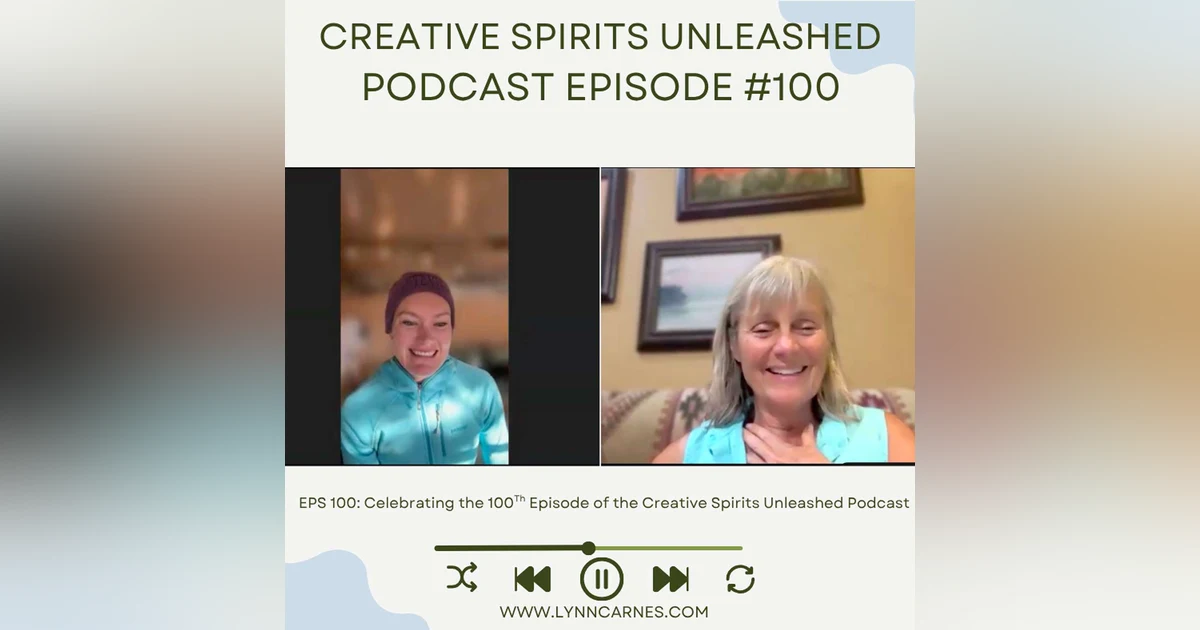
 I have just released the 100th episode of the Creative Spirits Unleashed Podcast. For most of the 99 episodes of this podcast, I have been your host. In this episode, the tables are turned. This time, it’s me answering some thought provoking, and in at least one case, tear-inducing questions asked by Stevie Delahunt.
Here’s how this episode came to be. I began working on a 100 episode retrospective about a month ago. This alone is a daunting task, because that’s a LOT of episodes, and my guests have inspired a lot of wisdom. Encapsulating so much inspiring advice in one single episode might be a bridge too far.
Just as I was realizing a retrospective will take more than one episode, I got this message from Stevie: “I saw that you are at the 99th podcast, and I was curious who the 100th podcast was going to be…someone should be interviewing you on your podcast. If you don’t have anyone, I will do it! You should be the 100th guest on your podcast, just so you know.”
Without blinking an eye, I jumped on this offer. Stevie was kind enough to send me some questions, and I may be borrowing many of these for future podcast guests.
One of the things we talked about in this episode is a glaring insight I’ve gleaned in my look back over the last 100 episodes over five years. What I thought this podcast would be about has taken a slightly different turn. Where I set out to explore issues in balance work and life, I found that instead, the prevailing theme is balance under pressure. It’s a subtle difference in words that is night and day in practice.
That means in a few episodes, I will be changing the language at the introduction to reflect today’s reality.
In the meantime, enjoy this episode where Stevie interviews me.
Intro:
Lynn, Welcome to Creative spirits unleashed, where we talk about the dilemmas of balancing work and life. And now here's your host, Lynn Carnes,
Lynn:
welcome to the 100th episode of the Creative Spirits Unleashed podcast. For most of the 99 episodes of this podcast, I have been your host in this episode, the tables are turned this time it's me answering some thought provoking and in at least one case, tear inducing questions asked by Stevie Delahunt, here's how this episode came to be. I began working on 100 episode retrospective about a month ago. This alone is a daunting task, because that's a lot of episodes, and my guests have inspired a lot of wisdom, encapsulating so much inspiring advice in one episode might be a bridge too far. Just as I was realizing a retrospective will take much more than one episode, I got this message from Stevie. I saw that you were on the 99th podcast, and I was curious who the 100th podcast was going to be. Someone should be interviewing you on your podcast. If you don't have anyone, I will do it. You should be the 100th guest on your podcast, just so you know. Well, without blinking an eye, I jumped on this offer. Stevie was kind enough to send me some questions ahead of time, and they were good ones, so I may be borrowing many of these for future podcast guests. One of the things we talked about in this podcast is a glaring insight that I've gleaned in my look over the past 100 episodes over five years, what I thought this podcast would be about has taken a slightly different turn, where I set out to explore issues and balance of work and life, I found that instead, the prevailing theme is balance under pressure. It's a subtle difference in words that is night and day in practice, that means, in a few episodes, I will be changing the language at the introduction to reflect today's reality. Stay tuned for more on that, as I will share some of that in the upcoming episodes for the retrospective. In the meantime, though, enjoy this episode where Stevie interviews me.
Stevie:
All right. Good morning everyone. This is Creative Spirits Unleashed podcast. It's had a little bit of a tables being turned. I'm Stevie Delahunt, and I am interviewing Lynn Carnes, your usual host, today and asking her a myriad of questions. Because when I saw that the 100th episode was coming up, I told her it needed to be an interview about her, because all the contributions she she's had in her recent podcasts have been super interesting to me, and I'm sure a lot of you want to know more about Lynn and hear her sides of the story. Rather than having her be do the interviewing, we're going to have her be interviewed. So, good morning. Lynn, good
Lynn:
morning. This is weird. I was like a minute, it's hard for me not to start asking questions, right?
Stevie:
Well, we'll actually start right off by I was hoping you tell us a little bit about what you've been up to, because you've alluded to it on your podcast. And I think myself and all the listeners would like to know what's going on in the Ski World with you, the horse world, and maybe beyond that as well. So let's start with skiing well.
Lynn:
So this is our last week, actually, as we record this, it's our last week of ski season, which is, like, always a really sad time for me because it's going to get too cold to ski, and it's something I do every day. So right now, I think I'm about to be on like, day five of skiing straight, and I'll ski a few more days. And I never do that in the summer because it's so intense. So I usually give myself a day off, a scheduled day off, if I don't have a forced one. But no, I'm like counting every minute, because, you know this, it's such a it's like such a short amount of time, but such an incredibly good endorphin kick. And it also, now I think I know why I love it is. It helps me work on my mindset, because things are happening so fast out there, and every time I go out and ski, I kind of get to find out really quickly, is my mind here, or is it somewhere else? And if it's somewhere else, things don't go so well. So yeah, that's what's happening this week. Is we're toward the end of ski season,
Stevie:
and I believe you were on a team, either coaching or helping get somebody to a world competition. Can you tell us more
Lynn:
about that? So Austin Abel, who runs the ski school here, got to he qualified for Worlds this year. And so what we. Doing was preparing for, like, an international competition and watching what he went through this summer. And I don't, I don't want to give away anything on his part. He it's up to him to tell about, but I will say this, I saw a distinct mindset shift with him, and I'm, I think, a lot about mindset, set myself and I'm I'm. My main role with him is I am his driver, which is a big damn deal, right? Driving at that short of a line requires really a tremendous level of precision, and we're sort of dancing together, and I have to be able to feel what he's doing, because I can't see what he's doing, because if I because if I was to even blink to look up in the rear view mirror to see where he is, I'm going to get out of center on the boat. So my job is to flow down the lake with him, you know, giving me a pretty good little tug behind the boat. I it's measured anywhere from 700 to 900 pounds of pressure that a skier at his level will put on the back of the boat as they're going by. And so I have to keep it within tolerance, down the middle of the lake, and then give give him good feedback on what he's feeling, or what, you know, what I'm feeling from him, because then he can make his adjustments. And so that's my main role. I don't coach him, per se, but we do have, I think I've almost every one of our conversations during the summer could have been a podcast. You know, what? What's he doing to get ready? What's he What's he feeling like he wants to change? What does he want to keep the same? And what's he going to do with what is he going to do with the things that are unexpected while under that kind of pressure, so, or even when it is expected? So I'll give a story. I think this one's fair. I think he think he'd be fine with me sharing this. He arrived in Italy, and it happened the last time he went to worlds, and it happened this time the the airline lost his ski, oh no, and the bag was not going to arrive in time for him to practice, and he can't just go hop on somebody else's ski. Austin is six, eight. He has a ski that's specially built and designed for him. Sometimes this happens, and other skiers will say here, just hop on my ski and practice or whatever. It's still really hard ski. Skis are very personal, so he knew he wasn't going to get practice. And that's huge, because every leg feels different. And you know, practice gives you a chance to feel it out. And what I recognized, we never talk about my book or dancing the tightrope or any of that stuff. But he sent me a text, and I was like, and that's what I mean by dancing the tightrope, because his text said, my first thought was, I was a little bit relieved, because then I'd have an excuse for not doing well. And then my second thought was, I was really pissed or angry, because I work so hard for this. And he said, and then I got to, well, I guess I'm going to learn something. And to me, dancing the tightrope is always sort of, there's something on either side of the tightrope, power under, you know, feeling like a victim, power over, feeling like you're the one in charge, that sort of relief versus anger thing, and then the one on the tightrope, which is, I'm going to be in the moment. I'm going to see what happens. I'm going to do my best. I'm going to learn that's all I can do. And he performed right at where he had been in practice, which, under those circumstances is beyond belief. Wow.
Stevie:
What an awesome progression to share with you too. Like, I feel like a lot of people actually have that first thought when something bad happens to them. Oh, an excuse for if I don't do well, that victim mentality. You've broken that down really well. That's really interesting and very cool that you've had gotten to have that conversation with him.
Lynn:
Well, it that? I think that the key thing is that first thought, second thought. And this is something I'm playing with as I'm starting to like work on teaching some things that I've been teaching in the corporate world, but now doing it in context with horses. And it's like the road to balanced thinking is always through a reactive thought. So in other words, we always say we want to respond, but I don't think it's possible to respond without first going through whatever your habitual reaction is. And so I think the question is, how quickly can I catch that reaction and shift the thought rather than thinking I'll some I'm somehow going to magically never have that reaction.
Stevie:
That's really, I really appreciate that there is an evolution in thought, right? Like you can go through the progression that you've already made, but oftentimes that habitual one still pops up. Whether, even if we've tried to eradicate it, it's still there.
Lynn:
Yeah, and. Thing I have to watch is when that, when it does come up, there's a part of me that's like, Oh, come on, have I not gotten further than this? Or I can't believe I'm still thinking this. Or if I'm really unaware, I don't even catch it, you know, until a few minutes or days or hours later. You know, it depends. So to me, the time, it's about shortening the time as much as it is not having the thought come up at all.
Stevie:
That's fair. Yeah, that time to time of judgment is wasted time, really,
Lynn:
yes, but it feels productive. That's the other thing that that I am like, well, if it's such wasted time, why do I love to relish in it so much? Right? And it's because it does actually feel productive, like if, if I'm hard on myself and judging myself, isn't that me trying to be better,
Stevie:
interesting, I sometimes feel like those things that aren't actually productive but feel that way are just loops that we've tracked before. We've been traveling in them for so long, and your mind is like always trying to go back to that, not even equilibrium, but the spot of which it was before.
Lynn:
Yeah, and most of the time for me anyway, it's not even my thoughts. It's the thoughts that were given to me by somebody else that was supposed to help me out of this circumstance that don't you know. So when I really look at it like I think I told the story in dancing the tightrope about quitting the bank, but the loop I got in, and I mean, it was a six month loop, is I can't tell my parents and I really can't tell my dad. And so what probably made what should have been a two week decision takes six months, was I kept looping through, but you're giving up all the security, and you're not going to have your stock options anymore. And this is a startup, and and in startups, you could fail and then be on the street, you know, I go into the homeless sequence, and how are you going to explain it to your dad? And I'm, of course, you know, I'm a 41 year old woman worried about explaining changing a job to my dad, so when I finally did make the decision to move and called him and had to tell him, Hey, I have a different job now, his response was that is great. Tell me more about it. And then I realized all of the mental angst that I had put myself through was never him. It was what I had decided he thought based on what something that was old and he's was long past him, like my dad was a gambler, and it's like, Why did I not recognize that part of him? All I saw in him was whatever I projected. That was the safety
Stevie:
net. We often tell ourselves the worst stories, don't we?
Lynn:
Yes, and then we don't check them out. Yeah, you
Stevie:
have a really great saying. We had spoken about this before, about like, suffering it twice, both in what actually happens, but mostly we suffer it for the long term, in the story in our head. And you told me something about assuming that everything is fine until you hear otherwise it. But you said it in a much more succinct way. Can you share that?
Lynn:
I think you just shared it beautifully. In a way. It's like that Schrodinger is cat, but it's like the which means that the cat is alive until it's dead, or until you open the you know box and it's either dead or alive. But it actually, again, happened with my dad, where I was teaching, where I really kind of realized this. I was teaching a self awareness program, and I needed to be really present with this group, and my dad was having a major heart procedure that day, and so what I had to go into that day was I was like, okay, I can be my physical body can be in here, and my mind can be in the operating room with him, and I'm worrying and angsting, and I'm going to be worrying with no knowledge, because I'm not going to stop this program to go call people, or I can just rest in as I start this program. He is absolutely fine. And there will be a time in the future I'll find out something as to how it goes. But for these next three hours, I'm here period paragraph, and I actually was able to let that happen, and it became a practice for me, which is, if I don't know, then all is well. And it kind of is a cousin to assume positive intent, you know, assume the best is happening, and you can't change. I couldn't have changed the outcome of what happened with my dad, but I definitely changed my experience, and that of the 10 people in the room, because I chose to be in the moment, right?
Stevie:
You made a difference by being by being present and assuming positive intent of the universe, right?
Lynn:
That's well, in a way, that's right, yeah, and, and I could, if I could have crashed that experience. Experience for them and me by wringing my hands worrying, you know. And I'm not going to say in three hours, my thoughts never went there, because, again, we just talked about is that the job is to catch so I remember specifically, like, because where I was teaching in that program, I could look out the window and I could see the ocean. And so I was already prone to daydreaming in that room, because I could look out, and sometimes I'd see a dolphin or something, I'd be go, Ah, look, there's a dolphin, you know, but I'd look out, and then I'd catch myself, and then come back in, and I think, isn't that all we can do? Like, isn't that all meditation is, is you, you know, you sit down and you try to meditate, and thoughts come in, and then you have to just bring yourself back. Yeah, I don't, I don't do that 100% of the time, by any means, but that was a specific time I remember that practice actually really did make a difference. I think
Stevie:
that's a great analogy, and a great place to start, as you're saying, to start catching those thoughts, is meditation, where you can really distill those and catch it and then just return to where you want to be going. Yes, so that's that kind of leads into and you've already said this already. I actually had a little list of questions that I let Lynn see, but I'm also going to pop some questions in here as they come up organically. But I had set asked what important skills that you've gotten in the corporate world that translate over to the equestrian one. So I'm going to combine that. Since you already mentioned one, I'm going to combine that along with what you've been up to in the horse world recently.
Lynn:
Yeah, so, well, there's like two or three threads. I'm actually coming up on my 100th horse that I've ridden since my fall. And being the counting person that I am way back, I decided to keep a list, and it started with just, I hope I can ride like five or six horses, you know, after not ever wanting to get back on a horse for a little while after my my fall. And so I started keeping the list, and then I realized I really like to honor the beings that have helped me along the way, and every one of them has helped me in a different way. So I'd never remember 100 of them, but if I kept a list, I did, so I'm like, I think I'm at 97 horses since I got back on the horse in 2019 which blows me away that I've been able to even commune with that many animals. But so that's coming up, and I'm still writing. I still take raining lessons, but my really big involvement is working with rain rescue, and I'm on the board Joy Baker has just put together the this most amazing place where we take on, and I use we very loosely, because joy does a lot of the work around this. But we we take horses who were formerly either feral, which are domestic horses untouched, or Mustangs, which are wild horses untouched, but our specialty is untouched horses, and then helping them, like enter into people's world. And what we realized how much these horses have helped us get in touch with ourselves, because they're so good at giving us feedback about where we are, in our in our energy and in our mindset, is we're going to be launching the first we're calling it rains foundational training. But I don't know what we're going to end up calling it in the long run, but in a couple of weeks, we're going to have the first five people come through that program and experiment with it's really going to be a blend of I'll be doing the self awareness piece and the human side of it. And I feel like a lot of the horse programs I've seen, people are aware of the human side of it, but they're afraid to touch it a little bit, or afraid to really go into it, because self awareness is a tricky topic with humans. So yeah, that's that's going to be my place. And it's a place where I wouldn't say I'm comfortable, but where I'm well versed, I'd say. And then we're going to also then have Julia Carpenter, who has been on this podcast, and who's a two does the two step way of being and seeing? Julia will sort of take those translations of self awareness to the horse, and then we'll spend a lot of time experientially with the horses, applying those things, but, but having the horse help people guide themselves through sort of the principles of as I've as I'm experimenting with them and as they've showed us to really letting the horse lead The way, and letting letting people learn how to really learn how to read their inner state and their outer state, so that they can give themselves over to letting the horse read the way or lead the way.
Stevie:
So sounds amazing.
Lynn:
Gonna be very interesting. We don't know yet. It's an experiment. So.
Stevie:
If I was a proper podcast host, I'd probably wait till the end. But if people want to get in touch with rain rescue or follow progress, or possibly be in line for a future program, how would they get in touch with that?
Lynn:
So the best thing is to follow rain rescue on our Facebook page. That's our most, you know, active place where we talk about what's going on. So it's just on Facebook at rain rescue R, E, A, I r, e, i n, and it stands for rescuing equines in need. And we are very good at keeping things up to date there. And of course, people can always reach out to me as well. And we have an email list. It's actually a really, really great we have a really great newsletter we put out at least once a month as well. But yeah, we just one of the fun things is, when I was when I was out in Montana in August, we all of a sudden heard about some mayors that were in the buoy auction, which is known for a place where kill buyers come, and somebody had dropped off eight mares and their babies. And these weren't just these are eight mares that had been out with stallions and had babies on the ground, which meant that they were also pregnant.
Stevie:
Oh, wow. So a lot of lives,
Lynn:
lot of lives. We're talking 16 plus eight, right? 24 Wait, is that right? Yeah, 16 horses on babies. I'm doing my I'm doing the math. It's just unbelievable. And so a group of people just really rallied, and we were able to take on two pairs of the mares and their babies. And indeed, the mayors were pregnant, but but joy already has a halter on them. And Maneely, because the slow way is the fast way we would go out. We spend time with them, you know, we, you know, one of the things that I noticed just from the very first minute, like when they came off the trailer, which I was taking a video of, is we were, we were pressure. So the question is, how much pressure can they handle at the beginning and after they got off and went running off to the corner of the field, we were a good long way away. And I looked over at the woman I was sitting next to, and I said, we've got to back away. This is too much pressure for them right now. And so then they could actually, like, sort of start exploring, find the water, find the food, because we really wanted to find the water. But within a couple of days, we weren't that much pressure. And it's like they they were learning about us through the pressure, because there's no way to avoid pressure, right, but, but you can calibrate it and keep them right at their edge, right? And so in short order, now, Joy has halters on all of those horses because we took the laser, but she didn't. She didn't. She doesn't back away because they're scared. She just keeps it just at the right level, like I thought this what I call the froth in my book, and she's a master at keeping the horse right in that place where it's like they can learn, because you can't learn without agitation, but you can't learn if there's too much agitation. And that's another dancing the tightrope principle. And I think a lot of I think a lot of times we get it wrong in the corporate world, I think we way get it wrong on the too much pressure side, and I think sometimes in the horse world as well, but also on the not enough pressure side, absolutely.
Stevie:
I love the idea of the froth that escaped me the other day. But we were, I was speaking to someone working with a Mustang, and I was like, basically explaining exactly that, how you have to keep it at threshold. And you just did that beautifully. Yeah. Speaking of dancing the tight rope and walking the tightrope, you've currently started shifting the podcast motto, and saying, um, because you've been saying you are finding yourself balancing under pressure. And to me, I was laughing, because I was like, balancing under pressure exactly sounds like walking a tightrope. You already knew what you knew.
Lynn:
I don't know if I've ever even told the story about how the name dancing the tightrope came up, but I had been writing articles about walking the tightrope in my corporate world long before I started getting involved with horses, and then really didn't bring it into what this book was becoming at all. This book was not about dancing the tightrope at the beginning or or it was, it was whatever it was about, right? But then my editor, Tina Wolf, came over to do a big whiteboard session with me one day, and she was trying to get the premises I was putting together in the book. And this is before I even knew for sure that the story of me getting back on the horse was going to be the through line of what I was trying to say, and she was trying to understand some things. And I said, you know, it's this. And she goes, Okay, so it's this. And I said, No, that's too far there. And she she said, Okay, well, is it this? And I said, Well, yes, but only if it's moderated by this. And it was sort of like the. Back and forth. And she goes, Oh, it's like, you're describing like dancing, like maybe even dancing a tightrope. And it was like this moment of clarity. We all in the room. Jennifer was in the room too. We were like, That's the title of the book.
Stevie:
Dancing is so appropriate. It reminds me too. Again, speaking with this person we're working with, the Mustang. We were talking about feel, and how sometimes it's this, but it's not always this. A little bit like math. It seems like black and white, but there's that gray area always. And nuance is so present in working with horses and and I imagine water skiing as well. So I really like that idea of dancing, because it really incorporates the idea of feel. And speaking of that, I'm curious, as you're talking about self awareness and guiding the self awareness portion of working with these horses, what is recent or doesn't have to be recent, but what's happened recently working with these horses that made you very self aware on these eight mares coming and noticing that, yeah, their presence was pressure.
Lynn:
It's every single time I go out to rain and I work with the horses, what i i Keep recognizing this is the Okay, here's here's the dilemma for me, I have a lot of energy, and my work is to keep it clear. Because what I have noticed is, the more my energy field is clear, no matter how high it is, the horses are fine with it. But if it comes cluttered or dirty or mindless, then they're not fine with it. Now what's interesting is, and this not not necessarily at rain, but in different locations, not everyone sees the high energy as clear, and so I've actually seen people try to dial me back as I approach a horse, even though the horse is welcoming me because I look like I'm moving too fast or coming with confidence, if that makes sense. And absolutely so the self the self awareness piece, is really learning to let the horse confirm where I am sometimes, because sometimes I don't always know where I am. I'd love to be that great at reading myself, but they're a great validator and a mirror as at the same time of what's going on. And so what I have, what we've all really learned, is how to stay present no matter what's going on and like, one of the one of the great moves is like, when they do things that are wild, is not losing our shit, because we have a what we wish we could do is have a camera all the time, because people we've actually gotten the feedback that it looks like things are too easy, and it's like, Oh, if you could only have seen because we have these moments, like these explosive moments sometimes, but for the most part, we're all that are those of us who are working with the horses, and I'm not as nearly as much because they're far away as others are, but we can stay grounded when the things kind of go wild. Like one day, we brought a Mustang in joy, and I did this to the barn, and she had not been haltered, and we were bringing her in with one of the other horses, and there were a few little scruffles and so forth, and joy and I just sat there and watched like, oh, isn't that interesting? And if you if joy will be the first to tell you, even a year ago, I couldn't have done that.
Stevie:
That's That's impressive, to keep curiosity in a situation that could honestly evoke fear or worry or anxiety, yeah,
Lynn:
and and knowing when to move away and when not to move away, because sometimes you actually really do need to step away, but you don't necessarily step away like, you know, running away out of fear, as much as just stepping away a
Stevie:
little bit about, like the process of letting go, just like you're speaking when your dad was in surgery. It's not different, that idea of, really, what is your attention gonna do for the situation, right? And oftentimes, nothing our mind tells us worrying about something or complaining about something, that it actually changes the outcome. But that's not really the case. It only changes your environment.
Lynn:
Yeah, I mean that that that distinction about what I what I call mine, created fear and and I think, I think initially, like Sue Robertson, who's been on this podcast, I think we actually talked about mind created fear. But that distinction has been, maybe the most important distinction in my self awareness journey is the distinction between mind created fear and true fear. And what really got me stuck as I was trying to start working with fear is working with anyone who would say fear is not valid, because I have really true. Believe Fear is an essential nutrient of life, like we better be afraid of some things, right? But, but, but mind created. Fear is something that actually is, is a gateway for other people to manipulate you, and danger, if you turn yourself over to danger, lets you let it tell you what to do, like in water skiing, you know, it's like we've actually had a couple of people that we would not let ski anymore because they were so not in tune as it's a dangerous sport. You can have terrible falls. I've seen people break bones. I've seen people lose their lives. It's it can be very, very, very dangerous, but it also can be done more or less safely. If you are willing to work towards staying in balance. It's a dynamic balance. You have 1000 points of balance on every pass, you know. But if you ski like a rodeo person, and you're willing to keep pulling when your body's not aligned, for example, you're going to take crazy tumbling out the front falls. You're going to break an ankle, you're going to pop a handle and possibly kill your driver. That's been done, actually just a couple of weeks ago, somebody hung on a little too long, and the handle wrapped around and gave Austin two black eyes and no stitches to have. You know, he had to have, like, bandage himself up. And so that's the great analogy of the difference between mind created fear and true danger. The the rope tells you when to let go. Your balance tells you when to let go. But if you're if you're trying to not listen to what it's telling you, then your mind will make you do something that causes you to either over or under react.
Stevie:
It's funny that you've chosen two sports where a rope or a horse is telling you when to do things how I'm sure we're all wanting to know, and maybe, I don't know if I would have an answer to this question, but what do you think draws you to these fairly, possibly dangerous sports?
Lynn:
Yeah, and, and I also fly airplanes, which a lot of people think is dangerous too. I don't. I've never. I mean, when I look at my childhood like I often somebody says they don't know what they want. I say, go, Well, what did you like to do when you were seven? And I learned to water ski when I was somewhere around between seven and nine, all I wanted as a child was to have a horse. I live near an Air Force Base, so I watched planes and and out our back window was the local, small airport. So I watched both military jets from the airport north of our house, but the airport kind of out our back window, I saw airplanes flying over all the time. I'm a watercolor painter, and what did they give me as a kid? But one of those little trays of watercolor paints. You know, I never had oil paints as a kid. So I obviously like watercolor. I played in the mud a lot. Got in trouble with my mother throwing mud at the house once. That's a whole story. So now I do clay, pottery. So if you look at everything I'm doing, I don't think that it's about the danger as much as it's what I was doing when I was a kid.
Stevie:
That's very cool, and that rings, that resonates with me as well. Really, was this what you were doing? I mean, we've laughed because I remember having, like, lots of little horses and imagining having a riding school, and each horse had all its own colors. And I literally didn't put that together until, like, a while ago, looking at the tack room and seeing that because, of course, we do endurance, where we have brightly colored tack, and each horse has its own color, so that everyone knows what's theirs, and there's just laughing about that. So yeah, for everyone out there, Lynn's not wrong. What was 789, year old? You doing? That's probably really part of your purpose.
Lynn:
I kind of feel like it can be sussed out from there. And it's certainly, you know, it's not, it's not also lost on me that, according to the psychological literature and studies and so forth, we kind of get formed around that time frame, like the general thought is that by the time you're in that 789, year old time frame, you've pretty much formed your personality. And there's going to be some things you can do around that and so forth, but a lot of the groundwork is laid at that point for who you're going to be in the world and how you're going to manage it. And one of the psychologists that I worked with in the self awareness program said, you know, you can take almost any eight year old and drop them anywhere in the world, and they will have the tools to figure out how to fit in in that world, because they figured out what adults do and how to be socially acceptable, and how to learn from people, and, you know, all of those things. Now, if you have a childhood this is where it's unfor. Passionate that didn't give you those tools, or gave you tools that don't necessarily work. Well, then you're going to have a lot of work. You have an uphill climb
Stevie:
that's very interesting and seems seems to make a lot of sense. So eight year old, you was painting, watching planes, imagining having a horse. Can you walk us through then where you picked up these really big identifying sports, like, when did you start water skiing, horse riding, painting? What happened in between?
Lynn:
Yeah, now late in life, because I gave everything up for my career. And like in my early 20s, of course, I was a single mom. I did start flying, actually, as a single mom, and then I moved to Charlotte, so I couldn't keep flying. But there's probably, almost certainly another trend, when I actually think about it, particularly with flying, horseback riding and skiing every one of them. As I entered into them, I had an event that should have scared me away. So maybe there's something inside of me that's also determined, because what got me flying in my 20s is I went on a date with a guy who had a friend that had a plane, and so the four of us hopped in a plane, went down to Fort Worth to eat dinner, and then flew back. And when we came back to Wichita Falls, it was dark and windy, and they had picked us up at this airport I was just telling you about that was out my back window when I was a kid. But his plane lived at a different private airstrip a little bit west of town, and he said, because of the wind, I don't want to make two crosswind landings tonight. I'd like to just make one at my runway. He turned around and goes, Don't worry, this runway doesn't have lights, but we'll be fine. Well, at this point, what was I supposed to do? I'm in the plane, and I could die. And I thought he was stupid, but I couldn't do anything about it. I just completely froze up and was absolutely terrified. We landed just fine, and we went into the hangar, and he pointed out his crop duster, which he calls his office, and I realized it was a very experienced pilot, and I was torn between that guy's an idiot, and I want to learn how to do what he just did. And so I chose the I want to learn to do what he just did, and started flying. And the first time i The and in my very first flight, they let me fly the airplane. They didn't let me land it, but they let me fly it. And I was like, This is what I have to do, because the way I felt, being able to sort of feel for how to move the plane and how to balance the plane and all that was just really, really exciting. So that was the story that could have told me to turn off of it forever and never get in another airplane. And and I still consider, you know, I mean, I know way too many people in small planes that have had crashes and died, way too many. And so I and most of the time it was because they were not present with what was going on. So I consider it like a really, really important thing to stay present with. And then in water skiing, the first water ski school I went to. I didn't get to ski for years and years and years, and then we moved to Lake Lure, and that's when I was like, I just decided, I'm just gonna act like a kid again, and I'm gonna ski all I can. So I go to the ski school, and I think it was the first or second day I took a fall because I was not understanding how to balance. Remember, I told you, this is a sport where you want to balance, and I was kind of going for it too much. And the ski came up and hit me on the back of the head. And the the instructor said, I said, I don't know that ski hit me pretty hard. I said, I don't I don't know if I'm, you know. I said, I think I'm okay, though. And he goes, Well, turn around, let me look at your head. And he goes, Oh yeah, no, you're bleeding. And so it was funny, because everybody then had to look at my head to decide what to do. And all the guys were like, yeah, she's bleeding. And then the women were like, I was like, two person it was like, and then the owner of the ski school took a look at it, and she goes, so I'm going to have you go to my doctor. And sure enough, I had to have my head stitched up. So then the doctor said, you know, you can keep skiing as long as you don't get your head wet. And I said, Well, you know, it is skiing. He goes, Well, I he says, Don't swim underwater and don't he said, if you get splashed, it's fine, and don't get under the shower head. So I did that, and I kept skiing with stitches in my head. And, you know? And then the story of dancing the tightrope, of course, I fell off a horse on my second trail ride after 40 years of riding, and I kept coming back. So there's something in me that's sort of like, all right, having things go poorly, evidently, is a way to get me to do something.
Stevie:
It's so interesting. I. We recently were listening to the president of AOPA, which is a personal Aircraft Association, and his whole family does Hunter jumpers. And I was laughing, because there's this interesting crossover of like, climbing, sailing, horseback riding, water sports, all of it, I find once you're addicted to one outdoor sport that in which you actually have to relinquish control, you're quite addicted to all the others, or you start down that path. So it's not a surprise, really, that you fly and you've got earth. What is it? Earth, Wind and water.
Lynn:
Earth, Wind and Fire could go in there, because I am a bit of a pyromaniac too. That's a whole nother story. No, there is something to that feeling of giving up control, especially when I think my main sort of nervous system. Anybody who knows me would say, you lean towards control freak, and I'll own it. I do, but it's really cool when I can give over control at the same time.
Stevie:
I think that would resonate with a lot of people. I you know, I think a lot of people that haven't yet explored doing something that like the things that you do, like flying, riding or water skiing, they might feel it's that they're not brave enough. And I always, I'm personally, always telling people, like, I actually do have anxiety and fear and I want to control the situation, but weirdly it's like touch. It's, as you said, fire. It's like touching fire, like you keep going back and doing it anyways. And maybe you could explain how you took those first steps coming out of the corporate world, into giving up control, because it seems like you recognize you. You had a too highly controlled life, maybe, and we're looking for something where you do surrender.
Lynn:
Yeah, it's interesting because, I mean, I'm going to just riff right now. I haven't really thought about this, but what's coming up is, as you ask, that question is, along with the control piece, is the is the proving piece and the approval piece? And I think one of the things that made me do really, really well in the corporate world was I was very good at figuring out your game and getting good at it, and so I had a really strong proving mindset and really high need for approval, which I think then needing to be a control freak is sort of the rebellious side of approval. So I'm going to give all my power over to you so that you can tell me, I'm a good person, but I'm also going to take it back by trying to control everything. And so neither of those is flow or dance, but it is, to a large extent, the nature of a lot of the corporate work I saw. I see people do, and a lot of the people are stuck in that sort of never ending cycle of wanting to prove themselves to other people without recognizing that they'd give when they do that, they've given all their power away to the people that they're trying to prove it to. And so I'm just kind of riffing on how that, how that went, and how a little bit lost I was at first, and I remember sitting here because I I left the corporate world and moved to Lake lore at the same time. And so we also left sort of the city life and the neighborhood structure and sort of stores and places to eat out and stuff like that, and came to a very rural place where I was at risk of becoming very much alone. And remember, you know, I would go, I'd travel out. And I went out to a workshop with a guy that wrote, two guys that wrote the book The work of leadership, Ron Heifetz and Marty Linsky, and and then I went to another workshop with a guy named Bob Keegan, and he wrote a book called How the way we work can change the way how we how the way we talk can change the way we work. But, but, but the combination of the two of them, those two workshops, I realized that I was, in a very profound way, creating my own reality that I had said that I wanted to work with other people, but I had been so controlling and unwilling to give up anything that I was just creating a very small and tiny world that only Lynn could live in. And so as I recognized that through those two guys, the work of both of those guys. It was like, Oh, you're saying something, but you're not living it like you don't line up between what you say and what you do. And then I started experimenting. Well, what would happen if I actually, like made declarations and just lived in two of them? Mm. Yeah, and that's very cool, yeah, just call people like, you know, like, the here's an example. I was, I very, very tangible, practical example. I just gone out on my own. I'd left the bank. One of the things that you have to do is put together something. This is pre web of who are you? What do you do? What do you have to offer? And I had booked myself a week at home because I was already doing a lot of work and traveling and so forth, but I had booked a week at home to work on it, and it was probably a day's worth of work, but, but I could not get off the first sentence for a week. I mean, I sat there with blank page syndrome for a week, and it's like, How can I not write this down? And one of the beautiful things that Keegan taught me was, when you're stuck like that, you've got some sort of belief that's holding that in place. That's countervailing the belief I need marketing materials. But what's the countervailing belief? And as I dug into it, I realized the countervailing belief was I don't want to need marketing materials, because why do I not want Martin to need them? Well, because if I was really good at what I did, I wouldn't need them, because people would just be calling me, and I wouldn't have to market my business. And then you get to that belief, and that's when you just laugh, and you go really, because even when you're good, you need something. And as soon as I saw that, I had those things, I had the whole thing done in three hours. Amazing.
Stevie:
I really like that. That's the belief holding it in place. That's really, really good advice or good phrase to hold on to,
Lynn:
yeah, the belief is like, and you don't know, it's not the it's not the surface belief. It's the one under that is the one that we normally don't see. Because the surface belief was, well, I don't want to need marketing materials, but I that that one's okay. But the i, i If I needed him, it means I'm not very good at my job. Is a harder thing to say out loud, right?
Stevie:
Absolutely. Um, I'm gonna kind of hop all over your timeline here, but we're talking about holding beliefs. And I'm thinking back to where we started, where you were saying, Austin went through this progression of thoughts, yeah. And then we probably, probably everyone's wanting to know how he did. And yeah, he persevered through not having the materials and preparation that maybe he was hoping to have. Because I think that happens to everyone, but people don't realize it. You show up to the big event and something is going to not go your way. Yeah, and I think people also hold a belief that everyone else is having a perfect experience. I at least see that, you know, when things happen to people like in the Mongol Derby or other big events that I've coached, like you feel you are the only one experiencing a setback. And I'm curious as to how he went through that, and what happened overall with his experience at Worlds?
Lynn:
Well, so the number one thing is, he skied right at his level of practice, which is, you know, there's a saying you don't rise to love or your aspirations. You fall to the level of your practice. But in skiing, it is very common for someone in a in an event like that, to go end up not making the gates, or falling on the opening pass, or because the pressure gets to you. And so he his, that was his intention, and his goal was to ski it. He said, I'd love to get more buoys. I know I'm not going to win. Because in skiing, we kind of know, we pretty much know who's going to win at what level. He ended up 30th in the world out of I don't know how many hundreds of people there were, so he's still pretty high up, but there were two other things that I thought were really important, and you just nail one of them with what you said, How much everybody cares and how much nobody's having any better experience than you are. And that was one of his biggest insights coming back. He said, I realized, as I talked to everybody, that every one of them had been working like I had, on their mindset, on their physique, on their practice schedule. You know, every one of them had put in as much care into this as I had, and every one of them had the same questions and doubts and weird things happening, and that was a huge eye opener, I think, for him, because I don't think he'd ever even been open to it until this summer, to looking at what was going on with other people. But the thing that for me was really something I could truly tell was different, was when I watched it, he skied at two in the morning, so I didn't get to watch it on the live stream. When it was live. I watched it afterwards, and I have watched him and others on the dock for many, many years, and I could, I can kind of tell how they're going to do almost by just watching them on the dock. Yeah, and when I saw him sitting on the dock, I was like, Oh my God, He is totally in his body, like he's there. And he later described the experience of being able to hear and feel and know everything that was going on, but not have it throw him off his game. Because sometimes, like, if you hear the announcer, you know, or you know, like they kept saying he was from South Carolina. He's from North Carolina, you know, stuff like that. You none of it was facing him, but he could hear it. And some people like are putting headphones in to block it out or do whatever they can to not be in the moment. And so that was, I thought, that was actually, I told him that he agreed with me later that that was perhaps the biggest achievement at the summer was he was in the moment under the greatest pressure he'd been in in forever.
Stevie:
That's incredible. I mean, I've had high pressure situations where I feel like I've blacked out, and even though I performed admirably, admirably, I do not have a memory of it. I think a lot of us have had that experience. So how cool for him to be able to fully embrace that pressure and be present with it?
Lynn:
Yes, and what's, you know, the question is, what are we doing this for? Like, this is a question a lot is, is it about the performance? Like, why am I doing this? And what? What does the score actually give me? And we were talking about this just this week with me, because, you know, I used to ski tournaments. I don't anymore, and Maneely, I just did the same thing in tournaments that I did, you know, in skiing. But like, my very, very best tournament score, I remember the feeling afterwards, and it was this amazing thing I could feel on, you know, like, like, like, it was, it was a rush unlike anything I'd ever had. But then I started learning how to have that rush in everyday life, and then to chase that score or a tournament, to get as much out of skiing as I did going to tournaments. And I don't feel like I have a proving mindset around it, either. So it's sort of like, I just go out every day and get the rush in my practice.
Stevie:
That's amazing. Yeah, our competition should be, you know, goal setting, right? And all about the process to get there. So it's understandable if you want to go and compete, but really, you better be dedicated to the journey, right? That's most the experience is mostly that we've talked about that before.
Lynn:
I mean, everything is about the journey, right? And I this is something that I really had to change when I started working with the horses. And, you know, I specifically remember being told more than once, slow down. You're trying to get ahead of yourself. You know, I'm saddling the horse, and my fingers are getting rushing, and all I think about is, you know, getting through this thing, as opposed to, you know, do this, and then this, and then this, be in each moment. And when I figured out that when I'm in each moment, there's a lot of like, little endorphin kicks along the way that are just as good or better than the moment I thought I was going for
Stevie:
that's, that's a great way to look at it. I really like that.
Lynn:
Well, it keeps me it's the way I've taught my brain that does still want to get ahead of itself, into staying, you know, with it, with what we're doing right now. Not that I do it all the time, because I still get ahead of myself, but
Stevie:
this leads perfectly into my question of, tell me how your interpretation of both the challenge and meaning of life have shifted over time for you, from your book Title to work life balance to balancing under pressure.
Lynn:
So again, it sort of started evolving, I think about the change I made when I went from being Carnes and associates to starting to go out in the world as creative spirits unleashed. And that started in the shower when I was right about the same time that I started my own business, I started barely daring to call myself an artist, and early on, learned, okay, well, you have to, actually, you know, if you sell art, you have to, you know, pay sales taxes and all that. So there's like, another little business you're starting. And so I said, Okay, well, what's, what do I want to call my art business? And I'm in the shower, and the term creative spirits unleash came up. And I was like, I like that. That's a good name for an art business. And I sort of had some meaning to it, but it was mostly just needing, you know, my corporate name, Carnes and Associates, Inc, and my art name, creative spirits unleashed. And then as things started evolving in my business, and I started looking at what I was doing, someone asked me, what is it that you really feel like you're helping the corporate people you work with do? And I realized it had evolved from. Helping them get higher performance or more promotions or more money, not that those things aren't important, or we're not doing those. But I said What I'm really helping people do is unleash their true creative spirit in that environment. But it could be in any environment. It's a hard environment in the corporate world, because there's a you're in a you're in a very large, intractable culture, usually, whatever the culture of that company is. But then I said, Okay, well, maybe I should just start going out as creative spirits unleashed. And so that's kind of how that and that's how this podcast title became the title that it is, and that's really the conversation. But the the point on the work life balance that I have played with and struggled a little bit about is, and I'm still working on this. But, you know, is it really an either or? Like, I'm playing with what's an either or and what's a both and, and an either or, to me, is like, while we're recording this podcast, I am not skiing, that's an either or, right? I had to be two places in one and once. But many women, including myself, women, more than men, although men, too are at work wishing they were at home. But when they're at home, they're wishing they were at work. And when I use the word wish, I mean because you're still doing emails, you're still answering phone calls, you're still interested in your business, you you're giving a whole lot of mind space to whatever's going on at the office, but then you're at the office and you're giving a whole lot of mind space to whatever's going on at home. And I think we've had this view that that's an either or, and I'm wondering now, is it not a both and but only if you can actually be where you are at the moment? So leaving, it's sort of back to that sort of opening the box with the cat leaving, I'm leaving my child in good hands. And you know, if they're sick and you need to check in in two hours or whatever, do that. But now I'm at work, so when I'm at work, I'm at work, and when I'm at home, I'm at home. But the reason I think it's so hard to do is because I feel like we have not been trained to balance under pressure, and it's created mental imbalance. And back absolutely back to the idea of the buttons we get guilted. We have expectations put on us. This whole idea of domestication creates, I think, mental imbalance in people. And we haven't been taught that pressure is just pressure, but when we feel pressure, there's a vibration and agitation. And if we treat that vibration and agitation as a sign we're making a mistake. I'm doing it wrong. I'm not good enough. I'm messing up, then we go into a whole cycle that is actually designed to give your power away. But if we can feel that vibration as a signal that says, Oh, I'm slightly out of balance here, something's a little bit off, then we just listen to the thing and say, Well, where do i Where is the balance point? If it's not here, where is it? And then we start playing with that. Then we can find our way to the right balance, and doing that actually keeps you in the moment, because the minute you start thinking with that vibrational sensation, I'm screwing up, you are not in the moment. You're in the past, because somewhere in the past taught you that that was a screw up, as opposed to, I'm just off a little bit here. And so where I see that is like when I'm leading meetings in the corporate side, it's like letting them tell me where to go with a meeting, but when I'm working with a horse, letting him tell me I haven't just screwed up, because he didn't just do the thing I wanted him to do. He just said to me, that isn't how you get me to go over there, or I'm not connected with you right now, so why would I move my foot
Stevie:
that way? You're just getting another data point. All you're doing
Lynn:
is getting data points. But if you can quit thinking that you're making mistakes when it doesn't line up with your expectations and that, I feel like that mental imbalance starts with not being trained on what to do with the vibration that happens when we feel pressure.
Stevie:
So what you're saying is release our judgment and get rid of destination addiction.
Lynn:
But then again, it. You're like me. This is, this is something I do very well, as I judge myself for judging, yeah, for beating myself up, you know? And then, and boy, that this is what I had this insight in the round pen a couple of months ago where I could, I could see the person that was working with the horse. I was on the outside looking in, but I saw them go into there, like beating themselves up, and I saw the horse. I felt the horse, feel the vibration of beating yourself up,
Stevie:
and what was the horse's reaction in that situation.
Lynn:
So though it was a disconnect, the horse just, it wasn't big, it wasn't like a horse or anything, but you could see that the horse just sort of like, sort of disconnected, like, I don't know what you want me to do right now, and the person was physically asking properly, but the brain was doing something different. Was a little bit locked up, and it was because the vibrations didn't match. We've talked
Stevie:
about that before, and asking horses to canner for the first like, not the horse's first time cannering, but a rider's first time cantering, where they'll really put the leg on, they make the noise. They put the hand forward, everything, what their mind is thinking, no, no, no, no, no, no. And it's amazing
Lynn:
Maneely Like for me, because this happened a million times. How do I get my body to join with the horse? And you know, the truth is, your body just joins with the horse, if you've, if you've, like, properly learned how to let the horse move you. Now that I've done 1000 counter departures, I understand that, but the first couple I was like, oh, shadow, so what horse is gonna want to, like, canter with that up on their back? Absolutely.
Stevie:
That's very cool that you're able to recognize that in the round pen. Yeah. And this goes right along with another question I had, which was, what advice do you give yourself often that you also have a hard time following? Because I think a lot of us, I mean, I personally look to you for a lot of things, and I feel like you've described things really, really well. And sometimes I would say, quote, unquote, that you're a person that has their shit together. My mind, and I think it's good to know that a lot of us feel like when people look to you and thank you that you have your shit together, you're, in fact, don't feel that way. So
Lynn:
remembering to breathe is probably literally the biggest one, like, you know, and it's funny because sometimes I'll be working with a horse or doing something, and somebody say, breathe, and I'll be like, oh, yeah, yeah, that one. But you know, again, under pressure, you lose access to your most basic skills. And the thing I love about breath is it's the bridge between the subconscious and the conscious, and I think it may be one of the only bodily functions that that does that, you know, most of the time, you and I are not thinking about our heart rate right now, or, you know, working on our digestion, you know, from breakfast or whatever processes are going on inside of our body, those are pretty much out of our control. And for a large part, our breath is too because we don't we breathe without thinking about it, but we can also think about it.
Stevie:
That's a really good one. Yeah, I like that. So
Lynn:
I like to, I like to remember the breath and another one. And it happened this summer when I was doing the audible book. You know, I, I literally say leadership is asking for help, like, if you could do it, if you could do everything, you wouldn't do it. If we could run like horses, we wouldn't ride them, right? We just do it. Yeah, right, but we can't without their four legs. And what they offer us is so amazing, but it's the same in the corporate world. And, you know, a lot of control freaks like me are in the corporate world with a proving mindset, thinking they've gotta do it all and and yet, they have 1000 people under him, and they think they have to do it all. And it's like, Well, but wait a minute, if you could do it all, you would, right? But you can't, so you've got to ask for help. That's literally, if you, if you take the logic extreme of leadership all the way down to its very essence, it's asking for help. And then what did I do this summer, when I was trying to work on my audible book. I tried to do it myself without asking for help. You know, three weeks in like because I thought, surely I can, surely I can learn to edit files, audio files, surely a software that I've never used before, I can figure out and and do at a quality that I'm willing to put it out in public. See how illogical that is. But for three weeks, I was determined that I was going to do my own audio editing. And then I found out another thing, which is, well, if I do my own audit here audio editing, then I don't want to have to fix all the mistakes I've made, because that's too much work,
Stevie:
you know, and it's so funny, because leadership, you know, by the name itself, implies that someone's following you too, right? And so it implies collaborative effort. It has to be, do you want to try to do things on our own? And that also kind of shows our trust in people, right? Like we feel like we are the only ones that can accomplish the task. It's pretty narcissistic.
Lynn:
Yeah, right. I mean, I'm looking around going, other people have gotten audible books done. And you know what broke me out of it? I was listening actually. The other part that was hard for me is I don't listen to Audible books usually. But after I had done most of my recording, I listened to Michael Dell's audible book, and as I was listening to his book and him reading, I was thinking, I bet he didn't go do the audio files. And he was telling stories about building Dell computer, and the kind of people he got to help him, and the kind of people he had to let go, you know, the places where they didn't meet his standards, and so forth. And just hearing that story again, I was like, Oh yes, I can go find somebody that can help me with this. And it really, it really showed me how easy it is to slip back into sort of limited thinking. And yet, when I found the right guy, it was truly a joyful process to work with somebody. I never even talked to him. We just texted back and forth through the software, and I ended up with such a better product than I would have if I had tried to do it myself, I'd still be trying to figure
Stevie:
it out the stories our minds tell us, yes.
Lynn:
So those are two I can think of right away that it's like this is my advice to others, and mostly I'm good at it, but not always.
Stevie:
And along those lines of asking you about struggles, what loops Do you find yourself traveling in on the day to day? And I'm not necessarily implying that loops are bad things, so I'm curious what you notice mentally, emotionally or maybe physically, like as in habits that you embody, and which do you want to continue, and what are you trying to break out of, and
Lynn:
how? Yeah, habits, that's, that's a good way for me to think about loops. I have an interesting relationship with chocolate, and I feel like it's, it's mental and physical and emotional, because, like, I, once upon a time, I gained a bunch of weight because I was eating all the chocolate I wanted to eat. I gained like, 15 pounds, you know, because I just kept eating one bite of chocolate. But to this day, I still, actually, I haven't gained a bunch of weight, but I've there's there every morning after breakfast, I have to get a piece of chocolate. And the other day, I thought, you know, well, I don't have any chocolate, so I'm just gonna let it go. And don't ask me why. I think it's better after breakfast than it is after lunch, but that's when I want my chocolate. And I really like, didn't like not having chocolate in the house, going down the chocolate aisle. Instead of saying, I'm going to be so good and not eat chocolate anymore, I went down the chocolate aisle. Said, Here you go, come home with me. So the thing like, that's a calm like, that's one where it's like, I call it a complicated relationship, because even as I say it out loud, I'm like, Well, shouldn't I not eat chocolate, but it's like, well, it's not hurting anything, and it's giving me, it's making me happy. Now, if I eat the whole chocolate bar, I've got a problem, but I can eat a bite of chocolate, and that's what I did. That's what I had this morning. That's what I do, is I have a bite of chocolate.
Stevie:
So probably the best time of day in the morning too, you're gonna you're moving around after that and everything so
Lynn:
well. And I exactly, in fact, I could. I was thinking about this yesterday. I was like, I am at the point in my life where I almost could just eat a really big, massive breakfast, which is what I usually do, and almost nothing else for the rest of the day, like even I'm thinking about starting to skip dinner altogether, because I normally will have a huge breakfast, medium lunch and a super light and very early dinner. And I think some of it has to do with just now. I understand why the retirement homes all have dinner at 430 because I do think our digestion slows down as we age. Oh yeah, I just don't think we get a lot of choice about that. I started intermittent fasting, like, eight years ago, and I do it like my intermittent fast is like, I try to finish my food by five. I don't eat again until eight in the morning. But most of my loops that are habits are habits that give me that I'm trying to do to to sort of, they're going to be around health. Because the thing I'm most aware of, especially as I watch other people in my age range, I just turned 67 and I still feel like I'm young. I feel better and healthier than I did at 47 so I'm going to try, I keep trying to think I can get better and better and better on my health, because I think time is a really critical thing, but I think health may be even more important.
Stevie:
I would agree with you on that absolutely. And I feel like you're really embracing mental, emotional, physical health on all fronts, all the things that you're doing. Yeah, and, and that's the greatest thing about those outdoor activities. They're obviously not just physical, right? Like they're so so much mental, like water skiing itself seems like such a mental game, really, especially in competition and trying to hit buoys. I can't imagine.
Lynn:
Well, it's, it's, it's the and it's such a good it's such good exercise. I mean, I think I feel like it's the fountain of youth. I mean, if you would come down to our ski dock in the summer, very few people are under 40. We have people skiing well into their 60s and 70s, and skiing Well, I mean, like badass skiers, and many, many, many of them, most of them, are better than me, but, but the cool thing is, it's like we're all like, really fit and feel like we're really, you know, pretty young, like everybody looks like they're pretty young, but, and I don't know if that 100% answered your question, because I, I would, if I get in what I think of as a thought loop or a doom loop, it's usually going to be in the middle of be in the middle of the night, if I remember the trick to just give it, to give my brain the assignment to solve the problem, because I usually just try to solve some problem that is always if at three in the morning, a problem that that's the size of A dime becomes the size of a dinner plate.
Stevie:
Yes, with a lack of sleep, especially Yes,
Lynn:
when you're in the middle of the night, the problem just seems so much bigger. And I would say I'm probably successful with this about 60 to 70% of the time. Is to say, Okay, this is a problem for unconscious you, for sleeping you. So I'm going to ask you to go solve this while I sleep, and I'm going to read my book here for a minute, but because that helps me fall asleep, but in the morning, can you give me the answer? And most of the time the like, one of the questions this week was, When am I going to pressure wash my deck? So Saturday night, that question would not let go until I said, let's just figure this out in the morning. Well, in the morning my dinner plate size problem of washing the deck, because I have to get it sealed, and I've got a guy standing by to do that, is this is a really easy thing. Don't pressure wash till ski season's over because you're going to wreck your back and not be able to ski soft. There you go, easy in the morning. You know? I mean, I was thinking about those things in the middle of the night, but it was like, in the morning, it was just so easy. It's like, just wait.
Stevie:
It is funny how, like, you have such a different lens on different times of day, and recognizing what creates that lens. And for me, like as, as I just said, I'm always like, if I if it's the end of the day, don't make a decision. A friend of mine, friend of mine has a saying, Nothing good happens after 2am which is a little bit like that, and that's often because no one's lenses, lens, lenses get clouded as the day goes on. Yes.
Lynn:
And decisions made on lack of sleep with brain cells not firing are usually not the best decisions,
Stevie:
absolutely. Yeah,
Lynn:
yeah. So the thing is, though, I really, really, really value my sleep. So there's that one of those occasions where, and I see this a lot, where it's like, I'm so worried about not sleeping that I keep myself awake. So it's like, you've got to have an outlet to say. And that's why I love giving my brain an assignment. Is it's a it's actually solving the problem for the moment. It's saying, Here you go handle this late. You know? We'll, I'll wait for the answer in the morning.
Stevie:
Yeah, I really like that. That's a better way to frame it. Give it something to do, but quietly, go.
Lynn:
Else you can go solve this problem outdoors. It's like sending my dog out when she's crazy. It's like you go out to take that energy out there.
Stevie:
So I'm going to ask some random questions here for you. Lynn, what is something that you've done in your life that maybe not many people know about? It can be a story or a hobby that you haven't shared with us yet, and I've definitely not given her this question ahead of time, so she might need a second to think here.
Lynn:
You know about this one most people actually don't know, and this is something else I have fairly recently picked up, but I did it a lot as a young person. A lot of I don't know if I'd call it fiber arts or needle arts, but crochet embroidery. So there is a TV show called Young Sheldon, which is a spin off of Big Bang Theory, and it's set in Texas, not far from the time frame I was growing up in Texas. It's, I think it's set more in the 80s. I was growing up in in these years in the 70s. But there was this thing we did that we would take these work shirts and we would embroider them. And I was a very good embroidery person. And I saw on that show the grandmother in young Sheldon is she's wearing those kind of work shirts. And actually the other day, I was thinking, Man, I hate that I gave all those away because I had so many really cool things that I had embroidered. And actually I used to cut my jeans off. I also sewed a lot of things, like I sewed my I personally sewed my prom dress in high school. I sewed several things. Actually, I was so tall and skinny in high school that there was this woman who would make you a special pattern for your clothes, and she made me a pattern for my pants that were long enough legged for how skinny I was, because I was like five, nine and 120 pounds. Oh, wow. And nobody had pants that would go like, every pant that would fit me up on the waist would not even, barely, even hit my ankles.
Stevie:
So high water.
Lynn:
Yeah, she made me a pattern so I could sell my own pants, which, you know, eventually those didn't last after I had a baby, for sure, but I would, yeah, I'd cut the jeans off of my my of my bell bottoms, and make purses and embroider those. And considered making a business out of that, but I didn't have the patience to do that much embroidery for other people, like I wanted to keep it all myself so and then I also do crochet as well. And I've actually picked that back up recently, because I found myself, while I was watching TV, doing too much scrolling at the same time, like just iPad, Mindlessly scrolling, and I was like, My hands have to be doing something that is like how I made straight A's in college. Was I was a good doodler, and I could doodle like as I was taking notes, I'd also doodle, and then when it was time to parrot back whatever answers they were giving me, I could anchor back to the doodle, and then I could go read my notes of that time and then give them the answer. And so doodling or working with my hands or something like that are generally really good for me to be listening to help me listen. So I've gotten back to crocheting again because I like the iPad has turned into way too much of a distraction device. So, you know, I don't need to give my attention to the computer, so I'll give it to my hands have to be busy, and I don't feel like drawing when I'm sitting in front of the computer. So I'll, I mean, the TV. So I'll just do crochet while I watch TV at night. So that's what I do. Well, apparently
Stevie:
that's trending. I don't know if it was you that was telling me that, but someone was saying that they went into a yarn shop and saw lots of really young people in their teens. And apparently it's a new trend to move away from using your hands to scroll and using them to actually crochet or net? Yeah, that that's, I've heard a lot
Lynn:
of young people are doing it. I didn't know it was a trend away from scrolling, but yeah, like, we have several yarn shops around here. Actually, in band. I went into the yarn shop when I was there, when I had a little bit of time, when I first arrived in, I guess, June, and just checked out the yarn shop and realized I couldn't buy a bunch of stuff because I didn't have any didn't have any room in my suitcase. But, yeah, it's really fun to go in a yarn shop, and I'm just finishing, like, in the last like, six months, I've made two full Afghans. I'm just finishing the second one.
Stevie:
So and I have, I have a knitted hat that Lynn gave me from her last visit as well. Pretty talented, well.
Lynn:
And, you know, it's so funny, because it all that all started ironically, the crocheting started up again from a Facebook post, and somebody had posted a, you know, somebody was advertising a pattern for a really cool looking hat that I tried to make seven times. I never successfully made it. And finally figured out that either the pet, it was not me, it was probably something wrong with the pattern, and maybe a little AI enhancement on what she was showing she could do versus what could be done, right? But then I then I remembered, well, that, but this used to be so much fun, so let me go do something different, and my hands just woke up and said, Yay, we're crocheting again.
Stevie:
That's so cool. Speaking of different habits that you've had throughout your life, actually, before I ask that question, I want to ask a little more about your painting. So tell us how, why when you picked that up, and maybe some lessons that you've learned from painting and how that has come across in your life.
Lynn:
Oh, that's interesting. So the painting started before we even moved here in Charlotte, and I'm trying to remember, you know, I've what I've come to realize is things like that usually have like, 10 steps that happen before you know the step that happened. If that makes sense, like, if you can go back and look at it, you can see the birth of something 10 steps before it was actually evident. And so while we were still in Charlotte, and it might have been when I was she. Shifting the the credit training program that I was over at the bank was very rigid and black and white, and, you know, just a bunch of lectures. And I ended up hiring a design firm that brought color into the picture, and they gave us colored markers that could, you could smell, which was really fun, except for, I'd walk around with colored dots on my nose a lot of times, because I'd be sniffing, you know, blueberry, yellow, lemon, you know, but, but I started, like, it started waking up my right brain a little bit when we started, like, having music, when you were coming into the program and, you know, colored markers and mind maps and stuff like that. And so I started thinking, Well, I'd love to, like, be an artist. And I think I saw, I was starting to go to art shows, and I saw a painting, and I thought, Oh, that would be so easy to do. And then I tried to copy it, and it did not go well, like it was just a bunch of lumpy, muddy, gnarly, horrible painting. But of course, that's, as we've already established, a sign that I'm now going to go do this thing because it was harder than it looked. And so we put it, I put a card table in my dining room and put art supplies on it, and started, like, copying people's paintings. And then I, you know, learned to, like, go to a class and draw, and it just sort of slowly opened up. And then when we built this house, Russ said, Well, we're going to do this room down here, and we're going to make that your art room. And I was like, art room. I don't think I deserve an art room like I like that dining table in the corner is not very much pressure, but a whole room that says art room, you know what, if I'm not an artist. So, but we did that, and interestingly enough, I remember the first day, somebody asked me, you know, if I was, if I was an artist, and I said yes, and I thought I was going to, like, get shot, like some kind of police was going to come out of the wall. You have not punched your artist card yet. You know, you're lying to people. And now I realize we're all artists, and it was silly for me to worry about that, but it was a slow dawning awareness. And then, you know something I probably could have made a commercial run at. I know a lot of people who make a pretty decent living as an artist, but everything I painted that ended up selling would be, well, that was that experiment, but I don't want to keep painting that. So one of the things same with artists is when they figure out that look that sells, they kind of get paralyzed in time. If you're making a commercial venture out of it. I prefer to keep doing a lot of different ways of doing it. So I've never really been willing to sort of mind the commercial vein of it as much as stay in the experimental mindset of it makes
Stevie:
a lot of sense. Sometimes your hobbies need to stay your hobbies for a reason.
Lynn:
Yeah, and these are all what you see over my shoulder. Not everybody else can see this, but those are all all my paintings, and you can see they're all kind of pretty different.
Stevie:
Yeah, I have quite a few of Lynn. Lynn's made some cards, and I've got some of her watercolors on them.
Lynn:
They're really beautiful. That was the way I used to share my watercolors. I still have a lot of those cards. It was cool that I could give those at the summit. That was a that was a good way for me to both give something memorable and clear some closet space.
Stevie:
Yeah, they were really a wonderful gift. Um, shifting, again a little bit here, and you've not that you've not given a lot of great advice so far, but just to put it in a more succinct way for people listening, what would be your advice to 25 year old you, or maybe even 25 year olds now and then? How would that it might not be different, but if you also had advice for 40 year old you or people kind of midlife now, yeah, what advice would that be?
Lynn:
I'm going to start with 25 year old me. And this is actually something that actually happened to, I think about a 25 year old young woman, maybe 10 or 15 years ago, because I was in a dinner conversation. With her, and I think I gave her the advice I wish somebody had given me, because she was living the dream in a corporate job. Her parents were super happy, and she was sort of happy, but she also had a passion in the Water Ski World. And I'm not exactly sure how I gave her the advice, but it was more along the lines of, you're not married yet, you're free, you've got no obligations, no show. And at 25 by the way, I had been married, I got married at 18. The first time. So that would be the first advice is, maybe catch me before I got married at 18, although I wouldn't change the way my life has gone. But she I said, you know, you're free right now. I said, you're always going to have your engineering degree, but you're not always going to have the ability to go pursue something as a passion for a little while. Anyway, I said, I mean, do you care if you're living in a little small place and not making a ton of money and doing what you love every day? She goes, Huh? Next thing I know, she ended up changing her she quit her job. Her parents probably got really mad at me, and went to work at a ski school, and then ended up getting a job at one of the big boat manufacturers and has made a career of it and found her husband, and has since has kids and is living the life she wants to live. So to me, that's what I advice I wish I'd gotten when I was 25 is let's take the age off of it and say, while you're able and free and before you have obligations, go mess up. Go, try some things. Go. You know, don't worry about, like, having to have everything set, because once you start having those obligations, they start to kind of run you in a way that's the kind of life I see you living is. You just said I'm going to live the life that's meant for me. And, yeah, I'm not going to have all the some of the other things, but you have your colored horses
Stevie:
Exactly, yeah?
Lynn:
And then, well, then, I mean, did you want to say something before I go to 40 year old?
Stevie:
Yeah, it's exactly about the 40 year old. So you had mentioned those obligations that can run you. So then for people that have do have that experience, they are, you know, maybe have kids job like they might feel like they're in a structured, a much more structured setting at 40 how does that change?
Lynn:
Yeah, well, so what changes is check your assumptions, because a lot of times, while those obligations are running us, and this was me at 40 is, first of all, one of the assumptions is you still have a lot of life ahead of you. And I will tell you 20 to 40 goes a lot slower than 40 to 60. I mean, 40 to 60 is it's going to happen. You're barely going to blink and you're going to be looking at, oh, wow. I'm two thirds through, or three fourths through, depending on, you know, if you look at 80 or 90 or 100 whatever you think your lifespan is going to be. But so check your assumptions on what the value of time is now, and also on what it means to pursue your passion. So for example, for me, with the art you know, how hard was it for me to just put a table up and start painting like that? Didn't cost much. It didn't affect much. It added so much. And I was working one of the clients I was working with that was regretting not playing guitar anymore. And I said, What is stopping you from playing guitar right now? Well, I've got a wife and kids, yeah. And I said, but what's stopping you from playing guitar? Well, because, I mean, if I do that, then I'm never going to be home. And I said, Well, where are you going to be? And he said, Well, I mean, when you're doing this, like you're in a band, you're on the road, you're like, doing shows. And I said, I didn't ask you about playing guitar. I mean, going on, on the road, playing shows. I asked you about playing guitar. And he had jumped. His assumption was because he was that good of a guitar player that he had to go all in. And I said, Who's to say you can't build a fire? You know, when you get home with your kids and play play some songs around a campfire?
Stevie:
Yeah? How you can blend these things? It's not all
Lynn:
or nothing, right? It's not all or nothing. And so that's the thing I'd say at 40, is find some space if you've gotten yourself, if your obligations are running you, chances are it's they're real but, but your beliefs about them are probably the constriction, not the actual thing as much.
Stevie:
Great, great advice. Really appreciate that.
Lynn:
What other Yeah, moving to Lake, or when I was 41 was breaking all the advice, right? Like I thought, I thought that I had really screwed my life up. And now I'm like, Oh no, I did the absolute best thing I could have done. And you know what? I could have moved back like? If it didn't work, we could have moved back.
Stevie:
I really like that. That kind of leads back into your timeline, what was sort of an, maybe a big awakening moment that made you transition your life and pursue things outside the corporate world. Mm.
Lynn:
Um, boy, I had a lot of I had so many, like, pivotal moments, but probably the one it was inside the corporate world still, but it was when I walked up to my assistant and we were talking about teaching the new program we had developed, which required our facilitators to be really much more present than they had been before. You do not have to be present to deliver a lecture. You have notes. You mouth them these days. AI could do it for you, right? You don't need AI can give us a lecture the way we were teaching meant that we were paying attention and asking questions, provocative questions, of people in the room, and then helping them come to their own conclusions. And we had a program coming up. I wanted to teach it. Even though I was the leader of the program, I was hoping I would be capable to do it. And my assistant, who happened to be really good in this vein, I said, What do you think of having me teach? And she got very quiet, and she was very kind, and I'm going to cry thinking about this. She held the space, but she said, No, because you're not ready. And I could have either doubled down on proving that I was ready, or I could do what I did, which first I had to leave the office for three days. I booked a place in the mountains and journaled for three days trying to, like, figure out what was going on with me, and then that's what really, maybe was the launch of my self awareness career or journey, was to say, if I don't get real with myself, I won't be able to do the things I want to do. So I didn't expect that to come up. But, man, that was a big one.
Stevie:
Obviously, it really touched you. And I really like how whenever you hit a roadblock, Lynn, you didn't you actually, that actually propelled you so you are living exactly what you say, that pressure is what changes things. It's absolutely true.
Lynn:
Like, what if she had lied to me? What if she had put me in front of the group, you know, and I might not have even failed, but I might have actually believed I did something worthwhile, but wasn't worthwhile.
Stevie:
And what a great advocation for everyone listening to like, actually tell your truth, and to say no to people when it's the right thing. Yes, look at what it did for you
Lynn:
and and you know, what my reaction was, not her responsibility. So I could have gone either way. And this is the tricky part. She did what she believed for herself, and then I had to take it for what I did. And there have been 1000 choice points, and this is not been a straight road. There's been a lot of false starts. There's, you know, and still are. I mean, I think you go, you go from the belief that you're going to have a stair step till you realize you're just going to be running all over the place, sometimes up, sometimes down, sometimes left, sometimes right. But that's where creativity comes in. And I am immensely grateful that someone was able to stand up to me because I was a pretty I'm pretty hard to stand up to. I'll admit that, and stand up to me and just tell the truth, and then I'm thankful to myself that I didn't bail on that.
Stevie:
That's really incredible. Thank you for sharing that. Oh, is there any is there any other like, Pivotal phrases or experiences that you'd like to share with everybody that perhaps we haven't heard from you before, or ones that we have but you feel are really life changing? I know I repeat certain phrases all the time and share those. Give me
Lynn:
an example of what you mean by phrases, because I don't even know, besides which, I always say, you have anything that comes up.
Stevie:
I definitely use that one from you too. I would say, how you do anything is how you do everything something I often tell people, so that's a really good example of one. And love it or change it from Karen,
Lynn:
yes, I love that one. I have integrated that one into my mind as well. The The thing I'm still really trying to get much better at is it's an improvisation phrase, yes, and which is a great way to it's a great trigger phrase to remember, to let whatever just happened to happen and add your part like it's letting it tell you what to do, or be the conduit. Another way to say it is be the conduit. And so. Let the situation tell you. And I was just talking about this with Austin yesterday in the boat driving like when I went, when I'm lining up for the course, this boat's going 36 miles an hour. There's this row of buoys that I have to get the boat in the middle of. If I think I know how to do it, I'm I'm not as accurate as when I say, what is the course telling me to do? And I know this sounds weird, but if I say, Okay, what's the course telling me about how to get to the middle of it, then I can line up much quicker, because my body arranges around that question. So yes, and yes, there's the course, and how am I going to get in the middle of it? As opposed to me thinking I know how to drive to the middle of it. It's the same as driving a car, too. If you think about it, the road kind of tells you where to go if you drive with the road, as opposed to not like, like, there's a speed on a bumpy road that you don't want to go. You can hate that the road is bumpy, but the road is telling you you got to slow down.
Stevie:
I really like that. Go ahead, sorry,
Lynn:
just let the road tell you. So that's yes, and yes, I have to get there. It's on a bumpy road, and I'm going to drive slow. I'm with the road, as opposed to trying to go against the road. And that's an improvisational phrase actors are taught this, you know, in New York every day. And if you think about great improv that we love, it's when somebody gives you something, and you know how to do something brilliant with it that adds your part without taking away from what they just did. And I think Ellen DeGeneres is brilliant at it like she's one of the best improv people I've ever seen. If you watch The Ellen DeGeneres Show, she made people look good so many times by just being brilliant at saying yes and to them.
Stevie:
It lines up perfectly with the year that Lynn and I presented at the work Schiller podcast, Summit. Work, son Tyler did a speech, and he said there's two types of people, yes and and yes, but people which essentially Yes, yeah. You would think it would be yes and no, but honestly, you're saying the Yes, and people are the type that can also say no and have clear boundaries, but they're like, yes, let's do that and and then there's always the people that say yes, but I can't say all that, you know, it just I really like that you're embracing Yes, and because that was sort of supposed to be in the speech, the type of person that you want to be, not Yes, I can go down that road and I'm going to need to drive slowly, whereas the Yes, but would be Yes, but that's gonna damage the car. We're, you know, we're gonna be late or really interesting to choose the yes end
Lynn:
well and, and I feel like we get held accountable to doing that and to really listening, like everything with horses is, to me, a yes and. And, you know, when a really good trainer actually turned around and said, I don't know what I'm doing right now. And I was like, Oh, you're making it up as you go, just like we are.
Stevie:
And
Lynn:
actually, what I have found is this is actually one of my distinctions for every everybody train horse trainers or not, is how much are you following rules and steps versus how much are you following tools and principles? And if you're following rules and steps, then it's only going to work if the situation plugs into your rigidity. But if you're following tools and principles, you can make this work anywhere. I love fun, yeah, and, and so I have, I have gravitated towards people who are more on the tools and principles. And I feel like the better pilots are the ones there's a lot of rules in flying, but the better pilots are the ones that can feel their way and follow their ability to 88 you know, it's, there's a there's a saying, It's 88 navigate, communicate. And I feel like the rule bound people will reverse that and start thinking they've got to communicate more or worry about the navigation with feel of the plane. Is the plane straight and level? Are you on if you're landing, are you on a control descent, you know, and all of those things are more field based than they are rules based dancing, yeah, so that's been that's a big one for me, and and, you know, I don't know if you want to, I'd love to talk to this about this story of the day that we didn't listen to hero when we were writing, he was telling us he wasn't ready for me to get on him. And yeah, absolutely, please do. I 100% ignored it, and a part of me knew that I needed to go, step away, walk him around, let him get. Ready. But there was another part. He's like, Well, everybody else got on, and it's really easy, and I should be able to do it, and Stevie can help me. And in no uncertain terms, he said, No. I mean, well, he, we also, he, we also, I said, Go. And you said, Stop. And then where else is he going to go, but right up. And so for those of you who haven't heard the story, I was getting on and and he went up, and I went off onto the ground, which I was fine, and he worked very hard not to step on me, but we ended up having then to decide what to do. And that's when Chuck stepped forward. Yeah.
Stevie:
And Lynn ended up completing the boot camp riding a horse that isn't always the most beginner friendly horse, but the two of them were their vibrations matched that weekend, and her and the horse, Chuck Norris, had a great weekend, and we had to listen to Hiro, who was on edge later, we sort of figured all of that out, realizing Lynn had asked him to go forward. I'd asked him to stop, so he went up. And also he was in a bit of a panic, because the last time he'd visited that forest area, he'd been attacked by ground bees, and so we assumed that maybe that was also some of the anxiety for the weekend.
Lynn:
Yeah, I hadn't, I hadn't even put that together, but it was interesting because we just listened, you know, and this is, to me, what deep listening is, is letting the other side of this Yes. And idea is, are you willing to listen in a way that you let the other impact your actions? And I wasn't listening that way because I wanted to be, you know, hang with the big kids and get on my horse really fast and get off on the ride. You know, a little bit of destination addiction going on there.
Stevie:
Absolutely, I'm
Lynn:
so grateful that it turned out the way it did. And you know what I loved about hero is he he did not want that to be the outcome. You could tell he was, like, concerned that he'd done something wrong, and I think it worked out great that he and Jesse got to ride together that weekend, because I think it gave him his confidence back too. I think if he and I tried to continue riding, he would have been too worried about me and vice versa.
Stevie:
Yeah, it worked out exactly as it should. Everything's happening for us, right?
Lynn:
And that's what I saw you do, is you let the situation tell you what to do. What was also cool, Jesse said this later she's she was like, Oh, well, we might be going to the hospital now, I guess that's what we're doing. And I would have projected thoughts on the other people, like, Oh, damn it, there goes our ride. But this one of the things I think that makes Jessie so good at what she does, too. Oh, her last name is escaping me all of a sudden. Stevie Dowling. Dowling, thank you, Jesse. Dowling, she also is very good at letting it tell her what to do, when to do, how to do like this is what's happening. So this is what we're going to do, and we ended up way of
Stevie:
getting us all good at that.
Lynn:
You better. But anyway, that was just a moment where I think that particular principle of being the conduit came
Stevie:
up, letting the situation guide us. I'm strangely in charge of this podcast today, so I'm going to try to keep our whole conversation to two hours, but that means that we still have a little bit of time here. And the thing that I was really thinking about, like, what is it that keeps us all engaged listening to you, Lynn, and why do I look up to you so much? And I think you have this really amazing balance between dreaming and doing. And this is kind of, I'll explain this mindset a little bit. I find that I interact with a lot of people that might be like, artistic and creative, but they just sit and have dreams, and they don't chase them down. I think, you know, there's that fear barrier from making them chase their dreams down. Or there's doers, but they don't necessarily have the vision. So there's people that are happy to be worker bees and get in line and do the physical, mental, emotional work. But sometimes those Well, oftentimes I feel like that Venn diagram doesn't cross, and I feel like you're really good at having this creative outlook of dreaming and then also going and pursuing those goals. And I had mentioned to you that I might talk to you about this, and I wondered what you had to say about that, and how you develop those skills, just in closing. So also, to wrap up everything, I
Lynn:
think it's a good way to kind of wrap our conversation up, because it is that whole balance. And you know, in every world, even in the corporate world, like dreaming and doing is where we go, vision and project plans, right? Like the corporate folks, you know, they call it vision, but they've got to think about where are they taking the organization. The project plans are what tell them the steps to get there. And different people are good at different parts. Maybe it's because I did it in the corporate world. To some degree that I I've been able to apply it elsewhere, but I think some of it also is like right brain and left brain are two different sides of us. It's more of a metaphorical but our brain does different functions, left brain being very practical and analytical and sort of literal and step bound, and the right brain being more emotional and strategic, and dreaming and connected, and things like that. And I did make a very deliberate attempt to open up my right brain as I was leaving corporate America, part of my art, my job with the art, if you will, my job. The reason I opened myself up to the art was I wanted to get some access to my right brain, which is where I got the dreaming part, you know, and and had I've obviously had encouragement. I have to give a huge shout out to my husband, because he was the one who sort of saw the art potential. And just a little furniture project I did where I copied something from a catalog where I painted like a little, a little picture, a little scene on some furniture that I had picked up in a catalog. And he's like, You're so talented, you should use it. And so I had him in the background cheering me on. And I think we all have to realize how many people we have. You have Dylan cheering you on. You know, cheering us on. But the dreaming and the doing to me, doing to me is dreaming feels like a vacuum if there's no doing, but doing feels like drudgery if there's no dreaming. And so I just kind of dance the tightrope between both. And I don't know, yeah, I don't know what else to say about that, other than I have truly learned to have a lot of joy in the little tiny steps to get things ready for things like, if I've got a big task ahead of me. You know, there's this saying, it's kind of gross, but it says you can, how do you eat an elephant one bite at a time? But it's, it's gross, but it's also really descriptive, which is, you just have to take things in their small steps. That's the doing part, but the dreaming part is keeps giving you a reason to do those steps.
Stevie:
Yeah, everything really comes back to in my in my head, ever since I saw your book and read it, balancing that on that tightrope, dancing on the tightrope. Really
Lynn:
true. Yeah, there. Almost everything has a tightrope. It's funny because I've come to recognize that when I'm coaching someone or even just meeting them for the first time, and like this week, I met someone you know, just for a quick hour phone call of are we going to think about coaching? I was thinking about what were her tight ropes, you know? And as soon as I understand sort of the the tensions that are holding somebody either in a stuck place of equilibrium or in a place that they don't like, it's usually because there's two two sides to their tightrope that they have. They're not addressing one side or the other.
Stevie:
Beautiful And in closing, I mean, that's a great place to stop right there. Honestly, is there anything else that you wanted to share with everybody before we close out?
Lynn:
Well, let me, I will say this about what's happening with the podcast, if I could, because this is our 100th episode. This was your idea to do, have somebody interview me. And I was like, Oh, I love that idea. That's perfect. I also though am planning to do a retrospective of the 100 episodes, and what this did again, this, there's, there's a concept we haven't even talked about much, around that feeling of vibration. We were talking about, which I call the negative positive pole. Got that language from Bruce Anderson, but it's like a car battery, where you can feel a positive charge or a negative charge. And when you said someone should interview you, I volunteer the positive charge was really high, and so I went with it, but then I didn't understand even what else that would lead to, which is that gives me a little bit more latitude to say, Okay, this is the 100th episode. It's a great way to sort of mark 100 episodes, but then I don't have to do one episode to do my retrospective. How do you how do you distill 100 episodes, episodes into one? Yeah, I think that's asking, and especially unless I really want to, like, truly cherry pick, but I haven't had a guest that hadn't offered a lot of wisdom. So my plan is to then for the next few episodes, they will be retrospectives, as opposed to one, and a little bit of a walk down memory lane and sort of pulling together some of the wisdom I'm I'm going to be developing, also a new bumper, not for this episode, for the podcast, and I may be putting it out to everybody listening to say, What's your favorite of these three or four choices I have, but I'm leading away from balance. Under like I say in the opening of this podcast, work and life, to balancing under pressure. So something that kind of is more descriptive around balancing under pressure, because that's what this podcast is evolved to. So in the future, it's going to have a new probably not a new cover art, but but definitely new new bumper. So that's where this is going.
Stevie:
I love that, and that ties into everything that you've just shared with us. So Lynn, thank you for being on your own podcast. Creative spirits unleashed. This has been an absolute pleasure, and I, I encourage everyone, if you had questions for Lynn, reach out to her. She's She's great at getting in touch with she has a newsletter that she sends out as well via email, which has really helped change my life and helps ground and center me. So I enjoy reading that, and thank you, Lynn, for letting me interview you. I'm really glad to get to know you a little better.
Lynn:
I treasure our conversations. We talked last time on a podcast about getting together regularly, and this was a good way to do it. And it's fun to hear what your questions have been so and really interesting and challenging to answer them. So thank you. And so I'll just say, if anybody wants to get on my email, it's it's called the coaching digest and Lynn, or on my website, Lynn carnes.com you can sign up easily for that. So thank you. Thank you. Thank you for listening to the creative spirits unleash podcast. I started this podcast because I was having these great conversations, and I wanted to share them with others. I'm always learning in these conversations, and I wanted to share that kind of learning with you. Now what I need to hear from you is what you want more of and what you want less of. I really want these podcasts to be a value for the listeners. Also, if you happen to know someone who you think might love them, please share the podcast and, of course, subscribe and rate it on the different apps that you're using, because that's how others will find it. Now, I hope you go and do something very fun to day.