#54 Anna Twinney: A Voice for the Voiceless
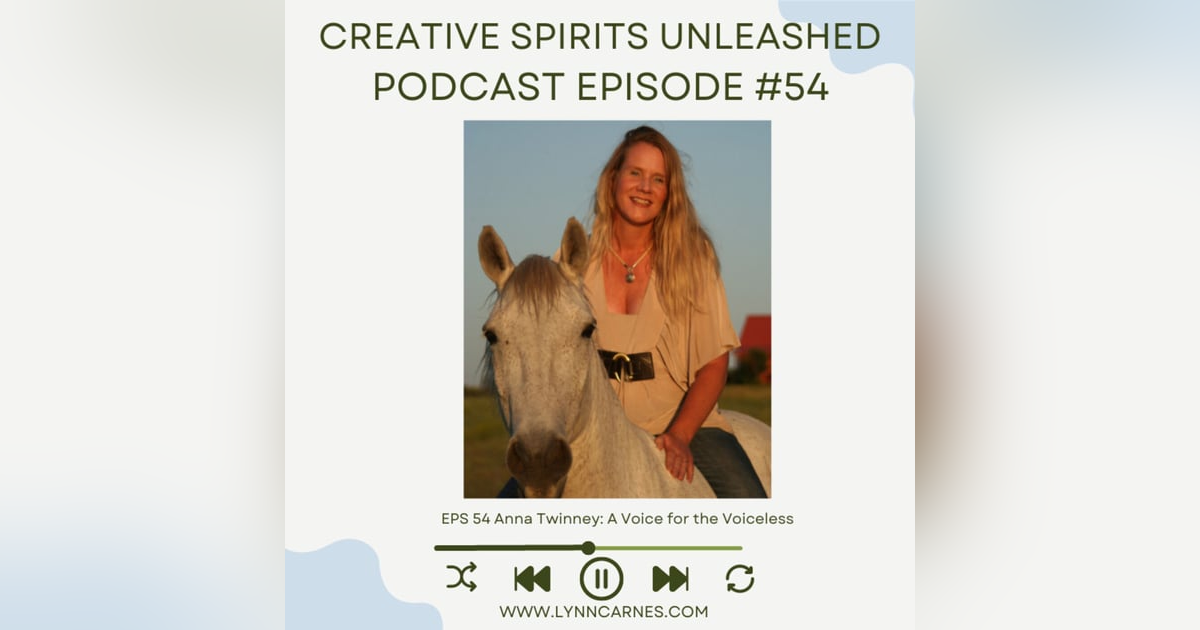


My guest for the latest Creative Spirits Unleashed Podcast episode is Anna Twinney. We had the rare treat of getting to sit down together over coffee and tea to have an unforgettable conversation. If you have ever wondered if your animal was speaking to you – or if you could speak to your animal - this conversation is for you. Anna has a way of describing animal communication that just makes sense. I had several huge lightbulb moments in the conversation. We talked leadership, balance, the dance between the tangible and the intangible and so much more.
Here is a little bit about Anna:
Following the call of the horse, a blind leap of faith took this horsewoman “across the pond" to become recognized by British Royalty and the US Government as one of the premier professionals in the language of the horse. Anna Twinney is a Natural Horsewoman, Equine Behaviorist, International Clinician, Animal Communicator, Healer, Teacher, Speaker, and Coach. She is best known for her authentic communication and connection to heal the hearts of horses and humans alike.
Before anyone had ever heard of equine coaching or therapy, Anna’s journey began as a lifelong horse enthusiast and British police officer looking for a way to bring healing to victims and her fellow officers through the horse-human connection. Her search brought her to California to become a co-creator and the first head instructor of the famous Monty Roberts International Learning Center (MRILC). Realizing her journey was only beginning, Anna left the MRILC to find her own voice, working with and studying wild and untouched horses.
Creator of Reach Out to Horses®, a comprehensive international equine behavior and training program, Anna has worked with over 10,000 horses and thousands more horse-lovers, professionals, and competitors. From serving military veterans, celebrities, backyard horse owners and Olympic dressage competitors, to shining a light on the plight of the wild horses, nurse foals, tribal mustangs, PMU industry, and supporting the non-profits who fight for them, Anna has worked with and trained horses and people in countless disciplines and industries.
For more than 25 years, her life’s work has taken her to almost every continent; she teaches and trains all over the U.S., the U.K., Europe, Canada, Central America, Australia, New Zealand, Asia, Africa and more. Anna was engaged by the Beijing AQHA as the first featured female demonstrator, she coached the Chinese Endurance team in Mongolia, worked with equine-assisted-learning programs in Singapore, and filmed with the FEI in Morocco (just to name a few highlights) and is a featured presenter on the Equus TV channel.
She is the creator of over a dozen video programs, author of books, and mastermind behind multiple online mentorship programs, and she continues to develop and teach cutting-edge methodologies both online and at her new home, Whispering Feather Farm, in Mill Spring, NC.
Topics:
- Animal communication is not something everybody can do because in on this planet we tend to look for the unseen and the logical. (2:47)
- The mind chatter that gets in the way. (9:19)
- What gives you the strength to be difficult and stay with it? (13:08)
- When you’re meant to be where you’re meant to be. (17:33)
- The language of the horse is silent and silent. (23:17)
- What does it mean to be a “good horse”? (28:00)
- What goes off the rails when you hit the mistake button. (34:05)
- How to deal with incongruence in the round. (41:26)
- How do you tease that out? How do you begin to own that? (45:10)
- The importance of having a knowledge base in animal communication. (51:31)
- Who doesn’t warm up in the saddle? (57:42)
- We are built to be empathetic, caring, and compassionate. (1:04:35)
- Is there a pecking order among the horses? (1:13:03)
- There isn’t one herd leader. (1:17:28)
- How do you get into your body to experience joy? (1:23:17)
- Get your feet on the earth. (1:30:00)
- What is your crystal ball? What is your knowledge? (1:41:38)
- Why we need our structure first -. (1:47:07)
- When you realize it’s not a coincidence, it’s a sign.
Contact and Other Links
Reach Out to Horses®
www.reachouttohorses.com
Equine Specialist, Animal Communicator, Energy Healer, Author & Speaker
Office: (888) 282-0656
Twitter: www.twitter.com/AnnaTwinney
Facebook: www.facebook.com/AnnaTwinneyHolisticHorsemanship
https://www.facebook.com/ACwAnnaTwinney/
Intro:
Welcome to Creative spirits unleashed where we talk about the dilemmas of balancing work and life. And now, here's your host, Lynn Carnes.
Lynn:
Welcome to the creative spirits unleashed Podcast. I'm Lynn Carnes, your host, my guest for this episode is Anna Twinney. Anna is a world renowned horse whisperer and animal communicator. She's also an energy healer. And all of those words, to me bring up the idea of something that would fit in the intangible category, I'm going to say, that's where I started this conversation with her because if you spend time with her, she doesn't seem like somebody who lives off this planet. She's very grounded. She's very practical. And she's very, I would call it evidence based. In fact, she used that language in this conversation. So I started by asking her about how does she make the distinction between working in the tangible scene world versus the intangible and unseen world. And she gave me quite a lesson in understanding the difference between impact. And I often think of it as an intent and impact. So she really talked about how we can see our impact on others if we are paying attention. And if there's any theme for this conversation, it is that there's so much more to everything, but especially horses, and I'll call it leadership than meets the eye. I don't want to spoil everything for this conversation, by giving away everything we talked about. But this is a conversation I will listen to many times because we talked about everything from how to develop curiosity, how to be balanced, how to work through different thinking systems within ourselves, and make really major distinctions and understanding different the purpose of different people and horses and so forth. So stick with this one, because I don't think you'll ever be bored. I think you're gonna love this conversation. So please enjoy this conversation with Anna 20. Anna, welcome to the podcast. Thank you, Lynn. So we're actually like having a podcast we're recording. And yet, we're really just two friends sitting here having coffee and talking to you. Because this is really what we've kind of gotten our
Anna:
that's what happened with our rhythm. That's.
Lynn:
And I'm proud of myself for having coffee for you today that would work. But what started art to do today, you had just finished three animal communication sessions this morning. And I'm really curious, I'm coming to your animal communication weekend, march 25, and 26th. But what is really interesting to me and I've been dying to ask you about this is you're a pretty tangible person to me, you're not, you don't present as somebody who's not living on this planet. In other words, you're very grounded. And animal communication is not something everybody can do. Because in on this planet, we tend to look for the unseen, I'm sorry for the scene, and the tangible, and the logical, and animal communication is unseen, and intangible. And yet, I'm really confident that you're getting real messages from animals like this is not something just made up. So how the heck does that work? And how do you balance those two factors in your own life? And so that's a big question. I'm gonna, I'm gonna, I'm gonna drink my tea and let you answer it
Anna:
in a few directions. Let me take the first one, which would mean a few roads that lead there, that's a good way to tell you. Yeah, so a road that led to the animal communication really interested in the language of the horse. And when you're seeking the true message of the horse, you're only going to see what you're willing to see. And individuals may be willing to look at it to say that there's a herd behavior or herd dynamic. And if that's all that they can see, then all they will notice would be the horses having a herd hierarchy and looking at the behavior amongst that herd. But if you're able to open up to say there's more to it, then perhaps we realize that we begin to expand to know that when we approach an individual, they're reading the body language for sure. Right. So then Looking at you, they know you better than you know yourself to read, how you're approaching. And whether your eyes are on eyes or your eyes are down if you're passive, walking sideways, how fast you're going. So these will be things that people love to hone in on because it will be the tangible. And perhaps we put that under mindful movement or personal development to realize what impact do I have on another, when they see me that beyond that, you've got the energy between the two. And that, I think is a big thing to realize that whenever you enter a room, you'll know if you'd like somebody right away, but you're also understand where that energetic component, how you're being received, what does their thinking, the impact you're having on another. So suddenly, we now expand the horses language, from behavior, her dynamics, mindful movement into something a little bit more, the word would be esoteric, but it's tangible. And the tangible pieces the cause and effect. So if I have Pro, well, usually, I have a cause, meaning I'm bold, and the effect is, particularly wild horses, or those that don't want to be called or have big bubbles, they'll leave and you realize the myths of keeping your eyes on eyes to actually gain a connection. And that would be something from the horse whisperer movie, which would be the eyes or an eye eyes. And it's the, the only thing you'd really want to tweak, because eyes on eyes from a predator to prey would actually mean for them to stand away, or we're going to attack, pay attention or leave, right. So out of respect, we generally drop our eyes, as soon as you've got eye contact. So you're connecting, knowing that you're talking to one another, you drop your eyes. But it becomes tangible, the intangible becomes tangible, the way we package it. And when you begin to use language that individuals understand to go, but what if you meet somebody and you feel like you've known them your whole life? Well, that could be an energetic exchange, you haven't had the verbal exchange to know if you get along with them, or their work choices, and so on, or their background history, it's only that energy, and we're not judging them necessarily out of their appearance, or even how they move. It's more about that energetic exchange. So suddenly, that becomes a little bit more tangible in apprentices. Because, of course, it's not something we can hold on to, but we can notice the cause and effect. So it's a big impact. And that's the impact, right? Okay. And so for me, that would have been the first step for having gone from learning their language, ringing in her dynamics, bringing in psychology of the horse, bringing in physiology of the horse, and then my own awareness. Now you go one step deeper to go, okay, everything's in place for these individuals just to succeed if you're, you're teaching, and you realize their movements are correct their language and behaviors correct. So what is affecting the source outside of what we're seeing, and you start to make the intangible tangible through cause and effect, go one step deeper. I was coined as the animal communicator, the real deal, because I'd always look for evidence. And so the evidence for me is, is exactly that. We don't all go out there claiming and putting a shingle out or, or looking at everything is animal communication. But instead, it's important to a degree to define the fact that movement, it's a form of animal communication, interaction in a knowing knowing that because you live with them, it's all communication. But the animal communication that we're referencing here would be a telepathic form. And within tele telepathy Now, not every thing is animal communication, because we have so many thoughts that are going around in our head anyway, we have to discern and decipher what is our mind chatter versus animal communication. And that's where the validations come in, which make it more comprehensible for people. And that would be my first stepping stone to go, you know, on how we define this would be understanding the truth behind it, which gets validated. Well,
Lynn:
okay, well, right. That's amazing. But the chatter, I want to I want to dive in on that for just a second. Because one of the things I've been working on a lot for myself, is recognizing that that mind chatter isn't even necessarily mine, but it's my programming. Okay, so my human programming from childhood from the society, from what people kind of want you to think. Right? And I was just listening to a study. Are you familiar with the Solomon Asch study Does that ring a bell? He did a study in the 50s where they put eight people in a room and seven were in on it with him. They were in on the joke. One person was the subject, they had three lines that were supposed to be compared to a reference line. And it was a very simple task. And everybody that looked at it could see that answer C was the line that was most like the reference line. So what he did once he validated that everybody would easily see which one is which it's obvious right answer, then what he did was when he gave the cue to the his cohorts, they would start answering a letter A, which is obviously wrong. But the subject was the eighth out of the gate to go. So the question was, would they go with the crowd, ie the mind chatter, I've got to fit in, I want to be a pleaser, I don't wanna look stupid, whatever? Or would they go with the other? Yeah, like what they could see with their own eyes. And what they found was initially more than 50% with the crowd, and then with a little pushback, a third of them would, at the end of the day, they just hold on and go on going with the crowd, because I can't stand to be left out, or I can't stand to be seen as off or weird or peculiar. So that's just one sample or example of the way our mind chatter can get in the way. How do you that's a long quiet way to get to the question
Anna:
pick up on that thread, which is fascinating to me. And if then was here, my husband, he'd always say, You're different or, or I'll always come back with I have this natural sense of respect or responsibility, duty commitment, and you said, Yeah, but you're not like the norm. And it would always guess they're not like you. And it's always been really difficult for me to actually comprehend and understand. Because, because when he says it all the time, he just go, but you're different. And when you live inside of me, you wish and hope that everybody's the same. Same mindfulness, the same commitment and dedication. And the more stories you begin to tell, you realize that not everybody is the same. And yeah, you find the people that are like minded or have lived similar journeys. And so with that in mind, my memory goes back to about the age of six. And it was when I was six, that I didn't fit in the norm. And I started questioning the schooling system. And I would question what the teachers were teaching at that age. And for me,
Lynn:
it was in so you were answering see, when you were six years old, you see
Anna:
a piece of we'd moved to Germany when I was five, by the time I was six, you go to kindergarten, and then is that age ish, that I remember, they would teach something and I would challenge question, and I never saw it as disrespectful. I always saw it as inquisitive and curious and wanting to answer and being the sponge, as well and also truth. So for example, if it was something to do with PE, and they would say, but you have to do it, I might ask why, why would I need to do that? Or that doesn't seem right, because the temperatures are cold, or this doesn't seem right, because that individual isn't talented to do that, could we put them somewhere else. So it is constantly this curiosity and this care. And I remember that since I was little, where that questioning never altered. And I ended up going in fields that would always be seeking the truth. And the field I was in was in London, and I was in investment banking for for a very short period of time, that supporting supporting truth as a compliance officer. Then I supported Troost, as a law enforcement officer, and then I've supported it with the SPCA, and moving forward all in the language of the horse. So what has driven me is to look at it to go but where's the why? Why are we doing this? Why is the horse doing that? Why do we know this is true? These these are all my questions to go. It doesn't serve any animal. When we make this up, it does a disservice. And on top of that, that individuals could suffer more. So if we made this up and we didn't have proof, we're harming animals, we're hurting them and we're not helping them right. So that piece of not following the norm gave me an image when I was little and it can be quite hurtful. When family members question you or go oh, she's always been disruptive. She's always been difficult but
Lynn:
she's lawmaker or black. She has always
Anna:
been difficult. And I always thought No, I've not now it hurts like anybody else being an empath, but it never stopped me.
Lynn:
So that's the fear I think most people have when they, especially if they're sensitive, as you call it empathic is the feeling of being shunned. And I think there's a really good chance that I went the other way. Because I didn't really have whatever it took to stay with what you use, use the language curiosity and care, right. And I've spent the last I don't even know 20 years trying to bring back my curiosity to bring back my sensitivity to bring back my willingness to look beyond the really obvious to feel again, and I've shared this with so many I mean, I, I think I share this with a lot of people who got shut down or let themselves go with the crowd. Yeah, so what do you think gave you the strength to be difficult and stay with it?
Anna:
It's not all from within sight. And people often believe it is. It's an it's not. And I was pushed on a path to follow the call of the horse and, and I get praised and applauded for it. And, and the truth is, I was pushed, and given the wings to fly. And I tried to hinder it, and try to stop it. I believe my place was standing by my husband then. And in the eyes of God, I was married. And so to be able to put that behind me was a big thing. And and I felt compelled to keep it going no matter what. And there was a larger force at stake, so much so that my then husband packed up the house and said, you belong in California, you don't belong here, but I can come with you. So the strengths came from him, he was guided to do that.
Lynn:
So so whatever guided you how would you describe the force was with it? Is that what you would call God?
Anna:
Yeah, I'd say God, I think, for me, it's God. We could say spirit. And often people reference the universe. But I believe it's, it's that God's force, that was a guiding force to say, this is where you're meant to go. And then everything happened for that path to lead there to go, Okay, you're going to suffer from PTSD, you're going to have a head on car accident, so so that you need the physical rehab, your horse is going to guide you here. We're going to create every path that you go with it. But the loyalty within me, took over everything else to go, here's the loyalty to stay. So it needed the partner to push
Lynn:
even all those things. Those dominoes were falling, and you're like, No, no, no, because this is my job as his wife, I love him. I'm loyal to him. It doesn't sound like you were doing it out of programming or obligation, but out of sheer love, care and
Anna:
care and love, and, and his guidance was just everywhere because you're meant to be and he came out to California and he basically saw the the piece on my face, which was you've never been so pleased. This is where you belong, and you're not able to make that leap of faith. But I'm able to push you to fly. It wasn't the only time it happened. I did the same a few years later, at Montes, so loyal to Monty, so loyal to the mission to go I don't need to shine that much. He's trailblazing and I'll hold the fort
Lynn:
here. Right. And so this is Monty Roberts, ya know, as a trainer, okay. Yeah. And we pass
Anna:
it as briefing because because his book had come out that the school didn't exist, and there are a number of acts, but he had his fame. He had famous people flying in with helicopters, their farm was buzzing.
Lynn:
And the Queen Elizabeth, Queen of Queen Elizabeth trainer, I mean that that's kind of like the ultimate of the ultimate endorsement.
Anna:
He got it all he opened the door to hundreds of 1000s to be able to run the school in his name, huge privilege. And, and I thought that was my story. And I thought that was the dream to go, Okay, this is where you're meant to be. You're meant to create it, you're meant to run it. You're meant to hold the full force. You're meant to be the buffer sometimes in between. And here's a great landing spot. But destiny had a different path. And I went, No, this is where I belong. Until that came crashing down. There were many signs there were signs on the retina hard and fast. You've you've got what you need in those days aid. I didn't know. I didn't know that the past meant you're learning you're experiencing. You're gathering and the dream will evolve. You know, I didn't know that. Well
Lynn:
what I'm okay. So what I'm hearing which is very heartening to me, is that you still could have red flags and missed them. Yeah. Because of the bigger purpose or the thinking that language you said I think was I thought this was the story, as opposed to this is a chapter of the story. Right? And I wonder how many times I've gotten stuck myself when it's like, I think this is the story, right? And then I then when it starts crashing down for whatever reason, and things just crash, like jobs crashed, friendships, crash, relationships, crash, whatever, you start looking and going, both sides have been there. But because this higher thing was there I am see it.
Anna:
And it's hard. I've always said if the book was written, it would be a million dollar best seller for the fact that when is it an obstacle that we've got to gain the knowledge and overcome? And when is it a boulder that were meant to go a different path that truly isn't written. And even if you check in with the guidance, there's been many places in the world that I've been called to go. And you get there. And it really feels really uncomfy. Yeah, and I've had an intuitive hit to go this is this is going to be horrible. Honestly, there's going to be horrible. You go. So why am I here, then, because you're learning what you have to learn? Well, you're learning but you're also providing us this piece of Oh, give and take. There you are, with that valid push and pull to go, Yes, I'm learning to get a thicker skin in effect, or I'm learning not to be abused in the location I'm at. But at the same time, I'm providing a higher service to give them the piece that they need.
Lynn:
So them being the horses or Panda people. Yeah,
Anna:
that became a huge learning curve for the people there. She was one of the top leaders in Germany and coaching, who's who she? Location, I was at one of the top leaders and coaching, okay, and they happen to have a very strong lineage of like, live coaching with the horses, but they wanted to have more to their repertoire. So I'm walking, going, Why am I here? And they're already the top in the country. Yeah. And then you realize they're going through the motion. They don't have the horses language they've learned to system but they're applying to the leadership coaching. And the truth was, they were being drawn to do more. So here's somebody coming in with the language of the horse to go, well, actually, you don't need to take a stick and whack it on the horse's ass to get a result. What about you communicating? And so you're bringing in the next level of communication that disrupted and exposed to their marriage in doing so. And suddenly she's being exposed to the audience and doesn't like it. And so here's another influence that came in to go well, actually, the language is silent. You don't need to whack a horse. Yeah, actually, the horse is saying this to you. And you suddenly bring another layer and in her case, it was an exposure so it didn't feel comfy to me. Did I feel personally I needed to be there no, absolutely not. And in the realization would be what now you're of service you're of service to the higher good that the horses to go you know what you're teaching leadership and you're you're really mildly of losing reusing in horses at this point in time whacking them on the ass stick until they comply? Yeah, it's not natural horsemanship. And it's not, it's not necessary. Well, and
Lynn:
if you say you will, there's so many places I want to go. But the first one I want to go because it's right there is you said, the language of the horse is silent. And as I have been on this journey, when I after I had my accident and got back on the horse and started teaching, working with different people to understand that they actually can read our minds. Yeah. And when I started playing with the idea of being really clear with a picture in my mind of what I was looking for, then and realizing that the horse could catch that, like, it actually happened yesterday, when I went out for my, for my lesson, she was gonna go catch the horse, and I said, I'm happy to go catch the horse. And she said, Well, she goes, Yeah, but it's my job. And I said, I think the ride starts the minute I catch her, I'd really like to, you know, and I told her at my original lessons when I would work with Elaine Brown, who is in my book a lot. She had six horses in a ginormous paddock. And sometimes my whole lesson would be, can you catch the horse? Right? Because my energy wasn't right or whatever. Well, yesterday, I just went down with a very I had the halter my hands. So there's a picture but I had a really clear picture. And she was at the far end of the pasture and she came right up to me, she paused and then I said, Okay, and so we just walked on no halter yet. And then before we got right before we got to the gate, before we got to the other horse that was standing at the gate, she stopped again, and was like okay, are you gonna go in but the halter on or what? Yeah. And then I put the halter on, but to me it some of it was she knows that right? There's a path pattern. But she's also like, not used to the student coming to pick her up. I just My first time to catch her and I feel like it's because I had a really clear picture, Hey, you want to go play?
Anna:
Yeah, there's your key to it. Because often people will have a perception that keep the picture of what you want. And that creates a superficial level of animal communication. Because then it's them and asked if I hold a picture I ask or tell and they do. And often that happens when people start learning animal communication, it's, it's about holding the clarity. But it goes way beyond that, because you're gonna have to hold an emotion to so your thought is yours alone, until you hold an emotion of love. Okay, there's really your key, right? Right. So not every animal will tune into your mind, with your 1000s of thoughts per day,
Lynn:
without the feeling part because it's the emotion that has a feeling it's the emotion that is
Anna:
the conduit, because it wouldn't be really disconcerting sometimes, to think that every animal is following every thought that you have.
Lynn:
Oh, no, if it's the thought chatter, like you're talking about that would be awful. Right? It'd be like that movie when Mel Gibson was in it, what did women why did you see that?
Anna:
Turn it off. So your your emotion is what transfers it and an emotion of want or need or desperation or worry, may or may not do that. And I say may or may not because it's got to have a vibration of love behind it, right? So worry could have love behind it. But your
Lynn:
your mother's worry certainly had luck, right? She has a lot of words that they
Anna:
might access that anyway. So it would just be the body language, if I see somebody who's worried. And so therefore, I either want to console I want to leave it would be the fact that they could pick up on the picture, when there's the conduit involved, right? But here's the next piece, if of all the animals or the horses have been brought up with telepathy, knowing that that's how it is. Well, the scales go like this for humans. And that means the human might go well, I held the picture, but she left that she doesn't want the food's true. She doesn't want it. But what did we do to create value? And in your case, you brought that to the table. So if you only had I want to catch you because I want to go riding, they might go nope, that's not how
Lynn:
that would have been about me. And this was the other lesson that horses have been teaching me is that there is a given a take. And, and I'm coming from, you know, I was an investment banker and worked in that kind of field where it was a very much dominance based leadership system. We call it command and control. You know, I make a command, I'm in control, you do what I say was, and the best compliment you could get at the bank I was at out was you've done everything we've asked of you. Which I'm like, Well, what nice completely well, but you are, you do that. But I used to take that as a big compliment. And what the horses have had began to teach me is we are equals in our own way, and that there's a give and take and a balance. So yeah, that
Anna:
very statement then, is if you look at it today, when somebody says they're a good horse, and you start to break it down, what's a good horse mean a complaint?
Lynn:
A lot of times that's true.
Anna:
How many people say oh, he's a good horse, when he's not wanting to be caught or not doing what they ask they don't they go bad, disobedient.
Lynn:
Oh, yeah, they've had all this judgment words, these human eyes on him as opposed to going I wonder why he's over there. I wonder why he's feeling so hurt off. So
Anna:
good horse for us, is a car kind, honest, transparent horse, that's a good horse, and everything else doesn't fall in there. So it's, it's fascinating to look at the horses that survive in our world are the ones that are compliant. The ones with their own voice don't. And this is actually where we go into all rescue when I've done the full rescue from the Warm Springs actually, they're all springs Mustangs, the tribe have given us the the false that they've cold that they felt were less intelligent. Well, it happens to be that all of them have multiple swirls. Kalex on the forehead, two to three swells, which is indicative of highly intelligent horses. Okay, you put that together with a statement? It would mean what they're defining as intelligent is compliant. Yes, what I define as intelligent is a horse with his own mind. So, so that own mind we can shift right and we can rein in and we can create partnership, but just because they have their own voice doesn't mean that lacking and this is where the telepathic piece comes in.
Lynn:
Okay, that's also I'm gonna go back to what you said about school because I it's fairly recent discovery online. Why did I miss this? Because you said you had questions school, and I was listening to Seth Godin has a podcast and I think it's called Stop stealing dreams. But his core question is, what is school For. And the question behind the question was, let's be clear, our education system was not defined to create intelligent people. It was defined to create compliant people who would sit still for eight hours in a classroom and work in the factories instead of being independent and living off the land like they did before as farmers. And when you know that little bit of background, you go, Okay, we have been stolen. They didn't just steal our dreams, they tried to steal our character, they tried to steal who we are. And in a way you're saying that's the same thing that's been done.
Anna:
And I know it's that question often people go, what do you believe? And I shifted it now you know, for 10 years, I might have believed that horses speak silent and believe that it's telepathy. Yeah, I now say I know it's moved. I know I've talked to so many animals trained so many Mustangs, you're looking at 1020 30,000 that have come through so at what point did it become knowledge Well, it's knowledge now. And so what that means is I know they've stolen the horses character they've wanting to to have in our way or the highway they want to mold them and so with that if you look at a lot of breaking that's what's called breaking
Lynn:
break. You said good records. I was like I heard dead broke was all you have is the highest compliment for what it is dead broke. Think about those two words.
Anna:
We've we break this. We Hume humans, break the spirits. So then, everything began to shift and not with natural horsemanship, natural horsemanship came in dominant. And the the primary linear lineage the first one Monty Roberts, Pat Burley, John Lyons about Brennaman all of them dominant base. So And what you also see with that lineage is that the nature of the horse was used against them, not for them. Yeah, look at all of it. So when their horse is wrong, and you reprimand you back them after no horse backs up in nature. And if they are, they're going to kick the shit out of another, really, but they don't back up otherwise. So we as people use that against them to go okay, back them up in Arena length, back them up this, so it wasn't used for the horse, it was used against the horse, and you could start looking at all distinct moments work versus rest and discomfort versus comfort. All of the nature of the horse was used against them. So now flip it next generation. That's me, I looked at Indigo and questioned it badly. And when that doesn't feel right anymore, might have felt right to jump from tradition to there. Yeah. And suddenly you look at that to go, that doesn't feel right. We're saying it's not dominant, but it is we're influencing the horse's feet, which is their form of escape and expression. So could we do it yet again, another way? And could we improve, make it more subtle, make it softer, make it more silent? And the more you question and query which we are not designed to do, and we're discouraged to do that, the more we can find out the animal's language. And the horses language is predominantly silent. And we like what the eye sees, which is nature. But you go beyond that. And you're here that they can speak. And that's then unique to individuals. That's the next key. So So what is horse is an individual? Well, everything here because you are so instead, this is what makes it complicated. For people. It's not complicated. But they get hung up on this, because I really like systems. And so the reason one of the many reasons some of these horsemen were so successful, because it's a system. Sure what would happen again, is we would bring people into this little funnel system to go all right, well, here's seven steps to doing the horse will be perfect. Yeah. And it was a system. It's far harder to tell somebody, there's 28 personalities in horses. Let's create 28 ways to get there. Yeah, people don't want that. It's too much effort and work. Now also, if we turn around and go, actually, that horse is this way because of you. Oh, we have to change you. Oh, that was too much work.
Lynn:
That's what goes off the rails because I believe our conditioning created I have my shortcut for it is the mistake. But okay. But the mistake button, you hit that button and you get all kinds of wacky behaviors from people you get defensiveness, you get shaken, you get fear, you get trying to look good. And that's my favorite game. You know, I've got this was my game, you hit my mistake button. I'm going to show you I've got this and what I start doing, when I do my corporate I've got this is I'm trying really hard not to let you see how I feel. Which means that I've got a lot of energy being bottled up. You put that in the presence of a horse, and I did one day and you know, we were in the middle of the round pen and the horse started running and kicking and bucking because what could be more scary than somebody trying to cover up how they really feel and how they really feel is intense and scary. So yeah, when you tell people that they're the problem, if you hit their mistake button, right And then they almost can't I had to read be like, this is the work I did with Bruce to rewire my brain to be able to show up with that curiosity and care to say, what is the horse trying to tell me here? It has nothing to do with me because I'm taking it so personally,
Anna:
yeah. And even even this, right, so. So if we have a wholesome human, the majority of time it is the human, but at the same time, this horse can carry the baggage as well. And so now we're peeling away another layer to go, when is it me? And when is it the horse? And while we're responsible for how we respond, so that's where we come in? Maybe we didn't cause it. And so at this point in time, we check in with us, am I at fault? Did I do something could shape shift that a bit? Well, now I know it's not me, it's them. And now it's about how I respond to them, right. And it comes back to how many people really want the work, they don't they want to say, he's biting me, I'm going to put my elbow or punch him in the face bite is here, use a pen, whatever they're going to do, which is on many of these chats to come back with. This is the list of things to do instead of looking at maybe he was asking for your attention. He was nibbling your clothes because he wanted to say hi. And he got punched in the face. Yeah. And so there's not only are we looking at is it you or me? We're then looking at what are they trying to say? And why? How do we fix it? And now your repertoire has to expand from here seven steps to here's 28 personalities, here's the history of the horse. Here's self development for me. And here's the litany of how we could
Lynn:
resolve it. permutations are so high and
Anna:
they don't normally want that they want the Can't you just tell me that he was wrong? And he's not allowed to stand in my space? No, I can't. Because he should be able to stand just here. If he wants affection, and he should be able to ask for it. And that's the other thing. How are these horses meant to ask? How can they say, Hey, can I touch you? Yeah. Hey, I'd like you to share breasts. Hey, I'm bored standing here. And it gets us thinking to go How many times have we always just made it about us and we're going to get on your back. We're going to right we're going to tell you to go left right for back. So I actually had a client the other day, huge animal communication session. And the question was, why did she misbehave on this ride? Where she misbehaved on this ride because she's used to going out just with you as a rider. Riding on the buckle, enjoying nature at its best. You're both going on a beautiful hike on a walk, exploring delving in appreciating and on this ride, you're with other friends and you're telling her to stay on the trail and she's lost the freedom and she's got complete control. So she's retaliating. That's not horsemanship, right horsemanship would be tell us to stay on the trail, make it uncomfortable off the trail, hold her back a bit, control her foot forward. It's not the answer to go. She doesn't understand why she can't have her voice over here when she always has it over here. And it doesn't mean she's not capable of understanding injuries. She's bought enough. But she doesn't understand the difference. Yeah. So she got mad and she barked. Yeah, doesn't make her a bad horse. But the human brain if you're not open enough to, to process that or comprehend it or allow for her to have a voice. Yeah. Or allow for a voice because she was
Lynn:
just expressing this is how I feel about doing and we always do it right. Like if you've take a child out to do the same thing, but they can go Hey, Mommy, why do I have to be good in the restaurant? But I don't have to do this at home. Yeah.
Anna:
And nobody takes the time. Because we're not brought up or raised to talk to them. And sometimes this is the fascinating one because I've always looked at myself here to go. Why would I was thinking about it the other day, there's a new horse coming on the property and I thought I'll take the time to talk to her. Here's the issue with just verbalizing you don't know if they've received it. She's like I was just telling
Lynn:
you want some evidence that they actually
Anna:
heard you? Well, because your voice and your thoughts may not transfer. So when I do animal communication, fingers to my ears and I shot Okay, you go your hands like this, and I drown out noises. But I'm also so committed. I know that I can just watch and nothing. Interrupts right when I shut my eyes because I'm seeing in pictures. I'm sensing in my body sensing emotions. I'm totally 100% there to go. This is all you not me. So therefore if I were to welcome this horse in and just say, you know, I'm sorry, you've lost your previous location and it was mighty nice and this isn't quite to your standards. I don't know if I'm sure speaking, if I shut my eyes and close my ears and feel my heart and allow my heart to expand, and to receive and reciprocate, then I know she can hear me. So while is a whole, they're going to understand you verbally, just like that. The piece you won't know if they've received it. And so therefore creating that space of telepathic communication, which means not moving at the time, sitting down quietly, then you know they're receiving because because the other piece is, your mind could be asking one thing and your body could be asking another. And this is what happens on horsemanship clinics, let's say we're doing liberty, yeah, your eyes and eyes are asking a horse to move shoulder square, or driving a horse being in the driving zone is asking them to move. Let's say they're going counterclockwise. Left hand is influencing the nose, right hand the horn shares. So the body is saying one thing, if I was asking for a transition up, I might get a little bowl opening the chest, raising the chin. But let's say in my head, I'm asking for a transition. And I happen to drop my chin. Yeah, go small. Now that poor horse has a conflict. That's right, which one? Do I listen to the mind or the body? And this is where you're taking natural horsemanship to the next level, which is ownership in your thoughts to realize I'm not creating clashing and conflict, because my thoughts are in alignment to my body.
Lynn:
Well, I've had that very thing in the round pen and trying to like, ask the horse to canter knowing that, by the way, I'm going to be on his back afterwards. Yeah. And I'm not a very experienced person in the transition. And that upward transition takes a minute to go, am I balanced or not? You know, so I've had to really work on that. And so I'm sure that there's this incongruence because my body might be saying go and my brain is going Oh, shit, OSHA OSHA. Right. It's an incongruence. And I think, I think I know, I've experienced that horses really tune in to any kind of incongruence, even if the two in congruence is are not necessarily bad, but they're just different. Yeah. Right? Because it just means it's not a match. And then a match has to be resolved in their mind, or they have to take what they've also got to
Anna:
actually push through it, right? So in incongruency, could mean let's stick with you. If your mind is saying I'm a little worried about that cost PTS, the past memories, whatever. They've got to look at which one is the authentic 1am I listening to the body? Is that authentic? Or is the mind authentic? So in effect, they're trying out different aspects. So that's one version. The other version is you're going to have helpful horses that go, I see you really want to counter your mind stopping you. But I'll give it to you anyway. Yeah. And then there's going to be other helpful horses going. I see you want to counter but the truth is underneath, you're too frightened. So I help you not to. Yeah. So and often, you know, in my younger days, two people would go with them, spurred them, she's not doing what you're asking she is doing, because
Lynn:
this is what I have learned. Yeah, she is a beautiful thing. Because when it got congruent, then yeah, then it works. But when it took a while for me to recognize it, because I was out there all by myself, like I didn't have an instructor. It's hard. So I don't I don't have anybody to say, hey, you know, you're doing one thing and another. And actually, yesterday, when we were doing my lesson, she was working with me to do more of a square turn. So moving the shoulder Oh, yeah. But I unconsciously was asking for more of the rear turret and she finally looked at me because she said, and you know, she's not, she's not doing it. And she goes, Oh, she's doing exactly what you're asking. So immediately, I told Annie, she's good, right? This is the horse. And then she said, alright, but now we've, you know, this is what we need her to do. And I said, How about we give her a break and do something else? And then come back? Because I said, right now she thinks she's giving you the answer. And no matter what I do, I think she's going to try to help me.
Anna:
Yeah, exactly. And that's when you get the character of the horse down more to realize, this one is so honest, and she's trying to help us versus another one could get confused, and then they get upset. And then, you know, I'm making it really complicated right now. But then you've got all of this piece to go. When are they getting confused? Because it's them? When are they getting confused? Because it's us? When are they getting confused with the situation? And the more you care, the more you peel away those layers and
Lynn:
if you will, okay. I mean, if you will, because I think sometimes the more you care, the more you beat yourself up, right? I've seen this happen and I and I'm going into like, I just had a flash, because we talked about leadership a little bit and I'm thinking about our human relationships. And I'm thinking about, you know, you're in a meeting and it could be, you know, when I'm teaching a class or it could be when I'm in a meeting with people, but I'm having that moment where someone that for example, this happened happens a lot. They're presenting a smile, but I'm not feeling a smile. Yeah. Right. They're trying to do that I've got this space with me. And there's some I know there's something off, but I don't know what to do with it. And then it's like, is it me? Is it them? Is it the situation? Is it the pressure of the situation? Right? How do I like begin to tease that out. And until I began to own, that, I don't have to take any of this personally, as much as my beating myself up, type wants to play. It's an old rule, right? This is, you know, our society, I think revers the person that beats themselves up, right? You see athletes do it, you know, they throw their, their golf club, or they, you know, whip the horse too hard, whatever. And it becomes a, I've heard the language, they beat themselves up to the other person, meaning again, like I'm thinking about the woman that was at the Olympics, that changed all of the decathlon, because she was like, beating up on that horse. And I'm looking at her going, Okay, you just feel so bad about yourself is so ashamed that you can't make this horse make this horse do what you want to do in front of everyone. So I'm just thinking about the work of leadership as well, and how often we are under leaders who are incongruent. And then we're trying to make up that difference. Okay, what do they really mean? And do they really want this or that? And it to me, horses are beautiful at helping us find that because they don't have a title and they don't have our paycheck, unless we're professional.
Anna:
Yeah, no, I hear you. And I, that that is the journey, right? That's the journey, because every day is different. And there's so many outside factors, when we're around these individuals that sometimes it's easy, if all you've got is a relationship where you're visiting a rescue horse, I'm going to feed you and pamper you, those questions may not be there. But when you're in performance, there's many outside factors that aren't taken into account. weather changes, environmental changes, sounds. Oh, yeah, horses that are calm have gone and, and most most are looking at the simple ways of what am I what am I doing the cause and effect, which brings us full circle here, with your opening question with the animal communication. When I first began the career, and to this day, all of that evidence is very important to me. If we don't get it, we don't know if we're honestly communicating and connecting better when we get that evidence. So it could be a year two or three in somebody's career when they started animal communication, you need that validation. And that there's a piece that is the going quiet, to learn it to learn to listen, then there becomes the dialogue between you and the animal. And then it's about so you're discerning, so you've got discernment, and you've got dialogue, and then you've got delivery. So the discernment might mean that you learn one to two years, you learn your language, just like a toddler actually takes three to four years to learn to speak them. But they learn to speak. So you learn your language. And unlike this verbal one that we speak, which is by tongue, you could have 12 ways that you're figuring it out. I'll explain that it could come through in a movie in a knowing taste, sound words written words that you hear like sentences. It could be colors, dream state, I'm glad you said dream clothes, mythical, mythical scimitar signs, it could be automatic speech, automatic movement, automatic writing. As you develop the language, you get more and more anyway. So for example, on a clinic situation, we're uncovering how it comes through for people. And they usually have three right from the get go. And they might say, Well, I see in pictures, I have an intuitive hit. And I have emotions. There's your three. If you continue massaging that muscle that expands over the years. And you'll have the more when you get a word that comes to you got to learn what that word means. And it could have something to do with the past the present time, or the future. So you're feeling that out. You're also feeling the expansion. So if an animal gave you the word noble, it wouldn't necessarily mean he sees himself as noble. So you've got to look at what is he referencing the past the present or the future? Is he referencing himself or another or his person? And that is through the sense. So the language now takes a while to learn for you to go. Okay, I need to know what it means when it's capital letters or when it's flashing or when I hear it silently or which angle the thought comes in at because the thoughts can come in at different angles. Now amongst all of that, if I've got multiple thoughts coming in at the same time, what Where did the animal communication come in from? Because you might find a pattern to go or when the animals talk it comes in from this way. might be, you know, if you notice your thoughts flying in, if you do, you'll notice where they come in for the animals if
Lynn:
I thought I was the only one that
Anna:
noticed a direction, thanks. It's really for me. And so this is the thing it's important for another day might go get up. It's just animal communication. No, because in the last week alone, three community communications three times I've connected with animals, it's been we need to euthanize this horse, unless you speak to them and find out so this isn't something little. And that reason I need to identify where that thoughts coming in from. Because I'm a horse whisperer, I have worked 10,000 horses. If I hear that horses backing, and we've got to use an item, I'm going to come up with all the answers why he's bucking, because that's my wealth of knowledge. And that's my job. So therefore, if I don't notice where it comes in on, I don't know, is that me coming up with the reasoning? Or is it because
Lynn:
I have 10,000 Horses worth of experience? Because the in my logic brands, this is this saddle fit chiropractic boobs as you're getting upset? Because they're on the wrong path? Or what? Yeah, there's my list. But I actually need to know is this whole? Yeah.
Anna:
And then there's and that's all valid. You never want to negate that because you're on that path for a reason. It's the chapter, right? So the chapter, Monty Roberts, huge chapter, I got recognized as the top 5%. In my profession, I was endorsed by the Queen of England. I'm top right. So I've now got my knowledge base. Take that into animal communication. You don't push that away. You have to bring it in, because you've got a knowledge base, right. So now you move in here to go. I can help that horse was my knowledge, but I have to discern what's me and what's him. In his case, he showed the buck, let's stick with that story. And, you know, when I'm when I can see the fiction,
Lynn:
watching, you're so cool.
Anna:
I nearly swore that were the effing buck. Yeah, I see the news that Oh, my God, you know, I saw that back. And I remember going, Fuck, yeah, he meant it. So the point is, it was it was from dialing out, it was catapulting out, nobody would sit this. And so then I'm able to describe it to go shit, there was a couple of strides he cut apart, it's like an ejection button. But you weren't gonna sit it. Now we've identified the buck. And then I can say to the client, is that the buck you're referencing? Because of course, if you say back, there could have been 100 bucks that he's done. Oh, yeah. How does he know which one to pull out? So he shows it to go, I think she's referencing this. I describe it client can come back with that 6x
Lynn:
One. And now you have the horse telling you it was this answer? And the human telling you it was this incident.
Anna:
And now I can marry your match. Because I've got the when When did it happen? I've got the when I can tell you, it's outside. I've got theory and I can tell you the surroundings. And he's relaying this one. So now he might come back with all that's the back and you go well, you meant it. You wanted to do this. Okay. So what's the circumstance? So he came back with and he probably flipped the conversation to when I'm in frame and have to concentrate and I'm going in frame. Okay. So now I know the terminology, etcetera. I can also even if he gives me the reason not negate the other 15 reasons, right, because I want to investigate that. And that's important to me, because if he simply gives me one, we haven't looked at three to four other that
Lynn:
could be contributing to ensure I'll get his lifestyle to
Anna:
go well, he lives inside. He gets turnout, but he's in his own paddock. The turnout I would judge as a small one. He can get a canter striding but it's not very big. These are the quantity of hours his outside this is where he lives otherwise. And he is five going on to ah so now as a horse we're sprite look at that to go wow, they're trying to bring him along quite far. And actually, He's immature physically, he's a Warmblood totally mature, physically, his bloodline is that that he's going to be successful in jumping mentally. He looks like he's coming far because he's bloody smart. But underneath that he's young at heart. And it's a lot to ask. So we've got this picture, which could cause the buck didn't could but then if he stayed on that path, we've classified as over face some point is going to exploit that to be able to say, Hold on a minute, could we back up a bit, his groundwork included nothing. So I'm looking at that from me. to then be able to discern to go if you were mine, I would do a little bit more here. He's not complaining. He knows no different. He's happy with the training as it is that if it were me, I'd be looking at that. Now we've got the saddle fits, we've got the rider really cool. And his explanation was, my rider is influenced by another instructor. She's following the guidance. And she's not going to shift from that. If it were up to her, she would write me differently. He described her as an assistant trainer. She wasn't she was a trainer. But the way he described was assisting because she was following guidance.
Lynn:
Understood. So to him it was a system because of the how
Anna:
many hours it was pulling, pulling the cords, right. And then bottom line, she goes, Well, I understand that piece. But he bucks when you mountain. That's interesting. He'd shown frame, I go back to go, well, you'd show me a frame. But she says at the beginning, his response was a fine lunch so I can see your movie of lunging left. Yeah, he looks beautifully in frame got an incredible stride. He's floating, and I went bloody how he floats for the young horse. And he seems to like it emotionally, mentally, physically, he loves it. And if you do that, he went back. And he went, That's right. So his response was, why don't you just do that every time? Oh, done. So instead of having to pick through, why is this horse barking? Yeah, he answered it. And if you look at it, this horse is on death row. And he's just gone. If they want me up this way, there is no bug, and I will float. And I will do all the things and I brilliant tells you I can do that my mind tells me I can do. So I could say that without getting emotional. Then you look at it to go, Oh, my goodness, he could die. We hadn't had you. He was scheduled two days later to go because because he doesn't fit in the mold. Because he's not the good horse. And the one person that ran me was the one to go, I'd love to take him on. But I'm worried he might do it with me too. And you look at it to go wow, without you love who's going to be euthanized? And how many more we know this 10s of 1000s natural horsemanship won't cut it, what are you going to do move his damn feet? Right? No do the less the saddle fits his lifestyle is incredible. The animal communication that could sift through all of that to go You're right if the answer is right in front of us. But meanwhile, we might have paid 1000s For saddle fitting, right, and massage and chiropractic and all these great things, which are incredible to try to get to the bottom of it when the next level of communication is ask them
Lynn:
and think about, you know, just having as an athlete a warm up, like, what professional athlete Do you know, that doesn't do
Anna:
what I like? I like always like your perspective. Is you go Yeah,
Lynn:
who doesn't warm up? Right? Like his uniform pick, like he sees if he's a football player. And you know, it's funny because people can't see us. But we're both emotional about this horse. Like we both have tears in our eyes, right now thinking about what could have happened. But what a simple request to say, hey, warm me up a little bit. Yeah, right. Let us get on the same page. Yeah.
Anna:
And that was his point. And another might go, Well, I'm warming up in the saddle. You're right, you're warming up in the saddle. However he would like to warm up on see I'm not an advocate of lunging per se. You also know it's not your thought because I never say lunge. I like longlining. But the way he described it, he's long and low. He's striding out. He truly described it as my muscles are warming up. I'm getting my head in the game. I understand that this is a piece of before I do it. The way he presented it lunging was the best thing since sliced bread that you go, you've changed my whole perspective. Isn't that amazing?
Lynn:
But you know, I think about okay, so I'm going to jump back into the people to people thing, because and this is we're here in like lower. This is one of those like little moments where we were interested in the like, and what was going on. And like when we walked into a meeting, and the guy started the meeting by starting in the middle. Right? He we had never been one of these meetings before. It was a small conference room. And it was about the management of the lake. And I think they were just starting boat permits or something. And he just started with the biggest objection to boat permits. And Russ and I are sitting there going, we just come into the middle of the movie. I thought this I mean, it's seven o'clock and the meeting starts at seven. What did we miss? And I'm thinking about your horse, thinking, you know, did we just start in the middle of the meeting? Can I the beginning of the meeting would have been in the boat permit cases. Hey, I'd like to welcome everybody. There's a couple of new people here. Could you say who you Arlen and Ross. Okay, great. This is who we all are. Here's our names real quick. You know, what we're here to talk about today is boat permits. And before we get started, does anybody have anything you want to add to the agenda? And then boom, now we're in. I did that interesting. In seconds, so it doesn't take any time. Right? But now we're all on the same page. And instead of like my mind would be going wait, what are they talking about? And why are they starting it but permits? And who is this guy? Right? Which one is the mayor? And Oh, that guy over there seems to be some other, like, like, volunteer, right? All that chatter is going on in my head because I didn't get that. 15 seconds. Yeah. And it seems to me like your horse is saying, I just need this moment where I can say, Okay, this is how we're talking today. This is how I feel. Because you know, when I'm on the ground, working a horse, it's like, okay, I need to know who I'm dealing with today. What kind of mood are you in? How's everything feeling? Are you still are you not stiff? You know,
Anna:
and naturalism chips got such a bad name now that you couldn't even coin or label it something else, people wouldn't know what you're talking about. So they don't necessarily want it. And also, what happens is when you hear he barks at the mountain block, the first logical thing would be kissing spine actually. And cold backed. Yeah, so people are going to look to go is it a physical issue? That means he's never going to get through a cold back door, kissing spine or saddle fit, right? So your mind jumps to that? That? And this is the beauty too, we can ask him, we can ask him? How do you feel physically? What supports you physically? And instead of sort of speculating, it was kind of neat to look at it. But at the same time, here's another aspect to this. clients often ask, Well, why didn't he come up with such and such? Let's say, why did he say about that physical thing? Let's put it like that. I'll give you a little story on it. So that it is more respective another one in in Denmark, she puts on the form of, can you check in? Is there anything wrong with my house and what's wrong? And when we check in, there was nothing more than a chiropractic adjustment needed to support her. She may never be able to get past a walk, but quite okay to be on a trail. Why it's okay to be semi retired. And she shows this physically to go. I can't jump like I used to, but I can do as I don't. I'm not in pain. And I'm not suffering. I can do this. I get choked up. A beautiful, call it journey. Now. It's not a story, because it's not a story. It's a journey. And it's her opening speech. I feel good about the opening speech, because we've shed light on how she feels emotionally, mentally, physically. The client says, I just wanted you to tell me that she was ready to go, because I can't afford two horses. I've got the second one coming next week and she needs to be euthanized. No. And luckily, I've got a little background, I would have paused and I said I can't give you my blessing on this. Because if that's what you were seeking, she's not giving. She's telling you she's fine, that you could still fight her and all she needs is a bit of help physically. Yeah. So whilst then people only want it their way, either as a commodity situation or a dream situation, if it's not my dream, and I understand the challenge around that if it's not your dream, and I understand the fear, nobody wants to get bucked off, and we can get catapulted that way. There's going to be a big fear. Oh, yeah. Also understand that it's easier to have a system to go if I do this, you do this because it's harder to warm one horse up this way, another lunging another long lining another one ponying another one, letting them hand graze, I get it, it's not easy. And yet it is easy to cause the car. The first client that ran with the bucking horse, she rang because she knew this horse was meant to be with her. How beautiful and I was able to say you picked up that phone, you know he's meant to be you're frightened. He's going to back and you shouldn't be Yeah, so now we've got a way we can pay for it, you know is meant to be that you as a client that wanted my blessing. You knew that she wasn't ready.
Lynn:
Good, because that's why you actually call me it's just nothing. You were hoping beyond hope that I would validate your lesser wish instead of her higher
Anna:
wish. So underneath when they pick up the phone or organize this session, a degree of intuitions hit, and that's come because they're hot spring strings being pulled or then paused enough. and which comes back to all of this with the language of the horse with the body language, that we want to see a piece and we compute and we discern. So we might look at the eye and go, Oh, he's terrified, or he's happy. That's a piece of it. But the other piece is to silence while doing that, and then Feel, feel them. What is that I telling you, you're on the ice saying who's worried, then instead of keep on doing it to these not worried, pause a minute, take a step back and connect. And, and I think, sometimes we don't know how to connect, sometimes we've been encouraged not to. Yeah. Because if we connect, we're feeling too much. Yeah. And if we feel too much, what are we going to do with that horse that we can no longer afford? You know, it's easier not to feel isn't that
Lynn:
that's the thing about being shut down. You know, it's, this, I spent a lot of my life not feeling I mean, literally, physically, like, not feeling to the point. This is how I, this is how I got back in my body. My trick, the only thing I would feel was a debilitating fear of heights. So if I got next to something high, and I would define high in my early days is standing on a table to highlight this, right, I would get a sensation of falling. And so to wake up my system, once I realized I needed to get back in my body and feel, I would actually intentionally do that, and allow myself to feel it instead of freaking the fuck out. Cuz I would freak out like nobody's business, My poor husband. We read, there's a famous story of us on the Statue of Liberty, we're walking up the stairs, and you can see down, you know, through the littlest thing way down there. And he touched me to comfort me. And I think about this when I think about touching a horse to comfort the horse, right? Because he touched me to comfort me. And everybody in the stairwell at the Statue of Liberty, got to hear Lin say to her husband did your hands off. Because the feeling I was already feeling so much. And I was so afraid that it felt like he was going to push me over even though there was no logical way I could fall from there. Yeah, right. That's how intense it was for me to get back in my body. And so now when I'm working with other people, and trying to bring them back into their bodies, which is something I work on a lot, and I'm working on them in shutdown environments, like investment banking, and medical system and stuff, but getting people back in their body is myself back in my body is we've been taught not to feel right. And so you first one of the first hurdles is to say, this nonsense that said, don't bring your true self to the office or to wherever to store this nonsense has to go away. Like we are built to be feeling empathetic, caring beings. And to me, what you're describing is like an entire feeling thinking system within us that you can tap into. Yeah, and that you are teaching people. Yeah.
Anna:
Yes, it's very much so in it all began on on the journey that we started with, is to look at as a law enforcement officer, I was trained not to feel, and so many bricks came up not to feel and you're trying to compartmentalize in order to survive, and it served me. And so these are the pieces to look at to go, it's served me then. And it doesn't serve me now. And so my second point in my life was flagged as a farmer that Montes and that was my decision making to go if you are staying, this was the sentence I said to myself, if you're staying, you need to start feeling. So either you stay or you leave. But if you're staying, you're gonna start feeling. So I was, I think 30 At the time, and that was a pivotal turning point to go, you're going to start feeling and that means everything you're going to start so you from 18, probably younger, but from 18 to 30. You've learned to push emotions down to compartmentalize them to lock them up to create categories. And everything you've learned have served you for survival and had a purpose at the time it no longer does. So you're going to unlearn all of that. And that was the start removing the bricks and the only way to do that was animal communication. So I started to see visions, and that became the next level of the horsemanship and with that the request was right, you're going to drop into your heart and it's not uncommon. It's not difficult to drop into your heart to talk to an animal and drop back out. So then the next level is can you stay there? I'm not or the next one after that. I'm not there where I stay there the whole time for sure. Because I feel like we're being asked to live between the worlds we are being we are being asked to be right And so some minute you're you're entering it, whether there may not even be a veil, and to feel the extraordinary sensations that animal communication has. And then next year, you're surviving COVID, and you're surviving, and not necessarily thriving, an economical breakdown, etc. So there's there is the degree of living between the worlds. But we can and we are being asked to connect to nature by connecting to these horses, we don't have to cannot to complement eyes. And that brings us back to cells. But it brings us back to where they live. And this is a sentence I've always used, which would be there waiting for us to talk to them. I can't even imagine what it's like for 30 years not to be heard. Because all the commands that the majority of people give a command of, Can you slow down? Can you come here? Yeah, that's put a halter on it's take your liberty away. You know, let's feed you now because it suits us. Let's do this. Let's put you with this friend, you'll make friends with this one. Oh, we're moving. It's moving. Everything's on our terms. So they, they've had everything taken away from them. What if we could give them a voice but and, and at least interpret their actions correctly, which would be its next level of horsemanship, and it means stop, stop going into a scientific mind alone. Stop going into a scientific mind alone, which simplifies everything with statements to go, all they want to do is reproduce, and all they want to do is survival. It's not true. They, they have dreams, they have hopes they want them for it. This is
Lynn:
the thing I've noticed, the way we talk about the animals, because they have all
Anna:
of that and it's so interesting to watch people go, Well, I'm looking for this kind of force, so that I can do this. I'm not looking for any kind. I'm looking for the one that wants to walk into my life and I'll take them unconditionally. And not everybody can do that. I get that they work bloody hard in order to get a little in return. But at the same time, understand that you're not trying to put them into what you're mold all the time. This is where natural horsemanship comes in, can they be out as often as possible? Can we not put put shoes on where we can? Can we bring in good dentistry because now we're managing. But above and beyond realize that one hour a week that you're visiting doesn't necessarily fit their schedule? When you ride them? That is not how they move in nature at all. While we speak of it that it is it's not they're not carried to take a human? And what voice and choice are we giving them so you're going to put them in a discipline that they didn't necessarily choose? Could we work with them? When we teach them as an athlete? Perhaps they need to have a year of body awareness before they could do this. Instead of now I do this you do this? We do this? No. What is it they need from me? And that's the sentence what is it I can do for you today? What can I do for you today instead of what I want to get from you today? It all ties in Wow, that's
Lynn:
that give and take and that one of the things I noticed talking to you early on was you talked about horses having a purpose and that horse different horses are meant for different things. And it's not boiled down to that. So what is the simple for natural horsemanship things? It's like food. Slay. Yeah. researchy reproduction like, like those those things? Yeah, it's
Anna:
a science, right? The simplicity of science. That's all they need.
Lynn:
Well, and there's like, lately, there's been a lot of talk about the science. Is there a pecking order among horses? And you know, there's people saying, well, you know, people who watch their herd say, Well, this is the behavior I'm seeing if other people say was not really a pecking order, there's not just one leader, you know, that comes from chickens. That's kind of a demeaning thing to talk about horses or whatever. But to me, you're talking in a whole different level than that sciences.
Anna:
And it will feel like a contradiction, honestly, because at one point, you'll hear me say that there is a pecking order. I've watched 10,000 horses, there's a pecking order. It is that way there is a leader. In fact Excalibur is father Excalibur is a Spanish Mustang. His father lost his life in a battle to a mountain lion, ruggedly in Utah,
Lynn:
my gosh, I just got chills thinking you
Anna:
didn't go over you will do because you're the lowest ranking and you've got no self esteem. Let's fight the mountain lion, the leader of leaders went ahead. He was a friggin leader. What makes him a leader, highly aware. He was a leader. Yes, there's a pecking order. It's not even a question. So there's that right to go. There's a pecking order. There's an order of bloodline to go You were born a leader. You're going to be raised a leader and you have what it takes. And then there's forces that don't want to lead. So is it a cog? Yes, because everybody has to work together. And like like any company that Jack I chose and important as the CEO, everybody has to work together in different way.
Lynn:
And by the way, I can tell you from working with hospitals, what they call the janitor is environmental services, right? Do you want to know what you want to know what blog clogged up the hospitals, emergency rooms the most, during COVID, having enough environmental services people to clean the rooms to turn them over, they might have empty rooms, but they weren't clean rooms. So don't tell me that in an important job, right?
Anna:
So everything's important. And everything's slightly different in a way for the big picture, because you will have low ranking and high ranking. But they're all important. So nobody's questioning the importance. But at the same time, in a way you need a leader
Lynn:
to you have to well, okay, so here's the other thing about that whole idea of pecking order. And I think we don't have enough conversations about this with horses or with humans, because what you just described to me is risk and responsibility. The leader took more risk. Yeah, he's the one who faced down the mountain. And he had the responsibility for his family or their family to do that. So as the leader, he's taking on more risk and responsibility. So it doesn't necessarily mean oh, gosh, you get more of everything, you have more on your shoulders, and the person who's cleaning the room could have an incredible experience, I think, you know, if you drop into it and quit hating it, which I can do earlier, easily. Cleaning can be one of the most soul fulfilling things you can possibly do. I mean, I can imagine somebody's going with care on this low man on the totem pole job into a hospital room and thinking, I'm going to make sure this room is sterile, and ready to help the next person come in and heal. And so now that Job has a tremendous amount of purpose, but with a little bit less risk and responsibility. Although if you think about germs, pretty big, you know, it's kind of another unseen thing. But that's how pecking order rides, right? People take two different risks and responsibilities. And there is a trade off. So not everybody
Anna:
know, and there's different drivers, we look at that, right? If that person can be responsible in the chosen profession he's had and to the best of his abilities and realize his importance, there's that. And then the leader of the company is driven for something different. So everybody's important, but there's a high
Lynn:
there is a hierarchy. I have had that question, as I've heard people say that, you know, different ad studies, and other different people say, Well, that makes sense. It probably isn't one leader. And it's sort of like well, but at any given time, it might be somewhat fluid. But for the most part, like in the heart of six, I told you that I worked with a lot. I always knew who was the head, and who was the bottom and kind of like there was an order that those horses ate in, and there was an order those food bowls went down as a result. And when I went in to do certain things, she reminded me of that, because it's going to be like this is the one that's going to push on you. If you do that I can trust trust me, that one over there, that's the low man on the totem pole is never going to push on you. But this one over here is going to think it's just absolutely fine for him.
Anna:
And let me put another piece to that, because I'm very adamant on how my horses get fed in herd hierarchy. And so one would be to identify that we don't want them pushed around. But here's my other piece to that is, if I show that respect, I'm honoring you. So in my honor, my hurt leader to go, you are carrying that responsibility. I'm feeding you first because I honoring your role. I think that sets us apart to instead of going well. He needs to not kick and he needs to be patient. No, he doesn't. He's our herd leader should be recognized. Done.
Lynn:
Yeah. So. So with it? Well, yeah, without it's a whole different
Anna:
mindset. Instead of the human going, don't let him kick that stall door. He's not allowed to do that. So we're going to push them away and feed them first. You're not going to change that herd. No, you're not going to influence them. But what if you can show mutual respect and understanding? So there's so many layers to this to realize that isn't hurt hierarchy? And people get confused because when they watch the horses, they'll they'll say well, such and such as now pushing them. So that means it's a fluid herd? No, it's not. This horse is decided that it doesn't matter who's being pushed at this moment, because it's inconsequential. So you can push me because it's inconsequential. When it counts, you will not trust me. I did never fluctuated. He always remained up. Now it doesn't mean they won't fluctuate, but in that 770 When and another for example, if you've got growing up individual, they might reach an age and they're gonna challenge
Lynn:
Well, I saw that because in this herd there was I was there for two years. And so it was a four year old that became a six year old. And when I came he was second from the bottom. Yeah. And by the time I left, he was right at the top like it was. So he grew into it and he tested his boundaries and, you know, asked the other horses basically and whatever horse language that they use, and he watched this young horse work his way up. And yeah, so I, but this whole, the subtext of this conversation to me is the idea of science. Because I feel like our society has a little bit of science worship going on at times, like you've got to follow the science. And where my brain goes with that is two parts. One is, I will never let now not when I was young child, but now I never is a big word. I try not to let my good sense override be overwritten by science. In other words, if my experience is opposite of sites, like we just talked about with the hurts, then I'm going with my experience. Okay, that's number one. The other thing about the problem was science in my mind is just go back five years, 10 years, 15 years, 100 years and look at what was called Science, then that has since been debunked, which tells me that whatever we're calling truth today in science, it's going to be debunked anyway. So why should I worship? That is it's the truth. That was a sound of my computer guys.
Anna:
And I'm with you have what is it? Anyways, it is it one research paper. And suddenly the world goes viral with the one research paper. And now that becomes the word that you look at it and go another research paper didn't make it. And it's all practice anyway. So therefore, too much emphasis can be placed on very small amount of research. So therefore, it's nice to listen to it, take it into consideration, and then realize, because the biggest thing is that, you know, science catches up with, they've got feelings. Great. Well, we've known that for 50 odd years that they have feelings, you know, science dates, they're connected to their family. And you know, another one was told me just the other day, it said that science had stated that a lot of the animals didn't recognize that family bond, once that raised them to weaning. And horses were amongst that to go. They're the ones that raise them, they let them win. It's true, right? If you watch in nature, they're when they're going into their heads. But it's not necessarily true. There'll be horses that want to keep their babies. So what we've got nine out of 10 that are willing to let them grow up and fly and leave the nest. We've got number 10. Not but we're going with the nine out of 10. are we forgetting? And we're saying that this is yes, when doesn't happen. And so then what happens is people go with horses or find letting their offspring go nine out of 10 out, but the 10th is not. So therefore we need to open that mind even greater and the same. I'm going to bring it back to the telepathy pieces to realize, yeah, they can access our thoughts. Yes, they can see we're out of alignment. Yes, they need us to start with our mind first and be congruent with our energy and our body. And so while it could be a seat bone, or a muscle flinching that they feel, there's way beyond that so much way, way beyond that.
Lynn:
I mean, there's so many places, we could still go with that. But the idea that I want to talk about real quick is just the individual piece, like the one horse wants to do this, if we'll just ask and it comes back to when I was just coming back through my journey. And I would be in the round pen and Bruce would yell at me. He would say, he said, use your tools. And I'd be like, What the hell tools are you talking about? It's just not working. He was listening, hearing patients feel timing, problem solving. And I'd be like, Okay, but what do you really mean? And it all those were sort of packaged up in the idea of being the conduit? Yeah. And to me, the language that I keep coming up to me as I've been listening to you speak today is you truly allowed yourself to be a conduit, which means you have to feel, which means you have to go on the roller coaster ride, which means that we've been sitting here for, you know, a little bit of over an hour, and we've both teared up several times. And I've had the chills several times. And I've been feeling a little bit of this roller coaster, as you talked about the different stories. And for Pete, there might be people listening who were like, well, I don't want to feel because it can, I might feel bad. And when I work with executives, one of the first things I start showing them is, you know, we are in a society that cuts off the bad feelings. We have a plethora of drugs to cut off the bad feelings, right? We have other coping mechanisms to cut off the bad feelings. We have shopping, we have workaholism, we have gambling we have you know, sometimes illegal drugs, sometimes illegal drugs, but we do a lot of things if you think about us having cycles which we've cycled just as we've been talking and we had that bottom off, we have to cut the top off, there's no way to have, you know, joy if you can't have sorrow, because joy won't have the same resonance, because it's a wave. Right? And if you think about the ocean waves, if there's no wave, then there's there's not going to have, you know, that long silence. So, my question because many, many of the people I work with, theoretically love the idea of feeling until they have to feel what that is. And you made a clear decision when you were out at manies place to feel I've made a clear decision to feel not always great. What's your advice to somebody who wants to just take a first step into feeling? How do they? How do they get into their body and begin to ride this joyous way? That's naturally ours?
Anna:
There's so many angles to take that. With a simple answer, maybe I would go with why are we here? What? Why do people think we're here? Do they think we're here to get a profession? Do they think we're going to end up in a black hole when we're dead? And this is it? Do? Do we realize that this is a moment in time being blessed to be on this planet? And then there's so much more? What if we are spiritual beings having a human experience what if that is true, then we've been blessed with this body to feel, to taste, to see, to hear, to touch to feel. And we've been blessed to do that. And we get overwhelmed while we're learning to do that. But we've forgotten that that's what we're here to do is here to see the beauty. And we're here to pursue happiness and love. We're here to love ourselves, love others, to support to bring joy. So I guess for me, that would be one of the answers is to remember, remember why we're here. Remember, and when we remember that this is a this is a moment that you've been chosen to experience it here. And to have the gratitude around it, which sometimes we forget, because we get consumed and overwhelmed by by the challenges of
Unknown:
living here.
Anna:
Then all of that changes the way we perceive this, you see. And so then,
Unknown:
when we remember
Anna:
that we're spiritual beings having this experience, then we can connect, we can connect to source. And if we're connecting to know we're not alone, we're here temporarily. With, we're coming from love. We're returning to love, can we exist within the love? And then finally, I dropped that word, and we're not here to exist, we're here to experience. And it would be a great question to ask us ourselves, are we going through the emotions of existing because we're not meant to be existing, we're meant to be experienced was to live. So all of this comes back to look at yourself oneself to look at? am I experiencing? Am I truly involved in experiencing and if I'm truly involved in experiencing, I'll find my compassion. I'll find my communication like connection and curiosity and curiosity. So tons of see words.
Lynn:
I like to see words.
Anna:
But that's, that's the key to go. Do I want to go through life and then blink and go, What did I do? And because I got a profession, yeah, and I made money, and what it what is achieving anyway? Did I achieve the happiness today remind myself and remember the connection to Source to see the beauty that surrounds me? Or was I on a hamster wheel, or a carousel going around? Right? And that's what nature can do. So we we feel as humans, we feel we're so evolved by taking man to the moon, and creating all of this stuff. And we've forgotten where we've come from. And we're destroying things in the process, that connection to nature, which means the connection to these animals is your way. So slowing down, right? I would say slowing down doesn't mean you have to forget your dreams or your responsibilities. I don't mean that. I mean within what we're doing to stay present to slow down. Evaluation. Discernment is huge, because that's what's kept us alive. So valuating we have to do discerning, I think, the smart thing to do, and then dropping into that heart, meaning pausing so that we can feel and there's your calm The Nation.
Lynn:
Yeah. And the first thing is getting out into nature, get your feet, you know, to me putting your feet on the earth bare feet. Yeah, get rid of it, get rid of the rubber soles. And three years ago when COVID Just hit, which was right about now, recording this in March, I wrote a blog called rough waters make good sailors. And I was giving people you know, ideas of what to do is we entered into what we didn't even those were very uncharted territories, but we knew we were in rough waters. And I said, you know, even if you're in a parking lot that has a tree, you know, on the edge, you know how you go to the target, and then got those little places or you're in the hospital, like find a way to take a minute and go outside and get in nature. So I'm thinking those are the most important thing you said was remember why we're here. So I am going to get to spend a weekend with you on March 25 26th. This is being this is evergreen, this podcast. But in 2023, I'm going to the whispering feather forum for the weekend to experience the animal communication workshop. And I'm also signed up for your online apprenticeship for this year. And I super excited about that. But can you give me an idea a little bit on this weekend? Of what first of all, let let people know if there's any space left. And also, and I'm I know I've gotten a few people things. I hope we space left as we talk about it. But also a little bit about what we're going to be experiencing that weekend. Because after this conversation, I'm like, Oh, I cannot wait for what I'm about to learn.
Anna:
I'm a firm believer that everything happens the way it's supposed to. And today, I realized I've looked at a lot. And and I needed to comment on that I usually look at people's eyes a lot, but I've looked up a lot. And it is drawing inspiration. And so that piece was to pause enough. And my voice changed halfway through a realize that to next this piece to look at. Okay, part of it is, is taking the answers. And the other part we softened into it. Isn't that interesting? Because I noticed that same thing. Yeah, it was really interesting to go we suffered a drone. And when we softened into it, of course, there's joy and excitement and all of that. But there was also the softening in to channel more in a way. And so for the weekend, the I believe the right people always come up. So all of coming in and leaving. However, the largest theme of the weekend would be the voice for the horses in the view of the rescue that have been invited, aren't showing. That would be dog cat, other species. So the themes becoming stronger, stronger horses. And then the other theme is becoming a lot of horses, in rescue and horses in coaching. That's a second theme coming in. So interesting. What that means is there's a diversity and teaching animal communication, even at the beginning steps and the beginning levels. And it doesn't matter if we're looking at how do we connect or bringing in different pieces, or aligning all these people, it means that it will be shown.
Lynn:
So you're going to be the conduit to be the conduit, right?
Anna:
And there's so many exercises that are instrumental in supporting people. And yet the flow of it. For example, life coaching doesn't usually enter that clinic such a short clinic but it mind which horses will step forward that need in which horses will step forward that want to coach all of that yet to show up. What I can say is we're focusing on live in person and long distance we're focusing in on the theme that will show up aligning people with other people. So becoming instrumental in people getting to know each other. I also believe it's instrumental in furthering the communication that we have. So thus, it would mean that we would go through and pass systems of this is what the horse can do for us. It will go way deeper to understand how How deep are these people willing to go? How deep because there's two parts that one they can only go as deep as the instructors willing to go well, I've never stopped I keep on going deeper and deeper. And the other part is how deep and they wishing to go and where will the animal communication where will spirits take this right okay, well spirit take it. I'm not sure. I have to have the tools in the box to be able to pull on them and then spirit can guide to go, this is what we're going to be doing so oh man, I
Lynn:
just got to complete
Anna:
it. So To Tarik, and so silly, really. But in Cillian, the fact of I haven't just said, this is what people are going to learn, because I can't
Lynn:
You can't describe this, how I run my retreats as well. And like when a coaching client comes in, I've had them, you know, do individuals and small groups, mostly individuals, but they'll often say, what can I expect? And I almost give exactly the answer that you give. And I have, I have found myself not being able to go deep enough sometimes for where a client would want to go. I have I've caught that. And I've caught the other as well. And, but But mostly, it's like, I have to continually go deeper and deeper, because my clients are ready to go deeper and deeper.
Anna:
Yeah. So you might have a curriculum right to go. These are the exercises, and then suddenly, you're guided? Actually, let's just do one, and it's going to go deeper and deeper.
Lynn:
Sometimes it just won't. And yeah, you know, almost always I ended up going, Why did I think I needed such a big agenda? Because this one things every everybody needed? And actually, I'm thinking about our conversation. I'm sure we've actually touched on this. But there's like, my little list of just in case I got stuck, I have like, eight or 10 things for us to talk about today. I bet when we go back and look at that I haven't even looked at it because it hasn't been necessary. I bet most of them were touched on, but in their own way. But it gets touched on when you let spirit move you in the way because you're exactly right. As we've been sitting here, I've been feeling that sense of channeling in this room. I feel about a lot in this, we're in the room where I have my coaching retreat. So this is a pretty well known space for me of being very in tune with spirit. So I am going to post this on how to do that workshop for people to find because it sounds like he may have a little bit of space left for those who are called. Yeah, but only for those who are. At the end, I think somebody listening to this will know.
Anna:
Yeah, and we have virtual webinars, the webinars finished, they can still bring it into their lives and purchase it. So there's virtual, there's animal communication master classes, there's a retreat in Arizona. So there's more than one way options. Exactly.
Lynn:
I've started watching the videos on the online webinar that I'm involved in, and they're really good. Really, really well done. I just started and I was like, Oh, well, I almost feel like if you know worse came to worse. And I couldn't be part of the actual training, I can glean a lot from Yes, you know, because I kind of get an idea of where you're going. And I'm like, because I'm body on. Like, it's like, oh, yeah, um, the skeptic in me, is always there. But the cynic is long gone. You know, the skeptic is just like, probably, how do I know that? I know. And you talked about that a lot today without an exact language.
Anna:
And, you know, and you also when you listen to this, because it started over 10 years ago, you're gonna see the evolution, because in those days, it would have been a lot about evidence, evidence, evidence. And while it still has that, because that to me is the justice, you'll see the evolution to go okay, yes, we need to know the differences make it easy. Between psychic medium animal communicator intuition, we need to know that because society requires that and when you you pay for something, you want to know what you're paying for. At the same time, the thread is similar, not the same. It's similar. And so then you keep on evolving to state maybe all we need is trust. But beginning how can we get trust when we don't have evidence? So there's, it's an ongoing evolution, like as far as robbery, yeah,
Lynn:
like your hand is drawing a spiral. For me one of the we may have talked about this before. But for me, one of the ways I know that I know, on things that are especially things that are hard to have evidence for, but there's a click, and I don't know how to describe it, because I didn't experience it until I was in the round pen with Bruce one day. And he has this maddening exercise I write about in my book called Finding the middle. And it really is about recalibrating that internal system to believe what you're feeling and not believe what you're feeling with the story on top. Because it's the story that often knocks us off, right? The man made story. Yeah. And the first time I felt the click, I was like, What the hell was that? And he knew what it was, but I had never experienced and now I experienced a lot of different domains. Right. But I'm excited to find out because that question and how do you know that, you know, is one that I have on my mind a lot.
Anna:
I think that's healthy. You're the person that that the information we can begin to trust will be authentic, because you're questioning the person that doesn't question it is the one that you'd have to be a little worried about. Because they'll come in so excited. Or say, Well, I've always been doing it. I've been doing it since childhood. Maybe they haven't. And I always question that within myself to go does it matter? It does matter. It matters if it's an intuitive it matters if actually you've discerned everything through movement. If it matters because if you're discerning the lameness through movement and not through the animal, that means the animal did not speak to you, when in fact, you've seen it. That's a very different thing. And I know Yeah, because the client isn't asking the person to see it and speak to it. They're asking to hear from their animal. So it's, it's a bad placebo effect. We want to hear directly from source. When I ask you a question, I wouldn't want your husband or daughter to answer. And while if they did, I might be polite to go. That was very clear. Thank you and want to hear from you. Yeah. And so this is the same with the animals have. They may like my expertise, but they're not asking for that expertise. They're asking for a voice. And people need to learn the difference. So if you intuitively feel that, that's awesome, we will encourage that, but that's your intuition. That is not your animal communication.
Lynn:
And that's different. And that's the
Anna:
distinction. Yeah, really important to know that a very important
Lynn:
distinction. A lot of distinctions. Enter.
Anna:
Yeah, yeah. Because Am I being guided by a guide? My being guided to go home to check on my animal? Right? Um, is it my intuition kicking in? Or did that animal call me home? I want to know, yes. And I want to know, because that's what makes a difference in the animals lives. Yeah. Because that's what you can teach. And if you can teach it, you can make change. And if you know it to be true, then you can shift people into believers. But if you're bullshitting your waste through, then that's where their harm is done. So we need to distinguish.
Lynn:
And the picture I get there is like the famous movies where you know, somebody's in a seance, and they've got their crystal ball, and they say, I see such and such. And what they're really doing is like they've had a briefing, or they're looking at your wedding ring, or the fact that there's a timeline down. So they're seeing things, but they're not really hearing from anything. And, you know, that's I think, where people get that skepticism is we all see those movies. And
Anna:
so here's one for you today, when I was talking to a horse today, the client I've never met, the client has a joint friend. I'd heard from my friend about South Carolina as a possibility they're moving to so this is how I delivered it. I said, I know for my friend, you're contemplating South Carolina, your horse is telling me he can. So he goes back to the friends that I had a great session. And and South Carolina came up and both of them discussing and well, you know what she? I did tell her about South Carolina, suddenly my session gets degraded. That's right, unless I've added a piece that I couldn't have known. Yes. So if I say I've heard this from the friend, but your horse is saying Akin, and this is why she's saying a can it's a good hunter jumper location, she's used to the south. So I'm giving a list. Now suddenly, it doesn't matter what I've heard on top, I can't debunk what I've heard, because I can't diminish it. And it's important, but the horse's voice is still strong. All of this matters is to know what have I heard? What is my knowledge? And what is the animals?
Lynn:
Well, and there's the honesty of it, because there's a part that you would want to like, okay, not you, me, this is what learn would do. Live would go, Okay, I've got one piece of data so I can look good, you know, like the one piece of data. And then you know, let's see where else we can go with that, right? Because that's the little like little games we can play with ourselves. And this is one of the reasons I want to learn this with that kind of level of I don't even want to call it intellectual honesty, but true. Deep honesty, which is this is where this came from beginning to have those distinctions as well. Yeah. And you can bring
Anna:
it into your sessions. That's what people are learning in animal communication, because the next piece is they get fearful that they go, I knew that I can't do it. So a classic is people have met Excalibur shouldn't. So when I say we're going to talk to Excalibur today, you'll get at least a third of the class going. I didn't do that because I know him. Yeah, that's what they say. And then I go but you don't not go to coffee with your friend to say hello. And you don't just sit there and go, I can't do about your work. Because I know your work. You bring it in and they have to learn how to bring it in. So I find it fun to learn all of this to realize I know who you are. You've told me this before, in order for me to realize I'm connecting Could you give me something? Yeah, and we learn to to make that hindrance. Part of a conversation.
Lynn:
Yeah, he's great. I actually, so the day I was over with you, and I was going back to the pig pan to get the pig poop out of the bucket and the scooper and Excalibur was eating and he was in a position where they really there was only one way for me to get without disturbing him was to walk in the kicking zone behind him because there was no other way and And of course, there's all those rules you don't want behind the horse, you don't know stay out of the kicking zone, you're carrying a bucket and a scooper. And, and so I stopped and I looked and I watched him for a minute. And I said, Can you just let me know if I can go behind you? And I just got a real quick, I gotta click a real clear, yes. And I went behind him both times I went, Goldberg came back behind him again. And it was it was just a simple yes. We weren't having a big conversation. No, but
Anna:
but it was beautiful. Because you've described that pause instead of automatic. I'm just doing or not being aware of you around. You paused, and you allowed yourself to drop in there.
Lynn:
Oh, no, I looked. No, I was like, I need to know. Can I walk behind you? Yeah. Because the other thing, the rules, Elon would have said, Okay. interrupt his eating, move the front of him aside. Right. That was the rule thing from my natural horsemanship training, right? Was this is how you're going to deal with this. And then he could go back to eating once you're safely by. And so I stopped and I and this is, what I've learned about this is back to the mistake button, right? We're always going to go into the mistake by button, I think the cycle of am I about to get hurt? Or is this bad? Or what's the rule here or whatever? And it's not those exact languages, right concept? Is okay, I know I'm in my rules stop, can I reach for my tools? Take a pause. What's the answer for this circumstance with this whole course, with this bucket with this? You know, with him eating, you know, on a new place, I've never met him. Yeah, you know. So I'm telling that story by way of an example, for people who are listening, because I'm a coach at heart, and I can't help myself. When you're wondering how to do this. There's an idea.
Anna:
But it's brilliant, in many ways, and one is the field we use feel for pressure release to go, this is how much touch you need to get the pressure release. But there's your true feel your true feel is I've learnt my information and knowledge. I've discerned it and I'm putting into action. And now I'm going into feel that I can go back there, right? You're asking permission you're feeling Yeah, it's suitable. And not everybody has that, then that's why we need our structure. First,
Lynn:
we have to have that you know what this reminds me of? Art, right, I think about the blank canvas. And when we're looking at a blank canvas, if you am an artist. And I've been through this many times, which is the whole noise of I need to paint a masterpiece, I can't wait to paper, which brush should I use, which color should I use is this the right picture, blah, blah, blah, blah, blah, all that noise, but there's a field that has to happen. And then I know which brush to reach for. And I might have 50 different brushes. But those are my tools that could do any number of things. But before I start reaching them, I do kind of have to know what they do. You know, this angle brush does this, this little skinny brush does this, you can never get anything, like a big wash with a tiny brush. So get the big brush, you know the tools have there. So I kind of have to know the rules of art and the rules of design. And then I get to express through those rules and even break those rules really break those rules if you're going to be a true artist. But I kind of think you first have to, like you say have your body of knowledge. So
Anna:
so that very thing you've said, I found with people learning horsemanship and animal communication would be life, that in order to hear spirits speak, we have to learn to be on the planet. As a child and adolescent a young animal, we're learning all of life systems. And then when we hit a certain age, we've got all of that knowledge to be able to live here and manage, share and survive here. And then we return to why we're here. Listening. Yeah.
Lynn:
And we're aware that we're not here forever. So figure this out before you're gone. Because I wonder how many people have left this planet? Well, only the first part of that.
Anna:
And they never were able to integrate the two which is horsemanship system and the field integrating.
Lynn:
That's the balance to me. That's the thing. When I think of dancing the tightrope, when people ask me what that means, that's exactly what I mean, which is, it is to sometimes even feels like opposing forces, but in balance, and not just in balance, but in joy. Because dancing is joyful,
Anna:
which was the piece of in pursuit of happiness, to put all of this together, which becomes life is that we're not here to exist and be on the hamster wheel. But we have to learn to, to pay our bills and so on. And then we get to wherever it is, it could be when you're 2030 it doesn't mean 5060 It could be back here, but you you you're still teaching the young people how to survive when they're ultra sensitive how to survive, to stay connected, because that's going to be their source to listen to connection to get through this experience. And then not just strive to get through, but to and not to survive to get through but to thrive, to be here to look at out there and go, isn't this isn't an incredible place to be for the time that I'm here, and how can I protect this incredible place, and all those that live on it? That's how we can.
Lynn:
That's how we learn to adapt. Because if we're only stuck in all this first half, you're describing the rules and the systems, the rules of the systems actually change. And then we get thrown off our game. Yes, right. Yeah. But if we develop this other piece, then as the rules and systems change, because we're operating from a deeper level, we can actually adapt those tools that we've developed to the new world to the
Anna:
new way. And that's where the animals live.
Lynn:
And they live there all the time, because they adapt. So people, Oh, my God, they're
Anna:
right. Yes, they're there. And they need somebody to not only be their voice so that they're not abused or hurt or don't get their life passed, then generally not all, but generally, they live there so they can return us back on the path. And they can teach us to listen, and we can help for them to have the voice so so it
Lynn:
all, and then there's that, like you said, and a horse might live here for three years and never get to have his voice heard or voice you know, she they want to, like live their purpose to Yeah. Oh my god. So I always ask at the end of a podcast, and we could go for hours and hours, but you have things to do. And so do I have to add? Yeah. So what would what what would you as you think about people listening to this, I always just want to open it up for you to say what was your piece of advice? Maybe even a challenge or a question for the audience be anything that you might want people just to know?
Anna:
What helped me when my life cruised in a totally different direction, I need to hit a wall, I'd driven into the wall. What helped me was to begin to listen to God's messengers, and those would be the wild animals. That's what supported me have, how do you start listening, when you can't discern and decipher through the noise? It's easy to say to pause and it's easy to stay to drop into your heart, but it's not always simple to do. So what helped me was to discern the messengers through God's winks. Yeah, there's a book that book is called God's winks. Okay. And it's really neat. And I anyway, and it might be that you're being spoken to through the radio, when you're thinking something, when you're clashing when you're not sure, like we said, if you're meant to pursue it, because these are obstacles together along the way, or jump the herd or or change course, the song can come on the radio in the right time. Now, it could be that you get a sign could be the angels communicate through fetters. And lets you know that you're not alone. It might be that you're starting to look at the clock, and you see that 111 or the 30111,
Lynn:
or whatever, head three times yesterday,
Anna:
and I think I think those on a spiritual path are getting support to know you're not walking alone. Yeah, that's how I'm seeing it right now. And while you could Google it and get the individual message from each number, the overall message is to say, we're walking with you, beside you, in front of you, behind you. That's what I think that is. So now we've got numbers, radio
Unknown:
feathers.
Anna:
To me, it's all of those. And that allows me to know I don't walk alone. But the animals that are appearing in a conscious way, unusual way. My most recent, it was incredible. At home, talking about the future, where of the coin warrior, the new nonprofit with my farrier and an eagle Did you know it's gonna be in?
Lynn:
I know it's gonna be an eagle. And I
Anna:
looked at him and I went, No, I've been told there's no eagles in this area. Nobody sees your sightings. And you said we don't there's no eagles on the air. And I and I get to read something. And then I get really excited and I get more Tourette's is there and he flew around us enough to make it unusual. His appearance was one and number two and I when Spirit is speaking, this nonprofit is the way now it's taken me 30 years to design the nonprofit. I've had so many obstacles that others might go you're swimming upstream. I've questioned it to see if I've missed the boat votes too late, if life took over, and here comes spirit to go. This is the next chapter. and it is divine timing, it might have taken longer, you might have had problems. Even the soft entry may not have looked quite like you wanted, but spirits spoke, and it was in the conversation with. For me, that's a huge sign to go, you're still traveling the path you're meant to, and arguably others will go every path is correct, I get that. But we can have a detour on times. And it can still be correct. But it's a detour or the same. That's right. So Spirit was speaking. This is the beginning of the animal communication is to look at spirits speaking. And then the best way to look at it is through the wild animal. Yes, not your own dog at home or cat. There's no such thing as a coincidence, they are going to come into your life for a reason. Look beyond look at Wild spirits, but you can show up and they will let you know and you can drop into your heart and you'll know the message. And then the piece. The second piece to that is live that message. So don't just go Oh, isn't that cool and interesting. And moving on and back into my slides. It's about living recall to go spirits energies here, I'm going to bring that towards me. I'm going to envelop in that energy to know this is the way forward. I don't know how it's gonna happen when it's gonna happen. But I'm going to keep walking my walk and walking my talk. And that's the way you asked me earlier. And it didn't come through that way with the answer. But that would be my way. That was what happened to me. And that's the gift I can pass along to go. You want to start listening to the animals watch Spirit speak.
Lynn:
Okay, you want to know what I'm about to cry? So August of 1999, we had just bought our house on Lake Lure. And I was I had been talking about leaving banking. I've been in banking for close to 20 years at this point. And I was scared shitless I had somebody encouraging me and helping me who called me on the weekend and we were set. I was sitting on the deck of what is now my guest house. We've since built another house. But I was in on my new lake house that we had just bought. Now mind you, the money brain is going You can't leave banking because you got to pay for this lake house and you have a house in Charlotte. Now you have a house and like Laura. And she said she had the job offer had been made. And it was it was to be number three in a startup. So I was not going into another corporate job. I was going to be in an entrepreneurial setting as an employee number three. She said, Are you going to do it? And I'm standing there looking out over like law. And I see this thing go by and I thought that's a bald eagle. And I'm talking to her and she said, Are you going to do it and I said, I see a bald eagle. We don't have bald eagles here. You should hear there's a bald eagle right here. And she said, I need to know are you going to do it or not? And I said, But I'm sitting here looking as if this can't be a bald eagle. So then we ended up having a conversation and I said right after that I said I'm gonna do it. I'm leaving. And then later in the day, we were in Asheville, and the eagle kept haunting me because I didn't believe my eyes. Remember when I said about the line. I was kind of thinking that can't be a bald eagle. And we went into Asheville, and there was some store that had a picture of an American flag juxtaposed on a bald eagle. And I was like, that was a bald eagle I saw this morning. I saw a bald eagle and I never quit thinking about it. In fact, I've written that story. I thought it was gonna open my book, but it didn't. So someday that story will be written. Maybe I just figured out my blog coming out. But I knew it was the right decision. And I'm you know what's funny is after I left banking, I went out leaving every door open. I made sure I could go rushing back in it was sort of like, Hey, guys, you got my back, right? I can come right back and I don't have to leave. Within a week. I knew I'd never go back. And it was the eagle. And they've shown up for me. Very, very, very few times here. Unlike lure I saw to yesterday. I had a juvenile eating a fish right outside my house. And then as I was out on the lake bed yesterday, burning the debris before they bring the lake up. I started hearing one and I was like, are you here and he's circling right about me. But he didn't come for no reason. Like I've only seen one on this land. We've been here for over 10 years. I've only seen one. So they're rare. They're here, but they're still there. But that's what you're talking about. So what
Anna:
I'm talking about, I know it when it becomes more than in all because we can be an hour of that when you realize it's not a coincidence. And what moment Yeah,
Lynn:
what was I doing? What was I thinking about what was I questioning as an overriding factor he came into and that's it. So start with everybody start with the Eagles. And in the meantime, we will put links in the show notes for how to work with Anna on animal communication. Because one of the things I love about watching you work, what's really clear to me is, you are doing everything to create access for people to learn what you know what you've developed, so that you can give that voice to the voiceless. It's really clear, there's not an disingenuous bone in your body, everything is about living that mission. And you make yourself incredibly accessible as a result, giving people a chance to learn from you. I have loved this conversation. Thank you so much. Anything else? Before we close? Tell people real quick how to find you your website? Yes,
Anna:
we are at reach out to horses.com. And while that's a horse name, and the website is under construction, after 15 years, I tell people I've been in the trenches and we have not focused on that piece. But it is coming. And that piece will stay reach out to horses.com. And it will have the horsemanship the animal communication, energy healing. And there's you're gonna see three buttons, and one is the life coaching.
Lynn:
There's so much more to you than just just the horses, but it's all there. Yeah. And there's the thing I would start with having been on your website, too is there's an events calendar, with the links for everything are teaching this year. So that's a nice quick way. If somebody says, Wait, how do I quickly work with her until the new three buttons comes out with a website,
Anna:
I know that there's working on websites, but go to that calendar. And there's links and that's how people can quickly you know, find a workshop that fits your calendar. Absolutely. And by the way, I'll just do a quick pitch, because if you come to this area, I'm five minutes from Anna and I have cabins for rent, here's a stick water. So you can come beyond two different pieces of land that are pretty magical in this area. So it will be supportive. That's the big thing. The land is supporting, we could go on about all these chapters, you could be as as educated and as experienced as you want to be. But if you're not spirit guided, you're going to lose the emphasis, the influence and the support from the land. And that's the piece of one doesn't work alone. Spirit works through you. And the land is incredibly important to support the whole process
Lynn:
again, and you know, the people who lived off the land, when we talk about getting back to nature, they knew where to put their homestead and they knew how to feel into it. We've lost that with our city planning and all of that. So, you know, remember that the land will speak and this is what you can get when you come here as well.
Anna:
Love it. Thank you for listening today, everybody.
Lynn:
Yeah, they're still with us. And I think they will be they're gonna love it. Thank you all for listening. And, as you know, be sure to share this podcast with your friends. Hit that like button. And if you want to leave a voicemail, which I really hope you will on my website at Lynn carnes.com There is a voicemail button. If you want something in your inbox every week. That's like working with me basically, it's like working with me if you follow my coaching digest, and you can sign up at Lynn corns.com. Hope to see you soon. Thank you for listening to the creative spirits unleashed podcast. I started this podcast because I was having these great conversations and I wanted to share them with others. I'm always learning in these conversations, and I wanted to share that kind of learning with you. Now what I need to hear from you is what you want more of and what you want less of. I really want these podcasts to be a value for the listeners. Also, if you happen to know someone who you think might love them, please share the podcast and of course subscribe and rate it on the different apps that you're using, because that's how others will find it. Now, I hope you go and do something very fun today.


