#53 Lisa Calder: The Art of Balancing Connection and Direction
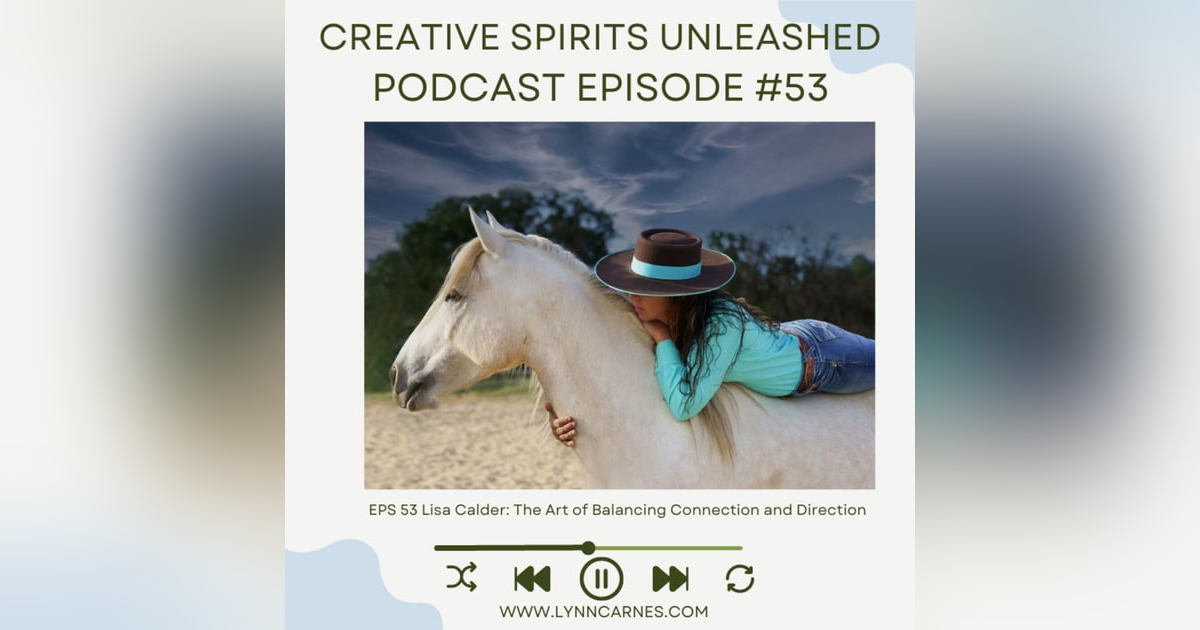


My guest for the latest Creative Spirits Unleashed Podcast episode is Lisa Calder. I met Lisa at the Equus Film Festival in December. When I watched her work in the round pen, I was immediately intrigued by her leadership style with horses. She has the precise balance of connection and direction that creates a seemingly effortless dance together, the kind of balance I call Dancing the Tightrope.
This was one of the most unforgettable conversations I’ve ever had. Early on, Lisa shared some of her darkest days with a story that took my breath away. Literally, as she told it, I had to remind myself to breathe. Her story is a powerful reminder of our inner strength if we can get out of our own way to let it rise to the surface.
She also shared her experience with burnout and how she finally learned how to say no and to walk with her spine and open heart. You have to hear how she described what this looks and feels like, because it is yet another balancing act. Many times during this conversation, I realized that Lisa was giving all of us a master class in self-awareness.
Lisa Calder is the creator of Mindful Horsemanship. Her one-of-a-kind approach to horsemanship combines personal development and a unique way of using the breath while working with the horse, creating an unbreakable bond of true connection. Lisa believes if we are only working on our horse, we are missing the art of horsemanship. One must change their unconscious behaviors from within in order to create lasting change in their relationships.
Topics
- What does it mean to be real?
- When you’re out of alignment, it’s time to stop and change.
- Dealing with suicidal ideation.
- Breaking everything down to one step at a time.
- The pressure was my own pressure
- We have turned money into an identifier of your worth.
- How do you know when you’ve got a horse that’s in trouble?
- Lynn’s story of how she drew her story into a corporate story.
- Stop making it about us and start looking at what does my horse need from me.
- He was the only horse in the group that would not leave.
- You can never show fear to a horse if you’re incongruent.
- How do you avoid taking things personally when it appears that the horse is wanting to be disconnected from you?
- Leadership is nothing more than asking for help -.
- How to get out of your shell.
- Reaching for your tools instead of your rules.
Website: http://lisacaldermindfulhorsemanship.com
facebook: https://www.facebook.com/Lisacaldersmindfulhorsemanship
Intro:
Welcome to Creative spirits unleashed, where we talk about the dilemmas of balancing work and life. And now, here's your host, Lynn Carnes.
Lynn:
Welcome to the creative spirits unleashed Podcast. I'm Lynn Carnes, your host. My guest for this episode is Lisa Calder. I met Lisa at the Equis Film Festival in December. When I watched her work in the round pen, I was immediately intrigued by her leadership style with the horses. She seemed to have the precise balance of connection and direction that creates that I don't know seemingly effortless dance together. It's the kind of balance that I call dancing the tightrope or two seemingly contradictory forces blend in perfect harmony. This was one of the most unforgettable conversations I've ever had. Early on, Lisa shares some of her darkest days with a story that simply took my breath away. Literally, as she told it, I had to remind myself to breathe. Her story is a powerful reminder of the inner strength we all have, if we can just get out of our own way, except help and let it rise to the surface. She also shared her experiences with burnout and how she finally learned to say no, how to walk with her spine and open heart and many other practical ways to take the journey back to herself. You just have to hear how she describes what these things look like what they feel like. And again, more balancing acts which I just love. Many times during this conversation I realized in a way, Lisa was giving us all a masterclass in self awareness. So who is Lisa Calder, she is the creator of mindful horse horsemanship. Her one of a kind approach to horsemanship combines personal development, and a unique way of using the breath while working with the horse, creating an unbreakable bond of true connection. Lisa believes if we are only working on our horse, we are missing the art of horsemanship, one must change their unconscious behaviors from within in order to create lasting changes in their relationships. So that's who Lisa is. And you will find that in this conversation, it's almost impossible in an introduction like this to do the conversation justice. But here's what I know. I know you'll get a lot of value out of it. So I hope you enjoy this conversation with Lisa Calder. Lisa, welcome to the podcast.
Lisa:
Hello, Lynn, thank you so much for having me.
Lynn:
Thank you for coming on. I was so excited when I finally got I finally got to meet you I just learned about you right before I met you at the Equus Film Festival. And from a distance I was like, she's a magical person. She smiles like the sun. But, but the other thing that struck me and so I just want to start by asking you what may seem like a really deep question. But you know, what I saw was such a real, open, fresh person. And I saw the horses respond to you like that as well. What does it mean to you to be real? And then I have a follow on question from that to
Lisa:
how to be real, I think is to really live from your truth. And really, to know your values and what you stand for. And to have this balance within yourself of walking with your spine but being open with your heart at the same time. And not being afraid to, to share that.
Lynn:
So wake up walking with your spine and open with your heart. Explain that.
Lisa:
Loving yourself enough to stand up for yourself and choose you in every moment. But also have a heart open enough to be empathetic with others and feel or truly hear what they are saying. Because so many times through life, we as the human species have a tendency to try to be nice. And by being nice. We're also giving up a piece of ourself. And when we give up a piece of ourself it very off then means that we allowed someone to come in and push on us. And, yeah, that bites us a little later than we realize it
Lynn:
happened to me. Well, when you said spine that you know, I another word is backbone. And when I was just starting my self awareness journey, I ran across a book, and I think it was called leadership with Backbone and heart or something along that I know back then and hard were in the title. When I devoured that book, it's, it's got to be an oldie, and I'll see if I can find out the name of it, it might have been executive coaching with Backbone and heart. But that idea that you did that beautiful balance you just described, it's it's that I think we're all seeking that balance in some way of being able to embrace others and be empathetic, as you said, and open and caring, but doing it without being a doormat.
Lisa:
Absolutely, absolutely. Holding on to our power, and not giving up our power to anyone else in the world, because it doesn't serve them. And ultimately, it doesn't serve us because it ends up draining us. And, you know, in my past, I truly discovered that burnout. That was, I call it a leak. That's one of the places that burnout had occurred for me.
Lynn:
Explain to say more about that, because I work with a lot of people who are at risk of burnout, I once had a client who came to work with me at an at an IT coaching retreat. And when she sat down, I literally could see almost like somebody who was fried. And she started talking me through all of her plans that she was a big deal in our company, and, you know, had a lot of responsibility. And a lot of people were looking to her. But she started talking to me through with our plans. And I was like, Well, what are you going to do about the fact that you've got no energy to fulfill any of this? Right? So what is how do you define burnout? And how do you have? What tricks have you have found to recover? from it?
Lisa:
Well, my my past, I would say that at least the last 12 years, I've had burnout more than a couple of times. And what I've learned from that is that it means that something for myself was out of alignment. Whether it meant my inside, wasn't matching my outside. So the way I was being in the world, maybe it was the way I was communicating with people or I was saying yes, when I should have been saying no to clients, or, you know, taking on horses that I Okay, I'll do it. But I knew that, well, this really is what I truly wanted. But you know, just this time. That piece of me that was out of balance, always, always drained me energetically. It wasn't food for my soul. You know, and not everything is food for our soul. But if it's so out of balance that is dragging us in a different direction, and draining us, then we need to stop at the very slightest inkling of that energetic leak. So that we can say, Wait, this isn't my path. I need to choose again. And I've learned to stop, breathe, and choose again. And that's all it really takes to reset, readjust and then move forward. But if we wait until we realize that it's burnout, I think we notice it. And then what happens as we keep kind of pushing the envelope. And typically there are only two things that will create that change for us. And one is inspiration, which I'm gonna be honest in my past that was not what made me shift. Tragedy was what made me shift, right tragedy or crisis. And so often we as humans, just keep going and ignoring so many signs until we hit this place of crisis. And then we it forces us to sit down and deal with the problem that we created until we can become back in alignment with ourself and choose us again, and then we can move forward.
Lynn:
So for you Whew, it's interesting. You said it could either be inspiration or tragedy or crisis, which tragedy I mean, a lot of crisis is our tragedy. And sometimes they're just we've hit the very rock bottom of our energy.
Lisa:
Yes.
Lynn:
It sounds like in your case, something really sort of knocked you upside the head.
Lisa:
He literally Yes, actually.
Lynn:
So. So I think I use that language because twice I have had an ambulance ride because I needed to wake up and got knocked upside the head. One of them was the time that I actually I wasn't knocked upside the head as much as I fell off the horse and knocked on my side. Luckily, my head one hit that hard. But But both both of the times, it was it was a wake up call, it truly was a wake up call. And this last one, probably as profound as any. So did you fall off a horse or get hit on the head? Or can you tell us what your what your experience was? Because I think a lot of people, you know, yes, well identify? Yes, absolutely.
Lisa:
Um, so I've had a few, but I'll choose one. In 2011, I had been living my life. For about a year really out of alignment. I was not being truthful with people around me. And I was in a relationship that was quite toxic. And, you know, at that time, my daughter was about six and a half or seven. And I was living in Southern California and Norco and I was training so much, I would get up at, like, 630 in the morning, ride my horse, take my daughter to school, drop her off, and then ride my horse to locations throughout this town, training horses. And I would train until 10 o'clock at night, just about non stop, and seven days a week. It was very exhausting. But that mixed with the being out of alignment. I had already had two minor head injuries that year when I was bucked off a horse and I had hit a panel on my head. And but I felt like I recovered within a month or so from a concussion. And I had another slight injury. And it took me about a month to recover. And then in the fall, I was standing with a draft horse. And the client was sharing her story with me about the draft horse. And a dog had come out of the bushes. And this Belgian was huge. And his neck was kind of bent back the opposite direction. And when the dog came out of the bushes, he leaped and his head swung around, and his cheekbone smashed right into my face, like the side profile. And it completely gave me whiplash and I landed in a puddle of mud. And I remember like holding my eyes closed going no, no, not again. And when I started to open my eyes, I was so nauseous and I all I could see were sparkles. And I knew right then so what the sparkles are when you hit your head really hard is it's lactic acid in your brain cauterizing like your neural pathways gray matter damage. And so I knew, because I had had three previous brain injuries and this one was really bad. And I just I laid there for a while and I don't know how but I drove home which was maybe a mile away. And I just remember the nauseousness the vertigo the and so I went to the hospital and they said oh you have a concussion just go home and rest. Weeks later, it was worse and I couldn't handle any light i It sent me into a massive spiral of depression. And I didn't know what to do. It took me to my darkest place in life and a very dear dear friend of mine. It's because of him that I'm still alive because I was very suicidal. And he pulled me out of it talked me into going home which is here in Grass Valley, California. Coming back to family and taking time for myself to heal and start living my life in my truth and regaining that alignment. And let me tell you it took a while. But that was the universe's wake up call for me to say, you need to make some changes, because you cannot be on the path that you are meant to be if you are doing these things, and you're not following your path at all. So it was to put me back on my path. And I am so grateful and I look at, I look at all those moments as gifts. That was one of my greatest gifts.
Lynn:
That's a hell of a friend you had to.
Lisa:
It took a while to recover. It actually it took about a year and a half. I went to neurologists at UC Davis, and she put me on some medication that made me sleep about 18 hours a day, because there was so much damage. And they diagnosed me with PCs, which is very common in football players post concussion syndrome. And I mean, you can't handle sunlight, loud noises I couldn't read, I would get so sick. I had to teach myself to rebalance. And she said, You know, I don't think you'll ever ride horses again. And yeah. After that I was I was determined, my great came out and I changed my diet. I discovered that your Omega three, six, and nines is amazing for your brain in extremely high volumes when you have brain injuries. And so I did that. I stood on an endo board, which is a balance board. I have. Yes. Awesome. I would eat a bowl of cereal or my breakfast while standing on it balancing. Oh,
Lynn:
I don't think I'd dare do that. But that's impressive.
Lisa:
So the endo board was my lifesaver. And I, you know, I learned to make cinches to help with my memorization and hand eye coordination. And I just I really pushed myself and you know why? I'm better than I was before. And that whole process that took two or three years, I didn't know it until years later. Her gifted me with so much because it forced me to sit still. And meditate and learn to breathe more. And I was able to come back to horses. And I thought God, I just feel so out of place. And I started using the techniques that I learned. And that was what shifted my horsemanship.
Lynn:
Isn't that interesting? I have to go back and ask a question about your friend. Because you said you were suicidal? Yes. And what I have experienced, I haven't ever had a coaching client be suicidal. But that's just one step or two steps away from where some of them have been where they were so caught up in the thing that they were using to cope. That it was hard to get them to see that you know, if you will let go of the thing you're holding on to the answer is on the release, not on the grip gripping if you will. Yeah. In other words, we've been sort of culturally trained to try harder, push harder, go harder, which is what I think is often under burnout, which is, well, I obviously need to say yes, even more, and I need to try even harder to please my boss and I need to try even harder. And then that's how I think we end up suicidal is because the harder we try, the worse it gets. So what's the hope? What's the reason? Absolutely. You're great. Yeah, but but the thing I'm interested in is how did he get through that? What did he say to you? Or what was it about him that pierced through that because all of that coping is a very big bucket of denial, which is really hard to Pierce.
Lisa:
Yes, that is such an excuse me an excellent question. So I want to start by saying that this friend of mine was also my, I guess you could say, like six years before that when I met him, I met him as a horse trainer. And I went oh my goodness. That's who I need to learn from. And you know, when you just see like this yellow or around people, that was him, and he's also a life coach and a spiritual. I guess you could say advisor or he's just such a tremendously profound, amazing person who truly exemplifies walking your talk and living in your truth. So he had facilitated a lot of workshops, personal development workshops, and he was my horse training mentor. And so he taught me the difference in what your horse is teaching you, and what you're teaching your horse and where the fine line of that is. So we had a very strong friendship, and a lot built on lots of truth and trust to begin with. So what I had called him because it wasn't just like, Oh, I'm having these thoughts. I was literally sitting in the corner of my room with a 357. O lease, and, yeah, and what really prevented me from actually pulling the trigger was listening to my daughter play Tea Party in the room next door with her Barbies. And I thought, I can't do this, I need help. So I called him and. And he said, Do you trust me? And I said, I said, Yes. And he said, Do you trust me with your life? I said, Yes. And he said, you're going to get up right now and grab a luggage bag. Do it now. And I got up and I grabbed the luggage bag. And he said, You're going to put enough clothes on it for a week or two weeks. And I did. And he said, Okay, now go get your shampoos or toothbrushes. And I did. And I zipped up the bag and he said, Okay, now you're going to go do that with Melanie's stuff, okay. And he said, You're gonna go put it in your truck right now. Okay. And he said, and then you're gonna get in your truck. And you're gonna call, you're gonna call me because we had to hang up. So I could do all these things. And he said, You're gonna call me. And so I called him and he said, Okay, now you're gonna drive. So literally, I had to buy a, I cannot be responsive. I am in a state where I am not. I cannot function. And I need to put my life literally in your hands. And I need to do just listened to you and do what you told me to do. And I did. And on the road, he had me call him back every couple hours check in where are you? How do you feel? Where are you? How do you feel? Okay, and you're gonna go to your mom and dads. And I did. And I drove to my mom and dads, and I got help. And that was, that was the only thing he literally saved my life. It was if it was not for him, I really don't know where I would be. That's,
Lynn:
I'm really glad that he did that for you. Because you're here. And talking to me right now and teaching me and anybody listening, some very important lessons about how to show up for a friend.
Lisa:
Absolutely. He's extremely profound. Friend. So he's, he's the reason my life is where it is today. And I can say that in so many angles. As far as the horse training and the personal development and the woman that I am today, he played a pretty profound role in that. Thank you As for tomorrow? He's, yes. Very amazing.
Lynn:
Well, what I what I think is fairly profound. And what you're talking about, is the breaking everything down to one step at a time. He did not say to you, Go pack your bags, and get in the car and drive to your parents. He didn't say that. He said, get clothes and put them in the bag. Now put your toothbrush in the bag. I mean, he went step by step. Now go in the other room pick like he knew that you couldn't take that kind of stacking even. Yeah. Which is a horse training principle. If you think about it, isn't it?
Lisa:
Definitely yes. Yeah. And
Lynn:
we break it down, you know, to the tiniest step, so they understand. But how amazing that you and you know, some part of you wanted to be here because you called him?
Lisa:
Oh, absolutely. And I think later on is when he and I had a discussion and he said, you know, in those dark moments, we know what we're doing. We know we're conscious of it. But and there's this piece of us that is telling us a different story and Sometimes a different story can overtake the other piece. But if we are told, like after he told me that, it was like, oh, yeah, there was that piece of me that was like, I knew exactly what I was doing. And I did not want to do it. But the pain of everything that I was going through, as far as like, it felt like so much pressure in my life from being out of alignment, as well as the head injury, that was bringing me an enormous amount of pain and depression. And, you know, staying in a dark room all day and functioning around that, even though I had spent years prior to that, in personal development and workshops. It was like the head injury just sent it right over the edge and uncontrollable space.
Lynn:
Until it was the opposite, right? Until you walk yourself through it. Yeah. And, you know, you said, you said a couple of things that I want to call out, because I don't know, if everybody really understands the power of the story. They're telling themselves. But you had two parts of you in a way. And that doesn't mean we have multiple personalities. When we talk about parts, by the way, because we all know, there's a part of me that wants to go to the party. And there's a part of me that would like to stay home and put my jammies on and go to bed, there's a part of me that wants to go for running for the marathon and another part of me that just will sit down and hope that it passes this urge. So you know, we have different parts, and you just described that, you know, two parts of you, you know, that are new, and were making choices. But most importantly, while you were in the middle of feeling shitty about yourself, pardon my French, but you found a way. And he found a way to help you tell a different story about the way you felt. And I have become so acutely aware that our physical sensations, which we label as anxiety and depression, and whatever you want to those are the big terms, but whatever you label it as our label is what's driving our behavior, not the physical sensation. Absolutely. Feel. And actually, interestingly enough, if you feel the physical sensation, and allow it to just pass through, it will go away. It can't, it can't stay there. But if you stuff it, it runs.
Lisa:
Absolutely, yes. And you know, the if we stop and breathe, and acknowledge it, and we can even identify it like within ourselves. Where's it living?
Lynn:
It's good to do that. Like, I even like to put like size and shape on it. So for example, if I feel something in my chest, is it baseball size? Grapefruit size, basketball size? Yes, it still or is it moving? Is it? You know, if it's moving? What kind of movement? Does it have a color? Can I like turn it upside down? You know, because then I have something to say about it. And I'm not subject to it. It's subject to me.
Lisa:
Absolutely. That's so funny. Because I do the same thing. And especially the the color piece, the color piece is really big, because we can breathe in when we inhale and wrap our breath around it. And we have the ability to begin to pull it out of us and release it. And you I mean, this could take many, many times of the process. But the fact that you're, you're aware of it, and you're able to identify it and allow it to move through you through expression. And that, absolutely, it's when we deny it. It begins to grow. Yeah. And sometimes it'll grow and manifest into an actual physical ailment within our body,
Lynn:
no doubt. Yeah, no doubt. Have you. Have you read the book? You can heal your life by Louise Hay.
Lisa:
Yes, it's one of my favorites. Oh my goodness. You know, it's so funny is I found that at a thrift store, it must have been 15 years ago. It was like time science and I put it in a box when I live in Southern California and I went through that process that I just got done talking about and eventually I ended up going back down and packing all of my things and moving back to Northern California. Well, once I got up here, and I am a new house, and I opened the very first box, that book was on the very top. And I went, ah, accidentally
Lynn:
on top, where it needed to be.
Lisa:
Yes, here we are. So absolutely amazing, profound back.
Lynn:
Although I have to say, a coach had me get this book. You know, really the very beginning, I was still in banking, and very much living strictly in my logical mind. And very much in my mind, that said, I have to cover up my emotions, because if anybody saw this, they would think I'm crazy, and they would fire me or not love me or kick me out, or whatever the fear was. So she had me read this book, and the woman was talking about how our thoughts, especially our thoughts about our emotions, can impact our lives and ultimately create illness. And I thought that woman was the craziest woman I had ever heard that in my life. And there was a part of me too, that felt like I was betraying, you know, everybody who'd ever taught me anything about the way the world works, everybody from my parents, to the schools to the whatever, right? And so then she says in the book, and she was in her 60s, I think, when she wrote the book, that she had cancer and cured it by changing the way she thought. And I thought that just had to be the craziest thing ever. But I she lived into her 90s Yeah, so I'm gonna give her credit for curing herself from cancer. Yes, but more importantly, what I finally did, and I had to struggle with this book for a long time, is finally I said, Okay, she has this table in the back of the book that says, you know, this is the thought pattern. This is the thing that it causes. And this is the way out of it. It's a very clear roadmap, right?
Lisa:
Yes, it is. And
Lynn:
I said, you know, I can't buy this, if I start with the thought patterns. But I do have a few symptoms, you know, I was having some sinus issues at the time and a couple of other things. So I got a little pack of yellow stickies, and I went through the book. And I actually still have this book, and I still have the stickies. But I went through the book, and I put on the place that I had something this sticky, I was paying no attention to the rest of the table. But then I went back and I looked at the thought pattern and said, Well, you know, is there a correlation? And I mean, to a to a one, the thought pattern and my ailments were lined up?
Lisa:
Yes. That is so funny. It is right on the money.
Lynn:
Yeah, yeah. And so you said, um, this is all this has been a long rabbit trail off of that you've said, you know, you had been telling yourself a different story. And the other word that you used, and I have to bring this up, because it's really a big part of what I've been thinking a lot about is the idea of pressure. And that you said you had so much pressure in your life. Yes. And that's what why a tragedy or a crisis can cause us to finally cry uncle and go, Okay, I'm gonna give up my bullshit now. Because this much pressure means I can't hold on to it anymore.
Lisa:
Yeah, absolutely. So the story comes from our ego, which is typically someone else's story. Okay, it's not truly ours. our higher self, you know, when I talked about to, you know, there being almost two people within us, we have a higher self, which is our spark the truest essence of who we are. You were born perfect. And throughout our life, at some point, our parents put a belief system on us. And this belief system, and we don't really know it at a young age, we're just in our environment and soaking this up. And this belief system is layers and layers and layers upon stories. And we believe it, because that's how we were brought up. And you know, as switching over to the pressure, the pressure was a story that I created myself. The pressure was my own pressure was anything else? Yeah, but I had, I had created these stories, which I'm sure we all do about what I had to do to be loved, or what I had to do to be a good mom, I had to prove myself. And a sacrifice. My Oh, love was sacrificial. That's what real love was, you know, in a toxic relationship that was, that was exhausting. And beyond exhausting, because that's part of what brought me all the way down to the very bottom of that dark hole. You know, but it wasn't until I removed myself from the environment, and had to hit the reset button. And it wasn't just like it happened in a day it was over and over and over and having such an incredible coach at my side, to help me process all of these things. And a lot of it was coaching with horses. And that brought me back to realize, oh, my gosh, look what I created. And I think that's a really big piece is having the awareness that I created this, and now it's my job to take responsibility for it. And number one, you're not holding yourself in a victim space. And now, you can begin to empower yourself.
Lynn:
Oh my gosh. So I don't even know where it hurts, I'm going to pull these threads because there's at least three of them they're full. But the first one I want to ask about because you what I found difficult for myself, was teasing out the parental love of the beliefs and the love I had for my parents from the belief system they put on me. Because when I began to break away from that, this is how we do things thing. Because we're not talking about religious beliefs. Here. We're talking about beliefs about the way the world works, and how to show up in the world and how to be accepted in the world and all those things that it's difficult to it's like untangling a root ball to keep the love for your parents, but but not necessarily accept everything they taught you was true. How did you? How have you navigated that? Because if if you're at the beginning, at least for me, it felt like a rejection. And I didn't want to reject my parents. I didn't want to unloved them. But I also didn't want to have to keep buying stuff that didn't work.
Lisa:
Exactly. So Ezra, Ezra is the one who taught me how to do that, through the workshops, and we'll all go back to how I talked about there were two pieces to ourselves, there's our higher self, okay, we come to this world, and we're perfect. And we, we don't have any, I'll call them shells, okay. And these shells are the belief system that our parents put on us. Okay, so our closest shell is our core wound. As much as it is our wound, it is also our gift. And it is gifted to us by our mother and our father. So when we began the world of personal development, and I am asked this quite often by horse people, you know, because it's very common in the horse world for people to say, Oh, you want to be better with your horse? You got to work on yourself. Okay, that's great. Well, where how do I start? And that's what that's what I do I help people to start with their, what they're projecting today, where are you operating from today. And that is the shell that is layered the farthest out and we tap on that shell and create that awareness of that's not truly my story. And then it through the years as you peel back these layers and the shells and you open one up and you go well, life is amazing for a while and then something happens and we're triggered and when we're triggered this is because our shell hit someone else's shell. Uh huh. And you know, way, connect back to my higher self right and then we can create an awareness around where the shell came from, with a non judgmental space within ourselves. And the more that we become non judgmental with ourselves, the more that we become non judgmental with others. And this is where when We work down to our core wounds, we realize, Wow, that story, my mom and dad told me, I know that that wasn't mine. So for example, I'm gonna use myself with my father, the gift that he gave me, is the gift of independence is also my greatest wound. Because I have denied so many people the opportunity to help me early on in my life before I knew of about it. And, you know, I have a hard time asking for help. And so it was a double edged sword, right. But it was also this beautiful gift from my father. And so going, Wow, thank you, Dad, for that gift, and you did the best you could. And I love you simply for being human, and playing your role in bringing me to this earth. And, you know, for my mother, my greatest woman was my mother is the fear of failure, as she is the queen of I can't. And growing up with that story, you know, I can't do this, you can't do that only the rich kids get those opportunities, you know, she really instilled my belief and what money was and how to feel about it. And so now, you know, as I grew up, and I discovered those things, I'm like, Oh, my goodness, I have all these money blocks, because I was raised and taught that there's never enough and it makes you a sour person. And all of these beliefs that simply are not true whatsoever. So I had to work on reframing all of that story for myself. And but I look at my mom, and I go, Oh, my goodness, she's magnificent. She gifted me with the opportunity to break through that Jenner from generations and generations. And I'm the one chosen to break through those ancestral wounds. So it to me it's a gift.
Lynn:
Well, that's, that's a wonderful way to keep your parents keep from throwing them under the bus, you know, because I went through periods where I wanted to do that I've gotten through the other side, but I did, because I didn't know how to, you know, untangle that root ball, it was sort of an all or nothing. Early on with me, because of the place and the stories I was telling myself, which you got to keep remembering those stories are not ours. And yet we had doped them. And then we get to have to look at it and say, Look what I've created here. But the power is in our hands, if we're the one who created it.
Lisa:
Exactly. Once we realize we hold the keys to our own our own creation in life, nothing can stop you.
Lynn:
Now, I want to get to some things. So you do with the horses. But first, I have to ask because you mentioned the money thing, which a lot of people have money blocks money. Money is a really good proxy for our belief system. It shows you how you feel about things, even though it's simply a tool. But have you heard of the book, the energy of money? No, it's a wonderful book. And it lies in some of these things. And there's another one I really like it's actually called Happy money. And I like both of them may kind of give a little bit of a different message. But in both cases, what I love is they put money in its place as a tool, as opposed to as a identifier of your worth. That's awesome.
Lisa:
That completely detaches such so much stigma around it.
Lynn:
Yes. Because in our society, we have turned money into an identifier of your worth. It's at least one of them. I do believe power and celebrity which are close cousins but not necessarily the same or also to send action instead of power. I might even just put those together and call it status as another quote unquote, identifier of your worth. Again, they're not true. Yes, but we let people believe that they you know, we can get caught up in it.
Lisa:
It's very easy. It's very easy. It's almost like a daily check in as needed. Yeah.
Lynn:
Yeah, daily check ins are are a good thing. So you mentioned the coaching with the horse helped you a lot. And I want to go back to something you said way back about the burnout where you said you know, sometimes you just stop and breathe and check in and then you can kind of reground yourself and I got to watch you working with your liberty work with your horse in a couple of horses, actually in California at the Equus Film Festival. I saw you do that Lisa, where the horse wouldn't be quiet with you and you didn't turn and punish or correct or anything you just sort of stopped and checked in. And when you did that, it's like he came along. So say a little bit about what you are learning about yourself and about working with horses, especially in the Liberty work about that. And also, I want to hear about, I think you called it the blue ball of energy. If I'm not mistaken, because I want to hear kind of the behind the scenes view of that, because I was mesmerized watching you work.
Lisa:
Thank you. So, Liberty work is one of my deepest passions. And you know, it was through working with Ezra who taught me to connect to my higher self and work through my wounds. And once I was able to learn how to in the workshops, we learn how to connect to our higher self because our horses seek that in us.
Lynn:
Okay, state of sake, what in us there our higher selves,
Lisa:
they seek our higher self right? Our we'll call it our Spark, okay. Okay, our spark. So in the workshops, one of the things that's talked about is what are we projecting, so if I am coming from a shell, because I have no, I have no experience in knowing anything about my inner landscape, right? So our inner landscape is the spark and the shells. And there's, if I am just walking through my world, aimlessly, most likely we are coming from a shell of belief system, or something, a grudge, we're holding all these things, we just pile on top of each other throughout the years of our life. And when we walk into a pen with a horse, and we are coming from a shell, the horse will reflect that shell to us. And it may not be the exact reflection, right, like a mirror reflection. So if I'm a person who has no boundaries, and the horse is going to bring that up to me in a way of pushing on me, right, so it's the puzzle piece. It fit the puzzle piece that I presented. And
Lynn:
oh, sorry. It's like they they can spot our holes, and then do something to help us fill the hole, if you will. Yes, exactly.
Lisa:
They're taking the leadership role by default, because maybe you're not taking it in our life, or with our self, if we're, you know, living in a victim space, then the horse is going to say, I'll make you a victim, right? I'll come in and I'll push on you or all, you know, I'll swish my tail at you and put my ears and go, Ooh, I don't like that energy. I don't want to be with you. But when we stop, and we become aware of our inner landscape, and we practice connecting to our higher self, right, and we can do this through meditation through breathing through having another person there, which I was blessed and fortunate enough to have Ezra
Lynn:
and remind me again, what is Esther's last name, I'll make sure I've got him in the show notes but
Lisa:
sure as our amaro ma R O W. Okay, God, thank you. So as Ron Morrow and Judy Atkins, and as his wife, Briana Mauro, they were all a team facilitating these fabulous workshops. And when you have a team like that, that is just so radiant, and coming from their sparks, and they stand in front of you. And they breathe and connect with themselves. And it helps you connect to that space in ourself. Because so many times we have buried it so deeply. Takes another person to stand in front of us and hold our hand and say, the beauty I see in you is your strength, or, you know, your power, your courage, whatever it is. I'm literally we have probably never felt this feeling before. It can be so uncomfortable. But if you can feel through it, you will shatter those shells. And it's the spark that lives through those shells when we live our truth and we are real. That makes the horse go oh my gosh. I want to be with that person. Right. And whether you are a non horse person, we have had non horse people who were just so authentic and so real. And they would just walk in, and they've never been around horses and the horses like glued to them. Oh, and it's just because they're living the truth of who they are. And they're so free inside and connect to that deep space. Whereas you could have, you know, and then there's another person who is a horse person and has all this technique and skill behind them. And the horses, like, I really do not want to be with you. And I'm going to oppose, I'm going to swish my tail, and I'm going to pin my ear. And I'm going to give you a really hard time and challenge you because you are coming from your shell, and you have wounds to heal my dear. So when you talk about the, the horse and the pin that day, if I when especially when I'm in front of a group of people, right, we have a tendency to kind of get in our head and go, oh, I want to look great. And
Lynn:
oh, yes, I was either and there before or after you I can't remember. But I remember that war in my head going, come on land now just show up as a real person. You're not trying to prove anything here.
Lisa:
It gets the best of us, right. And in, that kind of like, sank in for half a second and the horse feels it. And the horse goes. It's, yeah, it's a contraction. It's merely nothing more than a slight contraction of our insides and the horse contracts on its energy. And I go, Oh, I just felt that. I breathe. expand my insides and I soften all the way from the inside out and open up. The first reconnects
Lynn:
right away. Yeah, I witnessed that. I don't know that I could spot the contraction until you called it out. And then I really would notice that when you would breathe, and then expand yourself, and I could, I could see it in you. But I could also see it with the horse. But the one of the questions I have, because the I you know, for for last year for about six months, at least a couple of horses, and one of them. He was never dangerously pushy, and we didn't do Liberty work, but he would push into me. And I couldn't get him off of me. And so my, my question is, like, how do you work through that? Because there was a part of me that said, Well, isn't this cool, he loves me, he wants to be close to me, I'm such a good person. But there was another part of me that was like, this is a 1200 pound animal that isn't responding to my energy, no matter how big I get it. I mean, I'm talking jumping jacks and waving and, you know, carrying on and he just stood there. And so I have come to recognize, I went to one of Warwick Schiller's clinics, and I follow him, you know, online and know him, I was on his podcast, and he was on mine. And, you know, he talks about drive and draw, and he says, Look, the first thing you better have his drive, because he should move away from you. If he's not moving away from you, you're in trouble. So my question for you is, how do you manage that, especially in Liberty work?
Lisa:
So yes, the draw is number one, because that's how the horses communicate, or I'm sorry, the drive drive, having the drive is number one, because that's how the horses communicate with each other. And when I have a horse, that is like what you described, there's a couple things that go through my mind when I begin to assess the horses. One is, is this horse masculine energy? Or is he is she fiscally and or feminine energy? Right? And so that tells me right away, how my approach to correcting the horse will be? And also, is this horse a confident dominant? Or is this horse a low self esteem insecure? Because both can be pushy, right? The one that's really insecure and nervous can be like, right on top of us seeking, like, safety. Whereas then we can have a pushy horse who's just calling us to the plate saying, You're not being a leader right now.
Lynn:
Yeah. And if you're not the leader, I am.
Lisa:
Exactly and yeah, and it's
Lynn:
not a safety question. It's not that they need to be loved anymore.
Lisa:
No, not at all. And I see it all the time. Lynn, you know, it's that oh, the horse loves me. He loves me. This is great. Let me give him more treats and then somewhere along the way They get hurt. And that's that crisis moment, right? And we got, oh, now I have three broken ribs. And the horse being able to decipher Is he trying to take this leadership to challenge us, meaning push his body in us, and in a sense, like arching his neck in a specific way. And there's other behaviors that are looked at that I could usually pin within like five minutes of like, okay, this is a competent, dominant horse, and he needs more clarity, and he needs a strong structure and boundaries, because that is what ultimately brings him peace. Were
Lynn:
interested Okay, wait, say that again. And because and this is the horse that's arching his neck, is that what you are looking signal or
Lisa:
when if you look at horses, when they meet, if they stretch their neck out when they meet, then they're they're greeting each other in a respectful manner. They're like, Hey, are you but if one horse runs in with his neck really, like bent and kind of scrunched up with his body, in the space of the other horse, but the other horses Archie are stretching his neck. Now you have one horse saying, I'm challenging you for the leadership. Oh, okay. And the other side, okay. Yeah, the ones stretching his neck out says, I don't want it, I just want to meet you and let you know that I'm not a threat. And so when a horse meets as humans I'm looking at okay, how does he agree as if I put my hand out? Does he even acknowledge us? Does he know I had a thoroughbred a couple of weeks ago who was very expressive, and was new to the to the client. And she had had him for maybe three or four weeks, and she said, Oh, I'm letting him get to know me. And I had approached her after I watched the horse for a little bit and saw his behaviors in the arena. And he had laid down next to her, he rolled, he got up and then he was acting, you know, just completely not acknowledging her running into her with his shoulder, kicking out a little bit as he ran off, and then she'd have to like, hey, stop, stop, you know, she was just leaving him. And I walked up, and I asked her, I said, you know, how are things going for you? And? Well, you know, you saw what happened earlier? Uh huh. And she says, But I'm letting him get to know me. And I said, he knew you in five minutes. Yeah. And we have a tendency to want to let our guard down and give up that piece of ourselves. To try to make the horse or others feel comfortable. And what we don't realize is that the more self love we have, the more structure we will offer, the more boundaries. So we offer because we love ourself. And that brings the horse so much peace and relaxation. Like, Oh, I love your energy. Thank you for being true and clear.
Lynn:
Okay, so I have to actually draw this into a corporate story I have. Uh huh. Because I think people do the same thing. Yeah, I, I, this was years ago. And this is before I knew a lot what I know now, but it was one of those days where things worked out. And I didn't know why. But you just showed me why. Because I had a boss who was arching his neck, okay. And he was actually wasn't a boss, but he was a senior leader in the banking world I was in. And I was actually he was he had actually contracted with me along with a lot of the other bankers to train his people. So they sent him to me and Charlotte, I was training them to be bankers, then I sent them back out. And, you know, the, the leaders would tell me whether we were doing a good job or not, did you know were they getting good bankers back out of our training program. But early on, we were having a disagreement, and about how to handle some of the just logistics around sending people to you and so forth. And we were on a conference call. And, you know, he was he was very much arching his neck saying, he, you know, this is the way I want it done. And it just wasn't the way it wasn't the right way. And I remember kind of negotiating with him, I can almost picture us circling each other. And, and he kept pushing and he kept pushing, and I finally said, you know, we're going to call him, we're going to call him Bob. Okay, because I call everybody Bob or Joe. And I was like, Bob, this is the way it's going to work. They're gonna come here, you're gonna pay for it, I will send them back. If you don't like the way they are trained, you can come back and tell me how it is. But this is the way it's gonna work. And he goes, Oh, okay. And we were the best buds after that, but in a really respectful way. And the, it's like my setting those boundaries gave him peace of mind. And by the way, he was very senior to me in the organization, I had every excuse to just, you know, do this corporate game of cow telling, and brown nosing, and all that stuff. But just now I'm listening to your story going. If we all only knew that to give those boundaries to that horse, is the way they get peace of mind. Yes. That's brilliant. Lisa. Yeah,
Lisa:
that I that is that is such an awesome story. Lynn. And you know, it's the same that goes for our children. Our children just need structure. Yeah. And boundaries. And their home environment can. Ah, sad. Yeah.
Lynn:
Yeah. So So is there ever a time that you run into a horse? And I'm thinking about people in my life? Because I just love drawing these parallels? I mean, I feel like the parallels are so good. Not that horses are humans, but they show humans. And I submit to is there ever a time when you say, you know, this horse just isn't going to work in this environment? Like, he's not going to make it as a riding horse? Or a Liberty horse or a show horse? You know, do you ever find that some horses just aren't going to get with the program?
Lisa:
Well, I've had to lead to that. And they're the two most remarkable horses to me. They they've left me with so much more insight and love. And oh my gosh, I could write a book on each one of these horses and I, they deserve it. They have earned it. One was a actual techie, when I lived in Norco, and she went through a severe abuse case. And she had gone through two other trainers, and I was quite young. And they had brought her from the one location where she was abused. And I'm, you know, I'm not the kind of person to take that, like lightly like it was it was very, very severe. They basically laid her down, they were starting her, they laid her down, they tied her feet together, and they put a tarp over her and tried to choke her out. And when they took the horse out, the horse goes down to almost his last breath, and the person will blow in the nose, and then the, the horse will go, Oh, you're my savior when you take the tarp off? Well, if you know an apple techy, you know that that just isn't gonna work. Number one, but the horse broke free. And when she broke free, she sliced her foot down to the bone and sliced the rope around her neck. And she jumped up and she grabbed the man by his shoulder, and she threw him and which lovely story, but it's after that, no one was able to touch her. And the sign of a halter or rope has sent her in a complete panic, anxiety based panic. And so because she was inocle techie, a friend of mine was an actual techie, breeder and rescue and she said, you know, just bring the horse over here, I'll take her Don't eat the nicer and they're like, You are crazy. She's gonna kill someone. While they brought her over. They unloaded her from the trailer with a cattle prod. And they're like, You guys are crazy. And you know, you're on your own. She's gonna kill someone. Well, they left and my client had had two other trainers work with her in this three week span, and no one could get this horse to even look at them. I don't know what techniques they used or who the trainers were or anything but they heard about me and I lived a couple streets over and so the veterinarian asked me she's like we have to get this horse's foot X ray sits down to the bone and it could be infected and could mean the end of her life if we don't get it in time. So can you get this horse in a halter so you can X ray her? earned five days. Pick. Oh, wow, that's a really steep order. Okay, well, let's go see, you know. So I showed up one night, six o'clock. And I remember taking the halter and it was little rope halter and tying it to my jeans. And I had learned a lot of breathing techniques from as run all the workshops that we had done. And so I already saw that this horse was already running circles, and I wasn't even in the round pen yet. Well, wow, I went into the round pan, and just stood in the middle. And she just went into complete anxiety. And she was a white frothy mess and no time. And all I could do was stand and meditate and breathe. And over the course of a couple hours, the horse's head started the same. And
Lynn:
every time you were standing there breathing and meditating while the horse was running around you for two hours. Yep,
Lisa:
exactly. So there's this technique, and you may have heard me talk about it at the Equus Film Festival is called holding the space.
Lynn:
I actually have a chapter on holding the space in my book, I want to hear about
Lisa:
yours. So holding the space for this horse that is going through this emotional turmoil and stress and fear, right, she sees the halter on my side. And so her story, the horses story is humans, humans are horrible. And she also has this rope on her. And so she already has her own story. Okay, as much as we have an inner landscape, and a spark and shells, horses have that too. Okay. And so my job is to come in, and to say, Okay, I see your true self. But I also see your wounds. So I'm going to help you through that. And I'm going to help you change this belief system. And so I stood there meditating and holding the space for this horse, and allowing her to have her anxiety or her meltdown, or whatever it was that she needed to express, you are free to express. And I'm loving you through it. And the more that I allowed her to do that, the more she started to sink her head, and it took a couple hours. And she sank her head and then that white frothy, sweat, dried completely up. And then that's when her emotion shifted, as she started to look in and her ear started to come in. And then every time that she would give me one of these positive signs, I would exhale. And it was nice and deep. And she realized that I was landing and inviting her to land with me. Well, it was near 10 o'clock when she finally slow down, stopped and looked at me. And I went oh, thank you. And I just sat there with her for a while I did not walk up to her, which is what so many people want to do when their horse finally stops? They Oh yes.
Lynn:
I've been there versus Kobe. Oh, you met.
Lisa:
So that's that moment right there. When we have that inclination to go, Oh, I'm gonna go pet my horse and tell them good job by petting them. We're depriving them of the opportunity to just sit and feel and be with us.
Lynn:
And that petting them is all about us.
Lisa:
Absolutely. me wanting to
Lynn:
go good boy, you know, you're so good. Versus caught me so many times doing that and recognizing that is not for him. That is not what he needs. Or that is what you need it to feel good.
Lisa:
Yes, exactly. And can we stop making it about us and start looking at? What does my horse need from me in this moment?
Lynn:
Will you just Yeah, that's what I was just you know, you heard Bruce situs at the Equus Film Festival. Let the horse tell you what to do, when to do how to do like the horse tell you how much pressure to apply. In other words, be the conduit. And I just heard you describe. I held the space but she told me what to do. You didn't use that exact language but you were following her? Because you're you being in the round pen was more than enough pressure for her to go crazy. You could really almost like if I could be a little smaller for you. I would be because this is a lot of pressure even though I'm not doing anything other than exhaling.
Lisa:
Exactly. Yes. Oh, that's impressive. Yeah. So I I turned around and I walked out. And I remember opening the gate and the financial backer of the horse was standing there. And I said, Listen, this horse, I think she's out of my league. I'm not really sure I can do this. And he says, name, your price, that horse just followed you to the gate. And I turned around, and she was right there next to me. And in three days, I, I could put the halter on, and it wasn't just like, I could put the halter on. She put her nose in the halter. Oh, that's good. Yeah, but she was, you know, we did a lot of work with her. And her fear of a rope, just like laying over her back or behind her Hawks. It just, she was so triggered and so checked out. And it was so much stress for her. I thought, you know, why put her through this, let's just retire her and let her live out her days happy. And so she lives actually here at my place now and out in the field, and she just gets to be a horse with for the rest of her life.
Lynn:
And she doesn't have to. She doesn't have to do anything.
Lisa:
Nope. Just be beautiful. And be yourself out there.
Lynn:
Yeah. Wow, that's that's an incredible story. But you know that the thing I think we often forget is, first of all, we don't know what trauma our horses have been through. But even if they haven't been through trauma, they're all individuals. And I was having lunch coffee thing with Anna 20, who lives near me who's pretty well known animal communicator, and horse trader, and we were talking about horses that teach us and what they can teach us and so forth that she goes, you have to remember, not all horses are meant for all work, like some of them are just not mentally ready to go help other people work on themselves like, and that's not even why they're here. And you got to give each horse a chance to be an individual and not force them into your mold. And that was really profound for me, because sometimes, I felt I had found myself sort of glorifying all of them as, you know, the unified horse mind, right, and not seeing them as the individuals they are. And the more I remember, when I first started on this horse journey, and somebody would talk about somebody's, you know, their horse having a different personality than the other ones or whatever. And I'd be like, What do you mean, there, it's a horse, a horse is a horse. Boy, I mean, I just keep getting more and more distinctions and refinements about just how individual they are.
Lisa:
Yes, and, you know, that really, that makes me recall, a Mustang that I had to work with. And the owners, they had picked two Mustangs, and they, Ezra had worked with the horse, and he said, you know, this horse really needs more than just a couple days a week. You know, so they brought the horse to me for a monthly training. And I got, he was just stunning, massive, humongous Roan, he had bites all over. I mean, like, you know, scarred scarring all over him from everything he had been through in the wild. And anyways, I had worked with him for almost three months. And he is the only horse that when I walked into a pen, he wouldn't leave. He would not leave, I would try to drive. You know, oh, no, he was like, Nope, I'm not leaving. He had stand and face and scenario. And I went, Okay, I need a second horse. So we're in saddled up a second horse. And then I walked in the pan on a second horse, and I just started walking around and moving him around with my second horse. And I feel like that's how I won him over. And
Lynn:
yeah, because he already he already had the lessons of the horses. He had he knew how to speak horse. Mm hmm. Yeah, again, takes a lot of sense.
Lisa:
He was he was extremely dominant, probably the most dominant horse I've ever met. And I asked the owners, I said, Well, why why did you pick him? Well, you know, all the other horses were running around crazy. And he was just standing still. And I thought, Oh, boy. Boy, we picked the leader of the group didn't wait. So I had spent three months with this horse and I could saddle him, but he was always I would I have a energetic chart, you know, and it's one to 10 and five is tolerating. And five is like if you imagine a two liter bottle of soda, and you're shaking it, and the inside is under so much pressure, but the outside isn't expressing anything. And that was this worse, huh?
Lynn:
That's a brilliant way to look at it. By the way, I call this face inside of us the froth. And the soda bottle was a great because I think of it as a mix of the new and the old, like at the edge of the ocean. But the the shaking up of the soda is that's the better analogy. I love it. I'm stealing that just so you know, okay.
Lisa:
All right. So back to when I feel this in a horse, I try to open the lid and get some movement to happen happen with some expression. So it like, Yeah, this is it. And then the horse will bottle up again. And then the emotion rises again, and then diffuse it again, until the soda inside is, I don't want to say flat. I'm not trying to take away all energy from our horse. I just don't want it to be counterproductive. So in this work with this horse for three months, you know, the owners were like, well, you know, it's the third month and if he's, if it's not, if it's not, if he's not rideable by the end of this month, then we're gonna take him somewhere else. And I said, You know what I think that is? That's a completely true statement. Absolutely. Let me see what I can do. But I was not about to push this horse. Like some horses, there's like, okay, I can push them a little bit. And that was the old Lisa years ago, I'm talking 10 years ago, right? I will never sacrifice that now in the present day of who I am. And but back then, and this was over 10 years ago. And I thought, You know what, this guy, if you do this horse and injustice, and you push him, and you're not honest and true with him, every moment of that you're with him. He's gonna let you have it. He had already. And he did kick it One trainer and injured that trainer. And you could just feel it. So I was on the fence with this horse, this experience. It makes me cry. So I'm on. I'm on the fence with this horse. And I'm teaching him to come over to me, right just so I could pet his neck and get him used to a human being above him. And I'm using my long stick and trying to encourage the anxious to come over and waiting for the moment until he's willing to come over. But I had a 22 foot line on and I was trying to bring him in. And he was just like, No, nope, nope. And he's frozen. At the end. I mean, absolutely frozen. So I get off and walk around defused start again. And there was no way this horse was going to come over. And I had been I was exhausted trying to get him to come over. And finally I stopped. And I just I looked at him and I said, I'm done with you. I'm done. That's it. We're complete. Like, you're, you're not giving me any of yourself. And I just like had this huge conversation with him. I was yelling, I was yelling, I have like, and I threw my stick down on the ground. And I'm just like, that's it. I'm done. And literally, this horse walks up to me. And I just went, Oh my God, all you want is your family. Like I don't even know where it came from the feeling. All he wanted was to be back with his family and the wife. And I he walks completely up to me, he puts his head on my leg on the fence. And there were tears coming out of both sides. Oh, that I just sat there and I'm like, Oh my God, there's no one around even witnessed this. Like, this is so emotional. And I just started bawling. And we sat there and cried for the longest time. And I just went I honor you. I'm just gonna honor you, that's it. And I called the owners and decide, you know, I honor him. And if you want to send them somewhere else you can and so they chose to do that. And I said great, you know if if it's not done slow or right like he's he's gonna he he is a truth horse. He's going to hurt someone. And so they sent him sure enough, they sent him to two other trainers. And one trainer was a bronc rider and had the horse buck and he said I'd Nope, I don't want anything to do with it and sent the horse to another trainer, the other trainer, supposedly to get the horse rideable. But then when the horse got home, the gentleman went to get on and the horse broken too, and did injure the owner quite a bit. So they gave the horse away to a gentleman on a pack string, and the horse on the pack string. He did well for a little bit, and one day, he just decided that it wasn't for him, and he is free in the mountains right now. I was gonna say the only way that horse was going to be okay is if he was free. That's all he wanted. That's all he wanted. And you know, having conversations with horses, people ask me, how did you not get hurt by him? Because I had what I call truth moments, before I step in the round pen before I step in the stall, I take deep breaths, I clear my day. And I step in, and I tell him exactly how I feel. I am scared shitless of Euro. But I'm gonna breathe. I'm going to honor you through this. And we're gonna move together through this. And every single day we would have the truth moment conversation.
Lynn:
Yeah, that horses remarkable. Okay, so you just hit on one of those fallacies in the horse world that I was taught when I was a little girl when I first learned how to ride horses, and I hear it repeated a lot, which is you can never show fear to a horse. Mm hmm. And which is incongruent. Because if you're having fear, you can't hide it. Yes,
Lisa:
I love that you brought this up. So yeah, a lot of times, you know, especially if we're not an avid horseman, someone will hand us a horse here, hold a sword, don't let them know you're scared. Don't let them know. Whatever, you know, that is the bar that just from the truth, in fact, that will get you in trouble. Yeah, because the horse then looks at us and says, A, I don't trust you. Because you're inside is not matching, you're outside. And that is when the horse will like back up from you. snort ate you like frenetic? I don't want anything to do with you. So the best thing to do is express your fear to them. Yeah, let them know. And the horse will understand because they have it too. Yeah,
Lynn:
yeah, it's that. But you know, this is also the, the landscape that we operate in with people because we see somebody smiling, but we know they're not really smiling on the inside. I talk about my, I've got this face, which is like, I'm showing you that I think I've got this, but inside I'm going on got this. And people can tell when we're incongruent, we don't know exactly what the incongruence is, we can't necessarily put our finger on it. But I think our I think our energetic sensing mechanisms are tuned in to when things don't line up. Things, this might be a dangerous situation. And it could be little danger, like that person will stab me in the back when he goes out of this meeting. And not he won't do what he told me he was gonna do or he's gonna go try to make himself look better than me in the next meeting or whatever. It could be that, but if it's with a horse, it could be that the horse just can't let that fizziness of the energy out to the point where they get, you know, you're riding along and they're already nervous. And all it takes is a little blip. You know, a leaf blowing across the plastic bag blowing across the trail, and you're off. Exactly, they were already holding that much tension. Yep,
Lisa:
that's how it happens. You know, people go, Oh, he just did this out of the blue. And it's like, no, no, no, there's no such thing as out of the blue. The horse told you a long time ago, he's been telling you for a while.
Lynn:
You know, the horse telling the subtleties of those signals. You know, the weather the eyes are soft or hard. You know, that's, that's a that's very subtle. I'm still learning how to read these seven signals, because a lot of times, it's just not obvious. And what I've had to recognize for myself is that I spend a lot of my life I have spent a lot of my life just ignoring red flags.
Lisa:
Yes. Oh, yeah. Yeah, they and they show up all the time, and it's almost like now when I see them and I want to avoid them. I say opportunity You? Yes,
Lynn:
yes. Because that's, you know, this, this was the biggest thing when I started working with with Bruce, when I fell off the horse, and I was trying to get back on the horse, and he kept saying, I don't want the horse to do the picture. And every mistake is an opportunity. And I was like, looking at him going, Bruce, you're crazy. I want the horse to do the picture. I am here because the horse didn't do the picture. And I ended up in the hospital. So please, by all means, show me how to get the horse to the picture. And, and now I am with you. It's like, okay. That's the opportunity. Like, that's, that's where the growth happens. Exactly. Yeah. And I'm learning it with my dog. I have been working on having her I've got a six month old doberman. I'm training. And what we worked on this week, what she's been pretty good at down and stay. But was she good it down and stay with enough? You know, I think there's three things I'm looking for duration, distractions. And, and I can't remember the other thing I'm working on, but duration and distractions on how long and how many distractions can she handle, right. And so I had her in down and stay. And then the idea was to throw something by her that she wanted to go chase. But because I hadn't released her, she had to just ignore it. And the first couple of times I did it in the house, she was perfect. The ball roll by, and she just looked at it. And I was like, that's great. But that's not enough of a test. So then I took her outside and had her on a longer lead line, and threw the ball. And she went after and threw the Frisbee and she went after it, but then it gave me a chance to show her. No, that's not what I want. And now the next time she did it, it was much more solid, the Frisbee went right by her head. And she just looked at it. And that tells me I can have more confidence in her mindset. Because we've been through the things that didn't work, as opposed to thinking well, it's it's only good if she was perfect every time. Right? So yeah, I needed that I needed her not to do the picture. In other words for it to make it work.
Lisa:
Yes. And, you know, right there, that's, I love that you bring this up, because it's, we have to make mistakes in order to learn and grow. Yeah, but if we keep holding ourselves from making the mistakes, we're also holding back our growth entirely. And in including our horse, you know, we I, I will allow mistakes to happen, especially in my liberty work. It's like I allow the mistake to happen. And I allow the horse to run away. And so many times when we're beginning to Learn Liberty work, it's, we get caught up and like, oh my gosh, my horse just disconnected from me. And he doesn't love me, we created the attachment to to it. And it's like, oh, well, she she left? Let me see how long does it take me to recreate the connection and get the horse back? You know, and each time, the more that we let go of that attachment to being so I'm gonna use the word needy, like, oh, I need you to be with me, right? The more we let go of that attachment and free yourself from it, and just be stand tall in our truth and be empowered and connect to our higher self, the more the horse doesn't want to disconnect, and they want to just stay with us. So yeah,
Lynn:
that's, that's very huge. That is very huge. Wow. So now, the person taking things personally, you know, you said something about the neediness. Right? Right? How do you avoid taking it personally, when it appears that the horse is wanting to be disconnected from you or not doing what you're asking?
Lisa:
What that took for me to change was the personal work. The inner landscape work, identifying the shells, working through them finding the gift in all of it, which was ultimately freeing myself up from these stories that weren't mine and learning to not hold attachments to people things you know, situations and outcomes, right learning what we call responsibility to versus responsibility for. So with our horse when we are with or with our children, right? We have a responsibility to feed them, clothe them, love them. However, we are not responsible for their emotions. And we cannot control that we are not responsible for their breathing. In some cases, when our children reaches reaches a certain age, we are not responsible for their success. Right. So, understanding our scope and realm of responsibility is vitally important. Because otherwise, we tend to, like attach ourselves to all these things. And it's not ours. It's not ours to fix. It's not ours to change. It is ours to hold space.
Lynn:
And actually show them that we trust that they can handle it, including handling the mistakes of it. Yes, you know, even in the horse thing, one day I went, I was working with Bruce and I was trying to we were, I can't remember what he was asking me to do with the horse. But I started to go back and do it again, even though the horse had just done it successfully. And he said, you know, you're just telling the horse that he didn't do it right the other time, even though he did do it, right. So let him have his success. Like you're not responsible for getting it perfect. Right now. He did it. Let him have it. Yeah. And that was that was like that is a direct correlation to child rearing where we have to let them own their lives, our children, my daughter's 41 now are about to be 41, which is really stunning to me. But she went through very severe drug addiction. She was suicidal. We very much could have lost her. I tell a lot of the story and my podcasts that I was on with Warwick Schiller on his podcast. But one of the things I had to recognize and had to say to her was, this is your life. Yes. And you're destroying your life is not going to destroy my life. I'll miss you. But I am strong enough to live without you.
Lisa:
Why that must have been hard to say,
Lynn:
ah, and necessary. No, she will tell she will tell you that was the moment. And she will tell you she made a choice, a very deliberate, direct choice that she was going to live and not die. Wow. When I said that, but all of those years up leading up to that my neediness had fueled her desperation. Wow, in the name of love,
Lisa:
who the webs we weave.
Lynn:
But it wasn't love. It was my neediness. And my need to be okay, and to prove I was a good mom, which just dug her deeper and deeper and a hole. So you just what you're just hit is a truth. And I've never actually set it exactly the way I just said it, I'm having an insight. And I can feel it bubbling up as we're speaking. That's the beauty of these podcasts. By the way. I love how much I get to learn.
Lisa:
You know, and I'm thinking about what you said to her, and you reminded her of her power, right? And there really is nothing more powerful than when a human steps in and says remember your power, you have the power to do this. And I believe in you. That's, that's so powerful.
Lynn:
I could not agree more. And it's just if we could get out of our own way to see our power and let somebody show it to us. Because way back earlier you said you struggled with asking for help. And it was a thread I didn't really follow at the time. But I have a belief that leadership is nothing more than asking for help. You know, if I could run the bank, or if I could run the hospital or if I could run the manufacturing company or Procter and Gamble or name a company, right? If I could do those things myself as the CEO, I would not have to ask for help. I would just go make the product and ship it and account for it and change the labels and you know, get the customer feedback and answer the phones and you know, but I can't and not one person. So if I want to be a leader, I have to learn how to ask for help, which means I have to receive year because I'm receiving doesn't mean there's anything wrong with me. Receiving like I remember having to have somebody teach me how to accept a compliment.
Lisa:
Oh my goodness makes you really? Yes, like so when I first started working with iser I was with horses and I Um, you know, we would, he was a mobile trainer, we'd go from location to location, and I would travel with him. And I have my little notebook. And I write all about the task of working with the horse, right? Yield the shoulders, yield the hunches, breathe all these things. And little did I know that in between all these clients discussion with Ezra, he was actually working on me. And it was through that. It was like, I would always say, Oh, I'm sorry, I was in your way. Or, like, you know, he would say, Oh, good job. And I'd be like, oh, oh, like, it's like the words came in, but they stopped an inch from my heart. Yeah. And I really didn't realize that for the longest time. And until he actually sat down and had a discussion with me about it, like, breathe when you breathe and did the workshops. And then when you open up, you're like, oh, wait a minute, this is awkward. It feels uncomfortable. Do I deserve this? I've denied this my entire life. In the workshops, we do this, a nominal exercise called a dyad. Have you ever heard of that?
Lynn:
I do dyads in my workshops, but tell me how you do. So
Lisa:
we have two people. And one person sits in front of the other person with your feet flat on the ground. And you have like your palms, up or down on your knees. And you're going to look into the other person's right i and as role write a prompt up on a board. Tell me a way you can have more fun, right? Very simple. It's a way not three ways a way. Yeah. And the simple instruction is that you, one person will ask the question, the other person will respond. It's not a conversation back and forth. It's very simple. It's Tell me a way you can have more fun in your life. And the other person will respond with, I can have more fun by watching the sunrise in the morning. And the other person does not get to shake their head. They don't get to have conversation around it. They simply say thank you. And there's that space, little slight breath space in between each transition. And after, then it will switch the other person will ask the prompt. And that person will say thank you. I can go back and forth for hours. In fact, in other workshops, that's one of the things I do. And we with much deeper questions, right? So in the
Lynn:
end,
Lisa:
what you have is an experience of wow, what it feels like to truly be heard. Because so many times when we are sharing our response, the person who read the prompt, could be thinking about what they're gonna say next. So that means they weren't truly listening, to truly hear that person and receive the words they said, We can't receive if we're already thinking about what we're going to say next. So it's just a beautiful practice, as well as giving ourselves answers if it's a really deep question. When we can ask the quote, when we can answer the question. repetitively, we tend to dig deeper and deeper and deeper and get to the truth of our answer around that prompt.
Lynn:
That sounds like such a powerful exercise, every dyad I've ever done. I've been a part of them, and I actually have other people do them is that way, because when two people have to face each other and look in each other's eyes and do something wrong, you know, I've actually done dyads where I had people where one person was trying to process something with a family member or something that wasn't in the room. And so I would put a stand in front of them and let them talk to their dad, even though the person sitting there was just somebody else in the workshop. Oh, perfect. That's another really powerful way for someone to get out of them the things that they've been stuffing because the problem with the way we block ourselves from receiving and from listening and from hearing and from feeling. And just frankly, from being that unique Spark, you were talking about it, it's not in our awareness. It's so much a natural part of us. We don't even know where that blocked down. We don't even know that's not us. That that's our shell, we think that's us.
Lisa:
We do we
Lynn:
lose it, I lose myself.
Lisa:
It feels like you're dying. When it's when you're first. Like in that space of going through that process to discover it. It's it literally feels like you're dying.
Lynn:
Because your whole life. You've been told when you feel this this is that the thing that happens right before death. Yeah, yeah. And I guess in
Lisa:
a way, there's a small piece that you are shedding away. But the freedom and love underneath you, when you discover it, you're just like, oh my goodness, where's this been my entire life? I feel like a new person. And
Lynn:
it's like, you know what, this is how it suddenly reminded me of oh my gosh, I got this picture of a my God I'm about to tell a story on myself. So when I was a little kid, I had a blanket that my called the blue blanket. And blue blanket was the best I could say for my blue blanket. But it was evidently my comfort. So as a little kid, my mom, she ended up nicknaming me, Linus, you know, from the Charlie series. Because she called me Linus because I loved this blanket. And I actually had no memory of needing the blanket. But my mom said that they finally had to, it got so shredded and torn up and just like was this raggedy thing that eventually she had to like, take it away from me, but I can't. Like I'm thinking of our structures. And our, our, you know, shell is like my blue blanket like my comfort, right? And I thought I would die without it. And many years later, I was probably probably at least 10 or 15. Yeah, not 15. Yeah, I think it was probably about 10. My mom was cleaning closets. And she found where she had stuffed away my blue blanket. And she showed it to me. And I had no memory of it. But it was this really ratty, like nasty blanket. And I said, I was in love with this. And she said that's exactly what you were in love with. And and it was just a coping mechanism. It was the thing that made me comfortable as a little kid, you know, but it wasn't me. And if we could just see our defense structures as my radio blue blanket, or whatever your version of a radio blue blanket is, then it would probably give you the strength. You know, for whoever's listening, it gives you the strength to maybe find your own unique spark and work on I call it reaching for your tools, you know, instead of your rules, because we were given all of these tools in which to adapt to and, you know, really rise up to life.
Lisa:
Yes, exactly. And we forget we even have them unless we make it a consistent practice. But I'd love that saying the inside Yeah, about the tools and the rules. It's
Lynn:
and it doesn't mean rules are bad. You know, because we just overuse them. Like, I think there's some really basic like, well, I'm learning how to fly airplanes. It is very full of rules. And by the way, those rules are great. And even down to like landing the airplane, there's a set of rules for when to pull the power back what else to do, when to put the flaps in, you know, how to line up for the runway, what to do with the crosswind. There's rules for all of that. But at the end of the day, the only way you're gonna get that airplane safely on the ground is if you develop feel within those rules. And that's beautiful feel is for the tools come in. And to me, it's like learning how to listen and how to how to visualize and how to see and how to understand what your glideslope is. And also at the same time, how to like pay attention to Have you have you been given a clearance to land where there's another airplane still on the runway and are you going to go around it that airplane doesn't get out of your way in time? Or, you know, do you know how to speed up within safe bounds if a faster airplane is coming up your rear end at a busy airport? Yes, and all those things that yes, there's rules for those but at the same time, you have to have situational awareness and reach for your tools.
Lisa:
Yeah, that's, that is great. I love the airplane work that you're doing because it's, I mean, the field is so important. The field within it, it's like, currently, I have my great teacher, a Tom Beth, hello, Comey. He says, ride the horse, you know, don't I mean, the rules are there as structure. But don't forget about the horse that you're writing. For the rules, you know, don't don't write, don't put the rules ahead of the field.
Lynn:
Is this horse, this horse? Right. Now, what was that teacher's name again, that you just said?
Lisa:
That's a ton, a ton, that whole alchemy? Okay, you're gonna
Lynn:
have to send me that name. So I can put it in the show notes. Because I can't pronounce as I don't know how to spell it.
Lisa:
Okay, he's phenomenal. Such a phenomenal, amazing, one of a kind individual. And I have been so blessed beyond razor to have him in my life.
Lynn:
Isn't it great to have, you know, one of the one of the ways we learn is to have a teacher. And back to the conversation about receiving? You know, I remember early on, I didn't want to have to need a coach because I didn't want to have to admit that I wasn't perfect. And therefore, a coach could help me. And then once I began to understand what it was to have a teacher or a coach, or a trainer, even, you know, the the horse trainers that I've worked with Bruce is not the only horse trainer I've worked with, they've all helped me in some way. And it starts with being able to receive because you can't learn if you can't receive. Absolute Gosh,
Lisa:
that's Yeah, absolutely. That and sometimes we have we forget that we have to
Lynn:
ask to see yes.
Lisa:
Because we just think like, Why isn't this working? Why isn't this coming into my life? And we forget that we actually have to ask for it. And sometimes, sometimes physically,
Lynn:
well, and sometimes we've asked for it, and then we don't recognize that they that the answers are coming. Yeah. And on one of my other podcasts with Christine Dixon, I mentioned I did the commitment poem, which basically said as soon as one is committed, all manner of things rise up to help you. But then you have to be ready for them.
Lisa:
That is true. We have to decide clear decision, and
Lynn:
I'm committed, but then I'm committed. But then somebody calls me up and says, Hey, learn how about this? And I forget or don't realize that's right in line with my commitment. Hmm, I've had I've had that happen more than once, where I've actually called people back and said, you know, that thing I just said no to, I'm gonna say yes. Now, because I just realized this is complete alignment with what I just wanted to do. But my habitual response was No. Yeah. So well, I want to honor your time. So I want to say why I want as before we wrap up, I do like to and and we could go all day, let me say we probably are going to have to do a part two, you and I are definitely going to touch. Because this has been an incredibly rich and enriching conversation for me. But I like to at the end of a podcast, you know, what comes up in these conversations, typically, you know, you can start to picture that as people listen to it, they're going to be thinking about their own lives. And so I would like for my I always like my guest to have a way to like, give a piece of advice or ask a question or make a request of my audience just to kind of help them along in their journey. So you know, if you think about it, what would your message be in though in the along those lines to the people that are listening, that have made it this far in the podcast?
Lisa:
My message Oh, my goodness, I feel like this is really deep. Like I'm going in my head too much about it. You know, I think to start viewing your struggles and your triggers and everything as a gift rather than an obstacle. It's, that's the opportunity. That's the gift. As you move through your day, those moments that bring up tension, stop, breathe. What is the gift unless and that's where the shift can happen for you. And over the course of a week or two, your situations will change the people in your life will start to change and be happier. You'll see more joy and things and yeah,
Lynn:
I found, you know, that lines up a lot. Somebody asked me the other day, what the core message of my book was, which I didn't, I haven't always had good language for it, even though the book is finished and published, right? This is because I keep learning. It's almost like this is why it was hard to publish the book in the first place. It's like, but I'm not done learning. But um, I said, you know, the, the core message is that pressure is the catalyst for your growth, not a test to see if you're good enough. Yes. So the pressure is the thing that helps you grow. So you just put a better, I'd really love your words. The struggles are the gifts you can see them for what they are. They, they're what elevate you, not what keeps you away from your thing. whatever your thing is. Yes.
Lisa:
Wow. I love that. You said that. And pressure is our friend. It really truly is. And, you know, that's one of the very first things that I work with, with a horse is what is this horses belief system around? What pressure is? Oh, I
Lynn:
love that. Yeah,
Lisa:
I creates pressure equals connect to me. It does not mean leave. It does not mean check out. It does not mean go to anxiety. That means confined me look for me seeing.
Lynn:
So yeah, wow. That's incredible. Pressure is a way to connect.
Lisa:
Yeah, pressures where the connection lifts.
Lynn:
And you just hit okay, that's a whole nother podcast. We're not gonna open this. We're not gonna open this can of worms. But I actually have to point it out. The belief system about pressure is as much of the work as the pressure itself. Yes, yeah. And all of this, so says the woman at the beginning of our conversation, who said the pressure of my life caused me to have a 357 Magnum in my hand. Yeah. And it was the catalyst that brought you to where you are today. Absolutely, it
Lisa:
was a huge turning point. Yeah. That was the moment of transformation. And Lynne, a. You said something to me some time ago, you said the portal is open. And that that was an open portal moment.
Lynn:
That transformation happen? Oh, I just got chills. Because that's when the learning can happen. If we can just survive it. And for the most part, most of us are going to survive it. Right yet. Lisa, I cannot thank you enough for this conversation. You know, after a podcast like this, I don't know if I've ever told the guests this, but I I kind of walk around on a podcast I for the rest of the day from having had such a great conversation. Because yes, I do these podcasts for you, my dear listeners, but I do them for me as much as you. So I hope you after you listen to this, get to walk on such a high. Oh, my
Lisa:
gosh, I am. And thank you so much, again for inviting me to be here and to share and really thank you.
Lynn:
Incredible, incredible conversation. Thank you. And for all of you listening, if you like this conversation, remember to share it with your friends, your colleagues, the people you think will get something out of it. And in the meantime, I will see you on the next podcast. Thank you for listening to the creative spirits unleashed podcast. I started this podcast because I was having these great conversations and I wanted to share them with others. I'm always learning in these conversations, and I wanted to share that kind of learning with you. Now what I need to hear from you is what you want more of and what you want less of. I really want these podcasts to be a value for the listeners. Also, if you happen to know someone who you think might love them, please share the podcast and of course subscribe and rate it on the different apps that you're using, because that's how others will find it. Now, I hope you go and do something very fun today.


