#52 Hannah Pasquinzo: Getting Out of the Cycle of Beating Ourselves Up
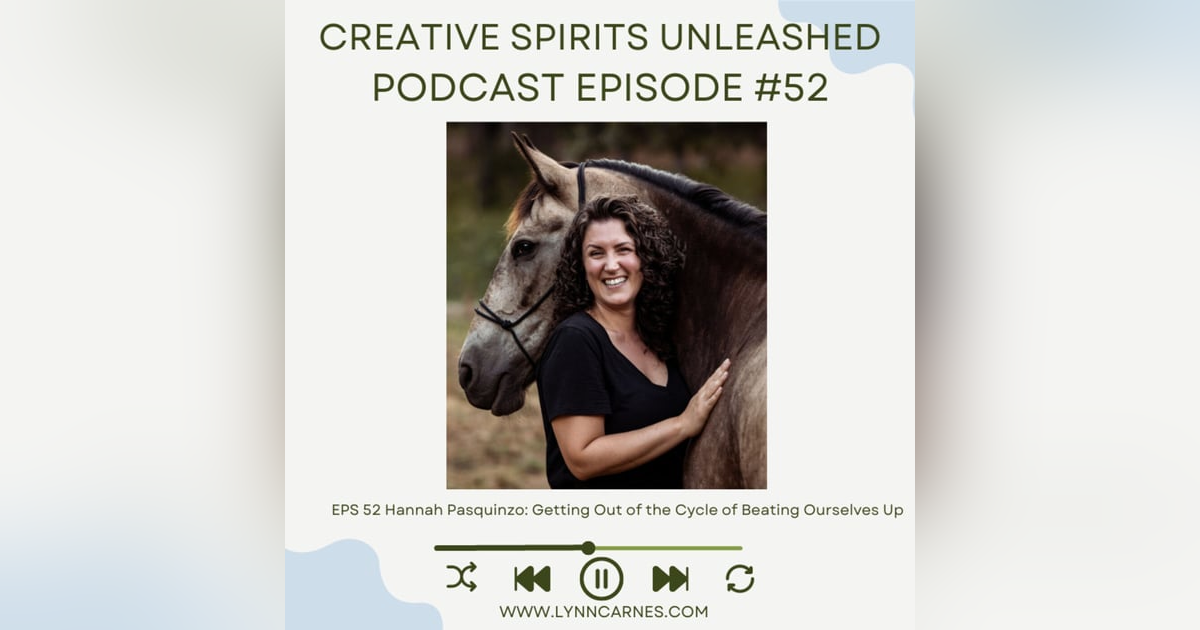


My guest for this episode of the Creative Spirits Unleashed Podcast is Hannah Pasquinzo. Hannah is a successful small business owner, yoga instructor, and coach living in the magical Ozark mountains with her horses, dogs, and cats.
Hannah and I met at the Journey On Podcast Summit in November. She was one of the 12 people who joined in the Ice Bath excursion on Saturday night. She inspired everyone in the group when she stayed in for the target of two minutes, and then said she could stay even longer. Her courage was contagious.
This conversation will tell you that not only does she live in the magical Ozark mountains, but she's a magical person herself. She and I touched on a variety of topics, from Human Design (a new way of seeing ourselves for me), what we do with mistakes, and how we get out of the cycle of beating ourselves up. How we handle mistakes
I had lots of questions for her, such as “How do we find mindful ways to approach life?” “In what way can we use our inner tools to do be mindful?” and many more. I will listen to this conversation several times because I feel like I learned so much about how to live instead of exist. Isn’t that what we want out of life? We started this conversation by talking about how to truly live while you're alive.
Here's a bit more about Hannah: She said her husband often likens her to Snow White but swapped the dwarfs for two teenagers. She offers both virtual and equine-assisted learning experiences for busy people, my audience who want to live more fulfilling mindful lives. Her favorite thing is to cheer her clients on as they gather the courage to reach for what brings them alive. I know you're going to enjoy this conversation with Hannah Pasquinzo.
Topics:
- What does it mean to “live?”.
- Yoga teacher training is a gift.
- Ice and hot and cold therapy.
- The superhero of what we are capable of.
- One of the biggest artifacts of our conditioning is beating ourselves up.
- The difference between listen and hear.
- You cannot receive feedback if you cannot occupy your body at some level below your neck.
- Moving through old emotions and letting go of old stories.
- Breathing is the bridge between our conscious and our subconscious.
- The cycle is what happens when we think we’ve made a mistake.
- What is human design and what does it mean?
- What is the role we’re here to play? What is our purpose?
- When you think about it collectively it’s like everything just runs more smoothly.
- How do you spell “splenic?”.
- What is advice that annoys you in your field?
- How the Schiller’s invited vulnerability from the presenters.
- The journey of becoming a small business owner -.
- What would you want your audience to know about you?
Guest Contact Info:
https://www.hannahpasquinzo.com
https://www.instagram.com/hannahpasquinzo
https://www.facebook.com/hannahpasquinzo
Intro 00:02
Welcome to Creative spirits unleashed, where we talk about the dilemmas of balancing work and life. And now, here's your host, Lynn Carnes.
Lynn 00:19
Welcome to the creative spirits unleashed Podcast. I'm Lynn Karns. Your host. My guest for this episode is Hannah. Pisco, Enzo. Hannah is a successful small business owner, yoga instructor and coach living in the magical Ozark mountains with her horses, dogs and cats. That's the beginning of her bio. But this conversation will tell you that not only does she live in the magical Ozark mountains, but she's sort of a magical person, herself. She and I had a such an incredible conversation about a variety of things, everything from human design, what we do with mistakes, how do we get out of the cycle of beating ourselves up? How do we find those mindful ways to approach life? Where are the tools that we can use to do that, and so forth. I will go back and listen to this conversation several times because I feel like I learned so much about how to really live instead of just exist. And that's really how we started this conversation was talking about how to be alive while you're alive. So let me say a little bit more about who she is. She said her husband often likens her to Snow White, but swapped the dwarfs for two teenagers. She offers both virtual and equine assisted learning experiences for busy people, my audience who want to live more fulfilling mindful lives. Her favorite thing is to cheer her clients on as they gather the courage to reach for what brings them alive. I know you're going to really enjoy this conversation with Hannah Winslow. Anna, welcome to the podcast.
02:07
I'm so happy to be here.
Lynn 02:09
I am happy you are here too. And people who listen to this podcast know that a lot of times the question I'm going to start with just comes to me in the space right before we start, and the word living is what's coming to me. And it's something that I read on your website about what it means to really live. And I often say what is it to live while you're alive? So what would you say? You know, just to start with kind of what does it mean to you to to live really live? I think it's
Speaker 1 02:55
the feeling of being alive. You know, we can like have you ever driven home from work, and not, you know, felt the steering wheel under your hands or paid any attention to the streets you passed. It's like we get on it autopilot. And, you know, all of a sudden you're home and you have no idea how you got there, or what happened in between work and home. And for me, I think living is
03:24
Yeah, more presence than that, like allowing the space and being open enough to feel you know, to be in our bodies. And for me, like those are the experiences where I do where I do feel alive. And that's what I would call living.
Lynn 03:44
Yeah. Well, I have been that person in the call. Oh, me too. I still am sometimes i 100% Still am and yet I am also learning to feel. And what struck me even before you use the word feel when you said being is that living really does involve feeling and we have labeled a lot of feelings as good or bad. How do you sort out and manage the feelings that don't feel as good as other feelings?
Speaker 1 04:30
that I think might be a lifelong practice for me. But I do feel like I'm getting better and better at just allowing. And part of that is working with, you know, coaches and healers. And I work with a woman named Adrian Hill. You know, will kind of get in a meditative state and, you know, get to the bottom of something and she'll say, all right, breathe into your belly and just feel feel loneliness, or whatever it is, and having support has been so helpful. You know, it's like, I know that I have somebody that if I just can't do it that day, or, you know, I can ask questions or, you know, sometimes just having someone help hold the space, it's like, I'm more able to allow it, you know, I know it's not going to kill me, because I've got someone there with me who agree she's on the phone. But that's been super helpful. And I just think with more practice, the more you realize that, okay, this might not feel quote unquote, good. But I know now, like, I trust that allowing it to move through will, you know, being humans weird. And in three seconds, you can feel completely different, you know. So I trust that more now that, you know, there might be grief one moment, and five minutes later, there may be joy. So
Lynn 05:56
that's it. For me, that's incredibly helpful, because I, for my clients will often ask them about how they feel, and where they feel and where it is in their body, and so forth. And of course, a lot of times I'm working with people who are living in a numbed out environment, and a numbed out life where they're expected not to feel and not to show emotion. A lot of people in the corporate world are not to show emotion. And I think there's a ginormous difference between feeling an emotion and expressing it. I once had a company I worked in where the CEO when he got angry, which is fine to be angry and feel anger, except for he threw books at people when they walked in the room. That is not okay.
06:44
Yeah, that's No, sir. What people
Lynn 06:46
you know, people tend to want to do if you think about, you just described a wave like a wave in the ocean, right, I'm going to have a wave of grief, which will be followed by a wave of joy, which is followed by a wave of sadness, which is followed by a wave of happiness, which is followed by a wave of whatever is coming. And as you allow emotions to move through you, they don't get stuck. But since we don't want to feel, we tend to numb them out and try to cut off the bottom ones, which you can't cut the bottom ones off without cutting the top ones off, and then we end up flatlining. However, if one is not used to feeling, it can feel like you're going to die. Like you just said, I know I'm going to survive. Because she's there when I'm going to actually let myself feel loneliness. Isn't it interesting how our survival mode can take over that at that level?
Speaker 1 07:42
It's fascinating. And I feel like my mind has done a good job of trying to protect me from, from all the feelings. Yeah. Yeah.
Lynn 07:53
And yet, that is what it is to live. And like you said, to feel the steering wheel underneath your hands. And, you know, I feel like every time I'm doing something mindfully, I often talk about a moment I had putting the lids back on my vitamin bottles in the morning, because I would rush through that kind of like the driving from one place to the other and pay no attention. And then the cycle as it goes is I'm rushing, so the lids aren't on, right. And then I tried to pull another one out, and I hit it because I'm rushing, and then the one without the lid on comes out and all the pills fall over the place. And now my day is going very bad because I have to pick up the kitchen, and so forth. And one day, I just stopped and mindfully went back and set every lid on and felt it. And what that did in terms of grounding me for the rest of the day. I've never forgotten. Yeah. And so it's actually become one of those ritualistic moments in the day where I kind of set my day up, and I call it pills. It's my vitamins, you know, it's my magnesium and all that stuff. But putting those lids back on those vitamins every morning. So do you have anything like that you do for yourself where you just intentionally mindfully feel it?
Speaker 1 09:11
Yeah. One for me that I thought of as you were speaking was, I had a friend who spent some time in India doing a yoga teacher training and we were in our 20s I think and I remember her telling me when she got back she was like God that in the village like the slower pace of life, it drove me freakin nuts like the first you know, several weeks I was there. And then after that, I realized that standing in line for instance, she said there were things weren't super efficient. There was a lot of standing in line and she said she realized that standing in line was a gift like nowhere to go nowhere to be I'm just this lady standing in this line. And for some reason that stuck with me. And so anytime I'm stuck in a line, that's a lie. Not anytime if I'm in the car rider line at school, that's still not awesome for me, but A lot of times when I'm in a line somewhere, it is a moment to like, I feel my feet on the ground. I take a deep breath. That's one that's interesting for me. And then I usually take a hot shower. At the end of the day. It's like my way to decompress. And like that sensory experience is super helpful. So again, for me, it's like anytime I can feel using the senses of the body that, yeah, it's a similar anchor for me, like your lids.
Lynn 10:28
Yeah. Yeah. Well, one thing that struck me You said, This is what loneliness feels like I think is how you put it. And that reminds me of an experience that we shared at the journey on podcast Summit. When we were both in the ice bath. Yeah, yeah. We're not sharing the video, but y'all should see her face.
10:52
reliving it, it was cold.
Lynn 10:54
Yeah, it was cold. So it was let's set the stage a little bit because there was particular coaching that we got from Robin Schiller that I want to touch on. But the stage was this. What was it 250 People at the podcast Summit. And I do want to talk about what that experience was like, as well. But 12 of us signed up. And I think it's sold out in minutes when she posted it on the on the on the group to go get an ice bath. And I don't know if she expected that, because who would expect that you'd have that many people that want to go get freezing cold. I had done iced some ice baths before a little bit. And I showers that are cold showers every day. So I was thought I was ready. So there were 12 of us. And then they had to open it up for a second night. So another night, they ended up being 25 of us. And I'll refer in the show notes to a podcast that we did about that experience. But there were two baths, one was 55, and one was 44. And I had never done anything as cold as 44. And you and I both did the 44. And I don't remember much about what other people's experiences were. But I do remember Robin, specifically saying as I was in the bath, and I could hear her saying it to you and you were in the bath and others as well. This is what the cold feels like. And she didn't say it until after the 30 seconds because the first 30 seconds or the hard seconds.
12:27
I only remember yourself.
Lynn 12:28
Oh yeah. But I remember after you guys got to the two minute mark, which was kind of our it was kind of a ballpark that we set for all of us to say, see if you can stay in for two minutes. I think I heard you say I could stay longer. So what was it like for you in that ice bath, especially when she was saying, this is what the cold feels like?
Speaker 1 12:50
It reminded me of my yoga teacher training. So all of the instructing that I was trained to do brings people back to the senses. And so there's a lot of language around that. And so when she said, This is what cold feels like, I could feel myself becoming more porous, almost like letting it in. Okay, this is it was like an acceptance of reality. I'm sitting in this freezing cold water. And this is what it feels like. Like, now I know. So it's another that would be an experience for me that was like I feel alive, man, because um, this is intense. And I'm feeling. So I love that she used that phrase, and I wouldn't have remembered it if you hadn't just said it. Yeah, it's right. Yeah, it took me right back. I was like, Yes, she did say that. Yeah. Yeah.
Lynn 13:41
What, I don't know why she said that. But what it did for me is, it's back to that same thing about the feeling of loneliness, or whatever feels like it could kill you. Because here you are alive, feeling like something's about to kill you. And yet it's not killing you. So it sort of resets that brain to me, it's almost like rewiring our, our our feelers for the survival mode to say, maybe you don't have to jump into action quite so fast. And I think that is it raises our pressure threshold. So we can now take the pressure of the cold because it's not just the cold it is the pressure created by the cold. That says I can take a little bit more of this. And now my mental tools are a little stronger. For the next time I feel the cold. Mm hmm. So that's the story I made up about why she said that. It's like telling our brains see you're not going to die.
Speaker 1 14:44
Yeah, you're not gonna die. And like you said, you said raising your pressure threshold and the word it makes me think about is resilience. Yes. Increase the feeling that I have that I can do hard things, you know. Yeah. Yeah, this is what the cold feels like. I loved that. And I liked the story you made up about it makes perfect. It makes perfect sense to me.
Lynn 15:08
While I'm going with it, I, we found a place in Asheville to go do ice and hot, hot and cold therapy. So last week, my husband and I went over there it was for our anniversary, and I thought he was going to kill me when I suggested that he also get the ice bath, he was perfectly happy in the sauna. And so I had him time me and I did a two and a half minutes. And like it was like 49. What was interesting is he hopped out. Instantly, he got in and got out and went, Oh, hell no. And I just looked at him. And I thought I've tried to channel Robert, I said, I know you can do this. And so I said, just get in for 30 seconds. And I'll time it. And after 30 seconds, as we did with every single ice baths person that night, you could see the shift, when the brain kind of went, Oh, I'm not going to die. Mike, I feel I feel like our brains are saying now my job is just to warm them up. And it kicks into that body thing that thermogenesis or whatever, right? It kicks that warming mechanism from the inside out. So I saw him, you know, and then his competitive spirit came in because after 30 seconds, he goes, Wait a minute, how long do you stay in here? And I said two and a half minutes. He goes, Okay, let me know when it's two and a half minutes. And two and a half minutes sail by and I said what are you doing? He goes, I'm staying until three. And I said oh competition. Challenge accepted. But it got through. He did three three minute ice baths that day. Wow. And I did more like the two two and a half minute ones. But it was I think he found the same experience, maybe not as intensely. But the way we felt when we got out I also felt like was worth the journey. What did you feel when you came out?
Speaker 1 16:51
I came out I'm glad that Robin mentioned, you know, striking a power pose. She said something about Yeah, increased testosterone, Science, Science Science. And for me, I remember getting out and holding my hands. You know, she demonstrated one where it was like your hands on your hips and your elbows are out wide and legs were strong on the ground. And I remember getting out and holding my arms straight up and out like Oh, alive. And I remember having a quick conversation with Warwick afterward about how you can just you can feel your body more intensely for an extended amount of time without having to try you know, it's like this, there are my hands, there are my feet. And that was what I think I loved about the experience most Yeah,
Lynn 17:45
I couldn't get over how good I felt. And the thing that shocked me the most. When I went to go change clothes, it was about 15 minutes, I stayed in my wet clothes for 15 minutes or so because I really didn't want to leave while everybody else was in there. Like I wanted to be part of the collective support because it really was a supportive environment. So when I finally decided it was time to go change my bathing suit on the bottoms were already dry. And I was like, Wait, what happened? And I think it's because my body had just from the inside out hated me up so much. That it it dried them out off. It was shocking to me. Well, I was glad I didn't have to wrap everything in a plastic bag, right? But to put it out, take it home in the back. But at the same time it's it was like, Okay, this is the power of this practice, is it teaches your body to handle things that it didn't know it could handle. And maybe it's not really the body as much as the body mind because I think the body mind is like, and I'd love to hear your take, especially as a yoga teacher. On what is the body mind like how how, what is this whole mind body connection? And how how much untapped power do we have in that? Oh, gosh,
Speaker 1 19:11
sometimes I wonder that myself, I think my sense is as far as the untapped power that it is beyond what most of us are willing even to imagine. Yeah, I mean, if I'm gonna be really honest, I almost wonder, like superhero type stuff, you know. But as far as the mind body connection, the way that I think about it now is I think usually the mind. You know, you hear a lot of people talk about how the mind is super useful and yes, obviously love our brains and the logical thinking that we're capable of but I Also think all the storytelling that we do that holds us back. You know, in in my yoga training my teacher Holly would just say in mind gets in the way of it, like hijacks our experience sometimes. And so I feel like we can't fully experience life if we aren't in touch with the wisdom of the body if we aren't feeling sensing being. And I think that that is where I would go first as far as wisdom and intuition, and allowing the mind to be the sidekick maybe is the word that's coming to mind right now, like, allow it to be in the car, but maybe in the passenger seat.
Lynn 20:58
Well, the the thing that comes up to me, we've heard that language before, I think it's Jane Pike's language, she says itty bitty shitty committee, you know, that is sending. sending the messages. You can't do it. This is bad. This is wrong. Don't let it happen, whatever it might be. Yeah, I've heard other people call it the board of directors or whatever. I think that's giving way too much credit.
21:24
Like anybody should committee. Yeah.
Lynn 21:26
Because it's it is a little bit more like that. And, you know, you said something about the superhero of what we're capable of. Have you seen or read the book. It's an oldie but a goodie. I think the way of the Peaceful Warrior.
Speaker 1 21:39
No, but I literally someone mentioned it to me last night. So now I'm like,
Lynn 21:42
Oh, well, no wonder that just came up. It goes, this is how this works. I have not once have I mentioned that one on this podcast. So that one's for you. Because it just came up, but I think it's Dan Millman wrote it. And it was one of the books they gave out in my first self awareness program, which was 20, many over many, like I said, many over 20 years ago. And I read that book thinking that that guy was nuts. Oh, I can't wait to read it, then. Yes. And I actually think there was a movie made, I want to say McNulty was in it, about the way of the Peaceful Warrior, and he talks about some kind of supernatural things. It's kind of a little bit of a matrix feel to it. And that the, you know, the mind is capable of doing more than we can, you know, than we can believe. But I also struggle with the society that we live in this modern world, which conditions us to think play small, and to play, according to somebody else's playbook. What's your take on sort of that dichotomy of we are natural humans living in a very unnatural world? I think
Speaker 1 23:05
of all things that break my heart, that might be the biggest, it's something I think about every single day. And it's something that I what's the right word, I want to say struggle against it's, you know, my horses are literally in my front yard, I can see them from my breakfast table. And I don't spend near as much time with them as I even could, you know, I'm self employed. I make my own schedule a lot of the time. And sometimes I can use that. to, like, sometimes I picture a whip in my own hand, I'm just whipping my own back self flagellating, I'm like, you know, I can beat myself up because I'm not doing the things that I say I care the most about to the extent that I wish I was doing them and I can beat myself up about it. But what I really think is at play here is exactly what you just said, like we live in a world that is not like none of us were brought up in a way that tells us that that's okay, that encouraged it in any way. It's like productivity is what we're all after, and success and busy, busy, busy. And so sometimes that's an issue for me, like, even remembering that I'm living in a system that is not here to support human thriving, you know, our animal selves. And I mean, that's the first thing that it makes me think of. And now I worry that I've gone on a tangent and forgotten your question. You haven't thought through your question or you
Lynn 24:50
have not but I actually think that you just touched on one of the biggest artifacts of our conditioning, which is the beating self up, because I don't know, I don't have a single client that I've ever worked with, that didn't have some form of that going on. Whether it's second guessing, whether it's questioning who do they think they are, whether it's beating themselves up. And I quoted in, I quoted Andre Agassi in my book dancing the tightrope to this very thing where he, I can't remember the exact quote, but in his book open, which was a real eye opener for me, because I didn't know Andre Agassi didn't like to play tennis. I didn't know that this was all because his dad wanted him to do this. And this was just him pleasing his dad. But then I bet all of us can find something that we do that was strictly whether it's to please our parents, or our boss, or our uncle, or whoever or doing something. But he talked about a moment where he no longer needed his dad to beat him up on the court, he had taken up the mantle himself. Yes. And that, I believe, is one of the greatest ways that we get, we give away our power is to do that. And it's so ingrained, we don't even know we do it. In fact, I think we do it for good reason. I think we do it because we want to be better. Like, what's under your comment that I heard was, I would like to spend more time with my horses. I would like to be more connected to these other beings and to the life outside of my door outside of my business, to the trees, to the flowers to the birds, you know, I would like all of those things. And that's the longing is under there. But the beating self up is the thing. I think that keeps us in place. One ironic,
Speaker 1 26:44
well, there's the Next Level two is I've gotten better at noticing this within myself, but not just beating myself up, but then beating myself up because I'm beating myself up because I know that's a problem. You know, like, so
Lynn 26:57
glad I'm not the only one who beats myself up for beating myself up.
Speaker 1 27:02
And so I think that, you know, I did have you heard of Tara Moore, I have not, oh, my god, read her book. Oh, playing big. I feel like it is so simple, but so profound. And just every woman especially should read it. But I did her facilitators training. And that was just one of the first things that we talked about was that part of ourself.
27:29
Like, it's,
Speaker 1 27:30
that is you said, the one big reason that we think beating ourselves up is going to work is because like, surely that'll motivate us, you know. And that part of ourselves that is being beat up on is never, like, that's not going to help me spend more time out there in the pasture with my ponies, like, I need care and compassion. And there's some part of me that needs, you know, my loving attention. And I just want to bring it back to my heartbreak about growing up in a world that doesn't support human thriving, like we really do live within systems that make it hard for us to make those changes. And I don't think that that means it's impossible, but I think we are. It's one reason we can be kinder to ourselves, like it's not all our fault. You know, it's also is there a bigger, bigger pieces to the puzzle at play. And I do think that I, I see this. I see a community of people talking more about this. And so I'm really excited about what that means for humanity. Like I think it's all gonna the pendulum is gonna swing, you know, and I'm really excited about that. So when I say heartbroken, yes, but that doesn't mean I'm not also hopeful and excited. And a big piece of that is wanting to be part of, you know, moving, moving this way forward. And it makes me think, to, whenever I grew up in church, and when I heard the stories about the Garden of Eden and how, you know, Adam and Eve could speak to the animals. I just remember again, being as a little kid, you know, being heart like, we can't speak to the animals anymore, like, oh my god, if I could live in a world where I could speak to the animals, like I remember being a little kid thinking about that. And now as an adult, I'm like, I think in my own way, I speak to the animals, but I mean, I know people who really speak to the animals. And that is so exciting to me like that my kids are getting to grow up, you know, with different belief systems about what's possible for humans, you know?
Lynn 29:30
Yeah, boy, there's so many places I want to go with this. But I'm going to start with speaking to the animals because I am signed up to do Anna 20s and your animal communication class.
29:40
I haven't thought about doing that myself. But
Lynn 29:42
she's here. She's five minutes from me. So she's jealous. She made an indication with her hands that tells me she's jealous. But she's were the there's a weekend coming in March. So I think I'm gonna also sign up for that weekend because I had an experience. Just the other day I was over at the place that I talk a lot about in my book dancing the tightrope, the folks that really helped me get back on the saddle after my really bad Horsfall. And there's a mule over there named Stella, that was a big deal when I finally got to read Stella, because Stella is a real meat. I mean, she is a brilliant mind reading mule. And she put her head right next to mine, I was standing in the next stall, and she put her head right next to mine, and I cannot tell you how I heard it. I heard it though, as clear as I could have possibly heard it. I am tired. I would like to not do this anymore. And I literally looked at her and I go, Oh, honey, you're done. Oh. And then I had this dilemma, because what do I do with this information. But as I was speaking with the owner of her owner, who's had her since she was two, he had already gotten ahead of me. And he said, I'm retiring her. And I said, thank goodness, because that's what I just heard. And I, I can't, I don't know how to tell you that I knew it. But I was like, I gotta learn more about how to do this. Because you know, in the work I did, and I've done in the round pen with, with Bruce Anderson, who just is amazing, amazing at reading horses. He would often say, Listen, use your tools, listen and hear. And it's like that is two kind of different things. So I want to learn how to do that more. So that's one place I wanted to go. So yes, we can do that. We can communicate with animals I've heard I've seen. And I've seen Anna talking to her animals. And I've been over to see her animals. And it feels like they're talking all the time.
Speaker 1 31:52
She is one of the first people that I had an animal communication session with, Oh, you've done a session with her years ago? Yeah, years ago. So she's been on my radar since then. But when you said the difference between listen and hear I wanted to take it a step further. And say here with your whole body. Hmm, yeah.
Lynn 32:15
What is that, like? Describe that more thoroughly? If you could, because some things are hard to put into words, but those to me are often the things that matter the most. So
Speaker 1 32:29
that was another thing that I feel like my yoga training did was expand my idea of what the senses were, you know, we learned that we have five senses. And yeah, I can remember the first time that my teacher Holly said, see the body through feeling. And I was like, What the hell does that mean? But I got like, I felt different in my body when she said it. And then I started listening to the book, radical wholeness, which has been on my list for years. And if you haven't read it yet, based on this conversation, I think you would really like it. But he is I'm only just into probably the first third of the book. But he already has been talking about how different cultures view the senses differently. It's not just senses from the outside in, you know, our western idea of the five senses is like we're getting sensory input from the outside. And that's how we interpret the world around us. And there are other cultures out there who there's one culture I think, in Africa, that balance is a sense for them, and but the hearing with the whole body. I think that language came from that book. But when he said it, I had the same moment when my teacher Holly said, see the body through feeling. To me, it becomes it's not just centered, you know, hearing and listening. We think of those words like I do anyway, like they involve the IRS. But whenever you hear with the whole body, it's like what if every cell in my body could hear then what kind of information am I open to? You know,
Lynn 34:04
wow, you know, that was that's a really nice way to describe what I first experienced because the first time Bruce put me in the round pen, and I tell this story in I can't remember what chapter chapter number it is in my book, but I think it might be chapter three. He told me to feel, he says, what I want you to feel is like the electrical charge inside your body like a car battery, like negative positive pole. But he says, I want you to feel it and give it a number and then balance it. So if it's out of balance, and you're feeling a 10 it means things are off to a large degree. And another way to think of things being off is looking at a level like the one we have on our phone, but the real ones are called Spirit levels because there's spirits inside of there. But I like to double entendre like my spirit, right? But he says you know that little Look, you're what you're looking for is that little I think of it as a click when the bubble gets right in the middle of The Spirit Level, right? And you kind of go, he says you're seeking that. But he says, feel what you have to do. And he had this maddening exercise called Find the middle, and we're in a round pen that isn't round, but I'm supposed to find the middle of his not round round pen. And then he would take me through this, this process of using my head to get there. And then showing me how to use my body to get there. And the distinction between the two is like a, an illustration of these two worlds we live in of the big day that has conditioned us, and has imprisoned us and taken us away from these feelings. And then the inner guidance that we are given at birth of this feeling from the inside out, like you're describing, and how do we get ourselves back in touch with this thing that we've been taken away from. And yet, frankly, a lot of these systems and structures in society don't want us to have that kind of power, because then we won't buy the Mercedes. We won't follow along, we won't sit in a classroom for eight hours,
36:05
it's gonna say we might not show up for school.
Lynn 36:08
Because that's what school was for. Most people don't know that. But school was not to educate us. It was to train us to sit still for eight hours, and leave the farm and go to the factories to do the work of the Industrial Revolution. Yep.
Speaker 1 36:25
Also heartbreaking. It's on my list. It makes me think of my, when I talk about my yoga teachers, Matt and Holly are a couple and they it's called circle yoga, Shaolin. It's off in the on the mountain, but we're in the Ozark Mountains. And people who live in the Rockies are like, those, those aren't mountains. But we call the mountains around here. But Matt, one thing that he said to me, he is a How would I describe him? A very engaging teacher, I'll say that. And one thing that he said to me once that like stuck in my brain, and I think it will, forever and ever is you cannot receive feedback. If you cannot occupy your body at some level below your neck. And when you're talking about I don't know exactly what that exercise in the round pen looked like, like trying to find the middle with your head versus trying to find the middle with your body. Pen makes me think of that. Yes. Yeah, because receive feedback. I immediately thought because I'm in a, in a learning environment where I have a teacher who's gonna give me feedback. I thought about that. But since then, it's just expanded into feedback from anywhere, anything all the time inside outside, like, yeah, I have to be in my body.
Lynn 37:41
Yeah, yeah. Well, he took me through and again, this is another story I tell told in the book. But he took me through another exercise where he had taken on a rescue of a thoroughbred that was eight years old, and recently gelled and so it had lived by itself in a field not gelded for eight years. And now, he brought it, he gelded it. And then we're getting beginning to get this course hopefully ready to be re homed. And it had already come a long, long way. But my my mission that day was just hey, we were going to debrief something that I had watched him do with another trainer. And he said, You're the horses your responsibility. So we were just hand grazing the horse, next to the round pen and next to the trailer, but no fences anywhere. And at one point, he said, you're holding on to that rope, like your life depends on it. And I said, Well, yeah, you told me the horse is my responsibility. And then he told me to look for feedback. He did not use that word. But he goes, Look at the horse. Do you need to hold the rope with a death grip? And I was like, well, but if the horse runs a web and my brain might not that and he goes, but is that what your body is telling you? He's going to do? Like, is that what your negative positive pole is going to do? So we went through the next. I don't know, hour, and I eventually let go of the rope and then let him wander away. And then I'd go back to get the horse and he'd go, Well, why did you go get the horse because he was 10 feet away because of blah, blah, blah, blah, blah. And he goes, because your negative positive pole told you it was time to go get the horse. And it was teaching me to read that inner guide. It's like a tuner, a receiver, if you will an antenna. It's like you've been given an antenna. And you're so busy caught up in your head, you're not receiving the feedback of your body, but your body in a way I'm using that language now. That's not what he said exactly. But it's the negative positive pole. So isn't that a cool thing to know that we have? I love it. And it's exactly what you're describing. And that was the maybe the most revolutionary thing on my journey. And I'm continuing to refine it. Because like any receiver, you can make it better. You can make it more sensitive.
Speaker 1 39:58
That's fine too. In it, yeah, yeah.
Lynn 40:01
And what I have found is when when I can't, that's when I'm up against an old pattern, I've got her rice, or, you know, let go of. And usually that is going to involve a lot of snotty crying and yelling and screaming and letting go of patterns and
40:17
feeling the loneliness.
Lynn 40:21
But you know, those are all the feelings that I haven't felt yet. And so I've got to go through them. And then let them go. And that's the tricky part. Because, like you said, those stories. So what is your, when you think about like moving through old emotions and letting go of old stories and sort of continuing to free the the inner you that's true to you? What is your? What are some of the ways that you have found to be effective? To do that, because I know a lot of people who are listening to this are going well, I'd like to let go of some emotions, but how do I do it? I
Speaker 1 41:03
love putting in my putting myself in novel situations. I feel like that always brings up whatever is meant to be brought up. And my favorite novel situations are like writing lessons or signing up for a new class to learn something new that I'm interested in. And then recently, I've started, I've stopped rather seeking out like, quote, unquote, healing experiences, I used to feel like I really need to heal this, I need to, you know, be finding someone who can help me with that, or some method or some class that's going to teach me the way to, you know, basically fix myself as I think where the motivation was coming from. But I'm not a student of astrology, but I pay attention to astrology. And the more that I'm paying attention to the astrological forces at work in the world, the more I'm starting to trust, the timing of things like I don't go seeking any more for, you know, healing experiences, because I know they're just going to come and they're going to come exactly when they're meant to come. And so, I don't know if that answers your question, but that's kind of where I sit with things right now.
Lynn 42:26
Well, when you're when you get a novel experience, or a moment where the thing comes. What do you do with it, to make it serve you rather than reinforce your old patterns?
Speaker 1 42:41
It depends on what kind of situation I'm in. But the one that's coming to mind is I did riding lessons, you know, my horse, you've heard about him my horse Takota, aka coding. When I was doing a lot of lessons with him with my friend, Kristen, we got into I got into all sorts of novel experiences where she'd yell from the other end of the arena, all right canner, that would be like and so for me, and moments like that, that are more risk, they feel risky. It feels like taking a moment to notice that fear often feels a lot like excitement and like trying to get clear really quickly on. Okay, am I really terrified of loping right now? Or am I actually really excited to do it. And I've just never done it before. And we're gonna put a smile on our face and like, go, you know, so I try and be aware of things like that when it feels like I'm in a risky situation. And then I can think of other times, and again, another lesson with her. Where I can't remember why. But I had tears, you know, we had stopped and we were chatting and I had tears pooling in my eyes. And that is when I've somehow made a habit. I just take deep breaths. It's just the first thing that I always do. And so I think it's not I will say, it's not always safe and everyone doesn't have the luxury of being able to express like you said, there's a difference between feeling your feelings and expressing your feelings, like expression of feelings and letting them really move. I think there is a time and a place you know, like you said you work with corporate people and they're probably not in an environment where it's really safe to like cry at the board meeting. But when I'm in a position where it feels safe to express myself, just allowing it to happen. Taking a deep breath and letting the tears fall down my cheeks.
Lynn 44:50
Yeah. Breath is that bridge between our conscious and our subconscious and you in the ice bath, wasn't that how she got us through it was. And actually, the breadth that she used is a really good one. I've never heard of it exactly. But it was sort of like an end for four out for eight count. So twice as long on the out as the end. And
45:18
I do not want a lot,
Lynn 45:19
I I've used it, I started using it in the shower, when I came home and started it's really cold here and using the ice showers or the cold showers. But it's a like a modified version, I teach a breath. I've taught this type problem, probably every one of my clients where it's a really long, deep as or as deep as possible. Inhale, and then an out breath. I call it the ribbon breath as long as you can make it go. And I have been able to extend it for like many seconds, sometimes as long as a minute. On one exhale. And there's nothing that shifts the mind faster than a breath like that. You know, it literally like lets all the thoughts just fall away. Mm hmm. So that's a great. I mean, for anybody listening that's like, Well, what do I do with it? We'll start by if you are running your breath, then your survival mode is not running you. I think a lot of us are running ourselves. We don't even realize our survival mode is running us.
Speaker 1 46:28
Yeah, it takes me back to that. driving home from work and not realizing how you got home. I don't know if I would call that survival. It made me think of that that would that be more just like mindlessness sort of lost and thought?
Lynn 46:43
Well, so I think it depends. Yeah, I mean, this is a great question. I've never actually really thought of it this way. But I feel like if we're doing things to numb ourselves out, it's because our survival mode is so triggered that we can't stand to feel it anymore. And so then we have to like mask it. Which means in a way, it's still running us because we're trying to avoid it. And this is one of the principles I often have to work with people on is no decision is a decision avoidance is a decision. You know, trying to counteract, a lot of times people get in, in the power over under game and they feel like victims than they, they try to like assert power, as opposed to find that power with balance. So they flip and over and basically all of it over and under reacting that we do. So maybe going mindless is under reacting? I don't know, I hadn't really thought of this question before.
Speaker 1 47:42
Yes, same? Because I'm not sure I would say that my survival mode is in full force when I'm in those mindless states. And I also feel like saying that. Again, for people like me, who might be listening, you have a tendency to self flagellate, they have the whip in their hand and they're beating themselves up. It's not an old, my, another one of my teachers, Stella, at the yoga Shala, she would say it's not a problem. You know, it's just practicing that awareness, like coming back and coming back and coming back is the whole point. But we I don't think it's necessarily a problem. It's just a noticing. Like, if we're on a path of, of more self awareness. Yeah, this is an interesting distinction for me, too.
Lynn 48:25
Okay, so that idea of it's not a problem. That is the cycle that we go into when we think we've made a mistake, is an automatic cycle. Right? We get that feeling. The boss says, I need to see you in my office. Though I haven't
48:45
had a boss in 20 years. And that still gets me.
Lynn 48:49
Right? Or the whole Can we talk? You know, can you I mean, those little like charges that we get, and then the place we go automatically is we've made a mistake. And just that just sort of like if you think about are working with horses, it's almost like you're fine, you're fine. It's not a problem. You're okay, if you can tell that they're scared. And it's so I'm wondering if it's not as much survival mode is it's just whatever our mistake cycle is, like, what do we do when we think we've made a mistake? And then what's the alternative? What's the different story we can tell? Same signal the body feels the same thing. But how do you come out doing something different rather than go into the old whether it's beat yourself up or second guess yourself or do whatever you do? Go try to make nice with everybody. Uh huh. Go be a good girl that was mine. Like oh, let me show them what a good girl I am. I make A's you know?
49:54
I have a four point I swear
Lynn 49:57
to tell them a good person because I make straight A's
Speaker 1 50:00
If I played that game, too, yeah, yeah.
Lynn 50:03
But I, you know, this, to me is the work. And I think everybody's got a little bit different nuance to the general cycle. But the cycle is what happens when we think we've made a mistake. And how do we, what I noticed working with Bruce was, I think where he came to the work he's done with people was because he started seeing what they did to themselves, when they when their horse didn't do what they wanted them to do. And then what they were doing to themselves they were doing to the horse. And so now the horse is suffering, because of people's world, and people the cycle that we have, and if we could just stay with it and not go into those old cycles, we could dance with the horse in our true partnership, rather than all the things that we do, because it's automatic. And I love that
Speaker 1 50:59
I cannot wait to go back and re listen to that part that you just said, like I'm having I'm having a learning moment right now.
Lynn 51:05
Yeah, well, you know what, what happened with me the first day in the round pin, and I saw what I was doing with the horse and not understanding it, I had a simple job. Coil Valaria. I hadn't had that many lariats in my hand. So I didn't know how stiff they were. It's like a garden hose. And my best cycle coming from my corporate life was I've got this. So I may be feeling like I'm under pressure, but you are never going to know it. Oh, yeah. And so I'm going to just keep that all to I'm going to put that face on. And I'm going to I'm fine. I'm fine. I'm fine. And of course, the Lariat did not coil according to the simple instructions, even coils with no tension in the rope. And I'm looking at him like how can there be no tension in the rope, when I'm feeling tension in the rope, thank you very much feel, you know the classic, impossible task that the bosses would give you, right? So as I'm sitting there trying not to let steam come out of my ears, the horse that's in the round pen with us is starting to run in circles. And I'm having no I'm not talking to her, I have no idea this is going on. And in fact, it wasn't until she she went from walking in circles to running and then bucking and kicking. And I'm sure Bruce was over there just laughing or crying. I don't know where he had your number. Certainly, he certainly knew that I didn't, I did not got this. But when I started, like it took me several years before I came to the conclusion of him, like of that idea that I just had, which is my my stuff was causing that horse pain. Because she did not feel safe with me stuffing all those emotions. And that's when he began to work with people. And he said, you know, people don't have problems, they have other people's problems. So let's get rid of the other people problems that you have. And to me, that is the work with the horses. Now, it's like Where's my stuff showing up? Yeah. And it's not that they're all okay, like not every horse, you can't always assume that a horse is ready for what you have to bring them either you have to help them build up their tools too. But let's start with the self. Yeah.
53:32
Yeah. Yeah, always bring it back.
Lynn 53:36
So one of the places that I've seen this idea just in the application that's not even in the horse world, but like, for example, in golf, or tennis or other sports is, have you read the books, the inner game of golf, or the inner game of tennis. There's also an inner game of skiing, all written by Timothy Galloway. And it's something I recommend a lot to my clients. Because I love the way he describes this, he calls it a self one and a self two. And the self one I can't remember which is which. So we just forget whether I got the numbers, right. But one of the cells is the one that can actually relaxed, under pressure, hit that golf ball or hit that tennis ball beautifully. And I think we've all felt those moments where it's like, we were in sync, we were in the zone, all was falling out, you know, the world fell away, and we could just be there. But the other self doesn't think that the self that can do it can do it. It's almost like the parent trying to teach the child or like, you know, tie the shoes. And it's like, no, no, no, no little Johnny, it's this way, turn that loop this way or whatever. And like that that voice gets ingrained in us as another self that tells the, the real us that we can't do it. And he gives all kinds of really practical ways in those books of have that bypass that second set. That's Self that doesn't believe in you. Got to
55:05
pick one of those up. I like that
Lynn 55:06
worth it. Ideally. Yeah, because nothing
Speaker 1 55:10
feels better when you are in those moments where you're under pressure and you pull it through, you know, like, it all goes, well, it feels so damn good. Yeah,
Lynn 55:17
yes. And that's really like my mission. I think, since since this whole horse thing started is, once I understood that it's possible to raise your pressure threshold, not avoid your pressure threshold. Like I think I unconsciously spent my whole life trying not to get triggered. But when I really learn that there were effective ways in life, not in meditation only if, in other words, to raise my pressure threshold, that's what I've decided, is like my mission. Yeah. You know, so I show up to Bruce's I go once a month to work with him. And he'll say, What do you want to do this week? And I'll say, more pressure.
55:57
Yeah, learn more. And he'll
Lynn 55:59
go Be careful. Be careful what you ask for.
Speaker 1 56:03
Another way, I think of thinking about it is like expand your comfort zone to like, yes. Is that another way that you think about it?
Lynn 56:12
It is because I think our comfort zone can move and me to what I started recognizing for myself as there's this place I call the froth, which is when I'm uncomfortable, but still able to make choices. And I can check it if I can make a new choice while I'm in the froth, then I'm raising my pressure threshold, especially if I recognize that I've made the new choice. So in a way, I have to sort of claim it. Right. It's like somebody's handing me a gold coin. And it doesn't count unless I actually accept the gold coin and say, Okay, I got it. I did. And then that moves it up a little bit. So that little bit of a discomfort zone can move up and up and up. And then eventually, it's no longer that same action is no longer in the froth. It's
56:59
it's old hat.
Lynn 57:00
I got that because you've done that so many times. And it's real. I've got this not fake, I've got this.
Speaker 1 57:05
Yeah. That's one of the things that I like to I like your language around it, too. But I really like to work with people who are like bringing something to life. Because I've had the experience a lot in my life where I'm terrified to chase that dream, or I'm like, whatever self one or two is involves going, you're never going to you don't have enough money. You can't you know, you can't move that far out of town. How are you ever going to learn how to take care of horses, like all those things used to be worries in my head. And now like I said, I stare at them while I'm eating breakfast every morning. And so bringing things to life is something I've done a lot. We can have a human design conversation if you want to manifest your thing.
Lynn 57:50
Yeah, I was just about to ask you about that. Because as you were describing this, I was thinking about my eyes, I peruse your website, which is beautiful. And, and not only beautiful, but makes me feel like I know you which I think is very difficult to do on a website, but you mentioned human design on there. And I don't I've just this is this term has just come across my radar over the last couple of weeks. So talk to me about what is human design and what does it mean? How do you use it? Well, I'm
Speaker 1 58:22
a manifester in human design, which the bringing things to life like getting spark started and initiating things in the world is kind of what manifest errs. It's our strong suit. That's what I was gonna say earlier is as a manifester, I'm, that's literally what I do. And so working with people who are wanting to bring something to life as well, to tidy up that last conversation about the expanding your comfort zone. That's, I love to do that work, too. But I wouldn't have language it in the same way. But expanding the comfort zone and taking the smallest baby step, you know, toward the big dream. I love to do that work. And yeah, like I said, as a manifester. I feel like I'm in my sweet spot, when I'm there. But human design is, I think of it as an awareness tool, like yoga, or like Myers Briggs, or like, you know, there, I feel like there are lots of awareness tools out there that help us learn more about ourselves. And kind of the role that we're here to play would be a big part of human design. It's called The Science of differentiation. And so it sort of honors each individual as that as an individual. So we may all be here to play different roles in slightly different ways. And when you put your birth information into the software that will pull up your it's called a body graph. Some people when they're first exposed to human design, they pull their body graph up and then they go Oh, that looks good. Bearden that's a lot. I don't can't make any sense of this, like, forget it, I don't even want to look into it. And then they might have a friend, mention it or hear it on a podcast or whatever. And that's a common experience I've heard is like the second or third time they return back to it. They're like, Ah, okay. So that's another reason I think it's cool to explore you your human design for the first time with somebody who's studied the system. But there are technically four types and one subtype, but most people just say there are five types. So there are manifest errs, projectors, reflectors, generators and manifesting generators. And how do you want me to keep talking?
Lynn 1:00:41
How Yeah, no, no, no, I'm well, I'm, I'm curious about it. Because I want to ask a question real quick, that role we're here to play. A lot of people use the language purpose. Is that like, our purpose is that or, you know, I often talk about the fact that we each have a unique spark. And our numbing mechanisms often will dim our Spark and our fear about being unique. Right? Because a lot of those systems are designed to make us fit in a bigger picture rather than really be kind of whoever we are in a funky, special way. But we each have our own special thing. So is that what this is building up on is kind of that making sure our unique spark gets dug. Tell me about what, let me not project anything on what you're saying. What does row we're here to play me.
Speaker 1 1:01:38
I think of it like manifester, is like already said, are here to initiate. Okay? projectors are really good at seeing and systems and well, why don't I just give you a metaphor that one of my teachers gave me? Yeah, I'd love that. So she gave me the metaphor of a coffee shop. And in this metaphor, the manifester is the one who's like, we don't have a coffee shop, like we need a coffee shop and I want to put it like how about we put it down there on the corner, like who's with me? Yeah. And then the manifester goes alright, the coffee shop started Great. Next, let's start the in the manifestos are kind of moving on, right? The projectors come in. And they in this metaphor would be the manager of the coffee shop, because they're really good at systems, they're good at seeing where things need to be improved upon. And they're also really good one on one with people. And that in a manager setting, that's great, you can see the systems but you can also sit down with people and hone in. And then the generators come in. And the generators in this metaphor are the baristas they're making the coffee. And the most important thing for generators is that they're enjoying making the coffee. So yeah, but they're, they can like go deep on something and enjoy. Enjoy a thing, you know, manifesting generators come in, they're a subtype of the generators. So it's also really important that they are enjoying their life as much as possible. But they don't want to usually just make the coffee, they might want to be the barista one day, but maybe the next day, they want to wipe down the tables. And the next day, they'd like to close up shop or order the supplies, or they like to have their fingers and a lot of different things. And then the reflectors are supposedly 1% of the population. But in this metaphor, they're the customers. So you know how you can walk into a place and you get the vibe. And you're like, Well, I think I want to buy coffee here. And actually, I don't want to buy it. I'm out there, reflectors come in, and they are taking energy in from the outside world and really able to reflect it back out like the health of the system. So really important, folks, but not very many of them. And so that is sort of where I think about roles to play. Does that help? Your understanding?
Lynn 1:04:11
Yeah, does I'm putting it in my and yours is this is more distinctions. But the I often talk about people being either builders or runners. And the builders are the people who sort of see what needs to be there, build it, but don't ask them to do the maintenance part. Don't ask them to stay behind and operate. Yep. And then you've got the people who are the operators are the runners. And they're the ones who love to do process and make things go better and come in and get charged up every single day doing something over and over again. And my that's my daughter and I'm more like a builder. I'm you know, I like to build things up but I can't do the day to day kind of thing. And my husband's also a builder. So the three of us together make a cool sort of business team because I can walk the worlds between the building and Running a little bit, where my daughter is very much. She's just amazing at running and my husband's amazing at building. And so yeah, I think it's why we've all three been able to
Speaker 1 1:05:10
make it together. Yeah, that's what for me human design is from a zoomed out perspective, like if we are all here with full permission to be ourselves and playing our roles in life. When you think about it, collectively, it's like, then everything just runs more smoothly. And that is, that's exciting to me that often when I do chart readings for people, afterward, they often share the experience of like, you mean, I'm just That's how I've always wanted to be, but I thought I should be this way. But you're saying, I really can just be how I want to be. And I was like, screaming from the mountaintops? Yeah,
Lynn 1:05:55
well, I'm just thinking about the so many people I've worked with, in my coaching practice finding that job, that thing for them, or that way to see their job, sometimes that gives them permission to lean into it, or to be okay with it, especially since they're sometimes getting messages that that's not okay. Or they should want to do something else. Yes. Sometimes people, by the way, ask me as a coach, what is my job? And I'll say, well, sometimes it's just to write permission slips. Yeah.
Speaker 1 1:06:25
I love that. I'm getting permission slips all day.
Lynn 1:06:29
Like you do have permission to go ask for that raise, or to ask your boss why they didn't follow through on a promise or permission to set priorities. You know, you have my permission to go ask for these things. And trust me, your boss wants you to.
1:06:45
Yep. So
Lynn 1:06:46
well, so. So you've talked about doing a rating, so somebody just goes and puts their, their birthday? And, and this can come back? Like is so is the time we're born just deciding what how we're designed? Is that how this is that what this is saying? I'm curious. It's similar to
Speaker 1 1:07:04
astrology in that way. Okay. So, time, date, location.
Lynn 1:07:11
So time and date. So it's not just the date, but the time of day.
Speaker 1 1:07:17
And location, which is used, I think, to find the specific time zone you were in.
Lynn 1:07:24
And there are
Speaker 1 1:07:28
like, the basics that I go through with people are their overall type. And then each type has a strategy and an authority. And the strategy is what you can use to move through your life with a little less resistance, you know, more ease and flow. And then your authority is, I think of it is connected to our intuition, your authority. I mean, it's bigger than that. But your authority is sort of your best decision making apparatus. Like, where it makes most sense for you how it makes most sense for you to make decisions, which for me, I used to waffle waffle waffle. And now I'm when I remember anyway, to Stop waffling and go, Wait a second, you know, and this is how you know, I can make a decision a lot faster now. And then the last thing I love to go through with people is called your profile. And your profile is kind of where the personality bit comes in. And so human design is a mix of like astrology, the E chain, Kabbalah, the chakra system, like it's a lot of sort of esoteric, ancient. Also, I mean, astrology, I don't think is so esoteric anymore, but it kind of all came together.
Lynn 1:08:41
Yeah. So something that really perked my ears, because you talked about decision making. And I feel like that is one of those actions that all of us have to do regularly. And that we often don't waffling is not uncommon. I have a lot of people surprise, it would surprise people how many of my corporate clients fall in the waffling category? Right. But but then there's also that piece that you said, but then I realize I know. And one of the questions I I'm constantly learning about more is, how do you know that you know?
Speaker 1 1:09:29
So from a human design perspective, I would say it's individual. My authority is something called splenic, which is instinctual and connected to survival. And it's that quick knowing that some people talk to you about when they talk about intuition, like what's the first thing that came to you before your mind got involved with what that means or the story about it or my mind will get involved if I get a sense of knowing and I don't like it and I'm like, I'll forget that I heard that and let my and let my mind get involved over here. So for me that quick decision making is, in the knowing for myself, like manifestos are not designed to be asking other people all the time, like, what do you think I should do or I'm literally supposed to go with my own desires, my inner knowing, and then add my my splenic authority and make decisions from from there. But some manifest errs, for instance, are emotional decision makers. And there are different emotional waves depending on your body graph, that people with emotional authority can go through. But people wish with emotional authority, like a phrase that could become their new best friend is, you know, what can I let you know, a couple days? Because if you're on an emotional high, and someone says, Hey, you want to go to that concert on Friday, and you're like, hell yeah, I want to go to the concert. And then Friday rolls around, and you're like, I'm on a low now and I don't want to leave my house. So and the opposite could be true if you're in an emotional low. So for emotional deciders, emotional authority, it's best to give it some time and run through kind of your emotional wave. And then make a decision when you come to a place of like, calm, like somewhere in the middle. And you can pay attention to Okay, over the last couple days, I would say this is for big decisions, too. If you're trying to decide what sandwich you're going to eat for lunch, like, forget it. I'm saying, yeah, just do what you want. But you can look back over time, and I kind of like the 8020 rule are, you can look at how often over the last couple days was I like in on this and I wanted to do it, or how often over the last couple days was I like, No, that's a no for me. And so when you get to that place of kind of a more level calm place is the best time to make a decision for someone with emotional authority. So that's an example of how they can be different their sacral authority. There's emotional authority. splenic authority. Yeah, I don't
Lynn 1:11:57
know that I've ever heard this word. splenic. Before. How do you spell that?
Speaker 1 1:12:01
SP L E. N IC. I know it's the weirdest one. Except that's how it the sad the weirdest sounding one.
Lynn 1:12:07
Yeah, it's I've never heard that word before. But what what I was, as you were describing just the way to make a decision, if you have a tendency to roll with your emotions, is testing the decision against the whole cycle? Gives you a chance to see if you can live with a decision, especially if it's a long term decision. Yep. Through all those cycles, so maybe changing jobs buying a new house? Buying a new home?
1:12:35
Yes, yeah. It'll change your life a lot
Lynn 1:12:37
of deciding who to hire.
Speaker 1 1:12:40
Yep. Or even if you want to go to the concert on Friday night, yeah. Yeah, I mean, for people like me can feel like a big decision of like, I don't know what I'm gonna want to do on a Friday.
Lynn 1:12:53
You know, I have had that I've had that very thing happen. And one of the things I fall into is empty calendar syndrome. So somebody asked me to do something far out. And since my calendar isn't very full, I'm like, Oh, sure, I can do that. But I don't run it through. Am I going to want to do it at that time. And then, you know, the day comes up? And are the weeks you look at your calendar, why did I say yes to this? So I think a lot about how to adjust between yeses and noes, you know,
Speaker 1 1:13:23
what do I want to be filling my time with? If it's not full yet? Like, is this? Yes? And Ally know where I'm headed? Yeah.
Lynn 1:13:30
Is this in alignment with the work I want to do the way I want to be in the world? And so forth? So so it sounds like, do you do these readings for people over the phone or zoom? Or do they have to come? They can? So this is something people who are listening could actually sign up for? Yeah. If they're interested in finding out more, because it sounds like it could be a really another interesting self awareness tool. I'm big on? Well, my big mantra is reach for your rules, not your I mean, reach for your tools, not your rules. I love that. Yeah. Because the rules are the artifacts of the past. And there's nothing wrong with them, we just overuse them. The tools are the things that you use to build a new future. I love that. And so I'm a big fan of tools. So this sounds like a really cool tool for people to know about too. So I'm glad you shared that. So let me ask you this. When you have a new client, how do you sort out how you can best serve them?
Speaker 1 1:14:37
Well, one thing I do now is keep their design in mind. Uh huh.
Lynn 1:14:41
So that's really helpful. And does everybody get this when you first work with somebody?
Speaker 1 1:14:50
I think it's awesome to have a full reading first, before you dive into coaching, because I mean, I haven't you know, Have 7590 minute conversations with people about their human design and just those four basic things that I just told you about. So it's a lot to cover. But when I do work with people, yeah, I mean, well, I'll find out what their design is for sure. And that helps me decide how to approach them. It helps me ask questions that are more in alignment with their authority. I can remind them a little bit like how you're giving yourself a little time on this, you know if their emotional authority or guide them to listen to their body sacral authority people just know in the moment they get a gut feeling like a big yes or no feeling, you know? Yeah,
Lynn 1:15:43
I think that's me.
1:15:45
Oh, I'm jealous of you. sacral people?
Lynn 1:15:48
No, I just I, you know, I get like a hell yes. Or hell no. And then I have to like, pierce through the shitty nose and the shitty yeses. And, you know,
Speaker 1 1:15:57
I literally, that was a conversation that I had on a podcast interview last week is the question was, what is advice, a common advice that's given in your field? You know, that annoys you? And that one annoys me because it works for people like you, but it does not work for people like me. Like, I don't get the hell yes. I don't get it. Yeah.
Lynn 1:16:19
Yeah. That's, that's the I think that's how we're different. And that's one of the reasons I ask how you get to know your clients. Because, like, it's one of my challenges is not to project the last client on the next client. Yeah. You know, just because they both happened to have similar jobs or whatever is, doesn't mean they'll be the same listening and learning. Yeah, yeah. And, you know, I have I have a plethora of tools I use myself are different assessments, Enneagram hpdi, occasionally, Myers Briggs, or disc or something like that. But but this is a new one that I think could take somebody pretty deep.
Speaker 1 1:16:53
Yeah, I think so. I also am, sometimes I'm a fan of like, I don't know, if you when you went through coach training, you know, the life wheel, where you would kind of assess each area of your life, like where you're at. And some people come with, like, Oh, I'm trying to bring this thing to life, and I want to work on this. And then some people come with like that kind of low grade dissatisfaction with life, just want to feel better, and they're not quite sure how or why or, and I think the life assessment tools can be helpful. In those cases, for sure.
Lynn 1:17:28
I actually include that I when people come in, I actually do an extensive questionnaire, a clarity profile that asks them everything from how you get ahead in your job, and how do you get paid to? How do you like to be coached? And you know, all the life wheel is included in that, you know, so many, just different pieces that let me get a sense of, you know, what best works for them? Yeah, so that's one way I do it is just get that, you know, really extensive questionnaire, there's times when people fill it out. I think if you just fill this out, and like really give it all you need, you don't really need me
1:18:04
to give you a lot of information. But you know, that's why
Lynn 1:18:06
I'm back to the coaching thing, though. That's why I think it's so good to have other people on the path with you. Because just because we know to do something doesn't mean we're going to do it.
Speaker 1 1:18:15
Yep. One of my best friends is a, it's so helpful to have a best friend who's a master coach. I say master, because she's just has been doing it for years. And she's so dang good. And I like the specific combination of coach friends, too. So she can blur the lines of coaching a bit and be like, Look, I've known you for 20 years, so listen up. But she, in one of the trainings that she did, she had a teacher who said this phrase over and over and over again. And it was you cannot become yourself by yourself. And that's why that's it. Support is so important. I always have a mentor or a coach, or I'm always working with someone just because I have found it so valuable in my life to have a mirror, you know, and someone who will poke me a little bit and help me expand my comfort zone or yeah, my pressure threshold, like you said,
Lynn 1:19:11
that's great. I love that language. Because I say, you know, trying to do this by yourself is like standing in a bucket and trying to lift it up. You've got to have somebody that can help you get out of the bucket, you know, and then together, you can lift it up. But yeah, you can't stand in the bucket and lift it up. So that's an poking are we actually we use that language sometimes it's like I will often ask him leadership problems. Can I poke for a minute because I can see it. But I also like to ask permission, can I just poke and sometimes the bubble just bursts. And sometimes you find out it's a lot stronger than that. And then the question is okay, we can dive in and we can help you I can help you unwind this. But this has been operating as your protection for a very long time. And if we start to unwind it, you're going to feel vulnerable at first so are you ready for this? Are you ready? Because I don't really I don't take this work lightly. So. So I have to ask before we run out of time, the you and I were at the journey on podcast summit together in November. I've talked a little bit about this with other folks on the podcast, because it's been, like, I think a lot of us are still trying to figure out what was that? Because I was inviting a friend is the tickets just went on sale for the one in November. And my guess is, it's probably sold out by now. But maybe getting on a waiting list for anybody listening would be a good idea. But I asked a friend of mine, who's who's a recent horse owner, and I said, you should come and she goes, Wait, it's just listening to speakers all day in a hotel. And I was like, Oh, wow, it does look like that from the outside on the outside. And that's what I thought it was kind of when I first went, you know, but like five minutes in, I realized this wasn't like any other hotel conference where I was listening to speakers all day. So how would she What was your experience? And how would you describe it? Because to me, it's part of this whole conversation we're having here today, which is a bunch of people trying to better their, their lives the way they show up in the world. So what did you and that's just my really shortcut? What? What did you do experience?
Speaker 1 1:21:26
I would say a few different things. One is, I experienced being in an environment where it felt like I was surrounded by like minded people to the point that I had talking about permission slips, I had a bit more permission to shine to show up as who I really am, it felt like a safe space to do a bit more of that. That alone, I think, is powerful. And then I also feel like the way that the Schiller's invited vulnerability from their presenters, the people who came up on stage to speak, and the way that they showed up, in that
Lynn 1:22:16
I feel like
Speaker 1 1:22:19
I'm one who in the past has done the power over power under thing or putting people who I feel like and I felt like everyone knew more than me. I did a lot of putting people up on pedestals. And none of those pedestals were there for me, there were people there sure, with expertise and a lot more practice speaking in front of people than say I have, or, but I was able to look around and see see it in that way for the first time. And I think part of my ability to do that was just like I said, the environment, it was, there was some high vibe stuff going on. So I feel like get invited for me. And I've heard from several other people who were there and invited all of us to just step a little bit further into our idea of what we could become or do or create. And that was lovely for me, personally, in particular. And I feel like I walked away. You spoke to this before, I think we hit record, to the feeling of like, I walked away with like a little less baggage, like my shoulders felt a little lighter, like, I think I can do this work in the world that I want to do in a bigger way. Like I feel like something shifted for me in that environment.
Lynn 1:23:51
Yeah, yeah, for sure. I know, I know it did for me as well, and that I've heard other people talk about that pedestal or the velvet rope, you know, this sort of better than less than the presenters are, you know, sort of inaccessible, or more special or whatever. And, you know, our celebrity culture, I think does that too. And, you know, we're all just human putting our pants on one leg at a time. And if there's, like this hierarchical thing that we do, whether it's in society or in companies, one of the big aha is as I work with my clients, as they move up in the organization, is to find out just how human the people at the top are, oh, my gosh, you know, they go home to their families. And I remember working with a CFO once, who said, Hey, if you could see how my daughter's treat me, everybody would quit worrying because we were talking about the dilemma he had, he wasn't getting people to tell him the truth about the news in the organization, and it was really causing problems for him. And I said, Yeah, but they look up to you. And he goes, Yeah, but if they could just see how my daughter's tricked me. They'd see I'm human and it's okay. First, yes, people below him just could not be convinced that it was safe to tell him anything but what they thought he wanted to hear. And notice, it's not what he wanted to hear. It's what they thought he wanted to hear. Yeah. Big distinction. Distinction,
Speaker 1 1:25:16
I think that that is a big step for a lot of people is realizing and remembering, and stepping out of those power dynamics that, like, that lady on stage, annoys the crap out of her husband, and he annoys the crap out of her. And we're all doing life. In a lot of the same ways, you know, it is sometimes just there can be differences in experience, level or practice. And I walked away with the feeling of I just have to practice, I just have to be a bit vulnerable. Increase my comfort zone. The things that we've talked about today, yeah. And it felt doable. Yeah.
Lynn 1:26:12
Well, that's all our life is if we look at it as a practice, then you give yourself a little bit of permission to make mistakes. And, you know, there's a lot of research that says deliberate practice is how people can become better. Because I think it was in the Talent Code, they might have talked about this, that, you know, they they teach people to break things down, like musical passages, throwing a baseball, whatever it might be, when you break it down into its smallest pieces. And then deliberately practice you'll get much further than if you just sort of mindlessly go at the same thing over and over again, getting yourself up.
Speaker 1 1:26:49
Yeah, and maybe it's helpful to tie it back to something you have personal experience with, because I'm making a connection now. So I'm a dancer and I own a dance studio. Really. And so I've that's literally what I've done for a living is break down something complicated into something simpler, you know, a seven year old can do a ton do differently than, you know, a 16 year old who's practiced, although skiers, just applying those same. You know, most of us have worked at something like started at the beginning and gotten, let's just say all of us, we all started not knowing how to walk, you know, we were babies. So we all have something that we could find that we might be able to use as a resource for okay, it's just like when I was first learning to X, Y, or Z. Yeah. And apply it to the new thing you're trying to do. Super helpful. Yeah. And
Lynn 1:27:39
there's, there will be noise about being a beginner. Oh, my gosh, just be prepared. There's mental noise, and it does not come from you. It comes from the expectations that you're supposed to know things. Especially as an adult. Yeah. Oh, my gosh, I mean, I can I can, I don't again, know how many people that have come to me. They've just gotten promoted, they want to coach, they think they're supposed to have all the answers. Like they gave me this job, I'm supposed to have the answers. No, you are, you're supposed to have better questions. You're supposed to let them tell you what to do. You can have a vision, you can understand the risks, you can start looking out more years than the people who are under you look out because that's one of the big distinctions as you move up in an organization is you're making decisions more for the long term, not the immediate decisions. And I've actually had a client that I've it's only happened a couple of times, but I had a client who so wanted to have all the answers for everybody that I said, you need to move down in the organization. If you want to have more control and have the answers move down to be closer to the work. Because moving up means more ambiguity, less control, more direction and less certainty.
Speaker 1 1:28:53
That probably either snapped or out of it or went yeah, maybe my role is actually here. And not there. It
Lynn 1:28:59
was It wasn't here. And it didn't it didn't. He actually fired me as a coach, which was fine.
1:29:05
Because last time, just
Lynn 1:29:07
joking. I mean, literally, we kind of fired each other because it was kind of like I can't help you. Like there's there's nothing for me to do here. If you're if you're insisting on me helping you with something, this is how I can help you. And if you want to go into the here's the problem, when you start going into the ambiguity, the uncertainty, the lack of control, right, the having to set direction rather than know for certain you have to do some personal work. If it's making you uncomfortable, if some people are more born for that, but if it's making you uncomfortable, you've got thoughts and patterns and beliefs that are not serving you and we can change that because they're not yours. Yeah, they came from your upbringing.
Speaker 1 1:29:50
I feel like I'm even still on that journey because my business falls into the category of small business. You know, I run a local dance studio. I would say it's as big in my area, but still, you were not a fortune 500 company, obviously, yeah. And so it's really easy for me to dive back into the daily emails or the Yeah. And it's like, I have to put my CEO hat on. And I liked the distinction that you're making, as you, you know, go up the ladder, there is more ambiguity, and you are making more long term decisions. And I feel like I'm finally at a place where I'm really sinking into that, which is giving me the freedom that I worked 20 years for now to be able to have this conversation with you on a Tuesday morning, or dive into lots more things that interest me. And so God, it's worth it. In the end,
Lynn 1:30:41
it is so worth it. And my guess is you have somebody at the dance studio that takes care of that operations that you're developing a less than perfect relationship with, because an email is going to get missed, a customer is gonna get pissed, a thing is gonna happen, and y'all have to resolve it. But you resolve it, and you trust them. And this is their life, like, this is their job. And so you're you're opening the door for somebody else to do something they love. Oh, yeah, you get when you step away from that work. Yep.
Speaker 1 1:31:11
And I think to moving up in an organization, moving myself up to the boss, to the boss, Lady at my own business. Getting to mentor the people who are coming up, you know, that's a special place to be to that I really love. That comes from mistakes has been a theme in our conversation that comes from, like you said, missing the email, or that didn't go quite right, or all of those conversations I actually really enjoy. So there's a gift to,
Lynn 1:31:43
that's the thing that like, to me, is the only way you can grow a business. Right? You have what I often will say is that the level to which you can rise in an organization is directly correlated to your ability to handle the mistakes that people make on your behalf. Yep. And so hard. Right, yeah. Yeah, that's, that's the thing, you know, and when you think about people, whether they're running, you know, automobile manufacturer or a hospital, you know, mistakes are being made every day. Yep. And they're under their potentially big ones, and they're under your watch. And yet, this is the work if you want to rise up or in your case, I mean, hats off to you for being able to sort of make that leap to become a small business owner that actually, lets go of some of that stuff. Because that's, that's the gateway to your next level. Yep. 100%. Yeah. And again, it's also personal work, because you have to get through the the fears, the what if all those, all of those thoughts. Yeah, but if I wish people could see you, because you absolutely glow. You're one of those people that walks around. Truly, like when you said permission to shine. I felt like at this at the podcast Summit, you were one of those people that did shine, and you just kind of exude life sort of just exudes from your pores. So I am so delighted that we got a chance to sit down and have a conversation like this for not only our benefit, which this is I've learned a lot in this conversation, but for others
Speaker 1 1:33:29
saying thank you so much. It's been a delight. And I feel the same way about you. Okay. Yeah, thank you.
Lynn 1:33:35
So before we wrap up and tell people how to find out about you, and so forth, I always end the podcast, just asking my, my podcast guests to think about the audience and who might be listening? And what would be the thing you would want them to most either think about to know kind of what would your request of my audience be for their own sake and their own life?
Speaker 1 1:34:00
I think I would just recap some of the things that we already talked about and say that if you are the type that tends toward beating yourself up,
Lynn 1:34:14
to recognize that
Speaker 1 1:34:17
we do live within a system that does not encourage us not to complete, they've probably encouraged us to. And even with that aside, it's still possible to be stepping in the direction of your dreams to be stepping in the direction of feeling more alive in your life. And that it's worth the work. It's worth feeling sometimes, like you might be going against the grain and there is so much support available to you.
Lynn 1:34:52
Yeah, yeah.
1:34:55
I would say just Yes, you can. Yeah, lots
Lynn 1:34:57
of different ways and you might actually be It's a form of support for people. So say a little bit about kind of what you do, how you work and how people can find you.
Speaker 1 1:35:07
You can find me at my website, my last name is strange to most, but it's Hannah Pasc window.com. And I'm on Instagram and Facebook. And I have human design readings available on my website at the moment. And I am revamping a little email course called mindful mornings for people who are either sort of beginner meditators, or they've kind of always wished that they kept up with their meditation practice and want some support around creating a morning routine, and a little bit more sacred space in their life. I'm putting the finishing touches on that. So that'll be available soon. And so I would say, hop on my email list. That's what I would say. And then you can be up on whatever I'm doing.
Lynn 1:35:59
Yeah, that's, that's a that's great advice. Being on someone's email list, you kind of get to know, you stay in the know. And I'm sure you're like I do I offer things on my email list that I don't offer to anywhere else. Yep. Because those are the people that are dedicated. But I want you to talk a bit a little bit about morning routines. Because we haven't talked about that I am a huge fan. And I have a very solid morning routine. So what do morning routines do for people or for you and for why you would recommend them for people.
Speaker 1 1:36:36
I want to be fully transparent and say that I go in and out of having a really defined morning routine. So I would say even your morning routine happens. At the end of the day or at noon on your lunch break, I would say be kind to yourself around any adding any more, quote unquote shoulds to your life. But I do know that morning routines. It's like setting up your whole day differently, like you talked land at the beginning about the mindfulness of just screwing on the lids to your vitamin containers, you know, it just provides that bit of space, to connect with yourself to connect with something bigger than yourself and do a little self reflection. I feel like self reflection is so important. And I would say that it is easier. And takes less time than you actually think to get those benefits. You could literally spend 15 to 20 minutes and gain a lot of presence. feel more grounded. And move through your day with those same energies. Yeah.
Lynn 1:37:47
Yeah. That's, that's amazing. And, you know, that's the thing, we don't want to beat ourselves up over not having a perfect morning routine. I found for myself, I have a really solid one that went out the window when I got a puppy. Because things like that happen. Yeah, puppies have to poop in the morning. And it was kind of messing with how I did things. And the sooner I got back on my routine, the better it was, but it's you know, I had to yield to her needs first, and let it go. And so it is a really powerful practice. And we're never going to be perfect. And that's okay.
Speaker 1 1:38:23
100%. And I think that the next the title for your next book should be puppies need to poop.
Lynn 1:38:35
Oh, that's really good. Well, I got to figure out how to write a book around that title. Because that's I love it. Well, with that I thank you so much for coming on my podcast. And for those of you listening, if you've made it this far, that means you liked it, you should share it with your friends, your family, whoever you think could get something out of this. And as always, remember to subscribe and like this as you see these things going out on social media and so forth. So with that, we'll see you on the next podcast. Thank you for listening to the creative spirits unleashed podcast. I started this podcast because I was having these great conversations and I wanted to share them with others. I'm always learning in these conversations, and I wanted to share that kind of learning with you. Now what I need to hear from you is what you want more of and what you want less of. I really want these podcasts to be a value for the listeners. Also, if you happen to know someone who you think might love them, please share the podcast and of course subscribe and rate it on the different apps that you're using, because that's how others will find it. Now, I hope you go and do something very fun today.


