#43 The Elegant Pivot Series Finale: Facing the Dreaded Fighting Francis
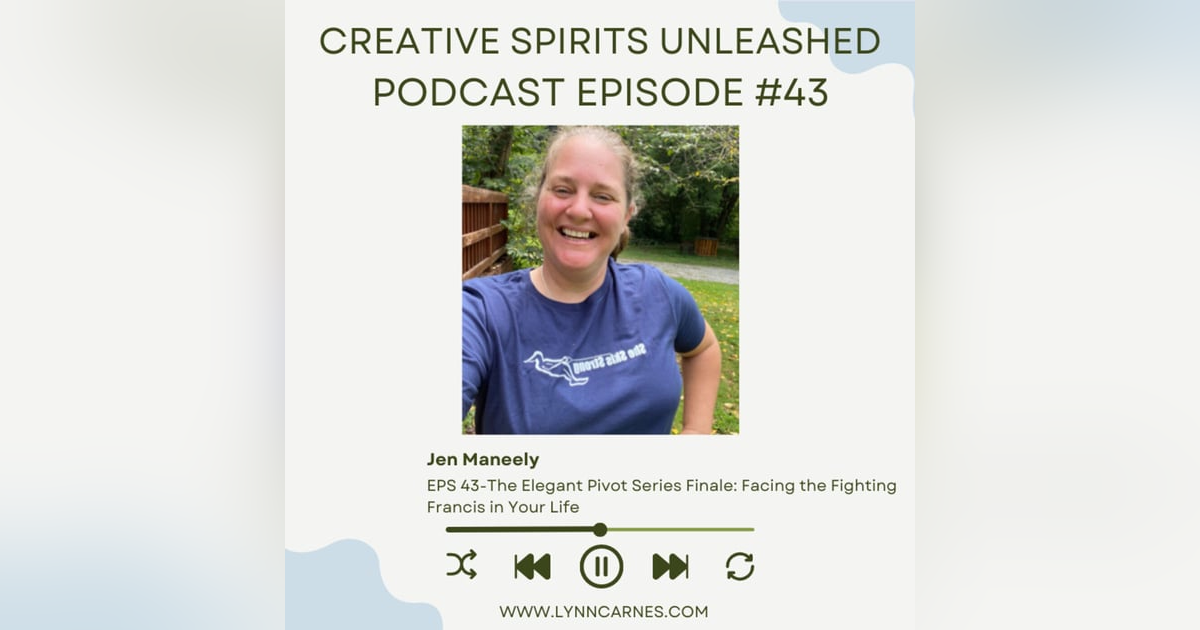


You asked for it, so you got it! We decided to wrap up the The Elegant Pivot Series with a final bring-it-all-together conversation. My daughter, Jen and I have been exploring the five principles in my book, “The Elegant Pivot: An Inspired Move for Navigating Corporate Politics”. While the subtitle may refer to “corporate politics”, my readers are telling me it applies to much, much more. As a refresher, here are the five principles along with the past podcasts we have done.
1: Discern Signal from Noise
2: Focus on what You Want
3: Take Nothing Personally
4: Master Your Stories
5: Develop A Sense of Inquiry
Jen and I have been working together for several years, and given that we are mother/daughter, we get lots of opportunities to encounter some personal politics. The Elegant Pivot, which is about how to assume positive intent, is a really powerful tool to use -- if you can get out of your own way. We've had so much fun having these conversations, because we’ve been applying the principles in the book with each other. We even encountered some live-and-real-time mother/daughter moments about how we have gotten in our own way, and how we navigated some of our difficult conversations.
In this wrap up, we dive deep into the trickiest character in the book, Fighting Francis. That’s the situation where someone truly has it out for you. When I ask people about assuming positive intent, and where it works for them, they say, “I'm okay to assume positive intent if I don't think they're out to get me, but if I think the other person has negative intent or is out to get me, I just can’t do it. I am going to assume the worst.” I get it and I’ve been there. I still have found that assuming positive intent works wonders and in this conversation, we talk through some practical situations that ended well – and give some strategies for how to use the five principles to navigate the dreaded Fighting Francis.
I would love to hear what you like about this conversation. All you have to do is go to the podcast page on my website at www.lynncarnes.com and click the “send a voicemail button” on the right-hand side of the page. Super easy to do and it helps me know what to bring you in future episodes.
Of course, also share this episode with your colleagues and friends. I hope you enjoy this episode.
Additional Topics
- It’s much easier to show up in the ways we want to show up when the space is created in that way intentionally. It’s when things catch us off guard is where we can find ourselves struggling.
- Are you going to keep owning the story that created a trigger?
- How can we pivot when someone is out to get us?
- Deciphering signal vs. noise
- Combating lack of enrollment
- How to connect with people in a aligned way with our goals in mind.
- Taking things personally can only happen when there is something we are insecure about
- Starting to pay attention to what you are taking personally if you want to start taking that self awareness journey
- When we take things personally, we take action that change the course of your life
- One small mindset shift on a regular basis can greatly change the outcome of your life
- We are going to experience triggers because we are human, can we master them is the journey of mastering our stories.
- What are some good types of questions (57:00)
- How can we effectively handle a Fighting Francis without giving out power away?
- Pressure is not a test; it is a catalyst to change the patterns and transform ourselves.
Additional Links
I’m Right You’re Wrong by Edward de Bono
Immunity to Change by Robert Kegan and Lisa Laney
Guest Contact Info:
Website: ManeelyConsulting.com
Email: Jennifer@maneelyconsulting.com
Intro:
Welcome to Creative Spirits Unleashed, where we talk about the dilemmas of balancing work and life. And now, here's your host, Lynn Carnes.
Lynn:
Well, welcome to the creative spirits unleashed Podcast. I'm Lynn Carnes, your host. The podcast today is about the elegant pivot and inspired move for navigating corporate politics. This is the final in a series of podcasts I've been doing with my daughter, Jen, who is also a co worker slash colleague. We've been working together for several years, which as you can imagine, in a mother and daughter, gives us lots of opportunities to maybe have some personal politics. And the elegant pivot, which is about how to assume positive intent is a really powerful tool to use if you can get out of your own way. We've had so much fun having conversations, sometimes live mother daughter moments about how we are getting in our own way. And navigating our conversations, you know, could be anything from requests, I've made agenda, do something for me, or at her asking for me to review something, or you know, it just any number of things. So this is the last in a series, we kind of summed up the five principles that we've gone through, and especially talked about that character in the book, fighting Francis, when I asked people about assuming positive intent, and how well they practice it to a person, including myself, they say, I'm okay to assume positive intent, if I don't think they're out to get me, but if I think the other person has negative intent, or is out to get me, I can't stand it. I am going to assume the worst. We talk through that character fighting Francis in a way that may give you some ideas about how to do it differently. I hope you enjoy this podcast with Jen Maneely. Jan, welcome back again to the podcast for the series that we've been doing on the elegant pivot.
Jen:
I know I think you know that it was interesting. You put this out and someone listened to it. And they were like, You need a wrap up to the whole series. And we were like, yes, because I think neither one of us really wanted to end it. But it needs to end somewhere. Right? Because it's so nice to have an ending. So we were very excited when someone said suggested a wrap up
Lynn:
several, several someone's Yeah, I got more than one saying you really do need to do a wrap up. So for those of you asking, and for those of you who aren't asking for followers in the podcast here right now. But it is I you know, I am not the best at completion. Because if anybody that knows me, well knows that if I don't watch it, I will live life as a run on sentence. I forget the comments or the periods.
Jen:
Hey, same here, capitalizations, as we just talked about.
Lynn:
And I feel like the modern world has a way of doing that to us it as it has us going from one thing to another and that downtime isn't even almost or you know, kind of breaking from one thing to the other, it is kind of hard to do. So yes, this one is putting a period in the elegant pivot just in time for my new book dancing the tightrope to start getting ready to be published. So I'm still working on some of the final things. In that book, people have it in hand right now that are reviewing it, I'm getting the feedback back. There's no such thing as perfect. So I'm getting some very good feedback that I'm going to work on, you know, making the book better. And it's not going to be just a couple of simple word changes. There's some conceptual changes. So it's gonna take a little longer. But I'm still excited about the book. I think in general, the bones are there and it's going to be a really good book.
Jen:
Yeah, it's definitely going to be right. I mean, it already is a really good book it is. And there may also be an opportunity. I think some of the things that you're you are looking at conceptualize may be going into another book.
Lynn:
It very well could be, you know, with the elegant pivot this book, what came out of this one, after it really got out in the world, was a lot of people said, I get those five principles, which we're gonna review in a minute. And yeah, I get the idea of the four characters, you know, right, the blameless, Bobby accidental and a provocative Peter fighting Francis, I kind of conceptually understand it, but I'm still taking things personally, or I'm still making up stories, or I still, like want to be right and don't ask a question because they want to prove I'm right. And yeah, you know, so I developed the workbook for this because it's really it's one to say, I think it's a good idea to do the elegant pivot and assume positive intent. It's another to have the inner landscape and tools and self awareness to pull it off in the moment. And especially when you're under pressure. And, you know, being under pressure, is what the dancing the tightrope is about. Really, right. It's all about the self awareness. You know, when you're not at a retreat. You know what I mean? Like, my self awareness, that retreats was great has always been much better than my self awareness when somebody's breathing down my neck for a result. Well, and it's,
Jen:
it's almost like when you carve that space out for self awareness, and that's where you're supposed to be in that mindset, right? You're like, okay, I can totally show up the way that I need to, and you're in that intentional space, it's when we're not in those intentional spaces where things have a tendency, like something catches us off guard. You know, that's where it's like, Oh, these are, those are the moments that I have a hard time showing up. So like, if I really sit down, and I'm in the space of thinking about these principles, and like, you know, living, I can totally show up in that way, when I make an intentional practice of it. It's when people catch me off guard. Or sometimes these principles kind of go right on out the window. Like they have never, I've never even heard of them before in my life.
Lynn:
One of the one of the things that I point out in the book, and in some of the articles around the book, is people know how to hit our buttons. And sometimes they hit our buttons and don't know they're hitting our buttons. Oh, yeah. That's the catching us off guard, you know,
Jen:
right. Yeah. It's, it's definitely the catching off guard of like, oh, they just hit my button that they don't even know they hit. And then you like, I know, I've been, you know, lash out at someone that has hit a button. And they're like, what's going on? What just happened? Well, vice versa, I've hit someone's button, and they lash out. And I'm like, Whoa, what just happened?
Lynn:
Right, exactly. And the funny thing is, we said, Okay, I should read this. I'm going to meet us now. I used to think if somebody hit my button, it was their job not to hit my butt. Mm hmm.
Jen:
Isn't it though?
Lynn:
And, you know, so I didn't ever use the sentence that was very triggering for me. But that's a pretty common language right now. What I see happening is people are, you know, saying that kind of thing. Like if it was my fault for triggering you, but I was just living my life doing a normal thing. Yeah. Right. We can't know what your triggers are. Right. And a lot of people's triggers are things that are fairly normal, like right one of mine, I'll give you a great example of one. And I had kind of let this group know that I had it. But what difference did it make? I showed up to a restaurant, and I was with work colleagues. And at that time, not now, but at that time, trying to enter into a larger noisy crowd was a trigger for me. So if the table had already been set, and people had already been there, I guess I had left out syndrome or where am I going to sit Central? I don't know. Yeah. But I walked in and and they were already all set. And everybody had kind of gotten their drinks, and it was going to have to be squeezing in and I want to just go in the corner and pout I was like, Well, yeah, fine. I'll just go over here and set it up. Because it's like a grown ass woman. And I had to like, fight, urge to not get triggered. And in my mind, especially since somehow that had come up in the meeting during the day, this was a dinner after a meeting thing. I felt like they should be responsible for taking care of me. And that it's absurd. Yeah. I mean, I when I tell that story now, at the time, I felt so justified, but I'm embarrassed. It's also reality, right? It is sometimes the way we get into these things with other people. And once we realized we're at a moment, like getting caught off guard or whatever the question is, what do we do with that moment? Yes.
Jen:
Yes, it is. Like, are we just gonna keep running with that? Whatever the story was, that was going on with you like, are you going to really continue owning that story that created the trigger? That made it seem like how are y'all not taking care of me? Right now in my tree? Like, how are you not acknowledging that you did this to me? Yes. You know, are we gonna keep owning that story? We're gonna look at it like you did, right? Like you can tell this story You now in such a way that it's like, maybe I don't want to say, I mean, you may feel embarrassed, but there's nothing embarrassing. I think we all have those things. But you can acknowledge that now today to say, Well, that was absurd, because of you didn't continue owning that story. Otherwise, it would have just kept happening, right? Like you're not owning that story anymore thinking that people should be taking care of you because you walked into a crowded room.
Lynn:
Exactly. Now, on the other hand, kind of in that same vein, a lot of times, you know, I have, you know, one of the most dreaded things when you get up in front of a group of people. You know, I've done a lot of facilitation, or speaking with people who are in the midst of big change, or we're in the middle of a meeting that they don't want to be at. Yeah. And I think there are two things that are probably the most nerve racking for a typical speaker or facilitator, they're probably more, but I'll give mine, one of them is, who are you? And what makes you think you know what you're doing? Yeah. And another one is, I don't want to be there. And one day, I was at a lunch, getting ready to be the facilitator for a leadership program. And the group, Matt, you know, they didn't all know each other. So it wasn't obvious who I was, I just went to the line, sat down at the table, sat down next to a guy. And he started really, really going into how pissed he was that he was at this mandatory meeting. That he didn't want to be at. He thought leadership was a bunch of crap. That if people were just don't understand, you know, blah, blah, blah. I mean, it was pretty devastating. And if I had had insecurities about my own teaching, or you know that everybody should love me or love this, it would have been really, really hard. Yeah. So he went on, it was a good 15 minutes, and I'm just sitting there eating my lunch and asking him questions and not saying anything. And then he said, So tell me, which division are you in? I said, Well, I'm in the division, that's going to lead this program. So I'm your facilitator. I said, I'm actually not in a division in your company. I'm from outside, and I wish you could have seen his face, his face turned white.
Jen:
I hate bad it did. Because he's
Lynn:
like, I, he looked at me and he goes, I have just done, dug myself a humongous hole, have an eye. And I said, you have just given me the best gift I could possibly have. And he said, Wait, what do you mean? And I said, Well, let me ask you a question. I said, You do not want your time to be wasted for them. And I think it was a three day program. I said, we're about to have three days together. What would you tell me as your facilitator that would make this program most worth it to you? And then you could see the color come back in his face. And he's proceeded to tell me and I can to this day, I can't remember exactly what it was. But I actually incorporated whatever he told me. And the story I said, Do you mind if I tell everybody the story, I think it'd be a great way to kick this off. And he goes, I'm okay with it. I said, I'm not going to tell people that you were bad or wrong. I'm going to tell them you challenge me to make it worth your time. And he said, okay, yeah, sure. All.
Jen:
Right, so go ahead. Sorry.
Lynn:
Well, so So what happened is, I can I can remember it to this day, because it was one of the better things. I remember that as being one of our best programs, because when I opened it up, you know, in this case, I actually did assume positive intent from the beginning. And gave him a chance to, you know, get out, like, get out of his own hole, if you will, and actually, he actually really helped me out.
Jen:
Well, so this sounds a lot like if we, since this is our wrap up, and we're looking at, you know, our five principles I can hear in that moment and that this is how quickly it looks like. So when I sometimes when I see like bulleted points or like one through five, my first assumption is is oh, I have to do these in order but that's not these principles are not to be done in order right. But when we really sit and break that down one it sounds like you're gentleman from the characters in the book we have a provocative Peter in question, right?
Lynn:
It could have been a fighting Francis like this is the guy that said
Jen:
it could have been a fighting France and by the way,
Lynn:
I forgot the most important part of the story. At first I was triggered you right? Okay. So when he first started talking a part of me when And to the well, who are you and what you know, and you should want to go to leadership programs and you're going to make me look bad. And you're going to be the scowling face in the corner. That's going to make my life hard. Great. Thanks. I hate people like you. I would just assume you go back home. There was that attitude for a little bit. So in that 15 minutes of silence, I was pivoting.
Jen:
Right. So you were right. You were just sitting here. Mm hmm. Now that also. So it sounds like if we can look at discern signal from noise, because there was noise that was coming up for you. And then there was also a signal. Yeah. Right. Yeah. So it's like, what, what's the, what's the signal versus the noise in this scenario?
Lynn:
Yeah. Well, and interestingly enough, the noise was made. Yeah. Oh, yeah. But voice was my trigger. Going, you should want to be here. Or, you know, there's another part, because what happens a lot of times, is the people who are gathering the people to come to these meetings, have not done a great job of communicating why they should be there. It is very common for people to get a notification. Over my 30 years of doing this, I've seen this happen a lot. There is a mandatory meeting at such and such room at such and such time. Be there. No enrollment, no context, no, why this matters. And so I get a little triggered, or could get a little triggered when somebody hadn't done a good job of communicating. Yeah, there's a noise I get triggered when somebody thinks I'm not a good enough facilitator. They're not excited about hearing, Have you not heard about Linkara? So do you want to come here from limb? Karns?
Jen:
Right.
Lynn:
This is exciting. And I love this stuff. And why can you don't love it? Right? That's all noise. Right? Right. The signal was, wait a minute, who loves mandatory meetings, who loves to leave a busy piece of work? You know, just leave for three days, knowing that they're probably gonna have to work at night, at lunch hour, before work before our meetings, they're going to, you know, because a lot of times the management team will send people to stuff like this, but they're not giving them the time off, per se, like, yes, continue to do your job as you always have. And oh, by the way, we're going to take three days out of it, but you still have to continue to do your job. Our expectations haven't changed. Right?
Jen:
Yes, show up for you know, getting all this stuff completed, or you're not taking a three day vacation. You're still working.
Lynn:
That's right. So so that principle that which is the first in the book was and it was part of my it was part of my, you know, helping myself manage the trigger as it was happening. You know, what was just certain signal from noise? Yeah. And I realized, you know, what, he's not the only one. Right? He's just the only one that has the courage to say it out loud. Right? Well, he happens to be
Jen:
sitting and making an assumption that, you that that, you know, at the same time, it's like, he probably didn't want to feel alone. And he probably knew he wasn't alone. And it was mandatory thing. And really, he was also probably wanting, because we do this too unconsciously. He wanted to connect with someone who asked about the same thing. So at the end of the day, he's looking for a connection was someone of going can we not just vent for just a second about how that what's the vision of can you believe this company? You know, we do that where it's like, we may that's a really good point. We may we're just we just may be looking to want to, like make this the whole thing like can I have a partner in my VIP session about how stupid this company is? And all of those things? And yeah, he's may be feeling a little out of place. He obviously didn't know you. He may not have known anybody. Right. But that's his. So like, these are the assuming positive and like what's going on? But so back to you, where you're just still here, you know, signal from noise and you have 15 minutes of kind of the silence of just hearing him bash. What he doesn't even know what the program is yet. Right? And so then kind of what in that moment when you're sitting there pivoting? Yep. What it what else is coming up for you like When? When did you decide and I think this is important. When did you decide and start recognizing the pivot?
Lynn:
I can't tell you exactly when because it's been a little bit too long. But as I was there quietly, I started thinking about how awful it is. Have a detractor in the audience. Yeah. And so I probably went to the next principle, without even realizing I was doing it because it's long before I wrote the book and put these principles down on paper. But I was focusing on what I wanted, which is, you know, I had had enough experience by this stage of my journey, to know that that the detractor can become your greatest ally. And so what I wanted was him to actually connect with me just the same way he was trying to connect with me on this other thing, but I wanted him to connect as a ally, not as the guy in the back of the room that's going to be there. Well, frankly, it's a heckler.
Jen:
Right. Why are we here? Why are you wasting my time asking those very confrontational questions? Yes, that leads to nowhere.
Lynn:
Right. And we were gonna be doing a lot of small group work. So people that are hecklers, like that can actually, you know, work the room a little easier, because they're in a small group, right? And I just remembered, you know, okay, this guy, is he's going to be one or the other, he's going to be an ally or enemy, he's going to be my best friend, or he's going to be fighting Francis. Right. And we really weren't that provocative Peter stage where how I responded mattered, because he was poking. But your insight is very important, because I didn't have that at the moment, I don't think, but to recognize a lot of times people connect through complaint. Mm hmm.
Jen:
Yeah. Brene, brown talks about that a lot in her work about how we often will connect through those those kinds of avenues, where it's like, we want to connect via, you know, it's just like, you go to work, and it happens to be a toxic work environment, even though like, you're really excited to talk shit about other employees with employees, right. And it's like, it almost kind of feeds that, that thinks you're communicating through a negative way. And you know, a lot of people, we do that. And we do that unconsciously, I had to be very conscious and diligent in breaking that habit for myself and being mindful of it even now. Because man, let me tell you, someone calls me up and wants to start talking about someone that I don't particularly like, I have to be very mindful not to feed into that into that story. And it's has nothing to do with what they're saying it has everything to do with I feel so good right now with this person. But it doesn't, it doesn't lend. It's not very strong. It's not very stable. In that so?
Lynn:
Well, it's not it's it's actually as this is coming up for me, this is reminding me that I had probably recently gone to a workshop with Bob Kagan and Lisa Leahy, and they wrote a book called How the way we talk could change the way we work. And they actually start a process about turning your big assumptions around. That starts with finding your biggest complaint. Here's their thesis, inside of a complaint is a commitment. Yeah, if you can find their commitment, then you can connect on a different level. So for the listeners that are listening, kind of tuck this little lesson away this, this idea that if there's a complaint inside of that is a commitment. And I'm guessing I can't remember for sure. But I'm guessing because of the timeframe that this happened. I probably spent some time on the focus what you want, deliberately thinking, okay, he's complaining, but inside of there was a commitment, what might he be committed to? Not wasting my time? Right. And I was just developing a theory, what might he be committed to?
Jen:
Right? Based kind of why he was,
Lynn:
you know, you're planning What's your commitment? You kind of can't do it that way. No,
Jen:
you can't but but that's and that's how it's like, you know, we we kind of break these principles down in the book and stuff, but when you're in the moment, it's more of just a practice of flowing through of like, really experiencing and being grounded in going okay, I'm not gonna like I don't think at any point in time in this did you go okay, now I have to discern signal from noise. No, no, no. Right now I have to focus on what I want. And now it's like, Oh, I really have to make sure that that third principle of take nothing personally really arises. But it is that practice of really thinking about these as we're dealing with someone who may be, you know, hitting on our triggers or who may be triggered by You know themselves of going, Okay, let's just approach this from a way that. And in order to do this really, it was like, I had to imagine that for a minute. You had to be taking things personally. But you also had to override taking things personally. Right? So like, right, in order to start coming out with and pivoting that, you had to let all the you know, him coming at you go for a minute and go, Okay. Now, what's a better conversation here? What's the Yeah, that's a great question that I can ask to vote what I want and the idea of focusing on what I want,
Lynn:
it's, I feel like sometimes the energy at a moment like that is in the taking it personally. Oh, yeah. It's, there's a lot of energy and taking things personally, because, you know, when we're little babies, and our parents come and answer our every beck and call, you know, we actually it is very personal, everybody's staring at you and saying, you're such a cute kid, or you're such bad, good or whatever. But, you know, you're getting a lot of like, the world revolves around me. And it's one of those like, earth shattering things, especially if you have siblings, and my case, I was the oldest. And when my sister came in the picture, it was kind of earth shattering. If they get two and a half years old, somebody else was coming in the home because it's like, this is my home. And I'm the center of attention. I mean, as a two and a half year old, I can remember it kind of rocking my world, you know, and realizing mom had other things to do besides take care of me, right? Like the world is not all about me. But there's a lot of energy and taking things personally. And I work with so many people who say that's the hardest thing for them, and they can know it in their head. But the energy is, you know, I in my new book, I'm talking about flywheels of energy. And I think this is a place where it really resonates for me is we have are all patterns are like a flywheel in a car. And a flywheel is an energy storage device, it gets to turning faster and faster, and it smooths out like the pistons in the car so that you're not getting dirt, dirt, dirt, dirt, dirt, but like a smooth ride, because the flywheel is actually gathering the energy from each piston and then smoothly deploying it into the transmission. Yeah. So in a way, if you think about it for us, we have all patterns that are full of an old flywheel of somebody who says this, and then I do this, and then I do this. And of course, I'm using flywheel in a business context, like Jim Collins did in his book, Good to Great. And then he wrote up a monograph on it called, I think, the flywheel. But we'll put that in the show notes for how to find that flywheel. But we it's sort of a series of steps that just one thing leads to another and next thing, you know, that's the flywheel you're running, which is well, if they're taking things personally, or if I'm taking things personally, then I have to change your mind. So I feel good about myself. Yeah.
Jen:
Yeah. And that's probably I mean, when I think about a lot of the situations that I found myself in that, you know, taking things personally if I if I go down that road with that story of taking things personally, I usually all the rest of the principles go right out the window for me. There now there have been times where I can set aside you know, what it means to take things personally and compartmentalize that for the heat of the moment and and work through the principles and move forward and have a different conversation, but man, that's probably my more triggering thing is taking things personally. And it's because every single time it happens, it's always the hit something that I was insecure about to begin with. Well, there's
Lynn:
no way you can take things personally unless they do.
Jen:
Exactly yeah, I mean, like, it's it's like I think about okay, if someone told me I have brown eyes, which anybody that knows me knows I don't have brown eyes. I have very low eyes. It's very blue, blue eyes and if someone you know got mad at me and said, but you have brown eyes, in no way shape or form, would that impact my emotional response or anything like it would just be like, okay, but you know, if someone clash I even have to admit, like an insecurity right now I'm always really uncomfortable. I make my point I kind of have to show the other side of of So like right now and I'm just be perfectly transparent. You know? I'm a little insecure about my weight at the moment. So if someone else by the
Lynn:
way, let's just take a pause. I wonder how many other people, yeah, that are listening to this are a little insecure about their weight. And it has nothing to do with what the scales are saying.
Jen:
No, say and that's the thing is is like, I'm insecure about my weight. But it's not because of how much I weigh. It's just because like, I'll look, I'll like, I'll look in the camera, and I'll see like, my fat face, or what I think is my fat face. It's not my fat face, like, I don't have fat face. But I think it's a bad face, right? So I have all of this noise coming up in me. And the point is, is I am already insecure, and most people are going to be gracious enough to say no, Jin, you're not fat, you don't have a fat face, you're a good shit, you look great, and all that stuff. But if someone came along and said, Jen, you've really gained a lot of weight, what's going on, you seem a little fat, look at your face.
Lynn:
Like your eyes are brown,
Jen:
as opposed to my eyes are brown that hits me nothing at all. Now, if I was really fit, and really skinny, like I used to be, which is just a fact, it's not a judgement, it I used to be really skinny, I used to be really nice to be really, you know, I could I was just very, in very good shape. And if someone had said that to me, then it would not have triggered me because I would have known it was not an insecure moment for me, right? Like, that's not an insecure button for me. Because someone says that today, um, then, because that's an insecurity of mine, this probably gonna, it's gonna hit me, it's gonna be like, Look, Alright, that's it, I'm putting down the tasty pastries. And, you know, probably not doing very good things that are healthy for me, in order to get back into shape, because I'm doing it through insecurity, not because, you know, from a more productive standpoint, but anyway, so it's, it's that taking things personally is my trigger every time and it's so like, now I have to look at my triggers and go, what's the insecurity and work on them? So then I don't take things personally.
Lynn:
So right there is the beauty of this stuff. Yeah. Because, as I've taught, I don't even know how many self awareness programs and I don't even know how many hundreds of people have gone through them. But one of their biggest questions is How do I develop self awareness? Because I've kind of developed knows blindness to myself. Yeah, nose blindness is when our house has a certain odor. We're the only ones who don't notice it. Anybody else that comes in can see it or smell it. Right. And we have nose blindness about ourselves, we don't see. And when we go on a journey to become self aware. The first question is, what are my ways? And I often say, start paying attention to what you take personally.
Jen:
Yeah. Well, and then here's the challenge. And I think both you and I know people on this scale as well, several of them the most self aware, insecure people we've, because it's like they're very aware of their insecurities. They're not very aware of how to deal with them.
Lynn:
That is exactly right. And that's for I love this idea of assuming positive intent, because in a way, it's a Get Out of Jail Free card. Yeah. Because when you take things personally, and I have a story about that about a loss, friendship, frankly, when you take things personally, you take actions that have consequences that move your life in a different direction. And, um, a lot of people know I'm taking flying lessons right now. And one of the things you do when you're flying is you have to hold a heading on your airplane, while the airplane unless you have autopilot, which beginner pilots so good to have. Doesn't have won't stay on heading unless you work that way. Any more than your car will stay between the two lines when you're driving. Yeah, constant corrections. Now up in the air, we don't have a road to give us guidance. It's a heading. Right and you can easily get off course and one degree off course, when maybe not put you at the airport to run out of fuel. Right. So if we make changes in our lives where we think Well, that wasn't that big a deal, but that wondered rate might have made a huge difference of whether you met your goals or not. Because you've let something go, rather than go back.
Jen:
Yeah, yeah. And I often tell people have like, you know, one small little one small, tiny little mind shit, set shift on a daily basis on a regular basis, can greatly change the outcome in your life. So try one small, it doesn't have to a lot of people think that change has to be this massive overhaul. It doesn't, it's one small shifts,
Lynn:
right. And I'll give you a shift for taking things personally. So I sometimes think we have to turn into a problem, in order to turn away from the problem, we have to do the opposite in a way, just like in an airplane, when you're stalling, and the plane is going to fall to the ground, if you don't do something, ironically, the move is to push the nose down to get the wind going back over the wind. So it's the opposite of what you would expect to do. Yeah, as you're afraid of the ground, no one will come into contact with the ground. Well,
Jen:
it's also like they say, you know, like, if you are in snow or ice, you turn into the
Lynn:
kid, it's exactly the same principle. So here's the thing to say, when you find yourself taking things personally. So I'm taking this personally, which means I am going to give this person all the power and how I feel about myself about this thing, my weight, my color, my quality of presentation, my book, you know, if I get a bad review on my book, and I take it personally, then I'm giving you all the power to tell me how I feel about myself. Now when I say that, when I when you hear that, what happens to you? Do you
Jen:
feel a little like, Oh, I did I?
Lynn:
Well, when you say it out loud, it means you are going to argue with your so you're gonna go wait a minute. No, I'm not. I'm not giving that power. Right a second. That has a way of getting the wind coming back over your wings. Yeah, it has a way of straightening out the skin, because then you realize what you've just said is, wait a minute, if I'm taking things personally, I'm not giving them all the power. Yeah, it opens up the realm of possibilities that okay, there may be something there for me to look at later. But right now, while I'm sitting here with this guy, talking about how much he doesn't want to be here and my leadership program, it's not about me, he doesn't even know me. Yeah. So my insecurity that I might not be as good a facilitator as I think I am, or whatever my self doubt is, that we can set aside for the moment because I'm not gonna give him the power to tell me I'm not a good facilitator. before I've even said a word in front of the room.
Jen:
Well, and that sounds a lot because it's like, I think a lot of what we're talking about here is just being human. Right of just, we're gonna find ourselves in triggers, we're gonna find ourselves with insecurities. Why because we are human. And so then the question is, is when we find ourselves in that moment? Can we master our stories? Can we Yes, you know? Why? Because what you're expressing Right, right. So but what you're talking about there is all right, I can say I have insecurities. Right now. I'm gonna go look at those later. Yeah, but for here, and now. We're gonna go down a little bit of a different path and not, not buy into the stories that I'm telling myself in the moment. But what's a different story that I could tell myself that gets me the outcome that I want?
Lynn:
This is where I say over and over again. You're the CO writer of your life. Yes. Because your stories are the driver of your actions. Yes. And guess what, if they're your stories, you also get to be the editor. Yeah. Yeah, actually get to change the
Jen:
story. You get to change the story. But you get to change the story in such a way and we're, you know, we'll kind of go back and forth because I want to kind of talk more about master your stories, but it also gives the ability that when you've kind of, you know, master that story said, Okay, I'm not going to focus in then on this. It's like, I wonder what his story is.
Lynn:
Yes. And then the sentence I wonder,
Jen:
I wonder what his story is, and now we can explore with him. Well, what is coming up for you? And isn't that the like in this developing a spirit of it? inquiry, which is the fifth principle of Wonder what's coming up for him, like, let's put my stories to the side. And let's, let's look a little bit at his stories, and maybe can we come together and talk about a different
Lynn:
story? And well story, you know what's cool, and, you know, the, the questions are such an important part, which we're gonna get to that's the 5/5 thing, develop a spirit of inquiry. But I remember and it's in the book, The Story of Mark, when I was on a team, this is when I was in my big banking job. And I was the team leader. And we had an executive sponsor. And a lot of times when you've got a project, these are the things that move your career to another level, if it goes well. It was that for me. And he had been just a complete supporter of this project. He was our champion. He, you know, ran interference with the executives, he got us the resources we need, he talked us up, it was so fantastic. You always want somebody like that. Right. And here we are, all of a sudden, our team finds us in this meeting, and he is not on our side. And he is acting offended. And I tell the story of us taking a break. And I remember, I can almost remember it like it was yesterday, three of us or four of us huddled in this little office, aside from the conference room, I don't even know whose office it was. But I remember where I was standing and where they were standing. And we were like, What is going on? We were kinda like, try not to take it personally. But oh, my gosh, he hates us. He hates our project. But
Jen:
our champion the one person that yeah, like was on our side that we didn't have to worry about. We never questioned, you know, anything from him all the sudden. So it's like, we must have done something wrong.
Lynn:
Well, and, and we were wise enough to also like go to look around, because sometimes in the corporate world projects come and go based on what's the flavor of the day, what the budget is what the news is, you know, what's the push right now? You know, so we'd all been on projects, where all of a sudden, we were the Darling and now we weren't because something else was the darling. So, you know, did our project suddenly not get as much attention? What was it? But we just sat there and huddled and somebody just said, It looks like he just feels left out? Oh, and we kind of always like, well, it does kind of seem that way. And you don't I often feel like the people in power would feel left out. Right? You know, because one of our jobs was to kind of run with this without keeping them too much in the loop because they have a lot on their plate, the senior ups. I had been in another project for I was reporting to the, you know, almost to the CEO, this was they had 150,000 people in the company. So you didn't get a lot of time with your boss when you're at that level. Right. And so I was kind of trading things like that. But we we said that's our best guess is what's going on? Yeah. So when we came back in the room, I said, you know, something to the effect of one of the questions I have is how do you feel something along the lines of how do you feel about how much we've been updating you? Do you feel like you need to be more hands on and more involved than you have beer? And we get paid or the first thing? Like it could have been something different, but at least a question like that would have prompted him to say know what it really is, is this right? Yeah. Because I actually posed the question with a theory. And it happened to hit painter. I wish he could have seen his eyes change. You know, it's that moment where it's like, you got me. Yeah. And it changed the whole tenor of the meeting. And of course, the project ended up being great. And he was a great sponsor, and all that kind of stuff, right? So little moments are where this all comes together. And there's
Jen:
been so many times where I have asked people questions with a theory. And, you know, I'll say, and please, and I'll, you know, correct me if I'm wrong, but what I'm hearing when I think it could be happening is this. And a lot of times I was like, No, that's not really it. What I think that it is, is that
Lynn:
and you know, you couldn't we didn't say this in this that story, but the story I'm making up is right. Yes. Yes. You know, that's a great way to say it. Now. On the flip side, I had a friend call me one time. This is back when you and I went back in like Charlotte days. Yeah. When I was at the bank, but still single and the friend had I we picked right up where we left a couple of times. As you know, as friendships go, sometimes you are close. Sometimes you're not long term friends, you kind of pick up but we had had a little bit of a time when we weren't hanging out that much. And she called me one night and the whole purpose of her call was to say not hey, what you've been doing, how are you going? Any of that? It was I'm wondering what happened to our friendship. And if I have done something that has caused you to distance yourself from me?
Jen:
Yeah.
Lynn:
Well, I didn't have the tools to realize that was a story or to understand it, but I did deny it. And then, you know, kind of in the phone, but I also was like, well, maybe I have and, you know, I kind of vacillated back and forth between feeling made wrong. So I had to justify myself to say, well, that's not really yet. But I remember when I hung up the phone that night, I was like, Well, I've got to do a better job of staying in touch with her. Yeah. But I didn't write. And it was almost like, I unintentionally made her right. Right. And that was the end of that friendship, I mean, just by virtual ghosting that I didn't even mean to happen or didn't want to happen. Right? We have been in touch since mainly because of my, frankly, my emotional immaturity at the time, of not being able to counteract her theory, which was not accurate. It was not that she had done anything other than I had been kind of, you know, I think I'd gotten caught caught up with another probably dating somebody or whatever it might have been. It might have actually been during the time this very project we were just talking about happen. Because I remember for about a year, I was just kind of like, yeah, this radar, I just had so much to do. I was workaholic, basically.
Jen:
So in this situation, how many times had she reached out to you, and you just didn't reach back? No. So she didn't reach out,
Lynn:
either? No, without her reaching out or saying, Hey, can we do this? Or that? I can't do it. I can't do it.
Jen:
Right. Yeah, it wasn't, it wasn't something where she was reaching out to you and trying to make plans. And you were always just saying, No, I can't No, I can't No, I can't. It was it was not a it was a it was very much a you know, thing. And that's
Lynn:
and then it's because she was making up stories. Let's be
Jen:
right. And so this is this is this is what it looks like when, you know, on the other flip side of when, you know, these principles are the opposite of said, principles that we're talking about. Right? So it's like, if you're living on the noise side of the spectrum, so at some point, she created noise for herself. Right? It wasn't really focused on what she wanted, like, did she want a friendship? Is this asking, like, how is this and then she obviously had to be taking something personally, we don't know what it is. Right? It's correct. And, you know, she hadn't mastered any of her own stories in this. And she did ask the question.
Unknown:
But, right, like,
Jen:
I mean, there's all sorts of different types of questions. And maybe it was a good question. Maybe Maybe it was, you know, it was the question she needed to ask. But the question that she asked was based in her own insecurities, it wasn't based from focusing on what she wanted, from, you know, like, hey, you know, maybe, I don't know how the, oftentimes, and I, and I'm looking at this, because this happens a lot in my friend group as well, because sometimes we just go off, and we may not talk to someone, and neither one of us are very good at keeping in touch, Oh, the other person. And then I have to own that I haven't been good. And they also have to own that they haven't been good. And it's a mutual thing. And then it's like, hey, if I want to break that cycle, then I can say instead of, did I do something wrong? It's, do you want to catch up? I haven't seen you in forever. Let's go grab a cup of coffee.
Lynn:
That's the focusing on what you want. And, you know, as we were sitting here, talking about this, I thought about this as a client and especially, I mean, as a coach, and especially as a new coach, sometimes it's not uncommon for people who haven't had a lot of coaching to ghost their coach accidentally. Mm hmm. Right, that they'll start will start getting into stuff where they're uncovering some stuff, or they're getting busy. And they feel like this is not a high priority, because it never has been a lot of times people don't take care of themselves like they should. And as a new coach, especially I would go What have I done wrong? Yeah, and have I failed them? Yeah. And what I learned is that story is never true. And it is never useful. And so I have made a product This of always going back more like yours, hey, do you want to catch up? Are you ready for a coaching call and depending on the agreement, I usually start out by saying you're going to go through this. Yeah. And here's what's going to happen, and how I'm going to help you help yourself to show up, right about not doing your meetings about use it or lose it about the cancellation fee, all these things to kind of set up an infrastructure around you that says, I'm your proxy for you, as your coach, right. And I will help you show up by setting these things up that make it painful for you not to. But what I won't do is make up stories that I'm not good as a coach. However, if I give you an assignment, if I do something, and it doesn't work for you, by all means, bring it back to me, and we will get something that does work for you. Right? And that's assuming positive intent of it. Because I could see people actually, if a coach, if you if you said to somebody you know, or I'm not, I feel like I'm not a good coach for you. Somebody who's not sure on it for themselves would be happy to take that self doubt. And put it on my head.
Jen:
Oh, yeah. Uh huh. And that's exactly what would happen. They would be like, you know, what? You saw, I thought it was about me, but it was really about you. And you are the one that yeah, like, you're not a good coach for me. Yeah, yes, instead of instead of really exploring that, you know, I'm, I'm not a new coach. But I'm gaining more and more experience of what this looks like, and having, you know, to work through the very things that you're talking about, of, you know, really creating that infrastructure for people that says, you know, I'm here to show up for you, you're not, you're not here to show up for me, like these appointments are not. For my benefit.
Lynn:
No, we are a resource to our client, where resources schedule
Jen:
the appointment, and that is not like it because it's like, you're right in thinking that, you know, when someone doesn't show up for their appointment. They think that they're just, it's just them that it's just costing them that and it is. And it's also, you know, it's not just about them, it's about showing up for themselves. And it's like, you know, but then also creating those, like, commitments, but for a long time I have, I've been working through some of my own stories, about commitments, and how strong I can be with agreements and all that stuff. So I'm a scary one away, right. And then it's like learning the value of what it means to create agreements. And also recognizing when my stories, my noise, my taking things, personally, my insecurities are showing up in there and going, Oh, we really got to, you know, look at this stuff and and clear it out really like that's the work, right. That is the work and making sure that it's not showing up in in in these things. And it's been a great journey through navigating. What does it mean? Because like you just said, a lot of new coaches do this. I agree. I think a lot of new coaches, myself included, would would show up and what did I do wrong? Oh, they didn't show up. Maybe I'm not being of service to them. Like, I
Lynn:
don't think I'm good. If I was good. They would never miss a meeting. Yeah,
Jen:
yeah, no, but but when it comes time to get into, and it almost never fails, when it comes time to get into that heavy work. A lot of times, that's when the agreements get a little shaky.
Lynn:
Yeah. Um, that it's that heavy work. And so as we, you know, we, one of the things I'm thinking about for this, you know, wrap up is we've talked about, there's five principles that we've reviewed in this series. Yes. So, can you review them in order? Do you have them in order of the book?
Jen:
I can do it? Um, so we have had podcasts
Lynn:
on every one of these, by the way,
Jen:
we have discern signal from noise, which talked about that today. Focus on what you want?
Lynn:
Oh, yes. Which doesn't mean you hit your head on a silver platter and say, I'm not very good coach. What did I do wrong? Right, because you're not focusing on what you want, which is to have your client get the most out of coaching and it doesn't work that way. Right. Put your head on a silver platter, you say? How can I support you to make your meetings?
Jen:
Right? Take nothing personally. Oh, that's a big one. And we have a whole podcast on that. Yep. Master your stories,
Lynn:
which we've talked a lot about as well. We've
Jen:
talked a lot about and develop a spirit of it. inquiry,
Lynn:
which we did in our last podcast that we've kind of mentioned today, the questions, and you started on something. And I think we should sort of as we start to wrap up, what what is the distinction between a good question, or let's call it a useful question and a not useful question.
Jen:
Well, so I'm, I'm still playing with this myself. And I think there's an art in questions, right? I can find myself asking leading questions, asking questions that are going to lead to something that you may not want to go down that rabbit hole, right. So I had someone tell me, I, I had a tendency to ask a lot of why questions. Yeah. And someone said to me, and I've been in practice of this ever since. Because what I think about it is true. They said, you know, questions are really great, great. And you may want to stick to the house and the what's in the wins. The y's have a tendency to lead us down a rabbit hole where they're answering maybe not away, but the hat, like how does that make you feel? What's coming up for you? When did you first start experiencing these kinds of emotions, those kinds of questions, and kind of steering away more from the why questions, because the why questions will lead sometimes into circular types of questions.
Lynn:
I could not agree more, I'll give one exception to that. There's a practice called the Five why's. And in that setting, I feel like the five why's which is a deliberate discovery to get to the root cause of things. Yes, can be very useful. But the problem with why questions if they're done without that context, or without that meaning? And, frankly, an agreement about what we're about? Is why tends to remind people of their mama, like, why did you put chocolate all over the kitchen table? Why did you do this? Why did you do that? Right? And it triggers people it gets submitted their kid mode? Yes, very easily. Yes. And when people are, like triggered or feeling wrong, or feeling like they made a mistake, I can guarantee you, you're gonna have a harder time assuming positive intent.
Jen:
Right? And it doesn't mean like sometimes, like when we're in the moment, for me, like questions just start coming out. And a why question may come out of my mouth before. I mean, because these are practices, right? So this is this is just being mindful. And then like, Okay, I asked the question, we'll let them finish. And then we'll go back into, you know, a different type of question or whatever. And there is definitely, you know, an art to this. And I think, a practice and asking questions. And this is what I remind people, whenever there's, you know, we're working through some things, especially if it's something new to them, it's going look, all of this stuff is about practice, you're not going to get it right every time. It's just like, the best basketball player in the world. And I think I've used this analogy on one of the podcasts before maybe I didn't know that what's great is first time anyone's ever heard of it. But the best basketball player in the world does not make 100% of their shots. Not not even close, like normally, the best baseball player hitting a baseball, exactly. Back hitting their receiver, you just the best players the best, whatever in the world doesn't get it right, every single or does, I don't want to get it right. But they may be at the mark, they may hit the mark more often than someone that's newer basketball, right? Or newer at playing football, they're going to be better because they've had the practice. But it doesn't mean that you're going to get it every single time. So, you know, that's what I like to remind people. And this is this is really important with these principles, because a lot of times, like when we're talking to people about these principles, it's like, they're like, you know, the, I don't want to say the five year old because we're grown adults here. Five year old, but it's like the five year old that just picked up the basketball for the first time, or just picked up the tennis racket or just picked up. The just sat down at the piano for the first time. Right? And so it's like we're talking in there like, Oh, but I understand the words that you're saying. And the concept of it, I get the whole meaning. But these are practices that we do in our life where we're going to come to a situation and it's going to be a practice of mindfulness of can we He be grounded, and it never looks like, Oh, I'm going to not take anything personally in this situation, it's more of an embodiment of of really going, Okay, I'm going to stay grounded in my power in who I am, and not let my stories override the situation. And what's really going on here. And and this is where, you know, we didn't talk much, but I think it would be really good. Because a lot of people every time that we bring up assuming positive intent, there's always that one person that goes, Oh, no. But what about that person that's really out to get you in that fight,
Lynn:
fight, and Frances and they really are out to
Jen:
and they are out to get you. Right. There's no doubt. So it's like, I am not giving away my power to those people. And it's like, no, you're not, you're not going to give away your power to those people. You're going to make them show you to themselves. And I love your article about the five ways. The
Lynn:
five methods for the five days for handling fighting. Frances I can't remember exactly what let me get this. I'll look at it.
Jen:
Yeah. And well, we're gonna put we're actually going to put this so you know, if you're new, and you haven't signed up for the coaching digest, then absolutely. Sign up. And there's going to be a link to the fighting Frances. Yeah. And you can go to like cars. Yeah, you can go to Lynn cars.com. And sign up for that. And the article will be there. Otherwise, we will be posting it out to the people that are also on the coaching digest. Yeah, there's a thing.
Lynn:
There's a there, if you go to Lynn cars.com. There's a box that says subscribe to the coaching digest. And the title of the article is five methods for navigating a fight fighting Frances. And you know, the the outcome of a fighting for instance, I'm actually working with a client who has this going on right now. And I can't go into too much detail because I don't give away client stuff. But the archetype of what's happening is pretty common. It's the classic rarity actually have the story in the fight in France is a live story in the in the book on fighting Frances, in that chapter, where it's the classic board meeting, and somebody's out to get you. It's a person, sometimes it's another board member, sometimes it's another executive committee member, or sometimes it's, you know, somebody that's a quote unquote, colleague, that doesn't like you, and it's gonna make you look bad in front of your people. Yeah. And it's so easy to get hung up by that, because, you know, they are trying to make you look bad. And they and only way that they can make you look bad is if you get hooked,
Jen:
right? Yeah. And it's like, they'll ask you those, like, really messed up questions like, either you're stupid, or you're incompetent. Which one? Is it? Right, like, exactly what kinds of questions but by the way, those are not good questions.
Lynn:
No, that is not the way to do it. And, and actually, it's almost never that obvious, but the tone and kind of the meaning, because you kind of know how they are, you know, you impute that tone and meaning on them, or you take it and run with it, because anybody can see it. But the truth is, if you can hold your ground, follow the five steps I have in this article, what happens is, you frustrate them. So they'll do a round one, and you didn't get hooked, and they're ready. So they'll come back for round two. And they're going to continue to escalate. And it's undercover at this point, I think of it as it's almost like somebody's passing notes under the table. Remember when we did that in school, and then we'll add the note, right? And so at first, they're passing a note under the table and you're accepting it, nobody else could see it. And then if you act on that note, you just read, you're in trouble. But after a couple of notes under the table, either they're going to either be relieved or put down their argument, if you will, they're quick passing notes, and they'll come back maybe for another day. And everybody in the room is going Wow, you really kept your calm, that's good. Or they'll get hooked themselves. Yeah, come out on top of the table. And next thing, you know, the notes are getting passed across the table, meaning that everybody else can see that there's something there's an undercurrent happening between the two of you and this person is trying to get a rise out of you. Yeah. If you continue to treat them with respect, say more about that. I'd really like to hear your thoughts on that. Well, that's a really good question. Keep staying calm, cool and collected. Eventually they have to write it in big red letters on the whiteboard. I hate your gut. Yeah. Now, if you're in a board meeting and somebody else says, I hate your guts, or the equivalent to corporate equivalent of that, it's obvious to everybody, I 100% assure you, the rest of the room will take care of this person. You don't need to do anything else your job is to just let them hang themselves. Yeah, I've never seen it fail. If I can help my space that long? Well, I'm gonna give away five methods for fighting Francis is a good way to the core behind it. By the way, I brought in a new idea in that article. i It's not my idea. It's Edward de Bono's idea. He wrote a book he wrote two books on this one's called raw water logic. And the other one's called I'm writing you are wrong. They are both based on the same idea, which is what assume positive intent does, which is asking the question, the action I'm about to take, what will it lead to? Water has a way of going around rocks. Rocks that beat each other up the right and wrong, tend to, you know, if you're beating yourself over the head with a rock constantly, because you're using rock logic, because I want to be right and you're wrong, tends to get you bloody. Yeah. But if you think like water, and go, You know what, I'm going to create a path for this water to go around the boulders, and over here and over there and follow the path of water, then we're going to end up with a good outcome. Yeah. So my article kind of talks a little bit about that. So I'm happy to get that for people. Yeah. And there's another kind of piece that we've kind of alluded to, if you're really, really, really stuck, and your assumptions feel like they're not assumptions, I just feel like fact, that's the way the world works. The best work I've done is called, there's a book called The Immunity to Change. It's also about Bob Kagan and Lisa Leahy. And a process you can go through to really uncover the assumptions that are really stuck. They call it big assumptions. Yeah. And they have been transformative for me. You can reach out to me through my website, or on my Instagram or LinkedIn, if you want to know more about that, I'm not going to add this to the coaching digest because it gets just too heavy. But if you find yourself so stuck in assumptions, then you know, reach out through one of those means the website, LinkedIn, Instagram, and I will get you a deeper worksheet on how to sort of start breaking through those things. Yeah, so. But this, this series has been just a ton of fun for me,
Jen:
it has been I've been I've learned so much. We've talked about so many deep things had so many good mother daughter discoveries along the way of of it, especially like when we're thinking about some of these concepts about, oh, you know, this, this is what I learned from you when I was a kid. And this is what I took away from that. Right? So we had a lot of really good moments of of doing that. And that's always fun when you're having epiphanies about your parent, right next to your parent while you're recording a podcast.
Lynn:
We didn't have a lot of those. If so, if you're stumbling on this podcast and haven't been through the rest of the series, you know, might be worth that because I think a lot of our mother daughter moments mirror other people's parent.
Jen:
Oh, absolutely. It's like, oh, so when you were saying this, this is how I interpreted it. I totally created a framework a story around that, that I'm living now. Oh, my goodness.
Lynn:
Yes. And we don't even realize we've been in training, like our parents have been teaching us. And we've been in training our whole lives. And unfortunately, a lot of the training equals patterns that don't serve us today. Yeah. Either because the world is changed, or because you might have the wrong stories about why your parent was doing something, you know, or because you were being defensive. Who knows? Yeah. So yeah, there's so much to this. So I just can't thank you enough for taking the time to give me somebody to chat with and riff off of and talk about these principles. And I'm with you, I keep getting them deeper and deeper. And every time we have a podcast, I know I'm gonna like be challenged immediately to try to practice what I'm talking about in my books, which
Jen:
means I can't wait for any conversations that we may have in the future around dancing the tightrope.
Lynn:
Oh, I know. And here's the thing. You started this conversation, probably not even knowing how much it feeds into dancing the tightrope, but talking about when we are under pressure and get triggered. And dancing. The tightrope is going to crawl it does chronicle the story of me getting back on the horse after I fell off and stumbling on to a couple of horse trainers that were really people trainers. Yeah, especially Bruce Anderson, who really focus As on how to be better under pressure. What that work, which I'm going to outline through the stories I tell in dancing the tightrope did for me was helped me begin to understand that pressure is not a test. It's actually the catalyst to change the pattern. Yeah. Which means instead of going, hiding away from pressure to practice a lot, and then going into pressure to perform, and thinking, I have to get it right and be perfect. And yeah, test myself, any kind of pressure can be a moment of transformation. Yes. And because most of the people I work with don't get to practice, corporate athletes are performing 95% of the time. And the 5%, but they're not are when they're in programs like mine, which they're still performing, because they're still getting emails and call it you know, whatever. But most of the time, they're having to show up, and they're having to show up well, so if you're going to live under pressure, why not be better under pressure, and that's my view on why I wrote the book. So I'm excited to share what I learned. It's a lot of things that I thought I already knew. But I learned at a whole new level, and I learned some new concepts that I'd never thought of it that way. Yeah. And so I'm laying all that out in a pretty comprehensive book. So it's subtitled and say it's tight dancing, the tight rope, what falling off a horse taught me about embracing pressure, fear and uncertainty.
Jen:
So what a great subtitle?
Lynn:
Well, I think a lot of people, it's really not, you know, a lot of people say, Well, is this a book for horse? People? I'd say yes. If you want to actually get back on a horse, right. But how many times do we have to virtually get back on the horse? How many times have we been in a sales meeting in bombed? And we have to go back, right? Or?
Jen:
Yeah, this happens to us a, a horse, that this is really about talking about just the idea of, you know, handling yourself under pressure in general pressure, uncertainty, fear, that's when we get triggered. And this was just your catalyst to really actually look at it. And chronologic, you know, kind of really put it down in the paper, but it's not a horse book, it is that a lot of our story has a lot of horror stories, because that was your catalyst to really work in the moment under pressure, about changing those patterns, right? So how do we get practice to actually change the patterns of like, Oh, I'm triggered, and actually have someone there to help us walk through and deal with, you know, you call them a lot of those tools? Like what are the mental tools that we're using in this moment? Not in theory, not like Okay, the next time you get triggered, tried to do this, because that's not how that works. It's,
Lynn:
this is live and I'm triggered. Now.
Jen:
How do I deal with my shit?
Lynn:
Right now? And the beautiful thing about being triggered is that's just a, you know, it's kind of a modern word world word for we're in fight flight or freeze. Yeah, right, our survival system, our sympathetic nervous system has been triggered. And therefore, we are going to go into a different mode, our body, dilutes, dilates our eyes, it, you know, sends more blood to our extremities, so we can move, blah, blah, blah. Interestingly enough, I draw a lot of parallels in the book about the survival brain of horses, which is a mammalian survival instinct that we also have. And it was interesting, because it's a safe way to learn about my own survival system to watch my impact on a horses survival system. And when I learned it on a horse, then I could take it over and apply it to people as well. Yeah, yeah. So in no, and that way, it is a horse, but because I do use them as a proxy for humans. Right. But it's not it's a it's very much a book for people who are trying to perform under pressure, mostly in my audience is the corporate
Jen:
world. Yeah. Well, and and, you know, I just want to bring it back, because we started actually talking about triggers. And, you know, us like, you know, other people not being responsible for taking care of us and our triggers and all of that stuff. But then what, what does it look like on the other end, when we have someone in front of us that also looks triggered? Where I do feel like there is there's a difference between you know, taking a moment and recognize that this person is triggered and they're feeling unsafe, so they have their, their survival mode is kicked on? Right? Well, from that point, we're not going to get a whole lot of places until that kind of, they're out of it, but I don't take ownership of them. that moment, right? And then it's like we can talk about it. So I just want to bring because we're talking a lot about triggers. But it's like, just because someone else is triggered doesn't mean I take ownership of it. But it also means that I can recognize it in someone else. And maybe not harm the more in that moment of going, oh, this person feels unsafe, how can we get them back to safety, so so that we can talk about it without me taking ownership of it.
Lynn:
That's a great distinction, which I am hoping you will be back on my podcast in a different way, because you are in the book. The next series that we're going to have around the podcast is going to be I'm inviting everybody that was in the book that will agree to come on the podcast to talk about their part in my journey.
Jen:
And I think I'm in there once or twice, you are in there once or twice. And
Lynn:
there's a lot of other people, I'm not going to name any of them yet, because not all of them have agreed to be here. But the guy who first put me back on a horse as agreed, I've got to get with him. He's a horse show guy. So he's out doing a lot of things right now. So we got to find a time. But anyway, enough of that. But we will. That's our next series is having our people back on the podcast. So thanks again for coming. And for those of you listening, if you liked it, share it. Let your friends know about it. Let your friends know about the books and we will see you or hear hear from you. Or you will hear from us, I guess in the next podcast. Thank you for listening to the creative spirits unleashed podcast. I started this podcast because I was having these great conversations and I wanted to share them with others. I'm always learning in these conversations, and I wanted to share that kind of learning with you. Now what I need to hear from you is what you want more of and what you want less of. I really want these podcasts to be a value for the listeners. Also, if you happen to know someone who you think might love them, please share the podcast and of course subscribe and rate it on the different apps that you're using, because that's how others will find it. Now, I hope you go and do something very fun today.


