#42 The Elegant Pivot Series: Developing a Spirit of Inquiry
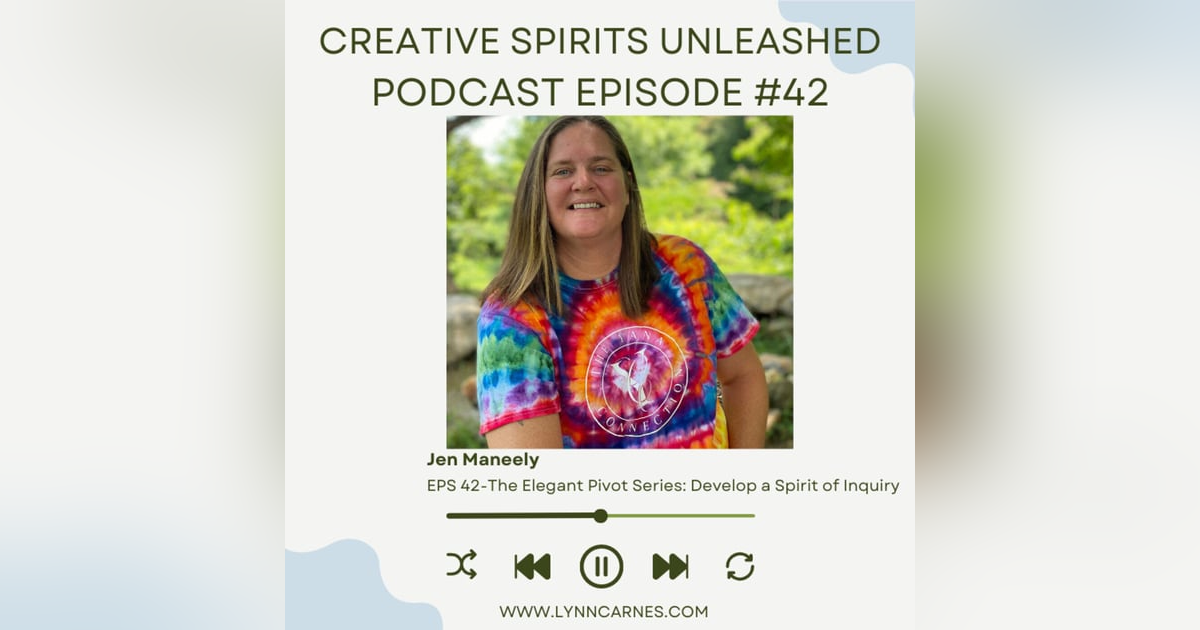


We are finishing up a series that I've been doing with my coworker, colleague, and daughter, Jen Maneely with my book “The Elegant Pivot”. This is a book I wrote and published in 2001. We've been following the five main principles of the elegant pivot around how to assume positive intent. The fifth principle is to develop a spirit of inquiry. And if you haven’t read my book, or need a refresher on the five principles, they are:
And boy, did we dive in today on that. My daughter and I actually had a couple of daughter and mommy moments or mommy daughter moments, however you want to put that, where we discovered where some of our patterns come from, and what patterns have to do with asking questions.
So, we went into everything from how to ask a good question, how to not interrogate somebody, how to recognize when you're feeling vulnerable, and more. I hope you enjoy this podcast and I hope you enjoyed this series as well with Jen Maneely.
Additional Topics
- Giving up control to get control
- Our conditioning plays a big part in how we react when people question us
- When something hits you, pause, assume positive intent, get curious, ask a question
- We can allow people to explore their resistances and that allows them to solve the problem for themselves
- Parent/Child Ego Stance
- How people define things is important to understand for context
- How we handle our emotions/moods is often taught
- Focused conversations: Different types of questions
- Four on the Floor Practice
Additional Links
Guest Contact Info:
Website: ManeelyConsulting.com
Email: Jennifer@maneelyconsulting.com
Intro:
Welcome to Creative Spirits Unleashed where we talk about the dilemmas of balancing work and life. And now, here's your host, Lynn Carnes.
Lynn:
Welcome to the creative spirits unleashed Podcast. I'm Lynn Carnes, your host. Today, we are finishing up a series that I've been doing with my co worker, colleague daughter, Jen Maneely. On the elegant pivot. This is a book I wrote and published in 2001. And we've been following the five main principles of the elegant pivot around how to assume positive intent. The fifth principle is to develop a spirit of inquiry. And boy, did we dive in today on that my daughter, and I actually had a couple of daughter and mommy moments or mommy daughter moments, however you want to put that, where we discovered kind of where some of our patterns come from? And what patterns have to do with asking questions. Well, we dive in, in this podcast about that. So everything from how to ask a good question, how to not interrogate somebody, how to recognize when you're feeling vulnerable, and more. So I hope you enjoy this podcast, my dog is in the background telling you she enjoyed it. I hope you enjoy this podcast with Jen Maneely. Jan, welcome back to the podcast.
Jen:
Man. I'm excited. This is our last one in the elegant pivot series, correct?
Lynn:
It is the last one, at least that we have planned. Yes, in the elegant pivot series, there may we may end up wanting to do kind of another overall wrap up. Because I continue to find that I keep going back to the material. And the elegant pivot is I'm coaching people. And this is everybody from CEOs to people who are new in their organization and trying to find their place to people who are trying to learn a whole new set of skills, people who are actually kind of ready to shift to the second half of life. And every single person I'm working with, I have to tell them, you've got to go read this book. So you'll at least understand where I'm coming from. Yeah. You know, what the most common responses? Makes me feel like I'm not alone. skepticism?
Jen:
Of course, it is. Because I mean, we're talking about assuming positive intent, and what have we been taught about assuming anything, that it makes an ass out of you and me? Yeah.
Lynn:
And also that it feels protective, to assume negative intent.
Jen:
Right? Well, because, you know, immediately from my experience, what people go to is, yeah, but not everybody has positive intent. And so I'm not going to assume that.
Lynn:
In fact, if I, if I assume that I'm opening myself up, I'm making myself vulnerable. Yeah. Yeah. And, and yet, interestingly enough, vulnerability can be a form of strength in and of
Jen:
itself. Yeah, absolutely.
Lynn:
So let's dive in. We are on the last chapter, which is develop a spirit of inquiry.
Jen:
This is this has been life changing for me, to be honest, and in so many ways, developing a sense of inquiry. There's been so many occasions, especially when I started diving into this idea of assuming positive intent, where, you know, I was able to stay in grounded in a moment, that was what could have gone downhill very fast. And just start asking a couple of simple questions to be clear about what it was that was really going on, or how did they mean that or, you know, in terms of like, so when you say that, what does that mean to you kind of questions?
Lynn:
Oh, I just love those questions. But I, you know, let's go back to what makes it hard to ask questions in the first place.
Jen:
Well, for I will, and I'll just answer for me, I think other people have very different things is, is when I think about when I'm in that mode of reactivity, I immediately don't even think that a question needs to be asked, because I know the answer. They are getting to me, right? Like, like, I know what is happening?
Lynn:
Yeah, that's certainly my case. In some certain circumstances. One of the places that I struggle with is this is a paradox, but it is, I don't want to ask questions, because I think I should already know the answer. Yeah, And so to ask questions back to that vulnerability word is a little bit vulnerable to say, maybe I don't know the answer, or maybe I don't know everything about this subject.
Jen:
Well, and has there ever been a time in which, and I can think of quite a few, someone is talking to you about something as if you should know what they're talking about,
Lynn:
oh, my gosh, okay. Almost every corporate meeting I ever went into, they would start in the middle, they give no context. And they were like, here's a classic start of the meeting. I know you all are worried about the XYZ project. But I wanted to let you know that I talked to Jim, and this is what we're gonna do. And I'd be like,
Jen:
what's the XYZ project?
Lynn:
And I don't even name the project, they say, I know, you're worried about this particular workstream, where we've had to go out and get more data. Okay, well, every project has a work stream where you're going to write a right, so which one of my 20 things that I'm working with? So yeah, it's, it's that like, Hey, can we just, you know, back up for a second, can you remind me which thing we're talking about? And, and what makes it even more difficult is certain types of people, and I shouldn't categorizing these types of people. But in certain settings, when you do ask that question, you actually do get an irritated response back?
Jen:
Sometimes, yeah, absolutely. And you're like, you should know this.
Lynn:
Or it's like, you know, I call it the mind reading game, right? They expect me to read their minds. But what I've actually come to learn over time is most of the time those folks, they're the irritation has nothing to do about whether I should know it or not. The irritation comes because they feel like I'm telling them, they're making a mistake. Yeah. And it's changed a little bit the way I approach something. So I'm less likely to ask questions, without saying a preface that said, I should probably already know the answer to this, or I know, everybody else might know the answer to this. Can you all just do me a favor and catch me up? So that I've sort of stipulated? I'm not calling you all them? Right? Yeah,
Jen:
absolutely. Yeah. And that's, and that's how I have learned to kind of set that up in the beginning. But it's, it can be really challenging to remember. And so there's a lot of practice to this.
Lynn:
It is and it's practicing not only the content of your questions, but the tone. Yeah. And, and there's another third part, I think that's that's loaded, which I heard somebody say something like, you know, to ask really good questions, you have to know something about the subject. Yeah. Yeah. And I was just reading a book last night about a situation. It was regarding some military thing. And the person that was asking the best questions was the one that understood there was some background and what was going on, you know, to the situation. And so yeah, I feel like you have to have some information to some degree, which is a good thing. That's the other side of the paradox is I don't want to look dumb, but I actually have to know something about some subjects to ask. Great question. Yeah. So I get a chance if I need to my ego needs to kind of look smart, if I'll ask really smart questions.
Jen:
And it's, it's, it's interesting of like, when you say something like, really smart questions, how do we define what a really smart question is? That's, that's the question.
Lynn:
Well, one thing I'll say it's not sometimes I think we define our path by when something isn't. Right. And I've learned this one in my marriage interrogations if it comes with a spirit of interrogation. That's not a good question. Ever. Yeah, right. It's true. It's designed to throw somebody back. And I, you know, there's a lot of corporate corporate gamesmanship that looks
Jen:
like that. Yeah. So this is kind of the like, almost like the gotcha question.
Lynn:
Watch congressional hearings, right? Oh, yeah. Guys are masters. At that with the people I've seen. And I've watched this for years because of this idea. And that sort of setting being the dreaded setting for most people. I've watched the people who stand those kinds of interrogations and they are interrogations, well, are the ones who still assume positive intent. Like when it starts going off the rails for the person that's getting interrogated is when they actually start feeling and acting. interrogated.
Jen:
Yes, yes. So it's like people standing up. And I I have spent a lot of time watching people, how they manage themselves through what you're calling the like, you know, interrogation kind of storyline, I guess, and I'm always watching the other people and how they respond to that and I know when they're Kind of going into that place. And I was like, Oh, this is getting ready to get really good because they're getting ready to fall apart, right? And then I get so impressed when I watch people. And you know, I'm gonna bring this up. And I'm gonna say his name and it'll people are gonna go, oh, no, but I think he's a master at this because he's had to face Congress so many times, but Mark Zuckerberg of Facebook, yeah, he gets interrogated, and rightfully so. Right. But he gets interrogated all the time. And he, he does a really good job of just staying grounded and responding to the questions, whether they're right or wrong, or how you feel about them is irrelevant, right? I'm just looking at the way that he stays very present and very grounded. And sometimes, like, he won't know an answer to the question is, he'll say, I don't know the answer to that question. My team, I have a team that knows the answer to that question. And,
Lynn:
yeah, that's actually what I mean, that's the principle behind this is that idea that the attack is only valid and interrogation is a form of attacking. It's only it's only successful if you agree to the attack, right. And so what Zuckerberg or other people who do this very, very well do so well, is they don't agree to the attack.
Jen:
Right, like, and they go. And here's the thing is, they're from what I can see, this is from I don't know, a lot of the background, right. So I don't know context. But I can just know what I see is they know going in that they are getting ready to get attacked. And they never come across, as if at least the ones that are good about this. They don't show that they are knowing they're getting attacked and get defensive. Next, honor. Each question, yes. In a very respectful way, knowing that the question wasn't asked,
Lynn:
in a respectful way. Well, and so here's the internal work for that. And this is this is what's behind all the the entire book of the elegant pivot, but especially the question part, both giving and receiving questions. It's that inner feeling of being caught in a mistake. Something wrong. Yeah. And if you haven't done your I hate to call it internal work. But if you haven't seen how your conditioning set you up for that. Yeah, and put the conditioning aside and said, you know, what, we're going to stipulate that I'm okay. Right. And that, you know, mistakes are actually okay. And I'm not a mistake, just because I made a mistake. Right? Then you can let those attacks slide because, you know, you don't have to be complicit in their accusation. But if you let it get to you, you are being complicit in the accusation. Right? Because you're putting your defenses up, because you think you have something to defend?
Jen:
Absolutely, I have a, I have a great example of how this plays out. I love I love. And I know that I go into my example, because this happened just yesterday. So it was really it was a, it was perfect timing in terms of relation to this to the recording of this podcast. And it was I, you know, I've mentioned before, I'm going through a coaching certification program, and they're teaching us all these things. And we have to do these learning groups where, where we're taking pieces of what they're teaching us, and having to go out and teach other people that are not part of this group. They're, you know,
Lynn:
about your guinea pigs, they're,
Jen:
they're like the guinea pigs. And, you know, context is, is that it that's supposed to help us with our own learning not necessarily become the best presentation person or how to how to do a presentation, it's more of like, you really learn the material by teaching it better. So I had to do one of one of my groups. And there was the, what I'll say is the material is just one piece of a whole bigger program. And it's really hard to actually only focus on the one piece of what it is that we're supposed to be spinning 90 minutes. Learning when we spent months doing it, right so I say that because it's hard keep to keep it focused because so many other things in form so many other things, but I don't have time, so to go into everything. So when I was sitting down there was one particular person that loves to just immediately reject all ideas. Am I? Right? Yeah. So it was a really interesting learning group, when it came to having a person that just wanted to reject everything you were teaching. Now, context is, this wasn't necessarily a place to say, either I accept or deny what you're teaching, it was just a place to teach the material. So it was really interesting what ended up happening. But as this person kept kind of saying, I don't buy into that I don't I, you know, I reject it, or whatever I found myself. My first in my head response is, I must not be teaching this well,
Lynn:
because I'm making a mistake,
Jen:
because so back to what you were saying is, I really felt I started feeling like I was just doing a really poor job. Because, you know, all if I was doing a great job, he wouldn't possibly be saying no, I don't agree to that. So this is where the spirit of inquiry comes in. And this is where a lot of the internal work so that a lot of the internal work has happened through this program, where I'm able to ask just really good questions, not, you know, let things land and go into the place of curiosity. Right. So I started asking him those kinds of questions. So yeah, of going. So when I say this, how are you defining that for you? Because he was also having a hard time with some of the language and the words and yeah, so he was disagreeing with the language. And I was like, so let's, let's actually go there. Let's, let's dive into how are you defining this? And I thought about it in this way, kind of questions. And what was great was, I was able to just stay with him in that moment, and honor the questions that he was having, and not making it about me and my mistake button, but going, well, maybe he's defining this in such a way that I'm not seeing. So why don't we just ask that? Like, what does that mean to you? And then we'll go from there.
Lynn:
I love those kinds of questions. Yeah. And it does take, like, it just doesn't seem like it should be that hard. But it is when you're in the middle of it, and you're feeling like that thoughts going through your head? Am I doing this? Right? I must be doing it wrong. Right. And the thing is, when we start getting that kind of interference, as opposed to really listening, which what you did was you listen to where he was and said, Okay, here's the question that he needs right now. In a way, you know, there's this idea. And I I actually allude to this in the chapter of the book, you're giving up control to get controlled? Mm hmm. Right? Yes. And that's the other reason I sometimes don't ask questions is because I actually don't want your answer. Because I think I know. And if I ask you a question, and you give me a different answer, we might have to go somewhere, I don't want to go. And that feels out of control for me. And yet, if I want you with me, if I give up control, to get control, what it means is not really control, but to gain partnership, to gain mutual respect to gain trust and connection.
Jen:
Well, and those that became, I guess, a way for him, because one I really genuinely and this is the spirit of inquiry, I genuinely wanted him to ask questions, so that I could understand how it was being perceived to him, right. And if I was ever teach this information, the next time, I may be able to do better at setting up context better, that I could not have done without him being able to ask questions. And my initial tendency when he started going down this road, what do you think I wanted to really do? Sell him? Well, and I really wanted to tell him to just shut up and listen. Yeah, that was, that was the truth of it was like, so do you just shut up? This is not the time or the place. Okay, so these things. So let
Lynn:
us do a little mommy daughter pots here, okay, because I'm literally calling myself mommy. Our conditioning for those moments comes out of our history. Right? Everybody had somebody that raised and there are humans out there raising themselves. So whether it's parents, true caregivers, or whatever, um, you also had some kind of educational system, again, generally schools for most people, not 100%. But in general, we learned that from somewhere. Yeah. And I got it from my parents and you got it from me. And it's that sort of broach no questions just do do what I tell you to do. And, you know, let's get on with it. Right. Like, we're in the grocery store and you ask if you can have candy. Come on, we need to go I need to get home and cook dinner. Yeah, just those simple little innocent moments which are completely valid, you actually would hope most parents would not like, in fact, I actually get pretty judgmental with parents that sit at the candy aisle and say, Oh, let's see which one do we want to get chocolates or gummies? Or I'm like, Just get them home.
Jen:
Dad, I'm out of here on the road,
Lynn:
you get that moment where the guy is like, you want to tell him just to shut up and listen and do what you told him to? Like, right?
Jen:
Well, because, you know, in my mind, you know, I was I was really in I tried to set up the context like this every time I do one of these things, and it never feels right. To have someone Pierce what my agenda is, right? I go, Well, I had an agenda going into this, which was I was just going to kind of regurgitate the information that I'm being taught so I can learn. And now you're challenging the end goal define you. Right, right. And now you're challenging me, and I reject your challenge. I didn't reject his challenge, though. But that was you wanted to but I absolutely wanted to because it was like, This is not what this was supposed to be.
Lynn:
And, you know, that's always our first thought, you know, one of the things I think about is, we are not responsible for our first thought, yeah, it is a reaction. Typically, it comes from our past, it is conditioning. But then once we're aware of it, we can change it to a second thought. Yeah. And I, you know, in the first page of this chapter of developers spirit of inquiry, there's a sequence that I put out that says, when something hits you pause, assume positive intent. That's the way you actually can do the next step, which is get curious. And then ask a question. Yes. Right. So get curious. Here's what I here's the paragraph that I feel like, it's a short paragraph that I'm going to read that kind of gets to this idea of giving up control to get control, because this is what I said, with curiosity, you can follow their lead in a way that actually keeps you in the lead. Why? Because you are crafting good questions that are worth exploring. So now, you've actually picked up the ping pong balls, I think about it sometimes, or I use the analogy of tug of war a lot. Which says, okay, instead of Listen to me, no, I'm not. Yes, I will. That won't work. Yes, it will. Those kinds of games, you start with things like well, what would work? Yes. Do you agree we have a problem? You know, as we always say, get the cow out of the ditch before you figure out how the cow got in the ditch. Yeah, I learned this from I think it was the CEO of Xerox that. She said, you know, a lot of times people start at the wrong place. But if we've got a problem, the first order of business is get the cow out of the ditch. Yep. The second thing to do is figure out how the cow got in the ditch. And then you start thinking, how do we keep the cows out of the ditch in the future? Yeah, a lot of times when we have problems, people start at the how do we keep this from happening in the future, and we're still with a cow in the ditch,
Jen:
there's still a cow. In addition, we're all sitting around talking about how we're going to prevent this from happening, because
Lynn:
we don't want to be making mistakes. Yes. So to me, the thing to really work on in developing a spirit of inquiry is can we cultivate curiosity? Yes. And I struggle with it. Sometimes Sometimes I don't want to know.
Jen:
It's, well it. And there's that. It's like, well, I just don't, I don't want you to ask questions. One, not because I'm, or, or the other way around, or I don't want to get curious. I don't want to start asking questions. Because like, you're you're saying I don't really always want to know the answer. That's my mistake button. That gets it all the time. Where it's like, you know, if I'm having to start asking this person and go into that place, then I must, I must be doing something wrong. Right? Again, bad if I can't handle
Lynn:
the answers. Yeah, that's a big one, you know, when I was facilitating? Well, anytime I've been facilitating something that involves big change, there's a lot of resistance. Yeah, it's natural. And I came out of initially a corporate culture that just tried to slam resistance down. So what I had to learn was that if you let people actually voice, their resistance and their questions and their concerns, they'll yet generally almost come up with their own answers and solve the problem for themselves. Yeah, especially if it's really clear that we all have a problem. Right. And when we were doing mergers, frankly, we all had a problem whether we were on the upside or the downside of the merger, right? Which is, yeah, we either have to take you over or you're taking us over and we still have to work together. And maybe some people were going to be losing their jobs, but maybe some people were going to have to learn new jobs. Right, and maybe some people are going to have feel like they got demoted. You know, other things like that. But if we actually all recognize We all have a problem that we're in it together, we can solve it together. And that's to me what a great question does is it? It actually creates if it's done with a power with stance, yes. And what I mean, when I say that, especially, it's funny with you and your mother daughter, yeah, we are a parent child relationship. But, you know, there's this idea of a parent and a child sort of ego state, Eric Bern, from transactional analysis, the book, I'm okay, you're okay is an example of that from back in the 70s. It was kind of like pop psychology. But it's a really good way to look at power dynamics, which is we can come from a child's place, I don't need your permission. So I'm not going to ask a question because I don't need your permission. I don't use if I want, or a dominance place, which is you don't dare do that in front of me. Yeah. Or we got to get the heck out of the store, or whatever, or a power with place, which is, here's where I'd like to go. Are you coming with me? Right? Yeah. And that spirit, you know, is lifted with curiosity, and with good questions.
Jen:
Well, and this is, you know, taking taking all of this into account. And I didn't even think about it until later, after all is said and done. Because I was, in my example, I was, like, so present in the moment, and, and just, genuinely, they're walking side by side with this person. Right. And when I thought about it later, I was looking at, like, what was some of the things that like I did that kept me in that place? Because
Lynn:
I think I do, too. I
Jen:
think we all want to know, well, like a couple of months ago, I don't think that this conversation would have happened like it did. You know, I think it would have gone very bad very fast. And it will just wouldn't have been as rich of a conversation. But I because I had a practice. And I had been practicing some of these things. But I didn't understand why I was practicing them. Because I, it wasn't like a real world example. But when I was in the real world example, I was able to put this stuff into place. And one of the things I realized that I did was I inept. We've talked about this in a podcast before, but was the four on the floor, I immediately put all of my feet on the floor, and I stay present. And I also unconsciously, but because it was a practice that was automatic, was able to like, kind of open things up for like, even physically. And when I did that, back to what you were just saying, when I did that, I have the ability, then of walking beside him, instead of turning in metaphorically running away, right when we have our heels up, and we're up forward, and we're constricted, and we go into that survival mode in that protective mode. But it was interesting of what it felt like to I guess, and metaphorically walked beside him, and what was some of the things that I did, but it had a lot to do with the practice of doing those things of being able to stand firm
Lynn:
in that. That for on the floor, which is a grounding practice. And as you described it, of course, there we have our heels and our balls of our feet. And it is sort of focusing on having all four points on the ground. And I'm doing it as we speak actually, right?
Jen:
Yes.
Lynn:
And I have found that it just puts you like it just gets you back in the moment. Instead of feeling like heels are up, I want to go fight or flight because if I want to come across the table and wring your neck, I've only wanted to do that 1000 times. Or I want to run out of the room. I've also wanted to do that 1000 times. But if I insist that I put my feet on the floor, and then you then you did said something else that was very important. You talked about opening up. Now, most of the time when we're feeling defensive, we close down and it's almost like we armor up. Yes. So instead of armoring up, you're talking about opening up, what does opening up give you?
Jen:
So that's an interesting question. I have to go back and really think like in the heat of the moment when I opened up it for me what it did was it took away some of because of course I was getting slightly like frustrated, upset, mistake buttons, all of those things. When I found myself opening up, I was able to stop that train of thought and just go home. This is really interesting. I wonder what's coming up for him. And it was just being able to, I guess in that moment and you know, there's Hundreds of layers that we can't possibly go into. But this is the one layer that pops into my mind, you know, immediately was I was able to stop looking at myself and was able to focus on him. Like I wasn't thinking about. Yes, I was thinking about what's next. But it was more of like, Huh, I wonder how this can be. So when I was open, I was able to be with him and not close up into myself. And hit those mistake buttons that, you know, triggering the defensiveness though I did something wrong. Or even, you know, some of the thoughts that I had in that moment about what he was doing, like, can you just shut up, please.
Lynn:
But you know, what's interesting is, it seems to me like if you are able to put down the armor, open yourself up, sit in his shoes. For a moment. Yes, that's a service to Him. Yeah. Because it let him sort of simmer in what he was saying and doing and make his own discovery.
Jen:
Yes, yes. And it, you know, and this was the ability and I kind of will summarize, like, one thing that he just really bought that. I was talking about just a couple of sentences. And it was it said languages, action, moods, and emotions are predispositions for action. Man, he had a really hard time for that. When when I was able to open up and ask the question, because he was like, and he I think he even said this, I reject
Lynn:
that, and was he What was he rejecting? He
Jen:
was he was rejecting that. Emotions could possibly have anything to do with action.
Lynn:
Well, and can you imagine what his upbringing was?
Jen:
Right? Here was the interesting thing is it first when he said that I think I felt myself close off, I felt myself, you know, go into that place, my heels came up a little bit. And it wasn't even my sin. It's like I was just reading a sentence, right. And obviously, this was a this that those couple of sentences were was a part of a much bigger article. But I couldn't read the whole article. But I thought those two sentences were really valuable. And when I said on, then he got very upset, and I got closed off there for a second. And it was in that openness that I was just talking about being open and being able to do that. I was like, Huh, I wonder how he's defining action? Ah, so that was when the question was able to come in. Because in his belief, and in what he was his framework, and his understanding was emotions are just feelings, they had nothing to do with actions, I just feel a certain way. Oh, and his, he was defining action, as only looking at like movement in the physical body. He wasn't thinking, you know, like, that was the only way he was able to define it for himself, because that's the, that was his framework for what action meant. Right. And so when we were actually able to delay or that, I was like, well, let's maybe broaden up our definition of what that means. And he was able to see it very differently from that point, when he understood what I meant. But I, this is where the conversation could have gone down in a very bad way where it was like, I could have closed that off. And you're wrong. Just listen to what I'm saying and buy into it and don't ask any more questions as you're overcomplicating, you're, you know, kind of going into that place. But it was, oh, we have to, I have to I really want to understand how, what does that mean to you? You're rejecting it, but what are you rejecting?
Lynn:
Well, and my question about that is, what is your sense of this, about the socialization of what we're supposed to do with our emotions? Because in my corporate life, emotions were theoretically not allowed. And when I say theoretically, the reason I say that is because you can't really disallow a feeling. What you can disallow is an action. I actually don't work in an organization as a coach, that the CEO would actually throw books that people want he didn't like, what they were said I was an actual, but that but people call it an emotion. and they said he would be angry. And so he threw books. And I'm like, Well, no, wait a minute, let's parse those two things. Throwing books is an action. Feeling angry, which I feel like is an emotion that we can't get rid of, although Alright, worked a lot in my life trying to. In fact, I think it can be a useful emotion. But throwing books is an action, feeling angry is a feeling. Right, right. I get to choose what to do with that feeling. Right motion? So my question for you as you work with these different, you're working with a lot of new people in your coaching, for example, but within your coaching practice with your own business, and in and taking your game up with this coaching certification. What are you finding about how people have been conditioned to approach their emotions? Is there a general approach? Or is it different for everybody?
Jen:
Yeah, that is a big question.
Lynn:
This podcast about questions.
Jen:
And that is, that is a big question. And so I could like in this, this is so the second part of your question, or the second part is, is it different for everyone? Right. And I think it is different. Because of our context, our history, our culture, what did we, what were we taught about? How to handle our emotions as it relates to action? Right? So yeah, for this person, that you were you were mentioning, and remember, like I said, moods and emotions, and this isn't me saying this is part of an article
Lynn:
article, but people might hear a helicopter flying around, and I don't want
Jen:
by the way, we're, we're outside. So if you hear background noise that that would be why. Okay, carry on. Um, but, you know, moods and emotions are predispositions for action. So it doesn't say what the action is. It just says that you feel angry. And then there's an action that follows by feeling angry, maybe it's nothing at all which inaction is action, right? Correct. Maybe swallowing it? Whatever it is. For him, the question is, is when his his own family got angry? What was the following action? What was he taught? Well, there is a deal with anger. So for someone else, though, in a different upbringing, may have been taught a different action to follow anger.
Lynn:
That's a very good point. And almost certainly, like, this is an exercise. Actually, if you're listening to this podcast, I suggest you actually do this exercise for yourself. We did it. In every single self awareness program I taught as part of my coaching program, you know, as well, which is, what emotions were allowed in your family and which emotions were not allowed. Yes. And for this exercise, you don't necessarily need to separate the behavior versus the feeling. Yes. But, for example, in my family, Joy was not I would say, allowed or giddiness was not allowed, because I think giddiness is more behavior. Joy is more of a celebration. But we could be happy, but we couldn't let it go too far. Right? Is an example. Right? So and it's also useful while you're finding out what was allowed and not allowed to see if there's a belief that goes with it, which is, I caught myself in this one, many years ago, which is things have been going really well, I'm happy. So that must mean, the other shoe is about to drop. And then I started looking for things that were going to make me unhappy, so that I could get ahead of what seemed to be inevitable. Right. And some of there's some truth in in that in the end, in that emotions are kind of like waves of the ocean. We can move through them though, right? And if we let them be and move through them, they'll dissipate just like a Whale on a Beach. Right? And we hold on to them, they tend to crash up against the wall we put up. And if you've ever been to the beach where the sea walls are there, it's sort of like a relentless splashing as opposed to a peaceful beach. Yeah. And if we just think of our emotions that way, then we can open up to the emotion of curiosity, because I think curiosity it might maybe it's more of a feeling state. I'm not sure. You know, if curiosity but I think being in a state of curiosity, being open and curious, definitely plays into how we feel emotionally.
Jen:
Right? Well, and it's kind of like when we talk about developing a spirit of inquire inquiry is what's coming up for me He, even in this moment is realizing it's not all just about it's it's about curiosity, not all just about how to ask questions, although questions are a really great thing to invoke the curiosity to like, that's the action, right? It's, it's Oh, like, how, but really sitting back and go, I wonder what am I practicing when I feel anger? Or when I feel giddiness or, and what was I taught? Like, all of those are that kind of inquiry of I wonder where this is coming from?
Lynn:
And then if it's not working for me, if I have that, how do I change it? Right?
Jen:
I I have learned, this is a mommy daughter moment. And it's like, I think back on like, you know, I've had a hard time really feeling like I could sometimes let myself be giddy and do all of the joys. Yeah. Right. So when you said that, that you were taught that I was like, huh, I must have been, I think I was taught that too. Because I know. And it's really interesting, because that's a lot of times, that's the perception that people have of me is that I'm I contain person, and I am a contained person. And as you're saying that I'm like, Hmm, there was, where's that container coming from? Oh, she just told me where that container was coming from. And now as we move through that, when I think about the inquiry piece, in that spirit of inquiry, I'm going to probably go off after this podcast and really look at that container. of, you know, feeling like I have to be contained. And I can't be like, if I get really excited, I can't just get really excited. And sometimes, here's the thing, here's part of the conditioning even now, I get loud. When I get excited. Yep, I'll talk louder. I will, my hand movements will get bigger. Half the time, I just want to like, you know, run and jump up and down. And even now I'm taught or in the past have had people tell me to calm down, when I start getting loud or like, yeah, tell me to like quiet down or like, Man, you're really speaking loud. And then what ends up happening is I will go back, I'll realize that I'm talking really loud. And I'll go back into like a normal, what is called the inside voice, use your inside voice. And but what that does, is it dampers the excitement as well.
Lynn:
Interesting. Well, and the question, so what's coming up as I'm listening to that is I've had the same thing all my life, because you're my daughter, right? I'm sure I was taught the same thing, because I have extraordinarily high energy. I have learned when I walk into a room, yeah, even if I'm not excited, I'm gonna hit people with my energy. And while everybody's responsible for their own energy, I have to actually be aware of that. So that I can both let my energy be what it is, but also not hit people so much that it's not useful for them or for me. Yeah, because a lot of times it can, you know, I can take people back, if I'm not careful. And when I say careful, meaning I'm not aware, right, right. And when I become aware, then I just realized I'm in this dance with other people. But if I want to, like really let it go, one of my favorite practices to do I love to put on some just serious, like, get it going music. Yeah, and rock out. I and it's not even like a dance per se. What I like to do instead of calling it dances, I just moved to however it feels like I want to move. So if I'm excited, I might be like, jumping a lot or raising my arms or Yeah, you know, allowing myself to just let those feelings flow. Take your space, take my space. And generally, I mean, I've done this in groups. We've done it many workshops, when we found the right moments, but I do it by myself. And so for people listening, if you're looking for a way to like totally be expressive and not yet not impact other people. That's a great way to do it. Yeah,
Jen:
absolutely.
Lynn:
Yeah. And so obviously I was thinking about, you know, just examples of questions and not being interrogation. One of the things that has helped me tremendously is many years ago, I went to a program up in Canada, it was held by the Institute of Cultural Affairs. And they teach a particular facilitation method, they call it focused conversations. And what they basically are doing is teaching you how to ask different questions from a different space. Right? So I actually because I was just sort of paralyzed as like, well, you can't just give me a list of questions. What I really need is, what kind of questions to ask somebody give me the questions to ask. But what I came to recognize is there are in their in their model, there's lots of models, but this one that worked for me, there's objective, reflective, interpretive and dishes decisional question. So an example of a decisional. Question is, well, given all that you've just experienced, what are you going to do about it? Like this week, we had lightning strike our house. So decisional question is, given that lightning does strike your house, what are you going to do next? Right, are you gonna put the fire out?
Jen:
So probably probably, let's get the cow out of the day exact, put the fire out,
Lynn:
the fire out and so forth. But you know, an interpretive question about that is, what made the lightning strike the house? Is there something going on in the house? Oh, that's
Jen:
good. Yeah.
Lynn:
And then a reflective question is sort of, how did you feel when you had the surprise? Like when that moment of the strike, what went through you? And then the objective question is, what time did the lightning strike the house?
Jen:
Those that's a good like framework in order, like, how to how to ask kind of the same question in a different way to invoke a different response,
Lynn:
exactly. Like an executive question is all about the data. Like, when we call the insurance company, they the first question they had is what time did the lightning strike happen? Right. And by the way, the way I discovered that was I went and found the time that the cameras frozen, right? Yeah, that's a
good way to do it. Yeah. 4:
35pm Oh, here, camera froze at 449. So it must have happened at 449. And there you go. That was that's, that's our best guess. Right? We don't have any other way of of showing that. But the reflective piece, which was, oh, my gosh, like, when it strikes your house, if you've ever had lightning strike close by or near, you know, maybe your house, there is no gap between the sound and the light. But in this case, it did feel like it. You know, it was such a surprise that we had to like first deal with our shop, right? And then start dealing with are we on fire? Right, right, and our power never went off? That's so crazy. It's so crazy. It did melt 60 days and a bunch of other things. And we didn't call the insurance company. But then the interpretive question that we started getting into later, which was like, which things got struck? And why was it? It's not that first time our house has had a lightning strike? Sort of? What are the options we can have in the future? To perhaps not get struck by lightning again, and so forth? And then the decisional questions? Alright, what are we going to do now? First call the insurance company do we can can we continue to stay here ammunition is not working in some places, but it's working in others? Okay, we can continue to stay here. You know, then it was down to decisions like the Direct TV melt melted. Right? So what are we gonna do about that? You know, and we're making decisions on a different kind of TV and a couple of places because some of our TVs were a little bit out of date. Right. And so there's just a whole series of decisions you start making, but if you see the different ways, and actually, for this podcast, what I think I should do, Jim is offer for all the news. A lot of times from our podcasts, people will start subscribing to my coaching letter. Yeah, it's called a coaching digest, you can sign up at Len carnes.com. Typically, we have some giveaways with that. And the neat thing about the coaching digest is that people on that list actually have full access to my coaching program. Not to me as a coach, right, but to the sort of backbone and tools and everything that I give my clients. It's useful. You helped me compile this years ago. It's got videos, it's got tools, it's got lots of stuff in it. So they have access to that. I think we should give I've got a tool I use in my coaching clients that I call the art of asking questions. And get one Yeah, I will just make that available. If you can help me do that. You're pretty Yeah. To my, for anybody that goes to Lynn cars.com and signs up for the coaching digest, you'll get an email with this tool that will kind of teach you exactly what we just went through, including like the setting. So sometimes, you're asking questions, because you're in a coaching setting, you're not just talking a lot about your coaching settings. Sometimes you're in a conflict. And you're trying to figure out how to get your way through the conflict. I talk a lot about that in the elegant pivot. If you're leading change, or trying to get your spouse to do something different, like maybe move to a different place or whatever and you're dealing with resistance. I have a whole set of questions for that. And it includes a personal question guide where you can kind of like write your own notes down and just start experimenting. So I'm going to offer that I've never done this on a podcast before. But it just came up for me as we were talking,
Jen:
I think it's gonna be really helpful just to practice sitting down and thinking about, okay, like, what in what domain is? Like the question, one that I want to ask. And you know, one of the things that I've really learned, as I mentioned about is, when I first start, especially when I first start practicing something, it can kind of be a little challenging and a little hard, and like, I'm not entirely sure how to do all of this. And you know, what's going on here? And am I ever gonna get it? Right? Am I do? Am I doing this? Right? is a big question, right? So I think, you know, it's, what I have to realize for myself, is just sit sometimes in that place of kind of confusion and uncomfortability. And just keep practicing it anyway. Because then all of a sudden, it'll start making sense. And like that, that was like back, you know, kind of to my story, like, I had put a lot of practices into place. And I didn't understand why or if I was doing it, right, or what was going on with it, and it was all uncomfortable. And all of a sudden, it just kind of yeah, all those practices came in. And so that's, that's where it's like, you know, sometimes when we look at some things, especially when they're new, and you're like, I don't, I don't really know what all this means to me yet. To just keep moving forward anyway. And that's part of, you know, asking and come up with, you know, practicing these focus questions in these kinds of domains is going to be really helpful. And to do it repetitively,
Lynn:
right? Because I've realized I do a lot of this instinctively now. Now, at first I was right where you were, which I call the froth, right? The froth is that place where it's sort of I've, it's not new, and it's not old, it's like the foam on the edge of the ocean, right air, a little bit of water. And it's in the froth can be incredibly uncomfortable. If the story you tell about the froth is I'm doing something wrong. Right. What I have really tried to work on is tell a different story, which is, this is something new. What's next? And how do I break this new thing down into the smallest tiny pieces? Yeah, because maybe I can't ask four of the best questions ever. But can I ask just one good question, right? Yeah, break it down, even to the tiniest. And if I can't even ask a question, Can I at least find a tiny little space of openness in me? Right, right. And if I can't even do that, can I at least put four on the floor? Right, and get grounded. And then just keep going down to step, you know, the earliest possible step to say, alright, where can I come from? So this has been so good, I have to go back and re listen to this, because we have a lot of fun insights in this one. Yeah, we did. So thank you for joining me on this series. And, you know, as just being a colleague, it's so fun to be a mother daughter. Yes, Colleague Team. I just love watching what you and I get to learn from each other.
Jen:
I know, it's been, it's been so much fun. I've enjoyed this series a lot. It actually really helped just by, you know, talking and breaking it down into each of these pieces as part of your book, it actually really helped me hone in even more of what it meant. And that that's been a great, valuable lesson.
Lynn:
That is that is really awesome. Now, people might be wondering what's coming next in my my favorite? Yeah, and what's next, and one of my thoughts or not one of my thoughts, but my plan is, as I wrap up dancing, the tight rope and we are still wrapping it up, there's still a lot of improvement. I want to go close. It's very close, close. But there is some things I want to do. But even before I put the book out, I'm going to ask the people who are in the book, who have stories of me on my journey from the book and let me just tell you what the book is. It's called Dancing the tightrope. What falling off a horse taught me about embracing pressure, fear and uncertainty. Wow. And I'm going through a lot of different stories about how I came to understand some of these concepts, which I'm still working on there really practices, not just concepts, one of them being the froth, and I'm going to there's a lot of people that helped me with this journey. And so I'm going to be asking them and I've asked many of them already to be on the podcast and we're going to share some of the stories behind the scenes.
Jen:
Oh, that's gonna be a great series. I'm excited for that series.
Lynn:
It will be fun and by the way, you're going to be one of the even I was in the book once or twice you were in the book once or twice. So we are still working on what what stories will stay in the book. One of the things that that I know for sure is that the book is a little bit too long. And boy, is it hard to cut down. Yeah, some of these things they say don't cut your darlings, but I'm going to cut some of my darlings. So with that said, everybody, if you got something out of this, please share it amongst your friends, your colleagues, let them know how to ask better questions. And if you want to ask me a question, you can go to my website, if you go to Lynn karns.com. On the podcast page, there is a voicemail button right there on the side. And you can actually leave me questions, comments, thoughts. So we appreciate that. And we also appreciate your ratings on the podcast page as well. So we will see you next time. Thank you for listening to the creative spirits unleashed podcast. I started this podcast because I was having these great conversations and I wanted to share them with others. I'm always learning in these conversations, and I wanted to share that kind of learning with you. Now what I need to hear from you is what you want more of and what you want less of. I really want these podcasts to be a value for the listeners. Also, if you happen to know someone who you think might love them, please share the podcast and of course subscribe and rate it on the different apps that you're using, because that's how others will find it. Now, I hope you go and do something very fun today.


